

When you're trying to find the best educational toys for your kids, it’s easy to get lost in a sea of blinking lights and noisy gadgets. The real secret? Look for toys that match where your child is developmentally and naturally encourage skills like problem-solving, creativity, and critical thinking.
Think less about flashy electronics and more about toys that invite hands-on engagement. For toddlers, that might mean classic building blocks that teach balance. For preschoolers, art supplies open up a world of imagination. And for school-aged kids, a good science kit can spark a lifelong passion by making complex ideas tangible and fun.
What Are Educational Toys, Anyway?
Let's start by rethinking what a toy's job is. The best educational toys are so much more than just a way to pass the time; they're powerful tools for a child’s cognitive, emotional, and social growth. Think of them as a 'gym for the brain'—every play session strengthens specific skills in a fun, pressure-free way.
This whole idea is built on the concept of play-based learning, which is just a practical way of saying that kids learn best when they're having fun and exploring on their own terms. When a child is trying to build a block tower, they aren't just stacking wood. They're running mini-experiments with gravity, balance, and spatial awareness. That's the core of discovery-based learning, and it's incredibly effective.
More Than Just Fun and Games: The Real Benefits
The magic of a truly great educational toy is its ability to ignite curiosity and get a child to lean in and participate. It turns simple playtime into a real opportunity for growth by inviting kids to explore, experiment, and figure things out for themselves.
This shift in how we see toys isn't just a passing trend—it's a global movement. The educational toys market was valued at around USD 66.22 billion and is expected to shoot up to USD 126.02 billion by 2032. This massive growth is happening because more and more parents are recognizing the profound benefits these toys offer.
The goal is to turn every play session into a chance for discovery. The right toy doesn't just entertain; it empowers a child to think creatively, overcome challenges, and build confidence one step at a time.
Key Takeaways: What Makes a Toy Educational?
Throughout this guide, we'll give you a clear roadmap for navigating the world of educational toys. We’re going to break down the best choices for each developmental stage and personality type, so you can feel confident you're finding the perfect fit for your child.
Our goal is to help you make smart choices that transform playtime into a powerful engine for learning. When you understand what makes a toy truly educational, you can invest in things that provide lasting value and support crucial life skills.
Here are the key skills we're targeting:
- Cognitive Development: Boosting problem-solving, memory, and logical thinking.
- Motor Skills: Refining hand-eye coordination and physical dexterity.
- Emotional Intelligence: Encouraging empathy, self-expression, and getting along with others.
- Creativity and Imagination: Fostering out-of-the-box thinking and storytelling.
Choosing Toys for Every Developmental Stage
Picking out the right educational toy for a kid feels a lot like being a personal trainer for their growing brain. The goal is to find something that’s challenging enough to build new skills, but not so tough it leads to frustration. When a toy hits that sweet spot for a child's developmental stage, playtime becomes a powerful, confidence-boosting experience.
This section is your guide to matching toys with those key developmental milestones. We’ll walk through the unique needs of infants, toddlers, preschoolers, and school-aged kids so you can choose toys that are genuinely beneficial—and a ton of fun.
The image below gives a great visual of how different types of toys support a child's growth, from simple sensory play all the way to complex problem-solving.
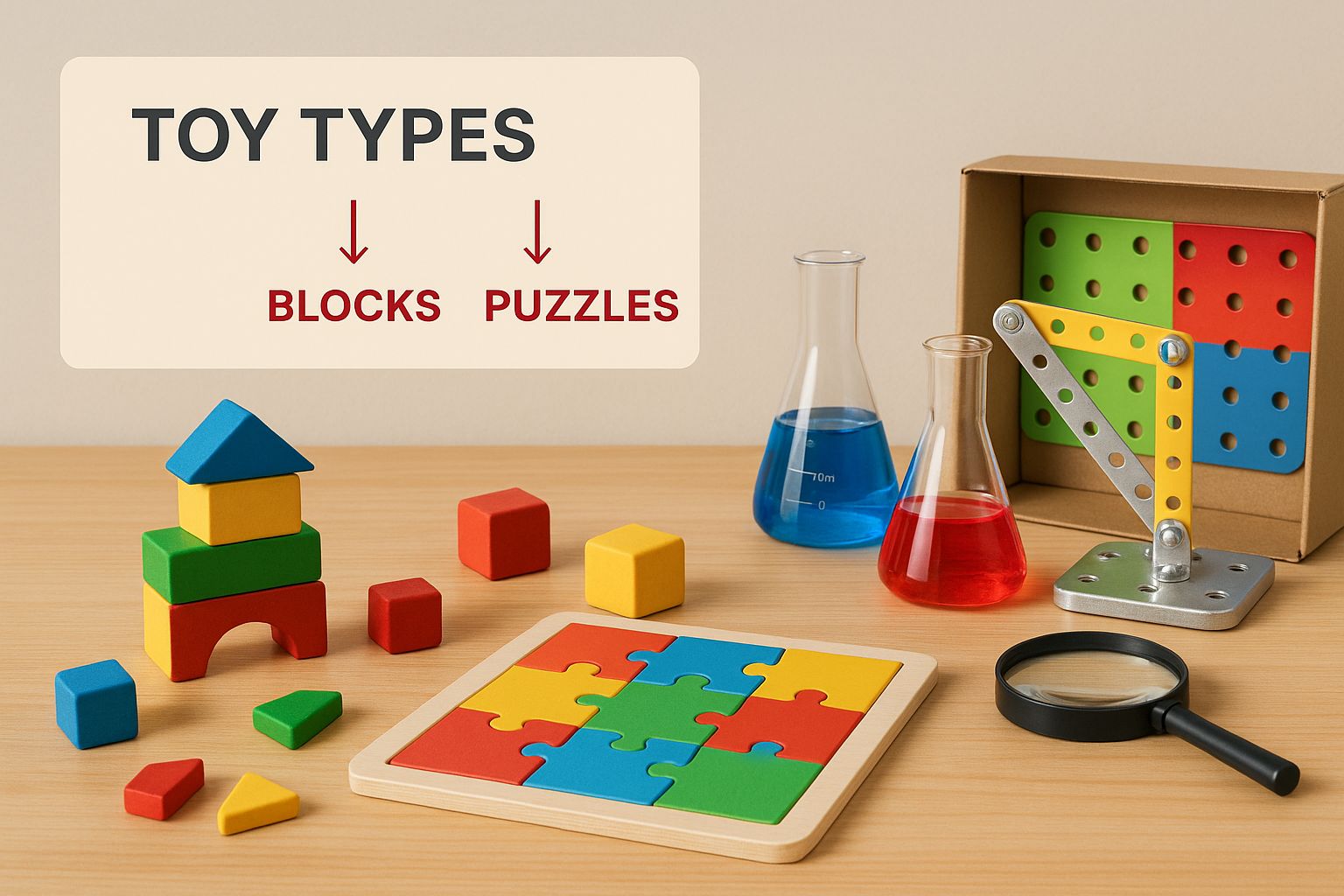
As you can see, developmental play builds on itself. The sensory toys for babies lay the groundwork for the fine motor skills needed for puzzles. Those puzzles, in turn, sharpen the logical thinking required for more advanced science kits down the road.
Let's break down how this looks in practice. This table offers a quick-reference guide for matching the right toy with the right age.
Educational Toy Guide by Developmental Stage
| Age Group | Key Developmental Focus | Recommended Toy Types | Example Activities |
|---|---|---|---|
| Infants (0-12 Months) | Sensory Exploration, Motor Skills | High-contrast toys, soft rattles, textured balls, easy-to-grasp items | Grasping a soft rattle, tracking a black-and-white mobile, exploring different textures with hands and mouth |
| Toddlers (1-3 Years) | Problem-Solving, Coordination, Language | Shape sorters, simple puzzles, building blocks, ride-on toys | Fitting shapes into correct slots, stacking a tower of blocks, pushing a toy car, scribbling with chunky crayons |
| Preschoolers (3-5 Years) | Imagination, Social Skills, Early STEM | Pretend play sets, art supplies, magnetic tiles, dress-up clothes | Playing "store" with a toy cash register, building a castle with magnetic tiles, telling a story with puppets |
| School-Aged (6+ Years) | Strategic Thinking, Complex Logic, STEM | Science kits, advanced building sets, strategy board games, coding toys | Building a functional robot, conducting a chemistry experiment, playing a game of chess, creating a LEGO machine |
This table is a great starting point, but let’s dive a little deeper into what makes each stage so unique.
Infants (0-12 Months): Building a Sensory Foundation
During the first year, a baby’s main job is to explore the world through their senses. Their vision is sharpening, they’re figuring out how to grasp things, and they're discovering cause and effect for the very first time. The best toys for this stage are all about sensory stimulation.
Look for toys with different textures, soft sounds, and high-contrast colors. These features are critical for building neural connections in the brain.
- Sensory Toys: An item like the Manhattan Toy Winkel is perfect. Its soft, pliable tubes are easy for tiny hands to grab and safe for teething, which helps kickstart fine motor skill development.
- Stacking Rings: A classic for a reason! Toys like the Fisher-Price Stacking Rings teach size differentiation and hand-eye coordination as babies learn to place rings on the peg.
Toddlers (1-3 Years): Exploring and Problem-Solving
This is an age of incredible growth and constant motion. Toddlers are mastering their motor skills, their vocabulary is exploding, and they're starting to grasp concepts like matching and sorting. It's the perfect time to introduce toys that encourage problem-solving and physical coordination.
Interestingly, this age group is a huge focus for toy makers. Toddlers between 1 and 3 years old make up the largest chunk of the educational toy market, accounting for about 51.0% of sales. This just goes to show how widely recognized this period is for critical development.
A great toddler toy offers just the right amount of challenge. It should invite them to figure something out, whether it's how to fit a shape into its slot or how to make a xylophone play a sound.
- Puzzles and Shape Sorters: These are fundamental for developing spatial reasoning and fine motor control. Simple wooden puzzles with big, chunky knobs are a fantastic starting point.
- Building Blocks: You can't go wrong with a set of wooden blocks. They are the ultimate open-ended toy, teaching balance, gravity, and cause and effect while letting a toddler's imagination run wild.
Preschoolers (3-5 Years): Unleashing Imagination
Preschoolers are becoming incredibly social little people with vibrant imaginations. They love making up stories, diving into pretend play, and experimenting with creative expression. The best educational toys for this stage are ones that support imaginative scenarios and introduce early academic concepts in a playful way.
This is the time for open-ended play materials that don't have a single "right" way to be used. Think art supplies, dress-up clothes, and versatile building sets. For even more ideas, check out our guide on the best learning toys for preschoolers.
- Imaginative Play Kits: A set like the Melissa & Doug Ice Cream Counter lets kids act out real-world scenarios, which helps them develop social skills, language, and emotional understanding.
- Early STEM Toys: Kits that introduce basic science or engineering are ideal. A simple butterfly garden or a set of magnetic tiles like PicassoTiles allows for creative building while teaching foundational STEM principles.
School-Aged Kids (6+ Years): Tackling Complex Challenges
Once kids hit school, their cognitive abilities take a huge leap. They can follow more complex instructions, think strategically, and stick with a project for much longer. Educational toys for this age group should challenge their growing minds with more advanced concepts in science, engineering, and logic.
You want to look for toys that encourage strategic thinking, experimentation, and perseverance.
- Advanced Building Sets: Something like LEGO® Chain Reactions or a solar robot kit challenges kids to apply physics and engineering principles to build working machines.
- Science Kits: A volcano-making kit, like our Playz Explosive Rainbow Volcano, or a gemstone dig kit makes learning hands-on and thrilling, sparking a genuine interest in scientific discovery.
- Strategy Games: Board games and logic puzzles are fantastic for developing critical thinking, planning ahead, and even good sportsmanship.
Unlocking Potential with STEM and STEAM Toys
You’ve probably seen the terms STEM and STEAM floating around, but what do they actually mean when you’re trying to pick out a great educational toy? Let's cut through the buzzwords and get to what makes these toys such a powerhouse for a kid's growing mind.
At its core, STEM is an approach to learning that focuses on Science, Technology, Engineering, and Math. STEAM simply brings a crucial fifth element into the mix: the Arts.
Think of it this way: STEM gives a child the blueprint and the tools to build something amazing, but the 'A' in STEAM provides the creative vision. An engineering mindset helps a kid figure out how to build a sturdy tower, but their artistic side is what turns it into a fairy-tale castle. That blend is what drives real innovation, teaching kids not just to solve problems, but to do it with imagination.
These toys are so much more than just a way to pass the time. They’re building a foundation for a future where technical skills and creative thinking are inseparable. They don’t just teach facts; they teach a way of thinking.
From Building Blocks to Brain Power: Your Child's First Engineering Lesson
The journey into STEM and STEAM often begins with something as simple as a set of wooden blocks. When a toddler carefully stacks one block on top of another, they're not just playing—they're running their first physics experiments.
They’re getting a hands-on lesson in balance, gravity, and structural integrity. Every tower that comes crashing down isn't a failure; it's a priceless lesson in engineering. As kids get older, the toys evolve with them, moving from blocks to magnetic tiles, and eventually to more complex building kits. Each stage builds on the last, sharpening their ability to think logically and spatially.
A great STEM toy doesn't hand over all the answers. Instead, it asks the right questions, pushing a child to experiment, fail, and try again. That cycle is what builds resilience and a true love for discovery.
For a deeper look at how these toys can support your child at every age, check out our guide on the benefits of STEM toys for kids. It’s packed with insights for matching the right toy to your child's natural curiosity.
The Power of Hands-On Science Kits
One of the most exciting areas of STEM has to be science kits. These are the toys that take abstract principles from a textbook and make them tangible, messy, and a whole lot of fun. A good chemistry set can instantly transform your kitchen table into a buzzing laboratory.
When a child mixes baking soda and vinegar and watches it fizz up, they’re seeing a chemical reaction happen right before their eyes. This isn't just a concept they read about; it's an experience they can see, hear, and touch. This is the kind of hands-on learning that sparks a genuine, lifelong curiosity about the world.
Take a product like the Playz Explosive Rainbow Volcano Kit. It’s designed to do more than just create a cool, colorful eruption. It teaches kids about:
- Chemical Reactions: They learn what happens when different substances are combined.
- Geological Concepts: The kit introduces basic ideas about volcanoes and earth science in a way that sticks.
- Following Instructions: To get that awesome explosion, they have to read carefully and follow each step—a skill in itself!
Key Takeaways: Cultivating Essential Life Skills with STEM
When it comes down to it, STEM and STEAM toys are about way more than just preparing a kid for a specific career path. They’re about cultivating essential life skills that will help them succeed in any field.
These are the core abilities they’re building, one project at a time:
- Critical Thinking: Looking at a problem and figuring out the best way to tackle it.
- Logical Reasoning: Understanding cause and effect and seeing how different ideas connect.
- Creative Problem-Solving: Brainstorming new and clever ways to get past a tricky spot.
- Perseverance: Learning to stick with a challenge and not give up when things don’t work on the first try.
By looking past the flashy packaging, you can find toys that genuinely prepare your child for what’s ahead. These are the tools that build not just cool projects, but confident, capable, and endlessly curious thinkers.
Fostering Creativity with Arts and Crafts Toys
While STEM skills give kids the logical building blocks to understand their world, creativity is the spark that ignites true innovation. This is where arts and crafts toys come in, moving beyond structured lessons to support a child’s whole development. They’re so much more than a recipe for a messy afternoon—they are essential tools for building life skills.
Think about what happens when a child grabs a paintbrush or a handful of clay. They aren't just making something; they're developing fine motor skills with every careful brushstroke and strengthening hand muscles as they squeeze, roll, and shape. It’s a powerful workout for their bodies and their brains.
The Power of Open-Ended Creative Play
Unlike a puzzle that has only one right way to be solved, arts and crafts thrive on open-ended creative play. There’s no single “correct” answer or finished product. A lump of play dough can be a snake one minute, a pizza the next, or a bizarre creature from the depths of their imagination.
This kind of freedom is incredibly empowering. It teaches kids to trust their gut, make their own decisions, and build the confidence to bring their unique vision to life without worrying about getting it “wrong.” Every choice—from picking a crayon color to shaping a sculpture—is a small act of problem-solving and self-expression.
The real value of a craft project isn’t the final product hanging on the fridge. It’s the process of experimentation, decision-making, and self-discovery that happens along the way.
Building Skills Beyond the Canvas: The Benefits of Craft Toys
The benefits of getting creative with arts and crafts go way beyond just artistic talent. These toys are fantastic for developing a whole range of cognitive and emotional skills that are critical for a child’s growth.
Here’s a look at how different creative toys help out:
- Patience and Focus: More intricate projects, like model-making or bead kits, teach kids to follow steps and stick with something to reach a goal. This is huge for building concentration and perseverance.
- Emotional Self-Expression: Sometimes, feelings are just too big for words. Painting, drawing, or even just squishing clay can give kids a safe and healthy way to process and express what’s on their minds.
- Planning and Execution: Even a simple project requires a bit of forward-thinking. A child has to decide what they want to make, then figure out the steps to get there.
From Simple Supplies to Intricate Kits: Choosing the Right Craft Toy
The world of arts and crafts is wonderfully diverse, with something for every age and personality. For the little ones, simple stuff like finger paints, chunky crayons, and play dough are perfect for sensory exploration and building up those tiny hand muscles. As they get older, their creative toolbox can expand.
For bigger kids, more structured kits like a mini pom-pom pet set or a build-your-own volcano can teach them to follow instructions while still leaving room to make it their own. Even everyday materials can become amazing tools for creativity. For some awesome inspiration, check out these fun and easy cardboard craft ideas that can turn a plain old box into a grand adventure.
Ultimately, by offering a rich variety of art supplies, you’re giving your child a language to communicate their inner world. You’re nurturing a well-rounded thinker who can tackle challenges with both logic and imagination—someone prepared not just to solve problems, but to invent entirely new solutions.
Making Safe and Sustainable Toy Choices
When you're picking out educational toys for your kids, two big questions always pop up: "Is this safe?" and "Is this good for the planet?" They’re huge considerations for any parent today. Trying to figure out what safety labels mean or which "eco-friendly" claims are legit can feel like a chore, but you don't need a PhD to get it right.
Let's break down the world of toy safety and sustainability into simple, practical advice. This will help you find toys that are not just brilliant for your child's development, but also safe for them to be around and a little kinder to the environment.
Decoding Toy Safety Labels: What to Look For
When you grab a toy off the shelf, you might notice a sticker that says something like "ASTM F963 compliant." Instead of some confusing code, just think of it as a gold star for safety. It means the toy has passed a rigorous checklist of tests here in the U.S. to screen for potential hazards before it ever got near your shopping cart.
So what does that "gold star" really mean? It covers the big stuff:
- Non-Toxic Materials: The toy is free from harmful chemicals like lead, phthalates, and BPA. This is a huge deal, especially for babies and toddlers who explore with their mouths.
- Choking Hazard Prevention: Any small parts have been tested to make sure they aren’t a risk for kids under three. A good rule of thumb? If a piece can fit through a toilet paper tube, it’s a no-go for a toddler.
- Structural Integrity: The toy is built tough enough to handle playtime without breaking into sharp, dangerous pieces.
A perfect real-world example is something as simple as balls for a ball pit. You want to see that they’re specifically made to be crush-proof and BPA-free soft plastic play balls. That language tells you they were designed from the ground up to be durable and non-toxic for totally worry-free fun.
The Shift Toward Sustainable and Eco-Friendly Toys
Beyond just immediate safety, there’s a massive movement toward making sure the toys we buy today don’t mess up our kids' world tomorrow. The toy industry is finally making some real progress here, slowly moving away from throwaway plastics and toward greener materials.
This isn't just a small trend; it's a fundamental shift. While traditional plastics are still common, the use of recycled and biodegradable plastics is growing at an incredible rate of nearly 12.42% every year. Even major brands like LEGO and Mattel have pledged to use 100% sustainable materials very soon, which signals a permanent change in how our kids' toys get made.
Choosing a sustainable toy is a powerful, quiet way to teach your child about environmental responsibility. It’s a physical example that the things we choose have an impact and that we can make choices that are kind to our planet.
So, what should you actually look for?
- Sustainable Materials: Keep an eye out for toys made from renewable resources like bamboo, solid wood from responsibly managed forests (often marked with an FSC logo), or recycled plastics.
- Non-Toxic Finishes: Check that any paints, stains, or glues are water-based and free of harmful volatile organic compounds (VOCs).
- Minimalist Packaging: Brands that use simple, recyclable packaging show they’re thinking about waste from the very beginning.
When you prioritize toys that are both safe and sustainably made, you're investing in your child's well-being on multiple levels. You're giving them tools that are safe to play with right now while helping protect the world they'll inherit down the road.
Wrapping Up Your Play-Based Learning Journey
So, after digging into developmental stages, STEM, and creative play, what's the big secret to finding the perfect educational toy? It’s simpler than you think. The best educational toys for kids aren’t about the flashiest features or the highest price tag; they're the ones that click with your child's unique personality and current passions. The magic happens when you match their developmental needs with something that genuinely lights them up.
Think of this guide as your roadmap to seeing playtime for what it really is: a powerful investment in your child’s future. It's not just a way to keep them busy. Every puzzle piece they connect, every wobbly tower they build, and every imaginary world they dream up is another step toward becoming a resilient, curious, and confident thinker. The real goal here is to plant a seed of curiosity that grows with them for life.
The most powerful educational toy isn't always the most complex or expensive. It’s the one that invites your child to be an active participant—to get their hands dirty, ask questions, and take the lead in their own learning adventure.
A Quick Checklist Before You Choose
Before you add anything to your cart, run through these simple questions. This little mental checklist helps cut through all the marketing noise and gets you focused on what actually matters. It's the best way to make sure every toy you bring home is adding real value.
- Does it require action? Look for toys that make a child do something—build, create, solve—instead of just passively watching.
- Is it open-ended? Can it be used in more than one way? Toys like building blocks or art supplies are fantastic because they grow with your child's imagination.
- Is it the right level of challenge? You're looking for that sweet spot: engaging enough to hold their interest but not so tough it leads to frustration.
- Does it connect with their passions? If your kid is all about dinosaurs, a fossil-digging kit is going to be a much bigger hit than something that doesn't tap into that passion.
As you start this process, see yourself less as a shopper and more as a "curiosity facilitator." Your job is to provide the right tools and create a space where your child feels safe to explore, mess up, and try again. When you choose toys thoughtfully, you turn simple playtime into a powerful engine for their development.
We invite you to check out Playz’s curated collection of educational toys, all designed to make learning feel less like a lesson and more like an adventure. We’re here to be your partner in fostering the kind of hands-on, meaningful play that will inspire your child for years to come.
Frequently Asked Questions About Educational Toys
Jumping into the world of educational toys can feel a bit overwhelming. What does "educational" even mean? Are the expensive ones really better? And how on earth do you balance screen time with hands-on play? Don't worry, you're not alone. These are the exact questions we hear from parents all the time.
We've put together some straightforward answers to help you feel confident about the toys you bring into your home.
Let's clear up some of the most common questions.
How Do I Know if a Toy Is Truly Educational?
Here’s the secret: a genuinely educational toy makes your child an active participant, not just a passive observer. It should spark their curiosity and get them to solve problems, think creatively, or build a new skill.
Ask yourself one simple question: Does this toy challenge my child to think for themselves? If the toy allows for open-ended play where your kid is in the driver's seat, you’ve found a winner. Look for toys that build tangible skills, like hand-eye coordination from a puzzle, logical reasoning from building blocks, or imaginative storytelling with a simple playset.
Are Expensive Educational Toys Always Better?
Absolutely not. The educational value of a toy has nothing to do with its price tag. Some of the most powerful learning tools are timeless, affordable classics—think wooden blocks, basic art supplies, or a good old-fashioned puzzle.
The "best" toy is the one that clicks with your child's current interests and developmental stage. A pricey, overly complex gadget will just lead to frustration. An affordable toy that captures their imagination, on the other hand, can provide hours of meaningful play. Always prioritize play value over price.
How Can I Balance Screen Time with Educational Toys?
The goal here is harmony, not competition. Instead of pitting screens against toys, create a healthy mix with clear boundaries. Designate specific "no-screen" times, like during family dinners or the hour before bed, to make hands-on play a natural part of the daily rhythm.
A great strategy is to connect their digital interests with physical play. If your child is obsessed with a building game on their tablet, introduce them to a real-world engineering kit. Use what they love on-screen as a launchpad to tangible, skill-building toys that offer a much richer sensory and cognitive experience.
Balancing screen time isn't about eliminating technology. It's about ensuring that hands-on, imaginative play remains a central and exciting part of your child's day.
What Is the Difference Between STEM and STEAM Toys?
This is a great question, and the distinction is pretty simple. STEM is an acronym for Science, Technology, Engineering, and Math. STEAM just adds one more letter to the mix: an 'A' for Arts.
Think of it this way: STEM toys are fantastic for building analytical and logical skills. A STEAM toy takes those same principles but weaves in creativity and design. For example, a STEM toy might be a robot that follows precise coding commands. A STEAM toy might be a kit that lets a child design, build, and decorate their own unique moving creation. That 'A' is a nod to the fact that innovation rarely happens without a creative spark.
Ready to turn playtime into an adventure in learning? Explore the full collection of engaging and inspiring educational toys at Playz and find the perfect tools to spark your child's curiosity today.
Discover our top-rated science kits, building sets, and creative toys at https://www.playzusa.com.