

You open a new STEM kit with your child, spread the parts across the kitchen table, and spot a tiny plastic piece that looks too simple to matter. It might be attached to a syringe. It might be sealed in a little pouch. And it might be labeled with words that sound like lab language, not family science night language: 0.22 micron filter.
That small part is one of the most fascinating tools in modern science.
Scientists use versions of it when they need liquids to stay clean enough for sensitive work. Parents and teachers use it to make invisible science visible. Kids see cloudy water become clearer. Adults see a chance to teach a big lesson: sometimes the most powerful science tools don't flash, beep, or light up. Sometimes they subtly control what gets through and what gets stopped.
A 0.22 micron filter can make hands-on experiments feel more real, because it connects home learning to the same ideas used in serious lab work. It also raises good questions. What does “0.22 micron” even mean? Is it making something sterile? Is it safe for DIY water projects? And why does a science kit need a filter that sounds like it belongs in a pharmaceutical lab?
That Tiny Disc in Your Science Kit
A parent opens a box, a child grabs the colorful parts, and then both pause at the same mystery item.
The beaker makes sense. The dropper makes sense. Even the tiny scoop looks familiar. But the small disc-shaped filter? That usually gets the same reaction: “What is this thing, and why does it matter?”
In many kids' science activities, that filter is the quiet hero. It doesn't fizz. It doesn't change color. It doesn't attract attention the way a test tube does. But it helps create one of the most magical moments in science education: showing that a liquid can look clean and still contain particles or microbes too small to see.
Think about a simple family experiment. A child collects a little muddy water from outside and pushes it through a syringe setup. The water on the other side may look different, but the bigger lesson is deeper than appearance. The filter becomes a doorway into scale, cleanliness, and scientific control.
That's also why basic lab tools matter so much when kids learn science. A simple 1 mL pipette for careful liquid transfer teaches the same habit as the filter does: science works better when you handle small details with care.
Why kids get so curious about it
Children love tools that seem secret. A microscope feels powerful because it reveals hidden things. A 0.22 micron filter feels similar because it works on a hidden world.
Adults often worry they need to explain everything in technical language. You don't. A strong first explanation is this: it's a super-tiny gate for liquids.
A 0.22 micron filter helps kids see that “clean” and “invisible” are not the same thing.
Why adults should care too
For parents and teachers, this tiny part does two jobs at once:
- It supports safer experiments: It helps reduce unwanted contamination in some educational setups.
- It teaches scientific thinking: Kids learn that scientists don't just observe. They also control conditions.
- It builds respect for procedure: Touching the wrong part, squeezing too hard, or reusing a filter can change results.
That's a wonderful lesson to bring into a home or classroom. Science isn't only about excitement. It's also about care.
What Exactly Is a 0.22 Micron Filter
The first confusing word is usually micron.
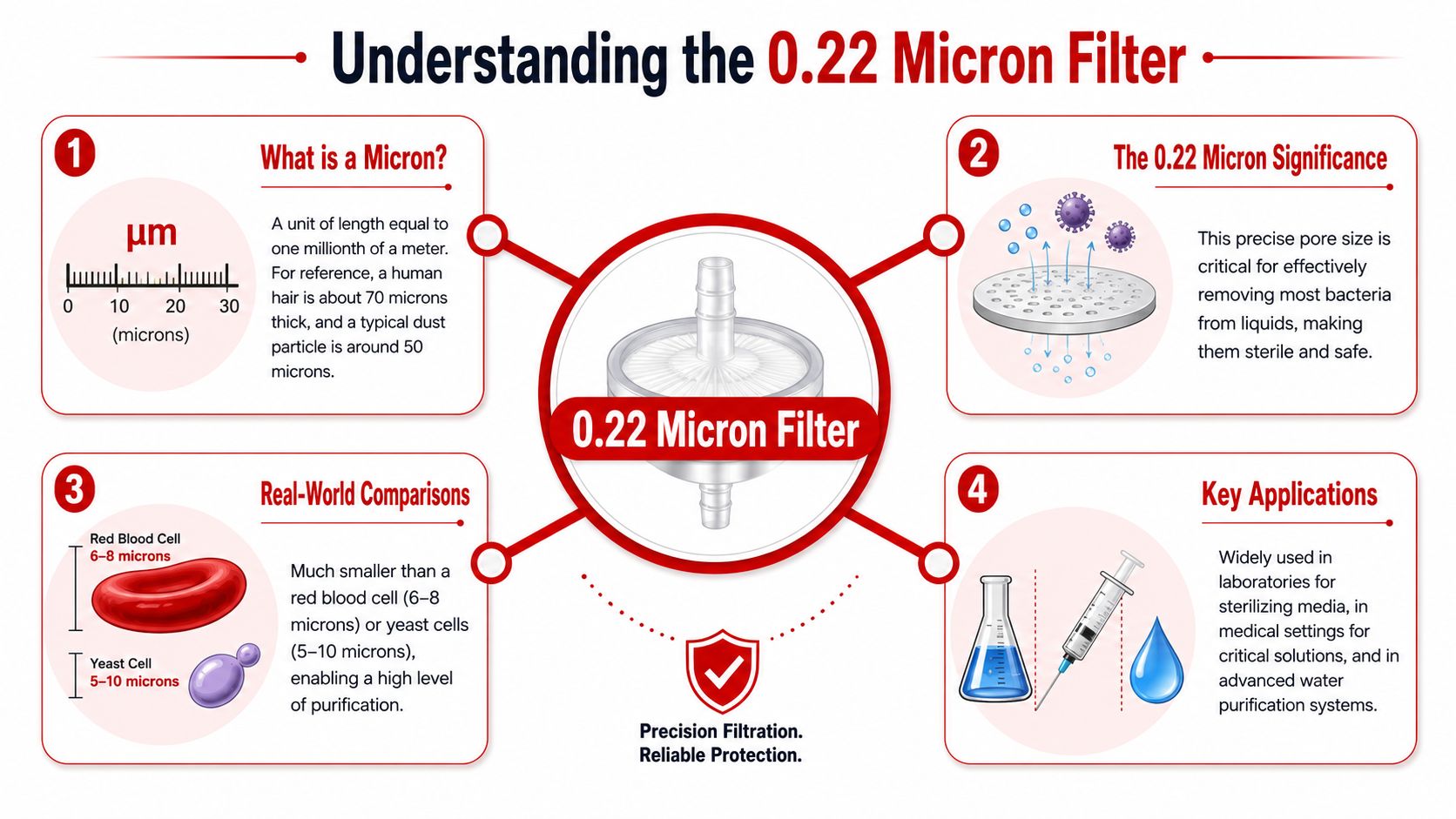
A micron is a very small unit of length. In this context, it tells you the size of the pores in the filter membrane. Those pores are tiny enough to act like a microscopic sieve. Liquid can pass through, but larger unwanted material gets held back.
A tiny gate with a very specific job
A 0.22 micron filter is widely used as a sterilizing-grade membrane in liquid filtration. According to this explanation of 0.22 micron filter use, it's classified as sterilizing-grade because its pore size is engineered to be smaller than the smallest known bacteria, typically 0.5 to 5 microns, and it achieves a Log Reduction Value of 6 or greater, which corresponds to 99.9999% removal of bacterial contaminants.
If that sounds abstract, try a kid-friendly analogy. Picture a playground fence with openings so small that marbles can't get through, but water can. The filter membrane works in a similar way, except on a scale too small for your eyes to see.
Core idea: A 0.22 micron filter is a gatekeeper. It separates many microbes and particles from a liquid by physical size.
Sterile is not the same as just clean
Many people misunderstand this point. A liquid can look crystal clear and still not be sterile. A disinfected surface and a sterile filtered liquid are also not the same thing. If you want a plain-language refresher, these key facts about sterile vs disinfected help sort out the vocabulary parents and teachers often mix together.
For classroom or at-home learning, that distinction matters. If a child filters a liquid and sees it become clearer, the visual result is helpful, but clarity alone doesn't tell the whole story. The point of the 0.22 micron filter is that it's designed for a much more precise task than “making something look cleaner.”
What the label doesn't mean
The label doesn't mean the filter removes everything. It doesn't mean every harmful thing in a liquid is gone. It doesn't mean any random water source becomes safe for drinking.
What it does mean is that this filter has a highly specialized role in separating out many bacteria and similarly sized contaminants from liquids when used correctly. That's why this tiny part shows up in both serious labs and educational kits. It introduces kids to real scientific filtration, not just basic straining.
How This Tiny Sieve Achieves Big Results
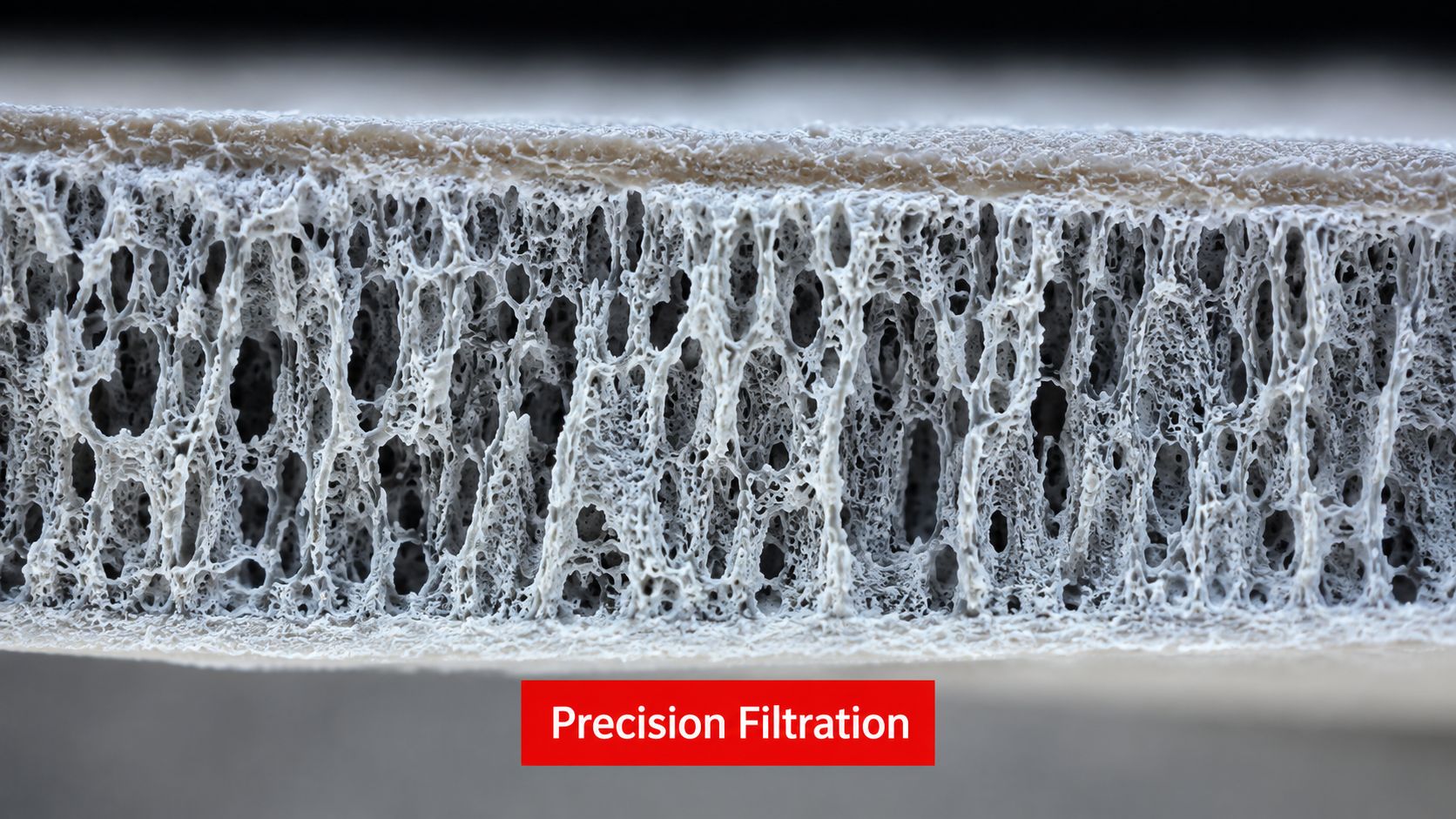
A 0.22 micron filter works by size exclusion. That phrase sounds fancy, but the idea is simple. If something is larger than the pore openings, it gets stopped. If it's smaller, it can pass through.
That's why the filter is so useful in science. It doesn't “zap” microbes with chemicals. It doesn't need heat. It acts as a physical barrier.
Think of a microscopic pasta strainer
A kitchen strainer catches noodles and lets water through. A 0.22 micron filter does the same kind of job, just at a microscopic level.
In lab settings, that matters a lot. As noted in this overview of 0.22 µm filtration in chromatography and cell culture, the membrane acts as a definitive physical barrier that traps particles larger than 0.22 micrometers while allowing smaller solutes and water to pass, helping prevent microbial contamination in growth media and buffer solutions.
A child can understand this with one sentence: “The holes are too small for many germs, but not too small for the liquid.”
Why handling matters so much
The membrane inside the filter is delicate. If you touch it, press too hard, or connect it badly to a syringe, you can affect how well it performs. That's one reason schools and labs care so much about good technique.
If you want a useful companion read on clean setup habits, preventing lab contamination with aseptic technique gives a clear overview of the behaviors that help keep experiments cleaner from start to finish.
Here's where home science gets exciting. Kids aren't just watching an experiment happen. They're learning how procedures protect results. Measuring with a 100 mL graduated cylinder for consistent volumes pairs nicely with filtration because both teach control.
What's actually moving through the filter
Several things can pass through:
- Water and small dissolved substances: These are usually small enough to flow through.
- Desired ingredients in solutions: In many educational and lab mixtures, the liquid itself is the thing you want to keep.
- Very small contaminants: Some tiny unwanted materials can still pass, which is why filter choice matters.
The filter doesn't “clean” by magic. It sorts by size.
That simple idea is one of the best science lessons you can give a child. Good tools are designed around rules, not mystery.
From High-Tech Labs to Your Living Room
In one setting, a technician filters a sensitive liquid before it's used in a tightly controlled process. In another, a teacher helps students compare filtered and unfiltered samples at a classroom table. The rooms look different. The logic is the same.
That's what makes the 0.22 micron filter so interesting. It belongs to both worlds.
Where professionals use it
In pharmaceutical and research environments, sterile filtration matters because contamination can ruin materials that need to stay extremely clean. A 0.22 micron filter is often part of that workflow for heat-sensitive liquids and gases.
But professional use also comes with an important warning. According to this explanation of endotoxin and membrane charge effects, while 0.22 µm filters effectively remove bacteria, they are physically incapable of retaining all viruses or smaller contaminants like endotoxins. For endotoxin removal, special cationically charged membranes are needed because that process depends on electrostatic attraction, not simple size exclusion.
That's a valuable lesson for adults supervising children. A filter can be excellent at one task and still be the wrong tool for another.
How that translates to home learning
At home, the filter becomes a teaching tool instead of a manufacturing tool. A child can use it to explore questions like:
- Why does one sample stay clearer than another?
- Why do scientists care about contamination?
- Why doesn't “filtered” always mean “safe for every purpose”?
A companion safety habit is surface prep. If you're setting up a home experiment station, understanding 90% isopropyl alcohol and where it fits in cleaning routines can help adults think more clearly about the difference between cleaning tools and filtering liquids.
A good story to tell kids
You can say this at the table: “The same kind of idea used in serious science is helping us with our experiment today.”
That statement is true, and it changes how children see the activity. Suddenly, the little plastic disc isn't random packaging. It's a real scientific instrument scaled down for learning.
Some of the best STEM moments happen when children realize home experiments use the same scientific principles that professionals trust.
That sense of connection is powerful. It makes science feel less like a school subject and more like a real human practice.
Using Filters Safely in Your STEM Kit
Adults should treat a 0.22 micron filter like a precise tool, not a toy part. Kids can absolutely help use it, but they need supervision and a clean, calm setup.
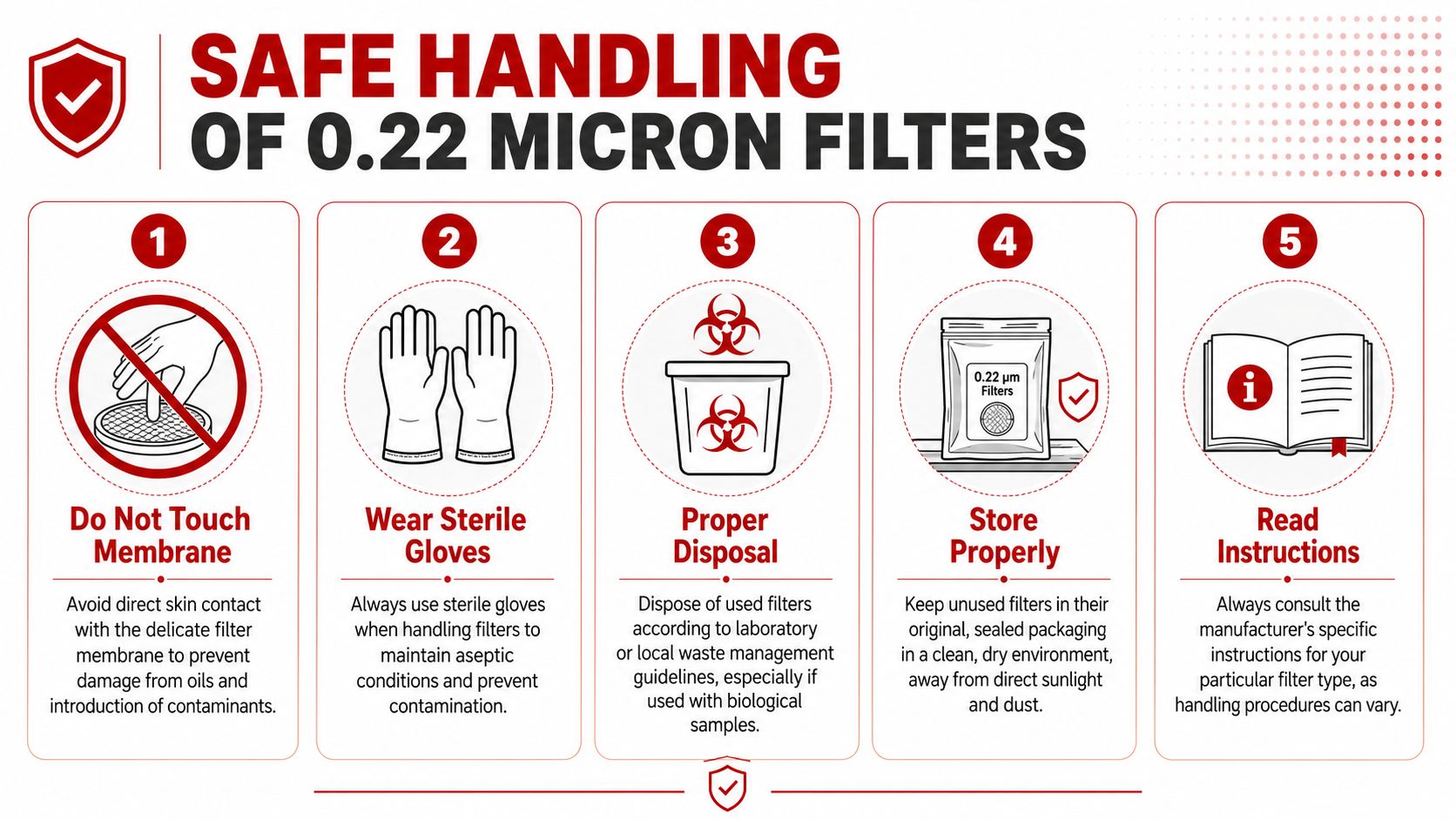
The basics matter a lot. Keep the filter sealed until use. Avoid touching the membrane area. Connect it firmly to the syringe or holder. Push the liquid through steadily instead of forcing it.
Safe handling rules for parents and teachers
- Keep fingers off the membrane: Oils and dirt from skin can contaminate the filter or damage its performance.
- Use a clean workspace: A wiped-down table and organized tools make better experiments and fewer mistakes.
- Go slowly with pressure: If the liquid won't pass easily, the filter may be clogging. Forcing it can rupture the setup or give messy results.
- Treat it as single-use in kids' activities: Reuse increases contamination risk and confusion about what changed the outcome.
- Store unopened filters carefully: Leave them in original packaging until you're ready to use them.
A 10 mL beaker for small sample prep is useful here because it helps children work with manageable amounts instead of trying to filter too much at once.
A smart rule for outdoor water experiments
If your child wants to filter pond water, rainwater, or water from a puddle, treat the activity as an observation experiment, not a purification project.
That caution matters because this PubMed-indexed report on waterborne bacterial penetration notes that some natural waterborne bacteria can penetrate 0.2/0.22 µm filters at low levels over 18 to 24 hours, a nuance not captured by standard industry tests using Brevundimonas diminuta. In plain language, a filter that performs very well in lab-style conditions may not guarantee absolute sterility in every real-world water source over time.
Practical rule: Never tell children that filtered pond, tap, or well water is automatically safe to drink.
A quick visual walkthrough can help adults feel more confident with the process:
Easy experiment ideas that stay educational
Try these safer uses:
- Compare clarity: Filter one sample of cloudy water and leave another unfiltered. Talk about visible versus invisible material.
- Test clogging: Run a relatively clean sample and a dirtier sample through separate filters. Kids can observe that some samples resist flow more quickly.
- Practice technique: Let children learn careful squeezing, steady pouring, and note-taking.
Those activities teach real lab habits without pretending the filter is a cure-all.
Comparing Filters 0.22 Microns and Beyond
Parents often hear several filter terms at once and assume they all do the same job. They don't. Some are for liquid clarification. Some are for air. Some inactivate microbes instead of physically removing them.
The easiest way to sort them out is side by side.
Filter and purification method comparison
| Method | What It Removes | Best For | Common Limitation |
|---|---|---|---|
| 0.22 micron filter | Many bacteria and particles larger than the pore size in liquids | Sterile-style liquid prep in educational and lab contexts | Doesn't remove everything in all cases, and can clog |
| 0.45 micron filter | Larger suspended particles | Clarifying cloudy liquid before finer filtration | Not the first choice when you need sterilizing-grade filtration |
| HEPA filter | Tiny particles from air | Room air cleaning and air-handling systems | Designed for air, not liquid experiments |
| UV treatment | Microbes by light exposure rather than physical removal | Water systems or equipment designed for UV use | Doesn't physically remove particles from the liquid |
| Activated carbon | Some odors and chemical-related impurities | Taste and odor improvement in water systems | Not a substitute for a sterile membrane filter |
The practical takeaway for families
If your science kit includes a 0.22 micron filter, that choice was likely made because the activity involves liquid handling where microbial control matters more than just visible cleanliness.
That doesn't make it the “best filter” in every situation. It makes it the right tool for a specific job.
Kids can explore that idea beautifully with magnification. If you're pairing filtration with observation, beginner microscopes for kids and families can help connect what the filter blocks with what children can examine afterward.
Pros and cons at a glance
Pros
- Precise liquid filtration: Useful when you want more than basic straining.
- Strong teaching value: Great for explaining contamination, pore size, and scientific control.
- Real lab connection: It introduces children to authentic scientific practice.
Cons
- Not universal protection: It isn't a cure-all for viruses, chemicals, or every water source.
- Sensitive to handling: Poor technique can ruin the result.
- Often single-use: That adds planning and cleanup needs.
Your Top Questions About 0.22 Micron Filters Answered
Can a 0.22 micron filter make any water safe to drink
No. A 0.22 micron filter should not be treated as a guarantee of safe drinking water for random sources.
One major reason is viruses. As explained in this consumer-focused guide to 0.22 µm filtration limits, viruses in the 0.02 to 0.3 µm range can pass through, and examples such as norovirus at about 0.03 µm and hepatitis A at about 0.03 µm are too small to be retained. For families, the safe rule is simple: use these filters for supervised science learning, not as a shortcut for drinking-water safety.
Can I reuse the filter for another experiment
No, not for kids' STEM activities. Reusing a filter can carry material from one experiment into the next, and clogging changes how the filter behaves. If you want children to learn good scientific habits, single use is the cleaner lesson.
Is 0.22 micron different from 0.2 micron
Yes and no. The labels are different, but in practical sterile filtration language they're often treated as the same sterilizing-grade class when properly validated.
What matters most for families isn't the tiny naming difference. It's whether the filter is being used appropriately and handled correctly.
If the water looks clear after filtering, is it sterile
No. Clear water only tells you what your eyes can detect. It doesn't confirm the absence of viruses, endotoxins, dissolved chemicals, or every possible microorganism.
Clear-looking liquid can still be unsafe. Visual cleanliness and microbiological safety are different things.
Is this too advanced for kids
Yes, for independent use. No, for guided learning. Young children shouldn't handle lab-style filtration alone, but they can absolutely understand the concept with adult support.
This is one of those rare tools that scales beautifully. A younger child can learn “big things get stuck, smaller things pass through.” An older student can learn about pore size, contamination, and why scientific claims need limits.
If you want science tools that turn curiosity into hands-on learning, explore Playz. Their kits are built to help kids ask better questions, try real experiments, and discover that learning sticks best when it feels like play.