

About 90% of preschool children's play in the United States involves a toy, according to early-childhood research summarized in World Health Organization guidance on play and child development. That figure reframes toys as more than birthday gifts or ways to occupy a child. For many young children, toys are the everyday materials through which they practise language, movement, problem-solving, imagination, and relationships.
The important question isn't just whether a toy is labelled “educational.” Development depends on the interaction between the toy, the child, the adult, and the play environment. A wooden block can support planning, communication, and cooperation when a child builds with a caregiver. The same block may offer a different experience during quiet, independent exploration. A toy with lights and sounds may attract attention, but it can also leave fewer opportunities for a child and adult to create a conversation together.
The Science of Play and Early Brain Architecture
A young child's brain develops through repeated experiences. Each time a child grasps an object, tests an idea, hears a new word, takes a turn, or changes a plan, the brain processes information and strengthens useful connections. Toys provide a physical setting for these experiences, but the developmental value comes from what the child does with them.
The World Health Organization describes play as a voluntary and imaginative activity that may be solitary or social and may involve objects. Its child-development guidance explains that young children acquire and consolidate skills through playful interactions with people and objects. This places play within a developmental framework, not outside it as a reward after “real” learning.
A helpful analogy is to think of brain development as building a house. A toy isn't the finished house, and it certainly isn't a magic construction device. It's more like scaffolding. It gives a child something to grasp, move, compare, pretend with, or discuss while the underlying structure of attention, memory, language, coordination, and social understanding takes shape.
Why physical interaction matters
A child who stacks cups must judge size and position. A child who pushes a car down a ramp observes cause and effect. A child who feeds a doll rehearses social routines and may use language associated with caring, comfort, or family life. These actions connect thinking, movement, emotion, and communication rather than isolating one skill.
The WHO also emphasizes interactive, non-screen-based activities such as reading, storytelling, singing, and puzzles. These activities give children opportunities to respond, imitate, anticipate, and share attention with another person. That shared attention is especially important because development doesn't happen only inside the child. It grows through relationships and responsive exchanges.
Practical insight: Choose toys as invitations to act and communicate, not as devices that perform learning for the child.
Parents who want a broader explanation of this relationship can explore how play supports child development. For educators, the benefits of play-based learning also offer a useful lens for designing activities around exploration rather than passive completion.
The result is a more useful way to judge a toy. Ask what the child can do, say, notice, repeat, and change with it. A simple object that invites many actions may support richer development than a complex toy that provides only one predetermined response.
How Different Toy Categories Shape Core Skills
Different toys place different demands on a child's developing systems. The label on the box matters less than the actions the toy requires. A puzzle asks a child to compare and persist. Blocks ask the child to plan and balance. Dolls and figures invite symbolic thinking and social language.
A 2026 systematic review found that 71% of studies reported cognitive gains from structured play, with puzzles and robotics improving problem-solving. The same review reported that guided play outperformed direct instruction for early mathematics, shape knowledge, task switching, and spatial vocabulary, with effects of g=0.24, g=0.63, g=0.40, and g=0.93 respectively, as described in the Frontiers systematic review of structured and guided play. These findings don't mean every puzzle or robotics kit will produce the same result. They show why active manipulation and thoughtful adult support can matter.
A practical map of toy categories
| Developmental Domain | Key Skills Built | Best Toy Examples |
|---|---|---|
| Cognitive and executive function | Planning, working through problems, flexible thinking, self-regulation | Puzzles, blocks, construction sets, sorting materials |
| Fine motor development | Grasping, hand strength, precision, hand-eye coordination | Play dough, threading sets, stacking toys, peg boards |
| Language and communication | Vocabulary, labelling, turn-taking, storytelling, questions | Picture books, dolls, animal figures, pretend-play props |
| Social-emotional development | Empathy, perspective-taking, cooperation, emotional expression | Dolls, puppets, role-play sets, cooperative games |
| Early mathematics and spatial reasoning | Counting, shape recognition, comparison, position, measurement language | Shape sorters, tangrams, pattern tiles, building materials |
| Physical development | Balance, coordination, body awareness, motor planning | Balls, tunnels, movement equipment, ride-on toys |
Structured toys work best when children manipulate them rather than just watch them. A child who rotates a puzzle piece, tests a bridge, or rebuilds a tower receives immediate information from the material. That feedback helps the child revise a plan without needing an adult to announce whether the answer is correct.
Why pretend play supports social understanding
Pretend play gives children a safe way to represent experiences. When a child makes a doll “sad” and then comforts it, the child is practising emotional vocabulary and perspective-taking. When two children negotiate who will be the shopkeeper, they're working on language, flexibility, and social rules.
A 2026 randomized controlled trial involving 73 children aged 4 to 8 found that children who took part in a six-week home play intervention with dolls showed better false-belief reasoning than children assigned to a creative tablet activity. The children played with their assigned toy for at least 230 minutes on average across the six weeks, or about 37 minutes per week, as reported in the PLOS ONE study of doll play and social cognition. A complementary neuroscience study involving 42 children aged 4 to 8 found differences in brain activation during social and solo play, including engagement of regions associated with social processing and empathy during doll play.
Not every child needs the same category. A child who seeks movement may benefit from large construction materials or active play, while a child who becomes overwhelmed by noise may prefer quiet sorting, drawing, or tactile materials. For children who need help with focus or sensory regulation, adults can use a guide to find the right fidget for your child, while still ensuring that the object supports purposeful engagement rather than becoming a constant distraction. More examples of how toy features connect with development appear in this guide to the best toys for child development.
Age-by-Age Guide to Developmentally Appropriate Toys
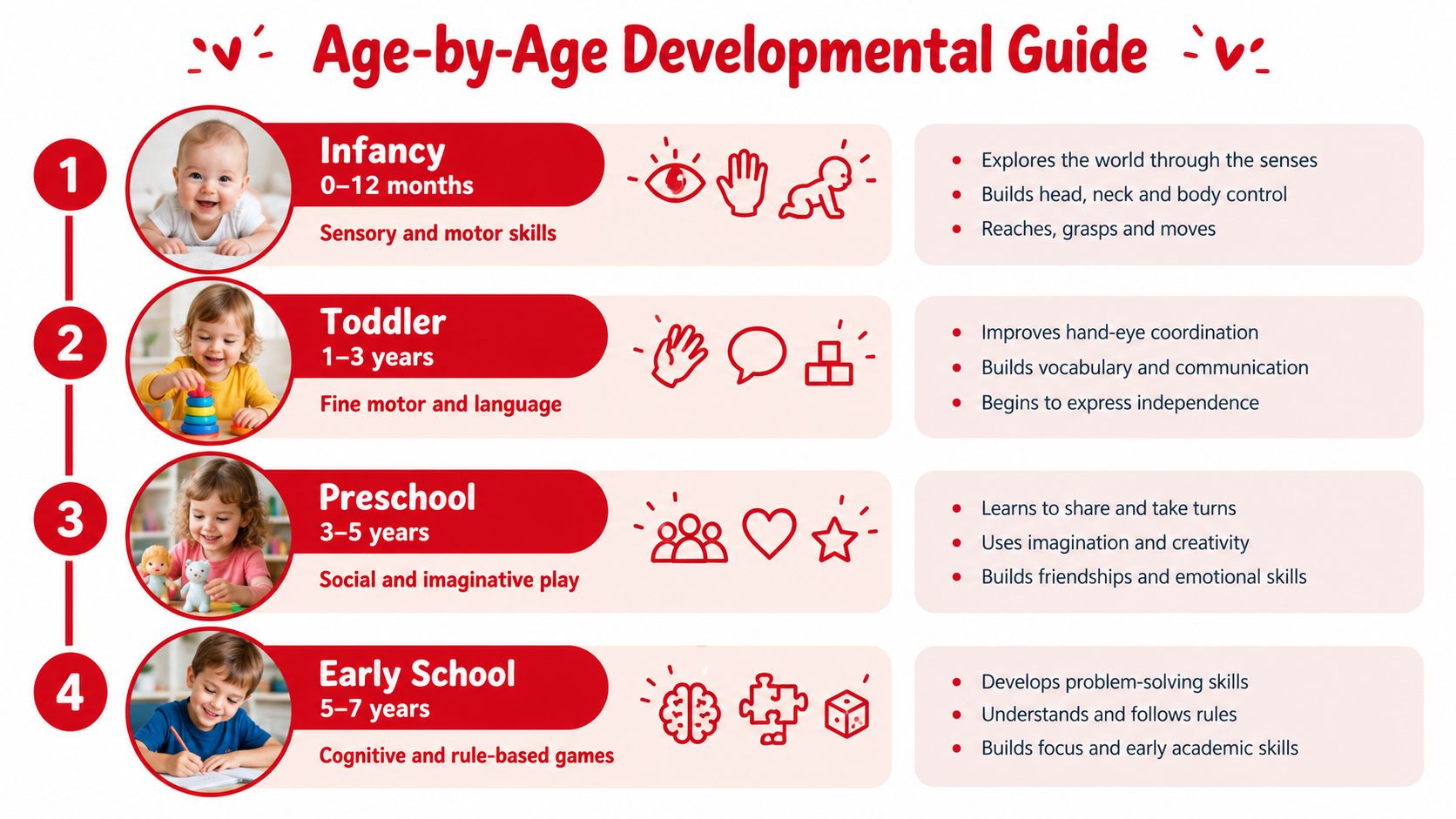
A toy becomes developmentally appropriate when its demands are close enough to a child's current abilities to invite success, but open enough to encourage growth. The same set of blocks can serve an infant who bangs and grasps them, a toddler who stacks them, and an older child who designs a structure. The adult's role changes as the child's skills change.
Infancy from birth through 12 months
Infants learn through sensory exploration. They may mouth, shake, drop, rub, or transfer an object from one hand to the other. Safe grasping toys, textured balls, soft blocks, cloth books, and simple containers give infants opportunities to notice weight, sound, texture, and movement.
Adults can support this stage by describing what the infant is doing. Say, “You shook the ring,” or “The ball rolled away,” then pause for the child's response. The aim isn't to test the infant. It's to connect action with language and shared attention.
Toddlers from 1 through 3 years
Toddlers often repeat actions because repetition helps them understand control and cause and effect. Stacking cups, large interlocking blocks, chunky puzzles, pretend food, toy animals, and washable drawing materials fit this period well. A toddler may first use a block to knock something over, then later use it as a road, a bed for a toy animal, or part of a tower.
A longitudinal study of mother-infant social toy play found that maternal responses to infant toy initiations, along with manipulating and labelling toys at 11 months, were related to infant language at 14 months, according to the study published through Utah State University. When a toddler points, hands you a toy, or starts an action, respond to that initiation before adding your own idea.
Preschool from 3 through 5 years
Preschoolers increasingly use objects symbolically. A cardboard box may become a bus, a puppet theatre, or a shop. Dolls, puppets, dress-up materials, art supplies, construction sets, and animal figures help children create stories, practise roles, and coordinate play with peers.
Research on symbolic play with 54 infant-caregiver dyads found greater conversational turn-taking during symbolic play than during functional play, along with more questions and mimetic language in infant-directed speech. Those features were positively related to infant language proficiency, as reported in the study of symbolic and functional play. Adults can extend this play with questions such as, “Where is the puppy going?” or “What does the doctor need next?” without directing every detail.
Early school years from 5 through 7 years
Children in the early school years can manage more complex construction, strategy, and rule-based games. They may enjoy model-building materials, simple science equipment, card games, board games, mazes, coding toys, and collaborative challenges. These activities encourage planning, sequencing, memory, negotiation, and the ability to follow or adapt rules.
Watch for the child's response rather than choosing a toy solely by age label. If the child abandons a game because the rules are too complex, simplify the first round. If a construction set is finished quickly without thought, introduce a design challenge such as building a bridge that can hold a toy animal.
A short demonstration can help adults see how to match support to readiness:
Developmental milestones can vary, so parents and educators should observe patterns across daily activities rather than judge a child by one play session. This overview of childhood development milestones can help adults connect play observations with broader developmental skills.
The Hidden Impact of Electronic Versus Traditional Toys
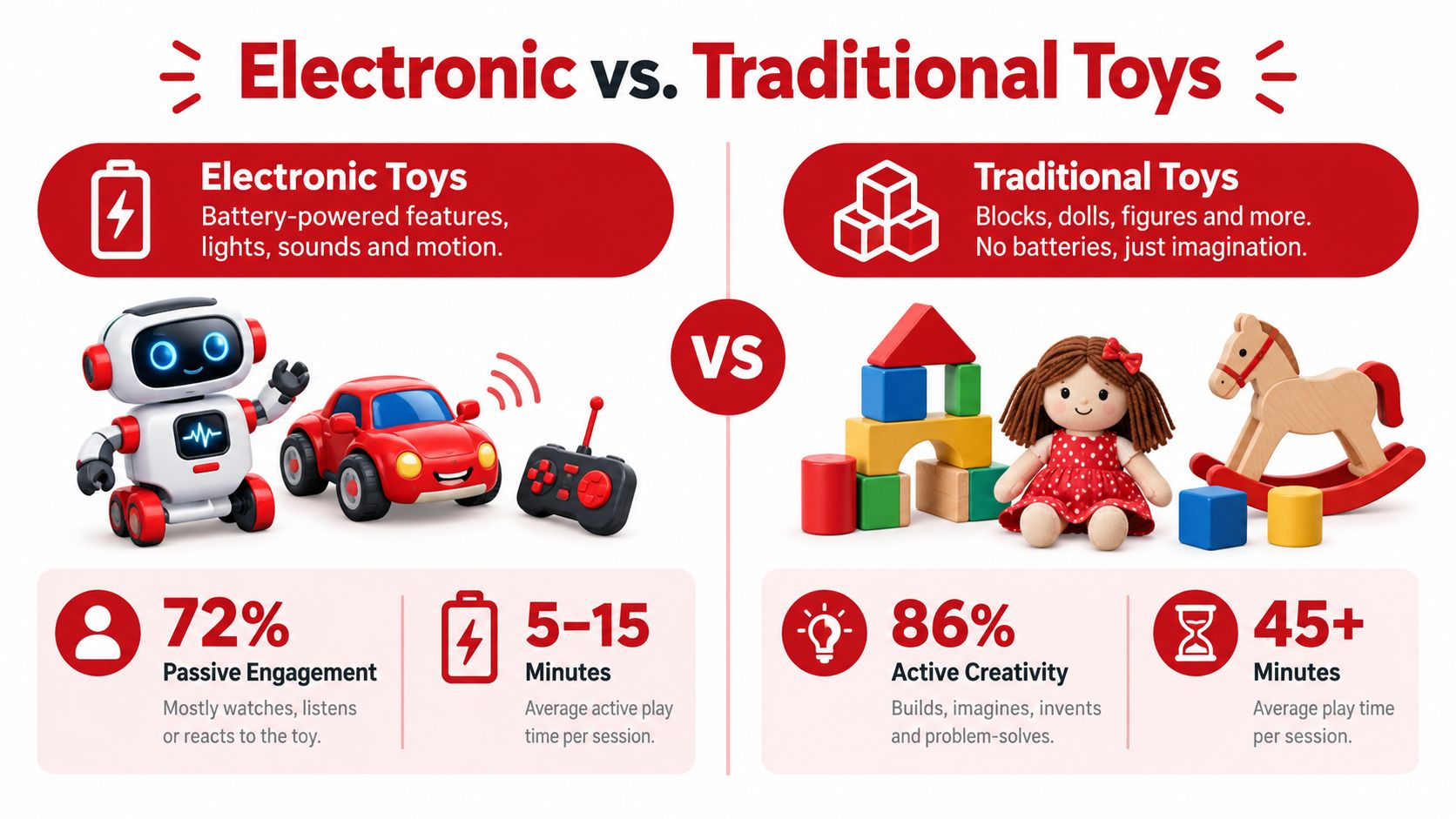
A toy that talks, flashes, or moves can attract a child quickly. Attraction, however, isn't the same as developmental richness. The key comparison is whether the toy leaves room for the child and adult to exchange ideas, respond to one another, and change the direction of play.
A 2015 JAMA Pediatrics study found that during parent-infant play, electronic toys were associated with fewer adult words, fewer conversational turns, fewer parental responses, and fewer content-specific words than traditional toys or books. The mean number of adult words with electronic toys was 39.62, according to the JAMA Pediatrics study indexed by PubMed.
What traditional toys make possible
A set of blocks doesn't announce what the child should build. That open space gives the adult a reason to comment, ask a question, imitate the child, or offer a new word. A doll can become hungry, tired, frightened, or excited depending on the story the child creates. A book provides pictures and language, while the adult can pause to follow the child's interest.
Traditional materials also give children clearer control over cause and effect. If a tower falls, the child can change its base. If a pretend meal needs a plate, the child can search for an object that works. These small decisions create opportunities for planning and flexible thinking.
What electronic toys can and can't do
Electronic toys aren't automatically harmful, and they may have a place in a varied play environment. The concern arises when sound, movement, or scripted prompts replace the child's own actions and the adult's conversation. A toy that gives the answer immediately may provide less reason to predict, explain, or negotiate.
The neuroscience findings described earlier also offer a useful comparison. In a complementary study of children aged 4 to 8, solo tablet play did not show the same social-processing engagement reported during solo doll play. That doesn't mean a tablet determines a child's development. It means the type of activity changes the demands placed on the child's brain.
Conversation check: If the toy is doing most of the talking, moving, and deciding, ask how you can return one of those jobs to the child.
Try switching from a press-and-watch routine to an active prompt. Instead of activating every feature on an electronic farm, ask the child to choose where the animals sleep, make an animal sound, or create a problem for the farmer to solve. Families looking for practical ways to reduce passive media habits can use this guide to limiting screen time, while keeping the focus on replacing passive use with satisfying hands-on play.
The strongest play environment doesn't need to exclude every battery-operated toy. It should give children frequent access to materials that require them to initiate, imagine, manipulate, and communicate.
Toy Quantity and Diversity in the Play Environment
Many parents have heard that fewer toys always lead to better concentration. The situation is more nuanced. A recent study summarized by PsyPost's coverage of toy diversity and infant communication found that a higher number of diverse toys in the home was associated with better infant communication skills and earlier language development. This finding challenges the assumption that more toys automatically distract children.
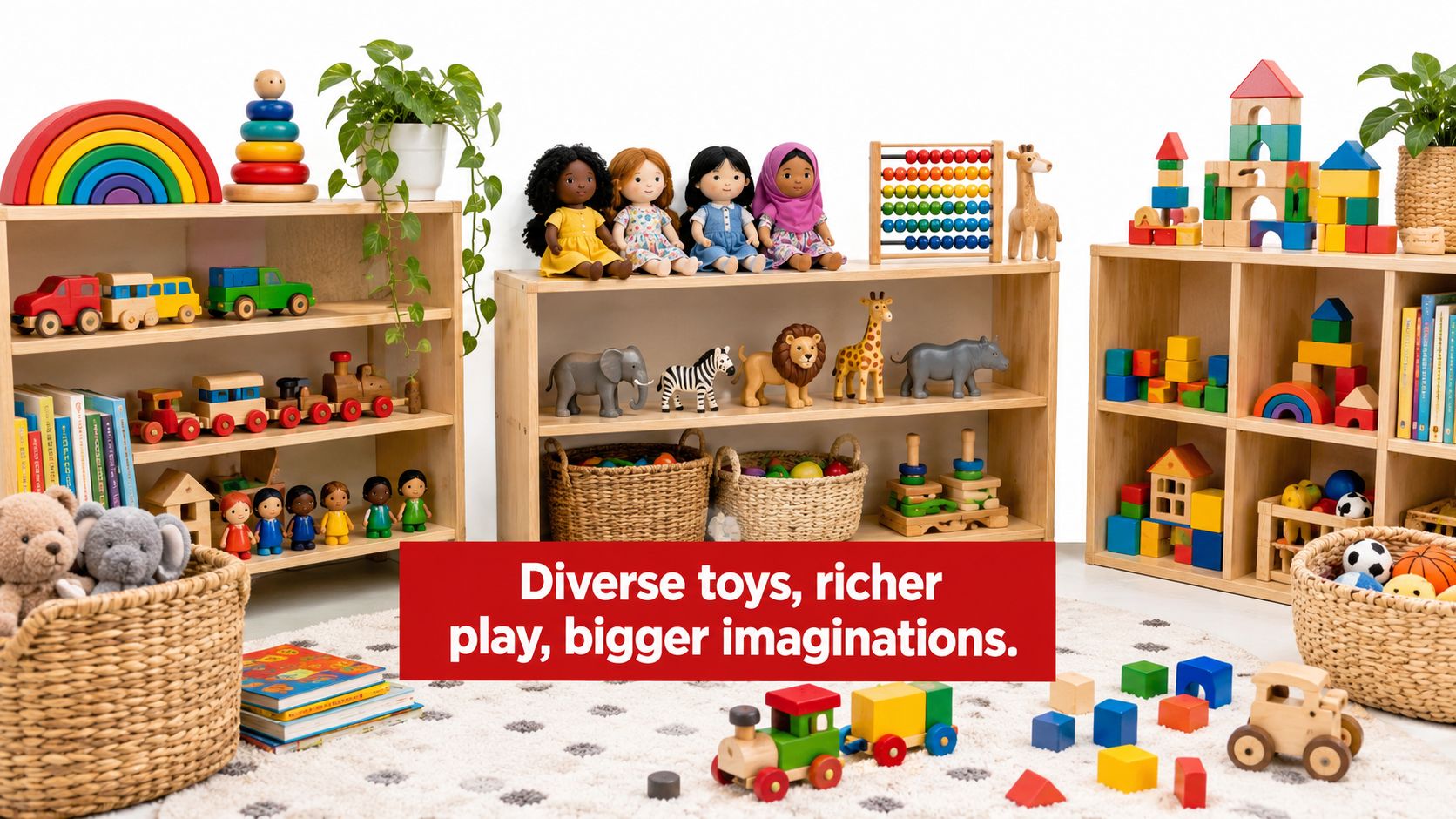
Quantity and diversity aren't the same thing. A large collection made up of near-identical toys may offer less variety than a smaller collection containing blocks, dolls, books, sensory materials, art tools, and objects for sorting. Diversity gives children different ways to practise communication and problem-solving.
Designing a richer play space
Place a few categories where children can see and reach them. A low shelf might include construction materials, pretend-play figures, books, and a container of drawing tools. Keep small parts away from children who still mouth objects, and use baskets so the space remains manageable.
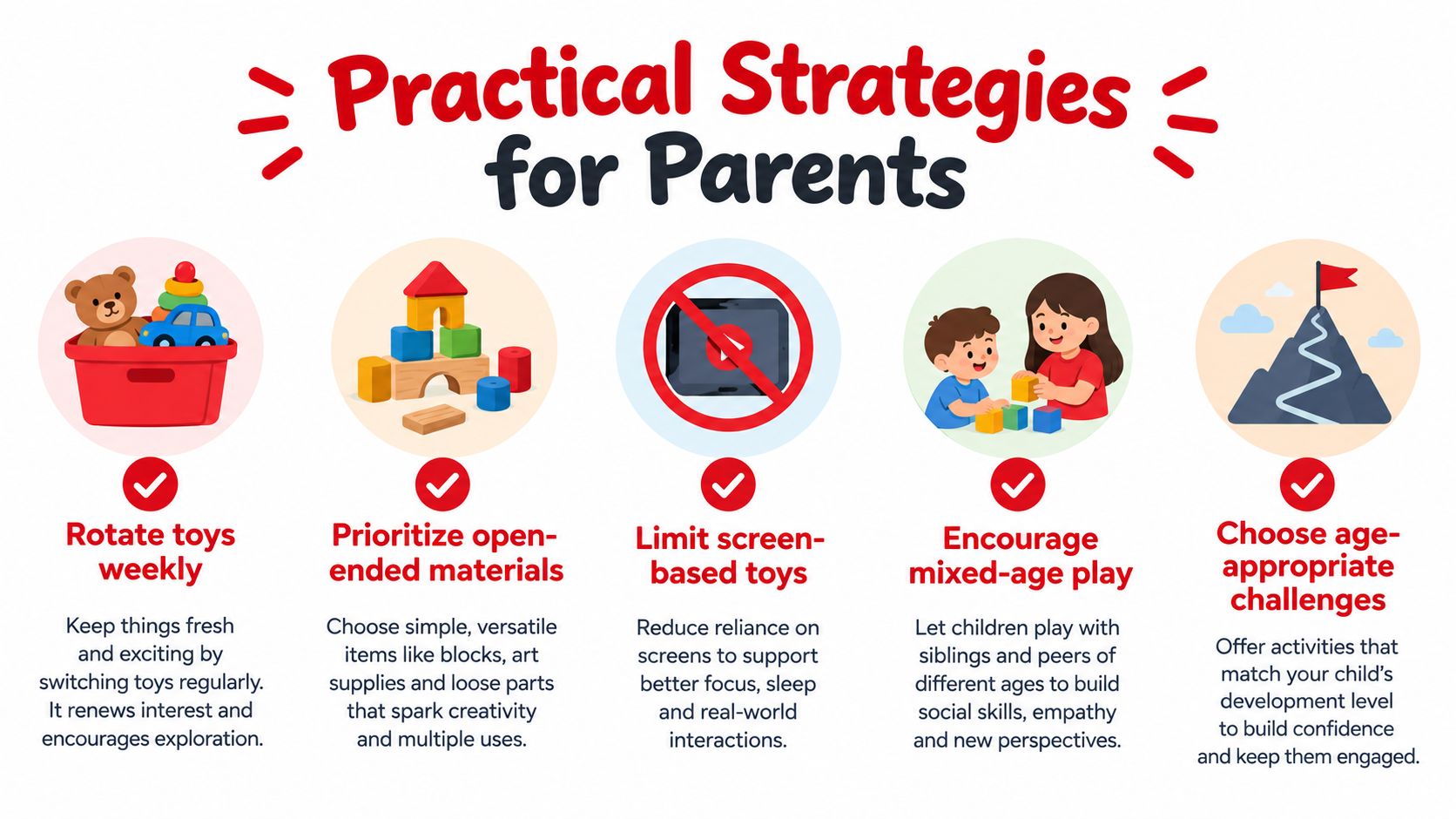
Toy rotation can help without treating variety as a problem. Store some materials and bring them back when the child's interest changes. Rotation is most useful when it preserves access to different types of play rather than reducing everything to one “approved” toy. A practical toy rotation system can help families organise materials while keeping the play area inviting.
Signs the environment needs adjustment
Observe the child for a few days. If the child repeatedly asks an adult to activate toys, add more open-ended materials. If the child moves rapidly between activities, reduce the visible options and offer one new category at a time. If the child plays intently with a particular theme, add complementary items rather than removing the interest.
A rich environment should support focus, flexibility, and interaction. It doesn't need to look perfect, and it doesn't need to contain expensive products. Everyday objects, when safe and supervised, can extend pretend play and encourage children to invent their own uses.
Practical Strategies for Parents and Educators
Buying a developmentally useful toy is only the first step. The adult's choices before, during, and after play shape what the child gets from it. A construction set may become a quiet solo activity, a language lesson, a cooperative engineering challenge, or a frustrating task, depending on how the adult introduces it.
Use a simple selection test
Before bringing a toy into a home or classroom, ask:
- Can the child act on it? Look for pieces to grasp, move, combine, sort, or transform.
- Can it support language? Choose materials that invite naming, describing, questioning, or storytelling.
- Can the toy grow with the child? Open-ended objects often allow simpler use first and more complex challenges later.
- Does it fit the environment? Consider noise, storage, supervision, and whether several children can use it safely.
- What kind of support will it need? Some toys work independently, while others are most valuable when an adult or peer joins in.
Age grading requires careful interpretation. The Toy Association explains that age grading on packaging is based largely on safety, not on how intelligent a child is or how advanced the child may be. Consumers should check and follow age guidance and other safety information before buying, as described in the Toy Association's statement on toy safety and age grading.
Join without taking over
Start by watching. Notice what the child has already decided, then describe the action: “You put the blue piece on top.” Wait before correcting or demonstrating. If the child seems stuck, offer one small prompt, such as “What could make the base wider?” rather than solving the problem.
Guided play works best when the adult adds language or a manageable challenge while preserving the child's ownership. In a classroom, an educator might place measuring cups beside a water tray and introduce words such as full, empty, heavy, and more. In a home, a caregiver might add paper tickets and a bag to a pretend bus game.
Build play into ordinary routines
A long planned activity isn't necessary. Sorting socks by colour, making a road with cushions, narrating a bath-time pour, or acting out a story before bed can provide meaningful practice. Follow the child's attention, protect uninterrupted play when possible, and value repetition.
Playz offers options including play tents, science kits, and creative toys, which families and educators can consider when they want materials for imaginative, hands-on, or exploratory play. The product should still be matched to the child's interests, safety needs, and readiness rather than chosen only because it carries an educational label.
Frequently Asked Questions About Play and Development
Is one favourite toy a problem?
Usually, no. A favourite doll, vehicle, blanket, or figure can provide emotional continuity and a familiar way to practise stories. Add related materials gradually, such as a box for the vehicle, food for the doll, or paper for drawing, rather than removing the preferred object.
Are open-ended toys always better?
No. Single-purpose toys can teach a clear action, support a specific interest, or help a child practise a new skill. Open-ended materials offer more possible uses, but the best choice depends on the child, the setting, and the way an adult or peer participates.
How can I move a child from screen-based play to hands-on play?
Make the replacement concrete and appealing. Begin with a short shared activity connected to the child's interest, such as building a vehicle garage, acting out a favourite story, or creating a simple experiment. Stay nearby at first, then gradually allow the child to direct more of the play.
Should I remove toys to improve concentration?
Not automatically. The evidence on toy diversity suggests that a varied home environment can support infant communication, so focus on organisation rather than extreme reduction. Use accessible shelves, clear categories, and rotation when the visible collection becomes difficult to manage.
What should I do if a toy seems too difficult?
Reduce the challenge without taking control. Use fewer pieces, demonstrate one action, change the rules, or work alongside the child. Success should create a bridge to the next challenge, not require the child to complete the toy exactly as the manufacturer intended.
Playz offers play tents, science kits, and creative toys that give children opportunities to build, investigate, and develop stories through active play. Explore the range at Playz and choose materials that match your child's interests, developmental readiness, and need for meaningful interaction.