

The living room is covered in cushions, books, and stuffed animals. Then a child pulls a circular frame from its bag, and within moments the chaos becomes a reading cave, a pretend shop, or a quiet place to recover after a busy day. A kids pop up tent takes up physical space, but it can also give children a clearly defined space for independent play without adding another screen to the routine.
The right tent isn't just colorful fabric. Its frame, seams, labels, materials, ventilation, and storage design all affect whether children keep using it. The most successful choice balances imagination with the practical realities of family life, including limited floor space, frequent cleaning, and the risks that many attractive buying guides overlook.
What Is a Kids Pop Up Tent and Why Your Child Needs One
A kids pop up tent is a lightweight play structure that opens through a flexible steel or fiberglass frame rather than a complex pole system. Unlike a basic fabric canopy that may need separate supports, a pop-up model is engineered to unfold quickly and collapse into a storage bag. That convenience matters when a child wants a fort now, not after an adult has sorted through several connectors.
The emotional value is just as important. A small tent can become a spaceship during the morning, a library after lunch, and a veterinarian's office before dinner. Children decide what the space means, then practice storytelling, negotiation, and problem-solving through the play they create inside it. Parents looking for more ideas can explore these benefits of pretend play when deciding how to make the space part of a daily routine.
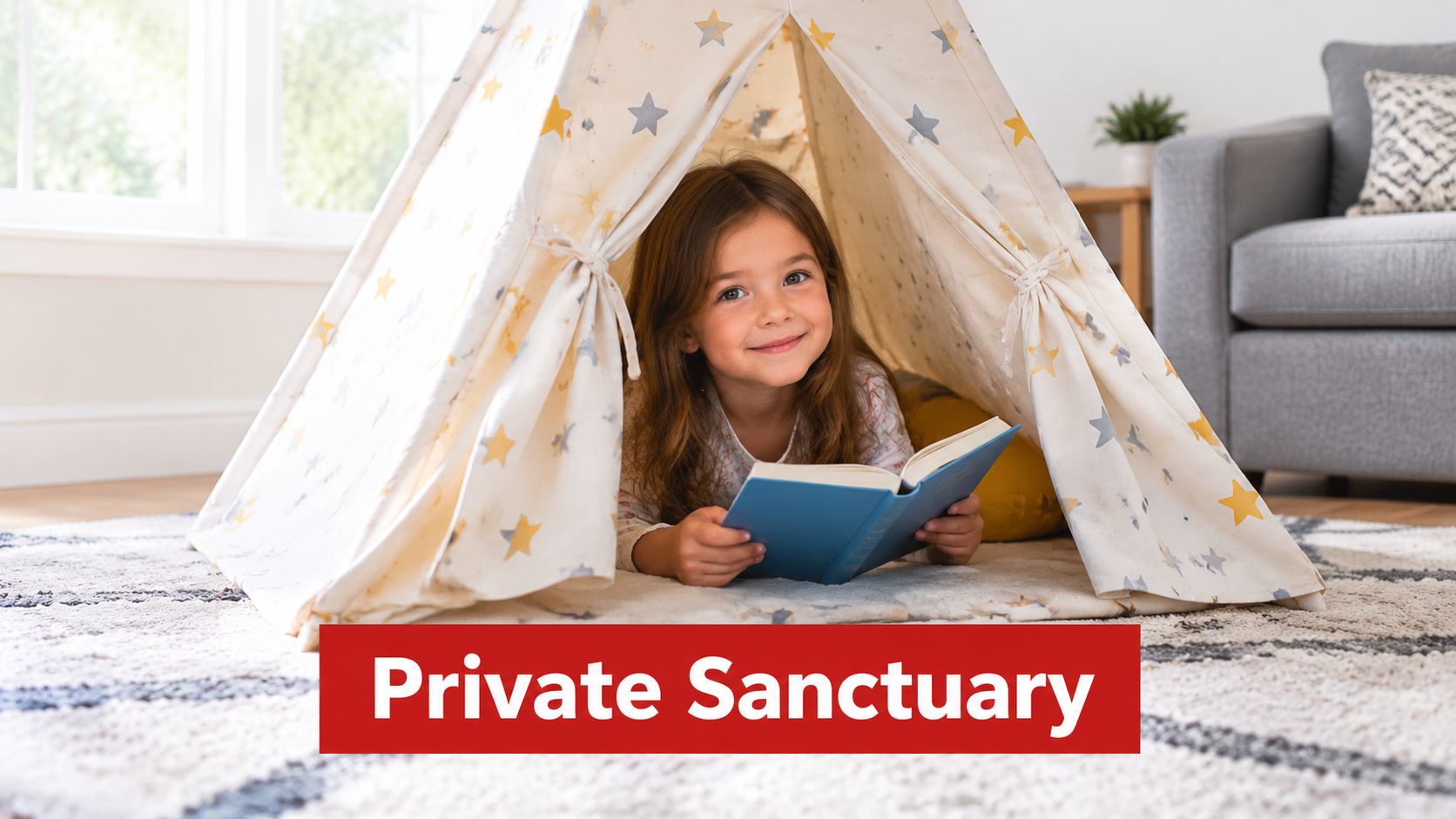
A private space that still belongs in family life
A tent shouldn't isolate a child from supervision. It should create a manageable boundary where a child can focus, look at books, organize toys, or act out a story while an adult remains nearby. Open windows, roll-up doors, and breathable panels make that balance easier than an enclosed structure with no visual connection to the room.
The best setup is often the least complicated. Place the tent in a corner where it doesn't block a walkway, heater, window, or exit. For families planning to use a play tent during trips as well as at home, a practical family camping essentials guide can help separate useful portable equipment from items that are difficult to store or supervise.
Practical rule: Choose a tent that children can reach, enter, and leave without climbing over furniture or pulling on unstable objects.
Understanding Safety Standards and Material Risks
Parents often see soft polyester and assume a pop-up tent has few technical risks. In reality, the flexible frame can spring back during folding, the fabric can ignite if it lacks suitable performance, and added chemical treatments may create concerns of their own. A pop-up tent is a compact engineered structure, not just a piece of cloth.
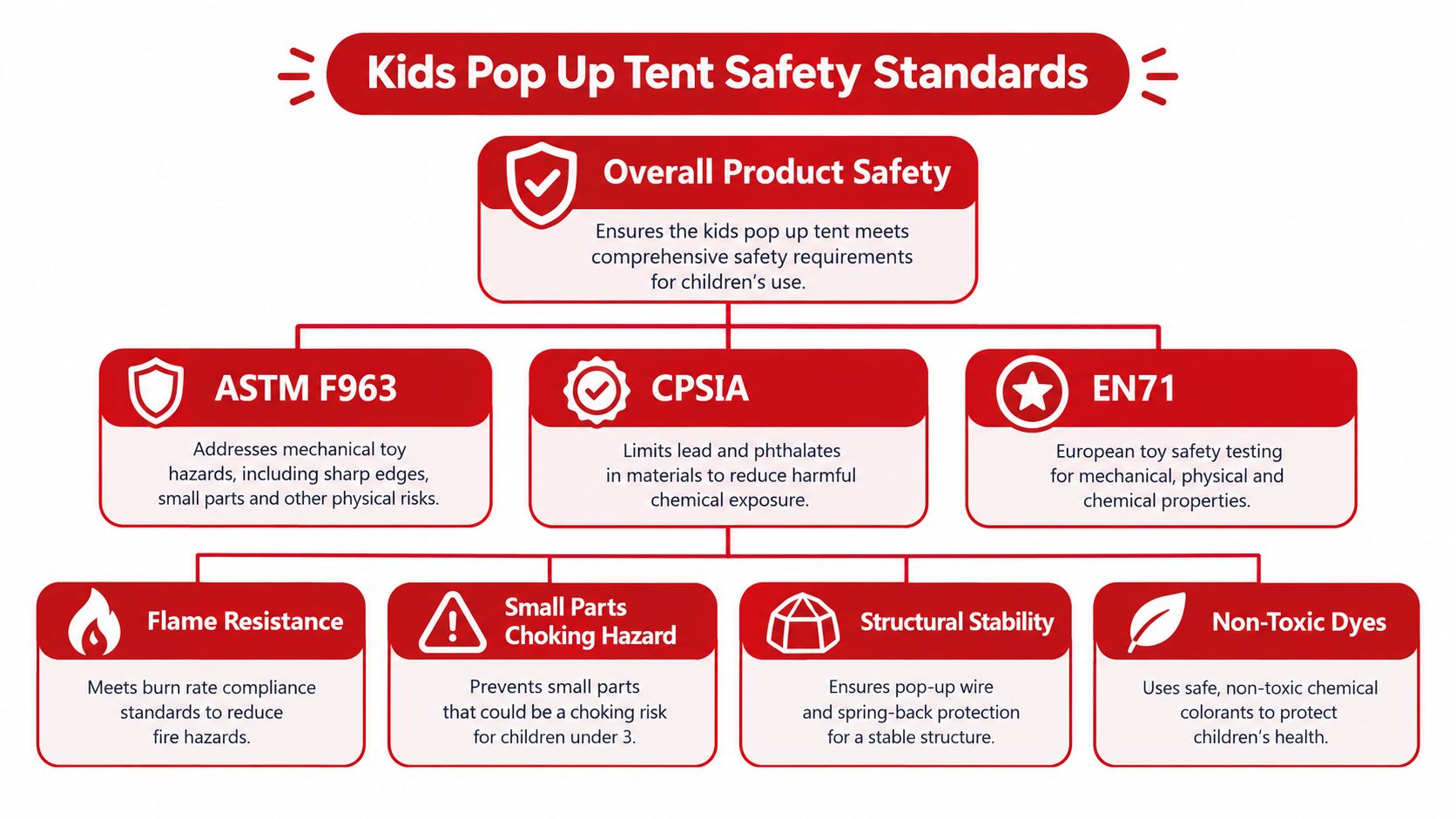
Start by asking for product-specific compliance information. ASTM F963 and Europe's EN71 are useful benchmarks in children's toy safety guidance, covering areas such as mechanical hazards, materials, labeling, and testing. U.S. children's products also sit within a broader mandatory safety framework. The CPSC sporting and camping equipment guidance explains that products designed or intended primarily for children 12 and under are excluded from ASTM F963-17 as general-use camping equipment, while still needing to meet other mandatory children's product requirements. It also identifies three flammability verification protocols, 16 CFR § 1500.44, ASTM F963-17 Annex A5, or CPAI-84.
Read the label, then question the treatment
Canada's amended Toys Regulations created a significant compliance milestone in 2024. The rules explicitly cover play tents intended to be entered by a child, define a children's tent as one intended for children under 14 and not meant for cooking or heating devices, and require flammability performance plus bold fire-safety labeling. The warning must be at least 3 mm high and appear in both official languages, while the outer surface of an enterable toy must carry a permanent warning to keep it away from heat and open flame. These requirements are described in this compliance guide for children's play tents.
Flame resistance shouldn't automatically mean heavy flame-retardant treatment. Washington State Ecology testing found 17 of 46 children's play tents and tunnels contained TDCPP or TCEP above the 1,000 ppm CSPA regulatory limit. That finding makes material documentation important. Look for certified low-toxicity textiles, clear chemical compliance information, and a manufacturer willing to identify the testing completed for the finished product. The Washington State Ecology testing document provides the relevant evidence.
A fabric label alone isn't enough. ASTM-based flammability specifications focus on controlled ignition and burn behavior, and the complete system matters, including fabric, seams, and construction. A tent that has been treated but lacks clear testing evidence deserves more scrutiny than one with transparent documentation.
For families comparing material choices, this guide to non-toxic toys for babies offers useful context for thinking beyond color and softness.
Choosing the Right Size and Age-Suitable Tent
A tent can be physically safe and still be a poor fit. A child who can't turn around comfortably may abandon it, while an oversized structure can dominate a small bedroom and tempt children to climb on it. Measure the intended floor area before shopping, then account for the space needed to open the door, supervise play, and fold the tent away.
Age guidance should come from the product manual, not only the photograph on a product page. One children's play-tent manual specifies use for children age 3 and older, requires adult supervision during assembly, disassembly, and play, and says the fabric isn't fireproof. It also directs users to place the tent on a flat, stable surface outdoors and secure it when wind is possible. Those instructions appear in the product manual and setup guidance.
Match the shape to the room
A low floor tent works well for a young child who mostly reads, carries soft toys, or plays without much noise. A taller teepee or roomier pop-up structure gives preschool children more room for role-play, but it needs a stable base and enough clearance around the frame. A tunnel can add movement, although it also increases the total footprint and gives adults more seams, connectors, and fabric to inspect.
| Home situation | More practical choice | What to check |
|---|---|---|
| Small bedroom or apartment | Compact pop-up tent | Door clearance, folded size, and visibility from the sofa |
| Shared playroom | Tent with open windows or roll-up panels | Airflow and easy adult access |
| Larger play area | Tent and tunnel combination | Stable placement and a clear route around the set |
| Outdoor use | Lightweight tent used only in suitable conditions | Anchoring, wind exposure, shade, and heat |
A useful indoor play tents guide for toddlers can help parents compare layouts, but the final decision should reflect the child's actual play style. Quiet readers need a different interior than children who crawl, carry props, and invite siblings inside.
Leave enough room for the child to exit without pushing against furniture. Don't place a tent beneath shelves with loose objects, beside a glass door, or where its frame can catch on a ceiling fan or curtain cord.
Setting Up, Cleaning, and Maintaining Your Tent
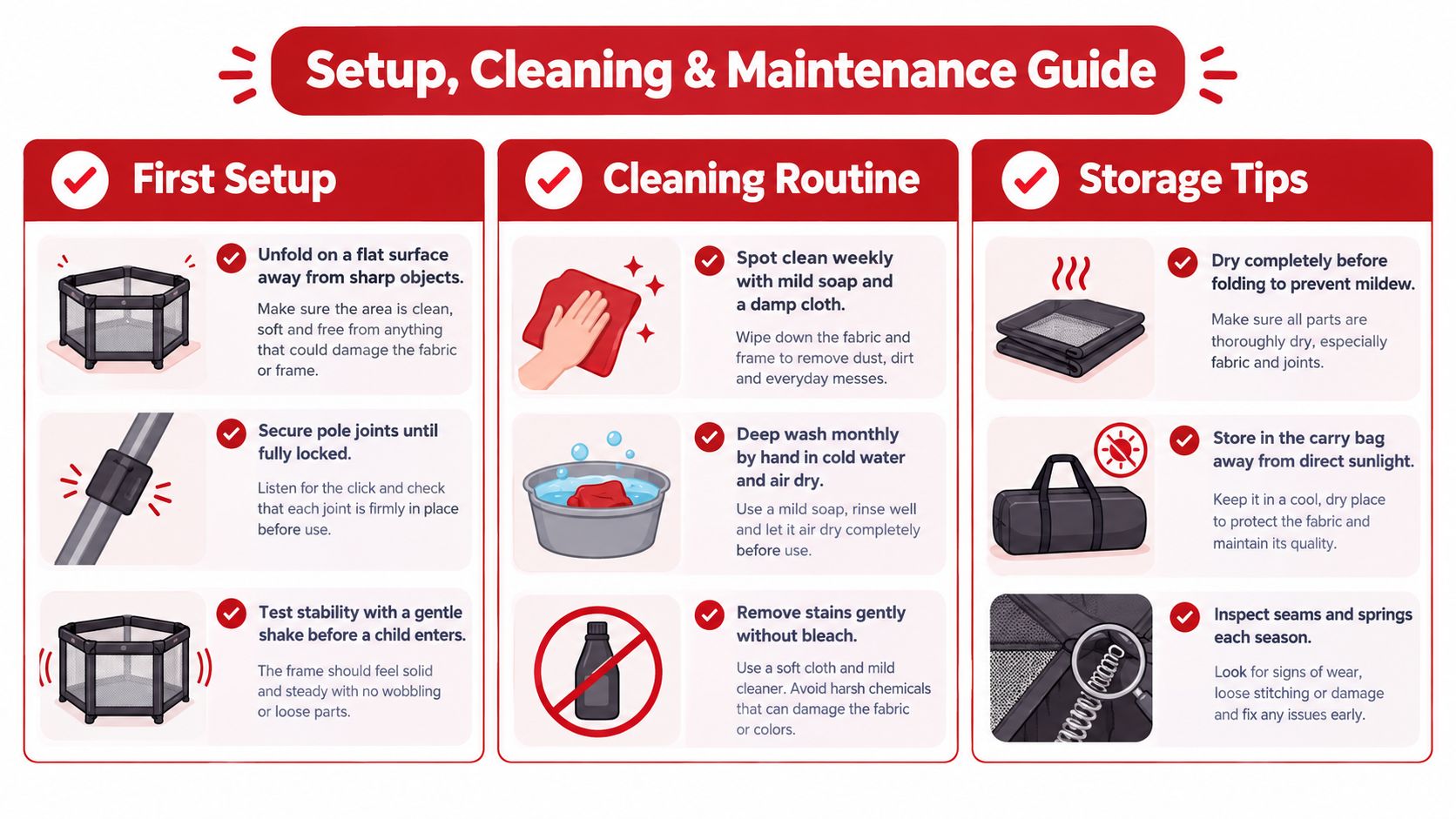
Pop-up convenience doesn't remove the need for careful handling. The frame should open fully rather than being forced into position, and the fabric shouldn't be twisted around a joint. A rushed setup can place uneven tension on the frame, while repeated folding with damp fabric can leave odors and mildew that make the tent unpleasant to use.
Compare maintenance demands before choosing a design. A removable washable cover is easier to refresh than a permanently attached shell, but extra zippers and fasteners create more inspection points. Mesh windows improve visibility and airflow, while thin mesh can snag if children pull toys through it. A simple interior may be less exciting at first, but it usually gives parents fewer difficult areas to clean.
A realistic care routine
The most useful routine is short enough to repeat:
- Open it carefully: Unfold the tent on a clear, flat surface and check that each frame section is seated correctly before play.
- Clean small marks promptly: Use mild soap and a damp cloth for food, dust, and fingerprints. Avoid bleach unless the manufacturer specifically permits it.
- Dry it completely: Air the tent after cleaning and before folding. Damp storage can turn a minor spill into a persistent odor.
- Inspect moving parts: Check zippers, stitching, mesh, springs, and frame sections for damage. Stop use if a broken piece can scratch, pinch, or detach.
- Store it without pressure: Fold along the intended curves and use the carry bag rather than forcing the tent into a smaller container.
A product manual remains the authority for washing and folding. These play tent instructions are useful when a family needs a visual reminder of the manufacturer's intended process.
A 2023 longitudinal study of 317 families, cited in a children's play-tent safety guide, found that only 28% of play tents were still used regularly after 14 months. The cited reasons included cleaning difficulty at 41%, frame warping at 29%, zipper failure at 22%, and storage issues at 19%. The maintenance and certification guide connects those failures with practical design decisions. A tent that folds neatly and tolerates ordinary cleaning may deliver more value than one with decorative features that are hard to maintain.
Creative Play Ideas and Educational Benefits
A tent becomes valuable when children can keep changing its purpose. One afternoon, place books and a soft cushion inside and call it a reading station. The next day, add paper labels and a toy thermometer so it becomes a clinic. The physical boundary helps children commit to a story because the setting is visible and consistent.
Turn one tent into several learning environments
Try prompts that require movement, language, and decisions rather than passive occupation:
- Story cabin: Let the child choose three objects to bring inside, then invent a story connecting them.
- Weather station: Use paper symbols for sun, rain, and wind, and ask the child to explain what a pretend visitor should wear.
- Delivery office: Create simple notes, sort soft toys by destination, and practice taking turns as the sender and receiver.
- Quiet reset space: Keep the interior uncluttered and invite the child to look at a book, listen to calm music, or spend a few minutes alone while remaining within supervision.
The tent also supports cooperative play. Two children must decide where objects belong, who enters first, and how the storyline changes. Those small negotiations are often more engaging than a toy with a fixed sequence of buttons.
The Playz brand emphasizes minimizing screen time through active play that fosters imagination and creativity, expressed in its motto #KidsLearnBestThruPlayz. That philosophy fits a pop-up tent because the product supplies a setting, while the child supplies the narrative, rules, and questions. Parents can find more ideas in this resource on play-based learning benefits.
Keep props lightweight and age-appropriate. Avoid turning the tent into a storage bin, because a crowded interior leaves less room for movement and makes cleaning harder. Rotate a few books, scarves, soft animals, or cardboard signs instead of filling the structure with every toy in the room.
Essential Indoor and Outdoor Safety Precautions
Placement determines safety as much as construction. Indoors, keep the tent away from radiators, fireplaces, portable heaters, candles, cooking areas, and electrical cords. A child may treat a tent as a private room, but the fabric and enclosed shape make nearby heat sources especially inappropriate.
Ventilation deserves a deliberate check. Use models with mesh panels or openable windows, keep entrances accessible, and don't leave a toddler zipped inside without adequate airflow. Use only low-heat battery or USB lights if lighting is needed, and keep the light source from touching the fabric.
A simple inspection before every active session
Run through the same sequence each time:
- Check the surroundings: Remove sharp toys, loose cords, unstable furniture, and small objects from the entry area.
- Check the structure: Look for exposed fiberglass, bent frame sections, loose stitching, broken magnets, and damaged zippers.
- Check the air: Open a panel if the interior feels warm or stuffy, and keep the tent visible from the supervising adult's position.
- Check the rules: No flames, heaters, cooking devices, or rough pushing against the frame.
- Stop when damage appears: Retire the tent if a component can detach, shed fibers, pinch skin, or create a choking hazard.
Recall notices show why these checks matter. The CPSC has addressed play tents and tunnels involving fiberglass poles that could shed fibers and irritate skin or eyes, magnets that could dislodge and create choking or laceration hazards, and products that failed flammability requirements. The CPSC play-tent and play-tunnel recall information is worth checking before buying secondhand or continuing to use an older tent.
A recalled product shouldn't be repaired casually with tape or replacement parts from an unrelated model. Follow the recall instructions for return, repair, or disposal.
For beach or backyard use, parents also need to account for sun, wind, and hot surfaces. A pop-up tent for beach use guide can help with broader outdoor planning, but it doesn't replace the product's own warnings. Fire guidance recommends keeping tents at least 25 feet from campfires and other highly flammable items, as well as maintaining a 3-foot clearance around portable heaters. Those distances come from county fire authority camping guidance.
A specific CPSC recall involving Kidoozie play tents and playhouses also cited flammability risk and burn hazards, reinforcing the need to keep an enterable fabric structure away from heat even during supervised play. The recall notice and safety instructions provide that warning in product-safety context.
Final Checklist for Choosing the Perfect Kids Pop Up Tent
The right kids pop up tent should pass a practical test before it passes an aesthetic one. Start with the documentation, then inspect the structure, and only after that compare patterns, accessories, and play themes.
Use this decision checklist
- Safety documentation: Look for applicable testing information, flammability verification, permanent warnings, and material compliance details.
- Chemical transparency: Prefer certified low-toxicity textiles and ask what treatments or coatings have been applied.
- Frame quality: Open and close the structure carefully. Reject any model with exposed fibers, sharp ends, unstable joints, or a frame that doesn't return to shape.
- Age fit: Follow the manual's age guidance and choose an interior that suits the child's movement, supervision needs, and play habits.
- Room fit: Measure the open footprint, entry clearance, and storage space, not just the folded package.
- Airflow: Choose accessible openings and breathable panels, especially for quiet play that may last longer than expected.
- Care demands: Check whether the fabric, mesh, and zippers can be cleaned without damaging them.
- Use location: Treat a lightweight pop-up model as a supervised play space, not a substitute for a weatherproof camping shelter.
- Engagement: Favor flexible designs that can support reading, pretend play, movement, and shared games rather than one narrow theme.
A tent earns its place in a home when children return to it without constant adult direction. Safe materials, clear warnings, sound construction, and easy maintenance create the foundation. Imagination does the rest.
Playz offers pop-up play tents and activity bundles that can support imaginative, screen-free play in homes, classrooms, and childcare spaces. Visit Playz to explore options that connect a dedicated play space with creative learning.