

When kids are deep in pretend play, it’s easy to just see it as fun and games. But under the surface, something incredible is happening. This imaginative world-building is one of the most powerful engines for a child's development, boosting everything from problem-solving and creativity to empathy and language.
Think of pretend play as a child's first real classroom—one they build themselves, where every lesson is an adventure.
What Is Pretend Play and Why Does It Matter?
At its heart, pretend play—sometimes called imaginative or make-believe play—is a child's personal laboratory for figuring out the world. It’s where they can safely test out ideas, step into different social roles, and work through big feelings.
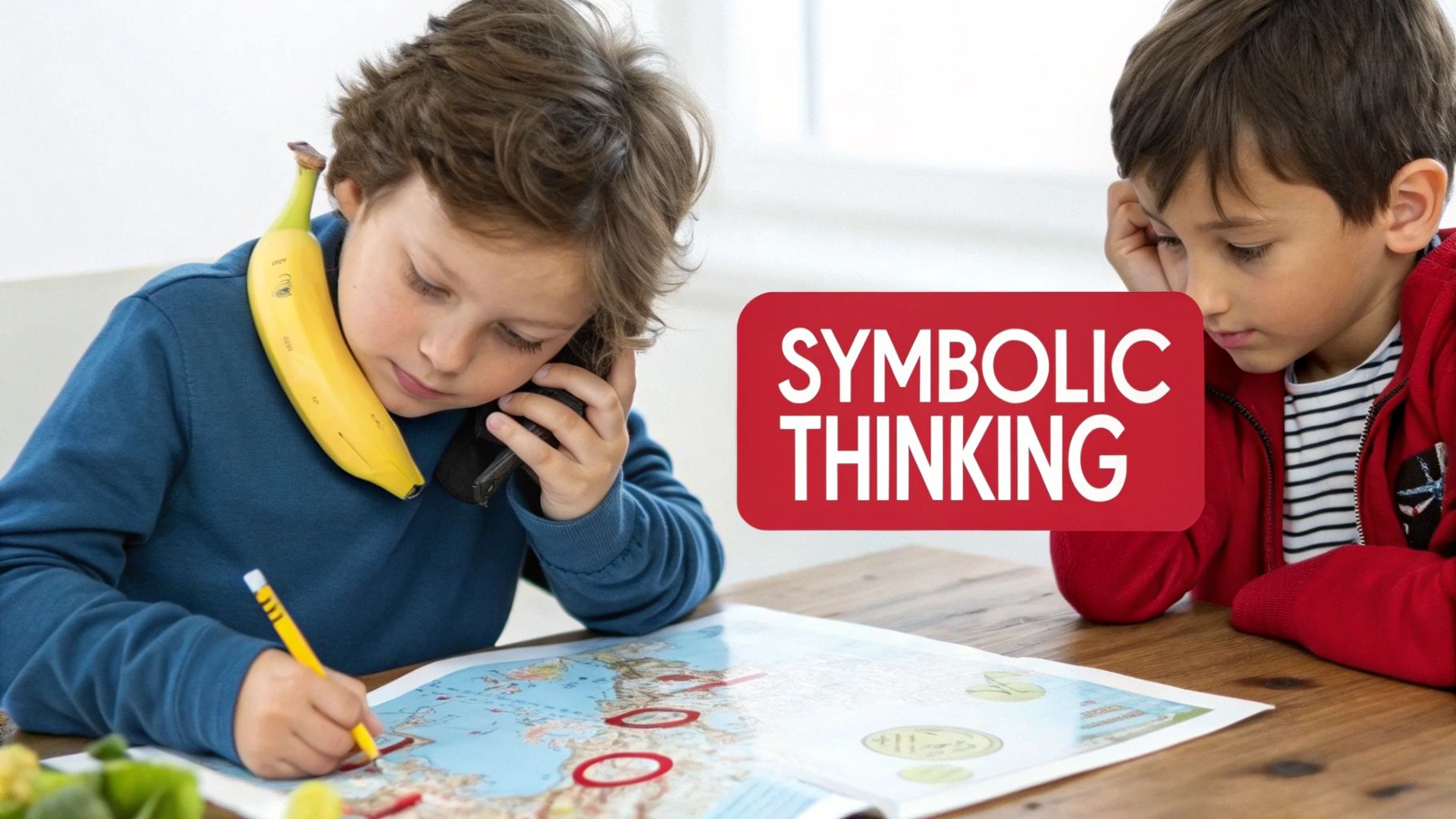
When your toddler picks up a banana and holds it to their ear like a phone, they’re doing more than just being silly. They're practicing symbolic thought, the ability to let one thing stand for another. This is a huge cognitive leap and the very foundation for understanding letters, numbers, and other abstract concepts later on.
This simple act of imagination is a true powerhouse. It lets kids make sense of their experiences by acting out familiar scenarios, whether it's a family dinner or a trip to the vet. Through these playful rehearsals, they build a rock-solid foundation for all future learning.
The Science Behind the Fun
All that "fun" is actually serious brain-building work. Neurological research shows that pretend play helps create dense synaptic connections, which are crucial for cognitive growth. One study even found a 22% increase in synaptic density in parts of the brain tied to language and problem-solving in kids who regularly engaged in this kind of play.
Key Takeaway: “Play is often talked about as if it were a relief from serious learning. But for children, play is serious learning. Play is really the work of childhood.” - Fred Rogers
It’s not just one skill at a time, either. These benefits are all woven together.
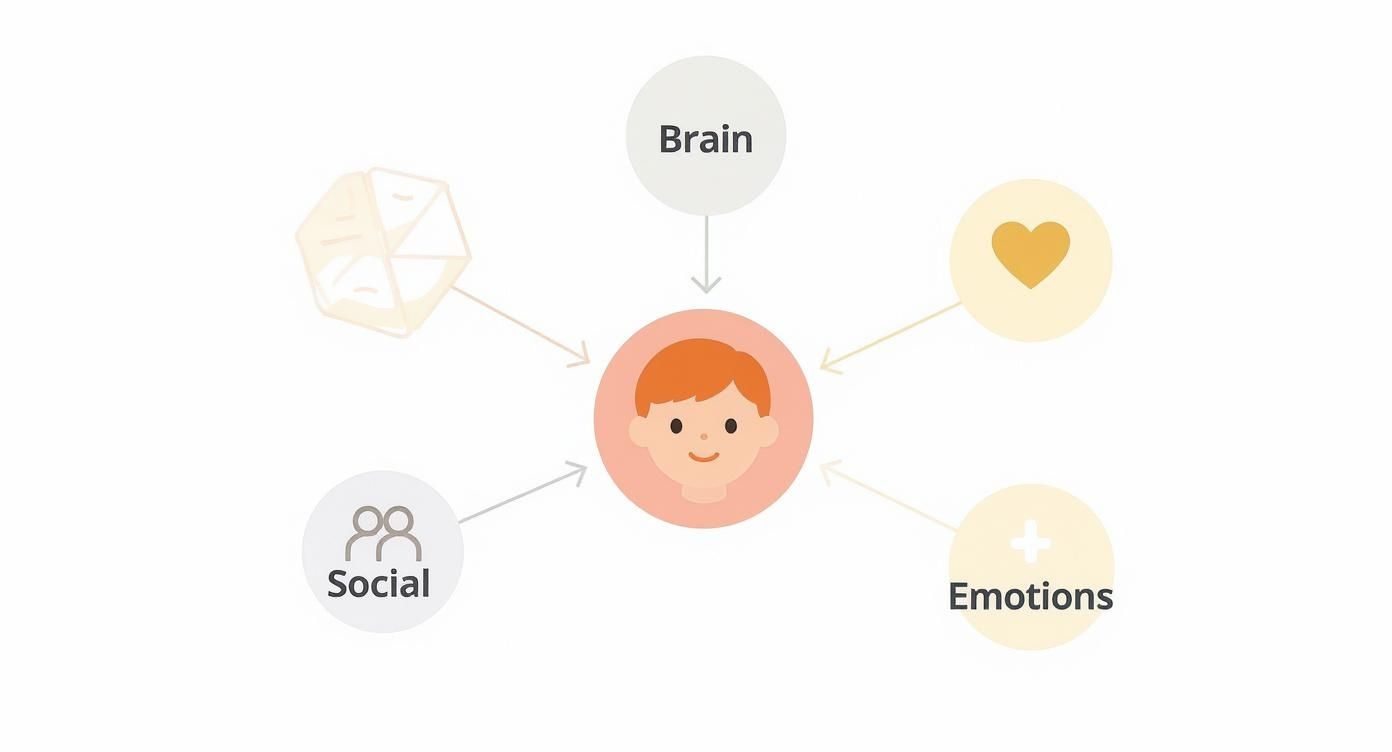
As you can see, imagination sits right at the center, strengthening cognitive, social, and emotional skills all at once. They don't grow in isolation; they grow together, powered by play.
To give you a clearer picture, here’s a scannable breakdown of how these developmental areas connect during pretend play.
Quick Guide to the Core Benefits of Pretend Play
| Developmental Area | Key Benefit | Real-World Example in Play |
|---|---|---|
| Cognitive | Problem-Solving & Creativity | A child figures out how to build a sturdy fort using only pillows and blankets, testing different structures. |
| Social-Emotional | Empathy & Cooperation | Kids playing "house" must negotiate roles, share toys, and understand each other's feelings to keep the game going. |
| Language | Vocabulary & Communication | Children playing "doctor" use specific words like "stethoscope" and "temperature," practicing new vocabulary in context. |
| Motor Skills | Fine & Gross Motor Control | Building with blocks, dressing up dolls, or crawling around like a lion all develop physical coordination and strength. |
This table just scratches the surface, but it shows how a single play scenario can hit multiple developmental milestones at once.
Building Skills for Life
Pretend play is a core part of a wider approach called play-based learning. As children dream up stories and assign roles, they're practicing skills they'll use their entire lives. You can learn more about the research behind play-based learning benefits in our detailed guide.
And it doesn't stop in childhood. This type of play simply evolves. For older kids and even adults, it might look like participating in structured roleplaying games like Dungeons and Dragons. No matter the age, the fundamental principles are the same: firing up creativity, tackling problems, and connecting with others in a meaningful way.
Boosting Brainpower Through Imaginative Play
When a child grabs a banana and holds it to their ear like a telephone, it's more than just a cute photo op. That simple action is a powerful workout for their brain, laying the groundwork for complex cognitive skills they’ll use for the rest of their lives. Imaginative play is where kids learn to think on their feet, solve tricky problems, and make sense of abstract ideas.
At its core, this kind of play builds symbolic thinking—the ability to let one object stand in for another. That banana-phone isn't just a banana; it's a symbol for communication. This is the exact same skill needed for almost all academic learning, from understanding that the letter 'A' represents a sound to grasping that the number '5' stands for a quantity.
This mental flexibility is a game-changer. By constantly inventing new rules and scenarios for their games, children are training their brains to adapt, pivot, and think outside the box.
Keyword-Rich Subheading: Developing Executive Function Skills
One of the biggest wins from pretend play is its impact on executive function. Think of executive function as the brain's air traffic control system. It's the set of mental skills that help us plan, focus, remember instructions, and juggle multiple tasks without dropping the ball.
Pretend play strengthens these crucial abilities in a totally natural, fun way:
- Working Memory: When kids act out a story, they have to remember their role, what everyone else is doing, and the rules of the game they just made up. For example, a "chef" in a play kitchen has to recall the "customer's" order while "cooking" it.
- Cognitive Flexibility: If a friend decides the game is no longer about a castle and is now about a spaceship, kids have to adapt their thinking and change the storyline. This builds the mental agility needed to switch between different concepts.
- Inhibitory Control: Pretend play demands self-control. A child playing a sleeping lion has to resist the urge to jump up and roar, practicing the ability to manage their impulses to stick with the game's rules.
These aren't just "play" skills; they are direct predictors of academic success and life management. The research backs this up with some impressive numbers. Kids who regularly engage in pretend play have been found to score up to 30% higher on executive function tasks than their peers. These advantages add up over time—children who engaged in frequent pretend play during their preschool years were 25% more likely to score above average in literacy and math by first grade. You can read the full research about these cognitive benefits here.
Keyword-Rich Subheading: Fostering Problem-Solving and Creativity
Picture a group of kids building a castle in the living room. They've only got a few pillows, blankets, and chairs. This scenario immediately becomes a complex problem-solving exercise.
Actionable Insight: Pretend play is the ultimate sandbox for experimentation. It gives children a safe space to test theories, fail without consequence, and try again, building resilience and confidence with every attempt.
They have to negotiate roles, plan the structure, and figure out how to keep the blanket walls from caving in. What happens when they run out of pillows for the tower? This is where creativity kicks in. Maybe a cardboard box becomes a turret, or a lamp becomes the royal flagpole.
This process teaches them to:
- Identify a problem (e.g., "The roof keeps falling down.")
- Brainstorm solutions ("What if we use the heavy book to hold the blanket?")
- Test their ideas (They try the book and see if it works.)
- Collaborate with others (They work together to find the best fix.)
These are the exact same steps involved in critical thinking and innovation. By practicing them in a low-stakes, imaginative setting, kids build a mental toolkit for tackling real-world challenges later on. For more ideas on sparking this kind of development, check out our guide on cognitive development activities for preschoolers. Each make-believe game is another step toward building a sharper, more creative, and more adaptable mind.
Building Social Skills and Emotional Intelligence
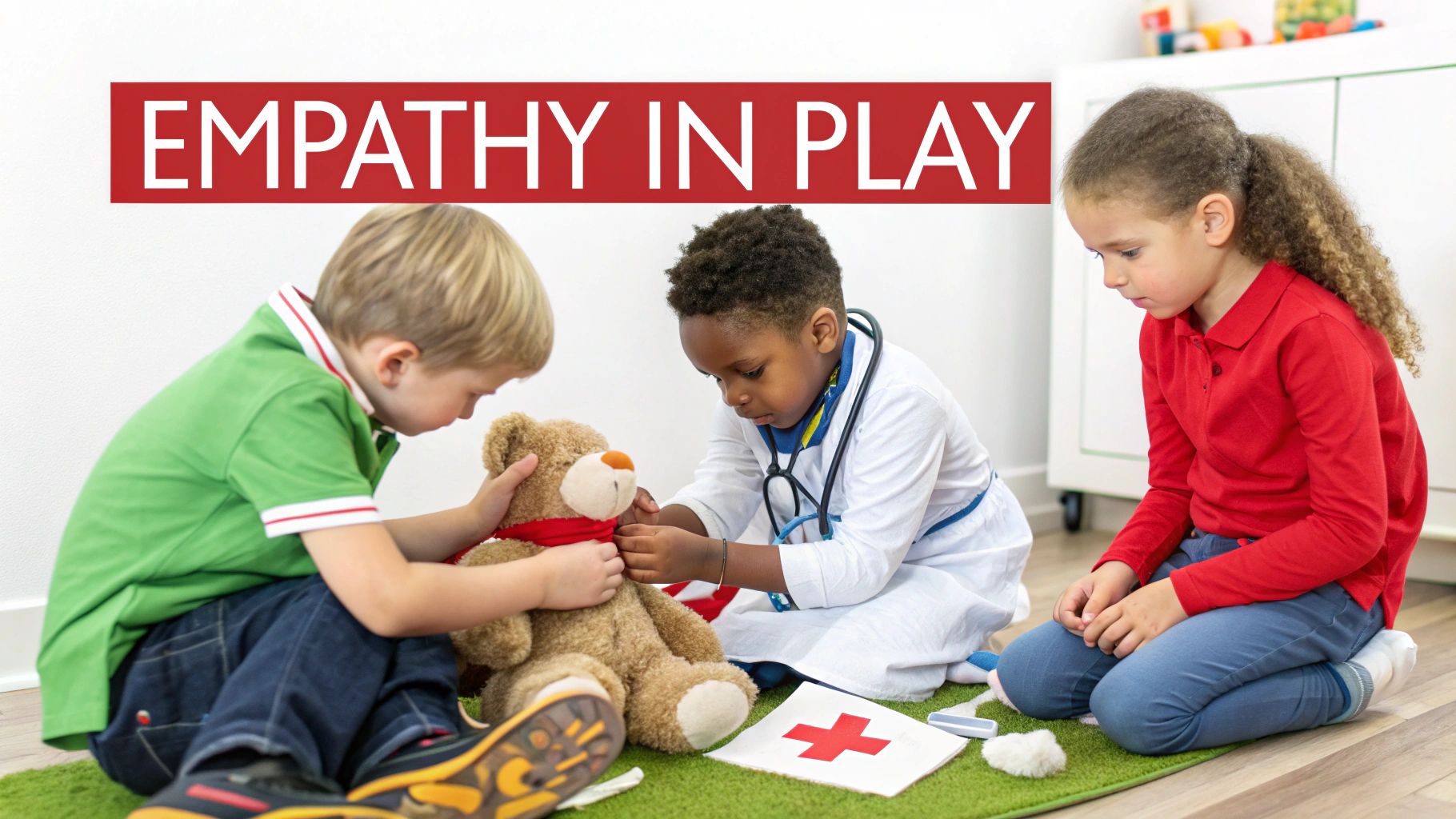
Beyond the brainy benefits, pretend play is the ultimate training ground for social skills and emotional intelligence. When kids step into the shoes of a doctor, a parent, or even a brave knight, they’re doing a lot more than just playing—they're actively practicing empathy. By imagining what it feels like to care for a sick teddy bear, they begin to understand the feelings of others in a real, personal way.
This make-believe world is a child's first society, complete with its own rules and roles. It’s where they learn that playing together means they have to cooperate. This is where the messy, real-world skills of negotiation and collaboration are born.
Learning to Navigate Social Worlds
Group play is a dynamic workshop for crucial life skills. A simple disagreement over who gets to be the pilot becomes a miniature lesson in compromise and sharing. These playful moments teach kids how to communicate what they want, listen to what others want, and find a middle ground that keeps the fun going.
These aren't just abstract ideas; they're skills forged in the heat of play:
- Negotiation: Kids learn to bargain and persuade. "If I can be the captain now, you can be the captain on our next trip to the moon!"
- Turn-Taking: Whether it’s sharing a single "magic wand" or taking turns being the "customer," play teaches patience and fairness.
- Conflict Resolution: When arguments pop up, kids have to figure out how to solve them. This builds a foundation for handling real-world conflicts peacefully.
A Safe Harbor for Big Feelings
Pretend play also gives kids a vital outlet for processing complicated emotions. A child feeling angry might stomp around as a mighty dinosaur, releasing that frustration in a safe, controlled way. Another child grappling with sadness might act out a scene where a doll is sad, letting them explore that feeling from a distance.
Actionable Insight: This imaginative space gives children a way to rehearse for life's challenges. They can explore scary or confusing situations—like a trip to the doctor or the first day of school—in an environment where they are in complete control, building resilience and emotional confidence.
Research backs up just how powerful these interactions are. One study found that preschoolers who engaged in structured pretend play showed a 40% greater improvement in emotional regulation skills compared to their peers. These same kids were also 35% more likely to show empathy and cooperation in group activities.
Building Blocks for Healthy Relationships
Ultimately, the social and emotional benefits of pretend play are all about building strong, healthy relationships. By practicing empathy, cooperation, and emotional regulation, children develop a solid toolkit for navigating the world around them.
This foundation is essential for making friends, doing well in school, and handling the complexities of human connection for the rest of their lives. You can find more ways to nurture these abilities in our guide on emotional intelligence activities for kids.
Developing empathy isn't just limited to play, either. Just as pretending allows children to step into different roles, reading books that teach empathy can expand their ability to understand and share feelings. Every imaginative scenario is another step toward becoming a more socially aware and emotionally intelligent person.
Developing Language and Communication Through Play
Pretend play is one of the most powerful language-building tools in a child’s world. It’s like a dynamic, real-life workshop where vocabulary isn't just learned, but lived. When kids slip into different roles, they naturally start using the words that come with the territory.
A child pretending to be a firefighter doesn't just say they're putting out a fire. They shout words like "rescue," "ladder," and "siren," picking up new vocabulary in a way that feels exciting and totally relevant to their game.
They also get to experiment with entirely different ways of talking. One minute they're a king issuing formal decrees, and the next they're a baby using simple coos and babbles. This isn't just empty mimicry; it's a hands-on exploration of how language works in all sorts of social settings, giving them a flexible and rich verbal toolkit.
A Workshop For Conversational Skills
Beyond just words, pretend play is often a child’s very first practice ground for the art of conversation. The back-and-forth dialogue needed to keep a shared story going teaches critical communication skills without them even realizing it.
- Turn-Taking: Kids quickly learn they need to listen while others speak and wait for their turn to jump in. The "diner" has to wait for the "chef" to take their order before they can list what they want to eat. It’s a fundamental rule of communication learned organically.
- Active Listening: To keep up with the plot, a child has to pay close attention to what their friends are saying and doing. This builds their ability to understand and respond in a way that makes sense within the game.
- Storytelling: When kids create and act out stories together, they’re practicing how to organize their thoughts logically and explain them clearly to someone else.
These interactions are absolutely essential. By getting to practice in a fun, low-stakes environment, children build the confidence they'll need for real-world conversations and friendships.
Building The Foundation For Literacy
It might not look like it, but the language skills from pretend play are a direct pipeline to literacy. When children dream up their own stories, they become authors, directors, and actors all at once—and this narrative practice is a huge precursor to reading and writing.
Key Takeaway: By inventing a beginning, middle, and end for their games, children learn the basics of story structure. This foundational understanding makes it easier for them to comprehend written stories and, eventually, to write their own.
They also start to play with more complex language. You might hear a child plotting an adventure by saying, "First, we will build the fort, and then we defended it from dragons!" In one simple sentence, they're experimenting with future and past verb tenses in a completely natural way. They’re learning grammar through action, not boring drills.
This rich linguistic environment—packed with new words, conversational practice, and storytelling—is precisely why pretend play is so vital. It lays a strong, comprehensive foundation for all future communication and learning. For more ideas on how to spark these moments, check out these fun and effective play-based learning activities.
Practical Ways to Encourage Pretend Play
Knowing that pretend play is a powerhouse for development is one thing. Actually sparking that magic in your living room is another.
The good news? You don't need elaborate setups or a trunk full of expensive, single-purpose toys. The simplest materials often provide the richest soil for creativity to grow. The real key is creating an environment where your child feels free to take the lead.
Think of your role as less of a director and more of a supportive stagehand. You’re there to offer a prop or a gentle nudge when needed, but the child is the true architect of their own amazing worlds.
Sparking Imagination at Different Ages
Pretend play isn't a one-size-fits-all activity; it evolves right alongside your child. The best way to encourage it is to meet them where they are. What captivates a toddler is worlds away from what engages a six-year-old.
A two-year-old, for instance, might be thrilled just to imitate stirring "soup" in a bowl with a spoon—a simple reflection of your daily actions. A four-year-old, however, can handle a much more complex scenario, like running an entire pretend restaurant complete with menus, customers, and a grumpy chef.
When you tailor your approach to their age, the play stays challenging enough to be fun but not so complex that it becomes frustrating.
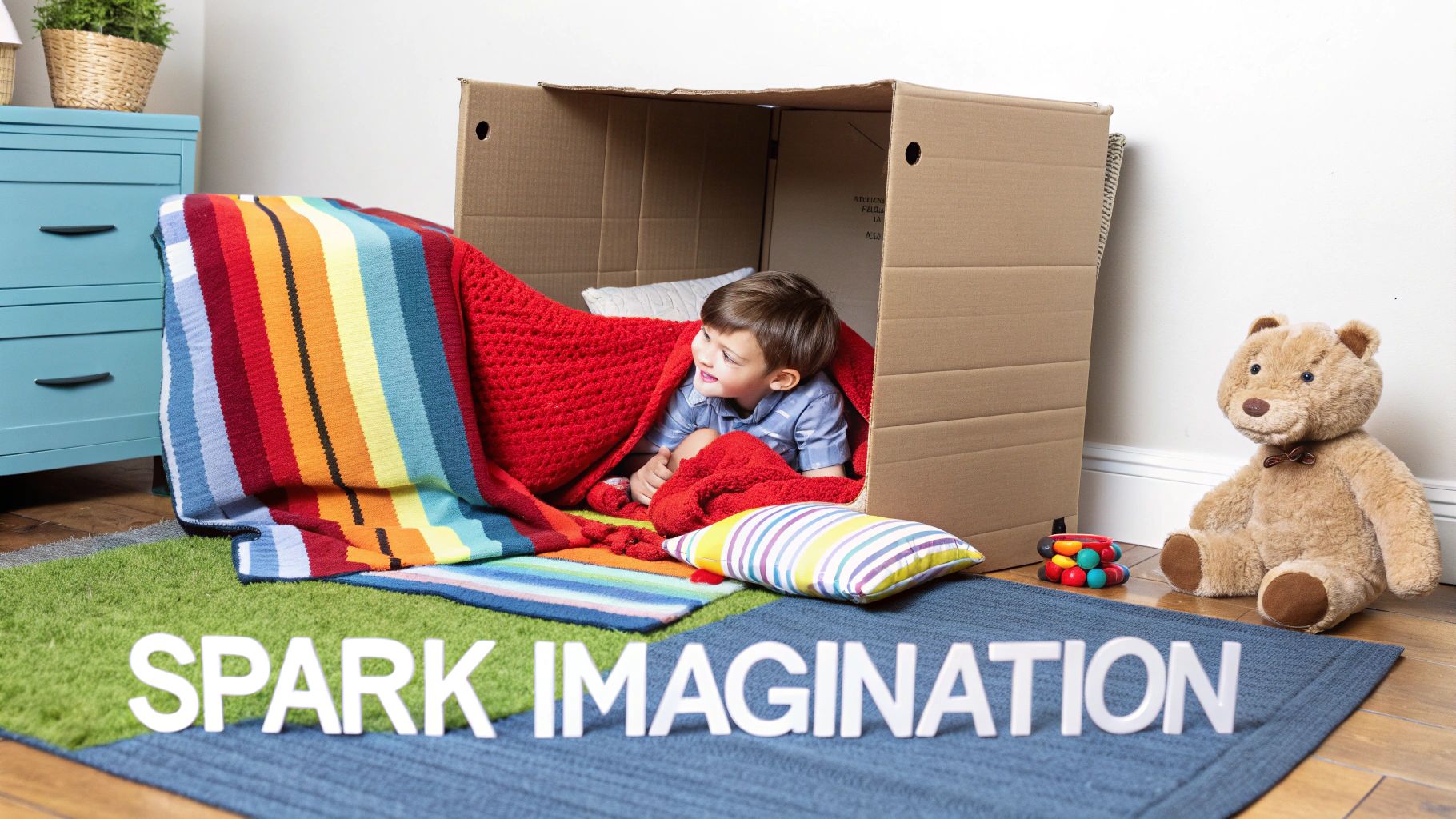
Actionable Insight: The most powerful tools for pretend play are often the ones without a prescribed purpose. A cardboard box isn't just a box; it's a rocket ship, a castle, a race car, or a cave. Open-ended materials invite creativity, while single-purpose toys can limit it.
Here’s a look at how you can nurture that imagination as they grow.
Age-Appropriate Pretend Play Activities
To give you a better idea of how this looks in practice, here is a scannable guide. This table breaks down pretend play ideas by age, helping you find activities that match your child’s developmental stage.
| Age Group | Developmental Focus | Activity Ideas | Recommended Props |
|---|---|---|---|
| Toddlers (1-3) | Imitation & Symbolic Thinking | Mimicking simple chores like sweeping or "cooking." Feeding a baby doll or talking on a toy phone. | Toy phones, soft dolls, play food, child-sized brooms, pots, and pans. |
| Preschoolers (3-5) | Social Roles & Storytelling | Creating a vet clinic for stuffed animals, playing "school," or running a grocery store. | Old clothes for dress-up, empty food boxes, animal figures, doctor's kit. |
| Early School (6+) | Complex Narratives & Rules | Writing and performing a play, building a detailed city with blocks, or creating a "spy" mission. | Craft supplies for props, notebooks for scripts, building blocks, maps. |
As you can see, play naturally grows from simple imitation to rich, collaborative storytelling. By providing the right kinds of props and gentle encouragement, you can support this wonderful journey.
The Power of Open-Ended Materials
While character toys from the latest movie have their place, the real heroes of imaginative play are open-ended materials. These are items that can be used in countless ways, forcing a child to stretch their creative muscles.
Think about the classic cardboard box—its potential is limitless. Blankets transform into superhero capes, impenetrable forts, or swirling blue oceans. A pile of sticks can become a campfire, a set of magic wands, or the frame for a fairy house.
Here are a few essential open-ended items to have on hand:
- Cardboard Boxes: All shapes and sizes. They are the ultimate blank slate for big ideas.
- Blankets & Sheets: Perfect for building forts, designing costumes, or defining a play space.
- Dress-Up Clothes: A simple collection of old hats, scarves, bags, and shoes can inspire dozens of characters.
- Natural Materials: Sticks, stones, leaves, and shells are fantastic for connecting play to the outside world.
Stocking your playroom with these simple items is often far more effective than buying another toy that only does one thing. For more ideas, check out our list of the best toys for imaginative play that put creativity first.
How Adults Can Join the Fun Without Taking Over
It's tempting to jump in and direct the action, but the goal is to support, not control. When an adult takes charge, the child misses out on a valuable chance to practice problem-solving, decision-making, and creativity.
Your job is to be a responsive play partner. Follow their lead, ask good questions, and add to the story without hijacking it.
Here’s how you can play a supportive role:
- Be an Observer First: Before you jump in, watch and listen. Figure out the story they're creating.
- Take a Minor Role: If they're playing restaurant, be the customer. If they’re the queen of the castle, be a loyal subject. Let them be the star.
- Ask Questions to Deepen Play: Instead of making suggestions, ask questions like, "What does this patient need next, Doctor?" or "Where is our spaceship flying to?"
- Introduce a "Problem": Gently add a small challenge for them to solve. In a pretend bakery, you might say, "Oh no, we're all out of sugar! What can we use instead?"
By following these simple strategies, you can enrich your child's imaginative play while empowering them to become confident, creative thinkers who know how to lead their own adventures.
FAQs: Answering Your Questions About Pretend Play
Even with all the amazing benefits we’ve talked about, it’s totally normal for parents and caregivers to have questions. From the outside, this kind of open-ended, kid-led play can sometimes look a little… chaotic.
Let's tackle some of the most common worries with clear, practical answers.
What If My Child Prefers To Play Alone?
It’s easy to worry when you see your child playing by themselves, but solo imaginative play is incredibly valuable. Think of it as their personal workshop for creativity. When a child plays alone, they are the director, writer, and star of their own show. This independence gives them the space to explore ideas without compromise, building focus and self-reliance. Solo play is where a kid can get really deep into what fascinates them.
Pros of Solo Play vs. Group Play
| Aspect | Solo Pretend Play | Group Pretend Play |
|---|---|---|
| Skills Honed | Deep focus, creativity, self-reliance, emotional processing. | Negotiation, cooperation, conflict resolution, empathy. |
| Control | Child has 100% creative control over the narrative. | Children must share control and adapt to others' ideas. |
| When It's Best | When a child needs to decompress or explore a personal interest. | When a child needs to practice social skills and teamwork. |
Of course, playing with others is important, too. It’s all about balance. As long as your child has opportunities to play with friends, their time in solo imaginary worlds is a sign of a strong, independent mind at work.
How Much Should I Structure My Child's Play?
This is the classic parent tightrope walk: how much do you guide versus let go? Too much structure can kill the very creativity you’re trying to foster. The best pretend play comes from the kids themselves.
Key Takeaway: Your role isn’t the director of the play—it’s the supportive stagehand. You provide the props and set the scene, then step back and let your child be the star.
Instead of giving instructions, try these more hands-off, actionable approaches:
- Set the Stage: Create an inviting space with open-ended items like cardboard boxes, blankets, and dress-up clothes, and just see what happens. Educators often call this a "provocation."
- Ask Open-Ended Questions: If you join in, ask questions that expand their world. Instead of, "Let's build a tower," try, "What does our castle need to keep the dragons out?"
- Model Playfulness: Sometimes, all it takes is seeing you sit on the floor and start talking to a teddy bear. Your example can give them the little spark they need to start their own adventure.
The goal is to empower them, not manage them. By offering support without taking over, you show them their ideas are valuable and that they can create their own fun.
Is It Normal to Have an Imaginary Friend?
An imaginary friend can be a little startling, but it’s a completely normal—and healthy!—sign of a blooming imagination. Research from credible sources like the American Academy of Pediatrics shows that as many as 65% of children have an imaginary companion at some point. It's not a red flag; it's a huge milestone in their cognitive and emotional growth.
Creating an imaginary friend is an advanced form of pretend play. It means a child has to develop a consistent character, see things from another (even fictional) perspective, and practice tricky social situations in a safe space.
These invisible pals serve all kinds of purposes:
- A Confidante: They're a trusted friend who always listens and never judges.
- A Scapegoat: They can be a safe way for a child to explore breaking the rules ("My friend spilled the juice, not me!").
- A Practice Partner: They help a child rehearse social skills like sharing, negotiating, and working out disagreements.
An imaginary friend is a tool a child creates to figure out their world. It shows they're developing empathy, creativity, and some serious social-emotional skills. So next time your child sets an extra place at the dinner table, you can smile knowing their brain is hard at work building the skills they'll need for life.
At Playz, we believe in the power of play to unlock a child's full potential. Our toys, from sprawling play tents to hands-on science kits, are designed to spark curiosity and fuel the incredible benefits of pretend play.
Ready to transform your playroom into a world of adventure? Explore our collection and find the perfect tools to inspire your child’s next great story.