

Your toddler is at the sink again, tipping water from one cup into another, and the science kit you almost ordered is still sitting in a browser tab. You're weighing the mess, the choking worry, and whether a box of parts is even right for a child who still mouths everything.
What Toddler Science Kits Are and Why They Matter
That sink moment is already science. Pouring, watching the water stop, and trying a bigger cup is observation and cause and effect, even when nobody says those words.
A science kit for toddlers is a small set of large, durable, reusable tools and simple materials, paired with picture-based prompt cards. It is not a chemistry set. Pediatric guidance warns that hobby kits and chemistry sets may create fire, explosion, or hazardous-chemical risks, and it advises against them for children younger than 12. Toddler materials should stay with water, ice, sand, paper, large natural objects, and food-safe colorants.
Early science is already part of classroom life, and it arrives in short bursts. An observational study of 65 preschool classrooms found that children received an average of 26 minutes of science-learning opportunities per day, about 25% of the instructional time recorded, and science was present in 96.92% of the classrooms observed. A kit's job is to make those short, recurring routines easy to set up at home or in childcare, not to fill a long lesson block.
A kit worth keeping has four traits:
- Oversized manipulatives: cups, ramps, and scoops a small hand can grip and that won't fit in a mouth.
- Picture cards: prompts a non-reader can follow while you talk.
- Unbreakable containers: trays and tubs that survive a drop on tile.
- No reactive chemicals: nothing that fizzes from a powder, needs a flame, or produces gas in a closed bottle.
Practical rule: If setup takes longer than the play, you won't repeat it, and repetition is where toddler learning lives.
The kit is a tool for adult-guided play. It is not a lesson plan, and it does nothing useful while it stays in the cupboard.
Matching a Kit to Your Toddler's Age
Read the band your child is in today, not the age you hope the box will stretch to. An age label is a minimum, not a target. A child who still mouths every object stays in the younger band, whatever number is printed on the package.
| Age band | What the toddler can do | Adult-only steps | Keep away |
|---|---|---|---|
| 12-18 months | Pour water with cups, squeeze sponges, touch ice, bang drums | Fill containers, open sealed packs, supervise any water tub | Small pieces, magnets, batteries, glass |
| 18-24 months | Sort large objects, stack, pour, and run simple float tests | Set up trays and check every piece for small parts | Loose caps, beads, deflated balloons |
| 2-3 years | Predict with picture cards, roll objects down ramps, mix sand and water | Cut, measure, handle warm liquids | Reactive or chemical products, small components |
| 3-4 years | Record with drawings, compare two results, repeat tests | Supervise any heat, clean spills and small parts | Kits with flames, acids, or enclosed gas reactions |
How to read each row
12 to 18 months. Your child can pour between cups, squeeze a sponge, touch ice, and bang a drum. You fill the containers, open any sealed pack, and stay at the water tub the whole time. Small pieces, magnets, batteries, and glass stay in another room.
18 to 24 months. Sorting large objects, stacking, pouring, and a simple float test are realistic. You set the tray and you inspect parts before they come out. This is a strong window for educational toys for 2 year olds that are big enough to grip and boring enough to repeat.
2 to 3 years. Picture cards can carry a prediction. Rolling cars down a ramp and mixing sand with water fit this band. You still cut, measure, and handle anything warm. Reactive products and small components don't belong on the tray.
3 to 4 years. Drawings can stand in for a result, and comparing two outcomes starts to make sense. You supervise any heat and you clean spills and small parts. Flames, acids, and enclosed gas reactions are still out.
A kit labelled 3+ still needs you at the youngest end of that range. The label tells you the product wasn't built for babies. It doesn't tell you a just-turned-three-year-old can run the activity alone.
If your child mouths tools during the first minute, drop back one band for this week. The activity can wait. A swallowed part can't.
Safety Checks and Choosing Between Kits
Safety is the first design requirement, ahead of how pretty the experiment looks. Run this six-step check before every activity, including one you've done before, because pieces crack and caps loosen.
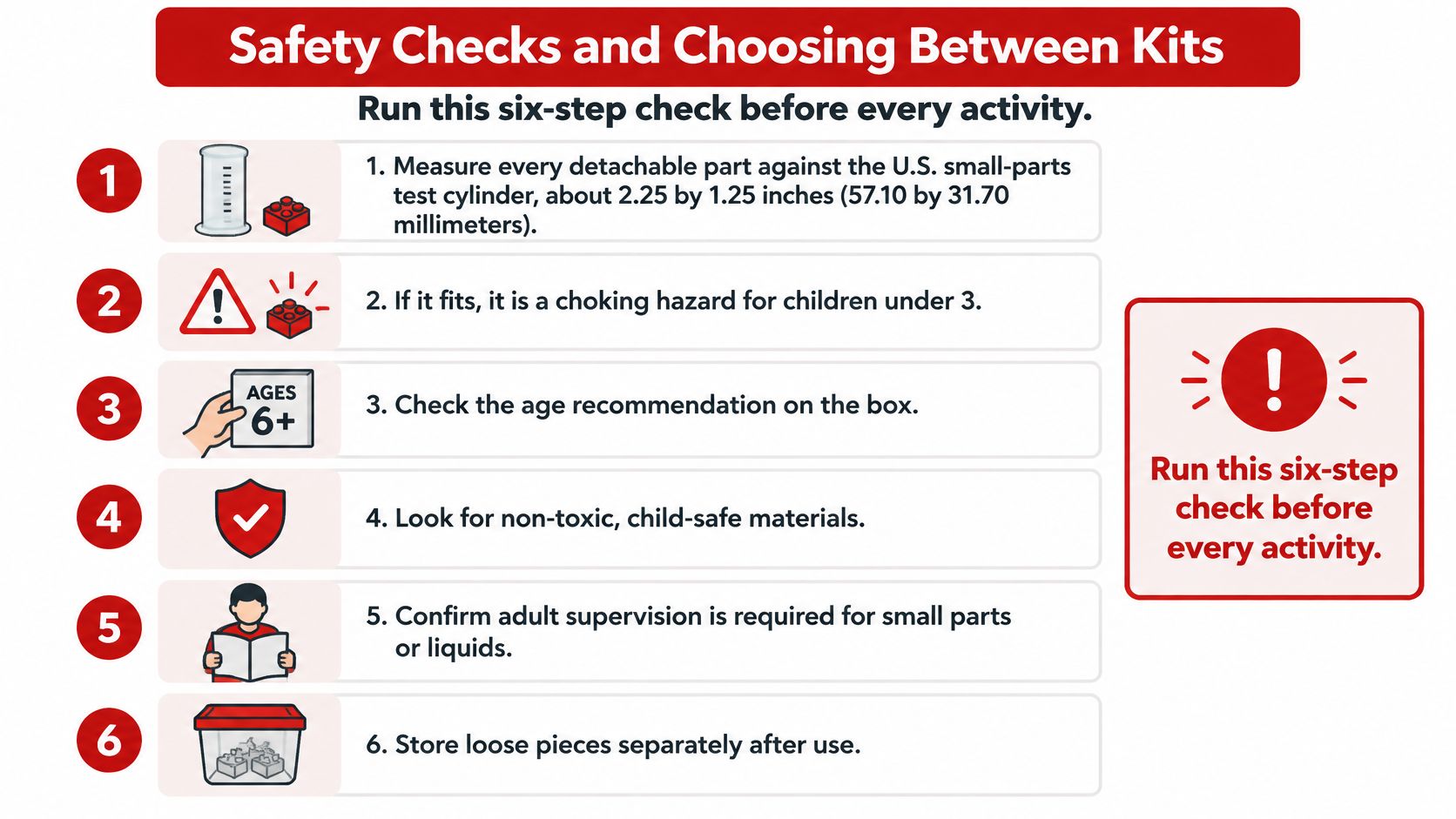
- Measure every detachable part. The U.S. Consumer Product Safety Commission defines a regulated small part with a cylinder about 2.25 inches (57.10 millimeters) long and 1.25 inches (31.70 millimeters) wide. If a piece fits entirely inside, it stays away from children under 3. Household measuring bits and rubber stoppers count too, even when they weren't sold as toys.
- Confirm magnets and button batteries are fully secured. Loose high-powered magnets and button cells are ingestion hazards, not minor nuisances. If a compartment can be opened with a coin or a thumbnail, that item doesn't come out.
- Inspect edges. CPSC toy-buying guidance says toys for children younger than 8 can't have sharp points or sharp metal or glass edges, and toys for children younger than 3 can't contain small parts that could be swallowed or lodged in the windpipe, ears, or nose. Check probes, wire ends, brittle plastic, and breakable cups. Keep small balls and deflated balloons away from children under 3.
- Separate food-safe household ingredients from kit chemicals. Water, ice, sand, and a drop of food colouring live in one bin. Anything from a reagent packet lives in another, out of reach.
- Require direct adult supervision for water, food colouring, or detachable parts. "Nearby in the kitchen" isn't supervision. More on day-to-day toy safety for children helps when you're setting a group rule in childcare.
- Plan the response first. If a child swallows something or gets a substance in the eyes, stop, remove the item, and contact poison control or emergency services at once. Don't wait to see if they seem fine.
Ready-made or household
| Option | Strengths | Limits | Best for |
|---|---|---|---|
| Ready-made toddler kit | Consistent large tools, saves prep time | Often sized for older children; cards assume reading | Parents who want a set ready to use |
| Do-it-yourself household set | Low cost, easy to repeat | Adult must plan and check every item | Families and childcare settings with time to prepare |
A ready-made kit saves the Sunday scramble. A household set wins when you want the same pour-and-sort game next Tuesday. Either way, run three questions at the shelf: Can my toddler handle every part? Can the same activity run again next week? Does the box say why this age?
A non-toxic label doesn't rule out mechanical hazards. Age labels on toys for children under 3 are safety requirements, not gentle suggestions, because CPSC small-parts rules treat the manufacturer's stated age, the advertising, and common recognition of the product as the test of who it's for. If your child mouths gear, material safety for chewable toddler gear is a useful companion read for what should and shouldn't touch a mouth.
What Toddlers Really Gain from Hands-On Science
Intentional early science can move learning in a measurable way. A meta-analysis of classroom science interventions from pre-kindergarten through first grade reported a pooled average improvement of +0.33 standard deviations in science achievement for children who received the intervention, compared with control groups. That is a real educational effect, and it comes from structured activity, not from owning a box.
The same body of work carries a caution. A longitudinal study of 8,642 children from the U.S. Early Childhood Longitudinal Study–Kindergarten cohort found that many ordinary kindergarten science experiences weren't strong predictors of third-grade achievement. Prior knowledge, motivation, socioeconomic status, and gender were significant predictors, and cooking activities showed a positive relationship with achievement.
What you can actually see
Translate that into the kitchen, not a score report.
- Cause and effect: "The sponge stayed up, the button went down."
- Words from talk: sink, float, faster, more, same.
- Persistence: trying the ramp again after the car stops short.
- Fine motor control: pouring, scooping, and squeezing without a spill every time.
- Shared motivation: a cooking-style mix or a water game you both return to.
No single kit has been shown to raise test scores. A box on the shelf does nothing without your talk. You can build better reasoning skills with Maxijournal as a later step for older kids, but a toddler's version is your question and their hands. The benefits of hands-on learning show up when the child does the action, not when they watch you perform it.
Watch for two signs that the session worked. Your child asks what will happen next, or they try again after a surprise. Those beats matter more than a correct answer.
Easy Experiments and the Predict, Test, Reflect Routine
Five household setups cover a week of science kits for toddlers without a reagent packet. Each one changes a single thing the child can see.
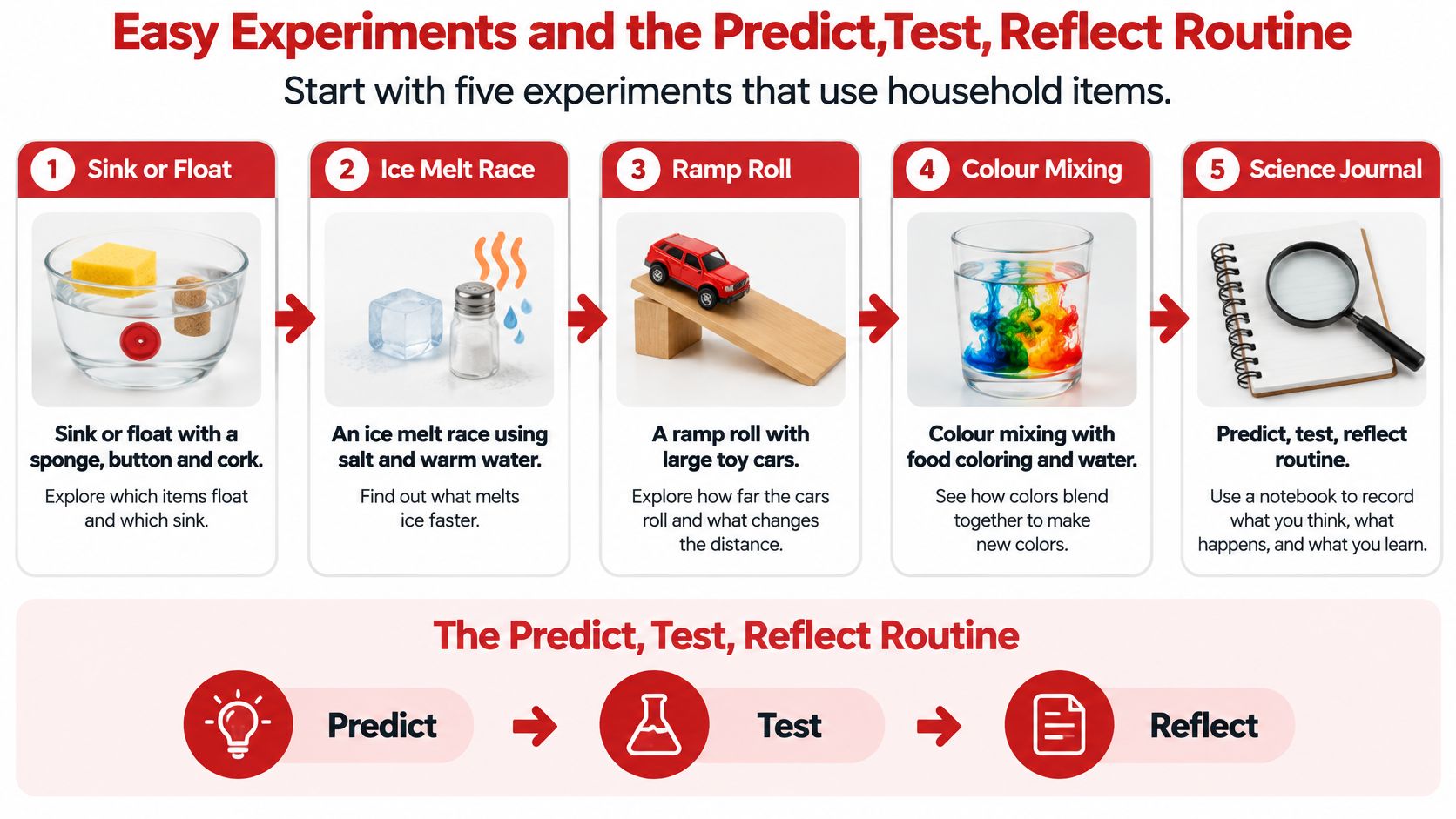
| Experiment | Materials | What the toddler does | Question the adult asks |
|---|---|---|---|
| Sink or float | Bowl of water, sponge, large button, cork | Drops objects in and sorts them | Which one will sink, and why do you think so? |
| Ice melt race | Ice cubes on trays, salt, warm water, cups | Touches, watches, and pours water | What changed the ice fastest? |
| Ramp roll | Cardboard tube, ramp, large toy cars | Rolls cars and raises or lowers the ramp | Which car went furthest, and what changed? |
| Colour mixing | Clear cups, water, food colouring | Pours and stirs | What new colour appeared? |
| Sand and water pour | Tray, sand, cups of different sizes | Fills and empties containers | Which cup holds the most? |
Use a large button only if it can't fit the small-parts cylinder and your child isn't mouthing. If either check fails, swap in a big cork and a wooden block.
Predict, test, reflect
Preschool children can test a hypothesis before they can reliably revise or confirm it, because working memory and flexible thinking are still developing, as a paper on early scientific reasoning describes. NAEYC guidance in that line of practice asks adults to help children pose a question, try a method, notice the result, and explain it from what they saw. You carry the hard part. They carry the action.
- Predict. Ask what will happen before hands touch the materials. A point at a picture card counts. You're separating "what we thought" from "what happened."
- Test. Let the child do it, and change one variable only. Same cars, different ramp height. Same ice, salt on one cube. Two changes at once and nobody can tell what mattered.
- Reflect. Restate the result in cause-and-effect language. "The ice melted faster because the water was warm." You supply the sentence. They supply the nod, the repeat, or a correction.
Repeat each test three times. A wrong prediction is useful information, not a miss. Ask instead of taking over. Plan on about 10 to 15 minutes, a practical window before attention drops. A scripted show the child only watches isn't the routine.
The scientific method steps for kids get longer once children can write. For now, three beats are enough. A short demo of a simple setup can help you see the pace before you try it at the table.
Choose Your First Kit and Store It Safely
Pick in this order, and stop if a step fails.
First, choose the age band. Match the child's mouthing, grip, and attention, not the birthday on the calendar alone.
Second, run the safety check on every detachable part. If one piece fails, the kit fails for this child, even if the rest looks sturdy.
Third, choose contents you can reuse across several days. Picture prompts you can repeat beat a one-time reveal. Instructions that assume reading belong to an older child.
Playz Science Kits cover chemistry, biology, physics, and more. Many of those products are labelled for older children. The Coding & Computer Science Kit is recommended for ages 6 to 12 and older, so a toddler should use a kit only when the label and the contents match their band. A coding set, a volcano, or anything with small parts waits.
Where it lives between sessions
Storage is part of the activity, not an afterthought.
- Small components go in labelled, lidded bins, up and out of reach, even if you think you'll use them tomorrow.
- Cooking ingredients stay sealed in the kitchen, separate from anything that isn't food.
- Trays get warm soapy water and a full dry before the next session.
- Cracked containers go in the bin. A hairline split becomes a sharp edge.
- Hands get washed after every session, including yours.
This week, pick one row from the experiment table, run predict, test, and reflect, and jot what your toddler predicted. Pair that with simple learning activities for toddlers at home you already have in the cupboard. Check the age label on the box before you buy anything new.
Frequently Asked Questions for Caregivers
At what age can a toddler start a science kit?
From about 12 months, but only with the adult-only steps for that band and a kit whose label matches. Mouthing moves the child to the stricter setup.
Is a non-toxic kit automatically safe?
No. Check small parts, sharp edges, and breakable containers. A non-toxic claim doesn't cover mechanical hazards or a piece that fits in the windpipe.
What if my toddler puts an experiment in her mouth?
Stop the activity, remove the item, and contact poison control or emergency services right away. Follow their instructions. Don't taste it yourself to "check."
How long should a session last?
About 10 to 15 minutes, with each test repeated three times. End while interest is still there so the next session is welcome.
Will a kit raise my child's test scores?
No single kit has been shown to do that. The conversation during the activity is what matters most.
Can a toddler do the experiments alone?
Not for water, food colouring, or detachable parts. Those always need you right there.
Playz offers science kits across chemistry, biology, and physics, plus story-driven play that keeps learning off a screen. For a toddler, the right pick is the one whose age label and large parts match your age band, not the flashiest experiment on the box. Visit Playz and check current age labels before you choose a kit for your child.