

Ever tried to assemble furniture just by reading the manual? For some, that’s enough. But for many of us, the instructions only click once we get our hands on the pieces and feel how they fit together.
If that sounds familiar, you've experienced the core of the kinesthetic learning style. It’s all about learning by doing—absorbing information through physical movement, hands-on activities, and tactile engagement. This style isn't just about fidgeting; it's about connecting the mind and body to make learning stick.
Understanding the Kinesthetic Learning Style
At its heart, the kinesthetic style is about experiencing a concept, not just observing it from a distance. Think about learning to ride a bike. You can read about balance and watch videos all day, but you only really learn when you get on and start pedaling. That physical process builds muscle memory and a deep, practical understanding that theory alone can't provide.
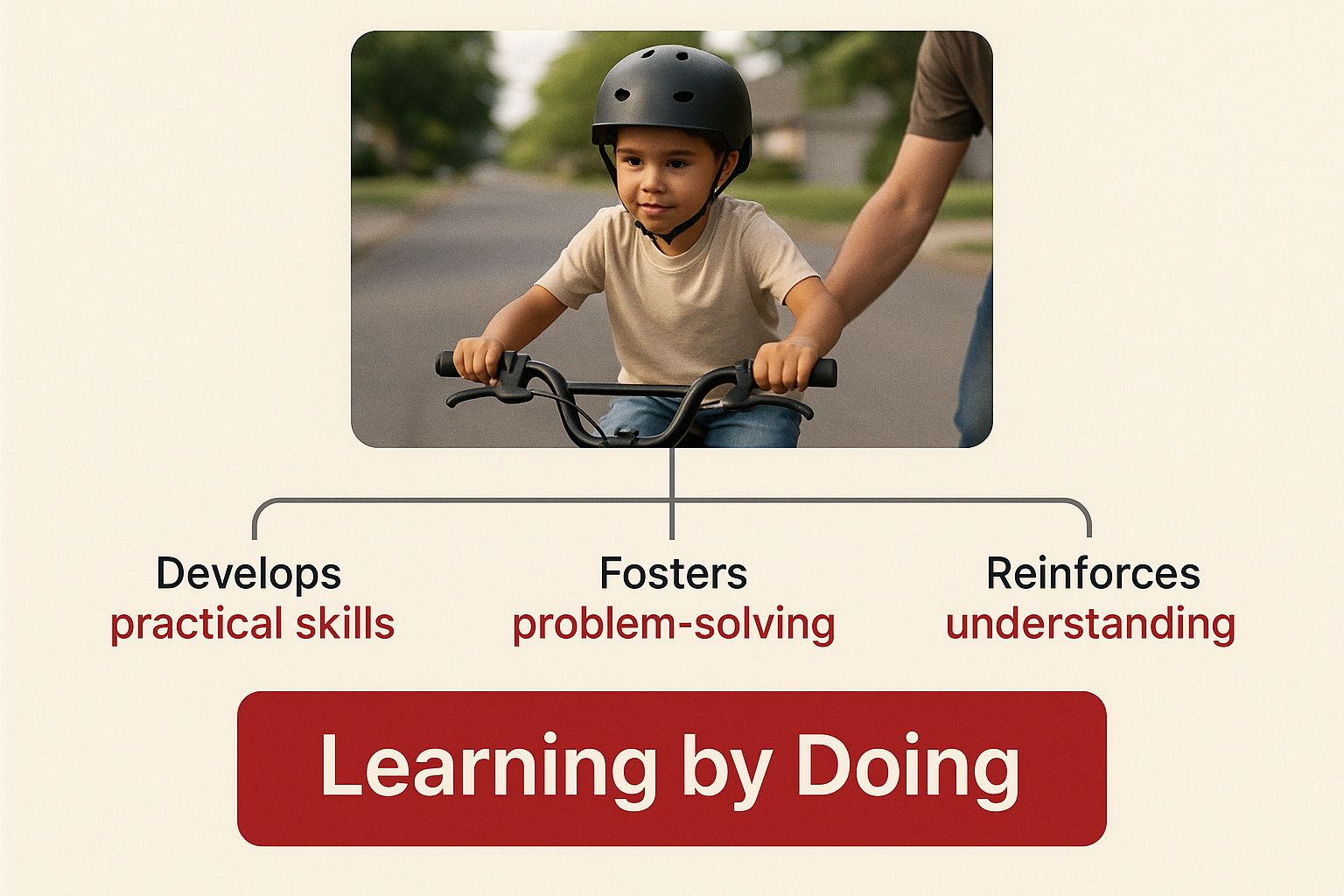
This hands-on approach is a key part of the well-known VARK model, which helps categorize different learning preferences. While some learners are primarily visual (seeing) or auditory (hearing), kinesthetic learners need to be physically involved to truly grasp new ideas.
How Kinesthetic Learning Compares to Other Styles
To truly appreciate what makes kinesthetic learners unique, it's helpful to see how they differ from the other primary learning styles. Each style represents a different pathway for information to enter and stick in the brain.
Here’s a quick comparison of the four main learning styles:
| Learning Style | Primary Method of Learning | Best Environment |
|---|---|---|
| Visual | Seeing information through charts, diagrams, and videos. | A visually stimulating space with whiteboards, posters, and colorful notes. |
| Auditory | Hearing information through lectures, discussions, and podcasts. | A quiet place for listening or a lively setting for group discussions. |
| Read/Write | Interacting with written text by reading and taking notes. | A library or quiet study area with plenty of books and note-taking tools. |
| Kinesthetic | Physical interaction, movement, and hands-on activities. | A workshop, lab, or any space that allows for movement and experimentation. |
The need for physical engagement is what truly sets kinesthetic learners apart. This active approach shares many principles with other hands-on methods. If this style resonates with you, you’ll likely be interested in our guide on what is discovery-based learning, which is also built on active participation.
While most of us use a blend of these styles, we often have one that feels most natural. Recognizing a primary kinesthetic preference is the first step toward creating learning experiences that are not just effective but genuinely engaging.
How to Spot a Kinesthetic Learner
Is your child always fidgeting, tapping their pencil, or unable to sit still during story time? While it might look like a short attention span, these are often classic signs of a kinesthetic learner. Spotting these traits isn't about diagnosing a problem—it’s about understanding how your child naturally connects with the world.
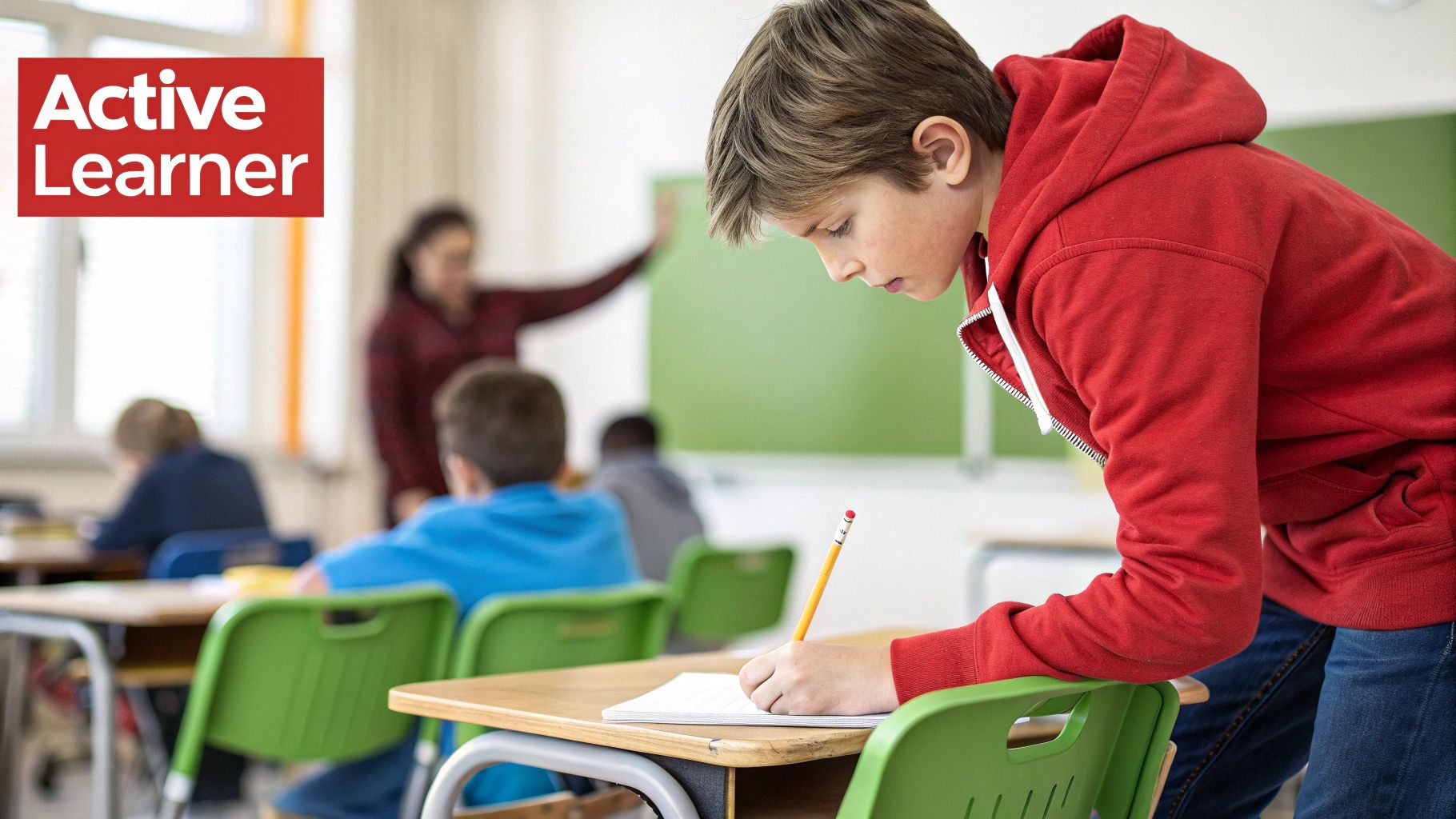
Simply put, kinesthetic learners think with their bodies. The same student who struggles during a quiet lecture might be the one who brilliantly grasps a concept during a hands-on science lab. Recognizing these signs is the key to unlocking their full potential.
Key Characteristics and Behaviors
Figuring out if you have a kinesthetic learner on your hands often comes down to observation. They have physical "tells" that show when their brain is firing on all cylinders.
Here are a few key indicators to watch for:
- Constant Movement: They might fidget, tap their feet, or shift around in their seat. This isn't just restlessness; it's a way for them to maintain focus and process information.
- Talks with Their Hands: Kinesthetic learners often use expressive hand gestures and body language to communicate their ideas. Their whole body is part of the conversation.
- Prefers Action Over Observation: They’d much rather build a model of a volcano than write a report about one. They learn by doing—assembling, creating, and experimenting.
- Strong Physical Coordination: Many are naturals at sports, dance, or drama. Activities that require fine-tuned physical control and muscle memory are often a strength.
Reframing "Distracting" Habits as Learning Tools
In a traditional classroom, many kinesthetic behaviors can be unfairly labeled as "disruptive." But when you understand the "why" behind the wiggles, you can see these habits in a new light.
Pacing while memorizing facts isn't a sign of inattention; it's an active study technique. Doodling during a lesson isn't zoning out; it’s a way to keep the brain focused on auditory information.
These actions are essential for how kinesthetic learners process and store information. These learners often have fantastic motor memories and quick physical reactions, which is why role-playing and hands-on projects are so effective for them.
Think about the child who takes apart their toys. They aren't trying to be destructive; they have a deep-seated curiosity to understand how things work from the inside out. This type of hands-on exploration is fundamental to their learning and is a fantastic way to build physical dexterity. For more ideas, check out our guide on how to improve fine motor skills with fun, engaging activities.
Why Traditional Classrooms Often Fail Kinesthetic Learners
Ever tried to learn how to swim by just reading a book about it? No practice, no dipping your toes in the water—just theory. It sounds ridiculous, right? But for many kinesthetic learners, that’s what a typical school day feels like.
Most classrooms are built around sitting still, listening, and reading. This structure is a fundamental mismatch for kids who learn best by doing.
This "sit-and-get" model can create significant hurdles. When a kinesthetic learner feels the natural urge to move to process information, they might fidget or ask to get up. These aren't signs of disrespect; they're essential parts of their learning process. Unfortunately, these actions are often misinterpreted as disruption or a lack of focus, leading to frustration for both the student and the teacher.
The Mismatch Between Movement and Methods
The real issue lies in the teaching method. Lecture-heavy lessons that demand students to passively absorb information are tough for anyone who needs to connect ideas to physical action.
And this isn't a niche problem. Research indicates that kinesthetic learners make up a significant portion of the student population, with some estimates suggesting 30% to 40% of school-age kids prefer this style. Despite this, one survey found that over 65% of teachers rarely incorporate physical activities into their lessons. You can explore these learning style statistics and their impact for a deeper dive.
This disconnect means a large group of students is being taught in a way that doesn't align with how their brains are wired to learn.
From Boredom to Underperformance
When learning is forced to be a passive activity, kinesthetic learners get bored—fast. That boredom can quickly spiral into academic underperformance. They aren't lazy or incapable; they're simply not being engaged in a way that makes sense to them.
A kinesthetic learner forced to be still is like a musician asked to appreciate a symphony with the sound turned off. They are present, but they cannot fully experience or process the information being shared.
This is exactly why embracing hands-on, active learning is so critical. It isn't just a "nice-to-have" alternative; it's a game-changer for their success. The power of integrating movement is immense, which is why understanding the core advantages of play-based learning is so valuable for parents and educators. By shifting our approach, we can transform a challenging environment into one where these dynamic learners can truly shine.
Actionable Strategies to Support Kinesthetic Learners
Knowing the theory behind the kinesthetic learning style is one thing, but putting that knowledge into action is what truly makes a difference. Supporting these active learners doesn’t require a massive budget or a complete overhaul of your teaching methods. It's about making small, intentional shifts that create space for movement and hands-on engagement.
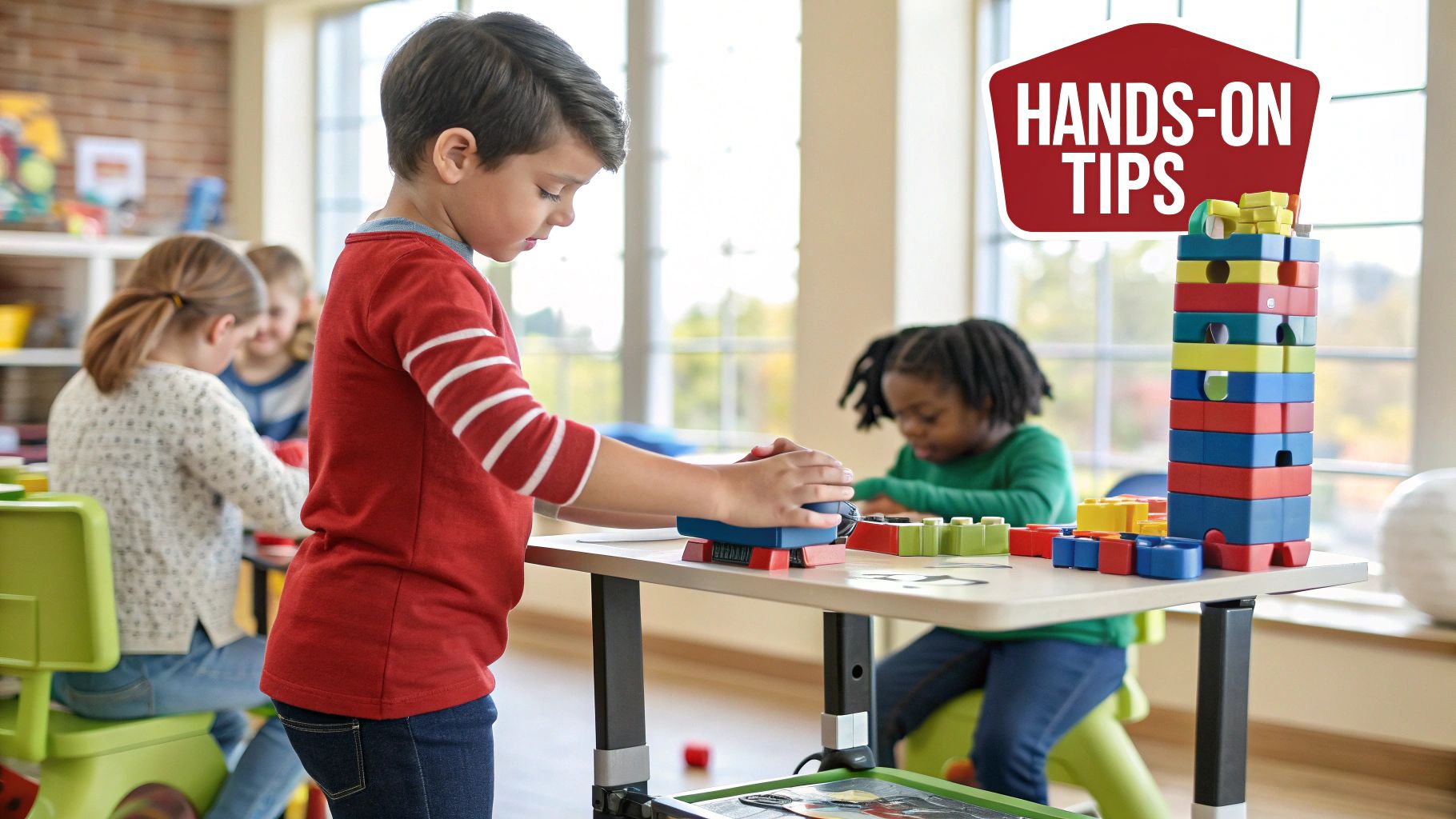
These low-cost, high-impact strategies are perfect for both the classroom and home, helping kinesthetic students thrive in any learning environment.
Embrace Purposeful Movement in Learning
The secret is to weave movement into the lesson itself, making it a tool for learning rather than a distraction. Instead of constantly asking them to sit still, find ways to make movement part of the process.
- Brain Breaks: Schedule short, 2-3 minute breaks for physical activity like jumping jacks, stretching, or a quick dance party. These resets are amazing for focus and provide a needed physical outlet.
- Active Study Sessions: Encourage pacing or walking around while memorizing facts or reciting information. The physical motion helps cement concepts in their memory.
- Act It Out: Bring subjects to life through performance. For history, have students role-play a key event. For literature, ask them to act out a scene from a book.
These simple adjustments acknowledge their need to move and channel it productively.
Make Learning a Tactile, Hands-On Experience
For kinesthetic learners, their hands are an extension of their brain. Turning abstract ideas into physical objects they can touch, build, and manipulate is a game-changer for comprehension and retention.
A math problem becomes a tangible puzzle when solved with building blocks. A science concept clicks when a student builds a model of it with clay. This physical connection is where deep learning happens.
Turn passive lessons into active ones by breaking out the physical tools. Use sand trays for practicing letters, magnetic tiles for geometry, or simple objects like beans for counting. You can find more inspiration by exploring all sorts of hands-on learning activities that can be adapted for any subject. This approach moves learning off the page and into the real world.
Optimize the Learning Environment for Action
Sometimes, the simplest changes have the biggest impact. Modifying the physical space to allow for more freedom of movement can dramatically improve a kinesthetic learner's ability to focus and engage.
Practical Environmental Tweaks for Better Focus
| Strategy | Why It Works |
|---|---|
| Standing Desks | Allows students to shift their weight and move slightly without leaving their workspace, preventing restlessness. |
| Stability Ball Chairs | Encourages "active sitting" by engaging core muscles, providing a constant, subtle physical outlet. |
| Flexible Seating | Offering options like wobble stools, floor cushions, or beanbags lets students choose a position that feels comfortable and helps them concentrate. |
By implementing these strategies, you create an environment where movement isn't just tolerated—it's celebrated as a vital part of the learning process. You empower kinesthetic learners to use their natural strengths, building confidence and fostering a genuine love for learning.
The Best Hands-On Activities and Tools for Learning
Once you know your child is a kinesthetic learner, the fun begins. This is where abstract ideas get their hands dirty and become concrete, memorable experiences.
The goal is simple: get hands and minds working in sync. You'll quickly find that the lessons that stick are the ones your child can touch, build, and feel. And the good news is you don’t need a high-tech lab to make it happen; you can create an incredible hands-on learning environment with dedicated educational toys or simple household items.
Tools That Encourage Active Learning
The best tools for kinesthetic learners invite interaction, experimentation, and creation.
- Science Kits: These are gold for kinesthetic learners. Building a volcano, mixing slime, or constructing a simple circuit pulls science out of the textbook and into the real world.
- Building Sets: Whether it's LEGOs, magnetic tiles, or classic wooden blocks, these are powerhouse tools for teaching math, physics, and engineering through construction.
- Art Supplies: Never underestimate the power of clay, paint, and drawing materials. They allow kids to physically express what they're learning, whether it's sculpting a historical figure or illustrating a scene from a book.
- Coding Robots: Simple, programmable bots provide immediate, physical feedback for coding commands, making abstract logic feel real and exciting.
Providing these tools gives learners the raw materials they need to build, create, and physically connect with new ideas. This is precisely why well-designed science kits for kids are so effective—they are built from the ground up to spark hands-on discovery.
Everyday Activities as Learning Opportunities
Learning doesn't just happen at a desk. For a kinesthetic learner, the entire world is a classroom, and many everyday activities are natural learning moments waiting to happen.
The kitchen becomes a chemistry lab when you bake cookies. A walk in the park transforms into a biology lesson. The trick is to see the learning potential hidden in everyday actions.
Here are a few ways to connect core subjects with hands-on activities that feel more like play than work.
| Kinesthetic Activities for Core Subjects | ||
|---|---|---|
| Subject | Activity Idea | Learning Outcome |
| Math | Bake a recipe, measuring all the ingredients. | Reinforces fractions, measurement, and sequencing. |
| Science | Plant a small garden or windowsill herb box. | Teaches plant life cycles, botany, and responsibility. |
| Language Arts | Act out a scene from a book or use puppets. | Improves reading comprehension and emotional expression. |
| History | Build a model of a historical structure (like a pyramid or castle) with blocks or clay. | Develops spatial reasoning and solidifies historical context. |
| Geography | Create a salt dough map of a continent or country and paint it. | Cements understanding of landforms and borders. |
Turning daily routines into teachable moments is easier than you might think. A trip to the grocery store can be a lesson in budgeting, and assembling a bookshelf is a practical exercise in following instructions. By reframing these simple activities, you create a continuous learning environment that feeds a kinesthetic learner's natural curiosity.
The Long-Term Benefits of Hands-On Learning
Embracing a hands-on approach does more than just help kids with homework; it builds a powerful toolkit for life. The benefits of learning by doing stretch far beyond the classroom, shaping how children will one day tackle challenges, solve complex problems, and innovate.
This active learning style builds skills that are incredibly valuable in the real world. Instead of just memorizing facts for a test, kinesthetic learners develop an intuitive feel for how systems work. They learn to think on their feet, adapt to new information, and trust their practical instincts.
From Classroom Skills to Career Success
The link between hands-on learning and future success is strong. By encouraging movement and physical engagement, we nurture the exact skills needed for some of today's most important and dynamic careers.
Consider these fields where a kinesthetic mindset is a huge advantage:
- Engineers and Technicians: They must physically build, test, and troubleshoot the designs they create.
- Healthcare Professionals: Surgeons, physical therapists, and nurses all depend on precise muscle memory and tactile feedback.
- Chefs and Artisans: Their skill comes from countless hours of hands-on practice, perfecting their craft through physical repetition.
- Creative Arts: Dancers, actors, and sculptors use their bodies as their primary tool for expression and creation.
Encouraging a child's need for hands-on exploration isn't just about managing a learning preference. It is an investment in developing the critical thinkers, innovators, and problem-solvers of tomorrow.
Ultimately, understanding and supporting the what is kinesthetic learning style in a child is about setting them up for a future where adaptability and practical skills matter most. It’s an investment in a brighter, more innovative world, built by people who aren’t afraid to roll up their sleeves and get to work.
Frequently Asked Questions About Kinesthetic Learning
Let's clear up some common questions people have about the kinesthetic learning style. Understanding this hands-on approach is the first step to supporting the active learners in your life.
Is the kinesthetic learning style a disability?
Absolutely not. It's crucial to be clear on this: a kinesthetic learning style is simply a learning preference, not a disorder. It describes the most effective way a person processes and retains information—through movement and touch. It has no connection to intelligence or overall ability.
Can someone have more than one learning style?
Yes, and it’s very common! Many people have a multimodal learning style, meaning they use a mix of visual, auditory, read/write, and kinesthetic methods. While they might lean heavily on one, they can usually adapt and learn in different ways. The key is to recognize their dominant preference and leverage it whenever possible.
How can I adapt reading for a kinesthetic learner?
This is a great question, as sitting still with a book can be tough for kids who need to move. The trick is to make reading a physical activity.
- Use magnetic letters on a whiteboard to physically build words.
- Let them trace letters and words in a shallow tray of sand or salt.
- Act out the scenes from the story as you read them together. Go ahead, get theatrical!
These tactile methods connect the physical act of "doing" with the mental process of reading, making it far more engaging and effective for a kinesthetic mind.
Ready to bring more hands-on learning into your home? At Playz, we create science kits and toys designed from the ground up to spark curiosity and make learning an unforgettable adventure. Check out our collection and find the perfect way to support your little kinesthetic learner.