

Saturday morning starts with a small mess that somehow needs a smart fix. A little spilled lotion on the counter, a half-used spice jar on the shelf, a kid asking for “just a tiny cup” to hold paint, and suddenly a 1 oz container feels less like packaging and more like a teaching tool.
That's the surprise with tiny containers. They help children sort, pour, measure, compare, and reuse things with their hands instead of a screen. They also show adults how much confusion can hide inside a label that looks simple at first glance.
A good guide to 1 oz containers should answer four practical questions, what does 1 oz mean, which material fits the job, what do the travel rules say, and how can a small container turn into a real STEM moment. For families and teachers who want more screen-free learning, that kind of clarity matters, especially when hands-on play already supports learning in meaningful ways, as discussed in Playz's guide to the benefits of hands-on learning.
Why a Tiny Container Matters in Big Learning Moments
On a kitchen table, a 1 oz container can do a lot of quiet work. One child scoops glitter glue into a tiny jar, another sorts sunflower seeds into mini cups, and a parent finally finds a container small enough for leftover sauce without wasting the whole batch. The size looks ordinary, but the learning inside it isn't.
The reason this matters is simple. Small containers invite children to slow down, compare amounts, and notice how packaging changes what we can store, carry, and reuse. They also give teachers and caregivers a low-cost way to build activities around real-world objects instead of printed worksheets.
A preschool corner, a homeschool shelf, or a birthday gift bag can all use the same object differently. That's why 1 oz containers show up in snack prep, craft trays, science kits, and travel bags. They're small enough to handle, but they're also specific enough to make measurement feel concrete.
Why educators keep coming back to them
A child can see a tiny cup fill, spill, stack, or nest inside another cup. That visual feedback builds confidence fast, especially for early learners who are still connecting words like “more,” “less,” “full,” and “empty” to real objects. It also makes storage and cleanup easier, which every adult in the room appreciates.
Practical rule: if a material can be poured, labeled, compared, and cleaned, it can become a lesson.
For parents who want a toy shelf that doubles as a learning shelf, a small container can bridge the gap between daily life and structured play. For teachers, it can support a counting lesson, a sensory bin, or a sorting challenge without needing special equipment.
Understanding What 1 oz Really Means
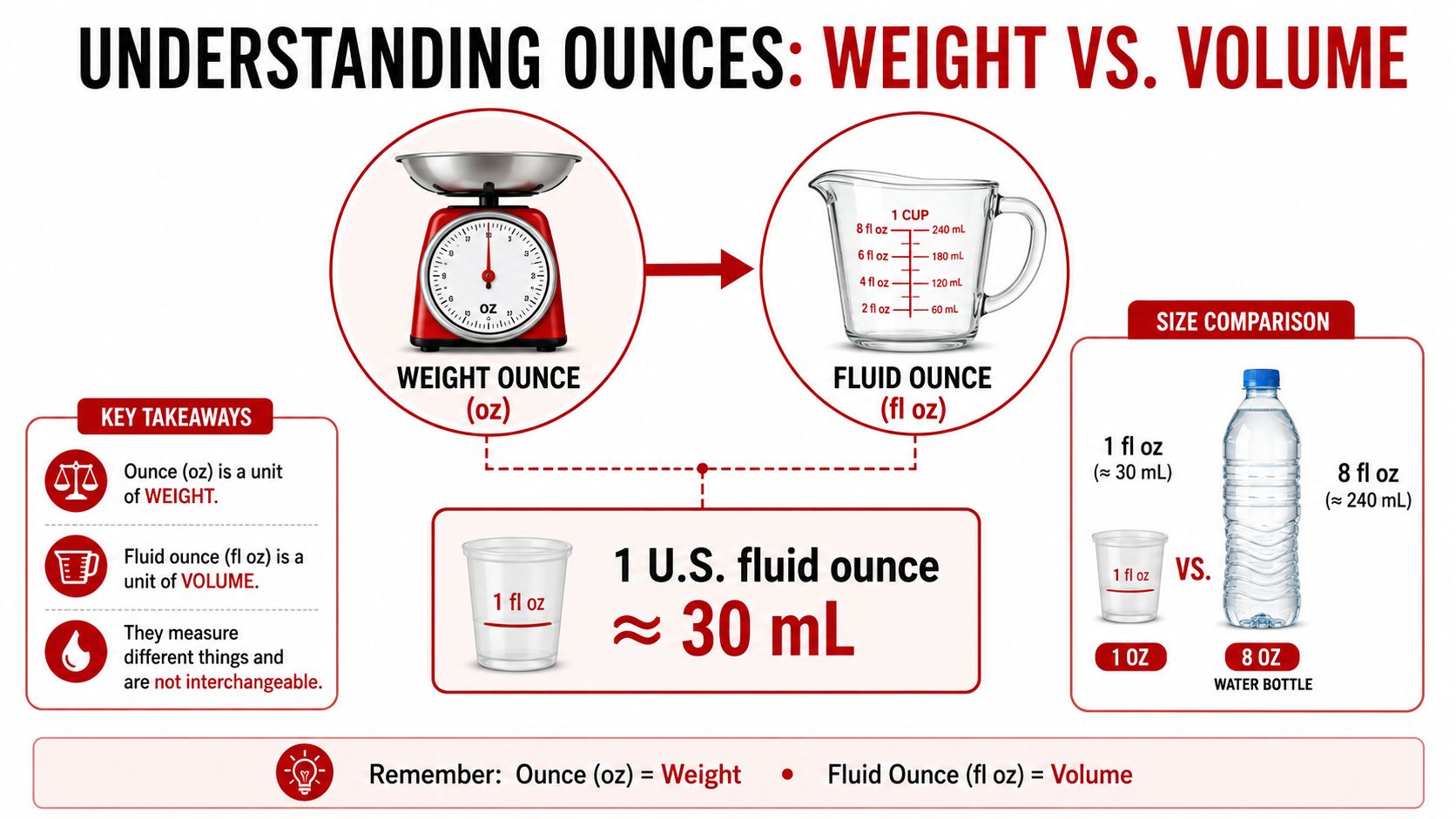
A lot of confusion starts with the word ounce. In everyday speech, people mix up weight ounces and fluid ounces, but they're not the same thing. A weight ounce measures how heavy something is, while a fluid ounce measures volume, which is why a sauce packet and a piece of candy can't be judged by the same label.
A useful shortcut helps here. 1 U.S. fluid ounce is about 29.57 mL, and in food labeling it's commonly rounded to 30 mL. That's why a small 1 oz cup often feels closer to a tiny medicine cup or sample container than to a full serving bowl.
Nominal size and actual capacity
The label on a container can be misleading if you assume it always means the exact amount it can hold. In packaging, “1 oz” is often a nominal fill size, not the same thing as overflow capacity. That's why two containers with the same label can still behave differently at the sink or in the classroom.
The USDA Food Buying Guide shows how container sizes don't map neatly to one universal shape, since a common 8 oz can is 1 cup, while a numbered No. 1 can is much larger at 10 1/2 to 12 oz (297 g to 340 g), which helps explain why size labels need context in the first place, according to the USDA Food Buying Guide table for common can and jar sizes.
For classroom use, that means one tiny cup might be perfect for a counting station, while another is better as a sample jar for lotion, paint, or spice. If you're planning activities, a simple rule keeps things clear.
Classroom shortcut: use 1 oz as a teaching label first, then check whether the container is meant for weight or volume before you buy more.
If you want a related visual aid for measuring activities, a standard kitchen reference like this 1 cup measuring cup guide helps children see how small and large volumes compare without turning the lesson into arithmetic.
The same logic works in creative kits too. When a child uses mini peelable nail polish collections, the appeal isn't just color, it's the idea that a tiny amount can still be measured, shared, and managed carefully.
Plastic vs Glass and Other Material Choices
The material matters as much as the size. A 1 oz container can be made from plastic or glass, and those choices change how it behaves in heat, in a backpack, on a classroom shelf, and in a child's hands. If you've ever watched a bottle deform in a warm car or a jar crack after a drop, you've already seen why the material question comes first.
A quick side-by-side view
| 1 oz Container Materials at a Glance | Temperature Range | Impact Resistance | Best For |
|---|---|---|---|
| PET | About -40°F to 120°F | Low | Light-duty storage, cool classroom use |
| Amber glass | About -90°F to 280°F | Low | Hot-fill, fragrance, cosmetic actives |
| HDPE | Varies by product | Good for squeeze use | Sauces, slime, portable craft liquids |
| PP | Varies by product | Good rigidity and everyday handling | Jars, samples, organized classroom bins |
A clear PET jar is light and convenient, but it's more sensitive to heat and impact. An amber glass jar handles a broader temperature range and offers high chemical resistance, which is why it fits products that need more protection from heat or reactive ingredients, according to the PET single-wall jar specification.
Matching material to the activity
For slime, HDPE and PP are practical because they're easy to handle and less likely to shatter if a child drops one. For hot-fill candle making, glass is the safer fit because it tolerates heat better and gives a more stable container wall. For a classroom bin that gets opened, closed, and stacked all week, PP often makes sense because the rigid shape holds up well during repeated handling.
A 1 oz HDPE cylinder bottle can overflow at about 1.25 oz with a mass near 5.5 g, while a 1 oz PP jar may overflow at 67 to 70.5 mL and weigh around 11 to 12.1 g, which shows that the nominal size on the label doesn't tell the whole operational story, according to the Berlin Packaging container specification. That difference affects squeeze feel, fill-line setup, and how tightly containers pack into a tote.
If you're choosing for baby-safe or child-focused use, a broader guide like this resource on non-toxic toys for babies helps frame the same question in terms of safety, not just size.
Best fit tip: choose glass for heat and chemical stability, PET for lighter handling, and HDPE or PP for everyday kid-friendly reuse.
Travel Rules Every Parent Should Know
A 1 oz container feels travel-friendly, but that doesn't automatically make it airport-friendly. The rule that matters in the U.S. is the TSA 3-1-1 rule, which allows liquids, aerosols, and gels in containers of 3.4 ounces (100 mL) or less, all packed into one quart-size bag per passenger, with common examples including toothpaste, shampoo, conditioner, mouthwash, and lotion, as stated by the TSA liquids, aerosols, and gels rule.
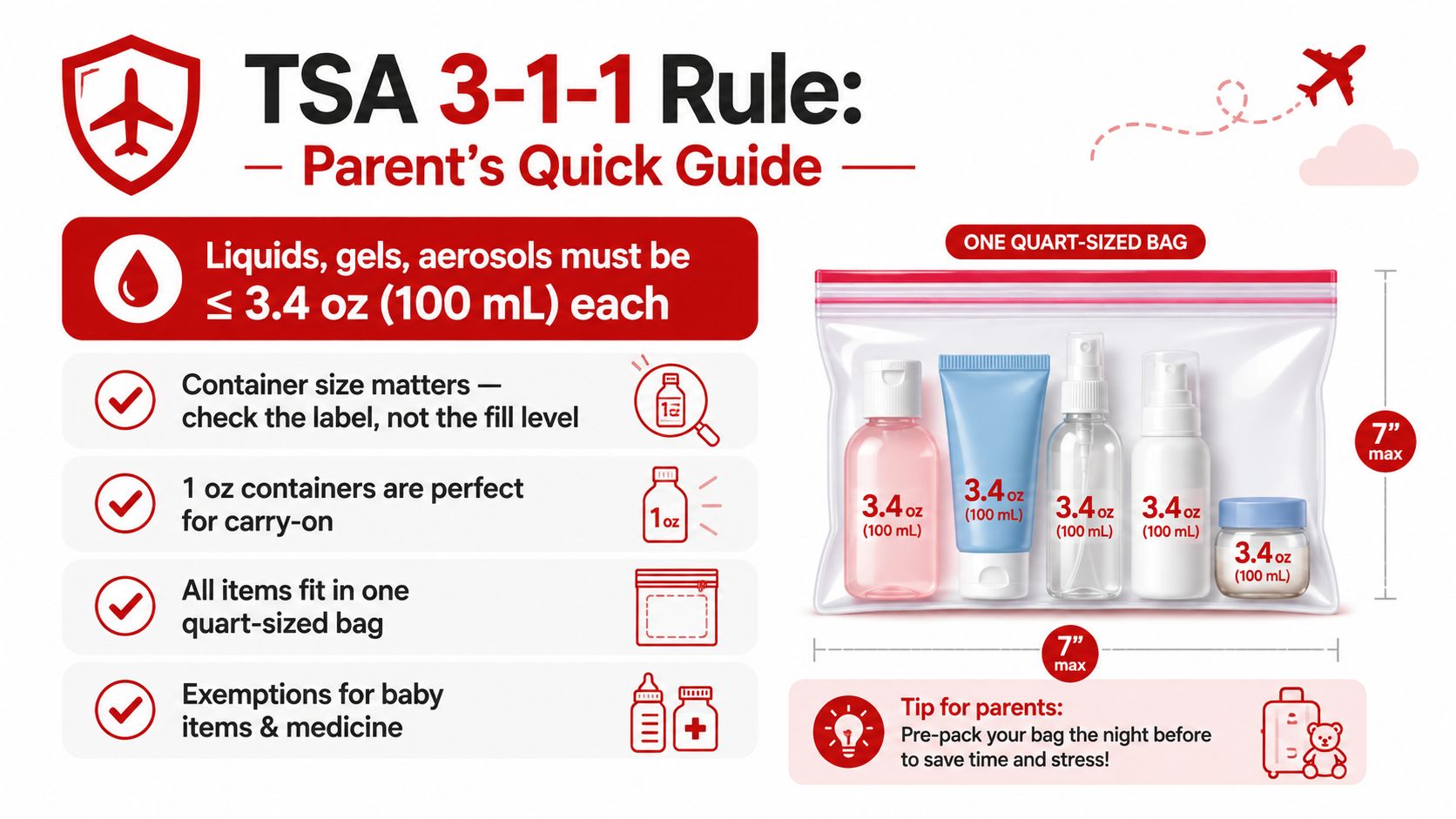
The part that trips people up is capacity. The TSA measures the container's maximum capacity, not how much liquid is currently inside it. So a half-filled bottle can still get flagged if the bottle itself holds more than 3.4 ounces.
A parent's packing checklist
- Check the label carefully: The bottle must be sized at 3.4 ounces or smaller, not just filled below that line.
- Pack by category: Liquids, gels, and aerosols all count, so group similar items together before screening.
- Use the quart bag early: Don't wait until the airport line to see whether everything fits.
- Keep exceptions separate: Baby items and medicine may need extra attention, so pack them where they're easy to explain.
For checked bags, the FAA PackSafe guidance gives a different ceiling. It allows 500 milliliters (17 fluid ounces) per container and a total aggregate limit of 2 liters (68 fluid ounces) per person for medicinal and toiletry articles, while carry-on liquids still follow the TSA's 100-milliliter (3.4-ounce) checkpoint limit, according to the FAA PackSafe medicinal and toiletry guidance.
That split matters for families because one bag can travel in the cabin and another can go in checked luggage under different rules. If your child likes to help pack, this becomes a great sorting exercise. One pile for carry-on, one pile for checked baggage, and one final check for container size.
Cleaning and Safety Tips for Reuse
A tiny jar looks harmless until glue dries in the threads or a lid warps after a hot rinse. Reuse works best when you match the cleaning method to the material, then inspect the container before handing it back to a child. Glass is more forgiving with heat, while PET is usually better kept to gentler washing, because repeated high heat can shorten its useful life.
Reuse, recycle, or retire
- Reuse it if the container is clean, the lid seals well, and the walls show no cracks or clouding.
- Recycle it if it's still structurally sound but no longer useful for food, craft, or classroom storage.
- Retire it if you see stress cracks, a warped lid, sharp edges, or residue you can't remove safely.
Labels matter too. Warm water, mild soap, and a slow peel usually remove adhesive without scarring the surface. If the sticker fights back, a little time soaking the outside edge helps more than scrubbing hard, which can scratch thin plastic.
For refill and repeat-use ideas, it helps to see how other categories use the same logic. A guide to plant-based sand candle refills shows how containers can stay in circulation longer when the refill system is designed well.
A few practical habits
Use the container for dry goods first, then move to wet materials once you know it seals properly. Store matching lids together in a bin so you don't waste time hunting for them later. Keep a small stack for craft paint, spice blends, bead sorting, or nature finds, and reserve the clearest jars for anything a child will observe closely.
For disinfecting classroom-ready containers, this isopropyl alcohol guide gives another cleaning reference point when you need a stronger reset between uses.
If a child can open it, close it, and wash it with help, it's a good candidate for reuse.
Hands-On STEM Activities Using 1 oz Containers
Small containers work well because they keep the task visible. A child can see one scoop, one pour, one seed, or one sample at a time, which makes the lesson feel manageable instead of messy. That's exactly why they fit so naturally into screen-free learning.
Three activities that work
Mini slime and potion lab. Use HDPE or PP containers for kids who want to mix color, glitter, and thick liquids. This works well for ages who can follow a simple sequence, and the learning goal is cause and effect, plus prediction, because children can test what happens when they add a little more of one ingredient. The mess level is medium, which makes it a strong choice for a tray or outdoor setup.
Seed-starting nursery. Choose PP or glass if you're using the jars as temporary planters or observation cups. Children can compare roots, moisture, and sprouting speed without needing large pots, and the learning goal is patience, observation, and life-cycle awareness. The mess level is low to medium, depending on how much soil is involved.
Mini specimen observation station. Clear PET or glass containers work well for leaves, shells, pebbles, or classroom nature finds. A child can sort by texture, color, or size, and the learning goal is classification and vocabulary building. The mess level stays low, which makes this a strong option for a center table or quiet bin.
For more activity inspiration in the same spirit, Playz's hands-on learning activities gives a useful mindset, use small objects to spark big questions.
Why the small format works
A tiny container limits the amount of material a child can spill, waste, or overmix. That limit is helpful, not restrictive, because it keeps attention on the process instead of the volume. It also gives adults a natural chance to ask, “What changed?” or “Which one holds more?” without turning play into a quiz.
Rethinking Mini as Reusable
Small packaging can become throwaway packaging fast, but it doesn't have to. The EPA's container-and-packaging data show why this matters, because containers and packaging generated 82.2 million tons of municipal solid waste in 2018, which was 28.1% of total MSW generation, and the category rose from 27.37 million tons in 1960 to 82.22 million tons in 2018, according to the EPA's container and packaging data.
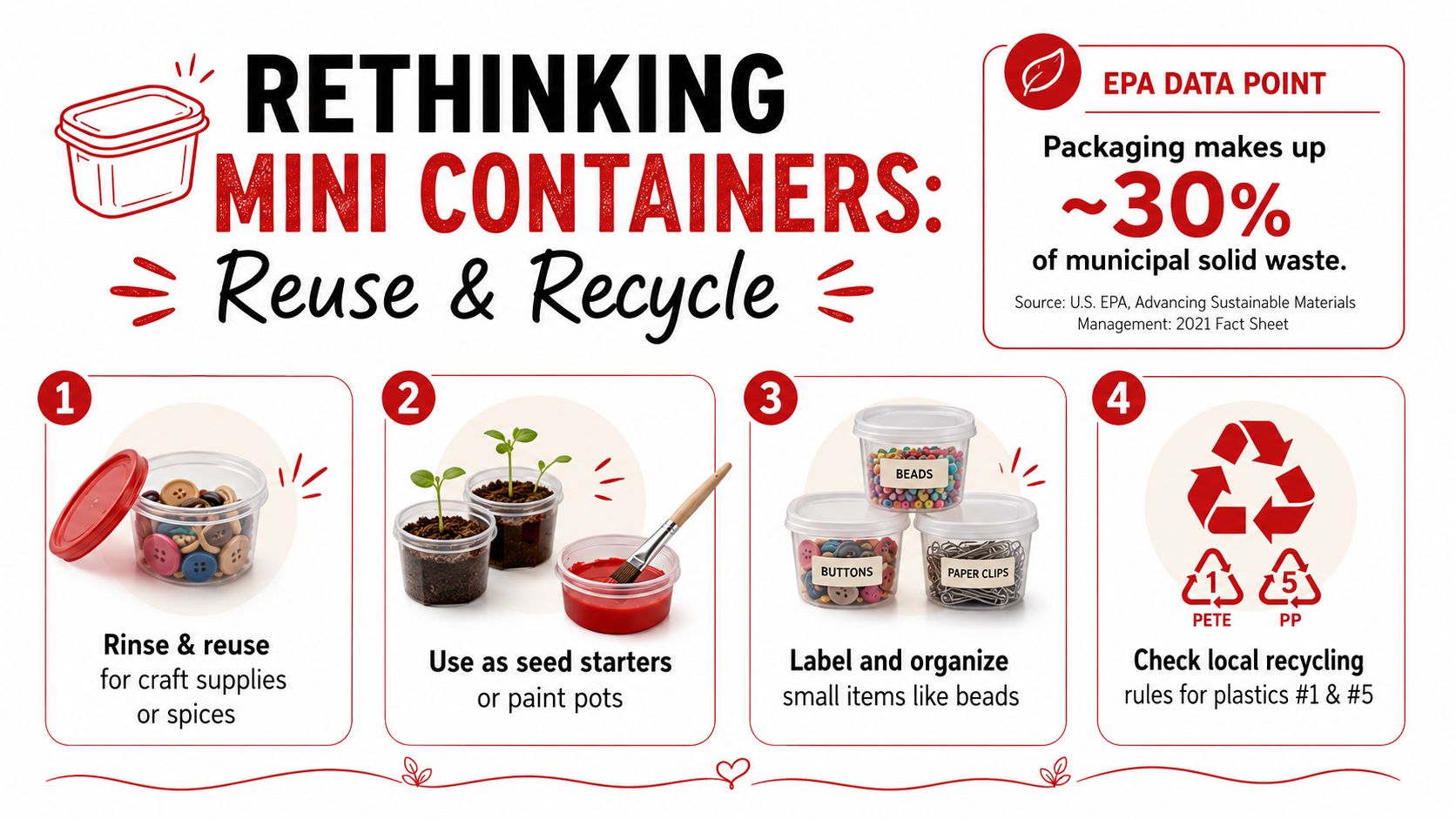
Four habits that make mini last longer
- Rinse and reuse: Keep small jars for craft supplies, spices, or snack portions.
- Turn them into tools: Use them as seed starters, paint pots, or sorting cups.
- Label what's inside: Beads, buttons, and tiny parts stay organized when each container has a clear purpose.
- Check local recycling rules: Plastics aren't handled the same way everywhere, so recycling choices should match your area's guidance.
The recycling rate detail for glass also gives a useful reminder that materials matter at the end of the life cycle, not just at the start. The EPA notes that glass containers accounted for 9.8 million tons, with 3.1 million tons recycled, a 31.3% recycling rate, while plastic containers and packaging totaled 14.5 million tons in 2018, which is why reuse habits can reduce the churn around small items.
For families who want travel toiletry ideas that don't end up as instant waste, the WipesBlog.com hotel toiletry guide is a helpful companion read because it keeps the conversation focused on practical packing and repeat use.
The bigger lesson is simple. A mini container can teach conservation, organization, and responsibility at the same time, which fits naturally with screen-free, hands-on routines that children already enjoy.
Quick Answers and Where to Try It Next
How many 1 oz containers fit in a quart bag? It depends on shape, lids, and how tightly they stack, but the TSA rule is still about fitting all allowed liquids into one quart-size bag. If you want a smooth pack, lay the containers flat and test the bag before you leave home.
Is 1 oz enough for a week of travel? Sometimes for samples, creams, or child-sized portions, but not usually for full-size toiletries. The better question is whether the product is meant to be refilled often, or whether you need a larger checked-bag option under FAA guidance.
What age is appropriate for glass containers? Use glass only when a child can handle it carefully and the adult can supervise the task closely. For younger kids, plastic is usually the safer classroom choice.
Where should I look for classroom-safe 1 oz containers? Choose sturdy, easy-to-label options with secure lids and a shape that matches the activity, then match the material to the task. Clear jars, PP tubs, and HDPE bottles each solve a different problem.
If you're ready to turn a tiny container into a bigger learning moment, explore Playz for science kits and STEM toys that keep kids building, measuring, and discovering without screens. Small tools can spark big curiosity, and the right hands-on set makes it easy to keep that curiosity going at home or in the classroom.