

You're standing in a toy aisle with a birthday party coming up, holding a bright, heavily advertised toy that looks perfect. Then you notice the tiny accessories, the complicated instructions, and the noise-making buttons. A three-year-old may adore the box, ignore the toy, or turn the smallest removable piece into a safety concern within minutes.
The best 3 year old presents aren't necessarily the flashiest. They're gifts that match a child's current stage, invite repeated play, survive ordinary family life, and pass a physical safety check. This guide focuses on the decision criteria generic gift lists often miss, including developmental payoff, choking hazards, storage, sibling sharing, mess, and long-term usefulness.
Why Age 3 Changes Everything About Gift Giving
A child who has just turned three may still enjoy stacking blocks, but the play has changed. Instead of building only to knock a tower down, they may announce that the blocks are a house, a bridge, or a shop. They're beginning to use objects as symbols, follow simple rules, solve small problems, and involve other people in invented scenarios.
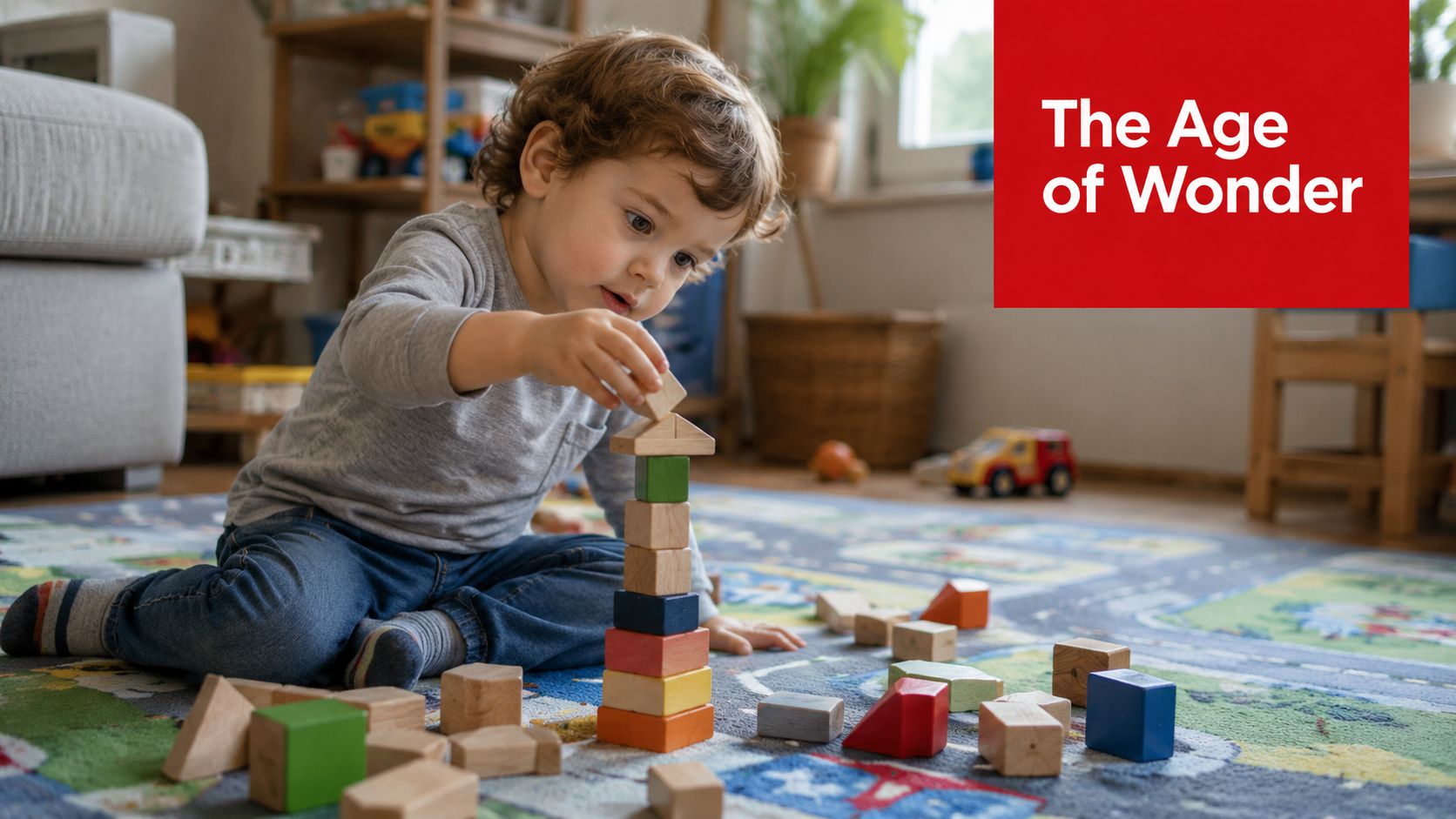
That shift makes age 3 a particularly important point for gift selection. Research on children's toy use separates children aged 3 to 5 from younger age groups, reflecting a stage in which play becomes more purposeful and complex (research on children's toy utilization). A gift should give the child something to do with an idea, not merely something to press, shake, or watch.
Look for the next step, not the biggest challenge
Three-year-olds are developing language, coordination, early reasoning, and social confidence at the same time. A simple pretend kitchen can support vocabulary, turn-taking, imitation, and storytelling. A chunky construction set can encourage planning, balance, and trial and error without demanding skills the child hasn't developed yet.
The useful question isn't, “Does this toy look educational?” Ask instead, “What will this child be able to do with it after the novelty fades?” A gift that supports several kinds of play usually earns more use than a toy built around one dramatic feature.
Practical rule: Choose a toy that's easy to start, but difficult to exhaust.
A three-year-old may abandon a puzzle that's too difficult, while a younger toddler toy may feel boring after a few minutes. The sweet spot is a manageable challenge with room for variation. Large blocks, washable art materials, simple puzzles, pretend-play props, and open-ended movement toys all fit that pattern when their design matches the child.
Parents looking for a broader developmental reference can also use this guide to childhood development milestones when deciding whether a present fits the child rather than the packaging.
Safety Checks Every Gift Buyer Must Know
A 3+ label isn't a guarantee that every piece is safe for every newly turned three-year-old. Some children still mouth objects, and small accessories can create risks even when the main product is age-labelled for preschool use.
The U.S. Consumer Product Safety Commission reported that 36% of toy-related deaths and injuries in 2023 involved children 4 years of age or younger, and it estimated 267,100 toy-related injuries treated in U.S. hospital emergency departments across all ages in 2024 (CPSC toy safety report). A pediatric injury review found severe injuries were more common among children younger than 3, with an odds ratio of 3.59, and remained higher among children aged 3 to 5, with an odds ratio of 2.97 (pediatric injury review).
Run the physical checks at home
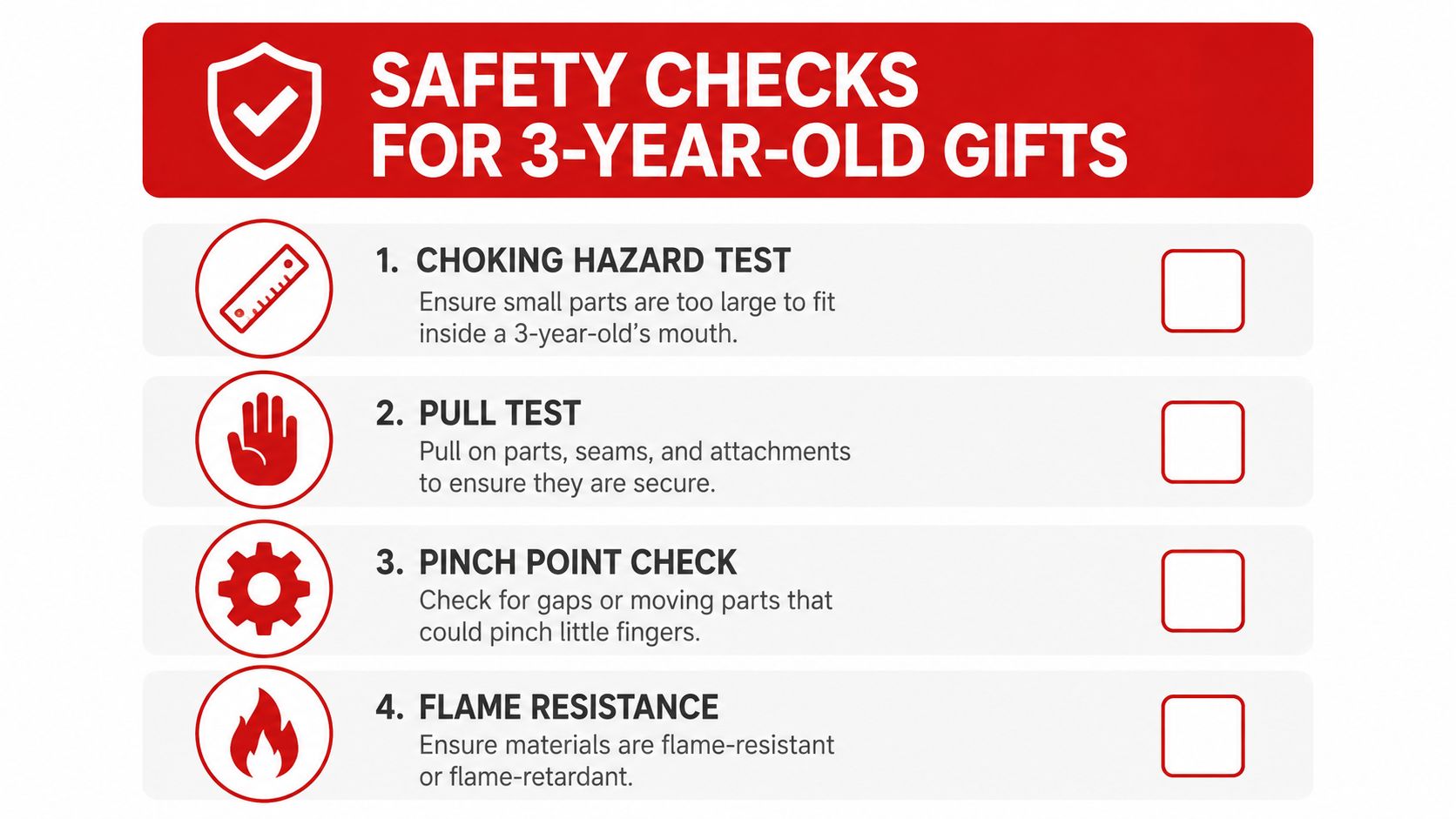
Start with the simplest screening method. Seattle Children's advises that, for children 3 or younger, small toys and parts shouldn't fit inside an empty toilet paper tube. Soft toys also need to remain too large to swallow when compressed, so squeeze plush, silicone, and flexible items before handing them over (Seattle Children's toy safety guidance).
Then inspect the construction:
- Check detachable pieces: Remove anything that can be pulled, twisted, or bitten off.
- Inspect batteries: Reject products with exposed button batteries or weakly secured battery compartments.
- Avoid loose magnets: Strong loose magnets are an unacceptable choice for a preschool gift.
- Test strings and cords: Long loops and cords can create strangulation risks.
- Feel every edge: Sharp points, rough seams, and cracked plastic are reasons to return the item.
- Read the warning panel: A toy for ages 3 to 5 with small parts should carry the warning “CHOKING HAZARD--Small Parts. Not for children under three,” according to the National Resource Center for Health and Safety in Child Care and Early Education (small-parts guidance).
The U.S. CPSC defines a small part for under-3 products using a small-parts cylinder, and products intended for children under 3 that contain hazardous small parts can fall under federal restrictions (CPSC small-parts guidance). For mixed-age homes, screen every loose component, not just the main toy.
Packaging can also create problems. If you're preparing nursery or classroom gifts in batches, the Packaging Panda baby range offers useful context for keeping children's packaging practical and appropriate.
For material-focused shopping, compare labels and construction with this resource on non-toxic toys for babies. The age range differs, but the inspection habit applies directly to preschool presents.
Choosing Gifts by Play Type and Developmental Payoff
A toy's appearance tells you almost nothing about how long it'll remain useful. Sort gifts by the kind of play they invite, then choose the category that fills a real need in the child's daily routine.
The Toy Association reports that 58% of U.S. parents favor toys that build a skillset, 60% seek STEAM-focused toys, 56% look for outdoor or active play, and 78% want toys that build creativity and problem-solving (Toy Association trend data). Those preferences point toward gifts with repeatable use, not one-joke novelty.
Compare the main play categories
| Play Type | Key Benefits | Example Gifts | Engagement Span |
|---|---|---|---|
| Creative and open-ended | Builds fine-motor control, expression, flexibility, and independent choices | Large blocks, washable art supplies, play dough tools, magnetic drawing boards | Grows through changing projects |
| Active and physical | Supports coordination, balance, confidence, and movement | Play tents, indoor climbing shapes, balls, outdoor ride-on toys | Repeated short bursts and longer active sessions |
| STEM and problem-solving | Encourages sorting, sequencing, construction, cause and effect, and simple planning | Chunky puzzles, large-piece construction sets, simple science kits | Strong when difficulty can increase gradually |
| Pretend and social | Develops language, imitation, storytelling, cooperation, and role-taking | Play kitchens, doctor sets, animal figures, dress-up props | Expands as siblings and adults join |
Open-ended gifts win on flexibility. Blocks can become a garage today and a zoo tomorrow. A play tent can be a reading nook, a shop, or a spaceship. Licensed toys can still be excellent if the child already loves the character, but the best versions add movable parts, figures, building options, or storytelling possibilities rather than offering only a branded image.
For simple games, Seattle Children's recommends no more than five or six pieces and only a few rules for this age (toy and play guidance for ages 3 to 5). That's a useful standard for puzzles, matching games, and beginner board games. If an adult has to explain the rules repeatedly, the present is probably too advanced.
A good preschool gift gives the child control over the story, the pace, and the next move.
Active gifts deserve special attention. Western Australian play guidance says children aged 3 to 5 need at least 3 hours of active play each day, including 1 hour of energetic play, such as running, climbing, hopping, jumping, dancing, kicking, and throwing (play guidance for ages 3 to 5). That doesn't mean every present needs to be large or outdoors. A compact ball, movement game, or play tent can support activity in a smaller home.
For younger-child comparisons, a guide to best 18 month boy toys can help clarify the difference between early manipulation toys and gifts suited to a three-year-old's more symbolic play. You can also explore what symbolic play means before choosing pretend-play equipment.
Practical Filters Most Gift Guides Ignore
A present can be developmentally sound and still be wrong for the household. A huge play structure won't work in a small apartment, a noisy electronic toy may disappear into a cupboard, and a beautiful craft set can frustrate parents if cleanup takes longer than the activity.
Start with the room, not the product page. Measure the storage space, identify whether the gift needs floor area, and check whether pieces can stay contained in one bin or bag. For siblings, prioritize toys that support parallel play, such as large construction pieces, a play kitchen, a play tent, or a wide art surface.
Use a practical filter before you buy
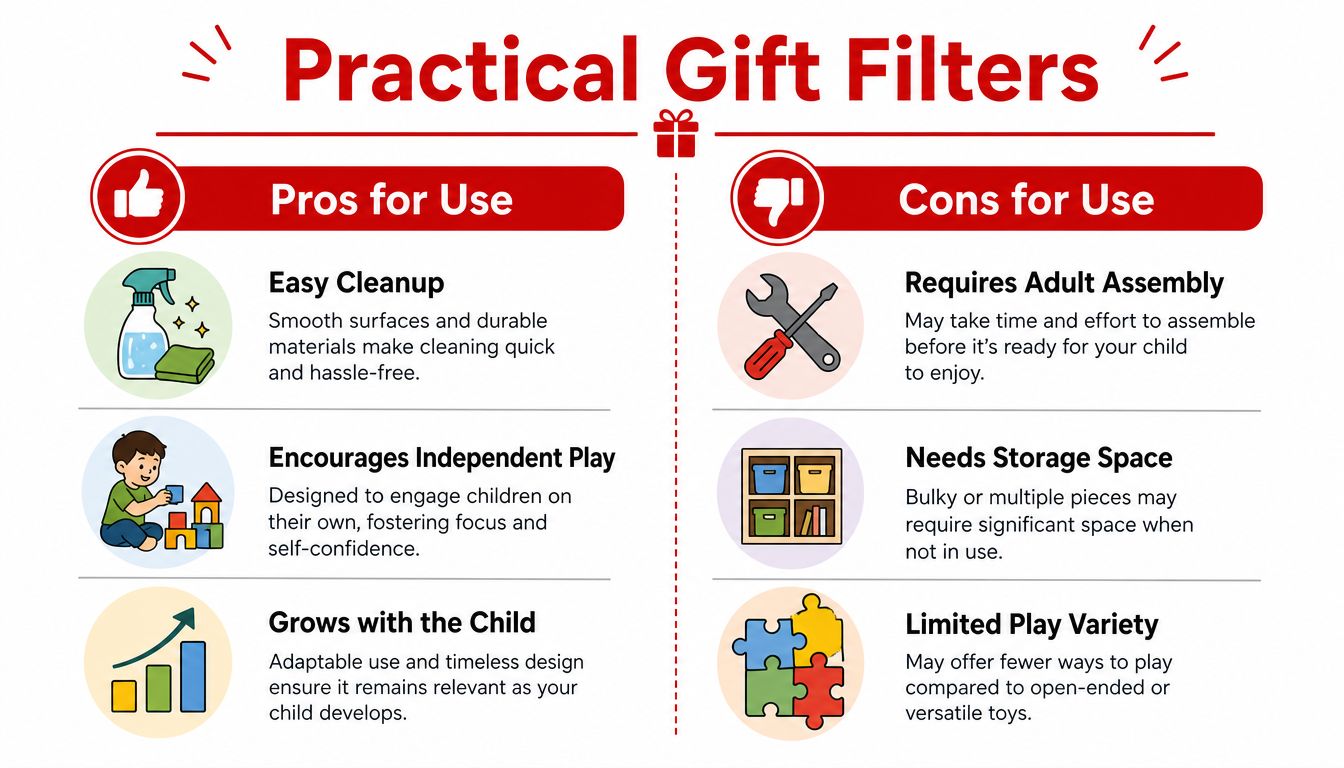
Space: Choose foldable, stackable, or flat gifts when the home has limited storage. A compact magnetic drawing board may get more use than a large set with many loose components.
Durability: Look for thick pieces, reinforced seams, washable surfaces, and attachments that don't loosen during ordinary handling. Three-year-olds build enthusiastically, carry toys from room to room, and test limits without intending to damage anything.
Noise and mess: Prefer toys with controllable sound, quiet modes, washable materials, and a defined play area. Arts and crafts can be excellent, but scissors, pencils, glue, and paint require close supervision, as noted in the Western Australian guidance linked earlier.
Sharing: A gift with multiple meaningful roles works better than a single-character toy when siblings or playmates are likely to join. A pretend shop, train layout, or building set gives children reasons to negotiate and take turns.
Materials: Recent market coverage reports that 72% of parents prioritize non-toxic, organic materials, while nearly half of under-40 parents consider a toy's environmental impact (children's toy gift trend coverage). Treat those preferences as a shopping filter, not a reason to pay for vague green language. Look for clear material information, sealed finishes, and easy-to-clean construction.
Preschool toys are projected to account for 26.8% of kids' toy revenue in 2025, according to the same market coverage (preschool toy market projection). That broad market size doesn't tell you which gift belongs in your home, but it does explain why shoppers face an overwhelming range of options.
Budget matters, too. At a lower price, choose compact gifts with repeat use, such as chunky puzzles, art materials, books, or simple balls. At a mid-range level, construction sets, pretend-play equipment, and durable activity kits offer more variation. Larger gifts should earn their footprint by serving several play types or multiple children.
For more ideas across gift formats, browse these Firacard gift shop recommendations. Then consider an experience instead of another object. A zoo visit, music class, or playground outing can be the better choice when the child already has a crowded playroom. Families managing clutter can also benefit from a toy rotation system, which keeps existing gifts visible without putting everything out at once.
Wrapping and Presentation Tips That Make It Special
A three-year-old doesn't need elaborate packaging. They need a package they can open without frustration, a clear sense that the gift belongs to them, and enough time to explore it before another present appears.
Use paper that tears easily and tape sparingly. Avoid tightly knotted ribbons, excessive layers, and decorative pieces that can detach. For a large play tent, easel, or play kitchen, wrapping one accessory or a picture of the gift can create anticipation without hiding the main present under an awkward sheet of paper.
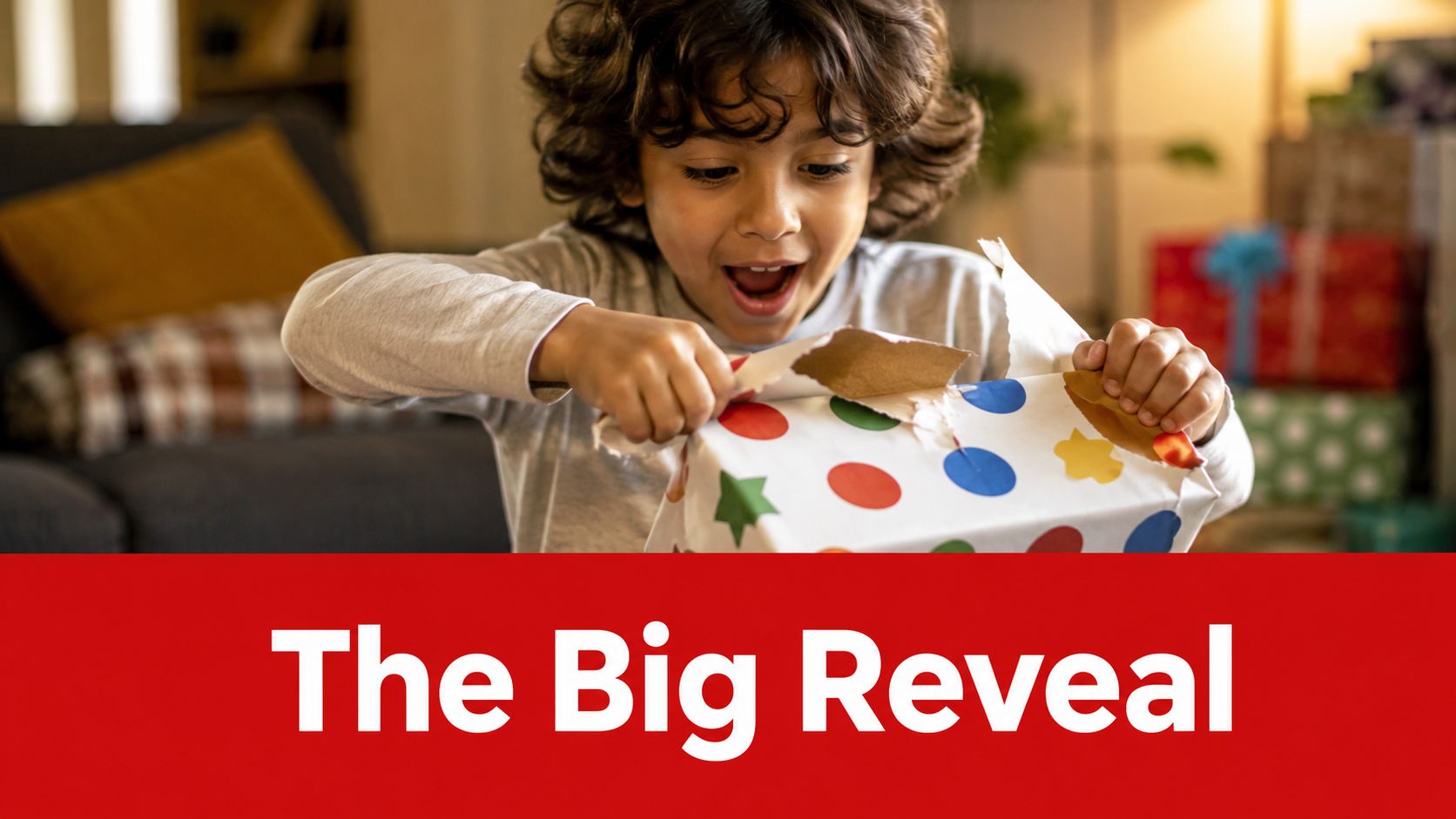
Personalization costs little. Add the child's name to a gift tag, draw a simple picture on the package, or choose paper in a favorite color. If several gifts are involved, give one at a time and allow the child to play before opening the next. A three-year-old often values investigation more than speed.
Experiences need a physical reveal. Put a homemade “ticket” for a zoo visit inside a small envelope, wrap a new sun hat for an outdoor outing, or place a music-class note inside a child-sized instrument case. The object acts as a visual clue, while the primary gift becomes shared time.
Duplicates and unwanted gifts need calm handling. Thank the giver, keep the child's reaction neutral, and exchange or donate the item later if it doesn't suit the household. Don't force a child to perform excitement. The best presentation leaves room for curiosity rather than demanding an immediate response.
For a creative finishing touch, use ideas from box decoration ideas to turn plain packaging into part of the play without adding clutter.
Your Complete Gift Selection Framework
Use this order when choosing among 3 year old presents:
- Start with the child's current play: Look for emerging pretend play, building, language, movement, or simple problem-solving.
- Apply the safety screen: Check the age label, detachable pieces, toilet paper tube fit, compressible materials, batteries, magnets, strings, and sharp edges.
- Choose a play type: Pick creative, active, STEM, or pretend play based on what the child lacks rather than what looks most exciting online.
- Check the household: Consider floor space, storage, noise, mess, siblings, travel, and whether adults can supervise the activity.
- Choose repeat use over novelty: Select a toy that can be rebuilt, retold, combined, moved, or used by more than one child.
- Make the reveal manageable: Use simple wrapping and give the child time to explore.
For a compact gift, choose a chunky puzzle, washable art set, magnetic drawing board, or simple matching game. For active play, consider a ball, play tent, or movement-focused toy. For imaginative play, choose a pretend kitchen accessory set, animal figures, dress-up pieces, or a playhouse if the family has room. For early STEM exploration, select a construction set with large components or a simple science kit designed for adult-supported discovery.
Playz offers play tents, science kits, and creative toys intended to support screen-free, purposeful play, with age collections that include options for children in the 1 to 3 Years and 2 to 4 Years ranges. Those formats can work well when you want one present to encourage imagination, movement, or hands-on exploration.
Frequently asked questions
Does a 3+ label guarantee safety?
No. Inspect the actual pieces, warnings, batteries, magnets, strings, and soft materials. A toy can suit a three-year-old developmentally while still requiring supervision because of small detachable parts.
What works in a mixed-age household?
Choose a larger main toy with no loose small accessories, then store any age-restricted additions separately. Older siblings can use the same play tent, blocks, pretend-play setting, or art surface in more complex ways.
What if you don't know the child's interests?
Choose a flexible format, such as blocks, open-ended art materials, a play tent, books, or a simple pretend-play prop. Avoid highly specific themes unless you know the child already likes them.
Choose a gift that fits the child's development, passes a real safety check, and works in the family's space. Explore Playz for play tents, science kits, and creative toys that give three-year-olds hands-on ways to imagine, build, move, and learn without relying on screens.