

Summer break arrives with a familiar mix of excitement and uncertainty. The children have plenty of free time, but screens can become the default before breakfast, especially when the weather changes or adults are working. A better plan doesn't require a packed calendar or expensive outings.
These summer activity ideas turn a backyard, kitchen, park, or living room into a place for movement, creativity, curiosity, and independent play. Each activity includes suggested ages, approximate time, setup needs, simple steps, learning outcomes, safety reminders, pros and cons, and an optional Playz connection.
Structured programs remain popular, yet many children still don't participate. A 2024 Gallup poll found that 55% of U.S. parents said their school-aged child joined at least one structured summer program, while 45% did not. Local day camps and weekly enrichment courses were the most common choices, followed by summer school and overnight camps, according to the CDC archive's summary of structured summer activity guidance.
Use these ideas as flexible activity cards. Choose based on today's weather, your available space, your child's energy, and the materials already at home. You don't need to fill every hour. A short, purposeful activity can be enough to shift the day from passive screen use to hands-on discovery.
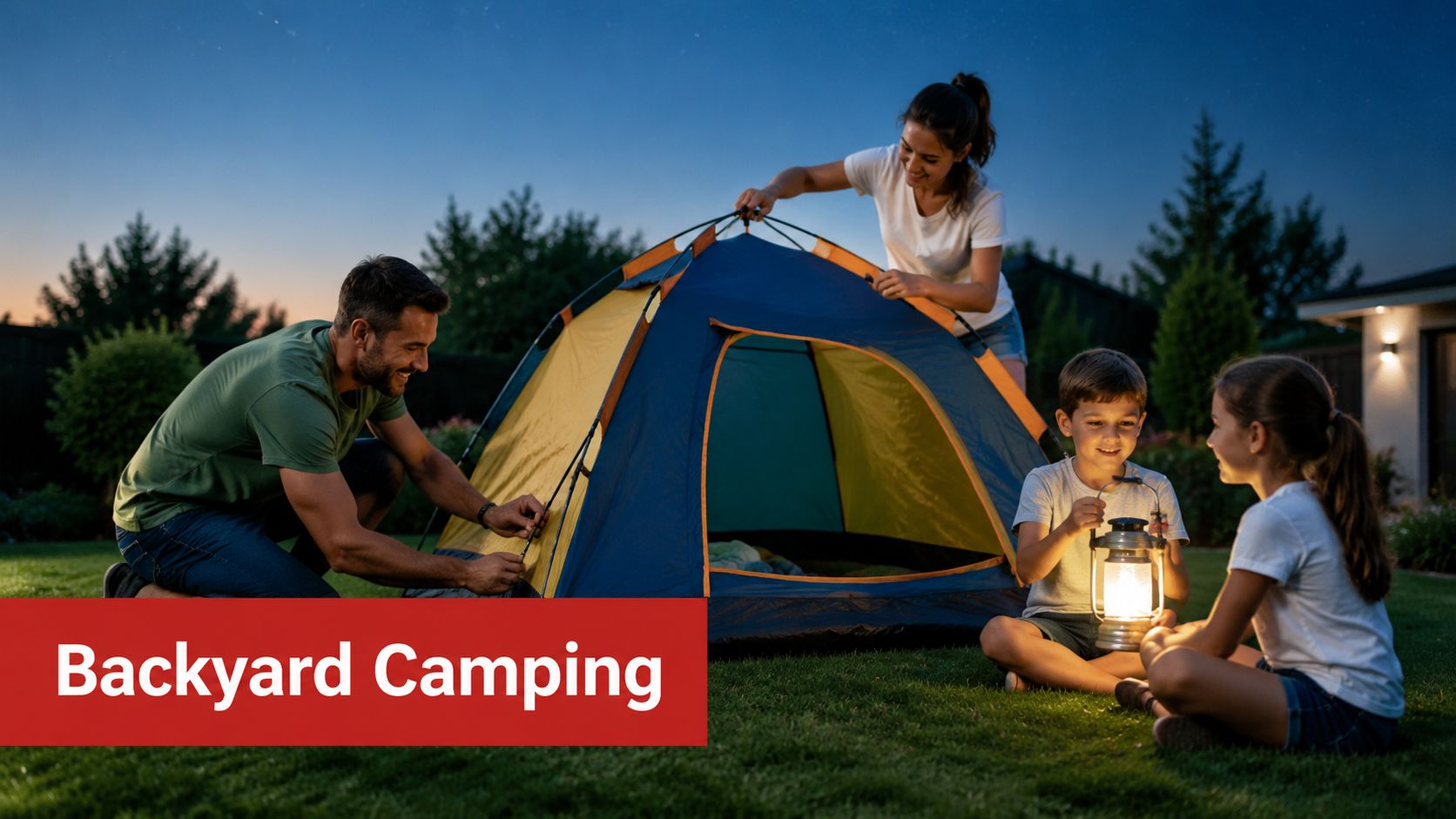
1. Backyard Camping Adventures
Backyard camping gives children the adventure of a night outdoors without the logistics of a distant campsite. They can help choose a spot, arrange sleeping bags, prepare simple food, and listen for evening sounds while a familiar home remains nearby.
Suggested ages: Preschoolers through early elementary children, with adaptations for older siblings.
Time and materials: An afternoon or evening, a play tent or family tent, blankets, flashlights, glow sticks, snacks, paper, and pencils.
Setup: Ask children to create a camping checklist before bringing out the equipment.
Start with afternoon setup if your child hasn't camped before. Let them build the tent, organize supplies, and spend time inside. For a first overnight, an indoor sleepover after outdoor play can offer the same excitement without making the experience overwhelming.
Use flashlights or glow sticks for a supervised nighttime nature search. Children can listen for insects, look for leaves and shadows, and record observations in a small nature journal. Cooking together also adds practical learning, whether you're preparing sandwiches, fruit skewers, or a safe outdoor snack.
Practical rule: Children can lead the camp setup, but adults should manage heat, flames, food safety, and nighttime supervision.
Learning outcomes: Planning, independence, descriptive writing, nature observation, and cooperative problem-solving.
Pros: Familiar setting, low travel demands, adaptable for younger children.
Cons: Weather, insects, and bedtime changes can affect the experience. Never leave a child unattended near a grill, fire source, or water.
A Playz play tent can help create a dedicated camp setting indoors or outdoors. Families can also find more ideas for kids' tents and outdoor play when they want to extend pretend camping beyond one evening.
2. DIY Science Experiments at Home
A kitchen counter can become a small science laboratory with baking soda, vinegar, water, food coloring, cups, droppers, and paper. The strongest experiments don't stop at a dramatic reaction. They ask children to predict, observe, compare, and explain what happened.
Suggested ages: Preschoolers with close adult help, elementary children working through simple hypotheses, and older children designing variations.
Time and materials: A short experiment can take part of an afternoon. Gather trays, household ingredients, measuring tools, paper towels, and a notebook.
Setup: Protect surfaces and place each activity on its own tray.
Start with something visually clear, such as a fizzing reaction, a floating and sinking test, or a simple density comparison. Ask, “What do you think will happen?” before adding ingredients. Afterward, have children draw the setup, describe the result, and suggest one change for the next trial.
A science notebook turns play into a repeatable learning routine. Children can record a question, prediction, materials, observation, and conclusion. Older children might change one variable, such as the amount of water or the shape of a container, while younger children can focus on vocabulary such as sink, float, dissolve, fizz, heavy, and light.
Learning outcomes: Observation, measurement, cause and effect, vocabulary, and flexible thinking.
Pros: Uses familiar materials and works indoors or outdoors.
Cons: Some experiments create spills or stains, and young children may put materials in their mouths. Adults should handle unfamiliar substances, supervise closely, and follow product labels.
Playz science kits can provide a ready-made starting point for families who want more guided exploration. For additional activity prompts, explore these science experiments for kids at home.
This short visual demonstration can also help children observe each step before trying their own version:
3. Nature Scavenger Hunts
Turn a familiar walk into a search mission. Instead of asking children to “go outside,” give them a focused question, such as finding something rough, something shaped like a circle, or three different kinds of leaves.
Suggested ages: Toddlers can search by color and texture, preschoolers can use picture clues, and older children can identify patterns or compare habitats.
Time and materials: A short walk or park visit, clipboard, pencil, checklist, magnifying glass, and optional camera.
Setup: Make the hunt match the location. A neighborhood list might include a mailbox, a bird sound, and a smooth stone. A park list could include bark, a seed, and a feather.
The activity works best when children investigate rather than collect. They can sketch a leaf, photograph an insect without touching it, or describe how two rocks differ. A collaborative hunt usually keeps younger children engaged better than a competition with winners and losers.
Choose a theme for each outing:
- Color search: Find natural objects in selected colors without picking living plants.
- Texture search: Compare smooth bark, rough bark, soft grass, and prickly surfaces from a safe distance.
- Sound search: Pause and record birds, wind, footsteps, or water.
- Shape search: Look for circles, spirals, lines, and repeating patterns.
Ask children what surprised them, what they expected to find, and how they could protect the place they explored.
Learning outcomes: Classification, descriptive language, physical activity, observation, and environmental care.
Pros: Flexible, inexpensive, and easy to repeat.
Cons: Heat, insects, uneven ground, and allergies require planning. Don't allow children to taste plants, handle unknown animals, or collect protected natural objects.
Children curious about rocks and fossils can continue the investigation with this guide on how to find a fossil.
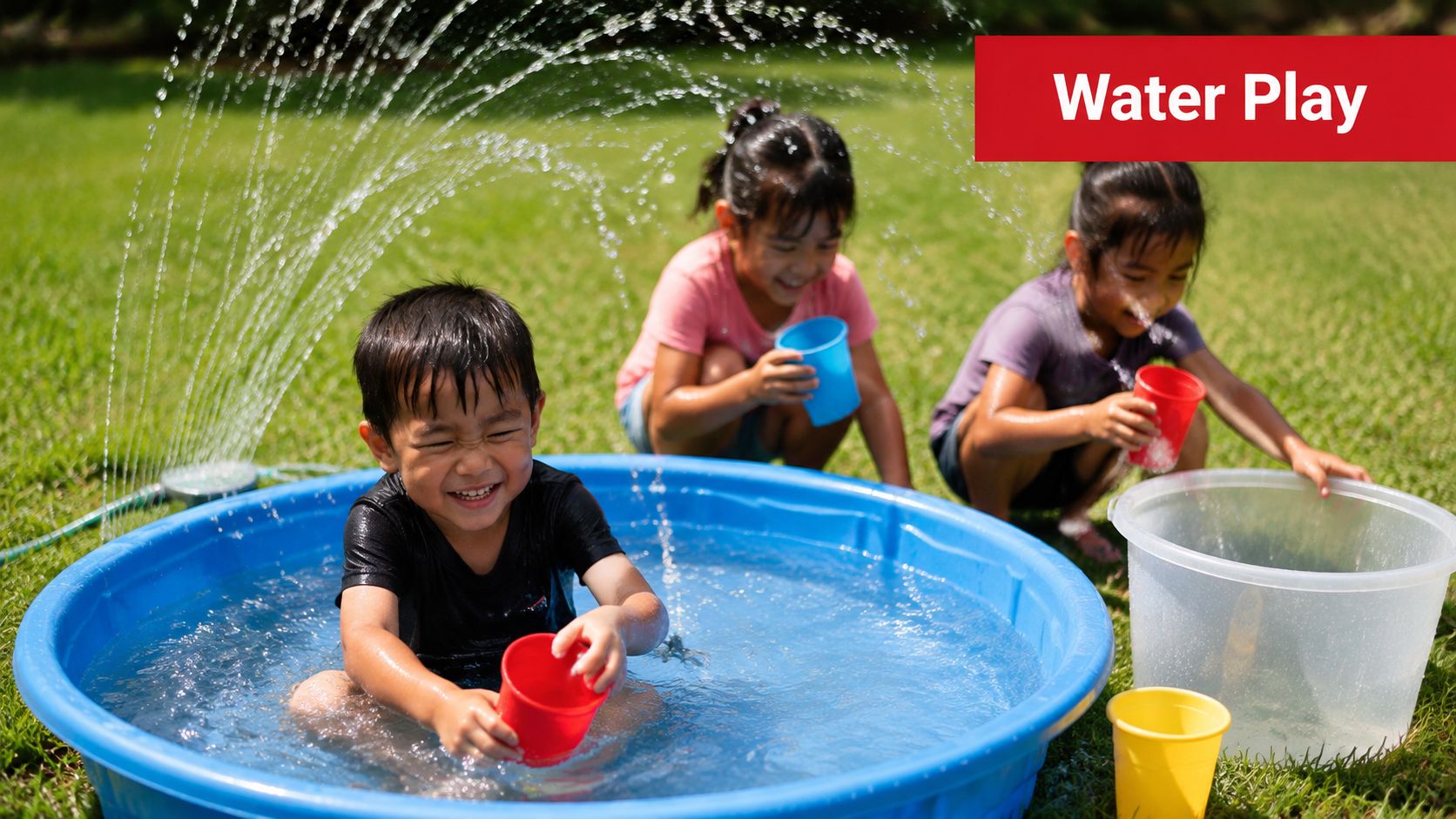
4. Water Play Stations and DIY Water Parks
On a hot day, separate water activities into stations instead of putting every container in one crowded area. A pouring station, floating station, and sponge-transfer station give children distinct challenges while keeping the setup manageable.
Suggested ages: Toddlers with constant supervision, preschoolers exploring sensory play, and older children solving water-flow challenges.
Time and materials: A short outdoor session or longer free-play block, shallow containers, cups, funnels, sponges, buckets, a sprinkler, and towels.
Setup: Place the stations on a stable surface near shade. Use only shallow water for young children.
At the pouring station, children move water between cups and notice which containers hold more. At the floating station, they predict whether a toy, cork, stone, or plastic lid will stay on the surface. For a problem-solving challenge, ask them to move water from one bucket to another using only a sponge or small cup.
Keep the activity open-ended. Children don't need a complicated water park to explore buoyancy, displacement, flow, and volume. A shaded rest area, drinking water, dry clothes, and frequent breaks make the experience more comfortable.
Learning outcomes: Sensory regulation, coordination, early physics, cooperation, and problem-solving.
Pros: Refreshing, adaptable, and engaging for mixed ages.
Cons: Water creates slipping, drowning, sun exposure, and hygiene risks. An adult must remain within reach of young children, and every container should be emptied after play.
Families planning larger water adventures can also review these portable fishing boat insights before choosing equipment for outdoor recreation.
Playz water-play ideas can add new variations when children need a fresh challenge. Try kids' water games for prompts that turn pouring and splashing into guided play.
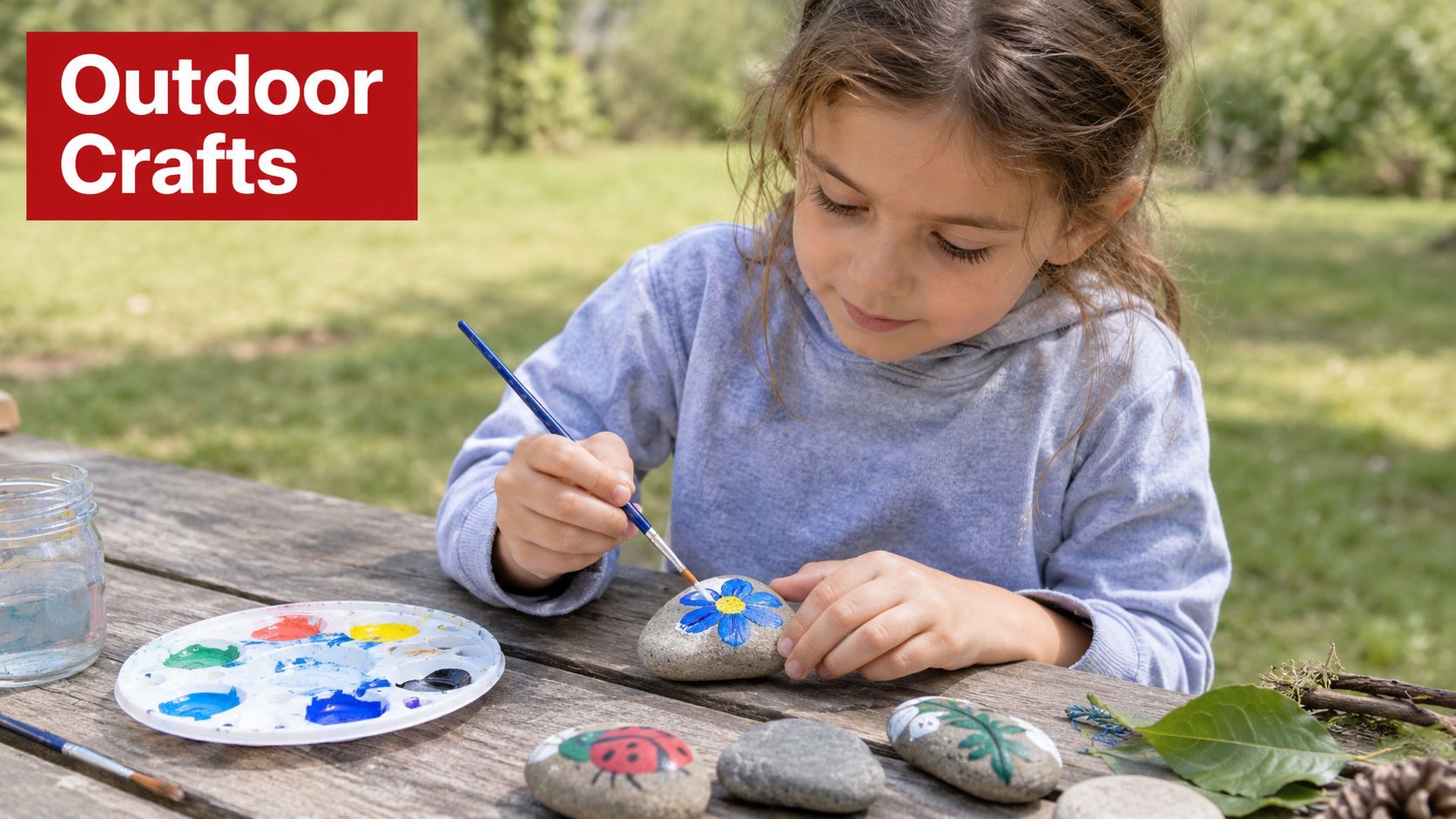
5. Outdoor Arts and Crafts Projects
Take art outside and let the setting influence the work. Sidewalk chalk, painted stones, leaf collages, stick structures, and nature mandalas all give children a creative task without requiring a perfectly clean indoor workspace.
Suggested ages: Toddlers can make marks and arrange large objects, preschoolers can create patterns, and older children can design collaborative installations.
Time and materials: A short creative session or an extended afternoon, washable chalk, paper, child-safe paint, brushes, glue, cardboard, and collected natural materials.
Setup: Set up a portable art tray on a washable surface. Collect only loose materials, and avoid removing living plants or disturbing animal habitats.
A nature collage can begin with a sorting task. Children choose leaves by shape, arrange twigs by length, and create a picture or repeating pattern. Chalk activities can combine art with movement, such as drawing a road map for toy vehicles or creating a life-size obstacle course.
Take a photograph before wind or weather changes the work. That simple step teaches children that art can be temporary and still valuable. For a group, invite everyone to add one section to a large mandala or sidewalk scene.
Learning outcomes: Fine-motor control, visual planning, pattern recognition, creative expression, and collaboration.
Pros: Outdoor space reduces cleanup concerns, and materials can be inexpensive.
Cons: Paint, glue, and natural objects can create stains, splinters, or allergic reactions. Use washable supplies, inspect sticks and stones, and keep small pieces away from children who still mouth objects.
Playz offers creative materials that can support a portable activity kit. For more prompts, browse these art and craft projects.
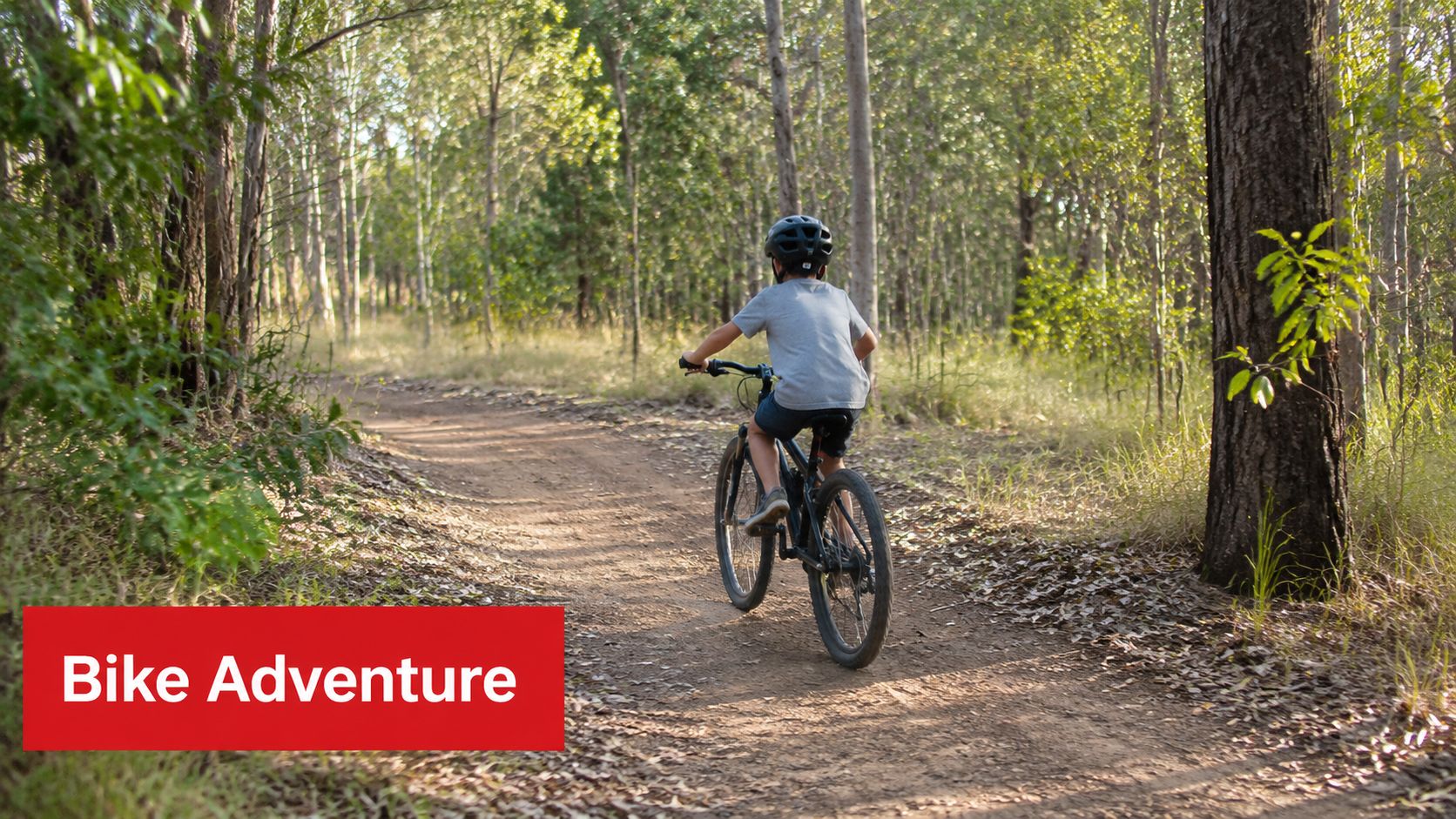
6. Bike Riding and Trail Exploration
Bike riding gives children a clear sense of progress. They balance, steer, stop, and gradually travel farther, turning a basic skill into an outdoor exploration routine.
Suggested ages: Toddlers may begin with balance bikes, younger children can practice with training wheels if appropriate, and confident riders can explore carefully selected trails.
Time and materials: A practice session or family ride, correctly fitted helmet, water, sunscreen, repair basics, and weather-appropriate clothing.
Setup: Begin on a flat, low-traffic area. Practice starting, braking, turning, and looking ahead before moving onto a trail.
Give children a destination that isn't too demanding, such as a shaded bench, a bridge, or a place to stop for a snack. During the ride, ask them to notice road surfaces, animal sounds, plant changes, or signs. That turns exercise into observation without interrupting the rhythm of movement.
A family ride should match the least experienced rider. Keep the route predictable, stop before children become overtired, and check bikes before leaving. Adults should model road awareness, helmet use, and respectful trail behavior.
Learning outcomes: Balance, coordination, endurance, spatial awareness, confidence, and route planning.
Pros: Builds independence and can become a regular family habit.
Cons: Falls, traffic, heat, and mechanical problems require preparation. Children need helmets and close supervision appropriate to their ability and surroundings.
Before heading out, use this guide to review eight essentials for cycling outings.
7. Imaginative Outdoor Play with Themed Tents and Forts
A blanket fort becomes more engaging when children give it a purpose. It might be a dinosaur research station, a castle, a space vessel, a wildlife clinic, or a quiet reading shelter.
Suggested ages: Preschoolers can act out simple stories, while elementary children can plan rules, roles, maps, and multi-step adventures.
Time and materials: A short setup followed by open-ended play, blankets, pillows, cardboard, clothespins, cushions, books, and theme-related props.
Setup: Offer a few materials, then let children decide what the structure will become.
Children practice spatial reasoning when they work out how to support a roof or make an entrance. They practice communication when siblings negotiate roles. A parent can start the story with one question, such as, “What does your explorer team need to discover?” and then step back.
Props should support the story without controlling it. Binoculars fit an explorer station, scarves can become royal costumes, and paper badges can identify a rescue team. Let children redecorate and revise the fort instead of insisting on one finished design.
The best fort isn't the most polished one. It's the one children can change, explain, and use together.
Learning outcomes: Storytelling, language, negotiation, design, planning, and social-emotional development.
Pros: Works indoors or outdoors and supports independent play.
Cons: Structures can collapse, block walkways, or become unsafe if children climb them. Keep exits clear and use stable, lightweight materials.
Playz themed play tents and pop-up play sets can provide a ready-made structure for imaginative scenarios. Add snacks and books for a quieter version, or combine a tent with a child-created map and pretend mission.
8. Gardening and Growing Projects
Gardening gives children a reason to return to the same place each day. They plant, water, observe, wait, and eventually harvest. The slow pace makes it a useful counterbalance to fast-moving digital entertainment.
Suggested ages: Young children can scoop soil and water with help, preschoolers can care for containers, and older children can keep records and compare growth.
Time and materials: A few minutes of regular care, pots or a garden bed, soil, seeds or starter plants, labels, and a watering can.
Setup: Choose a manageable container or small bed. Fast-growing, hardy options such as beans, marigolds, or sunflowers can help children see progress.
Give each child a clear responsibility. One child might check soil moisture, another might label containers, and another might draw the plant in a journal. Avoid turning care into a perfection test. Plants respond to weather, soil, light, and watering, so unsuccessful growth can become a useful observation rather than a failure.
Cooking completes the learning cycle when the plants are edible. Children can wash herbs, tear lettuce, arrange vegetables, or help prepare a simple snack with an adult. Discuss where food comes from and how the plant changed from seed to harvest.
Learning outcomes: Responsibility, patience, life-science observation, sensory awareness, and nutrition vocabulary.
Pros: Fits balconies, patios, yards, and classroom spaces.
Cons: Plants need ongoing care, and soil, tools, or fertilizers may be unsafe if handled improperly. Adults should supervise digging tools, handwashing, and any edible plants.
A garden journal can include drawings, weather notes, questions, and measurements. Children don't need formal worksheets. Their own observations are enough to make the project meaningful.
9. Building and Construction Projects
Give children a pile of cardboard boxes, tubes, blocks, recycled containers, tape, and paper. Then add a design challenge. “Build a shelter that stands,” “make a bridge for a toy,” or “create a vehicle with an opening” encourages planning before construction begins.
Suggested ages: Toddlers can stack large blocks, preschoolers can build simple structures, and older children can work with constraints and test designs.
Time and materials: A short build or multi-day project, blocks, LEGO bricks, cardboard, paper tubes, masking tape, craft sticks, and child-safe scissors.
Setup: Clear a floor area and place materials where children can reach them safely.
Ask children to draw a quick plan before building. The plan can be a simple sketch, a list of materials, or a picture of the finished structure. When the build collapses, ask, “Which part moved first?” or “What could support this side?” Questions keep the child in charge of the solution.
Change the challenge for different ages. Younger children might build the tallest stable tower. Older children might design a cardboard house with a doorway, create a bridge that spans a marked gap, or build within a limited material set.
Learning outcomes: Spatial reasoning, sequencing, engineering thinking, patience, and perseverance.
Pros: Uses recycled materials and naturally supports rebuilding.
Cons: Small parts, sharp edges, and unstable structures can create hazards. Supervise scissors and cutting, remove staples, and keep large builds away from stairs and walkways.
Photograph the finished creation before dismantling it. The record helps children reflect on what worked and gives them a starting point for the next design.
10. Outdoor Sports and Games Tournaments
A tournament adds structure to familiar games without requiring formal equipment. Badminton, frisbee, jump rope, roller skating, and simple relay games can all become part of an afternoon designed around participation and improvement.
Suggested ages: Choose simple throwing, catching, and movement games for younger children. Older children can help write rules, organize rounds, and track progress.
Time and materials: A short event or longer neighborhood gathering, open space, soft equipment, cones, chalk, water, and a rest area.
Setup: Offer several activity levels instead of one standard challenge.
A tournament doesn't have to focus on winning. Children can earn recognition for a creative throw, steady improvement, helpful teamwork, or careful rule-keeping. Cooperative games, such as group relay challenges or shared target goals, can sit alongside competitive rounds.
Let children help manage the event. They can draw a court, choose teams, make scorecards, or explain the rules to younger players. Adults should review the play area for holes, traffic, hard obstacles, and excessive heat before the games begin.
Learning outcomes: Motor skills, teamwork, communication, sportsmanship, decision-making, and self-regulation.
Pros: Works for groups and can accommodate different abilities.
Cons: Competition may frustrate some children, and active play increases heat and injury risks. Build in rest, offer water, adjust rules, and stop when children show signs of overheating or distress.
The best format is one children want to repeat. Keep the games short enough to maintain interest, and let the group vote on the next activity.
Top 10 Summer Activities Comparison
| Activity | 🔄 Implementation Complexity | ⚡ Resource Requirements | 📊⭐ Expected Outcomes | 💡 Ideal Use Cases | ⭐ Key Advantages |
|---|---|---|---|---|---|
| Backyard Camping Adventures | Low, simple setup, short planning | Low–Medium, tent, lights, snacks, yard space | Family bonding, basic camping skills, outdoor confidence | Intro to camping; young children; supervised outdoor nights | Accessible and safe; memorable; low travel cost |
| DIY Science Experiments at Home | Low–Medium, prep & safety monitoring | Low, household items or optional kits | Hands-on STEM learning, observation, problem-solving | Rainy days, STEM lessons, curiosity-driven play | Highly engaging; scalable difficulty; immediate results |
| Nature Scavenger Hunts | Low, create lists or clues | Very Low, checklist, clipboard, optional app | Observation skills, species ID, physical activity | Park walks, field trips, family exploration | Flexible, minimal cost; promotes environmental awareness |
| Water Play Stations & DIY Water Parks | Low–Medium, station setup & rotation | Low–Medium, pools, sprinklers, toys, water source | Sensory learning, motor skills, cooling physical play | Hot weather, group play, sensory exploration | Adaptable to space/budget; high fun and activity level |
| Outdoor Arts & Crafts Projects | Low, simple materials and setup | Low, natural/recycled materials, basic art supplies | Creativity, self-expression, sensory engagement | Quiet outdoor art time, nature-inspired projects | Low cleanup; uses sustainable materials; sparks creativity |
| Bike Riding & Trail Exploration | Medium, skill progression & safety prep | Medium, bike, helmet, maintenance, safe routes | Cardiovascular fitness, balance, independence | Neighborhood rides, trail exploration, family outings | Long-term skill building; affordable after initial buy |
| Imaginative Play: Themed Tents & Forts | Low, easy assembly or DIY builds | Low–Medium, tents, props, indoor/outdoor space | Imagination, role-play, social and language skills | Pretend play, reading nooks, collaborative storytelling | Deeply engaging; repeatable; screen-free focus |
| Gardening & Growing Projects | Medium, planning + ongoing care | Low–Medium, seeds, soil, pots, tools | Responsibility, plant biology, nutrition awareness | Long-term learning, school gardens, apartment containers | Tangible results; teaches patience and stewardship |
| Building & Construction Projects | Medium, design, build, test cycles | Low–Medium, blocks, recycled materials, kits | Spatial reasoning, engineering concepts, persistence | Maker challenges, STEM enrichment, group builds | Scalable complexity; fosters problem-solving |
| Outdoor Sports & Games Tournaments | Medium–High, organize rules & schedules | Medium, equipment, safe space, supervision | Athletic skills, teamwork, sportsmanship | Community events, school field days, organized play | Promotes fitness, competition, community engagement |
Build a Summer of Play, Learning, and Discovery
The right activity depends less on creating a perfect schedule and more on matching the idea to the child in front of you. A child who needs movement may respond to biking, water stations, or a sports tournament. A child who is absorbed by questions may prefer home science, gardening, or a nature hunt. A child who needs calm, independent play may settle into a themed tent, fort, construction project, or outdoor art activity.
Start with one choice. Ask, “Do you want to move, make, discover, pretend, or test something?” That question gives children meaningful control without handing them an unlimited list. You can then offer two realistic options, such as a chalk obstacle course or a scavenger hunt.
Use the available conditions to narrow the decision:
- For active play: Choose biking, water stations, or outdoor games.
- For creativity: Choose sidewalk art, nature collages, forts, or cardboard construction.
- For exploration: Choose backyard camping, a scavenger hunt, or gardening.
- For STEM learning: Choose a science experiment, a building challenge, or a plant-growth journal.
- For limited space: Choose a fort, science tray, container garden, or tabletop construction project.
- For changing weather: Keep a tent, art tray, building materials, and science supplies ready indoors.
Materials should stay manageable. A small basket of chalk, paper, tape, cups, pencils, and child-safe tools can support many activities. Too many supplies can make children wait for adults to organize instead of starting independently.
Difficulty should change with the child. Younger children may need a picture checklist, larger materials, shorter instructions, and direct supervision. Older children can plan the setup, modify the rules, document results, and teach a younger sibling. The adult's role can shift from demonstrator to questioner, then to observer.
Safety still comes first. Supervise activities involving water, heat, tools, roads, animals, and small parts. Check the play area, provide shade and drinking water outdoors, use age-appropriate equipment, wash hands after gardening or nature exploration, and stop an activity when the conditions no longer feel safe. Screen-free doesn't mean adult-free when the activity carries a real hazard.
Families also don't need to reject every device to create healthier summer rhythms. The Aura report linked to recent device-use findings describes how children's summer device habits can increase, with younger children spending more time on devices and teens devoting a large share of summer device time to social media. That makes a screen-aware swap more practical than a vague rule. Replace a Roblox session with a building challenge, a scrolling break with a scavenger hunt, or passive viewing with a science activity that lets children test something themselves.
Short outdoor play matters too. A 2025 NIH-linked position statement associates active outdoor play with more physical activity, less sedentary behavior including recreational screen time, and better sleep, as described in this position statement on active outdoor play. You don't need to fill the whole day. A brief, repeatable activity can build a rhythm that children recognize and request.
There is a strong tradition behind these choices. The National Park Service notes that around 100 youth summer camps existed in the United States at the start of the 20th century, mostly in the Northeast, and that the number had grown to more than 1,000 by 1918, according to the historical account available through this open-access review. Camps grew around outdoor exploration, teamwork, and learning through play, the same qualities that make a simple backyard activity feel purposeful today.
Structured summer experiences also continue to operate at scale. One forecast estimates the global children's summer camp market at about USD 20.5 billion in 2024, with a projection near USD 37.5 billion by 2033 and a 6.5% CAGR, as reported by DataHorizzon Research's children's summer camp market forecast. Families don't need to buy a camp schedule to use the same basic principle. Give children movement, discovery, social interaction, and a chance to make decisions.
Choose one card today. Set out the materials, explain the first step, and let your child take over as soon as they can. For practical ideas about creating play-friendly outdoor spaces, explore these family-friendly landscaping ideas.
Playz offers play tents, science kits, and creative toys that can extend screen-free summer learning through imaginative, hands-on play. Visit Playz to find tools that support building, experimenting, creating, and purposeful indoor or outdoor activity.