

A child may have plenty to say, yet still need inviting reasons to listen, name, describe, predict, and take turns. Maybe they point to a toy and call everything “that,” retell a favorite story in a few words, or rush through a conversation before another person can respond. These moments aren't failures. They're useful starting points for language practice.
The strongest language development activities fit into play, books, music, movement, and ordinary routines. This roundup organizes practical ideas by developmental emphasis and age range, with a repeatable objective, simple materials, step-by-step instructions, adaptations, and observation-based progress checks. You'll find activities for toddlers, preschoolers, kindergarten children, families, and early-years groups, plus ideas that can help make Irish words stick when children are learning more than one language.
Progress is best observed across repeated sessions, not judged after one attempt. Track one small behavior, celebrate effort and communication, and discuss persistent concerns with a qualified speech-language professional.
1. Storytelling Circle with Props
Best for: Preschool and early-years groups
Primary skill: Vocabulary, narrative structure, expressive language, and turn-taking
A storytelling circle turns children from listeners into co-authors. Place a few safe objects, toys, picture cards, or seasonal items in the middle. One child begins with a sentence, and each child adds a detail that connects to what came before.
Try a classroom story about a rainy morning. One child says, “A bear found an umbrella.” The next adds, “Then the bear walked to the tent.” Another child might introduce a problem, such as a missing snack. Familiar themes make it easier for hesitant speakers to join.
How to run it
- Materials: Three to six props, picture cards, or small toys.
- Sequence: Establish a speaking order, model the opening sentence, invite each child to add one idea, and retell the completed story together.
- Language prompts: “Then…,” “Next…,” “Suddenly…,” and “At the end…”
- Adaptation: Toddlers can name a prop or copy a short phrase. Older children can add a setting, problem, solution, and ending.
- Progress check: Note whether a child waits for a turn, adds a connected detail, or uses a new descriptive word.
A Playz toy tent can become a forest shelter, shop, or spaceship setting without needing a screen. For more circle-time variations, explore circle time activities for toddlers. Families can also use household objects during a relaxed game night and record stories to celebrate growing detail. Adults who enjoy storytelling can browse writing resources for authors for extra narrative inspiration.
2. Rhyme Time Jump and Learn
Best for: Around age four and preschool
Primary skill: Rhyming, sound awareness, listening, and movement
A child hears “cat,” spots “hat,” and hops across the room to match them. This quick action gives a concrete purpose to listening. Rhyming helps children notice which word endings sound alike, while movement keeps the task active instead of making it feel like a test.
An early-literacy guide suggests inviting children to generate rhymes for words such as “bat” or name words that begin with /b/ through using these rhyme and sound games.
Spread picture cards or word cards across a clear floor area. Begin with familiar pairs, such as “cat” and “hat” or “sun” and “run.” Say the target word, show its picture, and ask children to jump to a card with the same ending sound. Once matching feels familiar, ask, “What else sounds like cat?” Repeat each attempt clearly, including playful or imperfect answers, so children can compare the sounds.
Set-up: Picture cards, floor markers, and open movement space.
Play it this way:
- Say one target word slowly.
- Let children choose a rhyming card and move to it.
- Repeat both words, stressing their shared ending.
- Invite children to suggest another rhyme.
- Finish by sorting a few rhyming and non-rhyming cards.
Toddlers can move whenever they hear a repeated word or copy the adult's final sound. Older preschoolers can sort rhymes from non-rhymes and identify the starting sound, while still hearing the complete words first.
Watch for a child who recognizes a rhyme, produces a possible pair, or begins noticing the initial sound. These observations show which part of the listening skill needs more practice.
A Playz play tent can be a quiet “rhyme station,” where one child jumps inside after finding a match. Keep the area clear and offer turns so excitement does not crowd out listening. Repeated sound play builds familiarity before accurate rhyming becomes consistent.
3. Vocabulary Scavenger Hunt with Picture Labeling
A child hears “elephant,” finds the matching toy, and then has a reason to use the word. This concrete link supports receptive vocabulary, understanding a word when someone says it, and expressive vocabulary, using it independently.
Choose a small set of familiar objects and hide or place them around a safe area. Show one picture, say the word, and invite the child to find its match. Afterward, extend the response: “Elephant.” “Big elephant.” “The elephant walks.” These short additions model description, category, and action without demanding a long sentence.
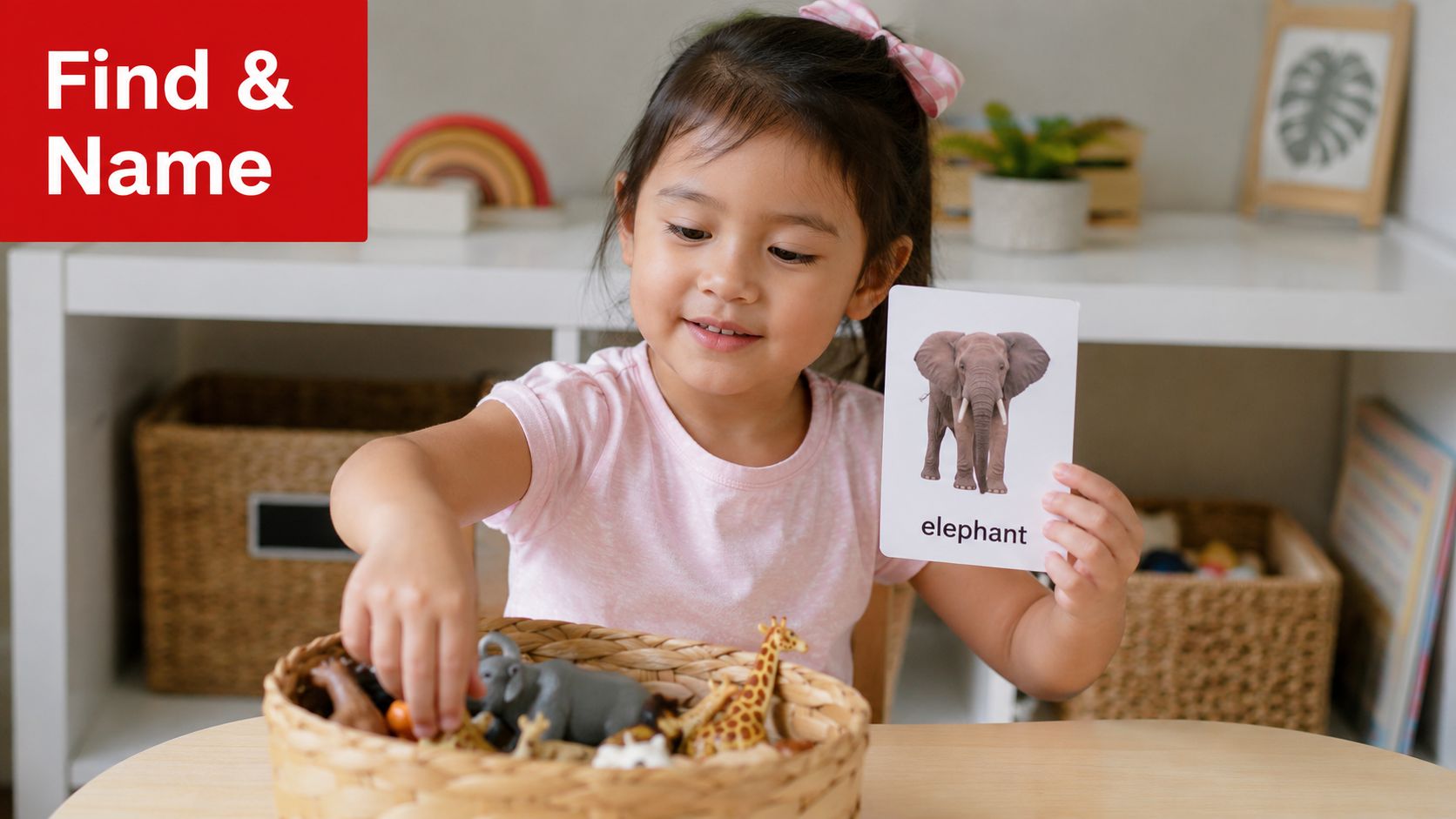
Use the same learning loop: picture, spoken label, search, match, and phrase. Prepare picture cards, written labels, household objects, or Playz toys. Keep the first round brief, then repeat with a different theme. Add the family's home-language label beside the English word and use both naturally, so the child can connect new vocabulary with familiar language.
A home hunt might include a spoon, sock, ball, and book. Outdoors, use these nature scavenger hunt ideas, then photograph found objects for a later recall conversation.
For toddlers, accept pointing, touching, or an approximate label. Older children can sort objects by size, function, color, or category and explain one choice. Observe whether the child finds the correct item, says the word without a model, or uses it in a phrase. Picture cards require preparation, but consistent matching makes the activity easy to repeat.
4. Sound Sorting and Phoneme Games
Best for: Preschool and kindergarten
Primary skill: Phonemic awareness and sound discrimination
A child hears “ball” and “banana,” notices that both begin with /b/, and places them in the same hoop. This simple decision builds the listening skill that supports later letter and word reading. Begin with clear differences, using a ball, banana, sun, and sock. Say each word slowly, stretch the first sound, and postpone similar-sounding pairs until the child can hear the contrast.
Use the game in short rounds. Name an object, emphasize the target sound, and model one sort. Then let the child place each item and explain the match, using words, a gesture, or pointing. Touch your lips for /m/, tap your arm for each sound, or move a card into the matching hoop to connect listening with movement.
- Materials: Picture cards, small objects, letter cards for older children, and sorting hoops.
- Younger adaptation: Sort by the overall sound of a word, such as words that sound alike at the beginning.
- Older adaptation: Compare initial, middle, and final sounds, then introduce a letter card after the child hears the sound.
- Progress check: Observe whether the child attends to the target sound, sorts without a model, and explains or indicates the match.
Playz toy collections can provide familiar objects for hands-on, screen-free sorting. Keep the set small in an intervention group and repeat one target sound across several sessions. A child may understand the sound distinction before being able to pronounce it clearly, so record listening and speaking separately. Correct sorting, even without speech, shows useful progress.
5. Conversation Building with Question Prompts
Best for: Toddlers through early primary years
Primary skill: Back-and-forth conversation, elaboration, and pragmatic language
A child's answer often grows when an adult responds to the meaning rather than correcting the grammar. If a child says, “Dog run,” you might say, “Yes, the dog is running fast.” That expansion models a fuller sentence while keeping the conversation positive.
Use a toy scene, photograph, story picture, or everyday event. Ask open questions that invite more than a yes or no answer: “What's happening?” “Where could they go?” “How do you know?” Follow the child's answer with one related prompt.
A practical conversation ladder
- Notice: “You built a tall tower.”
- Invite: “What is it for?”
- Follow up: “Who lives there?”
- Expand: “So the tiny fox lives at the top.”
- Wait: Give the child time to respond.
- Materials: Question cards, photos, toys, or a picture book.
- Younger adaptation: Offer choices, such as “Is it big or small?”
- Older adaptation: Ask for reasons, predictions, and explanations.
- Progress check: Count successful turns, longer responses, or spontaneous follow-up questions.
A Playz play scenario can supply a concrete reason to talk, such as deciding who enters a tent or what a pretend explorer needs. Keep a brief note after the activity rather than recording every conversation. Families looking for playful prompts can also explore games and conversations.
6. Dramatic Play Centers with Role-Playing Scripts
Best for: Preschool and childcare settings
Primary skill: Social communication, vocabulary, negotiation, and pretend-play language
A pretend shop turns vocabulary into action. Children greet customers, request items, make choices, describe objects, and solve small problems. A clinic corner creates different language needs, including asking questions, explaining symptoms, offering reassurance, and waiting for a turn.
Choose one familiar theme and prepare a small set of props. Add picture signs or labels so children can connect spoken words with visible meaning. Model two short lines, then let children shape the scene. For example, a ticket seller might ask, “Where are you going?” A child who is hesitant can begin by handing over a ticket, then repeat the phrase with support.
Materials: Props, costumes, picture signs, notepads, and a Playz play tent for a shop, home, campsite, or office.
Repeatable routine: Introduce the setting, name the roles, model a short exchange, and pause when a problem appears. Prompt useful language such as “I need,” “Can I have,” or “What should we do?”
Younger children can imitate actions and short phrases. Older children can write menus, tickets, labels, or simple scripts. Observe whether children greet others, make requests, negotiate roles, and use words to resolve disagreement.
Keep the theme and some props available across several sessions. Repetition gives children time to move from copying phrases to creating their own. A puppet offers another speaking route for a reluctant child. Use this guide to make a puppet, then let the character ask for help, make a mistake, or begin a story.
7. Sing and Sign Language Learning
Best for: Toddlers, preschool groups, multilingual settings, and inclusive classrooms
Primary skill: Vocabulary, rhythm, communication access, and sound awareness
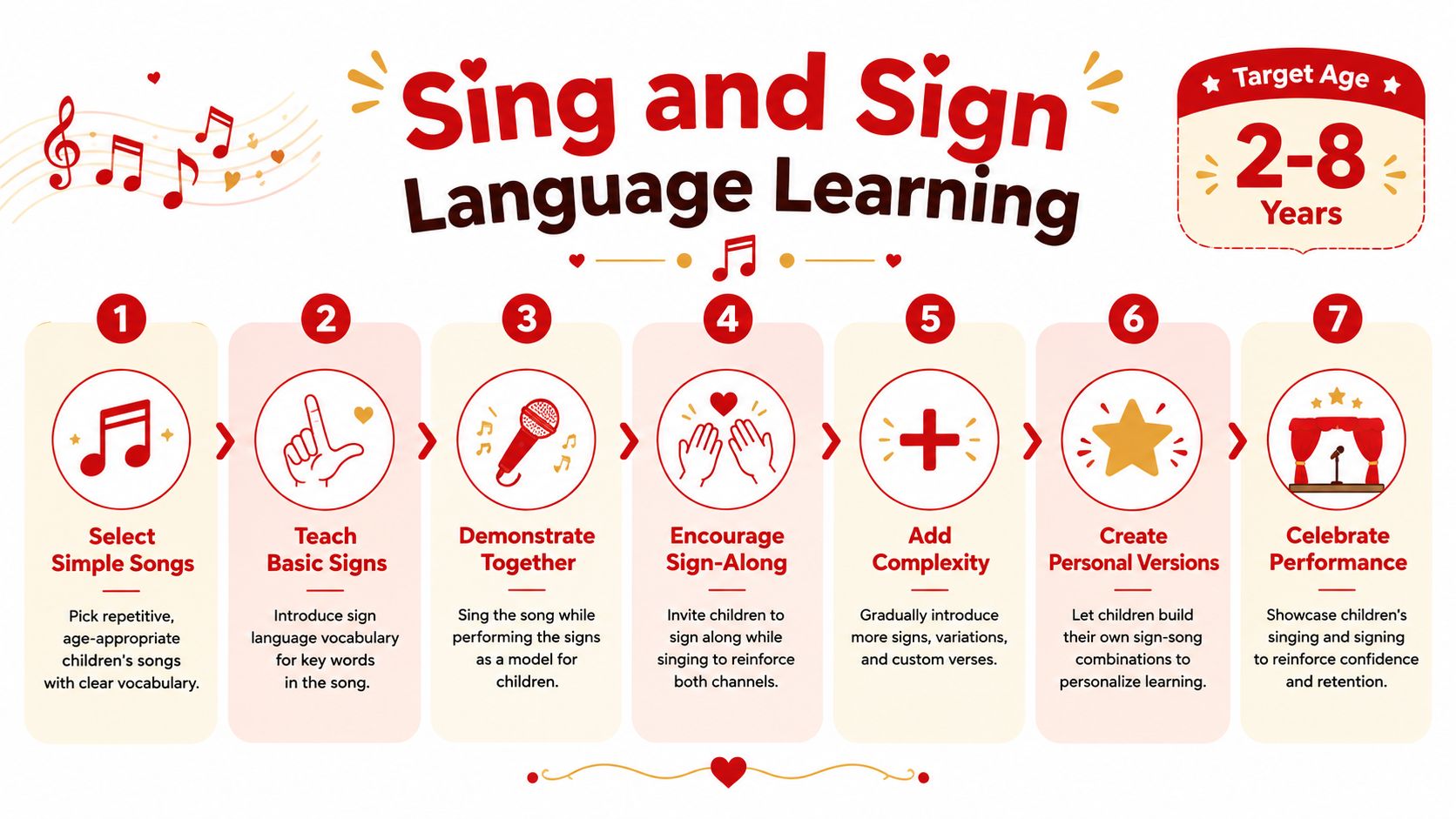
A child may know what “more” means before being ready to say it. Singing pairs repeated words with melody, while signs add a visual and physical cue. Together, these routes can support children with hearing differences, multilingual learners, and children developing spoken language at different rates.
Start with a familiar song and choose a small group of useful words, such as “more,” “stop,” “go,” “open,” or animal names. Show each sign on its own, then sing slowly while using it. Keep saying the word so the sign reinforces spoken language rather than replacing shared interaction.
Let the song set the pace
Prepare a song, visual sign cards, instruments, and open space. Introduce two or three signs, practice them without music, then sing a short verse. Add gestures or simple movements, pause before a repeated word, and let children supply the sign or sound. A child can lead one verse once the routine feels familiar.
Toddlers might copy one sign or join a repeated phrase. Older children can sign several key words, spot rhyming words, or teach the song to a partner. Watch for recognition of a sign, spontaneous use, participation in repeated language, and anticipation of the next word. These observations show whether the child is copying, understanding, or beginning to communicate independently.
Use community-informed resources when teaching signs, particularly in settings serving Deaf or hard-of-hearing children. Music toys can add turn-taking and sound exploration to a screen-free song station, including music toys for toddlers.
A brief visual demonstration helps adults prepare signs before leading the group.
8. Letter and Word Formation with Multisensory Techniques
Best for: Preschool and kindergarten
Primary skill: Letter recognition, sound-symbol connection, and early writing
At the writing table, a child may recognize a letter on a card but hesitate when asked to form it. Offer the same letter through touch, movement, speech, and sight. Tracing sand, shaping play dough, arranging letter pieces, and saying the sound connect one symbol with several memory cues. This approach reflects the principles of multisensory learning.
Begin with one useful letter, such as the first letter of the child's name or a familiar object. Name the letter and its sound, show where the formation starts, then invite the child to trace or build it. Keep the directions consistent: “Start at the top, go down, and across.” The repeated language acts like a verbal map for the hand.
Set up a small station with a sand tray or another safe textured surface, play dough, letter cards, paper, and writing tools. Follow this sequence: look at the letter, say its sound, trace it, build it, find it in a word, and try writing it. Young children can begin with lines, curves, and noticing the first letter in their names. Older children can form short familiar words and compare letters with similar shapes.
Watch the process rather than judging neatness. Record whether the child identifies the letter, produces its sound, follows the intended direction, and connects it with a word. If formation breaks down, return to tracing or building before asking for independent writing.
A Playz play tent can define the entrance to the letter-learning center, while trays keep materials together. This setup supports hands-on, screen-free practice without making the toy the focus.
9. Picture Walk and Guided Narrative Discussion
Best for: Toddlers through early primary reading groups
Primary skill: Vocabulary, prediction, comprehension, and narrative language
A picture walk slows reading down before children need to decode printed words. Look through the illustrations together and invite observations, predictions, and connections. The adult's role is to model rich language, ask open-ended questions, and help the child explain their thinking.
Shared book reading is especially valuable when adults ask open questions, model varied vocabulary, and help children create their own books or texts about themselves, as described in this evidence review of early speech and language approaches.
Follow the child's attention
Start with literal questions, such as “What do you see?” Move toward prediction: “What might happen next?” Then invite interpretation: “Why does the character look worried?” Wait after asking. Children often need more time to organize a response than adults expect.
- Materials: A picture book or illustrated sequence.
- Younger adaptation: Point, label, imitate sounds, and offer choices.
- Older adaptation: Ask for evidence from the picture and a retelling with a beginning, middle, and ending.
- Progress check: Note new words, predictions, story details, and whether the child connects the book to personal experience.
A bedtime picture walk may take only a few minutes. The trade-off is that you may read fewer pages, but the child gets more opportunities to talk, listen, and explain.
10. Vocabulary Building through Themed Play Boxes
Best for: Toddlers through early primary years
Primary skill: Categorization, semantic relationships, and extended vocabulary
A themed play box gathers related objects so children can compare, sort, describe, and use words in context. A kitchen box might contain a cup, spoon, bowl, cloth, and pretend food. An animal box can include figures, habitat pictures, and natural materials.
The adult should introduce a small group of words, then let the child explore. Rather than naming everything continuously, pause and listen. Ask, “Which one is used for eating?” “What does the spoon do?” “Where could the rabbit hide?”
Build, play, and revisit
- Materials: Real objects where safe, toy figures, photos, labels, and a storage box.
- Sequence: Introduce the theme, name objects, sort by category or function, create a play scene, and revisit the words during cleanup.
- Younger adaptation: Use a few familiar objects and accept pointing, gestures, sounds, or single words.
- Older adaptation: Add describing words, comparisons, and story problems.
- Progress check: Observe whether the child labels objects, groups related items, describes functions, and uses words outside the box.
A Playz toy collection can provide a hands-on starting point, while picture-and-word labels help children connect objects to print. Families can invite children to add safe household items, which makes the box more personal and reduces the need to buy every resource.
Keep boxes accessible but rotate themes when children need renewed interest. A stable routine matters more than a large collection.
Top 10 Language Development Activities Comparison
| Activity | 🔄 Implementation complexity | ⚡ Resource requirements | 📊 Expected outcomes | Ideal use cases | ⭐ Key advantages |
|---|---|---|---|---|---|
| Storytelling Circle with Props | Low–Moderate; needs facilitation to keep cohesion | Minimal: props, picture cards, story starters | Vocabulary expansion, narrative structure, turn-taking | Circle time, mixed-age groups, family nights | Peer feedback, adaptable format (💡 use sentence starters) |
| Rhyme Time Jump & Learn | Low; requires safety rules and supervision | Low: open space, optional floor markers, picture cards | Phonological awareness, gross motor coordination | Active preschools, early literacy movement sessions | Highly engaging for kinesthetic learners (💡 start with familiar words) |
| Vocabulary Scavenger Hunt with Picture Labeling | Moderate; prep time to hide and match items | Moderate: picture cards, labels, objects, baskets | Receptive/expressive vocabulary, categorization, visual discrimination | Classroom centers, home therapy, multilingual activities | Contextualized retention via real objects (💡 use concrete nouns) |
| Sound Sorting and Phoneme Games | Moderate–High; needs precise modeling and repetition | Low–Moderate: picture cards, objects, sorting containers | Phonemic awareness, sound-symbol correspondence, decoding prep | RTI groups, phonological intervention, small-group literacy | Evidence-based literacy gains (💡 use distinct sounds first) |
| Conversation Building with Question Prompts | High; requires skilled adult questioning and responsiveness | Low: picture books, prompt cards, photos | Pragmatic language, expressive complexity, discourse skills | SLP sessions, guided reading, parent coaching | Highly individualized language growth (💡 use open-ended Qs) |
| Dramatic Play Centers with Role-Playing Scripts | Moderate; set-up and ongoing facilitation needed | Moderate: play tents, costumes, props, script cards | Pragmatic language, social negotiation, extended discourse | Choice-time centers, play-based therapy, preschool classrooms | Authentic, sustained practice and motivation (💡 rotate themes) |
| Sing and Sign Language Learning | Moderate–High; requires sign knowledge and coordination | Low–Moderate: songs, sign cards, music player, videos | Multimodal vocabulary, phonological rhythm, inclusive communication | Inclusive preschools, bilingual/deaf education, music therapy | Multimodal retention and inclusivity (💡 start with familiar songs) |
| Letter & Word Formation with Multisensory Techniques | Moderate; materials prep and management (can be messy) | Moderate: sand trays, play dough, letter manipulatives, textured surfaces | Letter recognition, motor planning, early writing skills | Alphabet centers, literacy intervention, kindergarten | Strong multisensory retention for struggling learners (💡 use consistent directional language) |
| Picture Walk and Guided Narrative Discussion | Moderate; needs adult questioning skill and time | Low: picture books, sequencing cards, prompt cards | Comprehension, prediction, inference, vocabulary growth | Guided/shared reading, one-on-one sessions, preschool groups | Improves deep comprehension (💡 allow wait time for responses) |
| Vocabulary Building through Themed Play Boxes | Moderate; initial curation and storage required | Moderate: themed objects, picture cards, labeled boxes | Thematic vocabulary, semantic networks, sustained engagement | Literacy centers, home thematic play, multilingual families | Organized, reusable thematic learning (💡 use durable picture-word labels) |
Make Progress Visible Through Play
Language development doesn't require every activity to happen every day. Families and educators can create a simple weekly rotation that gives children repeated practice across different skill areas. Use movement and sound play for early phonological practice, object-based hunts and themed boxes for naming and categorizing, and conversation or storytelling for longer responses.
A time-poor family might use a sound game while walking to school, label objects during bath time, and ask one prediction question during a bedtime book. An educator might place a vocabulary box in the classroom, use a rhyme game during group time, and return to a story prop during free play. These short moments are easier to sustain than a rigid schedule packed with formal lessons.
The 2025 longitudinal study linked a richer home learning environment at age three, including storytelling, drawing, music, toys and games, everyday home activities, outdoor play, and reading, with stronger expressive vocabulary and grammar at that age and higher receptive language scores from ages five to nine. The findings support a practical principle: ordinary caregiver-led routines can contribute to language development over time through the home learning environment described in the study.
However, families shouldn't be made to feel that an ideal routine is the only route forward. A 2025 National Literacy Trust report found that, among UK parents of children aged zero to five, daily reading was 45.9%, daily play was 51.6%, and daily chatting was 70.2%, with declines concentrated in disadvantaged communities. The report identified lack of time, low confidence, and cost pressures as important barriers in its research on daily parent-child activities.
Observe one behavior at a time: Track a new word used independently, a successful conversational turn, a rhyme match, or a story detail retold.
A 2025 parent intervention that encouraged adults to talk about vocabulary words improved preschool vocabulary and strengthened beliefs about the value of parental input. A 2026 national trial of the Talking Time programme found that small-group conversation, storytelling, and play improved young children's language skills within months while educators learned to embed evidence-based talk strategies into ordinary nursery practice as reported in the national trial. The practical lesson is not to chase perfect performance. It's to offer short, structured prompts often enough for children to practice.
Celebrate attempts as well as accuracy. A child who points, signs, imitates, waits, or adds one detail is communicating. Write down what happened, repeat the activity later, and look for changes in independence, length, flexibility, and confidence. If concerns persist across settings or interfere with everyday communication, share your observations with a qualified speech-language professional.
Playz offers hands-on options such as play tents, creative toys, and science kits that can give children more screen-free reasons to name, describe, negotiate, and imagine. Visit Playz to choose a play setup that fits your child's interests, then use it as a daily setting for conversation, storytelling, and purposeful language practice.