


A child can start with a clipboard in a backyard, schoolyard, or park and quickly turn ordinary leaves, textures, tracks, and clouds into questions worth investigating. Why is one leaf smooth while another is serrated? Which insects share a patch of grass? What changed since the last visit?
The strongest nature scavenger hunt ideas do more than keep children moving. They connect observation with vocabulary, classification, documentation, drawing, measurement, and follow-up projects. That makes a short outdoor activity useful for preschool learning, elementary science, homeschool nature study, after-school programs, and family weekends.
Outdoor play matters because children often have limited opportunities to spend time outside. A 2024 study linked higher outdoor play among preschool-aged children with stronger physical, cognitive, and social-emotional development indicators, while a UNESCO review found that children aged 3–12 typically receive 60–165 minutes of outdoor play per day across 29 countries, as reported in the PubMed study summary. A scavenger hunt gives that time a clear purpose without requiring expensive equipment.
Before heading out, prepare a defined boundary, pencils, journals, optional cameras, magnifiers, and a printable checklist. For more ideas about making outdoor adventures manageable, explore hiking with kids in the parks. Remind children to observe without damaging habitats, avoid unknown plants and animals, and follow local site rules.
1. Backyard Biodiversity Hunt
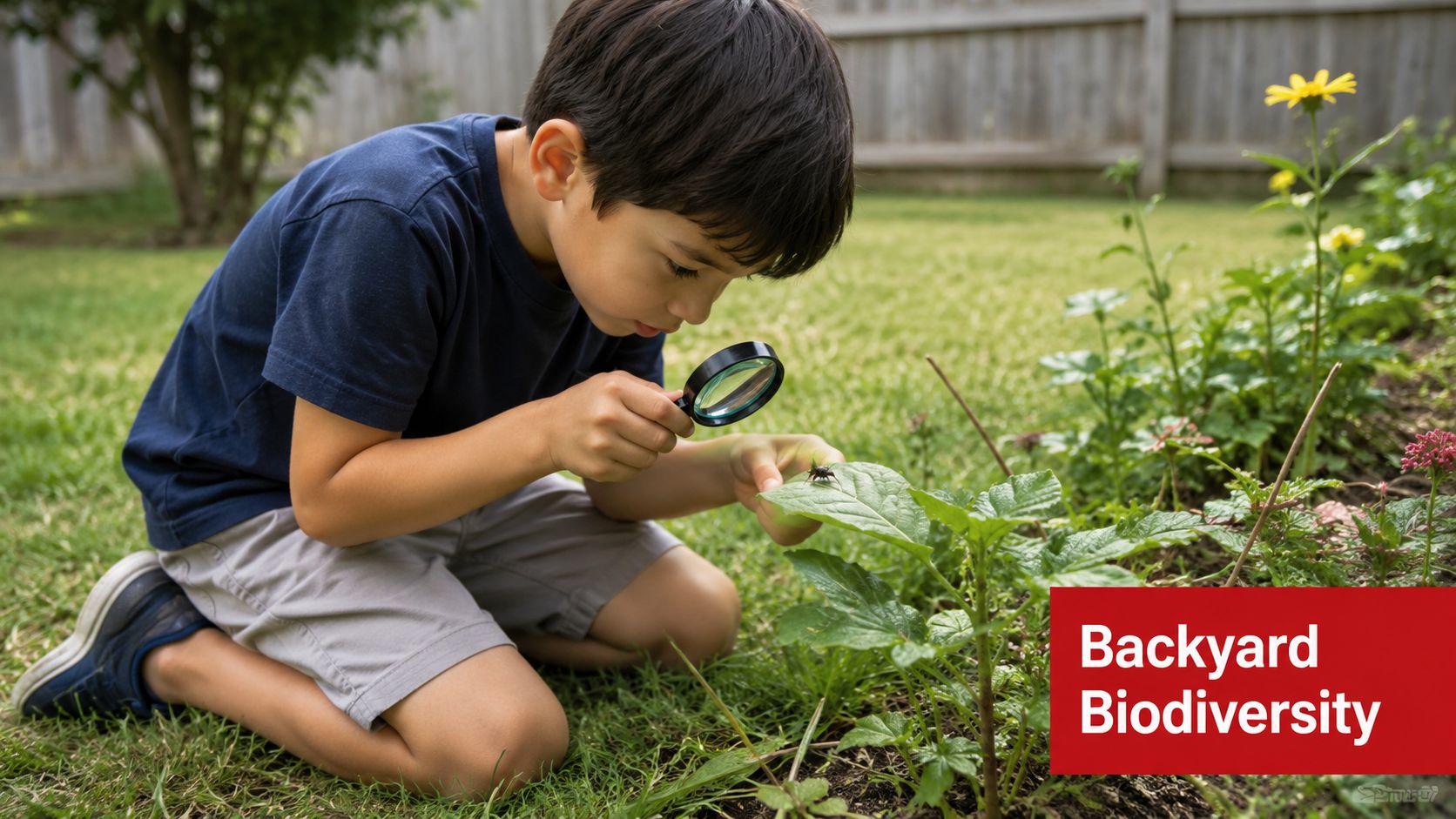
A backyard can become a small living laboratory. Ask children to look for a plant, an insect, a bird, a decomposing leaf, a patch of moss, and a place where two habitats meet. They aren't just ticking boxes. They're noticing that living things share space and depend on conditions such as shade, moisture, shelter, and food.
This is one of the most adaptable nature scavenger hunt ideas because it works in a garden, schoolyard, apartment courtyard, or nearby park. A 2021 U.S. dataset found that 36.9% of 11,743 children ages 3–5 played outdoors for one hour or less on weekdays, compared with 49.3% who played outdoors for three hours or more on weekend days. The difference makes a structured weekend or after-school hunt a practical way to give outdoor time a clear starting point. The same research also found that in nine states, at least 40% of preschoolers played outside for one hour or less on weekdays.
Ready-to-use setup
Create a checklist with picture cards for younger children and words for older children. Include:
- Living things: Find a plant, insect, bird, and fungus.
- Habitats: Find shade, damp soil, a sheltered space, and a place with direct sun.
- Evidence: Photograph a bite mark, track, web, or fallen seed.
- Documentation: Record the location, color, and behavior of one finding.
Use iNaturalist for plant and wildlife identification or Merlin Bird ID for bird calls, but treat app results as suggestions to verify with a reliable field guide or local expert. Children should photograph findings instead of collecting living specimens. A species journal that returns to the same yard across seasons can turn a single hunt into an ongoing science project. Families can pair this active exploration with the benefits of outdoor play and learn more about native plant container gardening.
2. Nature Color Hunt
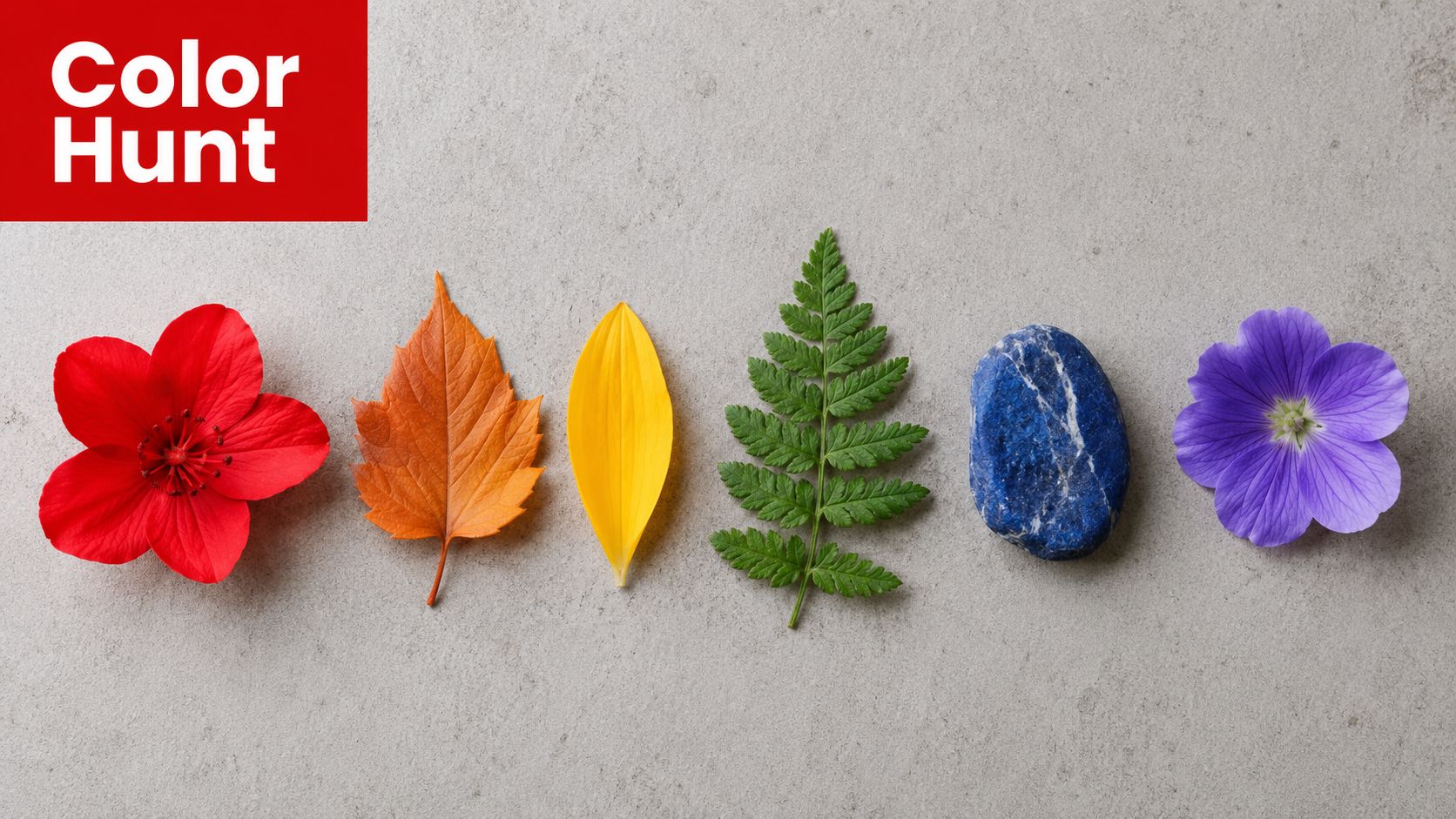
Give each child a color card or a simple rainbow checklist, then search for natural examples of red, orange, yellow, green, blue, purple, brown, white, and black. A child might find a red petal, yellow grass, green moss, a blue-gray stone, or a dark tree hollow. The point isn't exact matching. It's learning to notice subtle differences and describe them.
This hunt suits preschool classrooms, Montessori sensorial work, art lessons, and family walks. It also works in settings where children can't roam far, because a small planting bed, courtyard, or sidewalk edge can offer a surprising range of shades.
Printable checklist structure
Use one box for each color and add a second prompt:
- Match a color: Find something close to the swatch.
- Compare shades: Find two versions of the same color.
- Notice camouflage: Find an object that blends into its surroundings.
- Create a display: Photograph findings or arrange only safe, already-fallen materials.
Colored paper can become a temporary backdrop for a nature collage, rainbow arrangement, or observational painting. Photographing items is the better choice in public spaces and protected habitats. You can extend the activity by returning to the same location in another season and comparing which colors appear, fade, or become harder to find. For a related creative project, try crafts with crayons.
Practical rule: Children may collect only items that an adult has confirmed are loose, abundant, and permitted to remove. A photograph is always a safe alternative.
3. Texture and Sensory Hunt
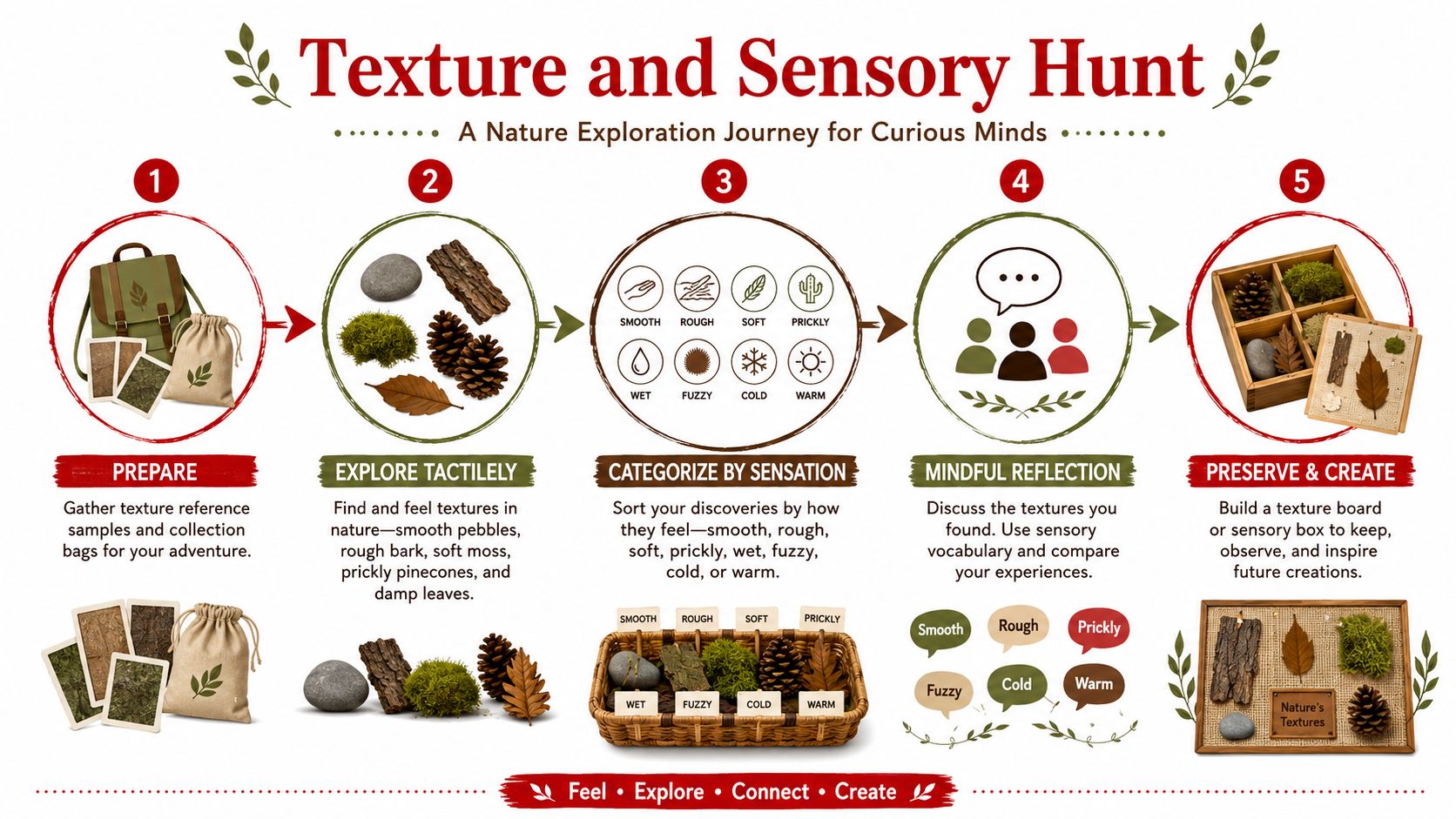
Smooth bark, rough stone, soft grass, prickly seed pods, wet soil, and dry leaves give children a vocabulary lesson they can feel. Begin by introducing words such as bumpy, ridged, sticky, soft, hard, cool, and grainy. Then ask children to find an example of each without rushing from object to object.
A sensory hunt can help children who learn best through touch, and it gives younger children a reason to slow down. It also works well in early childhood centers, special education classrooms, and occupational therapy settings, provided adults adapt the materials to each child's needs. A child who dislikes direct contact can point, photograph, or use a tool instead.
Make the hunt inclusive
Prepare a checklist with three columns: texture word, location, and description. Children might write “rough, tree trunk, vertical lines” or “soft, grass, bends when touched.” Add optional follow-ups:
- Sound pairing: Describe whether the object crunches, rustles, or stays quiet.
- Visual pairing: Sketch the texture using lines, dots, or shading.
- Sorting: Group safe, loose objects by texture rather than by type.
- Reflection: Choose one texture that felt comfortable and one that didn't.
Don't use a blindfold unless the child wants it and the area is completely controlled. Inspect every object for sharp edges, insects, irritating sap, allergens, and contamination. Never ask children to touch unknown plants, animal waste, or living creatures. Families looking for more indoor and outdoor sensory play can explore sensory activities for kids.
4. Seasonal Transformation Hunt
Choose one tree, garden bed, patch of grass, or park corner and revisit it as the seasons change. Children can search for new buds, flowers, mature leaves, fallen seeds, bare branches, animal signs, frost, puddles, or changes in ground cover. Repeating the hunt helps them see nature as a process rather than a collection of isolated objects.
The activity fits a year-long classroom journal, a homeschool portfolio, or a family tradition. The same location also makes comparison easier. Children can photograph the same viewpoint, draw the same tree, or answer the same prompts each time: What is growing? What is disappearing? What sounds can you hear? Which animals might use this place now?
A simple seasonal record
Print four matching pages with space for:
- Date and weather: Record conditions in words or symbols.
- Fixed viewpoint: Draw or photograph the same area.
- Visible change: Note one new feature and one feature that has gone.
- Life-cycle clue: Look for budding, flowering, fruiting, seeding, migration evidence, or dormancy.
- Question: Write something to investigate during the next visit.
Outdoor time varies with season and context. A systematic review of children ages 3–12 linked outdoor play with factors including warmer seasons, detached homes, physical activity, and whether electronics were present in a child's bedroom, showing why flexible activities matter across families and settings. The review also discusses how environment shapes outdoor play. Use what causes seasons on Earth to connect observations with an earth science explanation.
5. Nature Sketch and Identify Hunt
Replace the collection bag with a pencil. Children choose a leaf, stone, seed, feather found on the ground, or tree shape and draw what they see. Sketching requires close attention to edges, patterns, proportion, and structure, so the child naturally notices details that a quick glance misses.
The finished page can include a drawing, a species guess, the date, the location, the weather, and a sentence describing habitat. Artistic ability isn't the target. Careful looking is. A child may draw a crooked leaf and still produce valuable scientific observations about its veins, color, holes, and texture.
Printable field journal page
Create boxes for:
- Draw it: Use graphite first, then colored pencils.
- Label it: Add arrows for parts such as stem, veins, scales, or bark.
- Describe it: Write three visible details.
- Measure it: Compare length with a pencil, hand, or ruler.
- Identify it: Record a best guess and the evidence behind it.
- Ask a question: Note what remains uncertain.
Use a field guide or identification app after the sketch, not before it. That order encourages children to observe independently. You can also compare drawings of the same plant across seasons, or connect the hunt to a lesson about rocks and how to find a fossil. Keep journals in a folder or bind them into a class nature book.
6. Nocturnal Nature Hunt
At twilight, familiar spaces change. Bird calls fade, insects become easier to hear, and animals leave evidence that children may not notice during the day. A night hunt should focus on sounds, shadows, tracks, webs, moonlight, and movement at a distance, not on catching or touching wildlife.
Begin before full darkness so children can learn the route while they still have natural light. Choose a familiar, hazard-free site with clear boundaries, and keep the group together. Older children may enjoy recording sounds, comparing the same area at dusk and later in the evening, or linking the activity with moon and star observation.
Printable night checklist
Include prompts such as:
- Listen: Record two sounds and their direction.
- Observe: Find a web, moth, bat, owl, track, or other sign without approaching it.
- Compare: Describe one daytime feature that looks different at night.
- Look upward: Note the moon's appearance or visible stars.
- Explain: Write one adaptation that could help an animal live in darkness.
Use torches responsibly and avoid shining bright beams directly at animals. Red-filtered lights can help preserve night vision and reduce disruption, but the safest approach is still to minimize light and noise. Adults should supervise every night activity, check weather and site conditions, and cancel the hunt if visibility or footing is unsafe.
Night exploration works best as a listening and evidence hunt. The less children disturb, the more authentic their observations become.
7. Micro-Habitat Hunt
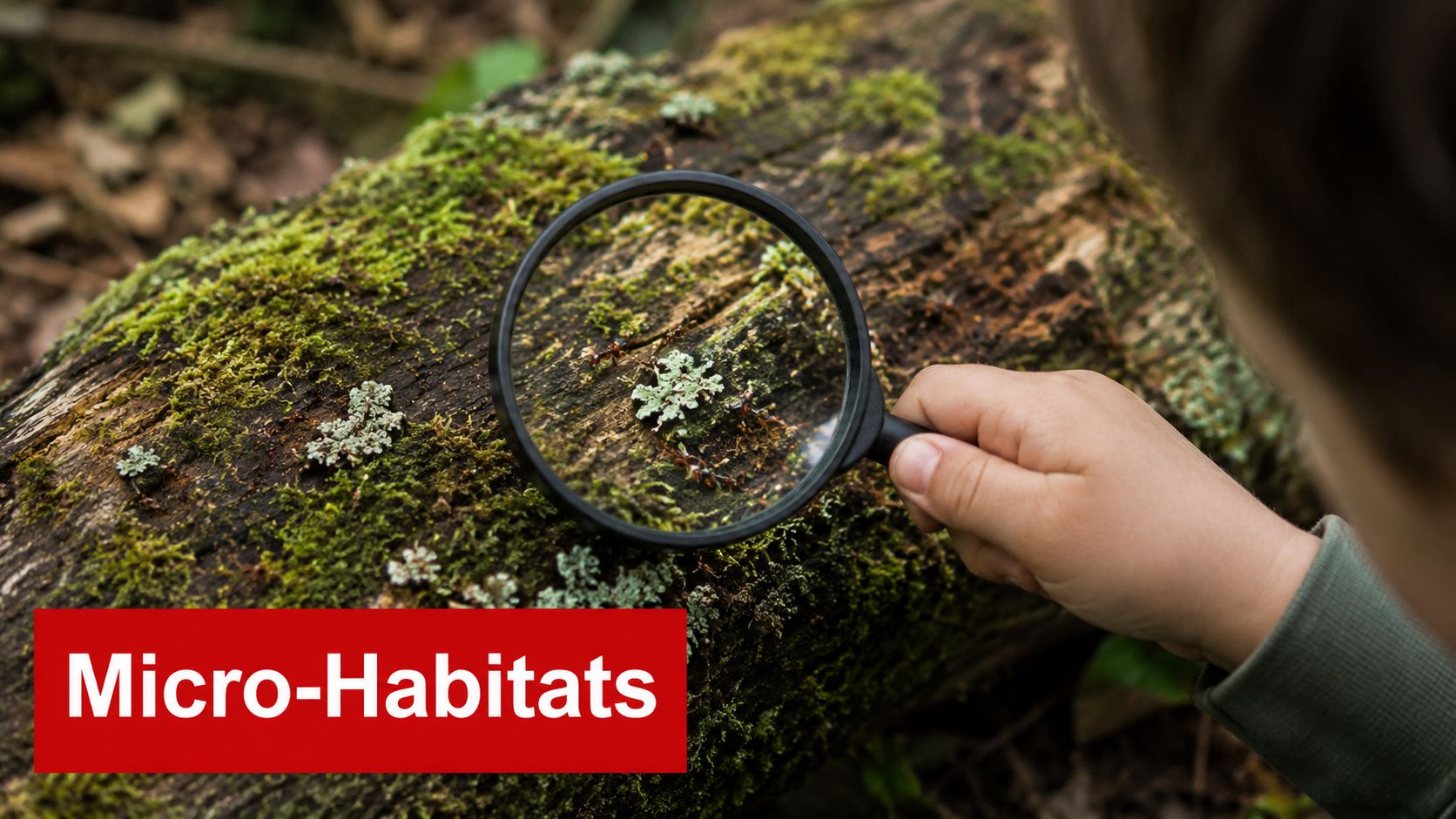
Lift a fallen log only with permission and adult help, look beneath a loose stone, or examine a moss patch without pulling it apart. These small spaces may contain decomposers, tiny predators, prey, moisture, and shelter. Children begin to understand that an ecosystem doesn't need to look large to contain relationships.
Give each child a hand lens and a white observation card. The light background makes tiny details easier to see without requiring children to transfer organisms into containers. If an adult uses a clear container briefly for a permitted observation, return every organism to exactly where it was found.
Observation prompts
A printable micro-habitat page can ask:
- Place: What is the habitat, under a log, in moss, beneath leaves, or in soil?
- Conditions: Is it dry, damp, dark, warm, or cool?
- Residents: What organisms or evidence can you find?
- Relationships: What could be food, shelter, or a decomposing material?
- Change: What might happen here after rain or over time?
Photographs, macro phone lenses, and careful drawings extend the activity without harming the habitat. A child can maintain a micro-ecosystem journal across repeated visits, noting which features stay stable and which change. Don't break bark, pull moss, disturb nests, or move rocks that may shelter animals.
8. Phenology Photo Hunt
Give children a camera and ask them to document stages rather than collect objects. They might photograph a swelling bud, an open flower, developing fruit, a seed head, a changing leaf, or a plant in dormancy. The activity turns a phone or tablet into a documentation tool, with the adult managing the device when needed.
Use the same plant, location, and camera angle for stronger comparisons. Children can organize images by date or by species, then add captions explaining what changed. This is a natural bridge to sequencing, time, descriptive writing, and data organization.
Photo checklist structure
Print a page with space for:
- Image number: Match the photo to the observation.
- Date and time: Record when the image was taken.
- Species or subject: Use a best guess if identification is uncertain.
- Stage: Note bud, flower, fruit, seed, leaf change, or dormancy.
- Conditions: Describe the weather and surrounding habitat.
- Question: Ask what may appear next.
For older students, create a digital album with labels and a visual timeline. They can compare two plants in different locations or document how a habitat responds to weather. Use identification apps cautiously, avoid photographing private information or people without consent, and never enter restricted areas to capture a better image. Photo documentation also gives children who cannot walk long distances a meaningful way to participate.
9. Invasive Species Identification Hunt
This hunt turns children into careful ecological detectives. Instead of pulling plants immediately, they photograph possible invasive species, record where they found them, and compare their features with a trusted local guide. Identification matters because a mistaken removal can damage native plants or disturb protected habitat.
The hunt is best for older children, environmental science classes, and supervised community programs. Contact a local extension office, conservation organization, or native plant society before starting. They can explain which species are relevant in the area and whether reporting or removal is allowed.
A conservation-focused checklist
Include:
- Identify: Record leaf shape, growth pattern, flower, fruit, or bark features.
- Compare: Note how the plant differs from a similar native species.
- Document: Take a clear photograph and record the location.
- Research: Find out where the species originated and how it arrived.
- Consider impact: Describe what habitat or resources it may affect.
- Report responsibly: Submit observations only through an appropriate local program.
Don't let children handle sap, thorns, berries, or unfamiliar plants. Never eat wild berries based on appearance. Home Science Tools recommends caution with wild berries unless they're identified as non-poisonous, and observation-based tasks are safer than collection. A follow-up lesson can explore removal, containment, biological control, and how changing conditions may affect species distribution.
10. Weather and Sky Scavenger Hunt
Look above the ground for cloud shapes, contrails, halos, rainbows, fog, wind movement, shadows, and signs of changing weather. A sky hunt can last only a few minutes, or children can repeat it across several days to build a simple weather record. It suits a backyard, balcony, school window, playground, or short walk.
For younger children, use picture cards showing different cloud appearances and symbols for sunny, cloudy, windy, rainy, or foggy conditions. Older students can describe cloud layers, compare wind direction, and connect observations with a weather forecast.
Printable sky checklist
Create boxes for:
- Clouds: Sketch the shape and describe its height or texture.
- Light: Look for a shadow, glare, halo, or changing brightness.
- Movement: Observe leaves, grass, clouds, or flags in the wind.
- Water: Find rain, frost, dew, puddles, or a rainbow when conditions allow.
- Prediction: Write what you think the weather may do next and why.
Never ask children to stare at the sun, approach lightning, or continue outside during unsafe weather. Move indoors for thunderstorms, high winds, extreme temperatures, or poor air quality. A classroom can continue the hunt through a window, using drawings and recorded observations rather than outdoor exposure.
Comparison of 10 Nature Scavenger Hunt Ideas
| Hunt | 🔄 Implementation | ⚡ Resources & time | ⭐📊 Expected outcomes | Ideal use cases | 💡 Key advantages / Tips |
|---|---|---|---|---|---|
| Backyard Biodiversity Hunt – Exploring Ecosystems in Your Own Yard | Easy–Moderate; create checklist and boundaries | Minimal: nature journal, pencil, optional magnifier; 30–60 min | Builds observation, basic ecology & ID skills; moderate data value | Home, school backyard, short lessons (ages 5–12) | Accessible, low-cost, repeatable; use iNaturalist or laminated cards |
| Nature Color Hunt – Rainbow-Based Exploration and Artistic Discovery | Easy; prepare color cards and collection method | Low: color swatches, collection bags or camera; 15–45 min | Strengthens color recognition, sorting, and art integration; high engagement for young children | Preschool, art classes, quick outdoor activities (ages 3–8) | Inclusive and quick; photograph items to avoid overcollecting |
| Texture and Sensory Hunt – Tactile Nature Exploration | Easy; set up texture board and safety briefing | Low–Moderate: texture samples, blindfolds optional; 20–50 min | Develops sensory vocabulary, calming multisensory learning | Early childhood, OT, sensory gardens (ages 2–10) | Highly inclusive and therapeutic; inspect items for hazards first |
| Seasonal Transformation Hunt – Documenting Nature's Cycles | Moderate; requires scheduling across seasons | Moderate: journal/camera, quarterly visits; 45–90 min per season | Deep phenology understanding, systems thinking, long-term data | Year-long curricula, citizen science, homeschool projects (ages 6–14) | Builds pattern recognition; fix observation points and consistent timing |
| Nature Sketch and Identify Hunt – Art-Based Field Journaling | Moderate; provide art supplies and quiet workspace | Moderate: field journals, pencils, ID references; 60–120 min | Enhances detailed observation, documentation, and identification skills | Art-integrated science classes, nature journaling (ages 7–16) | Non-destructive, produces keepsakes; emphasize observation over drawing skill |
| Nocturnal Nature Hunt – Night Exploration | Moderate–Challenging; requires safety plan and supervision | Moderate: headlamps with red filters, adult supervision; 45–90 min (evening) | Teaches nocturnal behavior, listening skills, unique ecosystem insights | Family night programs, nature centers, older children (ages 8–18) | Memorable and sensory-rich; start at twilight and use red light filters |
| Micro-Habitat Hunt – Miniature Ecosystems | Moderate; careful handling and magnification needed | Moderate: hand lenses, clear containers, observation sheets; 45–75 min | Reveals hidden biodiversity and small-scale ecological interactions | Forest floors, gardens, lab-style activities (ages 6–14) | Encourages non-destructive close study; always return organisms to habitat |
| Phenology Photo Hunt – Lifecycle Photo Documentation | Moderate; needs repeat visits and file organization | Moderate: camera/smartphone, storage, brief sessions 15–30 min each | Produces visual timelines of life stages; strong for phenology and citizen science | Tech-integrated curricula, long-term projects (ages 7–16) | Shareable, non-destructive records; keep consistent angles and metadata |
| Invasive Species Identification Hunt – Conservation Focus | Challenging; needs research and expert guidance | Moderate–High: ID guides, possible partnerships, 60–120 min incl. prep | Builds conservation awareness and actionable reporting; high real-world impact | Advanced classes, conservation groups, citizen science (ages 10–18) | Teaches stewardship and reporting; partner with local extension services |
| Weather and Sky Scavenger Hunt – Meteorological Exploration | Easy; prepare sky checklist and observation prompts | Low: cloud charts, apps, short or repeated sessions; minutes–days | Improves weather literacy, cloud and phenomenon ID; trackable patterns | Earth science lessons, quick outdoor activities, any age (school-aged+) | Can be done anywhere and quickly; use cloud charts and timing for accuracy |
Make the Next Hunt More Meaningful
The best choice depends on the child and the space you have, not on finding the most elaborate printable. A younger child may thrive with a five-to-eight-item list presented as a treasure hunt, while an older child may enjoy harder-to-find items, timed observation, or an identification challenge. Green Child Magazine recommends keeping lists for younger children limited to 5–8 items, then increasing difficulty for older children with more challenging finds and a timer.
Choose an activity by learning mode:
- Ecosystems: Use the backyard biodiversity or micro-habitat hunt.
- Senses: Choose texture and sound prompts.
- Art and literacy: Try color, sketching, or photo captions.
- Seasonal science: Repeat the seasonal transformation or phenology hunt.
- Technology: Use cameras and identification apps as documentation aids.
- Conservation: Investigate possible invasive species with local guidance.
- Weather and STEM: Track clouds, wind, light, and precipitation.
The setting can be just as important as the child's age. A city sidewalk can support a color, sound, texture, or sky hunt. A beach can provide shoreline observations, while winter conditions can support track, frost, and shadow prompts. A stroller or wheelchair route can use photo, sound, and observation-only tasks, so children don't need to reach every object to participate.
A 2021 systematic review found that outdoor play depends on environmental and seasonal context, and another study discussed in the International Journal of Behavioral Nutrition and Physical Activity reported average outdoor time of 7.72 hours per week, with 61.3% of children spending less than eight hours outside weekly and 2.1% reporting no outdoor play. A ready-made hunt can lower the effort needed to begin, especially when families and educators have limited space or time.
Turn the findings into something children can revisit:
- Nature journal entry: Add a sketch, date, location, and descriptive paragraph.
- Labeled photo sequence: Show a plant or habitat changing over time.
- Color display: Arrange photographs or permitted fallen materials by shade.
- Habitat diagram: Draw shelter, food, moisture, and living things.
- Seasonal comparison: Place matching observations side by side.
- Creative response: Build a model, write a story, or create a nature-inspired craft.
Keep safety consistent across every format. Children should observe rather than disturb, avoid collecting living organisms, and never identify or touch unknown species. Adults should supervise night activities, check conditions before leaving, respect private property and protected areas, and follow local site rules. Doing Good Together also encourages extending hunts beyond item collection with tasks such as spotting wildlife, skipping a rock, or identifying plants and tracks with an app.
Nature scavenger hunts can be low-preparation without being low-value. With paper, a writing utensil, and an optional clipboard, a family, class, camp, or childcare group can turn ordinary outdoor time into observation, movement, language, art, and science. Start with one small space, choose one learning goal, and let the child's questions determine the next step.
Hiking with kids in the parks can also inspire a broader outdoor routine, while candid guest photo prompts offer a useful reminder that simple visual prompts can encourage children to document what they notice. Pair that curiosity with purposeful Playz science, art, sensory, or creative play products, then keep the discoveries going indoors and outside.
Playz creates science kits, creative toys, play tents, and active learning products that help children turn curiosity into purposeful play. Visit Playz to pair your next nature scavenger hunt with hands-on activities that support imagination, discovery, and #KidsLearnBestThruPlayz.