


Have you ever wondered why you're building snowmen in December but jumping into a swimming pool in July? The secret isn't how close Earth is to the Sun, but something much cooler: our planet's permanent, steady lean.
Our planet is tilted on its axis by 23.5 degrees. That single, simple fact is the rockstar reason we get to experience the beautiful rhythm of four distinct seasons.
Why Summer Is Warm and Winter Is Cold: It's All in the Angle
Picture our planet as a spinning top that’s always leaning to one side as it travels around the Sun. Because of this tilt, for part of the year, one half of the Earth—a hemisphere—is angled more directly toward the Sun.
When your hemisphere (say, North America) is tilted toward the Sun, the sunlight hits it like a direct flashlight beam—it's concentrated and intense. This direct energy warms up the land, air, and water much more efficiently, giving us the long, hot days of summer.
Then, as Earth continues its year-long orbit, that same hemisphere eventually tilts away from the Sun. Now, the sunlight comes in at a slanted angle. Think about shining that same flashlight on a wall, but from the side; the light spreads out, becoming weaker and less focused. This indirect, spread-out sunlight is what brings the shorter, colder days we call winter.
How Earth's Tilt Creates Our Seasons
Seriously, this tilt is everything. Without it, most places on Earth would have the same monotonous weather year-round. The huge difference in daylight hours we see throughout the year is a perfect example of its power.
It's the perfect way to explain to a kid why summer days feel like they last forever, while winter evenings have us cozied up indoors with our favorite Playz science kits. It all comes back to that lean!
In a city like New York, a summer day can stretch for 15 hours, but a winter day shrinks to just 9 hours. That’s a massive 67% swing in daylight, and it’s a direct result of our planet's angle to the Sun. You can even see this principle in action with our guide on how shadows are formed.
Key Takeaway: The directness of the Sun's rays—not our distance from the Sun—is what cooks up summer and chills out winter. A direct angle concentrates heat, while a slanted angle spreads it thin.
To help clear things up, let's break down the primary cause versus the common myths.
Quick Guide to Why Seasons Happen
| Factor | Does It Cause Seasons? | Why It Matters |
|---|---|---|
| Earth's Axial Tilt | Yes (Primary Cause) | This 23.5-degree lean determines whether sunlight hits your part of the world directly (summer) or indirectly (winter). |
| Direct vs. Indirect Sunlight | Yes (The Effect of Tilt) | Direct rays are concentrated and intense, bringing heat. Indirect rays are spread out and weak, bringing cold. |
| Length of Daylight | Yes (The Effect of Tilt) | The tilt gives the hemisphere facing the Sun longer days in summer and shorter days in winter, affecting total heat absorbed. |
| Earth's Distance from the Sun | No (Common Myth) | Earth's orbit is slightly elliptical, but we are actually closest to the Sun in January—during the Northern Hemisphere's winter! |
This core principle helps make sense of climate patterns all over the globe. For instance, the way the sun's angle shapes the weather and seasonal conditions in Bled, Slovenia is a perfect real-world example of these astronomical forces at work, affecting everything from lake temperatures to when the hiking trails are open.
That simple planetary lean is the powerful engine driving the entire rhythm of our year.
Understanding Earth's Constant 23.5-Degree Tilt
Let’s zero in on the real hero of our seasonal story: Earth's 23.5-degree axial tilt. The best way to picture this is to imagine an invisible pole sticking right through the center of our planet, from the North Pole all the way down to the South Pole. This is its axis—the line it spins around once a day, giving us day and night.
But here’s the game-changing part: that axis isn't standing up straight as Earth makes its way around the Sun. It’s permanently leaning over, fixed at a steady 23.5-degree angle. This simple, constant lean is the single biggest reason we have seasons.
What makes this tilt so impactful is its stubbornness. As Earth completes its year-long trip around the Sun, the axis consistently points to the exact same spot in deep space, right near the star Polaris (also known as the North Star). It doesn't wobble back and forth; it just holds that lean.
This infographic is a fantastic way to see how that unwavering tilt changes the way sunlight hits us throughout the year.
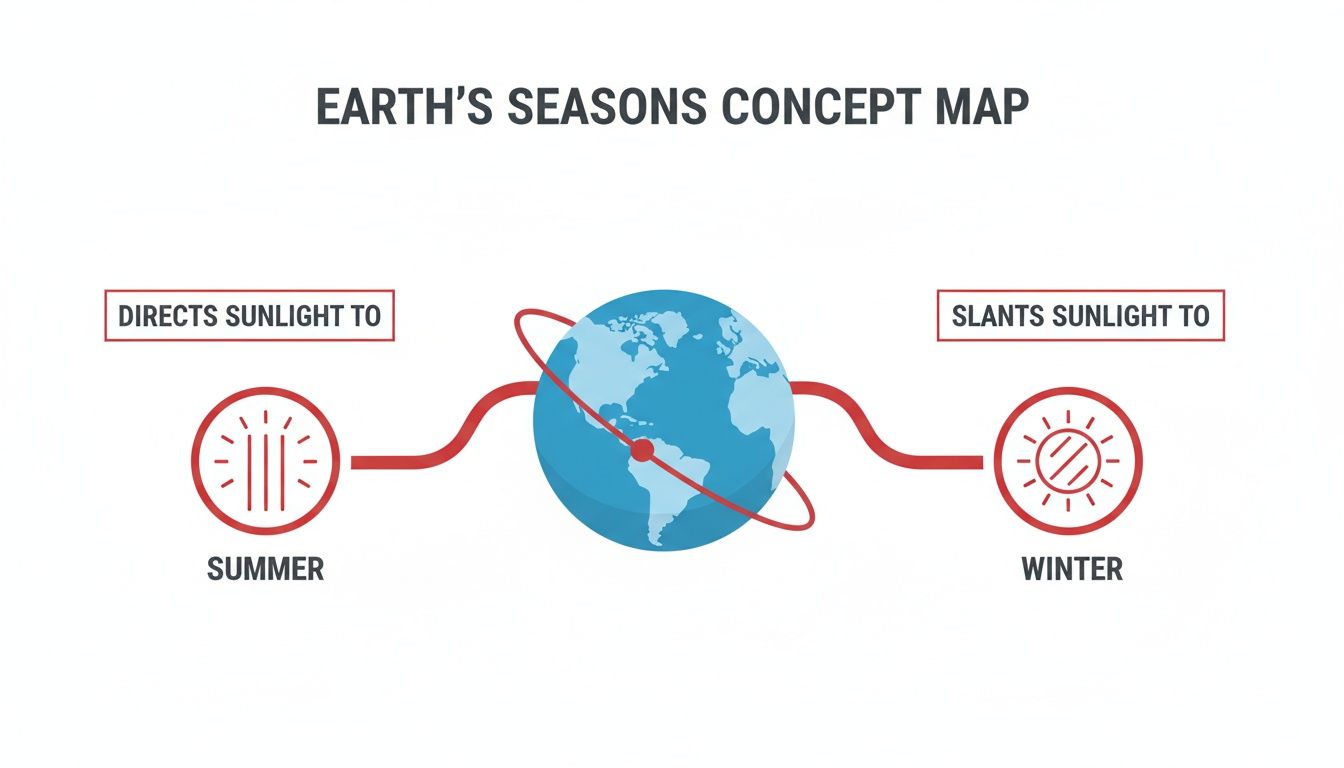
As you can see, direct sun rays bring on the summer heat, while the slanted, spread-out rays result in winter's chill—all thanks to that reliable tilt.
The Power of Direct vs. Indirect Sunlight
Think about using a magnifying glass on a sunny day. If you angle it just right, you can focus the sun's rays into a tiny, scorching hot dot. That's exactly what happens to the hemisphere tilted toward the Sun. It gets blasted with concentrated, direct sunlight, which is why summer is so hot.
Now, imagine the opposite. The hemisphere tilted away from the Sun gets indirect, slanted rays. It’s like shining a flashlight on a wall from a sharp angle—the light spreads out over a huge area, making the beam much dimmer and weaker. This scattered, less intense energy is why winter is cold.
Why the Tilt Matters: It’s not about being closer to the Sun. It’s all about the angle at which sunlight strikes the ground. A direct, 90-degree angle delivers a powerful punch of energy, while a shallow angle delivers a much weaker one.
This tilt doesn’t just control the temperature; it also decides how long our days are.
- Summer: When a hemisphere is tilted toward the Sun, it gets longer days and shorter nights. More of its surface is lit up during each 24-hour spin.
- Winter: The hemisphere tilted away from the Sun gets the short end of the stick—shorter days and longer nights, leaving less time for the Sun to warm things up.
This constant lean is a core feature of our planet, driving everything from global weather patterns to the very structure of our world. To get an even better appreciation for our dynamic planet, you can dig deeper by exploring Earth's layers for kids. It all comes back to this one beautiful, simple tilt that orchestrates the entire rhythm of the seasons.
Busting the Biggest Myth: Earth's Distance From the Sun
One of the most persistent myths about why we have seasons is that Earth gets warmer when it's closer to the Sun. It sounds so logical, doesn't it? Closer to the fire, you feel more heat. But when it comes to our planet, that idea is completely backward.
Let’s set the record straight once and for all. It's time to show why our planet's tilt is the true champion of seasonal change, not its distance from the Sun.
The truth is, Earth’s orbit isn’t a perfect circle. It’s a slight oval—an ellipse—which means our distance from the Sun does change throughout the year. But this small variation isn't what drives the massive swing from winter's chill to summer's heat.
The Surprising Truth About Earth's Orbit
Here’s the part that really blows people's minds: the Northern Hemisphere is actually closest to the Sun in early January, right in the dead of winter! This point in our orbit is called the perihelion. On the flip side, we’re farthest away in early July, during the peak of summer.
This single fact is the ultimate myth-buster.
If distance to the Sun caused the seasons, January would be the hottest month of the year for everyone in the Northern Hemisphere, not one of the coldest. This tells us that another, much more powerful force has to be at play.
The variation in distance is actually pretty small. Earth's oval-shaped orbit results in only a 3% change in distance between its closest and farthest points. We hit perihelion—our closest approach—at about 91 million miles around January 3rd. While we do get about 7% more solar energy at this point, it’s nowhere near enough to overcome the effects of the axial tilt.
That's why a place like New York City averages 33°F in January but a sweltering 85°F in July. The tilt is just that powerful. If you want to dive deeper, you can explore the science behind Earth's seasons here.
Key Insight: Being closer to the Sun during the Northern Hemisphere's winter proves that distance is not the cause of seasons. The massive temperature difference between summer and winter is created by the directness of sunlight, which is controlled entirely by Earth's axial tilt.
Grasping this is fundamental to understanding our whole solar system. For anyone looking to bring these big cosmic ideas down to Earth, a hands-on activity like our premium solar system model kit can make learning about orbits and planets an unforgettable experience. It’s a fantastic, tangible way to visualize Earth's journey and its place among the other planets.
Mapping the Seasons: Solstices and Equinoxes Explained
So we know Earth’s tilt is the big reason for our seasons, but how do we mark the exact moment one season hands off to the next? It all comes down to four specific points in our planet's year-long orbit: the solstices and equinoxes.
Think of them as cosmic signposts that tell us precisely where we are in our journey around the Sun. These four key dates are the official start of each astronomical season, giving our year a predictable rhythm.
The Solstices: Longest and Shortest Days
The solstices represent the absolute extremes. They're the moments when Earth's tilt is either leaning most toward the Sun or most away from it, which happens twice a year.
- The Summer Solstice: Around June 21st, the Northern Hemisphere gets its longest day of the year. The North Pole is angled as directly toward the Sun as it gets, bathing that half of the world in the maximum amount of daylight.
- The Winter Solstice: Fast forward to around December 21st, and the Northern Hemisphere experiences its shortest day. Now, the North Pole is tilted its farthest away from the Sun, which means fewer daylight hours and the longest night of the year.
Of course, everything is flipped for the Southern Hemisphere. When folks up north are celebrating the summer solstice, those down south are bundling up for their winter solstice, and vice versa.
The Equinoxes: Moments of Perfect Balance
Smack-dab between those two extremes, you'll find the equinoxes. The word itself comes from Latin for "equal night," which is a perfect way to describe what’s happening.
On these two days, Earth’s tilt is neither toward nor away from the Sun but perfectly sideways. As a result, sunlight shines almost equally on both the Northern and Southern Hemispheres.
Key Takeaway: During an equinox, day and night are nearly the same length—about 12 hours each—all across the entire planet. This amazing balance happens only twice a year.
- The Spring (Vernal) Equinox: Around March 20th, this event kicks off spring in the Northern Hemisphere.
- The Autumnal Equinox: Around September 22nd, this signals the start of fall for the Northern Hemisphere.
Understanding these four markers helps us see the bigger picture of our planet's incredible orbit. If you're looking for more ways to bring our cosmic neighborhood to life, check out these awesome solar system model ideas for some hands-on fun.
DIY Seasons: A Simple Hands-On Experiment

Reading about Earth’s tilt is one thing, but actually seeing it in action can make the whole concept finally click. This simple activity brings planetary science right into your living room or classroom, using everyday objects to show you exactly what causes seasons on earth.
It’s a fantastic way to turn an abstract idea into something tangible and memorable. You only need a few things to get started, making this a perfect experiment for a family science night.
What You Will Need
- A Lamp: One without a lampshade works best. The bare bulb will be your Sun.
- An Orange or a Ball: This is going to be our tilted Earth.
- A Stick or Pencil: Anything like a chopstick or a barbecue skewer is perfect. This will act as Earth’s axis.
- A Marker: You'll need this to draw the equator and mark a spot for your hometown.
Once you’ve gathered your materials, you’re ready to build a mini solar system and watch the seasons change right before your eyes.
Step-by-Step Guide to Your Seasons
- Prepare Your Earth: Carefully push the stick all the way through the center of your orange, from top to bottom. This stick represents Earth's axis—that imaginary line it spins on.
- Give It a Tilt: Now, lean your "Earth" so the stick is at roughly a 23.5-degree angle. Here's the most important part: you have to keep this tilt pointed in the same direction for the entire experiment, just like the real Earth.
- Draw Your Location: Use the marker to draw a line around the middle of the orange. That's your equator. Then, put a small "X" on the top half to represent your town.
- Orbit the Sun: Place your lamp ("Sun") in the middle of a dark room. Now, slowly walk your tilted orange ("Earth") in a big circle around the lamp. As you make your orbit, keep a close eye on how the light hits that "X".
You'll see it right away. When your hometown is tilted toward the lamp, the light shines directly on it. That’s summer! As you keep walking, that same spot will eventually be tilted away from the lamp, getting only weak, slanted light. Hello, winter.
Aha Moment: This simple model proves the seasons are caused by the tilt of the axis, not how close the orange is to the lamp. You’re seeing direct versus indirect sunlight in real time!
For more hands-on science fun, you might also be interested in this cool water cycle experiment you can do at home.
Frequently Asked Questions About Earth's Seasons
Now that we've journeyed through the science of Earth’s tilt and orbit, it’s time to tackle some of the most common questions people have. Digging into what causes seasons on earth really opens up a new appreciation for our planet's amazing mechanics. Let's clear up a few lingering curiosities.
This final section gives you simple, direct answers to help you lock in your understanding of how our world works.
Why Are Seasons Opposite in the Northern and Southern Hemispheres?
This is a fantastic question that gets right to the heart of the axial tilt! Because Earth leans on its axis, one hemisphere is always tilted more directly toward the Sun while the other is angled away.
Think of it like a giant cosmic seesaw. When the Northern Hemisphere is tilted toward the Sun, it catches direct, concentrated sunlight, which is what creates summer. At that very same moment, the Southern Hemisphere is tilted away from the Sun, getting weaker, slanted sunlight—bringing on winter.
Six months later, after Earth has traveled to the other side of its orbit, the whole situation flips. Now, the Southern Hemisphere is pointed toward the Sun and enjoying its summer, while the Northern Hemisphere is tilted away, deep in winter. This is why your friends in Australia might be heading to the beach in December while folks in the United States are building snowmen.
Do Other Planets Have Seasons?
Absolutely! Plenty of other planets have seasons, and just like here on Earth, it’s almost always because of their axial tilt. As long as a planet has a noticeable tilt and a steady orbit around the Sun, it's going to have seasonal changes.
Here are a few fascinating examples from our cosmic neighborhood:
- Mars: With an axial tilt of about 25 degrees (uncannily similar to our 23.5), Mars experiences four distinct seasons. But since a Martian year is nearly twice as long as an Earth year, each of its seasons lasts about twice as long, too.
- Saturn and Neptune: These gas giants both have significant tilts, which gives them strong seasonal variations in their massive atmospheres. Of course, these changes unfold over many, many Earth years.
- Uranus: This one is the real oddball. Uranus is tilted on its side at a staggering 98 degrees! This bizarre orientation means one pole faces the Sun for 21 straight years, followed by 21 years of complete darkness on the other side.
- Venus and Jupiter: On the flip side, planets like Venus and Jupiter have very small tilts (only around 3 degrees). That means they don't really have noticeable, Earth-like seasons to speak of.
Planetary Perspective: Seasons are not unique to Earth. The presence and intensity of seasons on other planets are almost entirely dictated by their axial tilt, proving it’s a universal principle in our solar system.
What Would Earth Be Like Without an Axial Tilt?
If Earth had no tilt at all—an axis of 0 degrees—our world would be an incredibly different and far less interesting place. The whole concept of "seasons" as we know them just wouldn't exist.
The weather at any given location would stay pretty much the same all year round. The areas around the equator would be permanently hot, while the poles would be locked in a perpetual, deep freeze.
Every single day, the Sun's path across the sky would be identical. Day and night would each last about 12 hours everywhere on the planet, every day of the year. While that might sound simple, this lack of change would have massive, disruptive effects on ecosystems, agriculture, and animal migrations that have all evolved to depend on seasonal shifts.
Does the Equator Experience Seasons?
Not in the way most of us think about them. Places near the equator get direct, overhead sunlight fairly consistently all year long. Since the equator doesn't really tilt toward or away from the Sun, the length of the day also remains stable at around 12 hours year-round, leading to very little temperature variation.
Instead of the four temperature-based seasons (spring, summer, autumn, winter), equatorial regions usually define their seasons by rainfall. They typically have a "wet season" and a "dry season." So, while they don’t get hot summers and cold winters like places at higher latitudes, they still experience a form of seasonal change driven by global wind and precipitation patterns.
For a complete overview and to address common queries about our planet's annual changes, you might find this external guide on What Causes the Seasons on Earth helpful.
At Playz, we believe that understanding the world around us is the ultimate adventure. By turning complex science into hands-on fun, we help kids grasp amazing concepts like planetary tilt and seasonal change. Our science kits are designed to spark curiosity and make learning an unforgettable experience, proving that #KidsLearnBestThruPlayz.
Ready to start your next scientific discovery? Explore our collection of award-winning STEM toys and science kits today at Playz