


Ever wondered what’s hiding deep inside our planet, right under your feet? It turns out the Earth isn't just one big ball of dirt. It’s actually built in layers, kind of like a giant, geological jawbreaker.
These layers are the thin outer crust, the super-thick and gooey mantle, the liquid outer core, and the solid inner core sitting right at the very center. Each one has a special job that shapes the world we live in.
A Journey to the Center of the Earth
Thinking about what lies thousands of miles beneath us can feel a little mind-boggling, but a simple analogy makes it much easier to picture.
Imagine you're holding a giant, hard-boiled egg. The thin, crackly shell is just like the Earth's crust—that’s the ground we live, play, and build on. Peel away the shell, and you get to the egg white. That’s our planet’s mantle, a massive layer of scorching hot rock that moves incredibly slowly. And the yellow yolk in the middle? That’s a perfect stand-in for the Earth's core, the super-hot, fiery center of our world.
This little comparison helps us see how our planet is built from the inside out. Simple, right?
What Makes Each Layer Different?
Each of Earth’s layers has its own special job and is made of different stuff. As you travel deeper toward the center, two things happen: it gets way hotter, and the pressure gets much, much stronger.
- The Crust: This is the thinnest, outermost layer where we live. All our mountains, oceans, and cities are on the crust. It's like the planet's skin.
- The Mantle: This is the big one, making up about 84% of Earth's total volume! The slow, churning movement of this rock is what causes earthquakes and volcanoes.
- The Core: The core is split into two parts. The liquid outer core spins around and creates Earth's magnetic field, which protects us from space radiation. At the very center is the solid inner core, a metal ball that’s as hot as the surface of the sun!
This diagram gives you a great visual of how the layers fit together, starting from the ground we stand on and going all the way down to the blazing hot core.
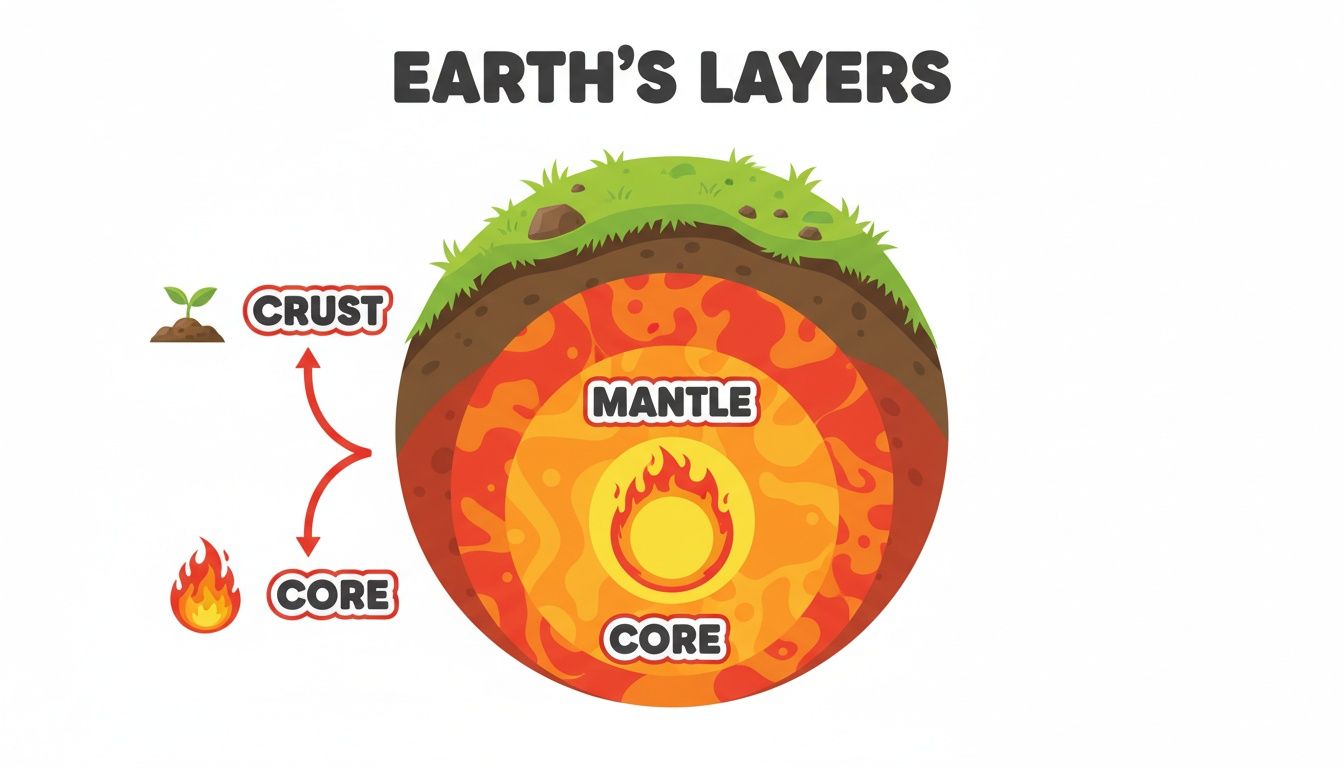
As you can see, each layer stacks on top of the next, getting hotter and denser the deeper you go.
For a quick reference, here's a simple breakdown of the four main layers.
Earth's Layers at a Glance
This table gives a quick summary of what makes each layer of the Earth unique.
| Layer Name | What It's Like | State of Matter | Real-World Example |
|---|---|---|---|
| Crust | A thin, rocky shell where we all live. | Solid | The ground under your school, mountains, and the ocean floor. |
| Mantle | A super thick layer of hot, slow-moving rock. | Mostly Solid | The gooey magma that erupts from volcanoes. |
| Outer Core | A swirling layer of super-hot liquid metal. | Liquid | The force that makes a compass needle point north. |
| Inner Core | A solid metal ball as hot as the sun's surface. | Solid | A super-pressurized solid center, like a diamond formed under pressure. |
It's pretty amazing to think about what's going on miles below us!
Exploring these layers is an exciting adventure in geology. You can even create your own models at home using fun and educational science kits for kids. Besides the scientific explanation, it can also be interesting to explore different cultural views, like the Earth's creation story.
Exploring the Crust: Our Planet's Thin Shell
Let's kick off our journey on the layer we all know and love—the crust! This is the ground beneath our feet, the mountains we climb, and the sandy floor of the deepest oceans. It’s where every city is built, every forest grows, and every animal makes its home.
Think of the Earth as a giant apple. If you did, the crust would be its paper-thin skin. Even though it feels totally solid and enormous to us, the crust is actually the thinnest of all Earth's layers, making up less than 1% of our planet's total mass.
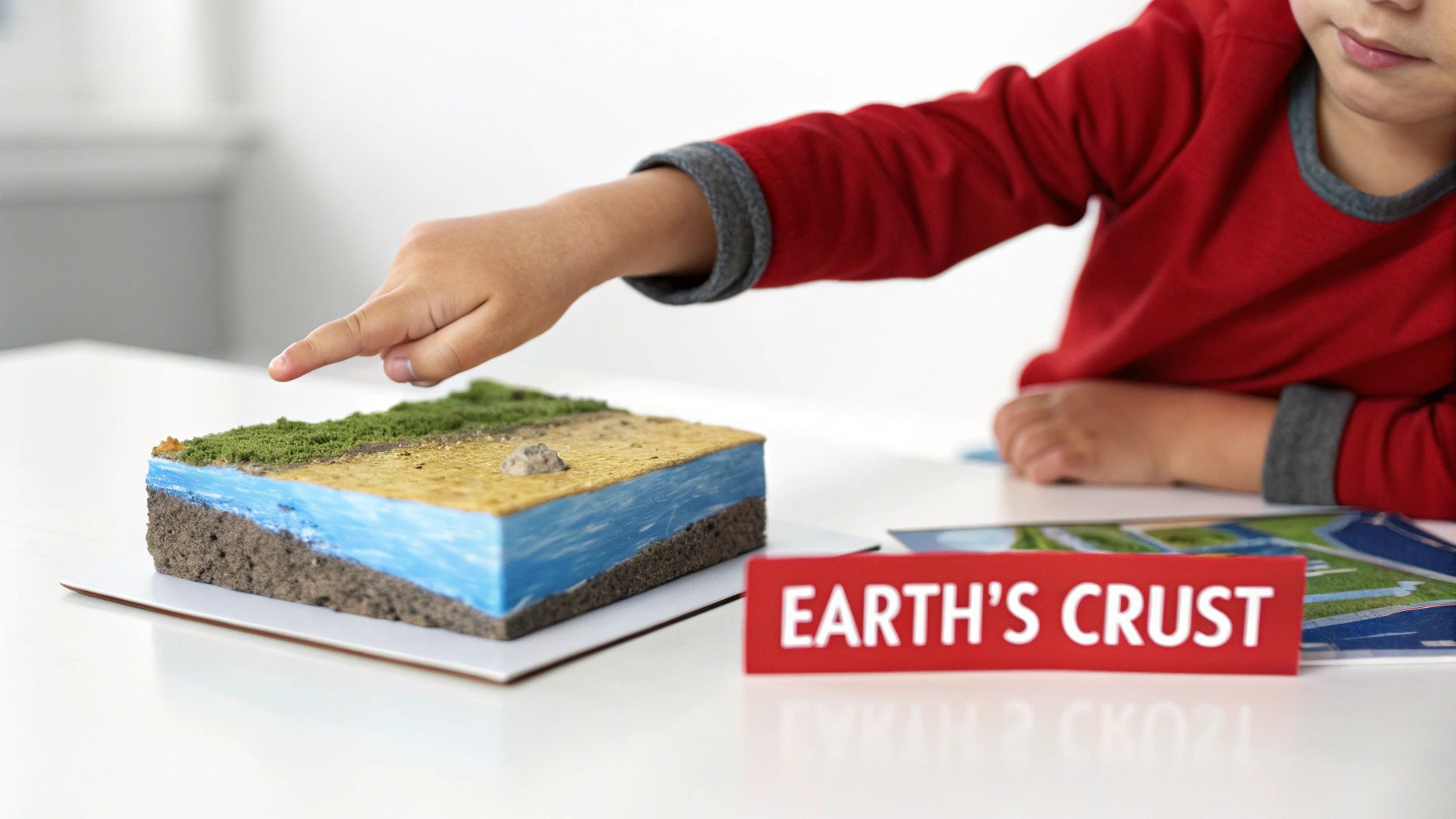
Two Types of Crust: Oceanic vs. Continental
Now, the Earth’s crust isn't the same everywhere you go. It actually comes in two main flavors, kind of like how a pizza can have a thin, crispy crust or a thick, doughy one.
- Oceanic Crust: This is the thinner, heavier crust found under our oceans. It's mostly made of a dense, dark rock called basalt. Think of the deep ocean floor off the coast of California.
- Continental Crust: This is the thicker, lighter crust that makes up all the continents we live on. It's largely made of granite, which is why the continents "float" higher than the ocean floor. The Himalayan mountains are a great example of thick continental crust.
The thinnest parts of the oceanic crust are about 5 to 8 kilometers thick, but the continental crust under huge mountain ranges can be up to 70 kilometers deep! To put that in perspective, the deepest hole humans have ever managed to drill is just over 12 kilometers down. You can dig a bit deeper into the composition of Earth's crust on Study.com.
This rocky outer shell isn’t one solid piece, though. It’s actually broken up into massive puzzle pieces we call tectonic plates.
Key Takeaway: These plates are always on the move, but super slowly—about the same speed your fingernails grow! When they bump, scrape, or slide past each other, they can cause powerful events like earthquakes and volcanic eruptions.
The slow dance of these plates over millions of years has shaped the world we see today, pushing up towering mountains and carving out deep ocean trenches. The crust is also where we find incredible treasures from the past. You can even check out our guide on how to search for fossils buried deep within these amazing rock layers.
Diving Into the Mantle: Earth's Gooey Middle
Okay, let's journey deeper into the Earth, right below the crust we just explored. Welcome to the mantle, our planet’s thickest layer by far! If the Earth's crust is like the thin skin of an apple, the mantle is the thick, fleshy part underneath.
This layer isn't quite liquid, but it's not completely solid, either. The best way to picture it is as a giant tub of super-hot, slow-moving caramel or taffy. This gooey, melted rock is called magma, and it’s always churning and swirling in super slow motion.
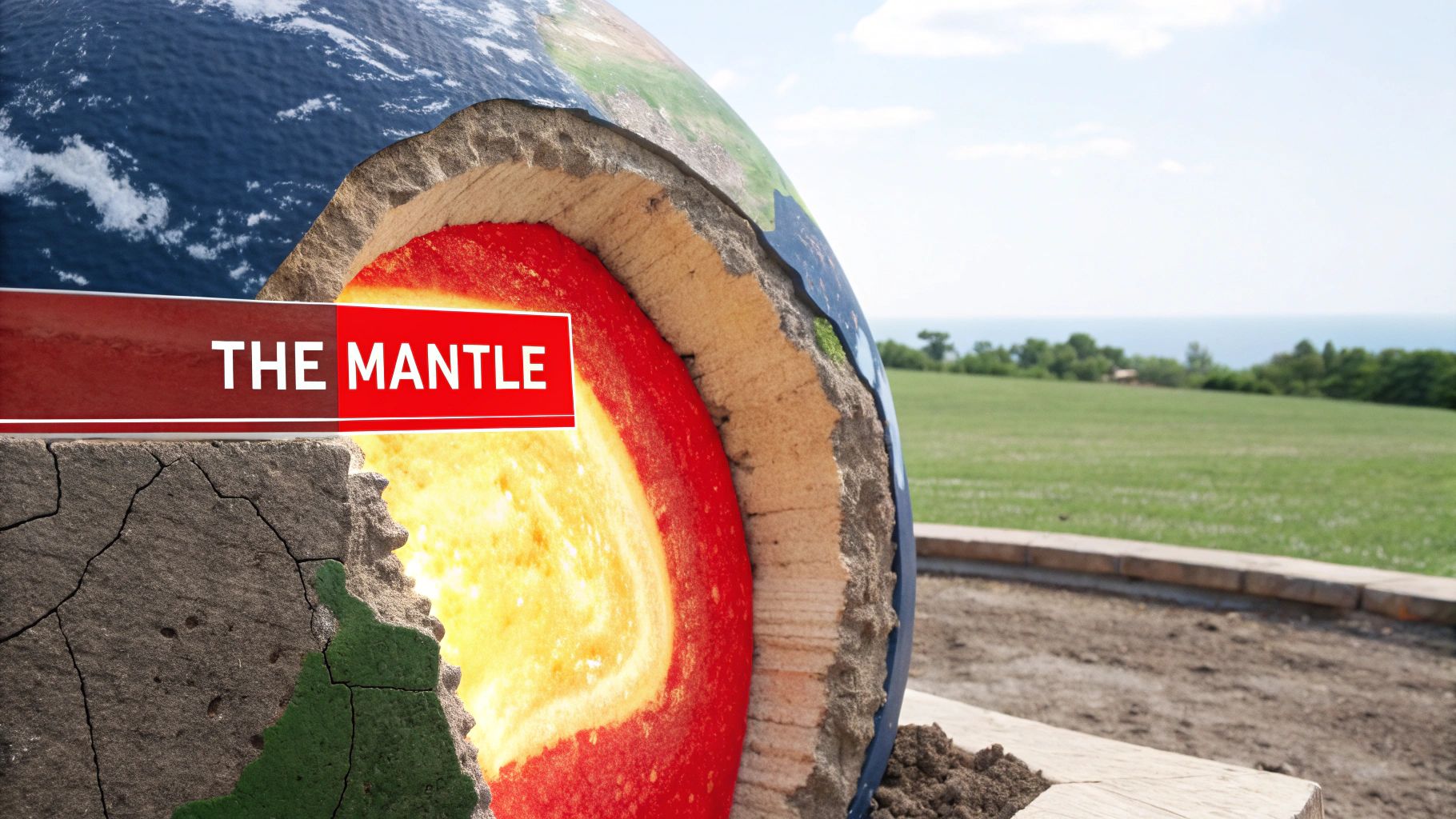
How the Mantle Shapes Our World
Think of the mantle as the powerful engine driving all the action on the surface. These slow, powerful movements, known as convection currents, are strong enough to push around the giant tectonic plates of the crust. It’s these currents that cause continents to drift over millions of years!
The mantle is enormous, making up a whopping 84% of Earth's total volume! It stretches from just below the crust down to around 2,900 kilometers (1,800 miles) deep. The upper part is a gooey solid with temperatures between 1,400°C and 3,000°C. You can see how these layers move in these fascinating plate tectonics insights on Britannica.
Practical Example: Imagine a giant pot of thick soup simmering on a stove. The hottest soup at the bottom rises, cools off at the top, and then sinks back down. This slow, circular motion moves everything floating on the surface—just like it moves our continents!
This constant movement is what gives us volcanoes and earthquakes, showing just how active our planet is deep beneath our feet. For some fun ways to see these geological principles in action, check out these awesome 5th grade science experiments ideas.
The mantle truly is the gooey, powerful middle that keeps our planet changing.
Journey to the Center: The Super-Hot Core
We’ve finally reached the heart of our planet—the core! It's so deep and extreme that scientists had to split it into two distinct parts: a liquid outer core and a solid inner core. Let's dive into the first part of this incredible final layer.
The Liquid Outer Core: Earth's Magnetic Shield
Try to imagine a giant, spinning ocean of melted metal deep beneath your feet. That’s pretty much what the outer core is! It's made of sizzling hot liquid iron and nickel, and when we say hot, we mean it. The temperatures here can soar past 5,000° Celsius—that’s actually hotter than the surface of the sun!
All that sloshing, swirling liquid metal does something truly incredible: it generates Earth’s magnetic field. This field acts like a giant, invisible force field wrapping around our entire planet.
Real-World Impact: Think of it as Earth's very own superhero shield! This magnetic field protects us from harmful solar winds and radiation zipping through space. It's one of the key reasons life can even exist on our planet.
This powerful field is also what makes compasses point north, guiding explorers across the globe for centuries. Without this churning liquid metal deep inside the Earth, our world would be a very different, and much more dangerous, place.
The Solid Inner Core: The Planet's Center
Now for the final stop on our journey: the inner core. Right in the very middle of that swirling liquid metal is a solid ball, also made of iron and nickel. You might be wondering, if it's the hottest part of the planet, why on earth is it solid?
The secret is pressure. The crushing weight of all the other layers—the crust, the mantle, and the outer core—is pushing down on the inner core with an unbelievable amount of force. This immense pressure is so strong that it literally squeezes the metal atoms together, forcing them to lock in place as a solid, even at those mind-boggling temperatures. It’s a tiny but mighty sphere holding our planet together from the inside out.
Hands-On Fun With Your Own Earth Layers Model
Okay, you've got the scoop on what’s inside our planet. Now for the really fun part—building your own model of the Earth's layers! Getting your hands a little messy is one of the best ways to make all this cool geology stuff stick.
Let's dive into a few projects you can easily tackle at home or in the classroom. These activities will help you see exactly how the crust, mantle, and core all fit together to create the amazing planet we call home.

Ready to create your own mini Earth? Here are a few of our favorite ideas, from edible models to classic clay creations.
Earth Layer Model Ideas
| Activity | Materials Needed | Best For |
|---|---|---|
| Play-Doh Earth | 4 colors of Play-Doh (yellow, orange, red, blue/brown), plastic knife | Visual learners who love building with their hands. |
| Edible Earth Parfait | Clear glass, crushed cookies (crust), chocolate pudding (mantle), orange Jell-O (outer core), banana slice (inner core) | A tasty treat that makes learning delicious and multisensory. |
| LEGO Earth Cross-Section | LEGO bricks in 4 different colors | Kids who love to build and engineer their own creations. |
Each of these models gives kids a different way to visualize and understand how our planet is structured, making abstract concepts tangible and fun.
Create a Colorful Play-Doh Earth
This is a classic for a reason! It’s a super simple and effective way to build a 3D model and see how all the earth layers for kids fit together.
- Inner Core: Grab some white or yellow Play-Doh and roll it into a tiny ball. That’s your super-hot, solid inner core.
- Outer Core: Now, take orange Play-Doh and flatten it out like a pancake. Carefully wrap it around your white inner core ball. You've just made the liquid outer core!
- Mantle: Use a bigger chunk of red Play-Doh. Flatten it out and wrap it completely around the orange layer. This thick red layer is the gooey mantle.
- Crust: Lastly, take a thin piece of blue or brown Play-Doh. This layer should be super thin because it represents the Earth's crust we live on. Wrap it around the outside.
- The Big Reveal: Ask an adult to help you safely slice your Earth model in half with a plastic knife or a piece of string. You’ll see all four colorful layers stacked perfectly, just like the real deal!
Actionable Insight: Creating a hands-on model helps make tricky concepts click. When kids can physically build and see the layers, they're much more likely to remember the order of the crust, mantle, and core.
Looking for even more hands-on fun? There are tons of awesome science experiments for kids at home that bring learning to life and let you explore all kinds of cool topics.
Why Earth's Layers Are So Important
So, why should we care about what’s happening thousands of miles under our feet? It turns out those hidden layers are the masterminds behind the world we see, play on, and explore every single day! Everything going on deep inside the Earth directly shapes life up here on the surface.
The slow, constant movement of the mantle and the crust is responsible for pushing up majestic mountains and causing powerful volcanoes to erupt. Without all that action, the Earth’s surface would look completely different—and probably a lot flatter!
A Planet with a Superhero Shield
Deeper down, the liquid outer core is always spinning. This constant motion generates Earth’s magnetic field, which acts like an invisible shield protecting us from harmful radiation from the sun.
Key Takeaway: This magnetic field is also what makes every compass needle point north, guiding explorers for centuries. It’s like our planet has its own built-in navigation system, all powered by its super-hot, swirling core!
Understanding the earth layers for kids helps us see how everything is connected, from the ground we walk on to the sky above our heads. It’s a great reminder that our planet is a living, breathing, and incredibly dynamic place.
Digging into these connections is what makes learning so much fun. You can discover even more about the benefits of hands-on learning to make these big ideas stick. It just goes to show that our planet is full of amazing secrets waiting to be discovered.
Common Questions Kids Ask About Earth's Layers
A curious mind is a wonderful thing! When it comes to what's under our feet, kids have some fantastic questions. Here are a few of the most common ones we hear, along with some simple answers.
How Do We Know What’s Inside the Earth?
That's a great question! Since we can't just dig a hole to the center of the planet, scientists get clever. They study the vibrations from earthquakes, called seismic waves.
Think of it like tapping on a watermelon to see if it's ripe. The waves from earthquakes travel through the Earth, and they speed up or slow down depending on what they're moving through—solid rock, gooey liquid, or a dense metal core. By tracking these waves all over the world, scientists can piece together a map of each layer.
Is the Center of the Earth Really as Hot as the Sun?
You bet! The inner core is an almost unbelievable 5,200° Celsius (that's 9,392° Fahrenheit). To put that in perspective, that's about as hot as the surface of the sun.
So, where does all that heat come from? A lot of it is leftover energy from when our planet first formed billions of years ago. The rest is generated by the slow decay of radioactive elements deep within the Earth.
Key Takeaway: It's wild to think that a solid ball of metal, hotter than the sun, is churning away right under our feet! The only thing keeping it solid is the mind-boggling amount of pressure from all the layers above it.
Ready to turn learning into a real adventure? At Playz, we believe in the power of hands-on discovery to make science unforgettable. Explore our awesome science kits for kids at the official Playz store today and spark your child's curiosity