

Remember the simple thrill of chasing a frisbee across an open field or the cheers after a game-winning kickball run? Parks provide the perfect, open-air arena for creating lasting memories, promoting physical activity, and strengthening connections with friends and family. This guide is your ultimate playbook for turning any patch of green space into a hub of excitement and friendly competition.
We've curated a comprehensive list of 10 fantastic games to play at a park, designed to suit every age group, party size, and skill level. Whether you're planning a relaxed afternoon with toddlers or a high-energy showdown with competitive friends, you'll find the perfect activity here. For each game, we'll provide everything you need to get started, including:
- Clear, step-by-step rules and setup instructions.
- Essential equipment lists, from basic to advanced.
- Actionable tips and variations to keep the fun going.
- Important safety considerations to ensure everyone plays responsibly.
Our goal is to make your next park visit more than just a walk; we want it to be an unforgettable adventure. As the experts at Playz know, play is a powerful tool for learning and development. By getting outside, we can spark creativity, encourage teamwork, and build healthy habits. If you're looking for even more ways to enjoy quality time together, you can find plenty of other inspiration for fun family days out to keep the adventures rolling. Let's dive in and explore how to transform your local park into the ultimate playground.
1. Frisbee Golf (Disc Golf)
Frisbee Golf, more formally known as Disc Golf, elevates the simple joy of throwing a frisbee into a structured and engaging sport. This popular park game combines the leisurely pace of a walk in the park with the competitive thrill of golf. The objective is simple: navigate a course by throwing a specialized disc from a tee pad toward a metal basket target, aiming to complete each "hole" in the fewest possible throws.
It’s one of the best games to play at a park because it’s accessible to all ages and skill levels, requiring minimal equipment to start. Many public parks across the country, like Golden Gate Park in San Francisco and numerous beginner-friendly courses in Central Park, offer free-to-play courses. The sport is an excellent way to get kids and adults moving, combining physical activity with mental focus and strategy.
### Getting Started with Disc Golf
To begin, you only need one or two discs per player and an open space, even if a formal course isn't available. You can create your own targets using trees, benches, or other park landmarks for a casual game.
- Find a Course: Use apps like UDisc to find local courses, which are often rated by difficulty. Start with a shorter, more open course to build confidence.
- Know the Rules: The player farthest from the basket throws next. A hole is complete once the disc comes to rest inside the basket’s chains or tray.
- Keep it Simple: Don't worry about specialized "drivers" or "putters" at first. A single, all-purpose disc is perfect for learning the fundamentals of throwing.
Disc golf offers a fantastic opportunity for families to enjoy nature together and provides a compelling alternative to digital entertainment. For more ideas on balancing outdoor activities with technology, explore these strategies for how to reduce screen time. By turning a park visit into a disc golf adventure, you encourage physical fitness, strategic thinking, and a lifelong appreciation for the outdoors.
2. Badminton
Badminton is a classic racquet sport that brings a lively, fast-paced energy to any park outing. Played with lightweight racquets and a shuttlecock (or "birdie"), the game involves hitting the shuttlecock over a net, aiming to land it on your opponent's side of the court. Its blend of speed, agility, and precision makes it an exciting challenge for players of all ages.
This game is perfect for a park because it requires minimal setup and can be adapted to any open, grassy area. While competitive badminton, like that seen in the BWF World Championships, uses a formal court, a casual park game needs only a portable net and a bit of space. It’s an excellent cardiovascular workout that improves hand-eye coordination, reflexes, and strategic thinking, making it one of the most engaging games to play at a park for both kids and adults.
### Getting Started with Badminton
All you need to begin is a set with two to four racquets, a few shuttlecocks, and a portable net. Many parks have open fields perfect for setting up a temporary court for an afternoon of fun.
- Find Your Space: Look for a flat, open area away from trees or obstacles. For the best experience, choose a day with little to no wind, as a breeze can easily carry the lightweight shuttlecock off course.
- Know the Rules: A point is scored when the shuttlecock lands in the opponent's court, or if the opponent hits it out of bounds or into the net. Games are typically played to 21 points.
- Keep it Simple: For a casual game, don't stress about official court dimensions. Focus on rallying back and forth and enjoying the fast-paced action. You can even play without a net, simply trying to keep the birdie airborne for as long as possible.
Badminton provides a wonderful opportunity for friendly competition and physical activity, turning a simple park visit into a dynamic sporting event. It’s a great way to teach children about sportsmanship while getting the whole family moving and laughing together in the fresh air.
3. Cornhole (Bean Bag Toss)
Cornhole, often called Bean Bag Toss, is a classic lawn game that has become a staple at social gatherings, from backyard BBQs to tailgates. This relaxed yet competitive game involves players taking turns tossing bean bags at a raised, angled board with a hole in its far end. The goal is straightforward: score points by landing your bags on the board or, for maximum points, getting them through the hole.
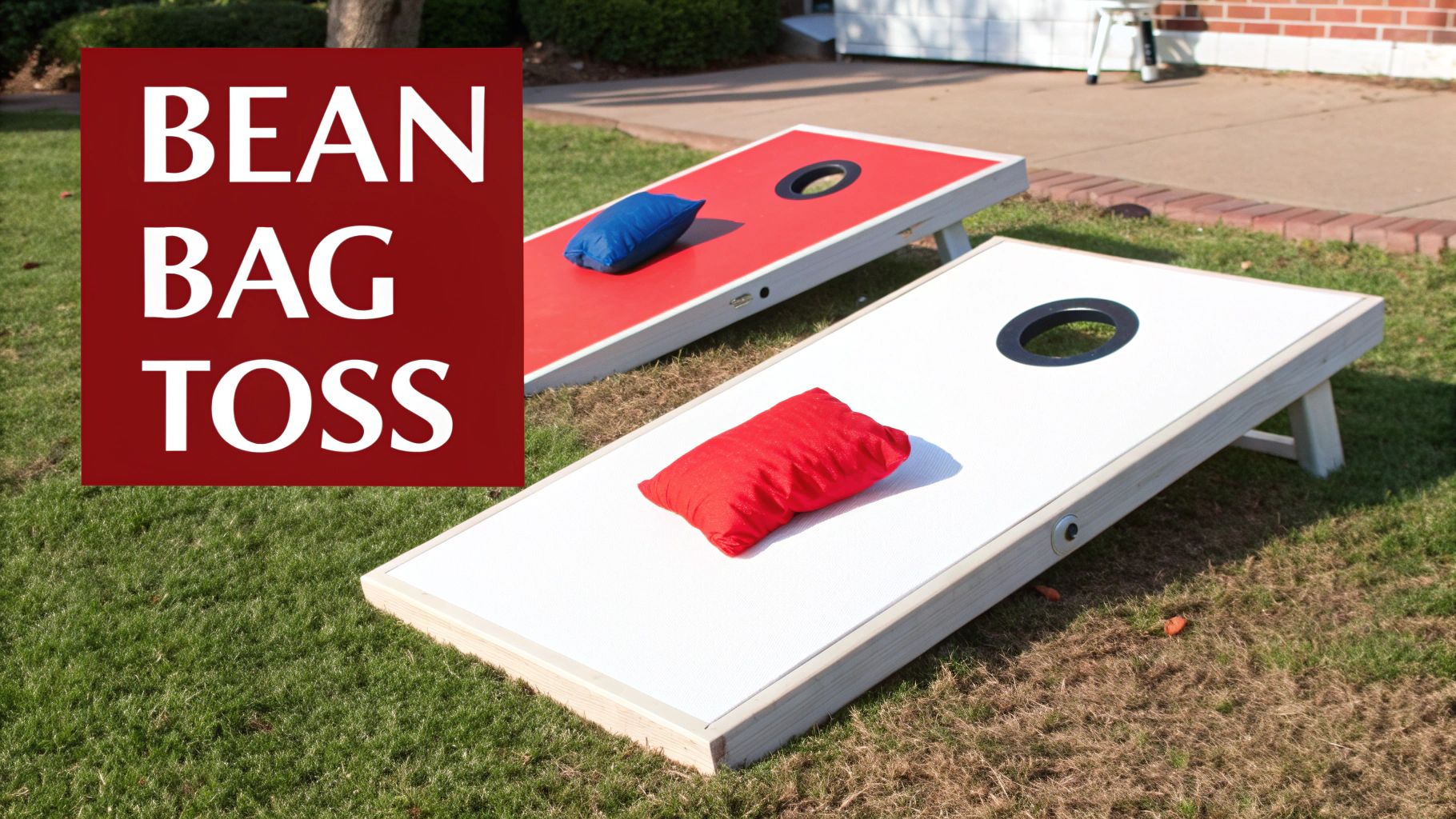
It’s an ideal game to play at a park due to its simple rules and appeal to all ages, making it perfect for family outings or friendly competitions. The portable nature of most cornhole sets allows for easy transport and setup on any flat grassy area. The game encourages light physical activity and helps develop hand-eye coordination and fine motor skills in a low-pressure, fun environment. Whether you're playing a casual match or organizing a mini-tournament, cornhole fosters a great social atmosphere.
### Getting Started with Cornhole
A standard cornhole set includes two boards and eight bean bags (four for each team). While many parks have ample open space, you’ll need a flat area to ensure the boards are stable and the playing field is fair.
- Set Up the Boards: Place the two boards on a flat surface, facing each other. For official regulation play, the front edges of the boards should be 27 feet apart. For kids or beginners, you can easily shorten this distance.
- Know the Rules: Players stand next to their board and toss bags to the opposite board. A bag on the board scores one point, while a bag in the hole scores three points. Only one team can score per round using cancellation scoring (e.g., if Team A scores 5 and Team B scores 3, Team A gets 2 points for the round).
- Practice Your Toss: A consistent, underhand throw with a slight arc is most effective. Focus on a smooth release and follow-through to control the bag’s trajectory and help it land flat on the board.
Cornhole’s simplicity is its greatest strength, offering an accessible way for everyone to participate and enjoy some friendly competition outdoors. It’s a fantastic way to bring people together, practice strategic tossing, and make any park visit more memorable.
4. Volleyball
Volleyball is a classic team sport that brings energy and excitement to any park outing. This game involves two teams, typically with six players each, positioned on opposite sides of a net. The goal is to send a ball over the net and have it land within the opponent's court, scoring a point. It’s a game of communication, coordination, and quick reflexes, making it a fantastic physical and social activity.
As one of the most popular games to play at a park, volleyball is perfect for larger groups of friends or families. Many public parks offer dedicated sand or grass courts, complete with nets. The sport, popularized by organizations like FIVB and its inclusion in the Olympics, is an excellent way for both kids and adults to develop teamwork, improve cardiovascular health, and enhance agility. Whether it’s a competitive match or a casual rally, volleyball encourages active participation and friendly competition.
### Getting Started with Volleyball
Setting up a game of volleyball is straightforward, especially if your local park provides a court. If not, a portable net and a ball are all you need to transform an open grassy area into your own playing field.
- Find a Court: Check your local parks and recreation website to find parks with available volleyball courts. Many coastal parks also offer beach volleyball setups.
- Know the Rules: The basic goal is to get the ball to hit the ground on the opponent's side. Each team gets a maximum of three hits to return the ball over the net. A game is typically played to 25 points, and a team must win by at least two points.
- Keep it Simple: For a casual game, don't worry about official positions or complex plays. Focus on the core skills of bumping, setting, and serving. A relaxed, co-ed game is a great way to introduce newcomers to the sport.
Volleyball is a highly adaptable game that can be enjoyed at various intensity levels, from a laid-back rally to a high-stakes match. By starting a game at the park, you’re not just playing; you’re building communication skills and creating lasting memories with every serve and spike.
5. Picnic Games (Lawn Games Bundle)
Picnic games, often found in a convenient lawn games bundle, transform any casual park outing into a memorable social event. This collection of classic outdoor activities like cornhole, ladder toss, giant Jenga, and Spikeball offers diverse entertainment for groups of all sizes. The beauty of these games lies in their simplicity and portability, allowing you to set up a mini-carnival of fun on any patch of grass.
These are some of the best games to play at a park because they foster friendly competition and easygoing interaction, making them perfect for family reunions, corporate picnics, or casual get-togethers with friends. They require minimal athletic skill, ensuring that everyone from young children to grandparents can participate. The variety within a bundle keeps energy levels high, as groups can easily switch from a strategic game of cornhole to a nerve-wracking round of giant Jenga.
### Getting Started with Picnic Games
Bringing a lawn games bundle to the park is an instant recipe for fun. Most sets are designed for quick setup and come with carrying cases, making transportation effortless.
- Create Stations: Set up different games in designated areas to allow multiple groups to play simultaneously. This encourages mingling and lets people choose the activity they prefer.
- Establish a Tournament: For larger groups, create a simple tournament bracket for a game like Spikeball or cornhole. This adds an exciting competitive edge to the gathering.
- Keep Score: Designate someone to keep score or use a small portable whiteboard. A little friendly competition can make the games more engaging for everyone involved.
Lawn games provide a perfect backdrop for socializing and enjoying the fresh air. This type of active, unstructured fun is crucial for development and well-being. By incorporating these activities, you can easily discover the many benefits of outdoor play while creating lasting memories with family and friends.
6. Frisbee (Ultimate Frisbee)
Ultimate Frisbee takes the classic backyard toss to a new level, transforming it into a fast-paced, athletic team sport. Combining the continuous movement of soccer with the aerial passing of football, Ultimate is played on a rectangular field with two end zones. The goal is to score points by passing the disc to a teammate in the opposing team's end zone. Players cannot run with the disc, making fluid passing and strategic field positioning essential for success.
It has earned its place as one of the most exciting games to play at a park because it promotes incredible teamwork, communication, and cardiovascular fitness. The sport is built on a "Spirit of the Game" ethos, a unique self-officiating system that relies on players' sportsmanship and respect. This makes it a fantastic game for developing social skills and teaching fair play alongside physical prowess. Leagues like the American Ultimate Disc League (AUDL) and organizations like USA Ultimate showcase the sport at its highest levels.
### Getting Started with Ultimate Frisbee
You don't need a full-sized field or official teams to enjoy a game. A frisbee, a few cones to mark end zones, and a group of friends are all that’s required for a fun pickup match in an open park space.
- Learn the Throws: Focus on mastering the two basic throws: the backhand (the standard throw) and the forehand (or "flick"). Consistent, accurate throws are the foundation of the game.
- Understand the Rules: The core rule is no running with the disc. Once you catch it, you must establish a pivot foot and throw to a teammate. If the pass is incomplete, it's a turnover, and the other team gets possession.
- Find a Pickup Game: Many communities have weekly pickup games that are open to all skill levels. This is the best way to learn the flow of the game and meet other players in a low-pressure environment.
Ultimate Frisbee is an excellent way to engage in kinesthetic learning, as players must constantly react and adapt their movements to the disc's flight. To understand more about this active learning style, you can explore the principles of what is kinesthetic learning style. By organizing a game of Ultimate, you provide a dynamic and social workout that builds both physical and interpersonal skills.
7. Kickball
Kickball is a classic team sport that blends the rules of baseball with the simple action of kicking a large rubber ball. This beloved pastime turns any open field into a stadium of fun, making it one of the most versatile and enjoyable games to play at a park. The game involves two teams that take turns "batting" (kicking) and fielding, with the goal of scoring runs by advancing players around a set of bases.
It’s an ideal choice for large groups, accommodating players of all ages and athletic abilities. The straightforward rules and minimal equipment requirements make it perfect for school P.E. programs, corporate team-building events, and casual community gatherings. Kickball excels at promoting teamwork, communication, and friendly competition in an active outdoor setting.
### Getting Started with Kickball
All you need to start a game is a kickball (or a similar bouncy, rubber ball) and markers for bases, such as cones, jackets, or even patches of dirt. The game is easily adapted to fit the size and shape of your available park space.
- Set Up the Field: Create a diamond shape with four bases: home plate, first, second, and third. The pitcher's mound should be in the center, a comfortable distance from home plate.
- Know the Rules: A player kicks the ball rolled by the pitcher and runs to first base. Fielders try to get the runner "out" by catching the ball in the air, tagging them with the ball, or throwing the ball to a base before the runner arrives. Three outs end the inning.
- Create Balanced Teams: For a fair and fun game, try to distribute players with different skill levels evenly between the two teams. This ensures everyone gets a chance to participate meaningfully.
Kickball is more than just a game; it's a fantastic social activity that builds camaraderie. It emphasizes group effort over individual skill, which is why exploring more cooperative play activities for preschoolers can help build a foundation for great teamwork early on. By organizing a kickball game, you’re creating an opportunity for physical exercise and lasting memories.
8. Geocaching
Geocaching transforms a simple park visit into a high-tech treasure hunt, making it one of the most exciting and modern games to play at a park. This global outdoor adventure uses GPS-enabled devices to guide participants to hidden containers called "geocaches" or "caches." The objective is to navigate to a specific set of coordinates, find the hidden cache, sign the logbook, and sometimes trade small trinkets.
This activity is perfect for families and individuals looking to add a sense of discovery to their outdoor time. It cleverly combines technology with nature, encouraging critical thinking, navigation skills, and physical activity. With millions of caches hidden worldwide, from bustling city parks to remote hiking trails, there’s always a new adventure waiting just around the corner. The global community on platforms like Geocaching.com ensures that the game is constantly evolving and growing.
### Getting Started with Geocaching
Getting started is surprisingly simple. All you need is a smartphone with GPS capabilities and a sense of adventure. The thrill of the hunt is accessible to everyone, from young children to seasoned explorers.
- Download the App: The official Geocaching® app is the easiest entry point. It displays nearby caches, their difficulty, and recent activity from other finders.
- Bring Small Trinkets: Many caches contain small, inexpensive items for trade (known as "swag"). If you take something, leave something of equal or greater value.
- Leave No Trace: Respect the environment. Always put the cache back exactly where you found it, and ensure it's well-hidden for the next person to discover.
Geocaching is more than just a game; it’s a powerful educational tool that supports the benefits of play-based learning by teaching geography, problem-solving, and environmental stewardship. For those interested in the mechanics, exploring advancements in GPS tracking technology in sport can offer a deeper appreciation for the precision behind your hunt. This activity turns any park into a map of hidden secrets, waiting to be found.
9. Tennis
Tennis is a classic racquet sport that offers a fantastic blend of cardiovascular exercise, strategic thinking, and friendly competition. Played on a rectangular court divided by a net, the goal is for players to use a stringed racquet to hit a hollow rubber ball over the net so that the opponent cannot legally return it. This dynamic activity is one of the most popular games to play at a park, with public courts readily available for singles or doubles matches.
The game’s appeal lies in its scalability; it can be a casual volley between beginners or an intense, fast-paced match for experienced players. Tennis is an excellent way to improve hand-eye coordination, agility, and overall fitness. Because many parks, like Flushing Meadows Corona Park in New York or the numerous public facilities in most cities, provide well-maintained courts, it’s an accessible sport for families and individuals looking to get active outdoors.
### Getting Started with Tennis
You don't need to be a professional to enjoy a match. With a couple of racquets, a can of balls, and a court, you have everything required for a fun afternoon. The basic rules and scoring can be learned quickly enough for a casual game.
- Find a Court: Many local parks and recreation departments offer public courts that can be reserved online or used on a first-come, first-served basis.
- Learn the Basics: Start by practicing fundamental strokes like the forehand, backhand, and serve. Focus on making consistent contact with the ball before worrying about power or advanced techniques.
- Keep Score Simply: For a friendly game, you can skip the official scoring (15, 30, 40) and simply play to a set number of points, like 11 or 21, making it more approachable for kids and new players.
Tennis provides a structured athletic outlet that promotes both physical health and mental discipline. It's a lifelong sport that can be enjoyed at any age, making it a perfect activity for family outings. For a fun twist on physics, you can even explore the science behind the bounce and spin of the ball with a hands-on experiment like the PLAYZ Ridiculous Inventions Science Kit, tying on-court action to off-court learning.
10. Pickleball
Pickleball is a wildly popular paddle sport that has taken parks and recreational courts by storm, blending elements of tennis, badminton, and ping-pong into one accessible game. The objective is to use solid paddles to hit a perforated plastic ball over a net, with rules designed to encourage long, exciting rallies. It's played on a court about one-third the size of a standard tennis court, making it less physically demanding but just as strategic and fun.
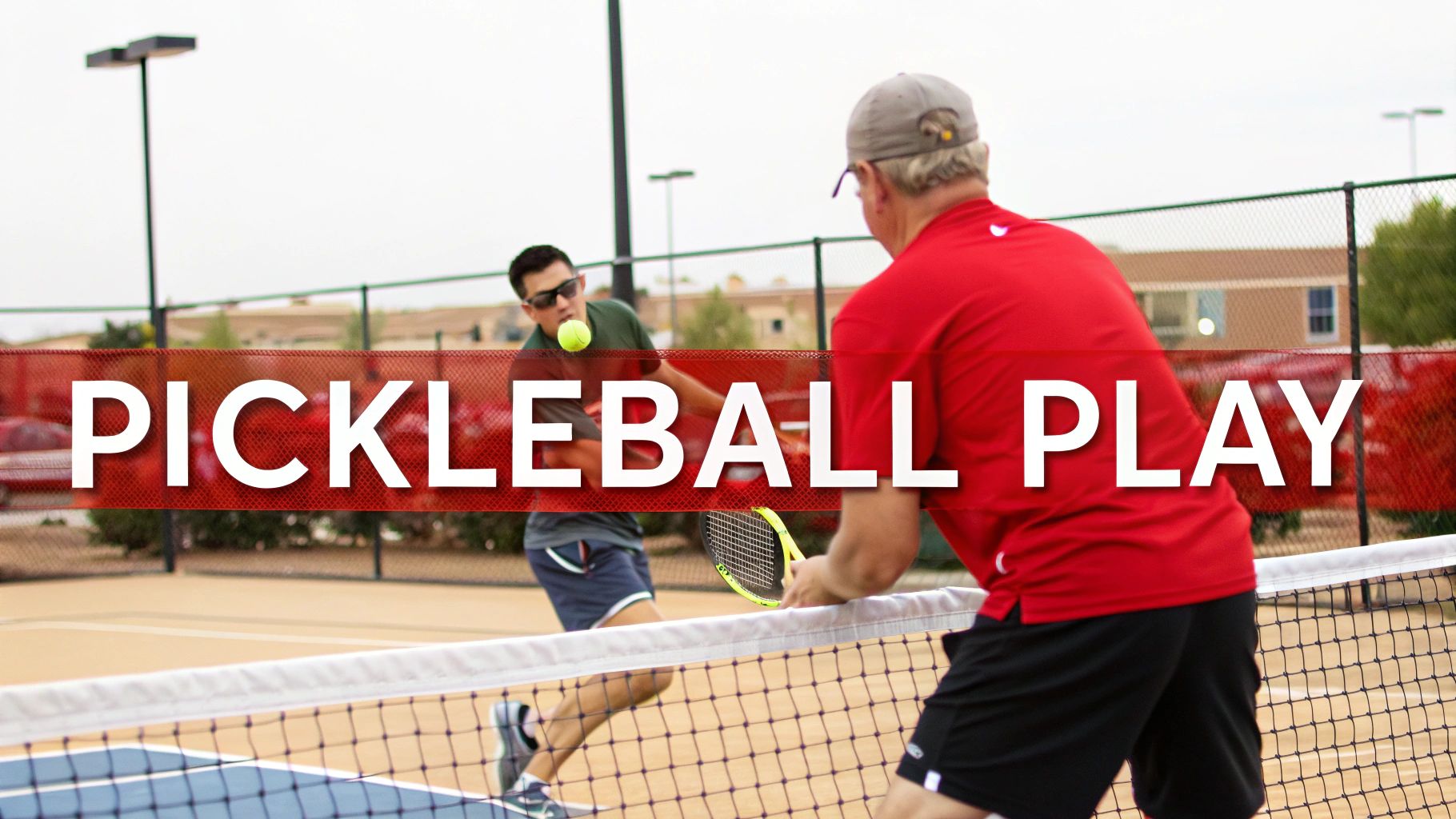
This sport is one of the fastest-growing games to play at a park because of its social nature and low barrier to entry. Its smaller court size means less running, making it a fantastic option for all ages and fitness levels. The community around pickleball is famously welcoming, and you'll find dedicated courts popping up in public parks, community centers, and even dedicated pickleball complexes nationwide. Organizations like the PPA (Professional Pickleball Association) and Major League Pickleball (MLP) have also boosted its visibility.
### Getting Started with Pickleball
The basics of pickleball are easy to learn, and most community courts have a friendly group ready to help new players get started. The simple equipment and straightforward rules make it an ideal family activity.
- Find a Court: Many local parks have converted tennis courts or built dedicated pickleball courts. Check your city's parks and recreation website to find a location near you.
- Know the Rules: The game starts with an underhand serve, and points can only be scored by the serving team. A key rule involves the "kitchen," a non-volley zone near the net where players cannot hit the ball out of the air.
- Learn a Key Shot: Mastering the "dink shot," a soft, controlled shot that lands just over the net in the opponent's kitchen, is fundamental to controlling the game's pace.
Pickleball is more than just a game; it's a social event that encourages communication, quick reflexes, and friendly competition. It’s an excellent way to meet new people and stay active in a fun, low-impact environment.
Comparison of 10 Park Games
| Activity | 🔄 Implementation Complexity | ⚡ Resource Requirements | 📊 Expected Outcomes | 💡 Ideal Use Cases | ⭐ Key Advantages |
|---|---|---|---|---|---|
| Frisbee Golf (Disc Golf) | 🔄 Low — basic throwing skills; requires course | ⚡ Low — discs; access to 18–27 hole course | 📊 Moderate fitness, skill progression, outdoor time | 💡 Parks, casual rounds, community leagues | ⭐ Low cost; accessible; encourages outdoor play |
| Badminton | 🔄 Low–Medium — simple rules, needs technique for higher play | ⚡ Low — racquets, shuttlecock, net, flat space | 📊 High-intensity bursts, agility, short matches | 💡 Backyard/court play, school PE, quick social games | ⭐ Fast-paced; portable equipment; easy to learn |
| Cornhole (Bean Bag Toss) | 🔄 Very Low — minimal rules and setup | ⚡ Very Low — two boards, eight bags | 📊 Low exertion, social engagement, short sessions | 💡 BBQs, tailgates, casual gatherings | ⭐ Highly accessible; inexpensive; easy to transport |
| Volleyball | 🔄 Medium–High — team coordination and positioning | ⚡ Medium — net, poles, ball, 6+ players, court space | 📊 Strong cardio, teamwork, skill development | 💡 Beach/park leagues, team-building events | ⭐ Excellent team activity; scalable intensity |
| Picnic Games (Lawn Games Bundle) | 🔄 Low — mix of simple games with varied rules | ⚡ Low–Medium — multiple lightweight items; transport needed | 📊 Varied engagement, social interaction, flexible duration | 💡 Reunions, weddings, family gatherings | ⭐ Variety keeps groups engaged; inclusive for mixed abilities |
| Frisbee (Ultimate) | 🔄 Medium–High — rules, strategy, throws and cuts | ⚡ Medium–High — disc, large field, ~14 players | 📊 High cardio, full-body workout, teamwork | 💡 Leagues, college teams, pickup fields | ⭐ Intense fitness; strong community and spirit |
| Kickball | 🔄 Low–Medium — simple baseball-like rules | ⚡ Low — rubber ball, bases, open field, 10–12 players | 📊 Moderate cardio, playful team interaction | 💡 School PE, corporate events, recreational leagues | ⭐ Inclusive for non-athletes; easy to organize |
| Geocaching | 🔄 Low–Medium — app/GPS navigation and planning | ⚡ Low — smartphone/GPS, optional trinkets | 📊 Exploration, light exercise, learning/navigation skills | 💡 Hikes, family outings, educational trips | ⭐ Free to join; scalable difficulty; encourages exploration |
| Tennis | 🔄 Medium–High — technical skills and consistent practice | ⚡ Medium — racquet, balls, court access, possible coaching | 📊 High cardio, agility, competitive development | 💡 Clubs, lessons, singles/doubles play | ⭐ Lifetime sport; strong fitness and competitive pathways |
| Pickleball | 🔄 Low–Medium — simple rules, developing advanced skills | ⚡ Low–Medium — paddle, ball, smaller court | 📊 Low-impact cardio, social play, quick matches | 💡 Community centers, seniors, casual leagues | ⭐ Easy to learn; low joint impact; rapidly growing sport |
Get Ready to Play: Your Park Adventure Awaits!
From the satisfying clink of chains in Disc Golf to the energetic volleys of Badminton and the strategic teamwork of Kickball, this guide has armed you with a diverse playbook of games to play at a park. We've journeyed through ten distinct activities, each offering a unique blend of physical activity, social interaction, and pure, unadulterated fun. The common thread weaving through all these options is the simple, profound joy of getting outside and sharing an experience.
The park is more than just a patch of grass; it's a dynamic arena for connection, learning, and memory-making. Whether you're organizing a family reunion, a casual weekend with friends, or an educational outing for a group of children, the right game can transform an ordinary day into an extraordinary adventure.
Key Takeaways for Your Next Park Day
As you pack your gear and head out the door, keep these core principles in mind to maximize your fun and ensure a smooth, enjoyable experience for everyone involved:
- Adaptability is Your Best Friend: The best park game is the one that fits your specific situation. Consider the age and energy levels of your group, the space available, and the equipment you have. A game like Cornhole is perfect for a relaxed, multi-generational crowd, while Ultimate Frisbee suits a more athletic, high-energy group.
- Safety First, Fun Always: A successful park outing is a safe one. Always survey your play area for potential hazards like uneven ground, roots, or rocks. Establish clear boundaries, especially for fast-moving games like Kickball or Tennis, and ensure everyone understands the rules to prevent accidental collisions or injuries.
- Preparation Prevents Problems: A little planning goes a long way. Before you leave, double-check your equipment list. Do you have the shuttlecocks for Badminton? Are the bean bags for Cornhole packed? Bringing essentials like water, snacks, sunscreen, and a basic first-aid kit ensures you can stay and play comfortably for hours.
Turning Inspiration into Action
You now have a comprehensive list of ideas, complete with rules, variations, and practical tips. The next step is the most exciting one: putting it all into practice. Don't let this newfound knowledge sit idle. Use it as a catalyst to plan your very next outdoor excursion.
Actionable Insight: Look at your calendar for the upcoming week and pick one specific day for a park visit. Choose one new game from this list you've never tried, like Geocaching or Pickleball, and commit to learning it. This simple act of scheduling turns a vague idea into a concrete plan.
The value of mastering these games to play at a park extends far beyond simple recreation. It’s about building a toolkit for a healthier, more connected lifestyle. It’s about creating traditions, fostering sportsmanship in children, and strengthening bonds with friends and family. Each game of Volleyball, each round of Cornhole, and each successfully found geocache becomes a shared memory, a story to tell, and a reason to look forward to the next sunny day.
The modern world pulls our attention in countless directions, often toward screens and indoor activities. Choosing to play outside is a deliberate, powerful act. It’s a declaration that you value fresh air, physical movement, and face-to-face interaction. So, embrace the opportunity. Gather your favorite people, pack a bag with a frisbee or a set of pickleball paddles, and rediscover the timeless fun that awaits at your local park. Your next great adventure is just a game away.
Ready to infuse even more learning into your playtime? Playz creates award-winning STEM kits that turn scientific principles into hands-on, explosive fun, making them the perfect complement to an active day outdoors. Explore our collection and discover how to make every day a new adventure in learning and play at Playz.