

Welcome to the vibrant world of preschool play, where every shared block and collaborative story builds a foundation for lifelong success. Fostering genuine connection and teamwork among young children is more crucial than ever. This guide moves beyond simple ideas to offer a comprehensive look at 10 powerful cooperative play activities for preschoolers.
Each activity is designed not just to entertain but to teach essential social-emotional skills like empathy, negotiation, and communication. We'll explore why these shared experiences are fundamental for development, helping children learn to navigate social landscapes, solve problems together, and build meaningful friendships. To fully grasp the educational philosophy behind these activities, it's beneficial to delve deeper into understanding play-based learning.
This article provides a curated collection of engaging activities that transform simple fun into profound learning moments. For each idea, you'll find everything you need to get started:
- Actionable Instructions: Clear, step-by-step guidance for easy setup.
- Materials List: A breakdown of required items, focusing on accessibility.
- Key Learning Outcomes: A look at the social, cognitive, and motor skills developed.
- Practical Variations: Simple ways to adapt activities for different ages and abilities.
Whether you're a parent seeking to enrich playtime at home, a childcare provider, or an educator designing a collaborative classroom, you'll find actionable strategies here. Let’s dive into activities that build brighter futures, one shared goal at a time.
1. Building Blocks & Construction Play
Cooperative construction play is a cornerstone of early childhood education where multiple preschoolers work together to build structures using materials like wooden blocks, LEGO Duplo, or magnetic tiles. More than just stacking, this activity is a rich social exercise. It requires children to negotiate roles, share limited resources, and merge their individual ideas into a single, cohesive creation, making it one of the most effective cooperative play activities for preschoolers.
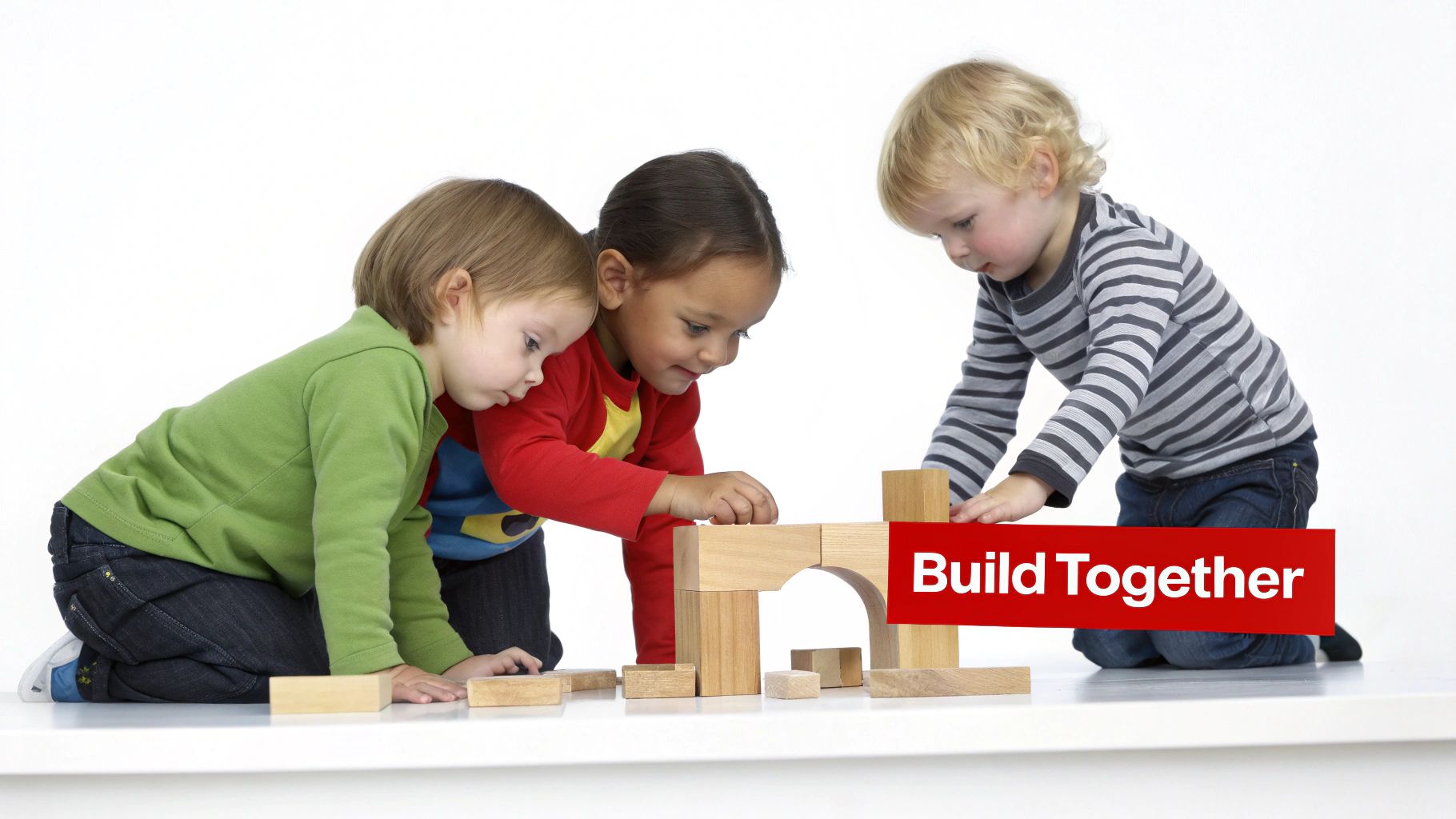
This approach, popularized by educational philosophies like Reggio Emilia and Froebel's Gifts, transforms a simple toy into a tool for collaborative problem-solving. Children learn to plan together, communicate their needs ("Can I have the long blue piece?"), and celebrate a shared achievement when their tower, castle, or bridge is complete.
How to Implement Cooperative Building
To foster successful teamwork, provide a clear, shared goal. Instead of simply saying "play with blocks," suggest a specific project like, "Let's build a house for this toy animal" or "Can we work together to make the tallest tower in the room?" This common objective gives children a reason to cooperate.
- Set a Project Goal: Provide a simple objective, such as building a zoo, a city, or a garage for toy cars.
- Use Visual Aids: Create simple "blueprint" cards with pictures of structures to inspire collaborative designs.
- Manage Resources: If certain blocks are popular, use a sand timer to encourage turn-taking and sharing.
- Celebrate the Process: Photograph the finished creations. This validates their collective effort and provides a topic for reflection, allowing them to discuss what worked well and what was challenging.
Key Learning Outcomes
Cooperative construction play is invaluable for holistic development. Children enhance fine motor skills by manipulating pieces, develop spatial reasoning as they fit blocks together, and build crucial social-emotional skills like patience, empathy, and negotiation. These foundational experiences also introduce basic engineering principles in a fun, hands-on way. For more ideas on fostering these skills, you can explore these engineering activities for kids from playzusa.com.
2. Circle Time & Group Singing
Circle time and group singing are foundational cooperative play activities for preschoolers, creating a shared space where children listen, participate, and contribute as a group. This structured gathering involves singing songs, chanting rhymes, and playing musical games together. More than just a morning routine, it fosters a sense of community and belonging, requiring each child to tune into the group's rhythm and follow collective cues.
This practice, central to educational models like Montessori and Head Start, transforms simple songs into powerful tools for social cohesion. Children learn to wait for their turn to speak, listen to their peers, and move in sync during action songs. The circular arrangement itself is symbolic, placing every participant on an equal footing and encouraging face-to-face interaction, which is essential for developing social awareness.
How to Implement Cooperative Singing
To make circle time truly cooperative, focus on activities that require group participation rather than passive listening. The goal is to create an experience where every child's contribution helps the activity succeed. A shared purpose, such as learning a new song with actions, gives them a reason to work together.
- Establish a Clear Routine: Start with a familiar "hello" song to signal the beginning of this special group time.
- Incorporate Call-and-Response: Use songs like "Who Stole the Cookie from the Cookie Jar?" where children must listen for their name and respond.
- Use Props for Participation: Hand out shakers, scarves, or rhythm sticks so each child can add to the group's music.
- Empower with Choice: Allow children to take turns choosing a favorite song or suggesting a movement, giving them ownership of the activity.
Key Learning Outcomes
Group singing is a powerhouse for development. It significantly enhances language and auditory processing skills as children learn new vocabulary and distinguish rhythmic patterns. Socially, it builds crucial listening skills, turn-taking, and self-regulation. Emotionally, singing together releases endorphins and reduces stress, creating a positive and unified classroom atmosphere. For more strategies on keeping children focused during these activities, you can find tips for increasing student engagement on playzusa.com.
3. Parachute Games
Parachute games are classic cooperative play activities for preschoolers where a group of children holds the edges of a large, colorful parachute and works together to manipulate it. This highly engaging activity requires synchronized movement and communication to create waves, make a "mushroom" by lifting it high, or play games like "popcorn" by bouncing balls on its surface. The very nature of the parachute means no single child can succeed alone; the entire group must cooperate to make the magic happen.
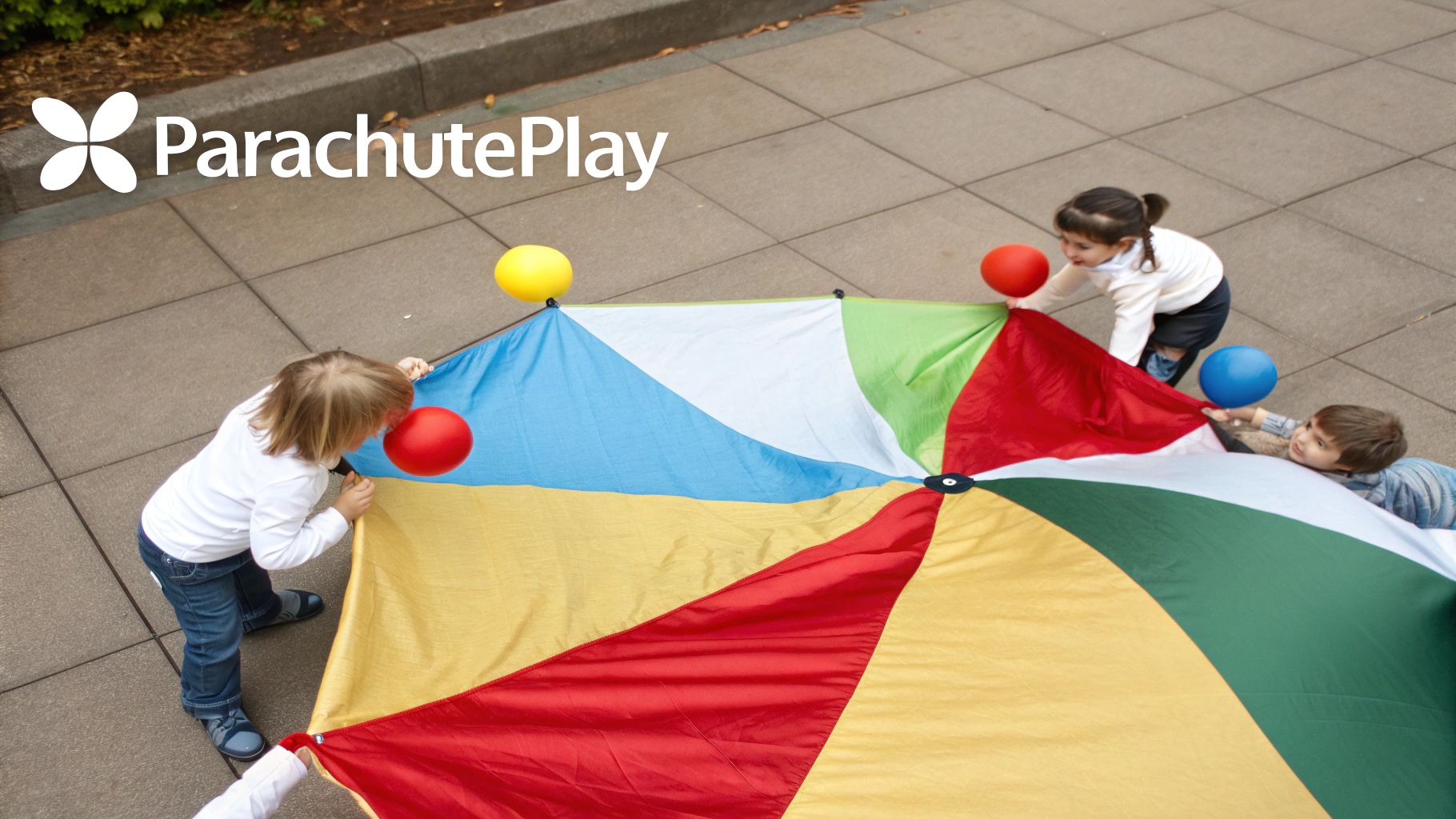
A staple in physical education programs and early childhood centers, this activity turns simple fabric into a powerful tool for teamwork. Children learn to listen to verbal cues, watch their peers' movements, and adjust their own actions to contribute to a shared goal. Whether they are hiding underneath the inflated parachute or working to keep a ball from falling off, every child has an essential and equal role.
How to Implement Parachute Games
To ensure a safe and successful experience, begin with simple, guided movements. Start by having children stand in a circle and practice gripping the parachute handles or edge, then introduce a clear, collective goal like, "Let's all lift together on the count of three!"
- Start with Simple Goals: Begin with basic movements like making small waves, then big waves, before progressing to games.
- Use Clear Verbal Cues: Use consistent and simple commands like "up," "down," and "shake" to guide the group's actions.
- Introduce Game Variations: Play "Popcorn" by adding soft balls to the parachute and having children shake them. Or, play "Cat and Mouse" where one child crawls under the parachute (the mouse) while another walks on top (the cat).
- Manage Group Dynamics: Encourage children to take turns choosing a game or calling out a color for others to run under. This gives them ownership and leadership opportunities.
Key Learning Outcomes
Parachute games are excellent for developing gross motor skills, including arm strength and coordination. They also enhance social-emotional skills by promoting listening, following directions, and taking turns. Children learn about cause and effect as they see how their collective actions impact the parachute's movement, fostering a strong sense of community and shared accomplishment. These activities are particularly wonderful for outdoor settings, and you can explore more about the benefits of outdoor play from playzusa.com.
4. Pretend Play & Dramatic Play Centers
Pretend play in dedicated dramatic play centers is a powerful form of cooperative learning where preschoolers collaboratively create and act out narratives. By taking on roles in settings like a grocery store, a doctor’s office, or a family kitchen, children practice social scripts and problem-solving together. This activity requires them to negotiate roles, follow shared rules, and respond to each other's ideas in real-time, making it one of the most dynamic cooperative play activities for preschoolers.
This method, embraced by educational philosophies from Montessori to the Reggio Emilia approach, turns make-believe into a laboratory for social and emotional development. Children learn to communicate their intentions (“I’ll be the chef, and you can be the customer!”), understand different perspectives, and resolve conflicts that arise naturally within their shared story.
How to Implement Cooperative Dramatic Play
To facilitate meaningful cooperation, a well-designed environment is key. Instead of a random assortment of props, create a themed center that encourages specific, shared scenarios. A "Veterinarian's Office" with stuffed animals, a clipboard, and toy medical tools immediately gives children a collaborative purpose.
- Set the Scene: Rotate themed centers monthly (e.g., post office, restaurant, auto repair shop) to maintain high engagement.
- Provide Realistic Props: Use items like an old keyboard for an "office," empty food boxes for a "store," or a real stethoscope to make the experience more immersive.
- Limit Group Size: Keep centers to 3-4 children at a time to ensure everyone can actively participate and contribute to the narrative.
- Model Scenarios: If children seem stuck, briefly join their play to model a role or introduce a new problem, such as, "Oh no, the puppy has a tummy ache! What should we do?"
Key Learning Outcomes
Cooperative dramatic play is a holistic developmental tool. It builds language and communication skills as children create dialogue, strengthens emotional regulation as they navigate social situations, and fosters symbolic thinking by using objects to represent something else. These experiences are fundamental for developing empathy and complex social understanding. You can discover more about the developmental impact of this activity by exploring the benefits of pretend play from playzusa.com.
5. Cooperative Art & Collaborative Murals
Cooperative art projects invite preschoolers to contribute to a single, large-scale creation, such as a mural, sculpture, or collage. This activity moves beyond individual expression to a shared creative endeavor. Children must navigate shared space, materials, and a collective vision, transforming a blank canvas into a powerful symbol of their teamwork and making it a standout among cooperative play activities for preschoolers.
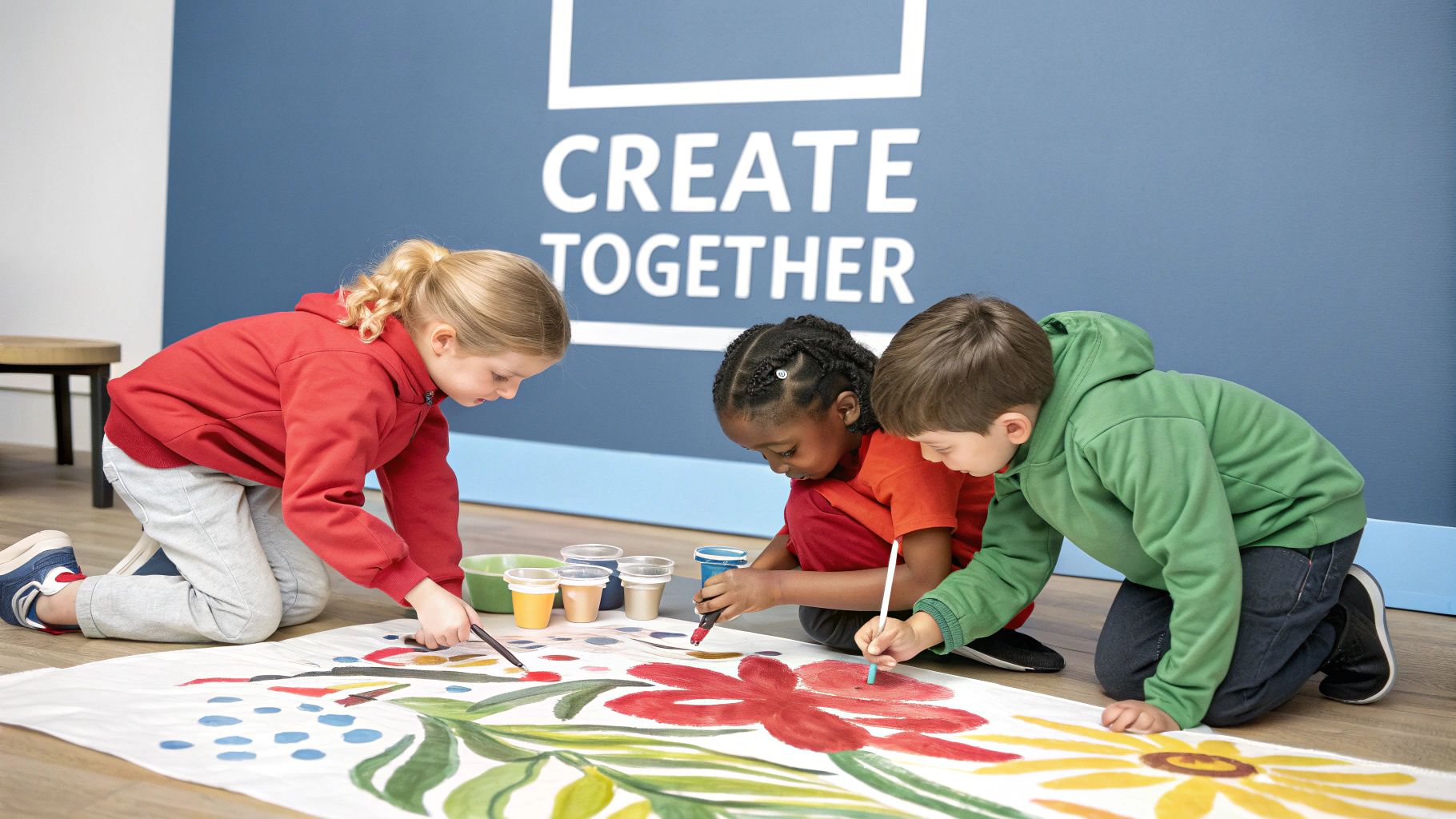
Inspired by community art projects and approaches like Reggio Emilia's documentation boards, collaborative art teaches children that their individual contributions are vital to the group's success. They learn to appreciate diverse ideas, as one child’s painted sun complements another’s collage grass, resulting in a richer, more complex final piece than any one child could create alone.
How to Implement Cooperative Art
The key to a successful collaborative mural is providing a large, accessible workspace and a clear, unifying theme. Instead of individual papers, roll out a large sheet of butcher paper on the floor or a wall and suggest a theme like, "Let’s create a big jungle together" or "What does our community look like?"
- Set a Common Theme: Provide a simple prompt, such as an ocean scene, a city skyline, or a seasonal landscape, to unify their efforts.
- Provide Varied Materials: Offer a wide range of supplies like paint, crayons, markers, fabric scraps, and natural items to encourage different forms of expression.
- Designate a Shared Space: Use a large canvas, butcher paper roll, or even a large cardboard box as the group’s single workspace.
- Document and Display: Take photos of the children working together and display the finished masterpiece prominently with the names of all the young artists. This validates their shared ownership and effort.
Key Learning Outcomes
Collaborative art significantly boosts social-emotional development by teaching negotiation ("Can I use the blue paint next?") and respect for others' work. It enhances fine motor skills through painting, cutting, and gluing, while also fostering creative thinking and aesthetic awareness. Children learn to plan, communicate, and celebrate a shared goal, seeing firsthand how collaboration produces amazing results. For more inspiration, check out these creative crafts for preschoolers from playzusa.com.
6. Group Movement & Dance Activities
Group movement and dance are dynamic activities where preschoolers move together, often in sync with music or verbal cues. From structured games like freeze dance to free-form expressive movement, these sessions require children to become aware of others in their shared space, follow group instructions, and coordinate their actions. This turns physical activity into a powerful exercise in social cohesion, making it a joyful and essential cooperative play activity for preschoolers.
This approach, seen in programs like Kindermusik and Gymboree, leverages music's natural ability to unify a group. Children learn to respond to auditory cues as a team, share physical space without bumping into each other, and mirror the movements of their peers. The shared experience of jumping, swaying, and freezing together fosters a sense of belonging and non-verbal communication.
How to Implement Group Movement
To facilitate effective cooperative movement, start with a simple, shared prompt. Instead of just playing music, guide the activity with a theme, such as "Let's all move like animals in the jungle" or "Follow my lead and copy my silly dance!" This gives children a common focus and encourages them to observe and interact with each other.
- Set a Clear Theme: Use themes like animal movements, growing plants, or weather patterns to guide the dance.
- Use Clear Cues: Provide simple verbal instructions like "Now we march!" or use a signal like a tambourine shake for "freeze!"
- Model and Invite: Demonstrate movements first to build confidence, then invite children to add their own ideas for the group to copy.
- Vary the Tempo: Use a mix of fast and slow music to help children practice self-regulation and respond to changing group energy.
Key Learning Outcomes
Group movement is exceptional for developing gross motor skills as children run, jump, and balance. It also enhances body awareness and spatial reasoning as they learn to navigate a shared space. Most importantly, it builds crucial social-emotional skills like following directions in a group setting, turn-taking, and reading non-verbal social cues. For more engaging ways to combine sound and motion, explore these 8 Fun Music and Movement Activities for Preschoolers.
7. Cooperative Games & Board Games
Cooperative games are specially designed board games or activities where all players work together as a team to achieve a common goal, rather than competing against one another. In these games, the "opponent" is the game board itself or a time element, shifting the focus from individual victory to collective success. This shared purpose makes them powerful cooperative play activities for preschoolers, teaching them to strategize, communicate, and support each other.
Popularized by game publishers like Peaceable Kingdom, these games transform traditional play dynamics. Instead of a single winner, everyone either wins together or loses together. This design inherently removes the potential for sore losers and fosters a positive, supportive environment where children cheer for each other's turns and problem-solve as a unified group.
How to Implement Cooperative Games
To introduce cooperative games effectively, choose simple options with clear rules and a playtime of around 10 to 15 minutes to match a preschooler's attention span. Model the collaborative spirit by playing alongside the children initially.
- Choose an Appropriate Game: Select a game like Hoot Owl Hoot! or Count Your Chickens. These games have simple, shared objectives, such as getting all the owls to the nest before the sun rises.
- Model Teamwork: As you play, think out loud: "I think we should move this owl to help us get closer. What do you think?" This encourages discussion and shared decision-making.
- Adapt Traditional Games: Modify a classic game like Candy Land by creating a new rule: "If you land on a licorice space, another player can give you one of their colored cards to help you move."
- Celebrate the Effort: Focus praise on how well the children worked together, communicated, and helped each other, regardless of whether they "beat" the game. This reinforces the value of the collaborative process.
Key Learning Outcomes
Cooperative games are exceptional tools for social-emotional learning. They directly teach children how to take turns, follow rules, and handle disappointment in a low-stakes context. Players develop strategic thinking as they plan moves together, enhance their communication skills by discussing options, and build empathy by helping teammates. For a great selection of these types of games, you can check out the offerings from Peaceable Kingdom.
8. Sensory & Nature Exploration Activities
Cooperative sensory and nature exploration involves preschoolers engaging together with materials like water, sand, and playdough or exploring outdoor environments. This type of play encourages children to share tools, negotiate space at a sensory bin, and collaboratively discover the natural world. More than just individual exploration, it becomes a shared scientific inquiry, making it one of the most organic cooperative play activities for preschoolers.
This approach taps into a child's natural curiosity. When two children at a water table decide to work together to see which objects float, or a group on a nature walk helps each other find all the items on a scavenger hunt list, they are practicing teamwork. They learn to verbalize their discoveries ("Look what I found!"), listen to their peers' ideas, and work toward a common goal, whether it's creating a "potion" in a mud kitchen or building a fairy house from twigs and leaves.
How to Implement Cooperative Exploration
To transform sensory or nature play into a cooperative experience, provide a shared purpose and the right tools. Instead of letting them explore aimlessly, frame the activity around a joint task. For example, "Let's work together to collect enough smooth stones to make a path," or "Can we mix sand and water to build a dam in this corner of the table?"
- Provide Ample Tools: Offer multiple scoops, funnels, magnifying glasses, and buckets to minimize conflicts over resources and encourage sharing.
- Establish a Shared Mission: Create themed nature scavenger hunts (e.g., find five different types of leaves) or sensory bin challenges (e.g., "Let's find all the hidden sea animals").
- Encourage Role-Playing: Suggest roles like "chief collector," "potion mixer," or "wildlife spotter" to give children specific responsibilities within the group.
- Document and Discuss: Take photos of their nature creations or discoveries. Use these as prompts to discuss how they worked together to achieve their goal.
Key Learning Outcomes
Sensory and nature-based play is a powerful tool for holistic development. It enhances sensory processing skills and fine motor control as children scoop, pour, and manipulate small objects. Simultaneously, it builds critical social-emotional skills like communication, turn-taking, and collaborative problem-solving. This hands-on connection with the natural world also fosters early scientific thinking, observation skills, and an appreciation for the environment.
9. Cooking & Food Preparation Activities
Cooperative cooking activities turn the kitchen or classroom into a vibrant learning lab where preschoolers work together to prepare simple foods. Children collaborate on tasks like measuring ingredients, mixing batter, or assembling snacks, transforming a routine activity into a powerful social exercise. This shared experience requires communication, following sequential steps, and taking turns, making it one of the most delicious cooperative play activities for preschoolers.
This hands-on approach teaches more than just basic life skills. It provides a tangible context for cooperation, as each child's contribution is essential to the final product. From making a simple fruit salad to decorating cookies, children learn that their combined efforts result in a rewarding and tasty achievement that everyone can enjoy together.
How to Implement Cooperative Cooking
To set up a successful cooperative cooking project, focus on a simple recipe with distinct roles for each child. A shared goal, like "Let's make smoothies for everyone to try," motivates children to work as a team and appreciate each other's contributions.
- Choose Simple Recipes: Select no-bake recipes or simple tasks like making fruit skewers, mixing a dip, or decorating cupcakes.
- Use Visual Recipe Cards: Create cards with pictures and simple words for each step, helping children follow the sequence independently.
- Assign Clear Roles: Give each child a specific job, such as "the pourer," "the mixer," or "the scooper," and rotate roles for fairness.
- Emphasize Food Safety: Begin every session by teaching and practicing proper handwashing and safe food handling habits.
Key Learning Outcomes
Cooking together is a rich, multi-sensory activity that supports holistic development. Children enhance fine motor skills by pouring and scooping, practice early math concepts through measuring, and build crucial language skills by following directions and discussing ingredients. Most importantly, it fosters social-emotional growth by teaching patience, teamwork, and the joy of sharing a meal they created themselves.
10. Story Time & Collaborative Storytelling
Collaborative storytelling transforms traditional story time into a dynamic, interactive group activity. Instead of passively listening, preschoolers actively participate in creating, retelling, or shaping a narrative together. This can involve anything from predicting what happens next in a picture book to collectively building a new story one sentence at a time. This method turns reading into a shared social experience, making it a foundational cooperative play activity for preschoolers.
This approach, championed by literacy advocates like Jim Trelease and Mem Fox, emphasizes that reading is a social act. It builds a sense of community as children listen to one another's ideas, connect over a shared narrative, and work together to understand or create a story. The group’s shared ownership of the narrative fosters listening skills and mutual respect.
How to Implement Collaborative Storytelling
To encourage participation, select engaging, age-appropriate books with clear illustrations and predictable patterns. Your role is to facilitate, not just read. Pause frequently to invite children into the story, turning them from an audience into co-creators of the experience.
- Set a Project Goal: Frame the activity with a clear objective, such as, "Let's figure out what the bear will do next," or "Let's make a new ending for this book together."
- Use Visual Aids: Use story cubes, picture prompts, or puppets to spark imagination and provide a starting point for group stories. Big books are excellent for ensuring all children can see the illustrations.
- Manage Participation: In a "story chain," pass a "talking stick" or special object to ensure each child gets a turn to add a sentence or idea without interruption.
- Celebrate the Process: Record the story your group creates and read it back to them. You can also have them illustrate their parts, compiling them into a class-made book that validates their collective creativity and hard work.
Key Learning Outcomes
Collaborative storytelling is a powerhouse for early literacy and social development. Children expand their vocabulary and understanding of narrative structure (beginning, middle, end). Simultaneously, they build crucial social-emotional skills like active listening, turn-taking, and valuing diverse perspectives. This cooperative activity teaches them that their voice is an important part of a larger whole.
Cooperative Play: 10-Activity Comparison
| Activity | Implementation Complexity 🔄 | Resource & Space Needs ⚡ | Expected Outcomes 📊 | Ideal Use Cases 💡 | Key Advantages ⭐ |
|---|---|---|---|---|---|
| Building Blocks & Construction Play | Moderate — requires peer planning and occasional adult mediation | Medium — blocks/tiles + adequate floor/table space; durable materials | High ⭐⭐⭐ — spatial reasoning, fine motor skills, cooperative problem-solving | Block centers, engineering provocations, mixed-age play | Tangible accomplishments; flexible difficulty; low language barrier |
| Circle Time & Group Singing | Low-Moderate — routine-driven but needs skilled facilitation for engagement | Low — songs, simple props, seating area | High ⭐⭐⭐ — language development, phonemic awareness, group cohesion | Morning meetings, transitions, language routines | Builds predictable classroom rituals; very low cost |
| Parachute Games | Moderate — requires synchronization, clear cues and safety supervision | Medium-High — parachute, open indoor/outdoor space, adults for safety | High ⭐⭐⭐ — gross motor, bilateral coordination, inclusive engagement | PE, large-group outdoor play, camps | Highly engaging and inclusive; whole-group participation |
| Pretend Play & Dramatic Play Centers | Moderate — needs role negotiation, setup and adult modeling at times | Low-Medium — props, costumes, dedicated center space | High ⭐⭐⭐ — social-emotional learning, language, imaginative play | Themed centers, long play sessions, social skill lessons | Deep social-emotional exploration; supports extended play |
| Cooperative Art & Collaborative Murals | Low-Moderate — planning for materials, layout and cleanup | Medium — large paper/canvas, diverse art supplies, display/storage | High ⭐⭐⭐ — creative expression, fine motor, classroom identity | Hallway displays, seasonal projects, community art | Visible group accomplishment; celebrates diverse styles |
| Group Movement & Dance Activities | Low — clear cues and modeling make facilitation simple | Low — music source and clear movement area | High ⭐⭐⭐ — gross motor skills, listening, physical health | Brain breaks, music/movement sessions, transitions | Releases energy; adaptable and minimal cost |
| Cooperative Games & Board Games | Low — simple rules but requires adult facilitation for turn-taking | Low — cooperative game sets or adapted competitive games | High ⭐⭐⭐ — teamwork, rule-following, early strategy skills | Small-group tabletop time, rainy-day activities | Removes "losing"; teaches collaboration and sharing |
| Sensory & Nature Exploration Activities | Moderate — setup, boundaries and supervision required | Low-Medium — sensory bins, outdoor tools, natural materials | High ⭐⭐⭐ — sensory regulation, observation skills, curiosity | Sensory tables, nature walks, outdoor classrooms | Calming and therapeutic; sparks scientific inquiry |
| Cooking & Food Preparation Activities | High — multi-step processes, strict safety/allergy management | Medium-High — ingredients, utensils, hygiene setup, supervision | High ⭐⭐⭐ — practical life skills, math/science concepts, shared outcome | Snack prep, cultural food projects, life-skills lessons | Tangible edible results; teaches sequencing and independence |
| Story Time & Collaborative Storytelling | Low-Moderate — needs facilitation to manage participation | Low — books, props, story prompts or picture cues | High ⭐⭐⭐ — vocabulary, narrative skills, listening and imagination | Read-alouds, literacy centers, circle time | Promotes literacy and imagination; low-cost and inclusive |
Building a Collaborative Future, One Play Session at a Time
The journey through these ten distinct cooperative play activities for preschoolers illuminates a powerful and profound truth: for young children, playing together is truly learning together. From the shared vision required to construct a magnificent block tower to the synchronized harmony of a group song, each activity is a building block for a child's social and emotional foundation. These experiences are far more than simple pastimes; they are essential rehearsals for life.
Through these seemingly simple games, children are actively practicing the complex arts of negotiation, empathy, and collective problem-solving. They learn to listen to a friend's idea, to share a coveted paintbrush, and to celebrate a goal achieved as a team. This is where the magic happens, in the small, unscripted moments of collaboration that define cooperative play.
The True Value of Playing Together
The most important takeaway from this comprehensive guide is that the process of cooperation is just as valuable, if not more so, than the final product. A wobbly block structure built with teamwork and communication holds more learning potential than a perfect tower built in solitude. A collaborative mural, with its blend of different ideas and styles, teaches more about community than a single, flawless drawing ever could.
Let's distill the core benefits we've explored:
- Social-Emotional Mastery: Children learn to navigate social dynamics, manage their emotions, and develop empathy by seeing situations from others' perspectives. They learn patience while waiting for their turn and resilience when a group project doesn't go as planned.
- Cognitive Expansion: Cooperative play is a fertile ground for cognitive growth. Preschoolers practice crucial skills like planning (what should our fort look like?), communication (how do we make the parachute go up?), and critical thinking (how can we make this tower stronger?).
- Language and Communication Boost: Articulating ideas, listening to instructions, and asking clarifying questions are central to all cooperative activities. From collaborative storytelling to discussing roles in a pretend play scenario, language skills flourish in a group setting.
Actionable Next Steps: From Reading to Doing
Knowledge becomes power when it is put into action. The goal of this article is not just to inform you but to inspire you to create these rich learning environments for the children in your life. Don't feel pressured to implement everything at once. The key is to be intentional and start small.
Here’s your roadmap for getting started:
- Choose One Activity: Select one activity from our list that genuinely excites you and seems like a good fit for your child or students' current interests. If they love being outside, start with parachute games or nature exploration. If they are budding artists, the collaborative mural is a perfect entry point.
- Observe and Facilitate: Your role is not to direct the play but to guide it. Set up the materials, explain the goal, and then step back. Observe the interactions, gently prompting with open-ended questions like, "What do you all think we should do next?" or "It looks like you have different ideas, how can we make them work together?"
- Reflect and Celebrate: After the activity, take a moment to talk about the experience. Celebrate the teamwork you witnessed. Say things like, "I loved how you all worked together to lift the parachute so high!" This positive reinforcement highlights the value of cooperation and encourages future collaborative efforts.
By consciously integrating cooperative play activities for preschoolers into their daily routines, you are giving them an incredible gift. You are equipping them with the essential skills to become thoughtful friends, innovative thinkers, and confident team players who understand that we are always stronger together.
Ready to take play-based learning to the next level? The right tools can transform a simple activity into an unforgettable scientific adventure. Explore the award-winning collection of science kits and engaging toys from Playz, designed to spark curiosity and foster the collaborative, hands-on learning that helps young minds thrive.