


It's one thing to say we should encourage critical thinking, but what does that actually look like in the middle of a busy day? It’s not about flashcards or formal lessons. It’s about asking thoughtful questions, sparking curiosity with hands-on play, and guiding kids to solve problems on their own.
Think of it this way: you’re not giving them the answers. You’re giving them the tools to find their own. This guide will show you how.
Why Critical Thinking Is a Core Life Skill Today
Picture a kid building a tower with blocks. It keeps falling over. Instead of stepping in and showing them the "right" way, you ask, "What do you think is making the tower tumble?"
That simple question changes everything. It shifts them from pure frustration to analysis. They're no longer just playing; they're problem-solving. They’re testing theories, learning from trial and error, and figuring things out.
That’s the heart of critical thinking. It’s the active, persistent process of analyzing information to form a judgment. In a world overflowing with information (and misinformation), knowing how to ask the right questions is far more important than knowing all the answers.
Unfortunately, recent data shows a noticeable dip in critical-thinking performance, partly due to learning disruptions from the pandemic. Longitudinal testing revealed what experts call a "COVID notch"—a significant drop in assessment scores between mid-2021 and mid-2024. This really highlights the need for us to be more intentional about building this skill back up.
Moving Beyond Rote Memorization
Traditional learning often leans heavily on memorizing facts, but critical thinking goes much deeper. It empowers kids to connect ideas, evaluate arguments, and build their own understanding of the world.
This approach lines up perfectly with frameworks like the constructivist learning theory, which emphasizes that children build knowledge through direct experience.
Key Takeaway: Critical thinking is the intellectually disciplined process of actively and skillfully conceptualizing, applying, analyzing, synthesizing, and/or evaluating information gathered from, or generated by, observation, experience, reflection, reasoning, or communication, as a guide to belief and action.
In short, it’s about teaching kids how to think, not just what to think. This guide is packed with simple, effective strategies you can weave into your daily interactions to foster that curiosity and build a foundation for lifelong learning.
Core Strategies for Fostering Critical Thinking
To give you a clear roadmap, here’s a quick overview of the core methods we'll dive into. Each one is a practical tool for your parenting toolkit.
| Strategy | Key Action | Primary Goal |
|---|---|---|
| Ask Powerful Questions | Shift from "what" to "how" and "why" questions to spark deeper thought. | Nurture natural curiosity and inquiry. |
| Hands-On Play | Use toys and activities that require experimentation and problem-solving. | Develop analytical and creative skills. |
| Guide Problem-Solving | Coach children through challenges instead of providing immediate solutions. | Build resilience and independent thinking. |
| Analyze Information | Discuss stories, media, and real-world events to evaluate different perspectives. | Promote media literacy and logical reasoning. |
These strategies aren't complicated, but they make a world of difference in helping kids become sharp, independent thinkers. Let's get into the details.
Turn Questions Into Adventures
The quality of a child's thinking is a direct reflection of the questions we ask them. Closed-ended questions—the ones with a single, correct answer like "What color is that car?"—are fine for a quick fact-check, but they're a dead end for curiosity. The real magic happens with open-ended questions.
These are the kinds of questions that don't have a neat and tidy answer. They're a launchpad for a child's imagination, turning a simple moment into a brain-building opportunity. Instead of just spitting out an answer and moving on, a child has to pause, think, and come up with their own ideas.
Real-World Example: A walk in the park can become a perfect opportunity. Rather than just pointing out a squirrel, you could ask, "What do you think that squirrel is getting ready for?" This small shift gets them connecting what they see (a squirrel gathering nuts) with bigger ideas (seasons changing, how animals prepare).
Actionable Tip: Ask the Right Question for the Right Age
Of course, the key is tailoring your questions to where your child is at developmentally. A question that sparks a great conversation with a ten-year-old might just overwhelm a toddler.
- For Toddlers (Ages 2-4): Keep it focused on what's right in front of them. Think simple observations and predictions. While playing with sand, ask, "What do you think will happen if we add water?" This encourages them to make a quick guess and then immediately test it out.
- For Young Children (Ages 5-8): You can start digging into cause and effect. During storytime, you might ask, "Why do you think the character decided to do that?" This helps them think about motives and consequences.
- For Pre-Teens (Ages 9-12): Now's the time for more complex, abstract thinking. If you introduce a new family rule, try asking, "What are some of the pros and cons of this new rule?" This invites them to see an issue from multiple sides and weigh them fairly.
Key Takeaway: By modeling curiosity yourself, you teach kids that "I don't know" isn't the end of a conversation—it's the beginning of one. Follow it up with, "Let's find out together!" and you've just turned a moment of uncertainty into a shared investigation.
And this skill is more important than ever. A 2025 global survey found that a whopping 81% of college faculty ranked facilitating critical thinking as the single most essential skill for educators. That tells you just how much demand there is for these foundational abilities long before a student ever sets foot on campus.
Your Go-To Question Starters
It helps to have a few question stems in your back pocket. You can adapt these to almost any situation, whether you're talking about a movie or trying to figure out why a toy broke.
- "What makes you think that?" This one is gold. It asks them to explain their reasoning and show you the evidence behind their idea.
- "How could we test that out?" This prompts a scientific mindset, getting them to think about how to prove or disprove their theory.
- "Is there another way to look at this?" This encourages flexible thinking and helps them practice seeing things from different perspectives.
These aren't just conversation starters; they're building the mental habits of a genuine critical thinker. Kids learn to back up their claims, look for proof, and stay open to new ideas. By sprinkling these into your regular chats, you'll be nurturing a deeper sense of inquiry without them even realizing it. For more hands-on ideas, check out our guide on inquiry-based learning activities.
Turning Playtime into a Thinking Playground
Play is a child’s first real laboratory. It's where they test physics by seeing how high they can stack blocks before everything tumbles down. It's where they learn social dynamics by trying to negotiate the rules of a game with friends. This kind of unstructured, hands-on playtime is an absolute powerhouse for building a critical thinking mindset.
When a kid gets their hands on a physical toy—think a science kit or a set of building blocks—they're actively solving problems. There's no pre-programmed outcome or a single "right way" to do things. Instead, they're making choices, testing ideas, and learning from the results in real time.
Real-World Example: A child is trying to build a small electric motor with a Playz kit, but it won't spin. They have to backtrack and figure out why. Did they connect the wires right? Is the battery working? This process forces them to analyze a problem, isolate variables, and systematically test solutions. That's the heart of scientific thinking, right there on the living room floor.
Active Engagement vs. Passive Consumption
This type of active engagement is a world away from the passive consumption that comes with a lot of screen time. Sure, some apps and games can be educational, but many are designed for quick dopamine hits, demanding reaction instead of reflection.
The physical world requires a child to adapt and create; a digital world often just presents a fixed set of rules. For a deeper dive into creating these kinds of learning moments, check out these awesome play-based learning activities you can set up at home.
Key Takeaway: Unstructured play isn't just about keeping kids busy. It's a serious cognitive workout where they build the mental muscles needed for analysis, creativity, and resilience.
To really kickstart this process, focus on asking the right kinds of open-ended questions during play. The infographic below shows three simple but powerful question types that can turn almost any activity into a brain-building exercise.
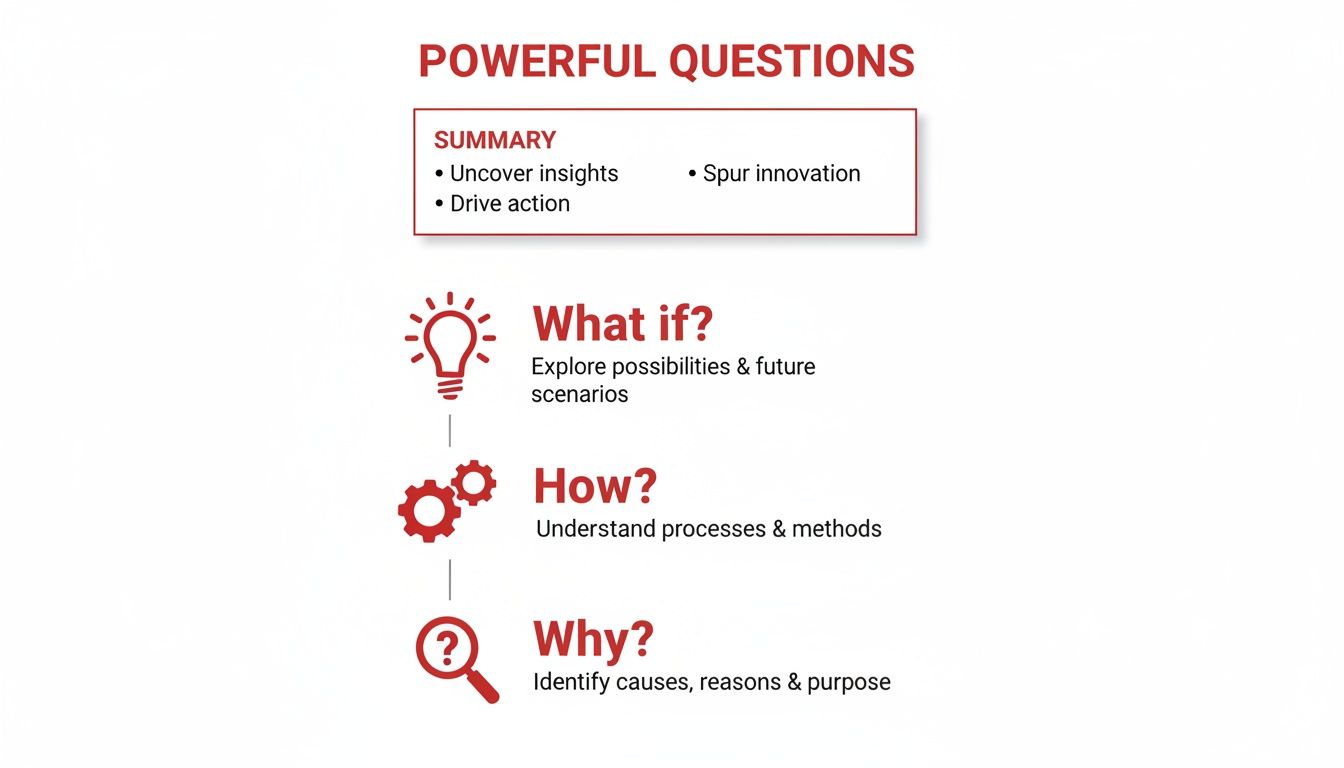
These questions—"What if?", "How?", and "Why?"—are your secret weapons. They nudge kids to move beyond just looking at something and start exploring possibilities, processes, and reasons.
Building Better Brains with Hands-On Fun
The difference between hands-on play and screen time gets even sharper when you look at the specific cognitive skills they build. While digital tools have their place, leaning on them too much can lead to something researchers call "cognitive offloading"—basically, letting a device do the thinking for you.
One study actually found a significant negative link between frequent AI tool use and critical-thinking scores, especially in younger participants. This really drives home the importance of balancing tech with activities that demand good old-fashioned brainpower.
Comparison: Hands-On Play vs. Screen Time Cognitive Skill Development
It's eye-opening to see how different play styles exercise different mental muscles. On one hand, you have active, creative problem-solving. On the other, you have consumption.
| Skill Developed | Hands-On Toys (e.g., Playz Kits) | Passive Screen Time |
|---|---|---|
| Problem-Solving | Child hits a wall (e.g., a circuit won't work) and has to test their own solutions. | Problems are often pre-defined with a limited number of built-in solutions. |
| Creativity & Imagination | Open-ended materials mean infinite possibilities and totally original creations. | Content is created by someone else, encouraging kids to consume, not create. |
| Spatial Reasoning | Physically handling 3D objects builds a real understanding of space and relationships. | Interaction is limited to a 2D screen, which offers far less tactile feedback. |
| Resilience | Trial and error is just part of the game, teaching persistence when things go wrong. | Instant gratification and easy "restarts" can lower a child's frustration tolerance. |
At the end of the day, the goal is to create a balanced play diet for your child. By prioritizing hands-on, interactive experiences, you’re giving them the space to become an active thinker, a curious creator, and a resilient problem-solver—skills that will serve them long after playtime is over.
Guiding Kids Through Problem Solving
When your child hits a wall, what's your first instinct? If you’re like most parents, it’s to jump in and fix the problem for them. It’s a natural impulse, but stepping back is one of the most powerful things you can do for their developing mind.
Instead of handing them the answer, you can give them something far more valuable: a framework for finding their own answers. This isn't about a rigid, formal process. It's about nurturing a flexible mindset they can use for almost anything, from figuring out how to share a single toy to planning a rainy-day fort.
By coaching them through it, you empower them to become confident, independent thinkers.
A Simple Framework for Any Problem
The goal here is simply to model a thoughtful approach. You can walk them through four simple stages, tweaking your language to match their age and the situation.
- 1. What’s the Goal? Start by helping them define the problem. Just asking, "What are we trying to do here?" can shift them from feeling stuck to feeling focused. Example: "Okay, you both want the red car. The goal is to find a way for everyone to be happy playing."
- 2. Brainstorm! Next, open the floor to any and all ideas, no matter how wild they seem. Try asking, "What are all the different things we could try?" This is purely about quantity over quality. You're encouraging creative thinking without judgment.
- 3. Weigh the Options. Once you have a few ideas, gently guide them to think about what might happen next. A simple question like, "What do you think would happen if we tried that?" teaches them to evaluate and compare potential outcomes on their own.
- 4. Give One a Try. Finally, let them pick one solution to test out. The key is to frame it as an experiment, not a final, high-stakes decision.
This approach turns overwhelming obstacles into manageable, almost game-like puzzles. You can explore how this builds foundational abilities in our guide on how to develop problem-solving skills in children.
Actionable Tip: Embrace Mistakes as Data
One of the most crucial parts of this entire process is changing how you talk about failure. When a solution doesn't work out, it’s not a dead end—it's just new information.
Key Takeaway: Use supportive language that celebrates the attempt, not just the outcome. Try phrases like, "That's interesting, it didn't work like we expected. What did we learn?" or "Okay, back to the drawing board! What could we try differently this time?" This builds resilience and a deep-seated curiosity.
This mindset is everything. It shows kids that the real win is in the process of trying, learning, and adapting. To get even better at guiding your kids through rough patches, it's worth understanding the practical strategies on how to improve problem-solving skills.
When you coach them through challenges with patience and encouragement, you’re doing so much more than just helping them solve a single problem. You’re handing them a mental toolkit they can use to tackle anything that comes their way for the rest of their lives.
Recognizing the Signs of Critical Thinking
So, how do you know if all your efforts are actually working? It’s a great question. You won’t see progress on a report card, but you will see it in the little moments—the gradual shift in how your child interacts with the world around them.
Forget formal assessments. The real proof is woven into your daily conversations, playtime, and simple observations. When you know what to look for, you can celebrate those small wins and offer feedback that keeps the momentum going without making them feel like they're being tested.
What to Look for at Different Ages
The clues that a child is becoming a critical thinker change as they grow. A preschooler’s wide-eyed curiosity and a teenager’s healthy skepticism might look completely different, but they both come from the same place.
Here’s a breakdown of what you might notice:
- For Preschoolers (Ages 3-5): The questions start to change. You’ll hear fewer “what is that?” and a whole lot more “why does it do that?” or “how does that work?” They’re moving from just naming things to trying to understand the mechanics behind them.
- For Elementary Schoolers (Ages 6-10): This is when they begin connecting the dots and—my personal favorite—spotting inconsistencies. A classic sign is when they point out a plot hole in a cartoon or argue that the rules of a board game just aren't fair.
- For Teens (Ages 11+): Their thinking gets more abstract. You might hear them questioning the bias in a news story, analyzing a character's motives in a book, or weighing the long-term consequences of a decision. They start seeing the gray areas.
Key Takeaway: A huge lightbulb moment at any age is when a child shifts from simply accepting information to actively questioning it. It's that moment they ask, "But what if...?" or "How do they know that?" That's when you know you're on the right track.
Giving Feedback That Fuels Deeper Thought
When you spot these behaviors, how you respond is everything. The goal isn’t to praise them for getting the "right" answer but to encourage the process of thinking. So, instead of a simple, "That's a smart idea," try asking, "What made you think of that?"
This small tweak encourages them to reflect on their own thought process, which is a critical skill in itself. We know this works on a larger scale, too. The Council for Aid to Education has helped over 825,000 students develop these skills using performance-based tools, showing that progress can be intentionally nurtured and measured. You can learn more about measuring critical thinking development on cae.org.
By celebrating their curiosity and offering gentle nudges, you help build a confident, analytical mindset that will serve them for the rest of their lives.
Frequently Asked Questions About Encouraging Critical Thinking
Even with a solid game plan, you're bound to run into questions. Let's tackle some of the most common ones I hear from parents and educators. Think of this as your quick-reference guide for those tricky moments.
At what age should I start encouraging critical thinking?
Honestly, you can start from day one. For toddlers, it's all about nurturing that natural curiosity. You're not running formal lessons; you're just making "I wonder..." a normal part of your day.
Start with simple sensory questions. When you're outside, ask things like, "What does the grass feel like on your hands?" or "Listen... what sound is that bird making?" As they get a bit older, you can introduce cause-and-effect through play. Every block tower that tumbles is a tiny lesson in physics and a chance to ask, "Hmm, why do you think it fell over?"
How do I handle my child's frustration with a difficult problem?
This is a golden opportunity. Frustration isn't just a hurdle; it's a chance to build real resilience.
First, get on their team. Validate their feelings with a simple, "I can see this is really frustrating." It shows you get it and you're there to support, not to judge. Then, shift from giving answers to asking great questions.
- "What's one tiny thing we could try next?"
- "Tell me about the things you already tried that didn't work."
- "If you had to explain this puzzle to your friend, what would you say is the tricky part?"
This simple shift teaches them that the struggle is part of the process. It's not about getting it right the first time; it's about the grit it takes to figure things out. If you're looking for more tips, head over to our frequently asked questions page.
What if I don’t know the answer to their question?
Perfect! Seriously, this is one of the best things that can happen. Saying, "You know what? I have no idea. That's a great question," is incredibly powerful. It models intellectual humility—the idea that it's okay not to know everything.
Key Takeaway: The magic words to say next are, “How could we find out together?” This completely changes the dynamic. You're not a failed encyclopedia; you're a co-explorer on an adventure.
This could lead you to a book, an online search (a fantastic moment to talk about what makes a website trustworthy), or even a quick experiment in the kitchen. You're showing them how to be resourceful, which is a cornerstone of critical thinking.
How can I teach critical thinking about online content?
This is a big one, especially today. The key is to get in there with them. Instead of letting them browse alone, co-view content whenever you can. This lets you have conversations in real-time.
Ask questions that get them thinking beyond the surface.
- "Who do you think made this video? What do you think they wanted us to feel or do?"
- "Is this trying to teach us something, make us laugh, or sell us a toy?"
With older kids, you can pull up two different articles about the same event and compare them. Talk about the different angles, the words they use, and any potential bias. Even better, encourage them to be creators—making a short video or a simple coded game—so they understand that media is made by people with a point of view.
Ready to turn playtime into a thinking playground? Playz offers a wide range of science kits and creative toys designed to spark curiosity and build critical thinking skills, one experiment at a time. Explore our collection and find the perfect hands-on adventure for your child at https://www.playzusa.com.