

Imagine a classroom buzzing not with lectures, but with questions. Envision a space where children are detectives, scientists, and creators, driving their own learning journey. This isn't a futuristic ideal; it's the power of inquiry-based learning, a dynamic educational approach that places curiosity at the heart of everything.
In a world demanding critical thinking and adaptability, memorizing facts is no longer enough. We must equip learners with the skills to ask meaningful questions, investigate complex problems, and construct their own understanding. This shift from passive reception to active discovery is crucial for developing lifelong learners. To foster this early on, creative activities for toddlers to spark imagination can build a foundational love for discovery that grows with them.
This guide moves beyond theory to provide a comprehensive roundup of powerful, practical inquiry based learning activities you can implement tomorrow. Forget generic advice; we're diving deep into actionable strategies that get results.
You will discover 10 proven models, each broken down with step-by-step instructions, practical examples, and adaptation ideas for both classroom and home settings. We will explore:
- Structured frameworks like the 5E Learning Cycle.
- Collaborative methods such as Jigsaw Learning.
- Expansive approaches like Project-Based Learning (PrBL).
This list is your toolkit for transforming any learning environment into a hub of curiosity. Let's unlock deeper, more meaningful engagement and empower the next generation of innovators—one question at a time.
1. The 5E Learning Cycle: A Structured Inquiry Framework
The 5E Learning Cycle isn't a single activity but a powerful, structured framework for guiding students through the entire inquiry process. Developed by the Biological Sciences Curriculum Study (BSCS), this model breaks down learning into five distinct, sequential phases. It’s an excellent starting point for educators new to inquiry-based learning activities because it provides a clear roadmap while keeping the student at the center of the investigation.
This model is exceptionally versatile, adapting to various subjects and age groups. For example, an elementary class might use it to investigate plant life cycles, while a high school physics class could apply it to experiments on projectile motion. The cycle’s strength lies in its logical progression, which builds conceptual understanding layer by layer.
The Five Phases of Inquiry
The 5E model guides learners on a scaffolded journey from initial curiosity to deep comprehension:
- Engage: This initial phase captures student interest and surfaces prior knowledge. It often involves a compelling question, a surprising demonstration, or a short, thought-provoking activity. The goal is to make students ask, "Why?"
- Explore: Here, students get hands-on. They actively investigate a concept through experiments, simulations, or problem-solving tasks. This is a student-centered phase where the teacher acts as a facilitator, guiding with questions rather than giving answers.
- Explain: After exploring, students articulate their findings and begin to make sense of their observations. The educator introduces formal vocabulary and scientific explanations, connecting them directly to the students' hands-on experiences.
- Elaborate: Students apply their new understanding to different contexts. This phase challenges them to extend their knowledge to solve new problems, deepening their comprehension and proving their mastery.
- Evaluate: Assessment is ongoing. This final phase involves both student self-assessment and teacher evaluation to check for understanding and identify misconceptions. It can be a formal quiz, a presentation, or another performance-based task.
2. Science Investigations and Experiments: Hands-On Discovery in Action
At the core of scientific inquiry are hands-on investigations and experiments—a cornerstone of inquiry-based learning activities. This approach moves beyond textbook learning, empowering students to design, conduct, and analyze their own experiments to answer compelling questions. It is the practical application of the scientific method, where learners form hypotheses, manage variables, collect data, and derive evidence-based conclusions.
This method is highly adaptable across scientific disciplines. For instance, a biology class could investigate enzyme activity, a chemistry class might explore reaction rates by changing reactant concentrations, and an environmental science group could test local water sources for pollutants. The strength of this approach lies in making abstract concepts tangible and fostering deep, procedural understanding of science.

Key Components of an Authentic Investigation
Effective science investigations guide students through a structured yet flexible process that mirrors how real scientists work:
- Question & Hypothesize: It begins with a question about the natural world. Students then formulate a testable hypothesis—an educated prediction about the outcome.
- Design & Conduct: Learners plan a procedure, identifying independent, dependent, and controlled variables. They gather materials and carry out the experiment, carefully observing and recording data. This direct engagement is a key benefit of a hands-on learning approach.
- Analyze & Interpret: Students organize their collected data into tables, graphs, or charts. They look for patterns, trends, and relationships to understand what their results mean.
- Conclude & Communicate: Based on their analysis, students draw a conclusion about whether their data supports or refutes their initial hypothesis. They then communicate their findings through lab reports, presentations, or discussions.
- Reflect & Refine: An essential final step is reflecting on the process. Students consider what went well, identify potential sources of error, and suggest improvements or new questions for future investigations.
3. Question-Based Inquiry (QFT): Putting Students in the Driver's Seat
Question-Based Inquiry, particularly through the Question Formulation Technique (QFT), places the power of investigation directly into students' hands. Developed by the Right Question Institute, this structured process makes students the authors of their own learning journey. Instead of answering teacher-provided questions, students generate, refine, and prioritize their own questions about a topic, which then drives their research and exploration.
This method is incredibly effective at fostering curiosity and critical thinking across all subjects. A history class could use a historical photograph as a prompt to generate questions about an event, while a science class might question the causes of local pollution after observing a community map. The core strength of QFT is its ability to build intellectual self-sufficiency and make learning deeply personal and relevant.
The QFT Process in Action
The QFT guides learners from a state of curiosity to focused, self-directed investigation:
- Introduce the Question Focus (QFocus): The teacher presents a stimulus, not a question. This could be an image, a quote, a short video, or a surprising statistic. Its purpose is to spark curiosity without giving too much away.
- Generate Questions: Following simple rules, students produce as many questions as they can in a short period. Key rules include: ask as many questions as you can, do not stop to discuss or answer any question, and write down every question exactly as it is stated.
- Improve the Questions: Learners categorize their questions, often distinguishing between "closed-ended" (answerable with yes/no) and "open-ended" (requiring explanation). They then practice changing questions from one type to the other.
- Prioritize the Questions: Based on the learning goals, students collaborate to choose the most important questions that will guide their inquiry. This step teaches them to think strategically about what they need to learn.
- Plan Next Steps and Reflect: Students decide how they will use their priority questions for research, experiments, or projects. They also reflect on the process, considering what they learned and how their thinking changed.
4. Problem-Based Learning (PBL): Solving Authentic, Real-World Challenges
Problem-Based Learning (PBL) is a dynamic instructional approach where students actively solve complex, real-world problems that intentionally lack a single correct answer. Instead of learning content first and then applying it, the problem itself drives the motivation and direction of learning. Students work collaboratively to identify knowledge gaps, conduct research, and present their findings.
This method is highly effective because it mirrors how people solve problems in their professional and personal lives. For instance, a middle school class might be tasked with designing a sustainable community garden, requiring them to learn about biology, engineering, and economics. The strength of PBL is its ability to foster critical thinking, collaboration, and self-directed learning in an authentic context.
The Problem-Solving Journey
PBL guides students from being passive recipients of information to becoming active problem-solvers. The process generally follows these steps:
- Present the Problem: The educator introduces a complex, ill-structured problem. This could be a business case study, an urban planning challenge, or an environmental remediation project. The problem should be engaging and relevant to students' lives.
- Identify Knowns and Unknowns: In small groups, students list what they already know about the problem and, more importantly, what they need to learn to solve it. This step generates their learning objectives and research questions.
- Investigate and Research: Students independently and collaboratively gather information, conduct experiments, and analyze data. The teacher acts as a facilitator, providing resources and asking probing questions to guide their inquiry without giving away answers.
- Develop and Propose Solutions: After researching, groups synthesize their findings to formulate one or more viable solutions. They must justify their proposals with evidence and reasoning gathered during their investigation.
- Present and Reflect: Finally, groups present their solutions to the class or an authentic audience. This is followed by a crucial reflection phase where students evaluate their solution, the process they followed, and what they learned. This iterative cycle helps them develop powerful problem-solving skills for future challenges.
5. Project-Based Learning (PrBL): Creating Tangible Solutions
Project-Based Learning (PrBL) is a dynamic instructional approach where students engage in a sustained, in-depth investigation of an authentic, complex question or challenge. Rather than completing short-term assignments, students work over an extended period to create a tangible product, presentation, or performance. This method transforms the learning process into a real-world quest for knowledge, making it one of the most comprehensive inquiry based learning activities.
PrBL is highly effective because it integrates content knowledge with crucial 21st-century skills like critical thinking, collaboration, and creativity. For instance, middle schoolers might design a community garden, requiring them to research biology, calculate area and volume, and write proposals to community leaders. A high school class could produce a documentary on a local social issue, mastering research, media production, and persuasive communication skills.

Key Elements of Authentic PrBL
Championed by organizations like PBLWorks, PrBL is built on a framework of essential design elements that drive student inquiry:
- Challenging Problem or Question: The project is framed by a meaningful problem to solve or a question to answer. This "driving question" is open-ended and directly engages students' curiosity.
- Sustained Inquiry: Students engage in a rigorous, extended process of asking questions, finding resources, and applying information. The project is not a simple task but a deep dive into a topic.
- Authenticity: The project has a real-world context, addresses genuine needs, and connects to students' personal concerns or interests. This relevance makes the work meaningful.
- Student Voice & Choice: Students have a say in the project, including how they work and what they create. This ownership increases engagement and personal investment in the learning process.
- Critique & Revision: Students give, receive, and use feedback to improve their work. This iterative process, involving peers and educators, helps develop high-quality final products.
- Public Product: The project culminates in a product or presentation shared with an audience beyond the classroom. This authentic audience motivates students to produce their best work.
6. Guided Discovery Learning: Scaffolding the "Aha!" Moment
Guided Discovery Learning strikes a perfect balance between open-ended exploration and structured instruction. Unlike pure discovery learning where students explore with minimal intervention, this inquiry-based learning activity involves a teacher strategically guiding students toward specific learning outcomes. The educator acts as a facilitator, using carefully crafted questions, prompts, and activities to scaffold the learning process and ensure students arrive at key conceptual understandings.
Influenced by theorists like Jerome Bruner, this method prevents the frustration that can arise from unguided exploration while still empowering students to construct their own knowledge. For instance, a teacher might lead a Socratic seminar on a historical document, asking leading questions that help students analyze the text's bias and context, rather than simply stating the facts. This approach makes learning an active, co-constructed process.
The Guided Discovery Process
Guided Discovery Learning typically unfolds through a purposeful sequence of questioning and exploration:
- Present a Puzzle: The process begins with a challenge, phenomenon, or problem that sparks curiosity. This could be a laboratory experiment with an unexpected outcome or a mathematical pattern that needs explaining.
- Strategic Questioning: The teacher asks a series of open-ended questions designed to prompt critical thinking. These questions move from broad observations ("What do you notice?") to more specific inquiries that direct attention to key variables or concepts.
- Student Exploration: Learners engage in hands-on activities, discussions, or investigations to find answers to the guiding questions. The teacher observes, listens, and provides just-in-time support or adjusts questioning as needed.
- Articulate the Discovery: Once students have gathered enough evidence, the teacher guides them to articulate the core principle or concept they have uncovered. This is where the "aha!" moment is formalized into a clear understanding.
- Apply and Extend: Learners then apply their newfound knowledge to a new problem or scenario, solidifying their comprehension and demonstrating their ability to transfer the learning.
This structured yet student-centered model ensures that inquiry is both productive and deeply engaging. Learn more about the foundations of this powerful approach in our detailed guide on Discovery-Based Learning.
7. Case Study Analysis: Dissecting Real-World Scenarios
Case Study Analysis is a powerful inquiry-based learning activity where students deeply investigate a specific, real-world situation or problem. Popularized in fields like business, law, and medicine, this method challenges learners to act as decision-makers by analyzing complex evidence, considering multiple perspectives, and proposing well-reasoned solutions. It transforms abstract concepts into tangible scenarios, making learning both relevant and memorable.
This method is highly adaptable across many subjects. For instance, a history class could analyze the causes of a major conflict, a science class might investigate a public health crisis, and an ethics course could dissect a complex moral dilemma. The strength of Case Study Analysis lies in its ability to develop critical thinking, problem-solving, and analytical skills in a structured, authentic context.
The Core Components of Analysis
A typical case study guides learners through a process of discovery and application, moving from understanding the situation to formulating a response:
- The Case: This is the narrative at the heart of the activity. It presents a detailed account of a situation, complete with relevant data, primary source documents, and character perspectives. A good case is complex and lacks an obvious answer.
- Analysis & Investigation: Students work individually or in groups to dissect the case. They identify the central problem, analyze the available evidence, and evaluate the motivations and actions of the stakeholders involved.
- Developing Solutions: Based on their analysis, students develop potential solutions or interpretations. They must justify their recommendations using evidence directly from the case materials, connecting their reasoning to broader curriculum principles.
- Discussion & Debrief: This crucial phase allows students to present and defend their findings. A facilitated discussion encourages them to challenge each other's assumptions and synthesize different viewpoints, uncovering the nuances of the case and solidifying key takeaways.
8. Field Studies and Outdoor Learning: Taking Inquiry Outside
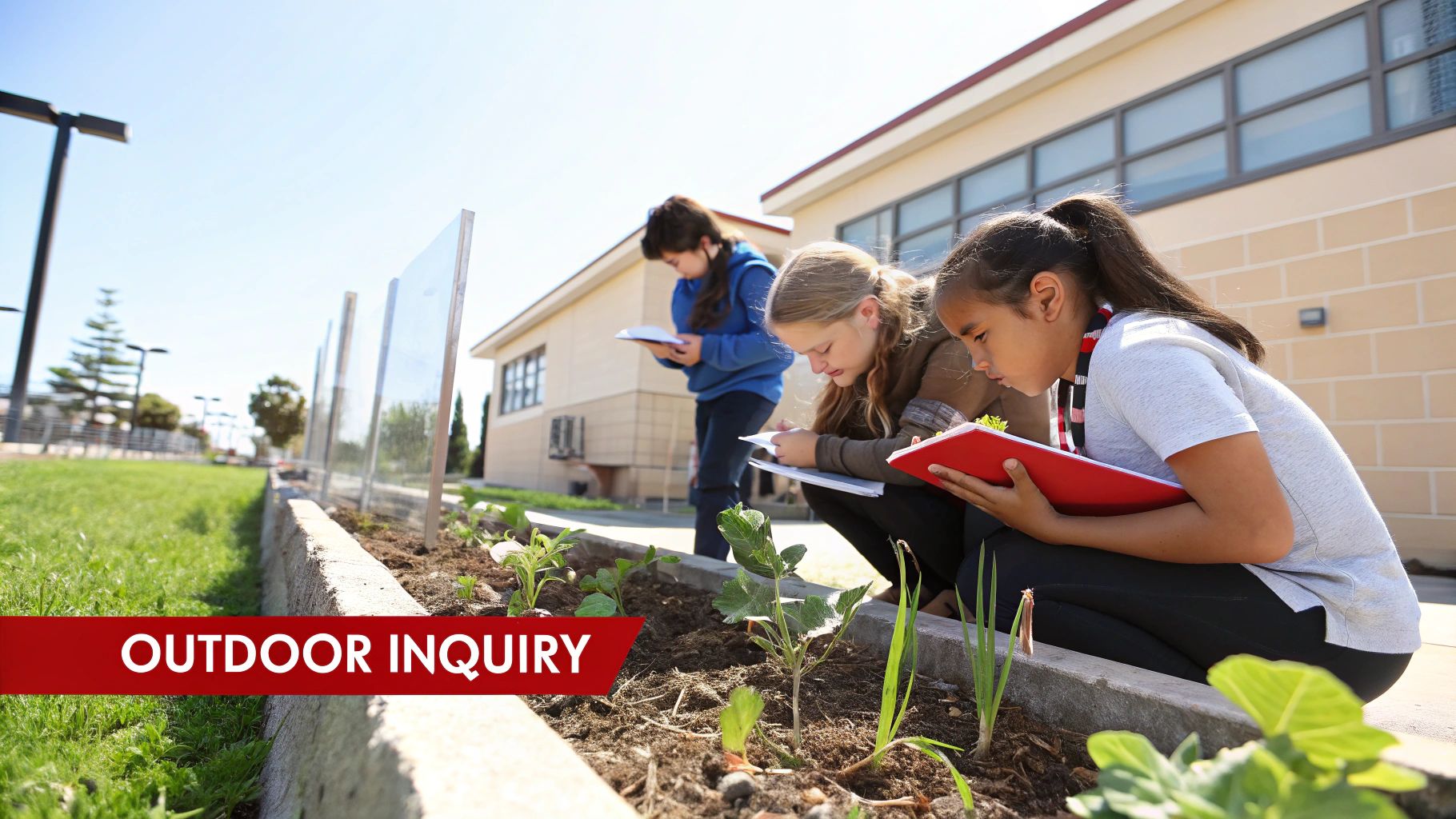
Field Studies take inquiry-based learning activities beyond the classroom walls and into the real world. This approach involves conducting investigations in natural or authentic outdoor settings, allowing students to directly observe phenomena, collect data, and explore questions in the context where they actually occur. It is an exceptionally powerful method for making abstract concepts tangible and fostering a deep, personal connection to the subject matter.
This method is highly adaptable for any age group. A kindergarten class could conduct a biodiversity inventory in the schoolyard, cataloging insects and plants, while a high school environmental science class might perform a stream health assessment. The core value of field studies lies in grounding learning in direct, sensory experience, which boosts engagement and retention.
From Observation to Analysis
Effective field studies guide learners through a structured process of investigation and reflection, transforming a simple outing into a rigorous academic exercise:
- Question & Prepare: The inquiry begins before leaving the classroom. Students develop questions based on curriculum goals and learn the necessary background information and data collection techniques. This ensures they arrive on-site with a clear purpose.
- Observe & Collect: In the field, students become active scientists. They use tools and established protocols to gather data, make detailed observations, sketch specimens, and record their findings. This phase is about disciplined, focused exploration.
- Analyze & Interpret: Back in the classroom, the inquiry continues as students organize and analyze their collected data. They look for patterns, draw graphs, and begin to form conclusions that answer their initial questions.
- Communicate & Reflect: Students share their findings through presentations, reports, or scientific posters. This final step solidifies their understanding and prompts reflection on the investigation process and its real-world implications. Explore the numerous benefits of taking learning outdoors to see how it can enhance student development.
9. Cooperative Inquiry and Jigsaw Learning: Building Knowledge Together
Cooperative Inquiry and Jigsaw Learning are structured collaborative methods that transform students into both learners and teachers. Rather than having one group tackle a large topic, these approaches divide the inquiry into manageable subtopics, assign them to small "expert" groups, and then create a system where students teach each other. This fosters positive interdependence, as each student's contribution is essential for the entire class to succeed.
This strategy is one of the most effective inquiry based learning activities for building both content knowledge and social-emotional skills. For instance, a middle school science class could investigate a biome by having expert groups research its climate, flora, fauna, and human impact. The subsequent sharing ensures every student gains a comprehensive understanding. The Jigsaw method excels at creating an environment where collaboration is not just encouraged but required.
The Phases of Collaborative Inquiry
These models guide learners from individual investigation to collective understanding, building a strong sense of community:
- Topic Division & Expert Groups: The main topic is broken down into several distinct subtopics. Students are first organized into "expert" groups, with each group assigned one subtopic to investigate deeply.
- Investigation & Mastery: In their expert groups, students conduct focused research, experiments, or analysis to become specialists on their assigned subtopic. The goal is mastery, as they will soon be responsible for teaching this content to others.
- Jigsaw & Peer Teaching: The groups are then reorganized into new "jigsaw" groups. Each new group is composed of one expert from each of the original subtopic groups. In this phase, each expert takes a turn teaching their peers what they learned.
- Synthesis & Application: After the peer teaching is complete, students return to their original groups or work individually to synthesize all the information. They might complete a final project, take a quiz, or solve a problem that requires knowledge from all the subtopics.
- Reflection & Debrief: The process concludes with a reflection on both the content learned and the collaborative process itself. Students discuss what worked well in their groups and how they could improve their teamwork and communication skills.
10. Think-Pair-Share: A Simple and Powerful Dialogue Structure
Think-Pair-Share is a foundational cooperative learning strategy that transforms passive listening into active, structured dialogue. Developed by Frank Lyman, this technique provides a simple yet powerful framework that encourages all students to engage with a topic by thinking individually, collaborating with a partner, and then sharing with a larger group. It is an essential tool in the inquiry-based learning toolkit because it ensures every student has processing time and a voice.
This method excels at scaffolding discussions around complex questions or new concepts. By providing a low-stakes environment to test ideas with a partner first, it builds confidence for whole-class participation. From a quick "turn-and-talk" during a science demonstration to a more in-depth dialogue about a historical event, Think-Pair-Share makes inquiry-based learning activities more accessible and equitable for every learner in the room.
The Three Phases of Structured Dialogue
The Think-Pair-Share model guides students from silent reflection to confident public sharing in three simple steps:
- Think: The teacher poses a high-level, open-ended question or prompt. Students are given quiet, individual time (typically 30-90 seconds) to process the question and formulate their own thoughts. This critical wait time prevents impulsive answers and allows for deeper reflection.
- Pair: Students turn to a designated partner to discuss their ideas. This phase is for sharing initial thoughts, listening to another perspective, asking clarifying questions, and refining their own understanding. The teacher circulates to listen in on conversations and gauge comprehension.
- Share: The teacher brings the whole group back together. Pairs are then invited to share the highlights of their conversation with the class. This can be done by calling on volunteers or randomly selecting pairs, ensuring a wide range of ideas is presented and validated.
10-Method Comparison of Inquiry-Based Learning Activities
| Method | 🔄 Implementation complexity | ⚡ Resource requirements | ⭐ Expected outcomes | Ideal use cases | 📊 Key advantages |
|---|---|---|---|---|---|
| The 5E Learning Cycle | High — phased planning and sequencing | Medium — manipulatives, time for phases | Deep conceptual understanding; improved retention | Multi-day science units; concept development across grades | Clear structure for inquiry; adaptable to learners |
| Science Investigations & Experiments | Medium–High — lab management & safety skills | High — equipment, consumables, safety protocols | Strong empirical reasoning; mastery of scientific method | Chemistry/biology/physics labs; hands-on demonstrations | Authentic hands‑on experience; memorable learning |
| Question-Based Inquiry (QFT) | Medium — facilitation and question guidance | Low — minimal materials, class time for Q-generation | Increased curiosity, metacognition, higher-order questioning | Introductory topics, literature, history, exploratory units | Student ownership of learning; low resource burden |
| Problem-Based Learning (PBL) | High — complex facilitation and problem design | Medium–High — time, research resources, possible partnerships | Improved problem-solving, transfer, collaboration | Real-world interdisciplinary challenges; capstone tasks | Real-world relevance; develops 21st‑century skills |
| Project-Based Learning (PrBL) | High — long-term coordination and planning | High — materials, community partners, sustained time | Strong skill development; authentic products and portfolios | Extended community projects, exhibitions, maker projects | Tangible outputs; sustained engagement and depth |
| Guided Discovery Learning | Medium — careful scaffolding and questioning | Medium — structured resources and formative checks | Progressive inquiry skills; reduced cognitive overload | Labs, math investigations, stepwise exploration | Balances independence and support; time-efficient |
| Case Study Analysis | Medium — selection & facilitation of cases | Low–Medium — texts, primary sources, prep time | Enhanced analysis, perspective-taking, application | Business, medicine, history, ethics, policy analysis | Authentic context; transferable across disciplines |
| Field Studies & Outdoor Learning | Medium — logistics, permissions, safety planning | Low–Medium — transport, simple field tools | Improved observation, environmental literacy, engagement | Ecology, geography, phenology, place‑based learning | Multisensory, memorable learning; stewardship focus |
| Cooperative Inquiry & Jigsaw Learning | Medium — group composition and monitoring | Low — materials and structured roles | Better collaboration, communication, content coverage | Reading groups, topic breakdowns, team research | Peer teaching; accountability; broader content reach |
| Think‑Pair‑Share & Structured Dialogue | Low — simple protocol to implement | Low — no special resources | Increased participation; clarified thinking; formative data | Quick checks, class discussions, formative assessments | Fast to deploy; inclusive and low-prep |
From Inquiry to Innovation: Your Next Steps in Playful Learning
You’ve just explored ten distinct yet interconnected frameworks for sparking curiosity and deep, meaningful learning. From the structured elegance of the 5E Learning Cycle to the collaborative energy of Jigsaw Learning, each of these inquiry based learning activities serves a common, powerful purpose: to shift the focus from rote memorization to active, student-led discovery. This collection is more than a list; it is a toolkit for nurturing the next generation of thinkers, innovators, and problem-solvers.
The core takeaway is that inquiry is not a single method but a mindset. It is the art of transforming a classroom into a space where questions are born. Whether you are guiding a learner through a simple Think-Pair-Share or facilitating a complex Project-Based Learning unit, you are building foundational skills that extend far beyond the topic at hand.
Key Insights and Your Path Forward
As you move from reading to implementation, keep these central themes in mind. They are the common threads woven through every successful inquiry-based experience.
- The Power of the Question: The quality of the learning is directly tied to the quality of the questions. Your role is not to be the 'sage on the stage' but the 'guide on the side', helping learners refine their curiosity into focused, investigable questions. The Question Formulation Technique (QFT) is an excellent starting point for this crucial skill.
- Structure Liberates, It Doesn't Restrict: Frameworks like Problem-Based Learning (PBL) or Guided Discovery are not rigid recipes. They are flexible scaffolds that provide just enough structure to prevent frustration while giving learners the freedom to explore, make mistakes, and construct their own understanding.
- Learning is a Social Act: From Cooperative Inquiry to analyzing case studies, many of these activities emphasize collaboration. This is by design. Learners challenge each other's assumptions, build on ideas, and learn to communicate complex thoughts, mirroring the collaborative nature of real-world problem-solving.
- Authenticity Drives Engagement: The most impactful inquiry based learning activities connect to real-world contexts. Whether it's a Field Study of a local ecosystem or a PBL challenge to design a community garden, authentic tasks give learning a tangible purpose and make the process intrinsically motivating.
Putting Inquiry into Action
Feeling inspired but not sure where to start? Don't feel pressured to implement a massive, semester-long project overnight. True transformation begins with small, consistent steps.
- Start Small: Choose one low-stakes activity. Try a Think-Pair-Share at the beginning of your next lesson or family discussion. Use it to gauge prior knowledge and spark initial questions.
- Embrace the "Messy Middle": Inquiry-based learning can feel less predictable than direct instruction. Embrace this. The moments of uncertainty, debate, and even failed experiments are often where the most profound learning happens.
- Model Curiosity: Be a learner alongside your students. When a question arises that you don't have the answer to, say, "That's a fantastic question. I'm not sure. How could we find out together?" This simple act validates their curiosity and models the inquiry process.
By championing these inquiry based learning activities, you are doing more than teaching science, history, or math. You are cultivating a lifelong disposition for curiosity, resilience, and critical thinking. You are empowering children to look at a complex world not with intimidation, but with a confident and inquisitive, "I wonder..."
Ready to equip your young explorer with the perfect tools for discovery? The hands-on science kits from Playz are designed to be the ultimate companions for your inquiry-based adventures, turning abstract questions into tangible, exciting experiments. Visit Playz to find the perfect kit and watch curiosity come to life.