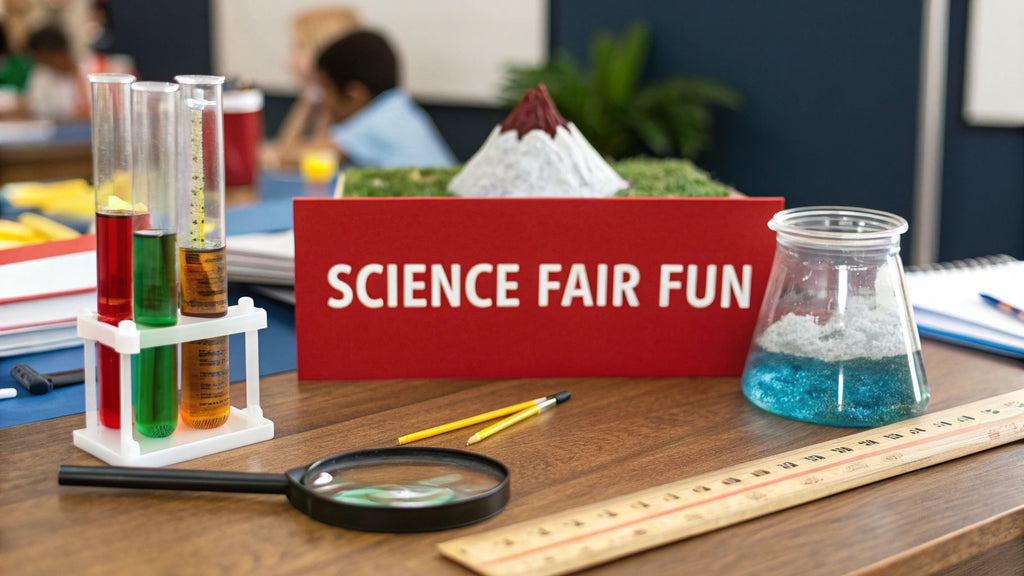

Welcome, parents, educators, and young scientists! The 3rd-grade science fair is a milestone in a child's academic journey. It’s their first big opportunity to apply the scientific method, shifting from reading about science to actually doing it. This hands-on experience is crucial for building critical thinking, problem-solving skills, and a genuine passion for discovery. However, finding the right project can be a challenge. You need an idea that is both educational and exciting enough to capture an eight-year-old’s attention.
This guide provides a one-stop resource for fantastic science fair projects 3rd grade students will love. We've curated a collection of experiments that are impressive, manageable, and fun. Each project idea serves as a complete blueprint for success, designed to make the process smooth and enjoyable for both you and your child.
What You'll Find Inside:
- A curated list of engaging, grade-appropriate projects, from growing dazzling crystals to building simple machines.
- Clear, step-by-step instructions that are easy for a third grader to follow with minimal adult supervision.
- Practical materials lists featuring common household items and affordable alternatives.
- Simple explanations of the scientific principles behind each experiment, helping your child understand the "why" behind their results.
- Actionable tips for creating a standout display board and presenting their findings like a seasoned scientist.
Our goal is to remove the guesswork and empower you to guide your young scientist through an unforgettable learning adventure. Let’s dive in and find a project that sparks curiosity and builds confidence.
1. Crystal Growing Experiment
Watching crystals form from a simple solution is like magic, making it a perfect science fair project for 3rd-grade students. This experiment visually demonstrates how molecules arrange themselves into structured, geometric patterns. It’s a fantastic way to introduce concepts like solutions, saturation, and molecular structures in a captivating way.
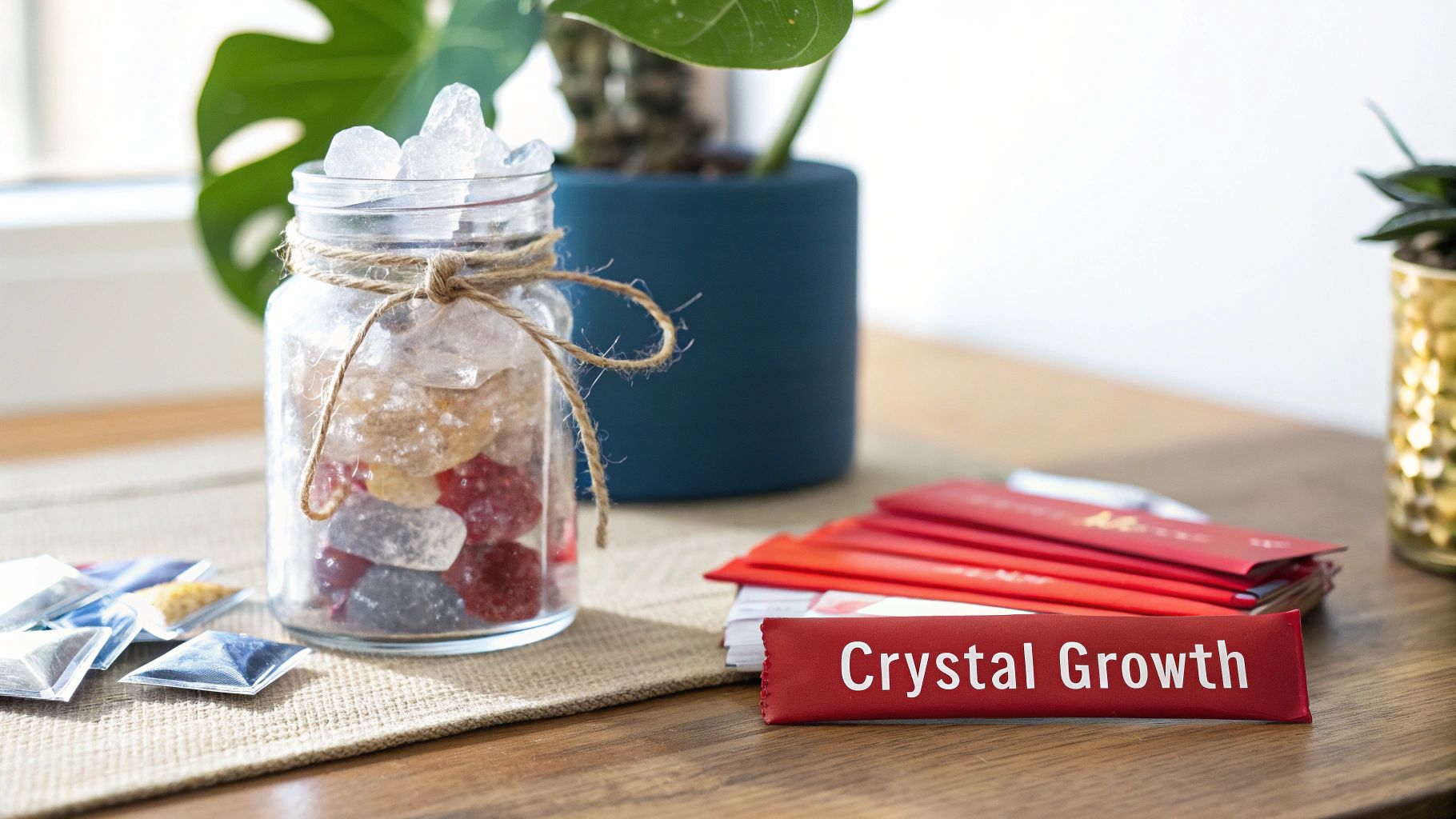
Students will learn how a supersaturated solution—created by dissolving as much solute (like sugar) as possible into a hot solvent (water)—provides the building blocks for crystals. As the water cools or evaporates, the dissolved particles are forced closer together and lock into a repeating crystalline lattice, creating beautiful shapes.
How to Get Started
Materials Needed:
- Crystalline Substance: Salt, sugar, or borax (with adult supervision).
- Solvent: Hot water (distilled water works best for clearer crystals).
- Container: A clean glass jar or beaker.
- Support Structure: Pipe cleaner, cotton string, or a popsicle stick.
- Extras: Pencil or skewer to suspend the string, food coloring (optional).
Step-by-Step Procedure:
- Create a Supersaturated Solution: With adult help, heat water in a pot (do not boil). Gradually stir in your chosen substance until no more will dissolve. Add food coloring for colorful crystals.
- Prepare the Support: Tie a string or pipe cleaner to the middle of a pencil. The pencil will rest across the jar's top, letting the string hang into the solution without touching the bottom or sides.
- Grow Your Crystals: Carefully pour the hot solution into the glass jar. Place the pencil across the jar's opening so the string is submerged.
- Observe and Record: Place the jar in a safe, undisturbed spot. Crystal growth should begin within a day. Document the changes daily with photos and notes.
Key Takeaway: For a stunning visual, try making Borax snowflake ornaments using pipe cleaners. This classic method produces impressive results in just 24 hours. For a complete guide, explore these crystal growing kit instructions for more detailed steps.
2. Volcano Eruption Experiment
The classic volcano eruption is a rite of passage in elementary science, blending geology, chemistry, and art into one explosive project. It's a stellar choice for a 3rd-grade science fair project because it provides a dramatic, visual demonstration of a chemical reaction. Students build a model volcano and then witness the exciting eruption caused by mixing an acid (vinegar) and a base (baking soda).

This experiment introduces young scientists to acid-base reactions and gas creation. When acidic vinegar meets basic baking soda, they react to produce carbon dioxide (CO2) gas. This gas rapidly expands, creating pressure inside the volcano that forces the liquid mixture up and out, simulating a real volcanic eruption.
How to Get Started
Materials Needed:
- Volcano Structure: A small plastic bottle, modeling clay or play-dough, or paper-mache materials.
- Reactants: Baking soda (sodium bicarbonate) and white vinegar (acetic acid).
- Base: A sturdy cardboard base or baking pan to contain the "lava."
- Extras: Red food coloring, dish soap (for more bubbles), and a funnel.
Step-by-Step Procedure:
- Build Your Volcano: Place the plastic bottle in the center of your tray. Use modeling clay or paper-mache to build the volcano cone around the bottle, leaving the opening clear. Let it dry completely.
- Prepare the "Magma": Add two tablespoons of baking soda into the bottle. In a separate cup, mix about half a cup of vinegar with a few drops of red food coloring and a squirt of dish soap.
- Create the Eruption: When you are ready to present, use a funnel to quickly pour the vinegar mixture into the bottle. Stand back and watch the fizzy eruption!
- Analyze and Record: Document what happens. Does the amount of vinegar or baking soda change the eruption size? Record your observations, take pictures, and explain the science behind the reaction.
Key Takeaway: For a more impressive lava flow, add a good squeeze of dish soap to your vinegar mixture. The soap traps the carbon dioxide bubbles, creating a more voluminous and long-lasting eruption that will wow the judges. Find more exciting science project ideas for 3rd graders to explore chemical reactions.
3. Water Cycle in a Bag
Bringing Earth's massive water cycle down to a size that fits on a window is an amazing feat, making the Water Cycle in a Bag one of the most effective science fair projects for 3rd grade. This experiment creates a miniature, self-contained ecosystem to visibly demonstrate evaporation, condensation, and precipitation. It’s a powerful tool for making a large-scale natural process tangible and easy to understand.
Students will observe how the sun's energy heats the water, causing it to turn into a gas (evaporation). This water vapor rises and cools as it hits the upper part of the bag, turning back into liquid droplets (condensation), just like clouds. When the droplets become heavy enough, they fall back down as "rain" (precipitation), completing the cycle.
How to Get Started
Materials Needed:
- Container: A sealable, clear plastic bag (zip-top).
- Liquid: Water.
- Coloring: A few drops of blue food coloring (optional).
- Tools: Permanent markers, clear packing tape.
- Location: A window that receives direct sunlight.
Step-by-Step Procedure:
- Decorate the Bag: Use permanent markers to draw the water cycle on the outside of the bag. Draw a sun at the top, water at the bottom, and clouds in the middle.
- Add Water: Pour about a quarter cup of water into the bag. If desired, add a few drops of blue food coloring and mix.
- Seal It Up: Press out most of the air and seal the bag tightly. For extra security, fold the top over and secure it with clear tape.
- Observe and Record: Tape the bag to a sunny window. Watch over the next few hours and days as the water cycle takes place. Document the changes with a photo journal and notes.
Key Takeaway: To make your experiment more comparative, set up two bags. Place one in a sunny window and one in a shady spot. This allows you to test the hypothesis that the sun's energy is necessary for the water cycle to work efficiently. For more guidance, check out this comprehensive water cycle experiment.
4. Magnetic Attraction Experiment
Exploring the invisible force of magnetism is an incredibly engaging science fair project for 3rd grade students. This experiment allows kids to discover which materials are magnetic and which are not, providing a tangible way to understand a fundamental force of nature. It’s a classic physics project that introduces concepts like magnetic fields, attraction, and material properties in a fun, interactive way.
Students will learn that magnetism is a force created by the movement of electric charges. By testing a variety of everyday objects, they can categorize materials as either ferromagnetic (strongly attracted to magnets) or non-magnetic, making clear, data-driven conclusions about the properties of different substances like iron, nickel, and cobalt.
How to Get Started
Materials Needed:
- Magnets: A bar magnet, horseshoe magnet, or strong refrigerator magnets.
- Test Objects: A variety of small, safe items like paper clips, coins, aluminum foil, plastic toys, wood, and keys.
- Data Collection Tools: A notebook and pencil for recording results.
- Extras: A ruler, a plastic tray, and iron filings to visualize magnetic fields (with adult supervision).
Step-by-Step Procedure:
- Formulate a Hypothesis: Start with a question, such as "Which objects will be attracted to a magnet?" Make a prediction about which items you think are magnetic.
- Set Up Your Test: Place all your test objects on a flat surface. Create a chart with columns for "Object," "Prediction (Magnetic/Not Magnetic)," and "Result (Magnetic/Not Magnetic)."
- Test Each Object: Bring the magnet close to each item one by one. Observe if the object moves toward the magnet and record your observations in your chart.
- Analyze Your Results: Compare the results to your predictions. Group the objects into magnetic and non-magnetic categories and draw conclusions about what magnetic materials have in common.
Key Takeaway: To take this project further, test the strength of your magnet. See how many paper clips it can hold in a chain, or measure the maximum distance from which it can attract a paper clip. This adds a quantitative element to your project, making your findings more impressive.
5. Plant Growth and Sunlight Experiment
Exploring how sunlight affects plants is a classic and highly effective science fair project for 3rd-grade students. This experiment visually demonstrates photosynthesis and highlights the essential needs of plants. By observing how identical plants behave in different light conditions, students learn the fundamentals of controlled experiments, data collection, and biological science.

Students will set up a controlled experiment to test the hypothesis that plants need sunlight to grow. They will track changes in height, leaf color, and overall health over several weeks, leading to clear, measurable results. This project introduces the core principles of the scientific method, including forming a hypothesis, identifying variables, and drawing conclusions based on evidence.
How to Get Started
Materials Needed:
- Seeds or Seedlings: Fast-growing seeds like beans or grass work well.
- Containers: At least three identical small pots with drainage holes.
- Soil: A standard potting mix.
- Water: A measuring cup to ensure equal watering.
- Tools: A ruler and a notebook or chart for recording data.
- Locations: Areas with full sunlight, partial shade, and complete darkness.
Step-by-Step Procedure:
- Plant Your Seeds: Fill each pot with the same amount of soil. Plant the same number of seeds in each pot at the same depth. Label each pot clearly (e.g., "Full Sun," "Partial Shade," "No Light").
- Initial Watering: Water all plants with the exact same amount of water.
- Place the Plants: Put each pot in its designated location: a sunny windowsill, a room with indirect light, and a dark cupboard.
- Observe and Record: Check on your plants every few days. Water them equally when the soil is dry. Measure the height of the sprouts weekly and record it in your log. Take photos and write notes about leaf color and health. Continue for at least three weeks.
Key Takeaway: For a successful experiment, make sure the only variable you change is the amount of sunlight. Keep the type of seed, pot size, soil, and water identical for all plants to ensure your results are reliable. Explore other cool science experiments with plants to expand your project.
6. Sink or Float Prediction and Density Experiment
Why do some objects sink while others float? This classic science fair project for 3rd grade invites students to investigate the fascinating concepts of density and buoyancy. It’s an incredibly interactive experiment where kids make predictions and then see the results unfold, making complex physics principles easy to understand.
Students will explore the idea that whether an object sinks or floats depends on its density compared to the liquid it's in. An object that is less dense than water will float, while a denser object will sink. This project also introduces buoyancy, the upward force exerted by a fluid that opposes an object's weight.
How to Get Started
Materials Needed:
- Container: A large, clear container like a fishbowl, plastic tub, or large jar.
- Liquid: Water.
- Test Objects: A variety of small, waterproof items like a toy car, a crayon, a coin, an apple, a rubber duck, and a block of wood.
- Extras: A chart for predictions and towels for spills.
Step-by-Step Procedure:
- Make Predictions: Create a chart with three columns: "Object," "Prediction (Sink or Float?)," and "Result." Have the student examine each object and predict whether it will sink or float.
- Fill the Container: Fill the clear container about two-thirds full with tap water.
- Test the Objects: One by one, gently place each object into the water. Observe what happens and record the outcome in the "Result" column.
- Analyze and Conclude: Compare the predictions with the results. Discuss why some predictions might have been wrong. Was it the object's weight, size, or shape that determined the result?
Key Takeaway: Take this experiment to the next level by testing the same objects in different liquids. Try the floating egg trick: an egg will sink in fresh water but float in very salty water, perfectly illustrating how changing the liquid’s density affects buoyancy.
7. Simple Machine Demonstrations (Levers and Pulleys)
Exploring how simple machines make work easier is an excellent engineering project that brings physics to life for third graders. This hands-on demonstration allows students to build and test fundamental machines like levers and pulleys, offering a clear, tangible example of mechanical advantage. It’s a perfect science fair project for 3rd grade because it connects abstract scientific principles to everyday objects, from seesaws to flagpoles.
Students will learn that simple machines don't reduce the total amount of work, but they reduce the force needed by increasing the distance over which the force is applied. By building their own lever or pulley system, they can feel the difference, making the concept of "work" easy to understand. This project empowers kids to see themselves as engineers.
How to Get Started
Materials Needed:
- Lever: Ruler or paint stirrer, a triangular block or pencil for a fulcrum, and small weights (like coins).
- Pulley: Spool of thread, string, a hook to hang it from, and a small object to lift (like a toy bucket).
- Measurement Tool: A spring scale to measure force (optional but recommended).
- Extras: Cardboard for the display board, markers, tape.
Step-by-Step Procedure:
- Build the Lever: Place the ruler (lever) over the pencil (fulcrum). Put a stack of coins on one end. Press down on the other end to lift the load.
- Test the Lever: Experiment by moving the fulcrum closer to or farther from the load. Observe how the effort needed to lift the coins changes.
- Construct the Pulley: Tie the string to your small object. Loop the string over a suspended spool. Pull down on the string to lift the object.
- Analyze and Document: Record the force needed to lift the object with and without the machines. Create charts and diagrams for your display board explaining how each machine provides a mechanical advantage.
Key Takeaway: Make your project interactive! Allow visitors at the science fair to try lifting the weight with and without your simple machine. Letting them feel the difference firsthand is a powerful way to demonstrate the scientific principle you’re explaining.
8. Slime or Non-Newtonian Fluid Experiment
Creating slime is a guaranteed way to capture a 3rd grader's interest, making it an outstanding science fair project. This experiment explores the fascinating world of non-Newtonian fluids—substances that defy the normal definitions of solids and liquids. It’s a messy but memorable way to introduce polymer chemistry and fluid dynamics in a fun, hands-on manner.
Students will learn that slime is a polymer, formed when molecules from glue (polyvinyl acetate) link together with an activator like borax solution. This creates a substance that flows like a thick liquid but becomes firm when squeezed. This dual property is the defining characteristic of a non-Newtonian fluid.
How to Get Started
Materials Needed:
- Polymer Base: White or clear school glue (containing PVA).
- Activator: Borax solution (1 tsp Borax in 1 cup warm water, with adult help), or contact lens solution with baking soda. For a simple oobleck, use cornstarch and water.
- Container: A mixing bowl and an airtight container for storage.
- Extras: Water, measuring cups, food coloring, glitter, or glow-in-the-dark paint.
Step-by-Step Procedure:
- Prepare the Glue Base: Pour about 1/2 cup of glue into a mixing bowl. Mix in 1/2 cup of water. Add food coloring and glitter now and stir well.
- Create the Activator: In a separate container, have an adult help you mix 1 teaspoon of Borax into 1 cup of warm water until it is dissolved.
- Combine and Mix: Slowly add the borax solution to the glue mixture, a little at a time, while stirring constantly. The slime will begin to form immediately.
- Knead and Observe: Once the mixture is too thick to stir, take it out and knead it with your hands. Observe its properties: how does it stretch? What happens when you poke it quickly versus slowly?
Key Takeaway: For an easy and borax-free alternative, mix cornstarch and water to create "oobleck." This classic non-Newtonian fluid is perfect for demonstrating how pressure changes its state from liquid to solid. To dive deeper, explore these other exciting chemistry experiments for kids.
3rd Grade Science Fair: 8-Project Comparison
| Project | Implementation 🔄 | Materials & Cost ⚡ | Time to Results ⚡ | Expected Outcomes 📊 | Ideal Use Cases & Key Advantages ⭐ |
|---|---|---|---|---|---|
| Crystal Growing Experiment | Low — simple setup, low supervision; moderate patience required | Common household salts/sugar/borax, jars, string; $5–15. 💡Use distilled water for best results | 7–14 days (visible daily growth) | Visual crystal formation; teaches saturation, evaporation, molecular structure | Display projects, chemistry intro, low-cost visual engagement |
| Volcano Eruption Experiment | Low–Medium — build model then trigger fast reaction; easy repeatability | Baking soda, vinegar, craft materials for model; $5–20. 💡Use a tray to contain mess | Immediate eruption (30s–2min); prep 3–7 days | Dramatic chemical-reaction demo; qualitative learning about gas production | High-engagement demos, memorable intro to reactions and geology |
| Water Cycle in a Bag | Low — simple assembly, requires good seal and placement | Resealable plastic bag, water, markers; $2–5. 💡Seal with tape for reliability | Long-term observation ~30 days | Shows evaporation, condensation, precipitation in a closed system | Earth science/long-term observation, low mess, classroom climate lessons |
| Magnetic Attraction Experiment | Low — simple tests with potential for quantitative extensions | Assorted magnets and everyday objects; $3–10. 💡Gather varied materials in advance | 3–5 days (individual tests immediate) | Immediate measurable attraction data; supports hypothesis testing | Physics demos, promotes data collection and scientific method |
| Plant Growth and Sunlight Experiment | Medium — controlled variables and ongoing care required | Seeds, pots, soil, light source; $5–15. 💡Use identical pots/seeds for fairness | 21–28 days | Quantitative growth measurements; teaches photosynthesis and variables | Biology projects, responsibility-building, real-world gardening lessons |
| Sink or Float / Density Experiment | Low — simple predictions and tests; interactive | Clear containers, objects, optional liquids (salt/oil); $3–10. 💡Use clear containers for visibility | 2–3 days (tests are quick and repeatable) | Immediate buoyancy results; demonstrates density and displacement | Interactive fair stations, adaptable difficulty, great for visitor participation |
| Simple Machine Demonstrations (Levers & Pulleys) | Medium — requires construction accuracy and measurement | Craft/recycled materials, pulleys, spring scale; $5–15. 💡Pre-test machines before demo | 5–7 days (build + testing) | Measurable mechanical advantage; visual physics/engineering principles | Engineering-focused, hands-on problem solving, visitor interaction |
| Slime / Non-Newtonian Fluid Experiment | Low — easy prep, multiple recipes; can be messy | Glue + activator (borax) or cornstarch; extras for effects; $3–10. ⚠️If using borax, supervise | 1–2 hours (fast prep and demo) | Tactile demonstration of non-Newtonian behavior; qualitative observations | Highly engaging sensory demo, excellent crowd-pleaser; practice recipes beforehand |
From Project to Presentation: Nailing Your Science Fair Display
You’ve explored growing sparkling crystals and creating a miniature water cycle. Now it’s time to share your scientific journey! The list of science fair projects 3rd grade students can tackle is vast, but the experiment is only half the adventure. The other half is presenting your findings with clarity and confidence. A well-organized, engaging display board is your secret weapon for telling the story of your scientific discovery.
Think of your presentation board as the book cover for your project—it needs to be neat, colorful, and easy to understand at a glance. Your goal is to guide the viewer through your scientific process, from the initial question to the final conclusion, in a logical and exciting way.
Structuring Your Story: The Anatomy of a Great Display
A successful science fair display tells your project's story clearly. Every element should have a purpose, guiding viewers from your initial curiosity to your final "aha!" moment. Break your board into distinct, easy-to-read sections.
Here’s a proven structure that judges appreciate:
- The Big Question (Title): Make your project title large, bold, and catchy.
- The Hypothesis (Your Guess): Clearly state what you predicted would happen. Use a simple sentence like, "I think the plant in the sunny window will grow tallest."
- Materials & Procedure (What You Used & Did): Use bullet points or a numbered list for your materials and step-by-step actions.
- Data & Results (What You Found): This is where visuals shine! Create a simple bar graph or a chart. Include photos of your experiment in action.
- Conclusion (What You Learned): Briefly summarize your results and explain whether your hypothesis was correct. This is the perfect spot to explain the science in simple terms.
Making Your Presentation Pop: Practical Tips for a Good Presentation
Once you have the structure, it's time to add flair. A visually appealing board invites people to stop and learn more. The key is to balance information with engaging design.
Here are some actionable insights:
- Use a Tri-Fold Board: It stands on its own and provides three panels for organizing your content.
- Create Borders: Mount your text and images on colorful construction paper to make them stand out.
- Practice Your Pitch: Walk a family member through your board from start to finish. Rehearsing will build your confidence and help you feel prepared to answer questions. Your enthusiasm is contagious!
The science fair is a celebration of curiosity, discovery, and the joy of learning. Each of these science fair projects 3rd grade explorers can undertake is a stepping stone, building critical thinking skills and proving that science is an incredible hands-on adventure.
Ready to keep the discovery going long after the science fair? Playz kits are designed to turn curiosity into hands-on learning with dozens of exciting experiments in every box. Explore our collection and find the perfect Playz science kit to spark your young scientist's next great idea