

Embark on an astronomical journey without leaving your home or classroom. Building a model of our solar system is a timeless project that brilliantly merges science with creativity, making complex concepts like planetary orbits and cosmic scale tangible and exciting. Whether you're an educator planning a memorable lesson, a parent seeking an engaging weekend activity, or a student aiming for a show-stopping science fair project, you need fresh, innovative solar system model ideas that go beyond the basics.
Traditional projects are a fantastic starting point, but the universe of possibilities has expanded considerably. From edible creations that make learning a treat to high-tech augmented reality experiences that bring the planets into your living room, there is a model for every age, budget, and skill level. Understanding our place in the cosmos helps foster a deeper appreciation for astronomy, physics, and engineering. These hands-on activities transform abstract data into concrete, memorable learning experiences that can spark a lifelong passion for science.
This comprehensive guide is your launchpad. We will explore 10 detailed, hands-on solar system model ideas, each packed with actionable steps, STEM learning points, and practical tips to ensure your project is a stellar success. You will find everything from simple craft-based models perfect for young children to advanced mechanical or digital projects for dedicated hobbyists. Get ready to build, learn, and be inspired by the wonders of our cosmic neighborhood.
1. Styrofoam Ball Planetary Model
The Styrofoam Ball Planetary Model is a timeless and accessible project, making it one of the most popular solar system model ideas for classrooms and homes. This classic approach involves using various-sized polystyrene spheres to represent the Sun and its planets. The core activity is both creative and educational: participants paint each sphere to match the colors and surface textures of the celestial bodies, then arrange them to illustrate planetary order and relative positioning.
This method is a hands-on introduction to our cosmic neighborhood. It's a staple for school science fairs and a foundational project in many homeschooling curricula precisely because it simplifies complex astronomical concepts into a tangible, memorable format.
### When and Why to Use This Approach
This project is ideal for introducing fundamental astronomical concepts to younger learners (ages 5-10). Its strength lies in its simplicity and tactile nature. It effectively teaches the order of the planets, basic color identification (e.g., Mars is the "Red Planet"), and the concept of varying planetary sizes. It is the perfect entry-level project before moving on to more complex models that incorporate orbits or planetary rotation.
### Actionable Tips for Success
To elevate your styrofoam solar system, focus on accuracy and creativity. These tips can help you create a more impactful and durable model:
- Proportional Sizing: While a true-to-scale model is difficult, use noticeably different ball sizes to represent relative scale. For example, make Jupiter the largest ball and Mercury the smallest.
- Prime Before Painting: Styrofoam can absorb paint, leading to a splotchy finish. Apply a coat of craft primer or a mixture of white glue and water before adding color for a vibrant, even coat.
- Add Texture: Create more realistic surfaces. Mix fine sand with orange and red paint for Mars' dusty terrain, or use a swirling technique with blues and whites for Neptune’s stormy atmosphere.
- Label Everything: Attach small, clear labels to each planet with key facts, such as its name, distance from the sun, and one unique characteristic.
By focusing on these details, a simple craft becomes a powerful educational tool. For those interested in exploring pre-made kits that build on these foundational concepts, you can discover more about solar system models and get inspired by our complete collection. This hands-on project is an excellent first step in a child’s journey to understanding the vastness of space.
2. Orrery (Mechanical Planetary Model)
An orrery is a sophisticated mechanical model that illustrates the relative positions and motions of the planets as they orbit the Sun. Unlike static displays, this advanced project uses gears, motors, or hand cranks to create a dynamic representation of celestial mechanics, making it one of the most compelling solar system model ideas for those interested in physics and engineering. The core challenge is building a system that accurately reflects planetary orbits and relative speeds.
This project connects art, history, and science, echoing the intricate astronomical clocks and historical orreries of the 18th century. Modern maker communities have revived this craft, using everything from laser-cut wood to 3D-printed parts to build stunning, functional models that bring the solar system to life on a tabletop.
### When and Why to Use This Approach
An orrery is best suited for older learners (ages 14+) and hobbyists with an interest in mechanics, physics, and astronomy. Its strength lies in demonstrating complex concepts in motion, such as orbital periods, gravitational relationships, and why planets move at different speeds. It is an excellent project for a high school science fair or a long-term STEM club activity, providing a deep, hands-on understanding of orbital dynamics that static models cannot offer.
### Actionable Tips for Success
Building a functional orrery requires precision and patience. These tips can help you navigate the mechanical complexities and achieve a more accurate and impressive result:
- Start with Simple Ratios: Don't try to build a perfect eight-planet model on your first attempt. Begin with a simplified Earth-Moon-Sun system to understand the fundamental gear ratios and mechanics.
- Leverage 3D Printing: For custom gears and structural components, 3D printing is invaluable. Websites like Thingiverse and Instructables offer pre-made designs and templates that you can adapt.
- Plan the Math First: Before cutting or printing, calculate your gear ratios to approximate the planets' orbital periods. This planning phase is critical for achieving a model that moves with relative accuracy.
- Use Stepper Motors for Precision: For a motorized orrery, stepper motors offer precise, controllable motion. They allow you to program specific rotational speeds, adding a higher level of scientific accuracy to your model.
By focusing on the mechanics, an orrery becomes more than a model; it's a functioning scientific instrument. For those looking to explore similar hands-on projects, you can find inspiration by checking out these physics projects for science fair. This challenging endeavor rewards builders with a profound appreciation for the elegant mechanics governing our solar system.
3. Scale Model with Accurate Distance Representation
The Scale Model with Accurate Distance Representation tackles one of the biggest challenges in astronomy education: conveying the sheer vastness of space. This ambitious project focuses on accurately scaling the distances between planets, a detail often lost in tabletop solar system model ideas. Instead of clustering planets together, this method spreads them out across a large area like a schoolyard, park, or long hallway to provide a true sense of cosmic scale.
This approach transforms an abstract concept into a physical, memorable experience. Participants walk from the "Sun" to each planet, internalizing the immense, empty distances that separate celestial bodies. It’s a powerful educational tool used by science museums and in advanced STEM curricula to move beyond simple planetary order and into the realm of spatial relationships.
### When and Why to Use This Approach
This project is best suited for older learners (ages 10 and up) and group settings where ample space is available. Its primary strength is in demonstrating astronomical scale and distance, making it ideal for students who have already mastered basic planetary facts. It's a perfect follow-up to simpler models, providing a "wow" moment that illustrates why space travel takes so long and why planets appear as tiny dots in our sky. This model is excellent for a school-wide science event or a community learning project.
### Actionable Tips for Success
Creating an effective distance-based model requires careful planning and calculation. These tips will help you make the experience both accurate and engaging:
- Establish a Clear Scale: First, define your scale. For example, one foot could represent 10 million miles. Calculate the scaled distances for each planet from the Sun based on this ratio before you begin.
- Use a Hybrid Scale: For smaller spaces, a logarithmic scale can help represent the tightly clustered inner planets without requiring an impossibly long area for the outer ones. This keeps the project manageable.
- Create Informational Markers: At each planet’s location, place a marker or plaque. Include the planet’s name, its actual distance from the sun, and a fun fact to enrich the learning experience as participants walk the path.
- Document the Journey: Have students photograph or video their journey from one planet to the next. This documentation can be used to create a presentation that reinforces the concept of scale and shares the experience with others.
By prioritizing accurate distances, this project offers a profound and perspective-shifting lesson on the true structure of our solar system. It’s an immersive activity that provides a deeper understanding of our place in the cosmos.
4. Planetary Motion Simulation (Computer-Based Model)
The Planetary Motion Simulation is a dynamic, modern approach that moves beyond static displays, making it one of the most powerful solar system model ideas for understanding celestial mechanics. This method uses software or web-based tools to accurately model planetary orbits, speeds, and gravitational interactions. Participants can observe the solar system in real-time, manipulate variables, and visualize complex astronomical phenomena in a way physical models cannot.
This digital approach transforms learning from a passive viewing experience into an interactive exploration. It’s widely used by institutions like NASA and in university physics departments, but free tools like Stellarium and NASA's Eyes on the Solar System make it accessible to everyone, from homeschoolers to curious adults.
### When and Why to Use This Approach
This project is perfectly suited for older learners (ages 12 and up) and anyone interested in the physics governing our solar system. Its strength is its ability to visualize abstract concepts like gravity, orbital velocity, and celestial mechanics. It is the ideal next step after a physical model, allowing users to ask "why" planets move the way they do and to see the direct consequences of physical laws in action.
### Actionable Tips for Success
To get the most out of a digital solar system model, focus on guided exploration and data-driven learning. These tips can help you turn a simulation into a powerful educational experience:
- Start with Existing Software: Before attempting to code a simulation from scratch, explore powerful free tools like NASA's Eyes on the Solar System or Celestia to understand the core concepts.
- Use Accurate Data: For advanced projects, incorporate real orbital data from resources like NASA's Horizons System to ensure your simulation is scientifically accurate and not just a visual approximation.
- Create Guided Activities: Develop specific tasks for users, such as "Track Mars's path over two years" or "Observe the speed of Mercury versus Neptune" to focus their learning on key astronomical principles.
- Combine with VR: For a truly immersive experience, pair the simulation with a VR headset. This allows users to feel like they are traveling through space, providing a unique and unforgettable perspective on the solar system’s scale.
By leveraging these interactive tools, you can explore our cosmic neighborhood with a level of depth and accuracy that a physical model alone cannot provide.
5. Interactive Tactile Model for Visually Impaired Students
An Interactive Tactile Model makes space exploration accessible to everyone, positioning it as one of the most inclusive solar system model ideas. This approach goes beyond visual representation, using a variety of textures, 3D shapes, and even audio components to create a rich, multi-sensory experience. The project involves crafting planets with distinct surfaces, such as sandpaper for Mars or smooth glass for an ice giant, allowing learners to feel the differences between celestial bodies.
This specialized model is a powerful tool for inclusive education, often seen in museum exhibits and special education programs. By engaging the sense of touch, it translates abstract astronomical data into concrete, physical information, making learning more intuitive and memorable for students with visual impairments. It embodies the principles of universal design for learning.
### When and Why to Use This Approach
This model is specifically designed for visually impaired learners of all ages but is also highly beneficial for kinesthetic learners who thrive with hands-on engagement. It is the perfect project for mixed-ability classrooms, science centers, and homes aiming to create an inclusive learning environment. Its strength is in making complex concepts like planetary size, texture, and order understandable without relying on sight. This method moves beyond simple identification to foster a deeper, more personal connection with the cosmos.
### Actionable Tips for Success
To create a truly effective tactile solar system, focus on sensory detail and user feedback. These tips can help you build a more impactful and accessible model:
- Vary Textures Deliberately: Assign a unique and representative texture to each planet. Use rough sandpaper for Mars, a smooth, cold marble for Uranus, and a bumpy, cratered clay surface for the Moon.
- Incorporate 3D Printing: Use 3D printers to create accurately scaled and textured planetary models. You can add distinct features like Jupiter’s Great Red Spot or Saturn's rings as raised, tangible elements.
- Add Braille and Audio: Label each celestial body with Braille and large-print tags. Enhance the experience by embedding QR codes that link to audio descriptions of each planet's characteristics, orbit, and history.
- Consult the Users: Involve visually impaired individuals in the design and testing process. Their feedback is invaluable for ensuring the model is not just creative but genuinely functional and educational.
By prioritizing sensory feedback, this project becomes a profound educational instrument. Exploring how different students learn is key, and you can learn more about this by understanding the kinesthetic learning style. This model ensures that the wonders of our solar system are within everyone's reach.
6. Homemade Planetarium Dome Projection
For a truly immersive experience, the Homemade Planetarium Dome Projection transforms any room into a personal cosmos. This ambitious project involves creating a dome structure and using a projector to display stars, planets, and celestial events on its interior surface. It moves beyond a static display to offer a dynamic, wrap-around view of the universe, making it one of the most memorable solar system model ideas for group learning.
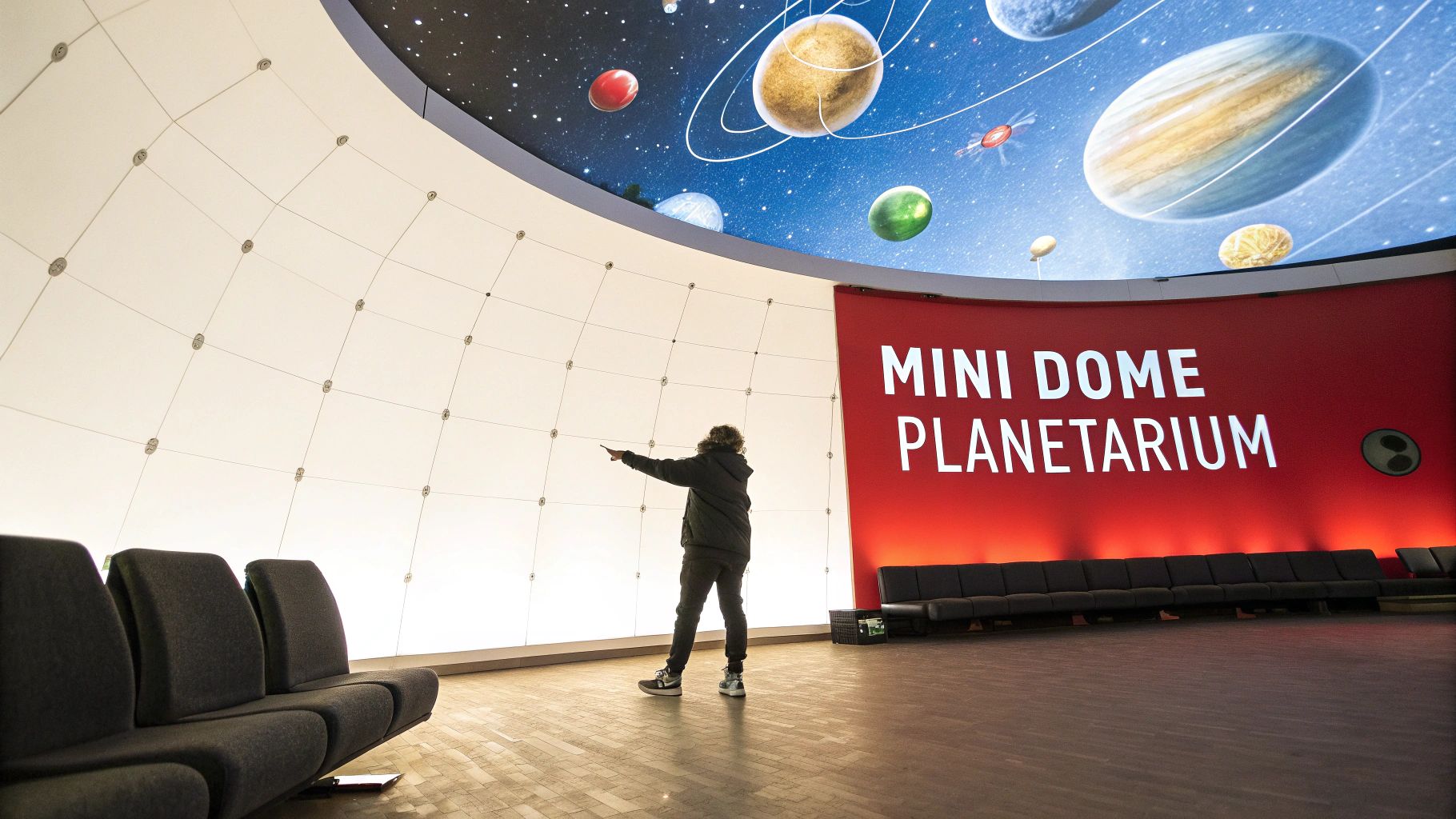
This method elevates the learning experience from observation to immersion. It’s perfect for demonstrating complex concepts like planetary orbits, constellations, and the vastness of space in a way that captures the imagination. Examples range from classroom-sized domes made of PVC and fabric to larger installations in school gymnasiums or science centers.
### When and Why to Use This Approach
This project is best suited for older learners (ages 12 and up) or as a major group project for a science club or classroom. Its strength lies in illustrating dynamic astronomical phenomena and the 3D nature of space. It’s the ideal choice for teaching about planetary motion, seasonal changes, and the perspective of an observer on Earth. This immersive approach makes abstract concepts tangible and awe-inspiring.
### Actionable Tips for Success
Creating a functional planetarium dome requires careful planning and execution. These tips will help you produce a stunning and educational cosmic theater:
- Build a Sturdy Frame: Use PVC pipes to construct a geodesic dome frame. This provides a stable and lightweight structure to support your projection surface.
- Choose the Right Surface: A seamless white sheet, parachute material, or even a large weather balloon painted white can serve as an excellent screen. The key is a smooth, non-reflective surface.
- Use Planetarium Software: Leverage free, open-source software like Stellarium. It allows you to project a realistic night sky from any location on Earth and simulate astronomical events.
- Calibrate Your Projector: Projecting onto a curved surface causes distortion. Use the projector’s keystone and warping correction features to ensure the image appears clear and correctly proportioned from the inside.
- Create Guided Tours: Enhance the experience by developing a narrated script or pre-recorded audio guide to point out planets, constellations, and significant celestial bodies as they appear on the dome.
7. Edible Solar System Model
The Edible Solar System Model transforms a classic astronomy project into a multisensory experience, making it one of the most engaging and delicious solar system model ideas available. This creative approach uses various food items like fruits, candies, cookies, or cakes to represent the Sun and planets. The project is as much about culinary artistry as it is about science, with participants designing, creating, and ultimately eating their cosmic creations.
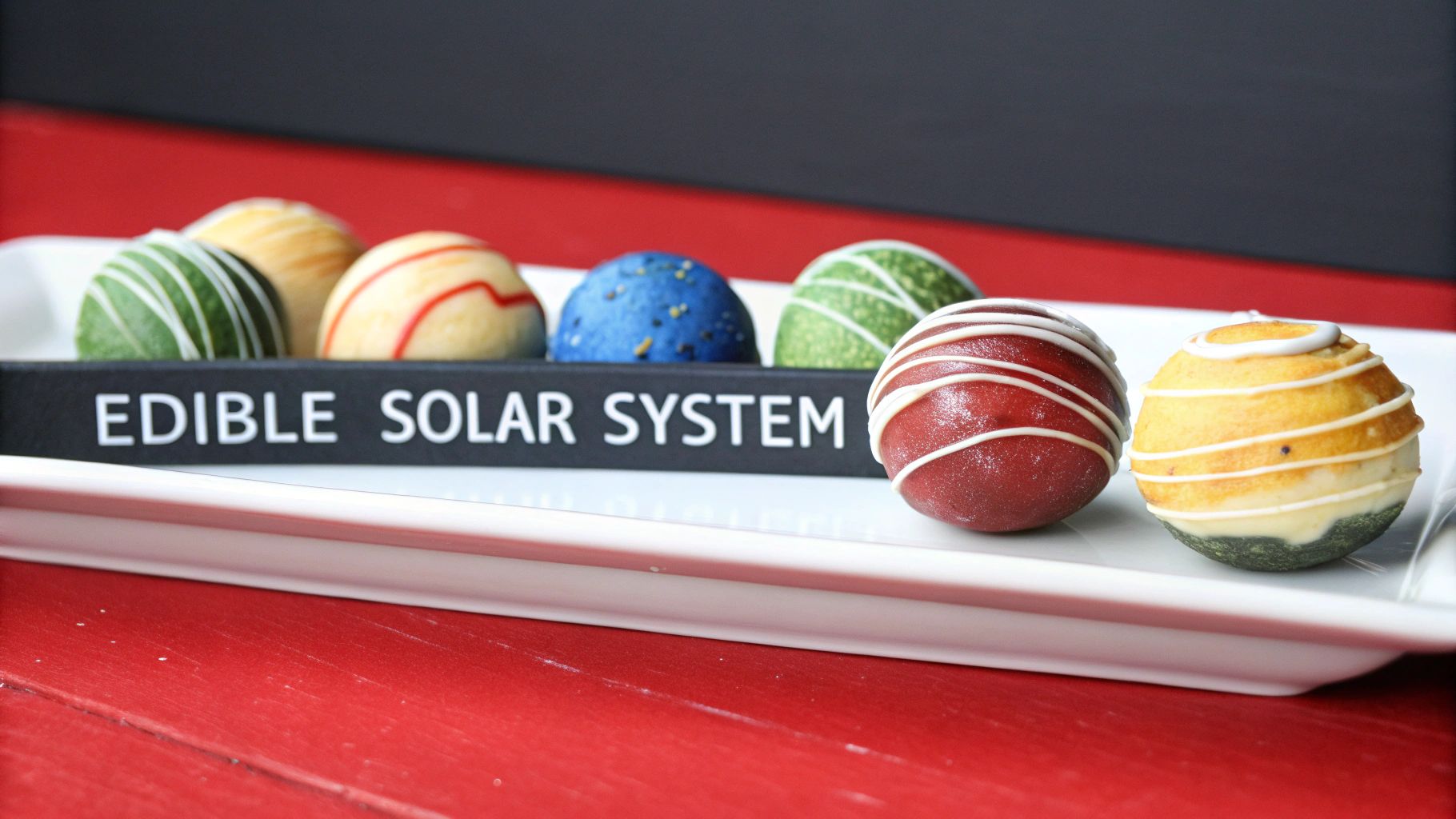
This method is exceptionally popular for its ability to connect abstract scientific concepts with tangible, enjoyable rewards. It is a standout activity for family STEM nights, classroom parties, or homeschooling lessons, ensuring high engagement by appealing to a universal love of treats.
### When and Why to Use This Approach
This project is perfectly suited for younger learners (ages 4-9) and special events where a memorable, hands-on activity is desired. Its primary strength is in creating a positive, celebratory association with science education. It effectively reinforces the order of the planets and their basic appearances in a fun, low-pressure environment. The immediate gratification of being able to eat the model makes it an excellent capstone project to celebrate the completion of an astronomy unit.
### Actionable Tips for Success
To ensure your edible solar system is both educational and appetizing, consider these practical tips for a successful project:
- Plan Your Planetary Palette: Choose foods that naturally match the planets' colors and sizes. Use a large orange for the Sun, a strawberry for Mars, jawbreakers for Earth, and various gumballs or round candies for other planets.
- Create an Edible "Space": Use a dark-colored tray or a cake covered in black or dark blue frosting as your backdrop. Sprinkle powdered sugar or small silver sprinkles to represent stars and galaxies.
- Discuss Before Devouring: Before anyone takes a bite, use the model as a teaching tool. Have each child point to a planet, name it, and share one fact they learned about it.
- Document Your Creation: Take plenty of pictures! An edible model won't last, so photographs are the best way to preserve the memory of the hard work and learning that went into it.
This approach makes learning about space an unforgettable treat. For families who love combining science with kitchen creativity, you can discover more about food science with an edible slime and candy making kit. By turning a lesson into a snack, you cement scientific knowledge in a uniquely joyful way.
8. Digital 3D-Printed Solar System Model
The Digital 3D-Printed Solar System Model brings our cosmic neighborhood into the modern age, making it one of the most innovative solar system model ideas for tech-savvy creators. This approach uses 3D printing technology to fabricate highly detailed and accurate representations of the Sun and planets. Users can either design their own models using CAD software or download pre-existing files from online communities like Thingiverse.
This method transforms digital files into physical objects, allowing for incredible precision in surface features like craters, mountains, and atmospheric bands. It represents a fantastic fusion of astronomy, engineering, and digital art, perfect for makerspaces, libraries, and advanced classroom projects.
### When and Why to Use This Approach
This project is best suited for older learners (ages 12 and up) or younger children with adult supervision, especially those interested in technology and design. Its strength lies in its precision and customizability. It is the ideal method for teaching concepts like planetary topography, comparative planetology, and the principles of digital fabrication and engineering design. The final product is also far more durable than traditional craft models.
### Actionable Tips for Success
To get the most out of your 3D-printed solar system, focus on precision in both the digital and physical stages. These tips will help you create a museum-quality display:
- Find Quality Models: Start by searching for "solar system" on platforms like Thingiverse or Printables. Many creators share meticulously designed files for free.
- Use Real Data: For a truly scientific model, use NASA texture maps and topographical data to inform your designs or paint job, ensuring realistic surface details. For those exploring advanced methods, learning how to create a 3D art sculpture with AI can open new possibilities for intricate and unique designs.
- Optimize Print Settings: To save time and material, orient your models on the print bed to minimize the need for support structures. Lowering the infill percentage can also speed up printing without sacrificing structural integrity.
- Post-Processing Matters: Sand the printed models to smooth out layer lines before painting. Using a primer will help the paint adhere better, resulting in a professional and vibrant finish.
This high-tech approach turns a classic project into a lesson in modern manufacturing. For those who appreciate the detail of advanced models but prefer a ready-to-build experience, you can explore our premium solar system model kit for another engaging option. This project is an excellent way to connect astronomical science with cutting-edge technology.
9. Mobile/App-Based Augmented Reality Solar System
The Mobile/App-Based Augmented Reality (AR) Solar System is a cutting-edge project that bridges the physical and digital worlds, making it one of the most innovative solar system model ideas available. This high-tech approach uses a smartphone or tablet camera to overlay a virtual, interactive 3D solar system onto a real-world environment. Participants can explore planets, watch orbits in motion, and access a wealth of data simply by pointing their device at a specific trigger image or a flat surface.
This method transforms a passive learning experience into an immersive digital adventure. It leverages technology that children and teens already use, making complex astronomical concepts like planetary rotation and orbital mechanics dynamic and engaging. Apps like NASA's Spacecraft 3D and the AR features in SkyView bring our cosmic neighborhood to life right in the classroom or living room.
### When and Why to Use This Approach
This project is exceptionally well-suited for older learners (ages 10 and up) and technology-focused STEM programs. Its primary strength is its ability to visualize abstract concepts in three dimensions. It is perfect for demonstrating the dynamics of the solar system, including planetary orbits, rotational speeds, and the vast distances between celestial bodies, which are difficult to convey with static models. It also serves as an excellent introduction to AR technology and its applications.
### Actionable Tips for Success
To ensure your AR solar system project is a success, focus on smooth implementation and user experience. These tips will help you create a memorable and effective educational tool:
- Choose the Right App: For a plug-and-play experience, download established apps like Celestron’s StarSense Explorer or SkyView. For a more custom project, use platforms like Unity with ARCore/ARKit plugins to build a simple AR scene.
- Create Clear AR Markers: If your app uses trigger images (markers), print them in high resolution and place them on a flat, well-lit surface. This ensures the device's camera can track them easily and render the AR model consistently.
- Prepare Your Devices: Test the app on multiple device types before the lesson to check for compatibility issues. Ensure all devices are fully charged and connected to a stable Wi-Fi network if the app requires it.
- Offer a Non-AR Alternative: Have a backup plan for students without a compatible device. Provide videos or interactive web-based models so everyone can participate in the learning experience.
By integrating technology, this model transforms a traditional lesson into a futuristic exploration. For further inspiration on integrating digital overlays into learning experiences, explore various educational augmented reality examples that show the potential of this technology.
10. Museum-Style Exhibition Model with Interactive Stations
Transform a classroom, school hall, or even a large room at home into a comprehensive learning environment with a Museum-Style Exhibition Model. This ambitious project elevates typical solar system model ideas by creating a series of interactive stations, much like you would find in a science center. Each station is dedicated to a specific celestial body or concept, featuring models, informational placards, and hands-on activities.
This approach turns learning into an immersive journey. Participants don't just view a single model; they travel from the Sun to the outer planets, engaging with different aspects of our solar system at each stop. This method is inspired by professional installations at places like the Smithsonian Institution and is perfect for a capstone project or a school-wide science fair.
### When and Why to Use This Approach
This large-scale project is best suited for older students (ages 11 and up) or collaborative group settings where tasks can be divided. It is the ultimate project-based learning experience, encouraging deep research, creativity, teamwork, and public speaking skills as students act as "docents" for their stations. It’s ideal for concluding a unit on astronomy, allowing students to showcase their accumulated knowledge in a dynamic and engaging format for parents, younger students, or the school community.
### Actionable Tips for Success
To create a professional and educational exhibition, meticulous planning and a focus on engagement are key. These tips will help guide your ambitious project:
- Plan Each Station: Before building, map out the theme and learning objective for each station. For example, the Mars station could focus on rovers and geology, while the Jupiter station explores its moons and Great Red Spot.
- Create Visitor Checklists: Design a "passport" or checklist for visitors to stamp or check off as they complete an activity at each station. This gamifies the experience and ensures they engage with all the content.
- Incorporate Interactive Elements: Move beyond static displays. Include a "crater creation" sandbox for the Moon station, a spin wheel of facts for Jupiter, or a simple lever mechanism to demonstrate planetary orbits.
- Assign Student Docents: Empower students by making them the experts. Assign one or two students to each station to explain the concepts, guide activities, and answer visitor questions.
By treating the project as a genuine exhibition, you foster a sense of ownership and pride, turning a complex subject into an unforgettable, interactive experience.
Comparison of 10 Solar System Model Ideas
| Model | 🔄 Implementation Complexity | ⚡ Resources & Time | ⭐ Expected Outcomes | 📊 Ideal Use Cases | 💡 Key Advantages / Tips |
|---|---|---|---|---|---|
| Styrofoam Ball Planetary Model | 🔄 Low — simple cutting/painting | ⚡ Low cost, ~2–3 hrs, basic craft supplies | ⭐⭐⭐ — good for order & basic features | Elementary classrooms, quick demos, homeschooling | 💡 Affordable, hands-on; seal foam before painting |
| Orrery (Mechanical Planetary Model) | 🔄🔄🔄🔄 High — gears, alignment, mechanics | ⚡ High cost, tools/parts, 10–20+ hrs | ⭐⭐⭐⭐ — strong for orbital mechanics & motion | Middle/high school STEM, makerspaces, museum demos | 💡 Use 3D-printed gears & stepper motors; test ratios first |
| Scale Model with Accurate Distance Representation | 🔄🔄 Medium — planning + math for scale | ⚡ Low–medium cost, needs large space; moderate setup time | ⭐⭐⭐⭐ — excellent for grasping true distances | Outdoor trails, gym hallways, kinesthetic learning | 💡 Use logarithmic scale for inner planets; add distance markers |
| Planetary Motion Simulation (Computer-Based Model) | 🔄🔄🔄 Medium–High — coding or software setup | ⚡ Moderate hardware; dev time medium; runtime interactive | ⭐⭐⭐⭐⭐ — very accurate, adjustable physics visualization | High school/university labs, remote learning, virtual demos | 💡 Start with existing tools (Stellarium/NASA Eyes) before coding |
| Interactive Tactile Model for Visually Impaired Students | 🔄🔄🔄 Medium–High — specialized design & testing | ⚡ Medium cost, 3D prints/textures/audio; planning time | ⭐⭐⭐⭐ — high inclusivity and tactile learning gains | Special education, inclusive classrooms, museum access programs | 💡 Consult users, include braille & audio QR codes; test with students |
| Homemade Planetarium Dome Projection | 🔄🔄 Medium — dome build + projection setup | ⚡ Medium cost (projector + materials); moderate setup/takedown | ⭐⭐⭐⭐ — immersive, highly engaging group experience | Group shows, school events, after‑school programs | 💡 Use white fabric, calibrate projector, add ventilation |
| Edible Solar System Model | 🔄 Low — simple assembly with food items | ⚡ Low cost, quick (1–2 hrs); perishable materials | ⭐⭐ — high engagement for young children; low depth | Elementary activities, family STEM nights, celebrations | 💡 Consider allergies, photograph before serving |
| Digital 3D-Printed Solar System Model | 🔄🔄🔄 Medium–High — CAD + print setup | ⚡ Requires 3D printer/materials; print times long | ⭐⭐⭐⭐ — very detailed, durable, repeatable displays | Makerspaces, long-term classroom exhibits, advanced projects | 💡 Use NASA texture maps; optimize orientation to save time |
| Mobile/App-Based Augmented Reality Solar System | 🔄🔄🔄 Medium — app use or AR development | ⚡ Device-dependent; development varies, runtime responsive | ⭐⭐⭐⭐ — immersive, interactive, flexible scaling | Tech classrooms, digital-native students, demos in small spaces | 💡 Test on multiple devices; provide non-AR fallback |
| Museum-Style Exhibition Model with Interactive Stations | 🔄🔄🔄🔄 Very High — multi-station design & coordination | ⚡ High budget & staffing; weeks of prep and logistics | ⭐⭐⭐⭐⭐ — comprehensive, multimodal learning impact | School-wide exhibitions, science fairs, public outreach | 💡 Plan station objectives, create activity checklists, assign docents |
Bringing the Cosmos to Your Fingertips
Throughout this exploration of diverse solar system model ideas, a powerful theme has emerged: the cosmos is not just an abstract concept to be memorized from a textbook, but a dynamic, awe-inspiring reality to be built, explored, and understood with our own hands. From the classic, paint-splattered Styrofoam planets that have graced countless science fairs to sophisticated augmented reality apps that overlay celestial bodies onto our living rooms, we have journeyed through a universe of creative possibilities.
Each project, whether edible, mechanical, or digital, offers a unique lens through which to view our cosmic neighborhood. The journey has shown that there is no single "best" model; the right choice depends entirely on your goals, resources, and audience. What matters most is the act of creation itself—the process of transforming abstract data points into a tangible, interactive experience that sparks genuine curiosity.
Key Takeaways for Your Cosmic Journey
As you prepare to embark on your own model-building adventure, remember these core principles that unite all effective solar system model ideas:
- Learning is Tactile: The most profound learning often happens when multiple senses are engaged. Building a model, whether it’s a mechanical orrery demonstrating planetary orbits or a tactile model designed for visually impaired students, solidifies abstract concepts like rotation, revolution, and scale in a way that reading alone cannot.
- Scale is Everything (and a Choice): One of the biggest challenges in representing the solar system is its immense scale. Your project's success lies in making a conscious choice about what you want to emphasize. Do you prioritize accurate planetary size, as seen in the Styrofoam or 3D-printed models, or do you tackle the mind-boggling distances between planets with a true-scale field model? Each choice offers a different, equally valuable lesson.
- Technology is a Powerful Ally: The modern toolkit for a cosmic creator is vast. Digital tools, from planetary motion simulations and 3D printing to mobile augmented reality, open up new dimensions of learning. These technologies allow us to visualize complex mechanics and explore space in ways that were once impossible, making astronomy more accessible and exciting than ever.
From Model to Mindset: The Lasting Impact
Building one of these solar system models is more than just a weekend project or a classroom assignment; it is an investment in fostering a scientific mindset. It teaches problem-solving, attention to detail, and the critical skill of translating complex information into a physical or digital representation. It encourages questions like, "Why is Jupiter so much bigger than Earth?" or "Why does Mars have a different orbital period?" These are the questions that fuel a lifelong passion for science and discovery.
By choosing and creating one of these solar system model ideas, you are not just building a miniature replica of planets and moons. You are constructing a powerful educational tool that demystifies the universe, fosters an appreciation for scientific inquiry, and inspires the next generation of astronomers, engineers, and explorers. The ultimate goal is to transform a distant, star-filled sky into a familiar, understandable, and deeply personal space.
Ready to take your hands-on science exploration to the next level? The projects in this guide are just the beginning, and Playz offers a universe of tools to fuel your child's curiosity with our award-winning STEM kits. Explore our collection at Playz to find the perfect experiment to ignite a passion for learning and discovery.