


At its core, sensory play is any activity that lets a child explore the world using their senses. Think of them squishing dough, splashing in water, or listening to leaves crunch under their feet. It’s the natural, hands-on way kids make sense of everything around them, turning simple curiosity into foundational knowledge.
Why Sensory Play is the Foundation of Early Learning
Sensory play is like a multi-vitamin for a child’s brain. It nourishes the pathways needed for all future learning and growth. This isn't just about making a mess with glitter and slime; it’s a critical part of development that builds the neurological framework for more complex skills like reading, writing, and problem-solving.
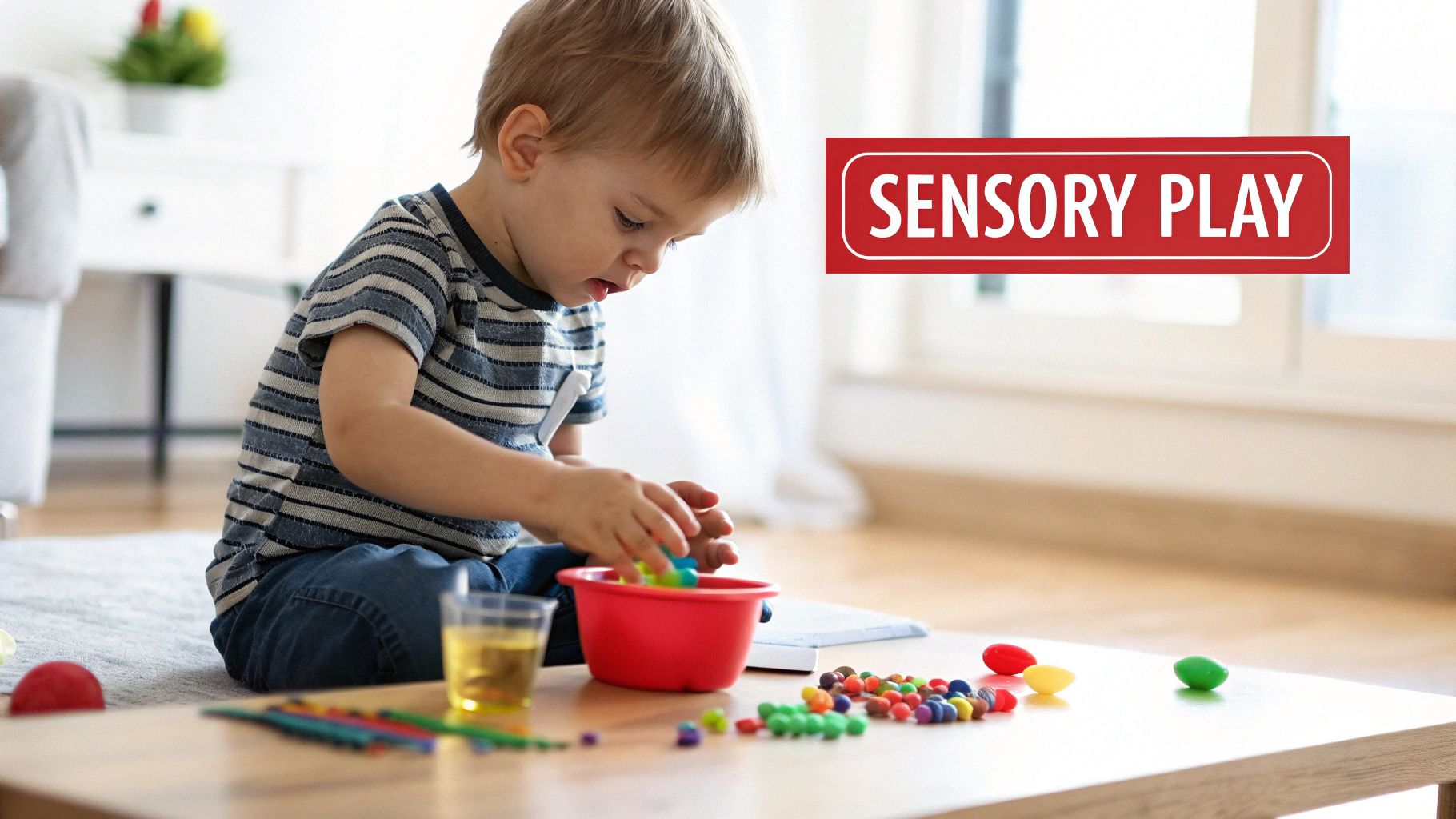
Every time a child engages their senses, they’re gathering information and sending it straight to their brain, creating and strengthening vital connections. This process is fundamental to all aspects of learning, laying the groundwork for a lifetime of discovery.
Sensory Play At a Glance: Key Developmental Benefits
To quickly see why this type of play is so important, here's a simple breakdown of the core benefits. Each activity, no matter how simple, is a powerhouse for building a well-rounded foundation for a child's future.
| Developmental Area | How Sensory Play Helps (Practical Example) |
|---|---|
| Cognitive Growth | Strengthens neural pathways. (Figuring out how to build a stable tower with blocks of different textures.) |
| Fine & Gross Motor Skills | Develops dexterity and coordination. (Using tongs to pick up pom-poms or carrying a bucket of water.) |
| Language Development | Encourages descriptive vocabulary. (Using words like "squishy," "cold," and "bumpy" to describe play-doh.) |
| Emotional Regulation | Provides a calming outlet. (Squeezing a stress ball or kneading dough to release frustration.) |
| Social Skills | Promotes cooperation and sharing. (Negotiating who gets the blue scoop in a shared sand bin.) |
More Than Just Fun and Games: The Deeper Purpose
While it definitely looks like simple fun, each sensory activity serves a profound purpose. The act of pouring water back and forth teaches early physics concepts like volume and gravity. Tracing letters in a tray of sand or rice develops the fine motor skills essential for eventually holding a pencil.
Sensory play creates a low-stakes environment where there is no right or wrong answer. This freedom encourages curiosity, boosts confidence, and allows children to lead their own discovery, fostering independence and creative problem-solving from an early age.
Building Real-World Life Skills Through Play
The benefits extend far beyond academics, too. When children share a sensory bin, they learn to negotiate, cooperate, and communicate their ideas with one another. Squeezing a ball of play-doh can be a calming activity that helps a child self-regulate big emotions.
It’s through these hands-on experiences that children build a comprehensive toolkit for life. For a deeper dive into these fundamental principles, you can explore guides on understanding how children learn through play.
How Sensory Play Literally Builds a Smarter Brain
Every time your child squishes mud between their fingers or listens to the rain, they’re doing more than just playing—they’re literally building a brain. The simplest way to picture it is to think of a young child's brain as a new city just starting out.
Each new sensory experience—the smell of baking cookies, the feel of cool grass, the sound of a firetruck—is like paving a new road. The more roads they build, the faster and more efficiently information travels. This real biological process is called neuroplasticity, and it’s the brain’s amazing ability to rewire itself by forming new connections. Sensory play is one of the most powerful ways to kickstart this process.
Strengthening Neural Highways for Faster Learning
Think about those roads again. When a child has the same sensory experience over and over—like repeatedly scooping and pouring water—that little dirt path gets paved, widened, and eventually turns into a multi-lane superhighway.
Pathways that get used often become stronger and faster, allowing for lightning-quick communication between different parts of the brain. This isn't just a cool science fact; it has real, tangible benefits for your child's thinking skills.
A well-connected brain is a high-performing brain. By strengthening these neural connections, sensory play improves memory, sharpens problem-solving skills, and builds the foundation for more complex learning down the road.
These strengthened pathways are the bedrock for everything from learning ABCs to tackling long division. For example, sorting colorful pom-poms by texture isn't just a game. It's an exercise in classification and critical thinking, building the exact mental framework a child needs for future success in school.
From Sensory Input to Cognitive Output
So how does feeling something gooey actually make a child smarter? The connection is surprisingly direct. Sensory experiences provide the raw data the brain needs to make sense of the world and understand abstract ideas.
- Problem-Solving: When a toddler figures out how to scoop water without it spilling everywhere, they’re learning about cause and effect in a way a book could never teach.
- Language Development: Describing what they feel—"slimy," "grainy," or "bumpy"—builds a rich vocabulary and makes them better communicators. You can find more great ideas in our guide to cognitive development activities for preschoolers.
- Abstract Thought: Concepts like "more" or "less" are fuzzy until a child can physically hold a big pile of blocks in one hand and a small pile in the other. Suddenly, it just clicks.
This kind of hands-on exploration makes learning feel natural and helps it stick. It's also why understanding sensory play is so critical when it comes to supporting children with learning differences and helping them thrive. Every single sensory interaction is a fresh brick laid in the foundation of a robust, efficient brain ready to take on any challenge.
Exploring All Seven Senses in Your Child's World
When we talk about sensory play, most of us immediately think of the big five: touch, sight, hearing, smell, and taste. But a child’s experience is so much richer than that.
Two powerful "hidden" senses are always working in the background, helping kids make sense of their bodies and the space around them. Getting to know all seven is the secret to unlocking the true power of sensory play.
Beyond the Famous Five: Introducing the Hidden Senses
The five classic senses are easy to spot. A kid squishing their hands in slime is all about touch, and listening to birds outside engages their hearing. These experiences are fundamental, and you can learn more about why touch is so critical in our guide to the tactile learning style.
But those two other senses? They're just as important for development.
-
Proprioception (Body Awareness): Think of this as your body's built-in GPS. It’s the sense that tells you where your arms and legs are without you having to look at them. Every time a child pushes a heavy toy box or hangs from monkey bars, they’re lighting up their proprioceptive system.
-
Vestibular Sense (Balance & Movement): This one lives deep in the inner ear and is the master of balance and spatial orientation. Spinning, swinging, and rolling down a grassy hill are all essential workouts for the vestibular system.
These two systems work together to help a child feel grounded and in control of their body, which is crucial for everything from sitting still in a chair to mastering how to ride a bike.
Your Actionable Guide to Engaging All Seven Senses
Let's break down what each of the seven senses does with simple, actionable ideas you can try today. Remember, every little activity contributes to building a stronger, more connected sensory system.
When a child hangs upside down or carries a bucket of water, they aren't just playing—they're conducting crucial experiments that teach their brain about gravity, balance, and force. These experiences build an internal map that helps them move confidently and safely.
The table below is your cheat sheet for understanding each sense and finding the perfect play activity to spark it.
| Sensory System | What It Does | Example Sensory Play Activity |
|---|---|---|
| Tactile (Touch) | Processes texture, temperature, and pressure from the skin. | Playing with kinetic sand, water beads, or different textured fabrics. |
| Visual (Sight) | Interprets light, color, shapes, and movement to understand the environment. | A colorful light table, I Spy games, or playing inside a vibrant Playz tent. |
| Auditory (Hearing) | Processes sounds, including volume, pitch, and location. | Making music with household items, listening to nature sounds, or a sound-matching game. |
| Olfactory (Smell) | Detects and identifies different scents in the air. | Smelling different herbs from the garden, using scented play-doh, or guessing spices. |
| Gustatory (Taste) | Differentiates between sweet, sour, salty, and bitter flavors. | Taste-testing different fruits, making and tasting a simple recipe together. |
| Proprioceptive | Senses body position and movement from muscles and joints. | Pushing or pulling a wagon, jumping on a trampoline, or giving tight hugs. |
| Vestibular | Manages balance, spatial awareness, and coordinated movement. | Swinging, spinning in a chair, or rolling down a gentle grassy hill. |
By making a conscious effort to engage all seven senses, you’re giving your child a well-rounded "sensory diet." This supports every single area of their development, from fine motor skills to emotional regulation.
The Overlooked Social and Emotional Benefits of Sensory Play
We talk a lot about the cognitive perks of sensory play, but the impact these activities have on a child’s social and emotional world is just as powerful.
Think of it this way: sensory activities create a safe, low-stakes environment where kids can practice vital life skills long before they have the words to describe their complex feelings.
For example, imagine two toddlers at a sand table. One wants the shovel, and the other has the bucket. Through this simple back-and-forth, they’re learning to negotiate, take turns, and see things from another person's perspective. It’s a miniature lesson in cooperation and empathy, played out with sand and plastic tools.
Sensory play also provides a constructive outlet for big emotions. A frustrated child who is encouraged to knead and pound a ball of play-doh can physically work through their feelings, helping them shift from distress to calm. This process is a foundational step in learning self-regulation.
Fostering Empathy and Cooperation in a Play Setting
Group sensory activities are natural laboratories for social learning. When kids gather around a water table or a large bin of rainbow rice, they aren’t just playing alongside each other; they’re learning to share space, tools, and ideas.
A child who feels calm and understood is a child who is ready to learn. Sensory play creates the ideal conditions for this by meeting a child's need for physical exploration, which in turn helps regulate their emotional state and makes them more receptive to social interaction.
This infographic breaks down the seven senses—both the ones we all know and the "hidden" ones—that get stimulated during play. Each one contributes to a child's overall well-being.
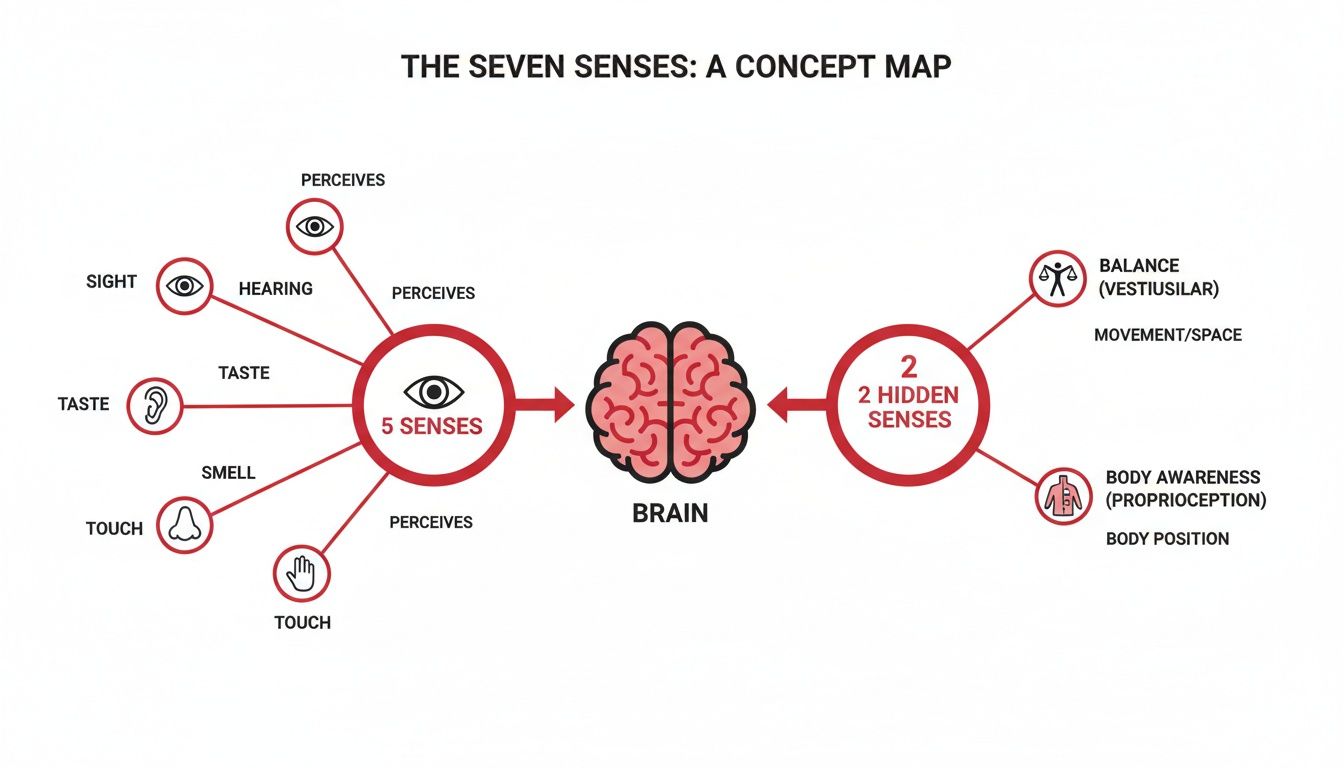
As the visual shows, the brain integrates input from the five classic senses as well as the two hidden senses of proprioception (body awareness) and vestibular (balance). A well-rounded sensory experience truly supports holistic development.
Building Emotional Intelligence from the Ground Up
Sensory-rich activities are incredibly effective at nurturing social and emotional growth. In fact, research shows these experiences create opportunities for kids to engage with peers and communicate their needs, fostering social skills in 80% of group settings observed in US preschools.
By providing a healthy outlet for expression, sensory play helps build a strong foundation for emotional intelligence. It teaches children that their feelings are manageable and that there are healthy ways to express them.
For more great ideas, you can explore these powerful emotional intelligence activities for kids.
A Practical Guide to Sensory Play for Every Age
Understanding the why behind sensory play is the first step, but knowing how to apply it to your child's specific stage of development is where the real magic happens. A baby’s needs are worlds away from a preschooler's, and the activities that delight them will be, too.
This is your simple roadmap to age-appropriate sensory fun.
Infants (0-12 Months): Gentle Discovery
Babies are the ultimate explorers, using their senses to make their very first connections with the world. For this stage, play should be simple, safe, and focused on gentle stimulation.
- Ribbon Mobile: Tie colorful, textured ribbons to a baby-safe hoop and hang it above them. This engages their developing vision and encourages reaching, which is fantastic for building gross motor skills.
- Texture Blanket: Lay your baby on a blanket with different fabric squares sewn on—think silk, corduroy, and fleece. This gives them gentle tactile input and is a perfect opportunity to introduce descriptive words.
- Discovery Bottles: Tightly seal clear plastic bottles with items like water and glitter, uncooked rice, or small bells. They create fascinating sights and sounds that are completely safe for little hands to shake and explore.
Toddlers (1-3 Years): Cause-and-Effect Exploration
Toddlers are all about cause and effect. They're mastering their motor skills and are captivated by anything that involves pouring, scooping, and dumping.
For a toddler, a simple pouring station isn't just a fun way to splash; it's a hands-on physics lesson. They are learning about volume, gravity, and object permanence with every single scoop.
- Pouring and Scooping Station: Set up a bin with dry materials like oats or chickpeas and hand over some scoops, cups, and funnels. This activity is a powerhouse for developing fine motor control and hand-eye coordination.
- Edible Mud Painting: Mix a little cocoa powder with water to create a taste-safe "mud." Let your toddler paint with their fingers on a tray. It's a fantastic, messy way to explore textures and smells.
- Nature Soup: On your next walk, collect leaves, pebbles, and flowers in a bucket. Once home, just add water and a big spoon. Your toddler can mix and stir their own "nature soup," connecting them to the real textures and smells of the outdoors.
Preschoolers (3-5 Years): Imaginative Creation
Preschoolers have more advanced fine motor skills, booming imaginations, and their play is becoming more complex and story-driven. They're ready for activities that involve sorting, creating, and experimenting.
- Potion Making Station: A guaranteed winner. Provide colored water in squeeze bottles, along with glitter, flower petals, and baking soda. Add a splash of vinegar for a satisfying fizzy reaction. This kind of play fuels creativity and sneaks in early science concepts.
- Ice Block Treasure Hunt: Freeze a few small toys inside a large block of ice. Give your preschooler droppers with warm water and a toy hammer to excavate their treasures. This is a brilliant way to teach patience and problem-solving skills.
- Scented Play-Doh Creations: Add a few drops of lavender or peppermint extract to your next batch of homemade play-doh. This engages their sense of smell while they build, which can have a calming effect while strengthening fine motor skills.
For even more inspiration, explore our full list of engaging sensory activities for kids that cover all ages and stages.
How to Create a Simple Sensory Play Space at Home
You don’t need a dedicated playroom or a mountain of expensive toys to bring the magic of sensory play into your home. Some of the best sensory spaces are built with simple, everyday items, making it an accessible and budget-friendly way to play.
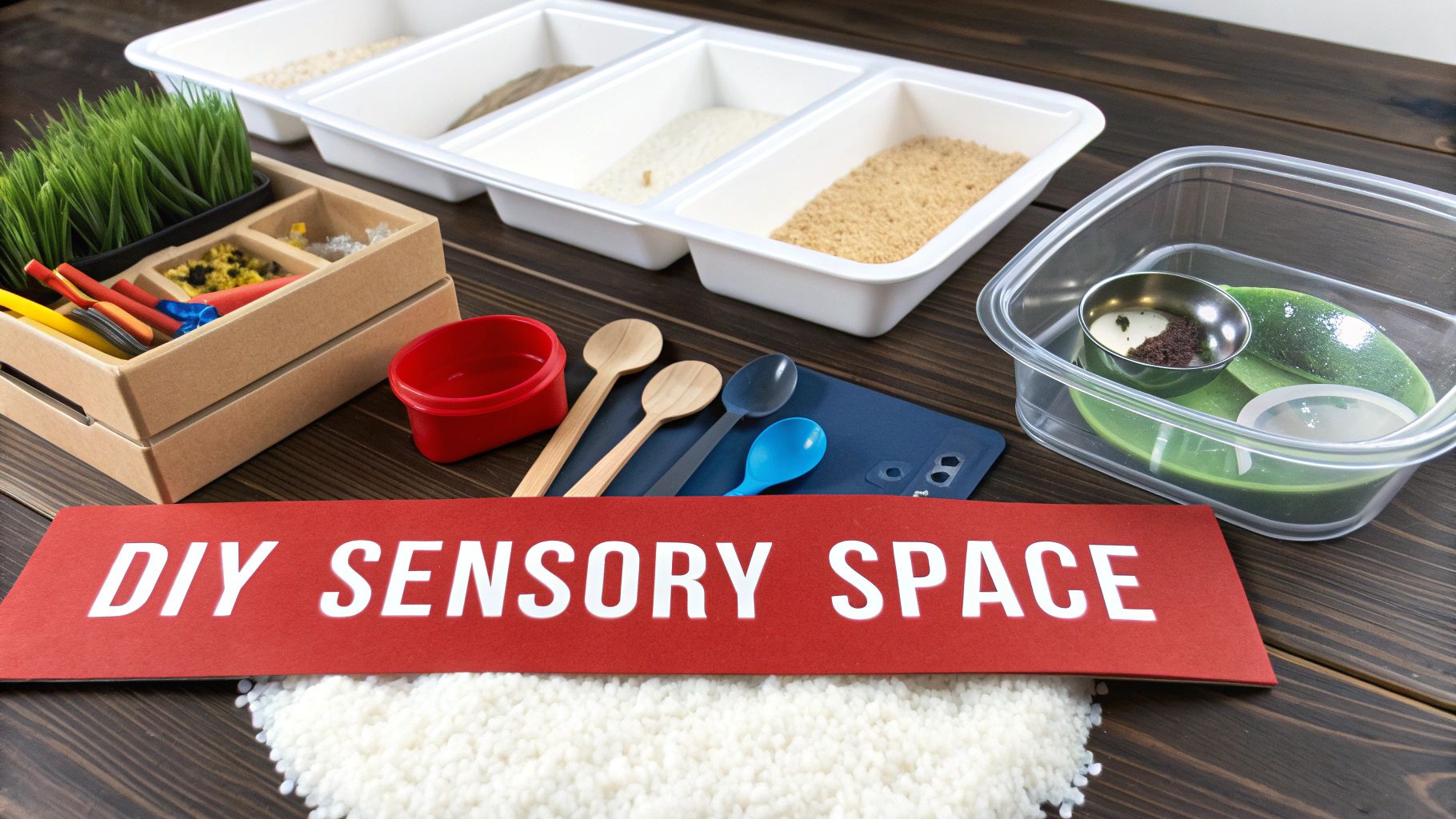
The key is to think less about the "stuff" and more about creating opportunities for exploration. A plain cardboard box can become a rocket ship or a cozy cave. A simple bin filled with dry pasta and a few toy trucks is suddenly a bustling construction site.
Your First Sensory Bin: A Step-by-Step Guide
The sensory bin is the classic cornerstone of at-home sensory play. It's really just a container that holds different materials for your child to explore, defining the play area and making cleanup so much more manageable.
- Choose a Container: Start with a basic, shallow plastic storage tub.
-
Pick a Taste-Safe Base: This is crucial for younger kids. Good options include:
- Dry pasta or rice
- Rolled oats or cereal (great for "sand" or "dirt")
- Water with bubbles
- Add Simple Tools: Toss in a few kitchen utensils like ladles, measuring cups, funnels, and tongs. These everyday items are amazing for developing fine motor skills and hand-eye coordination.
How to Manage the Mess (and Keep It Safe)
The fear of mess is a big hurdle for many parents, but it’s entirely manageable with a little prep. Sensory play is only as messy as you allow it to be.
Pro Tip: Set clear boundaries. A large towel or an old sheet placed under your sensory bin creates a designated "play zone." This visual cue helps children understand where the materials should stay and makes cleanup as simple as folding up the corners and shaking it out.
Of course, safety is always the top priority. Always supervise young children during sensory play, especially when small items are involved. For babies and toddlers, stick to edible or "taste-safe" bases, and always ensure any toys or objects are large enough that they don't pose a choking hazard.
Frequently Asked Questions About Sensory Play
As you dive into the wonderful world of sensory exploration, a few questions might still be bubbling up. Let's tackle some of the most common ones we hear from parents.
Is sensory play only for kids with special needs?
Absolutely not. While sensory play is an amazing therapeutic tool for kids with sensory processing disorders or autism, its benefits are universal. Think of it like a healthy "play diet"—every single child needs it to thrive and build the foundational cognitive and motor skills they'll use for the rest of their lives. For more details, you can learn about important childhood development milestones in our other guide.
What if my child avoids messy activities?
It's completely normal for some kids to be hesitant about getting messy. The key is to start small and never force it. Respecting a child's boundaries is the most important part of making sensory play a positive experience.
Actionable Tip: Start with "dry" sensory materials, like a bin of uncooked pasta. You can even offer tools like scoops or tongs so they don't have to touch anything directly at first. Once they're comfortable, you can gradually introduce textures with minimal mess, like kinetic sand or play-doh, building their confidence over time.
How often should my child do sensory play?
There's no magic number. The goal is to weave some form of sensory exploration into your child's daily routine. It doesn't have to be a big, planned-out activity every time. In fact, the best sensory play often just happens naturally.
It can be as simple as:
- Splashing and pouring during bath time.
- Feeling the sand or woodchips at the local park.
- Helping you knead dough when you're baking together.
- Touching different leaves and tree bark on a walk outside.
What matters most is providing consistent, varied exposure to rich sensory experiences that spark their natural curiosity.
Ready to bring more hands-on learning into your home? The Playz collection of science kits, play tents, and creative toys are designed to spark curiosity and support sensory development. Explore our toys today and discover why #KidsLearnBestThruPlayz.