

Picture this: a brightly colored box arrives at your doorstep, addressed to your child. Their eyes light up. This isn't just another toy; it's a promise of adventure, a mystery waiting to be unboxed. That's the magic of monthly science kits for kids.
These subscription boxes are your personal, at-home science lab, delivered on a schedule. Each one contains a unique, hands-on experiment, complete with all the materials and kid-friendly instructions needed to explore a real scientific concept in a way that feels like pure fun.
Unboxing a World of Discovery
The excitement of a monthly science kit starts the moment it arrives. Each box is a self-contained world of discovery, designed to blend the thrill of a surprise with the deep satisfaction of learning something new.
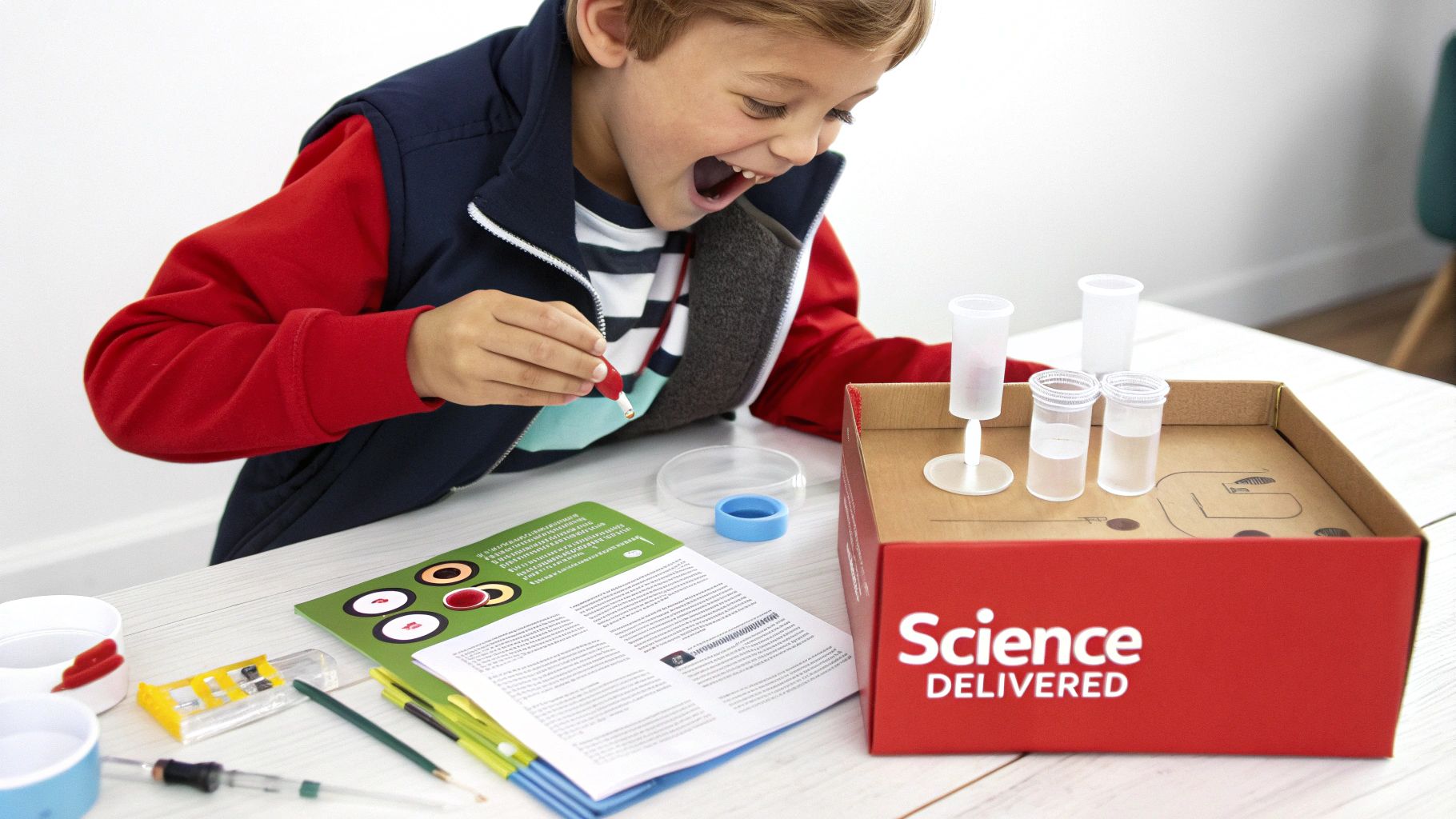
From the moment they lift the lid, they’re greeted with a collection of intriguing materials—vials, powders, gears, and gadgets. For example, one month they might unbox everything needed to build a fizzing volcano; the next, it could be the components for a lemon-powered clock. This tangible experience turns abstract ideas from a textbook into something they can hold, build, and understand.
Why Are Monthly Kits So Effective for Learning?
The genius of these kits lies in how they package learning. Instead of presenting science as a list of dry facts, they frame it as a series of engaging puzzles to be solved through action. This simple shift taps directly into a child's natural, boundless curiosity.
Here's why they work so well:
- Convenience for Parents: Forget last-minute runs to the store for obscure materials like zinc strips or alligator clips. Everything you need is right there in the box.
- Sustained Engagement: A new, exciting project arriving every month keeps kids looking forward to their next scientific challenge. It builds momentum and turns learning into a consistent habit.
- Confidence Through Creation: Successfully completing an experiment—whether it's making slime or lighting an LED—creates a powerful "aha!" moment that builds self-esteem and fosters a positive relationship with learning.
Key Takeaway: Monthly science kits transform learning from a passive chore into an active, thrilling adventure. By providing all the tools and clear instructions, they empower kids to become confident creators and problem-solvers.
To get a better feel for how this plays out, you can explore the kinds of hands-on science activities that form the foundation of these kits. This guide will walk you through everything you need to know to choose the perfect subscription for your budding scientist.
The Real Benefits of Hands-On Science
When your child successfully launches a bottle rocket or grows a crystal, something much deeper is happening than just a cool reaction. Monthly science kits are powerful tools that build essential life skills with every project.
Think of it like learning an instrument. Each kit is a practice session, reinforcing key ideas and building their scientific instincts over time. This regular, hands-on work is what makes abstract concepts concrete. A chemical reaction is no longer a formula in a textbook—it's the colorful foam bubbling out of the volcano they just built. That direct connection is the key to genuine understanding and long-term retention.
Building Critical Thinking and Problem-Solving Skills
Every science kit is essentially a puzzle. It presents a challenge and gives your child the tools to figure it out. As they follow the steps, measure ingredients, or connect circuits, they’re flexing their problem-solving muscles. What if the experiment doesn't work the first time? That's when the real learning begins. They learn to troubleshoot, adjust variables, and think critically about what went wrong—a process scientists use every day.
This approach teaches them to ask "why?" and "what if?", the foundational questions that drive all scientific discovery. They get a feel for analyzing a problem, forming a hypothesis, testing it, and observing the outcome. These aren't just "science" skills; they're life skills applicable to any challenge they'll ever face.
Actionable Insight: The real magic of these kits is that they teach kids how to think, not just what to think. They learn that curiosity is a tool and that figuring something out is a rewarding adventure.
Fostering Resilience Through Trial and Error
One of the greatest benefits of hands-on science is how it redefines "failure." In an experiment, an unexpected result isn't a mistake—it's data. It's an opportunity to learn something new. For instance, if a homemade slime is too sticky, a child learns to adjust the recipe, adding a bit more activator.
Monthly kits create a safe, low-pressure environment for kids to try, fail, and try again. This builds a growth mindset—the belief that abilities can be developed through dedication and hard work. When a child sees that a "failed" experiment can be tweaked to get a cool result, they learn a powerful lesson in resilience and perseverance.
Sharpening Fine Motor Skills and Following Directions
Many science experiments require precise actions that are fantastic for physical development. Carefully using a dropper, connecting tiny wires, or folding a paper airplane just right are all excellent practice for fine motor control and hand-eye coordination.
Furthermore, simply following a multi-step instruction manual is a crucial skill. It teaches kids:
- Sequential Thinking: Understanding that steps must happen in a specific order for the desired outcome.
- Attention to Detail: Realizing why precise measurements and actions matter—too much of one ingredient can change everything.
- Reading Comprehension: Translating written words and diagrams into physical actions.
For a deeper look at why this learning style is so effective, check out the core benefits of hands-on learning. These kits make abstract science real, helping kids grasp complex ideas like visualizing atomic structures like the Bohr diagram for nitrogen. Each project strengthens the link between instructions and results, creating a powerful learning loop.
How to Choose the Perfect Science Kit
With so many science kits on the market, picking the right one can feel like an experiment in itself. The secret is to find a subscription that aligns with your child's personality, interests, and developmental stage.
Think of it like choosing a bicycle. One that’s too big is intimidating, while one that’s too small is frustrating. The right fit empowers them to ride off and explore. A great science kit does the same thing for their mind.
Match the Kit to Your Kid's Age and Stage
This is the most critical factor. Age appropriateness is everything. A chemistry set designed for a 10-year-old will overwhelm a 5-year-old, while a kit for a younger child will bore an older one. Look for that "sweet spot" where a project is challenging enough to be exciting but not so difficult it leads to frustration.
- For preschoolers (ages 3-5): Focus on sensory play, like making gooey slime or mixing primary colors. These simple activities build fine motor skills and introduce basic cause-and-effect.
- For young children (ages 6-8): They are ready for kits that involve following simple instructions, such as building a mini volcano or growing crystals.
- For pre-teens (ages 9-12+): They can handle more complex challenges, like building a simple robot or conducting chemistry experiments that require careful measurement.
Practical Tip: Before you buy, look at sample instructions online. Can your child handle the components safely? Can they follow the steps with minimal help? Nailing the age-appropriateness is the key to a positive experience.
Prioritize Safety and Quality Materials
Safety is non-negotiable. Always choose kits from reputable brands that use non-toxic, kid-safe materials and provide clear warnings.
Beyond safety, consider the quality of the components. Flimsy plastic parts that snap mid-experiment are a surefire way to kill the fun. Durable, well-made materials not only last longer but also send a message that your child's scientific explorations are important.
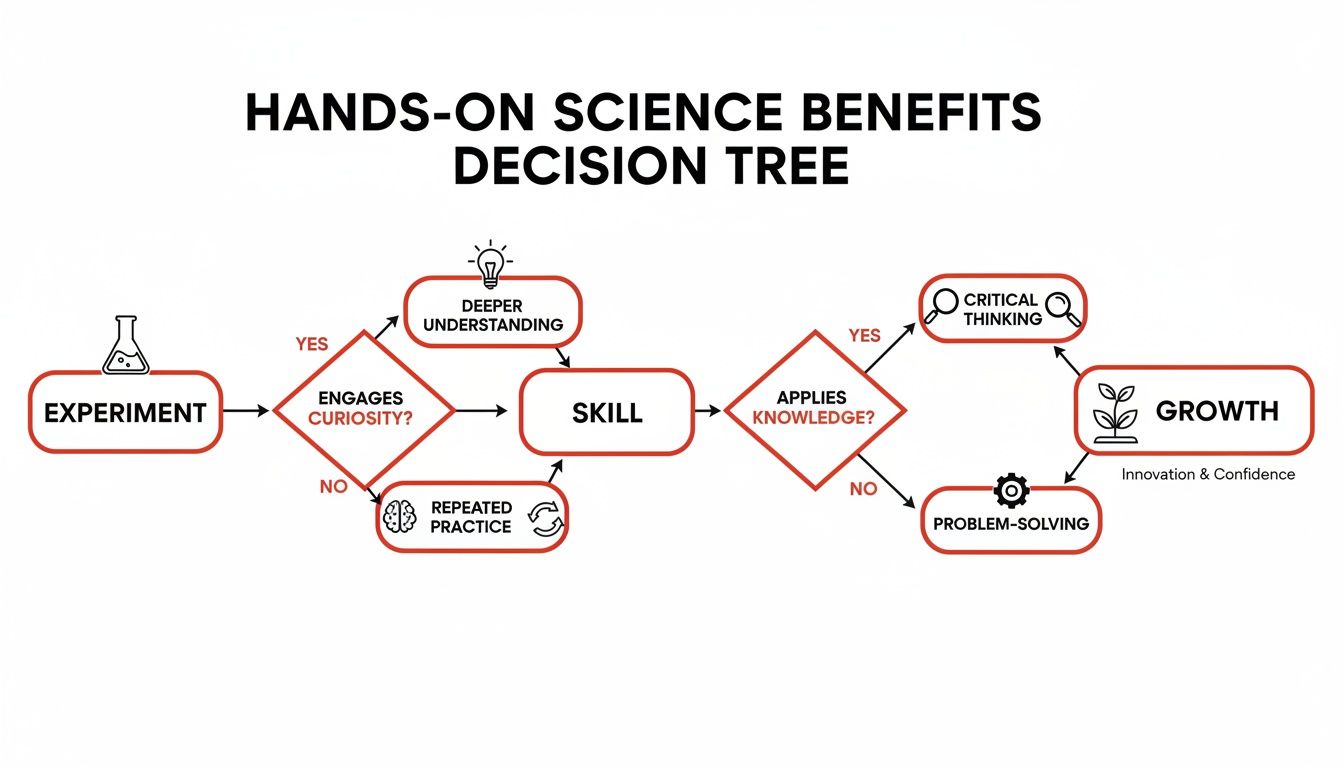
As the chart illustrates, a single engaging project can spark a chain reaction, leading directly to improved critical thinking and long-term intellectual growth.
Zero In on Their Natural Interests
Is your child obsessed with digging for worms, staring at the stars, or building epic LEGO towers? Monthly science kits for kids often focus on specific fields like biology, chemistry, or engineering. Tapping into their natural curiosity is the surest way to guarantee they’ll be hooked.
Comparing Types of Science Kits
Here's a quick comparison to help you find the right fit for your child's passion.
| Kit Type | Key Concepts Covered | Ideal Age Group | Real-World Examples |
|---|---|---|---|
| Chemistry | Chemical reactions, states of matter, acids & bases | 8-14 | Making slime, bath bombs, crystal growing |
| Physics | Motion, gravity, simple machines, electricity | 8-14 | Building circuits, catapults, solar-powered cars |
| Biology | Plant life, human body, ecosystems | 5-12 | Growing a terrarium, building a model skeleton |
| Engineering | Structures, robotics, problem-solving, design | 6-16+ | Constructing bridges, coding simple robots, hydraulic claws |
Choosing a theme that aligns with what they already love makes learning feel less like a lesson and more like playtime. For more ideas, explore different kinds of STEM toys for kids to see which category gets them most excited.
Consider Subscription Flexibility and Value
Finally, review the subscription details. Most companies offer various plans. A monthly plan provides the most flexibility, while a 6 or 12-month subscription usually offers a better price per box. Look for services with easy pause or cancel options, because kids' interests can change quickly.
The global science kits market, valued at an estimated USD 1.97 billion in 2024, is projected to hit nearly USD 3.68 billion by 2033. This growth is driven by parents seeking engaging, screen-free learning experiences—and subscriptions deliver that perfectly.
Exploring the World of Playz Science Kits
So, you know the criteria for a great subscription box. Now, let's look at a real-world example: Playz. Their entire philosophy is built on one simple, powerful idea: science should be an absolute blast. They are dedicated to making learning an active, joyful experience.
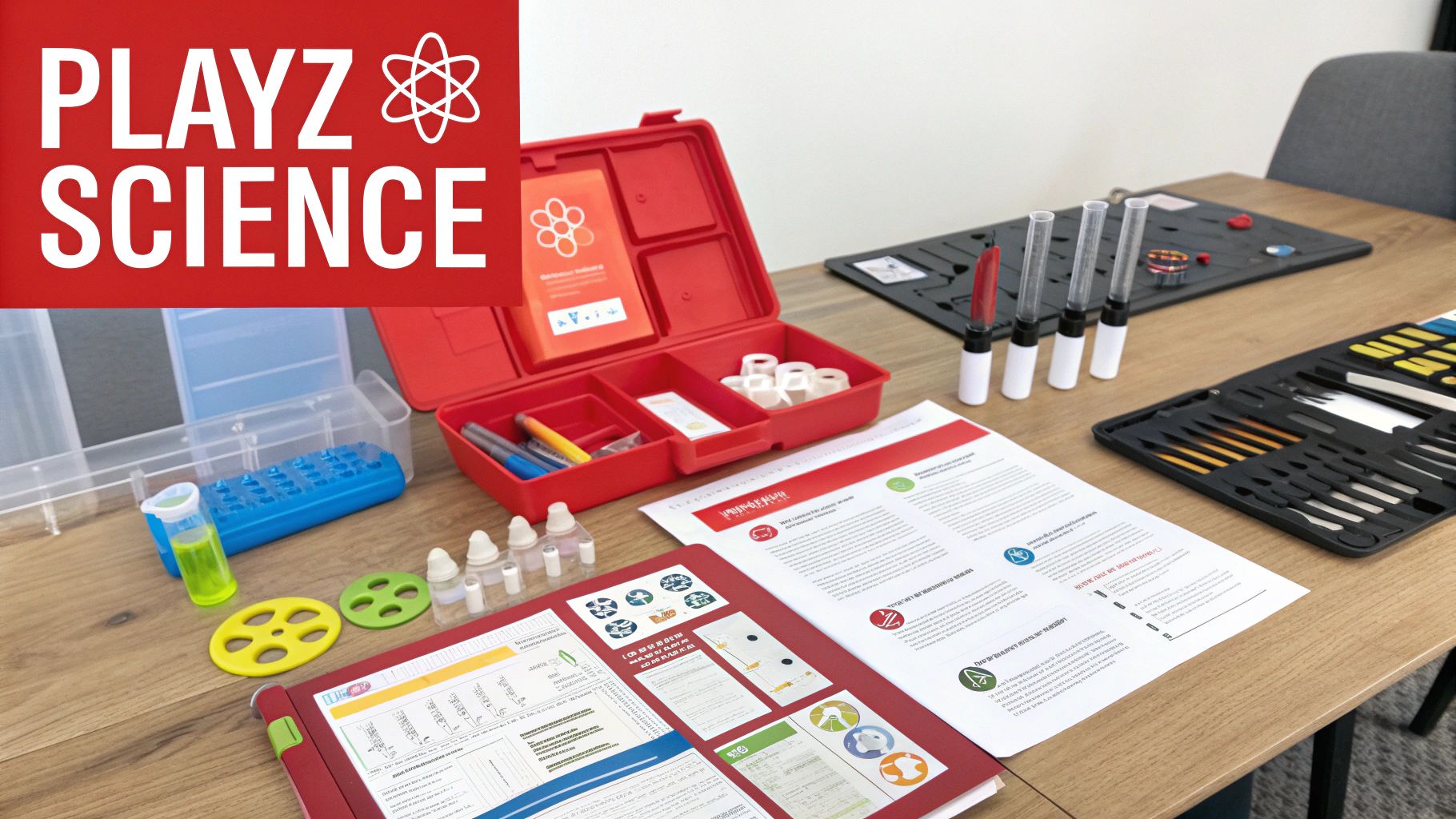
You can see that commitment in every detail. From the vibrant, eye-catching packaging to the clear, kid-friendly instructions, everything is designed to pull children in and make them feel like real scientists on a mission. This isn't just about mixing chemicals; it’s about sparking genuine wonder.
What Makes Playz Kits Different?
Playz kits are engineered to be complete learning adventures, not just one-off experiments. They make complex science feel approachable and incredibly fun, turning your kitchen table into a buzzing laboratory.
Here are their pros and cons:
Pros:
- Engaging Themes: Instead of generic titles, Playz uses themes like "Explosive Kitchen Chemistry" or "Lava Lamp & Volcano Science" to grab a child's imagination.
- Exceptional Manuals: Their instruction books are a standout feature, filled with colorful illustrations, fun facts, and clear, step-by-step directions that empower kids to take the lead.
- High Value: Many kits come loaded with dozens of potential experiments, offering hours of exploration and encouraging kids to revisit concepts.
Cons:
- Parental Guidance Needed: While kid-friendly, some experiments may require adult supervision, especially for younger children.
- Household Items Sometimes Required: A few experiments might require common household items (like oil or a lemon) that aren't included in the box.
Key Takeaway: The Playz philosophy is that children learn best by doing. Their kits are designed not just to be followed, but to be explored, inspiring kids to ask "what if?" and experiment on their own.
The Playz Subscription Model: Consistent Learning
The Playz subscription service delivers this hands-on philosophy to your door every month. It’s built to nurture a long-term love for STEM by providing a steady stream of new challenges. This regular delivery transforms science from a special occasion into an anticipated part of their routine.
Each new box builds on the skills and confidence from the last. A child who masters a simple fizzing reaction in one kit will feel ready to tackle a more complex crystal-growing project in the next. This continuous journey solidifies learning and builds scientific fluency. The global market for STEM kit subscriptions, estimated at USD 1.2 billion in 2024, is expected to skyrocket to USD 4.7 billion by 2033—a testament to the effectiveness of this sustained learning model.
From Slime to Volcanoes: Playz in Action
Let's look at some practical examples of what a child might do with a Playz kit.
Imagine your child’s excitement as they:
- Create Gooey Slime: They mix polymers and activators, learning about non-Newtonian fluids in the most hands-on way possible.
- Build a Working Volcano: This classic experiment teaches them about chemical reactions as they create an epic, fizzing eruption right on the kitchen counter.
- Construct a Lemon-Powered Clock: They explore the basics of circuits and electricity using everyday items, making an abstract concept finally click.
Each of these activities directly builds critical thinking, teaches resilience, and sharpens fine motor skills. By providing everything needed in one box, Playz removes the barriers, making it easy for kids to dive into discovery. For parents seeking a reliable and high-quality monthly science kit for kids, this all-in-one approach is a perfect fit. You can browse the full collection of engaging Playz science kits.
What to Expect in Your First Box
So, you’re ready to subscribe. What is it really like when that first box lands on your doorstep? Let's walk through the experience, from the moment it arrives to that first "wow" moment of discovery.
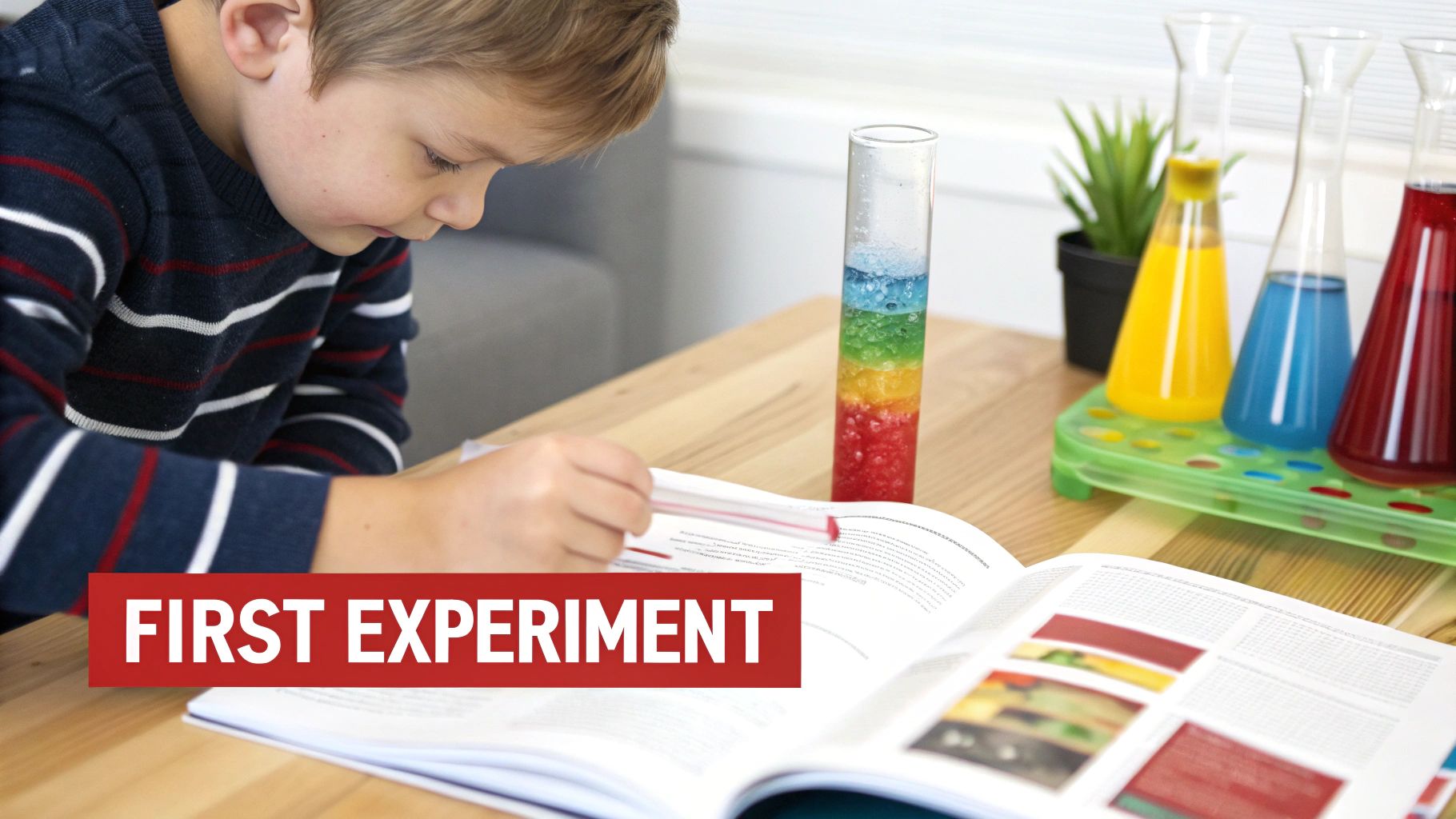
A brightly colored package arrives with your child's name on it. The excitement of getting their own mail is half the fun! This small detail gives them a sense of ownership, turning it into a personal adventure before the box is even opened.
The Unboxing Moment
When your kid lifts the lid, they won’t find a jumble of parts. Everything is thoughtfully arranged—vials of colorful powders, pre-measured liquids, droppers, beakers, and maybe even safety goggles. Each component is neatly packed, sparking curiosity from the get-go.
It's not just what's inside; it's how it's presented. Good kits feel both professional and playful. The materials are sturdy and sized for little hands. The first thing they’ll probably grab is the instruction manual. A great manual is more than a list of steps; it's a colorful, illustrated storybook for their experiment, empowering them to take the lead.
Diving Into the First Experiment: A Practical Example
Let’s imagine they’re doing a classic "Fizzing Colors" experiment. The lab guide turns a potentially complex chemical reaction into a simple, follow-the-pictures recipe.
Here’s a step-by-step of how it might unfold:
- Gather Your Gear: The guide shows pictures of everything they need, which is all conveniently included in the box. No last-minute store runs required.
- Measure and Mix: Using a small scoop, they add a specific powder (like baking soda) to a vial of water.
- Add the Magic: With a dropper, they squeeze in a few drops of a colored liquid (like a citric acid solution) and watch as the mixture instantly fizzes, bubbles, and erupts.
That moment of reaction is pure magic. It’s the "aha!" moment when a science lesson clicks. They didn’t just read about acids and bases; they saw them in action, creating a vibrant, bubbling reaction they made happen all by themselves.
Real-World Impact: The joy on a child’s face during that "aha!" moment is unforgettable—when the rocket they built soars or the robot they wired takes its first step. These moments of discovery link happiness directly with learning.
Beyond the Initial "Wow"
Once the fizzing stops, the learning isn’t over. A good guide will explain the "why" behind the reaction in simple terms, connecting the fun they just had to a real scientific concept. This makes the knowledge stick without ever feeling like a quiz.
This first box is so much more than a single activity. It sets a new standard for playtime, showing your child that they have the power to create, discover, and understand the world. It transforms the idea of a subscription into a real, joyful, and deeply educational experience—one that gets them pumped for whatever next month’s monthly science kit for kids has in store.
Frequently Asked Questions (FAQ)
Jumping into a subscription is a decision, and it’s smart to have questions. Here are clear, straightforward answers to the most common queries from parents.
What’s the best age to start a monthly science kit subscription?
While it depends on the child and the kit, here's a general guide:
- Ages 3-5: Kids can start with basic, sensory-focused science kits centered on concepts like color mixing or cause-and-effect, using large, safe parts.
- Ages 6-8: Most children are ready for classic monthly science kits for kids that require following a few steps. They have the fine motor skills and attention span to really engage with a project.
- Ages 9-12+: This is the ideal age for more advanced kits tackling chemistry, physics, or robotics.
Are the materials in the science kits safe for kids?
Absolutely. Safety is the top priority for any reputable company. All materials are non-toxic and selected for at-home, kid-friendly use. Kits always come with clear instructions and safety warnings.
Key safety features include:
- Non-Toxic "Chemicals": Most are common household ingredients like baking soda, citric acid, or food coloring.
- Age-Appropriate Tools: Components are designed for little hands, with no sharp edges or small parts that could be a hazard for younger kids.
- Clear Safety Guidelines: The manual will specify when to use safety goggles (often included) or when an adult should assist.
What if my kid doesn’t like a specific theme?
It happens! One month might be an exciting chemistry kit, and the next might be biology. If a theme doesn’t spark immediate joy, frame it as a chance to explore something new—sometimes the most unexpected topics become favorites. If it's truly a miss, most subscription services offer flexibility. You can often pause your subscription for a month or, in some cases, swap a kit.
Actionable Tip: The journey of scientific discovery isn’t always a straight line. An experiment that seems uninteresting at first might be the one that sparks a completely new passion.
How easy is it to pause or cancel my subscription plan?
Reputable companies understand that family schedules and budgets change. Most services, including Playz, make it simple to manage your plan online. Pausing for a month or two should only take a few clicks. Canceling should be just as painless. Transparent and customer-friendly account management is a sign of a company that is confident in its product. For more details, you can always check out our complete Frequently Asked Questions page.
A Peek Behind the Subscription Box Curtain
The popularity of these kits is part of a larger trend. The kids' subscription box market is a multi-billion dollar industry, with North America holding about 39.7% of a USD 3.5 billion market in 2023. This growth is fueled by parents seeking engaging, educational activities that can compete with screen time. Getting these boxes from a warehouse to your doorstep is a complex logistical operation—you can learn more about mastering subscription box fulfillment to see how it works.
Ready to unbox a world of discovery? At Playz, we make it easy to start your scientific adventure. Our monthly science kits are designed by experts to be safe, engaging, and ridiculously fun, sparking a lifelong love for learning with every box.