

At its core, the tactile learning style is all about learning by doing. It's the simple idea that some people understand and remember information best when they can physically touch, move, and interact with their subject matter.
Think of it this way: You can read a book about how to ride a bike, look at diagrams, and listen to an expert explain the physics of balance. But you don't truly learn until you get on the bike, feel the wobble, push the pedals, and find your own center of gravity. That, in a nutshell, is tactile learning in action.
Understanding the Hands-On Learner
Have you ever met a child who just has to take things apart to figure out how they work? Or a student who can't stop fidgeting during a lecture but absolutely excels when it's time to build a model in science class? Those are classic signs of a tactile learner. They aren’t just looking for information; they need to experience it to make it stick.
This learning style isn’t just a casual preference—it’s how their brains are wired to forge strong, lasting connections. By engaging their bodies in the learning process, they activate different neural pathways that cement information in a way passive listening or reading simply cannot.
Key Traits of Tactile Learners
Tactile learners are often misunderstood in a traditional classroom setting. What might look like a short attention span is often just a brain craving physical engagement. They aren’t bored or disinterested; they're just waiting for the chance to get their hands dirty and learn through action.
Here are a few defining characteristics:
- A Need for Movement: Sitting still for long periods can feel like a genuine struggle. They learn best when they can move, whether it's walking around while thinking, tapping a pen, or shifting in their seat.
- Excellent Motor Memory: These are the people who remember what they did far better than what they saw or heard. For them, assembling a gadget once is more valuable than reading the manual ten times.
- Preference for Action over Theory: They’d much rather jump into a project and learn through trial and error than sit through a long-winded explanation. They figure things out by doing, not just by listening.
This hands-on philosophy is everywhere once you start looking for it. A perfect real-world example is the wonderfully tactile world of mechanical sewing, where feeling the fabric and guiding the needle is the only way to truly master the craft.
To make this clearer, here's a quick look at what defines a tactile learner.
At a Glance: Tactile Learner Profile
| Characteristic | Description | Real-World Example |
|---|---|---|
| Learns by Doing | Prefers active participation over passive observation. | Assembling a 3D puzzle instead of looking at a picture of it. |
| Needs to Move | Struggles with sitting still; fidgeting often aids concentration. | Using a stress ball or standing desk while working on problems. |
| Strong Motor Memory | Remembers actions and physical experiences vividly. | Learning a new dance move by physically practicing the steps. |
| Enjoys Real-World Tasks | Thrives when learning has a practical, tangible outcome. | Building a simple circuit with a kit to understand electricity. |
This table just scratches the surface, but it highlights the key takeaway: tactile learners connect with the world through touch, action, and direct experience.
How to Spot a Tactile Learner in Action
Ever watched a child who just can’t seem to sit still? The one who’s always fidgeting, taking things apart to see how they work, or just needs to touch everything? You might be looking at a tactile learner.
These kids, often called kinesthetic learners, make sense of the world through physical sensation and movement. This hands-on approach can sometimes get them labeled as unfocused in a traditional classroom, but what looks like a distraction is actually their brain hard at work processing information.
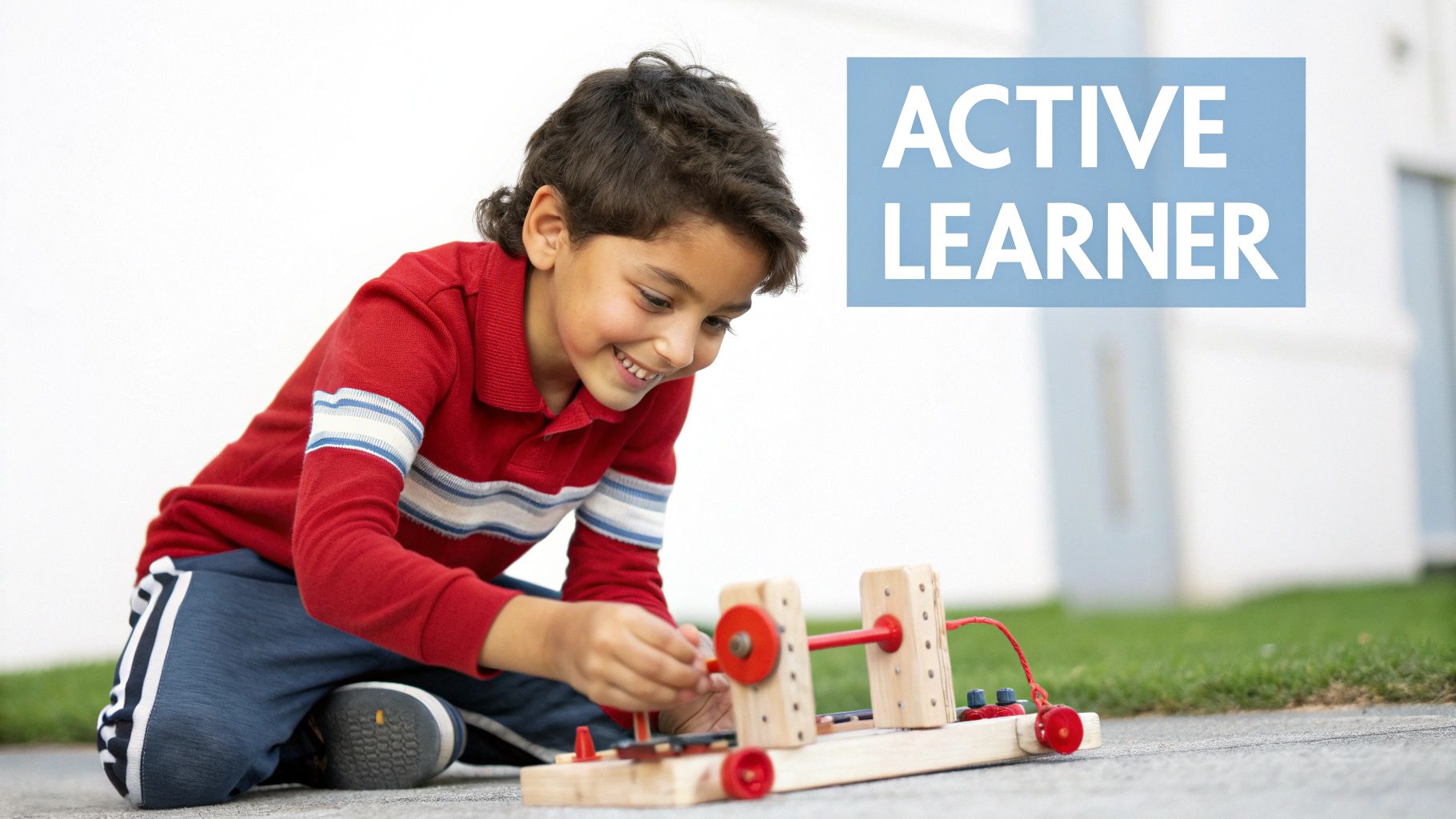
Recognizing these traits is the first crucial step. Once you see their behavior for what it is—a genuine learning style—you can stop fighting against their natural instincts and start channeling that energy into productive, hands-on learning experiences.
Common Signs of a Tactile Learning Style
Spotting a tactile learner often means paying attention to their everyday habits and behaviors. They’re constantly sending out little clues through their actions, often without even realizing it. They also tend to have a natural knack for anything that demands fine motor skills or physical coordination.
Here are a few common behaviors to look for:
- Constant Fidgeting: They might tap their feet, click a pen, or need a stress ball just to focus while someone is talking.
- "Talking" with Their Hands: You’ll notice them using big gestures to explain ideas, almost as if they’re sculpting their thoughts in the air.
- Prefers Trial and Error: Forget the instruction manual. They would much rather jump in, experiment, and figure things out as they go.
- Excellent Physical Memory: They will remember what they did far better than what they heard. Actions, movements, and physical experiences stick with them.
- Loves Building Toys: From a young age, many show a clear preference for toys like blocks, clay, and puzzles that let them build and manipulate with their hands.
A key insight to remember is that for a tactile learner, movement isn't a distraction—it's part of the thinking process. Physical action helps them encode information and make sense of abstract concepts.
Practical Examples in Everyday Life
Once you know what to look for, you’ll start seeing these traits everywhere. The child who shines in sports, dance, or drama is often tapping into their kinesthetic intelligence. The same is true for the student who loves science labs but zones out during lectures—they’re showing a clear preference for hands-on discovery.
Their need to physically engage isn't just a quirk; it’s a core part of who they are and how they learn best. Providing them with ample opportunities to build, create, and experiment is the most effective way to support their development. For more ideas, check out our guide on sensory activities for kids, which is packed with great ways to turn their natural inclinations into powerful learning tools.
The Brain Science of Learning by Doing
Ever wonder why getting hands-on makes such a huge difference for some learners? It’s not just a personality trait; the answer is wired directly into our brains. For a true tactile learner, physical engagement isn't just helpful—it's the key that unlocks deep understanding and lasting memory.
When a tactile learner builds a model car or acts out a historical scene, their brain lights up differently than when they just read a textbook. Activities involving touch and movement fire up the cerebellum and the motor cortex—the parts of the brain that handle coordination, procedural memory, and physical skills.
This process creates neural pathways that are stronger and far more durable. Think of it like this: looking at a map gives you a general idea of a trail, but actually walking that trail creates a rich, multi-sensory memory that’s almost impossible to forget. You remember the turns, the terrain, and the way the sun felt. That’s what hands-on learning does for the brain.
How Movement Forges Stronger Memories
This powerful link between physical action and cognition is often called muscle memory. We typically associate it with learning to ride a bike or play an instrument, but the same principle applies to academic subjects. When a child uses their hands to stack counting blocks, they are physically encoding the abstract concept of numbers into their brain.
This "learning by doing" approach is the foundation of effective educational philosophies like constructivism. Active participation is central to how we build knowledge, a concept you can explore deeper in our guide on what is constructivist learning theory. The core idea is that we construct our own understanding through direct experience. For a tactile learner, the brain doesn't draw a neat line between "thinking" and "doing"—the two are completely intertwined.
The act of touching, manipulating, and moving isn't just a way to keep fidgety kids busy. It's the primary language their brain uses to process, organize, and store new information.
The Power of Touch in Cognitive Development
The sense of touch itself is a powerhouse for learning. Neuroscience research highlights how much physical interaction shapes our understanding. For example, a 2019 study revealed that when someone learns a tactile skill, the improvement is highly concentrated in the exact finger that was trained, with minimal transfer to adjacent fingers. You can read the full research about these neurological findings to see just how specific this process is.
This tells us that when a tactile learner touches an object, their brain isn't just getting a vague signal; it's processing highly specific data. Every texture, shape, and weight adds another layer of information that passive learning—like listening to a lecture—simply cannot provide. This is why a simple science experiment or a hands-on building kit isn't just for fun. For a tactile learner, it’s an essential tool for cognitive growth.
Practical Strategies to Support Tactile Learners
So, you've identified a tactile learner. That's the first step. The next, and most important, is creating an environment where they can succeed. The good news is you don't have to fight their wiggles and fidgets. Instead, you can channel that energy into real, productive learning.
This doesn't mean completely reinventing your teaching style. Often, it's the small tweaks that make the biggest difference—like swapping a rigid chair for a stability ball or scheduling short "brain breaks" for quick physical activity.

The goal is to weave movement and touch directly into the learning process. When you do that, abstract ideas suddenly become concrete experiences they can literally grasp. This isn't just a hunch; the data backs it up. The Learning Pyramid model suggests that students retain as little as 5% of what they hear in a passive lecture. But when they learn by doing—the heart of the tactile learning style—that retention rate can soar to 75%. You can explore more of these tactile learning statistics if you're curious.
Transforming the Learning Environment
A tactile learner’s success is hugely influenced by their immediate surroundings. Simple changes can turn a space that demands stillness into one that encourages focus through movement. It's about helping them engage their bodies so they can better engage their minds.
Here are a few actionable ideas:
- Flexible Seating: Think wobble chairs, stability balls, or even standing desks. This provides an outlet for subtle movement, which ironically helps them concentrate.
- Fidget Tools: Having stress balls, modeling clay, or fidget spinners available gives their hands a task. This can free up mental bandwidth to listen and process information.
- Textured Surfaces: Bring in sandpaper letters for spelling, felt boards for storytelling, or beads for counting. Adding texture engages their sense of touch and makes learning more memorable.
The key is to make movement a part of the lesson, not a distraction from it. When a tactile learner is allowed to move, their brain is better equipped to absorb, process, and remember new information.
Making Homework Interactive and Fun
Let's be honest: homework is often a battlefield for tactile learners. Most of it involves sitting still and filling out worksheets—their personal kryptonite. The fix? Turn those static assignments into dynamic, hands-on activities. This can make learning feel less like a chore and more like a game.
For example, instead of just writing spelling words, have them build the words with magnetic letters or trace them in a tray of sand. For math problems, use LEGOs or snack crackers to work through addition and subtraction. History lessons can come to life by building a diorama of a famous battle or acting out an important speech. These approaches dramatically improve comprehension and retention. For more tips, check out our guide on how to increase student engagement.
Hands-On Activities That Make Learning Stick
Now, let's get our hands dirty. The best way to support a tactile learner is to stop telling and start doing. We need to pull abstract concepts out of textbooks and put them directly into a child's hands. This is about moving beyond worksheets and embracing activities that let them build, create, and physically interact with what they're learning.
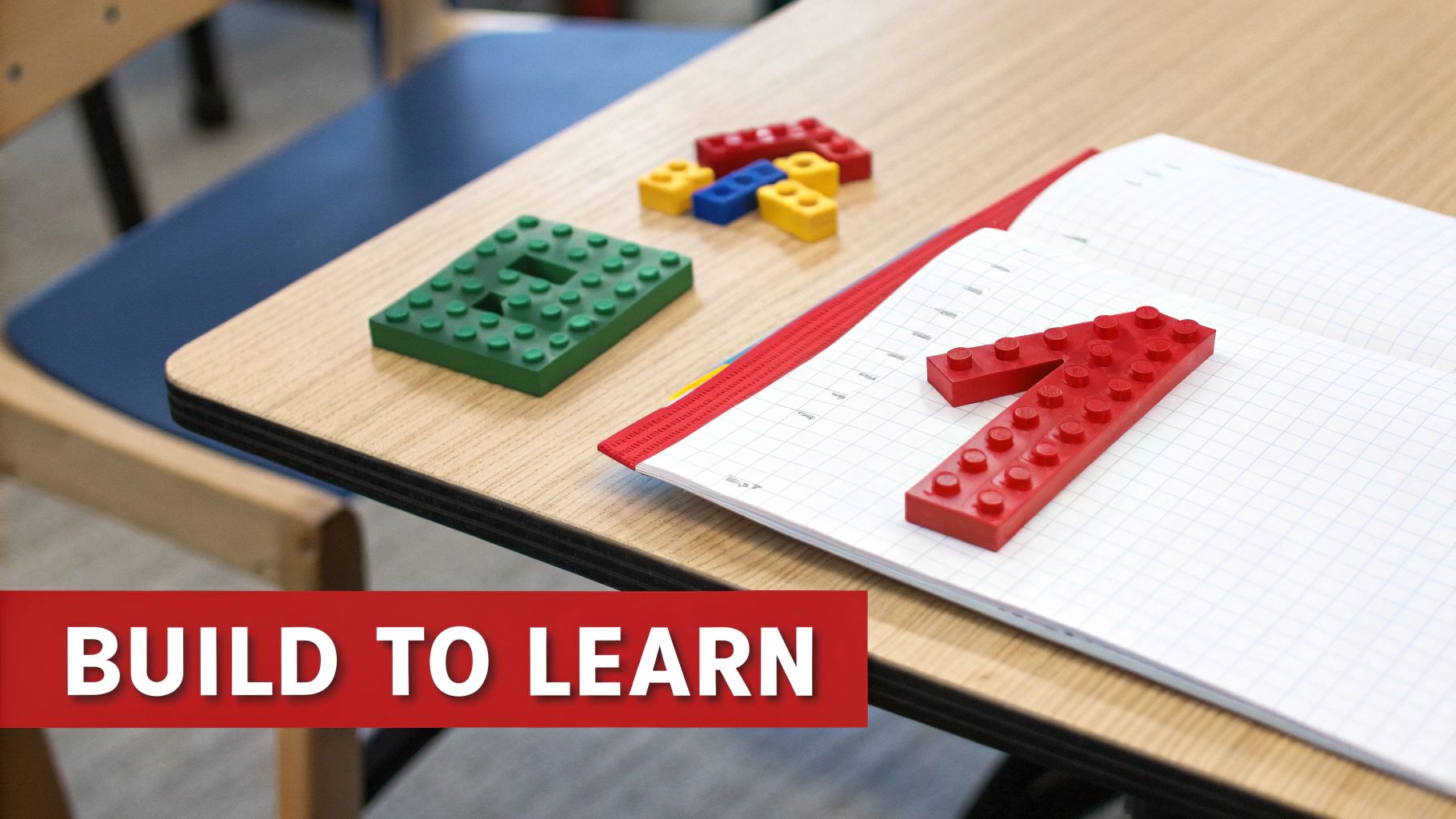
From ancient history to modern science, almost any topic can be transformed into a hands-on project. The goal is simple: make learning an active, engaging process. When kids can move and touch, their brains forge much stronger, more permanent connections to the material.
Actionable Ideas for Core Subjects
Even subjects that seem static on paper can become dynamic adventures. Tactile learners don’t just want to read about a topic; they need to do something with it.
- Math: Forget just writing equations. Use LEGOs, blocks, or marbles to bring addition and subtraction to life. Need to explain fractions? Cut a real pizza or a piece of paper into equal parts. The physical act of dividing the whole makes the concept click.
- Science: This is the natural habitat for tactile learners. Simple experiments, like a classic baking soda volcano or a basic circuit with a battery and bulb, transform theoretical principles into events they'll never forget. This is where quality science kits really shine.
- Language Arts: Get physical with words! Use magnetic letters on the fridge to spell out vocabulary words. Trace letters in a tray of sand or shaving cream for a great sensory experience. You can even have them act out scenes from a book they’re reading.
The secret is connecting a physical action to a learning goal. When a child builds a diorama of a historical event, they're not just playing with craft supplies. They're physically sorting through facts, timelines, and characters in their mind, building a tangible representation of their knowledge.
Subject-Specific Activities for Tactile Learners
To see how this works across the curriculum, here are a few ideas that turn passive listening into active doing.
| Subject | Activity Idea | Learning Goal |
|---|---|---|
| History | Build a model of a Roman aqueduct using straws and clay. | Understand principles of ancient engineering and gravity. |
| Geography | Create a salt dough map of a continent, painting mountains and rivers. | Learn landforms and spatial relationships between countries. |
| Biology | Assemble a 3D model of a plant or animal cell using various craft materials. | Memorize the parts of a cell and their functions. |
| Art | Sculpt figures or objects out of clay instead of just drawing them. | Develop spatial awareness and fine motor skills. |
| Music | Learn to play a simple song on a recorder or keyboard. | Connect musical notes on a page to physical finger movements. |
Expanding Your Hands-On Toolkit
Once you get the hang of it, you can weave tactile learning into every part of a child's day. This approach reinforces the idea that learning isn't a passive chore but an exciting, active process. You can find tons of inspiration by exploring different hands-on learning activities perfect for this style. For even more ideas, check out these 10 Hands-On Learning Activities to Engage Students to keep the inspiration flowing. When you provide these outlets, you’re empowering them to use their greatest natural strengths to succeed.
Turning Challenges into Strengths
A traditional classroom, with its long lectures and quiet desk work, can feel like a maze for a tactile learner. Their constant need to move is often misread as a lack of focus, and their struggle with purely abstract ideas can be mistaken for a lack of understanding. But what looks like a challenge is often a sign of incredible, untapped potential.
Those so-called hurdles are directly linked to their greatest strengths. The same child who struggles to sit through a passive lesson is the one who can solve a complex puzzle with their hands or build an intricate model without instructions. Their mind is simply wired for action, not just observation.
Reframing Common Misconceptions
Instead of seeing these traits as problems to be fixed, we can reframe them as powerful assets. That shift in perspective is the key to helping tactile learners thrive.
- Short Attention Span? No, a Need for Engagement. That restlessness during a lecture isn't a deficit; it's a brain craving physical input to process information. Give them something to manipulate, and their focus sharpens instantly.
- Trouble with Theory? No, a Knack for Application. They don’t just want to know why something works; they need to see how it works. This makes them natural-born problem-solvers and innovators.
- Fidgeting and Restlessness? No, Active Thinking. For a kinesthetic kid, movement and cognition are deeply connected. Pacing, tapping, or building is how they think through problems and lock in new memories.
The key is to recognize that for a tactile learner, action is a form of thinking. Their physical engagement isn't a distraction from learning; it’s the very mechanism that makes learning possible.
Harnessing Their Natural Talents
To turn these challenges into strengths, we need to provide the right support structures. Breaking down complex tasks into smaller, manageable steps can make a huge difference. This supportive approach, often called scaffolding, is detailed in guides about what is scaffolding in child development and helps build their confidence one step at a time. When we create opportunities for hands-on exploration, we empower tactile learners to lean into their ingenuity. This doesn't just help them succeed in school—it prepares them for real-world careers where doing, building, and solving problems are the skills that truly matter.
Frequently Asked Questions About Tactile Learning
Even after getting the hang of what tactile learning is all about, a few practical questions often pop up. Here are some quick, straightforward answers to the things parents and teachers ask most.
Is Tactile Learning the Same as Kinesthetic Learning?
For the most part, yes. You'll often hear the terms tactile and kinesthetic used interchangeably because they both describe learning through physical experience. To be precise, "tactile" refers specifically to the sense of touch, while "kinesthetic" covers the broader concept of body movement and positioning. In a practical, educational setting, they both fall under the same umbrella of "learning by doing."
Can a Person Have More Than One Learning Style?
Absolutely. In fact, most people do! It's rare for someone to fit neatly into just one box. Most people have a dominant preference but use a mix of styles to learn effectively. For instance, a hands-on learner might also have a great eye for visual details. This is why the best teaching strategies—often called multimodal approaches—are so effective. They blend visual aids, auditory instruction, and hands-on activities to engage every student.
How Can I Make Abstract Subjects Like History More Hands-On?
This is a great question. The answer is to find creative ways to turn history into a physical experience. Instead of just reading about ancient Egypt, have your child build a model of the pyramids out of clay or blocks. You could create a giant timeline on a long scroll of paper that they can physically unroll, or even act out a famous historical event. Something as simple as drawing maps or handling replica artifacts can make dates and facts feel real, tangible, and much easier to remember.
Ready to turn learning into a real adventure? Playz creates award-winning science kits and educational toys that bring complex topics to life in a fun, tangible way. Explore our collection and see for yourself how hands-on play can unlock your child's true potential.
Check out the full range of products at https://www.playzusa.com.