

You're in the aisle with a toddler who wants the shiny toy that lights up and sings. You can already hear the problem, though. If it's too loud, too busy, or too hard to use, it may end up in a closet by next week.
Music toys for toddlers can be much more than noise-makers. The best ones give children a clear cause-and-effect loop, a chance to repeat actions, and a safe way to explore rhythm, pitch, and movement. That's why this category has grown into a huge part of play shopping, serving an estimated 680 million children under age 12 and selling more than 2.8 billion musical toy units across 90 countries in 2024 (industry report).
What Music Toys for Toddlers Really Are
A toddler banging a toy xylophone is usually doing something deeper than “making noise.” They hit one bar, hear one note, then hit it again to see if the result changes. That tiny loop is the heart of music toys for toddlers, because the toy answers the child quickly enough for learning to stick.
The category is bigger than one kind of toy
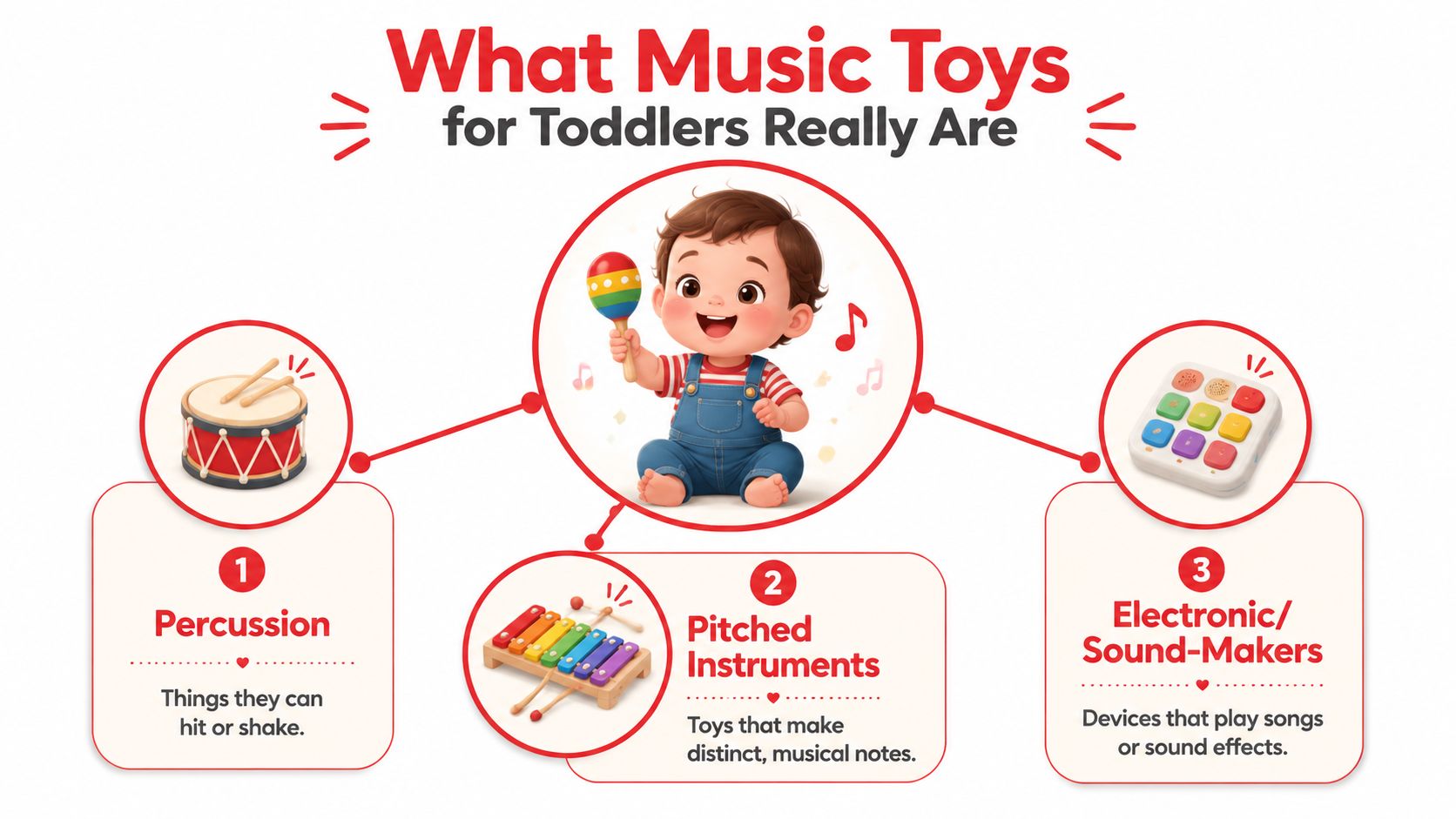
In practice, this bucket includes percussion toys like drums and shakers, pitched instruments like xylophones and simple keyboards, and electronic sound-makers that play songs or effects. The market data reflects how broad the category has become, with 55% of parents reporting they bought musical toys in 2024 to support early childhood development, up from 41% in 2021, and with educational toy sales including musical instruments rising 36% year over year (industry report).
Toddler-focused products also skew young. Toys aimed at ages 1 to 3 account for 46% of market volume, and 53% of new musical toys now integrate light, rhythm, or digital interactivity (industry report). That explains why shoppers now see so many flashing pianos, sound tables, and button-heavy toys in every aisle.
For parents trying to keep play purposeful, a helpful lens is the one used in Montessori-inspired toys for toddler learning and growth. It's useful because it focuses attention on what the child can do with the toy, not just how loud or colorful it is.
Practical rule: if a toy lets a toddler press, hit, shake, or strum and get a result right away, it's doing real developmental work.
A lot of parents also connect this category to sensory play. That overlap makes sense, and the simplest explanation is in this overview of what sensory play looks like in real households. Music toys sit right in that space, where sound, touch, and movement all matter at once.
How Music Play Shapes a Toddler's Development
Toddlers do not experience a drum, maraca, or keyboard as a lesson. They experience it as a response machine. They act, they hear something, and they act again, which is why these toys can pull attention for much longer than a passive object.
Cause and effect builds the first layer
A peer-reviewed study of electronic music toys found that infants' behavior changed in measurable ways depending on the toy's sound characteristics and developmental stage, which means the toy isn't just background noise, it can alter attention, movement, and vocalization patterns in babies and toddlers (study). That matters because the child is not only listening, they're testing how their own body changes the sound.
That same pattern supports sensorimotor learning. A single tap on a drum, a shake of a maraca, or one key on a toy piano gives toddlers a clean link between motion and outcome. Over time, that repeated experimenting supports timing, hand control, and early rhythm sense.
Language and social growth ride along
Music toys also invite repeated sounds, short songs, and call-and-response play. A caregiver claps once, the child claps back. A parent sings a line, the toddler tries the ending. Those little exchanges help children practice turn-taking, timing, and early language patterns in a way that feels playful instead of formal.
For readers comparing music play with broader developmental milestones, this related guide on childhood development milestones helps show why repetition and imitation matter so much in the toddler years. Music toys fit neatly into that stage because toddlers are built to copy, test, and repeat.
The age label on the box doesn't tell the whole story, either. Research on toy use found that in musical-toy categories, age-appropriateness did not significantly predict whether children fully used the toy, and younger children were still likely to engage with toys designed for older ages (study). In plain English, the sticker is only a starting point.
A toddler often tells you the developmental match faster than the packaging does.
For social-emotional learning, many caregivers also like practical music-based SEL strategies. The useful part is not the label, it's the reminder that music can help children wait, copy, lead, and follow in a low-pressure way.
Why Real Instruments Often Beat Electronic Toys
Most shopping lists lean hard toward the toy that flashes, talks, and repeats a tune. That makes sense for quick attention. It doesn't always make sense for learning depth.
Acoustic toys give toddlers more control
A wooden maraca, a child-sized tambourine, or a small drum gives a child direct control over sound in a way that feels physical. Lovevery's music-education argument is that real instruments expose children to cause-and-effect, tactile control, and richer sound variation than many button-based toys do (Lovevery). That difference matters because toddlers learn a lot from texture, resistance, and variation, not just from novelty.
Electronic toys often win on convenience. They can travel well, and some children like them because the toy seems to “perform” for them. But a toy that does most of the work can turn play into passive watching, especially if it repeats the same song or effect without much child input.
A simple instrument usually stays open-ended longer
A shaker can become a rhythm tool, a counting tool, or a pretend microphone. A xylophone can be a color-matching game, a note hunt, or a sound exploration. That openness keeps the toy flexible as the child's attention span changes from week to week.
The hands-on case for simpler toys lines up with this broader overview of benefits of hands-on learning. A toddler learns better when the toy asks the child to do something active, not just press a button and wait.
Electronic toys still have a place. They can be useful for travel, for independent play in short bursts, or for children who need a very obvious starting point. But if the question is which kind builds deeper exploration, the simpler acoustic toy usually has the edge.
How to Pick Age-Appropriate Music Toys
A good buying rule is surprisingly simple. Look for a toy the child can hold, understand, and use without adult rescue every time.
Start with the child's hands, not the box
Toddlers do best with large, tactile controls, one-step activation, and adjustable volume. In mainstream toddler products, that often looks like 4 pads, 8 to 10 keys, or a few preset modes instead of nested menus or tiny buttons (product example). Those simple layouts reduce frustration and let the child repeat the action quickly.
Size matters too. Toddler music toys commonly sit in the roughly 4 to 12 inch range and weigh under 2 pounds, which helps them stay stable on a table while still being easy for young children to reposition (product example). If a toy is too small, it can skitter away. If it's too heavy, a toddler may not manage it independently.
Use packaging claims as clues, not proof
A toy that lists ASTM compliance and volume control is usually giving you a better signal than a toy that only promises “fun.” That kind of wording suggests more attention to construction and everyday use. For a broader shopping frame, this guide to sensory toy selection for kids is useful because it encourages buyers to think about the child's response, not only the toy's appearance.
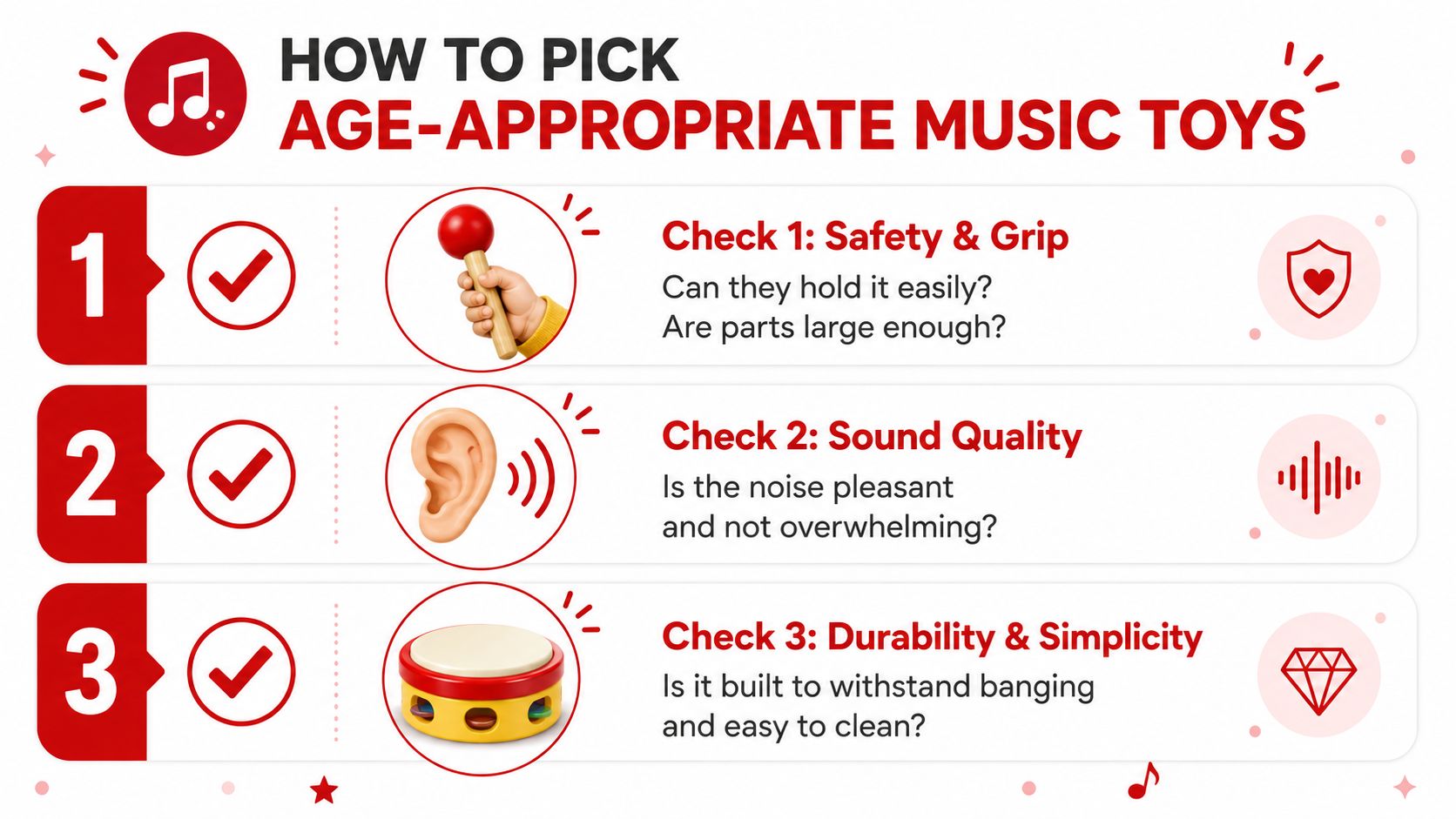
- Check the grip: The child should be able to hold or strike the toy without awkward finger positions.
- Check the controls: Big pads, simple keys, and direct activation work better than tiny menus.
- Check the size: A compact but stable toy is easier for independent play.
- Check the sound: Adjustable volume is a real feature, not a bonus.
- Check the label: Clear age ranges and durable construction matter more than flashy packaging.
Safety Essentials Every Parent Should Check
Noise is the part most parents underestimate. A toy can look perfectly toddler-friendly and still be too loud for a home, classroom, or car ride.
Sound level is a real safety issue
Independent buying guidance points to a maximum sound pressure level of 65 dB at 5 cm as a baseline for infant and toddler audio toys, and it warns that prolonged exposure above about 70 dB can increase hearing risk because infant ear canals are shorter and more resonant (buying guide). A separate study measuring popular children's toys found mean maximum noise amplitudes of 104 dB A at 0 cm and 76 dB A at 30 cm, with the loudest toys reaching 125 dB A at close range (study). That gap is why “sounds fine in the store” is not a meaningful test.
Check the physical design before you buy
Look for sealed battery compartments, no detachable small parts below the choke-test threshold, and sturdy enclosures. The reason is simple. Under-3 children mouth and handle toys aggressively, so loose parts and flimsy battery doors are not minor flaws.
A retailer listing ASTM compliance plus volume control is a useful sign that the toy was built with more care than the average bargain-bin item (buying guide). Materials matter too. You'll often see ABS plastic or mixed plastic and wood shells, because they balance durability with easy cleaning.
| Check | Threshold | Why It Matters |
|---|---|---|
| Volume | Comfortable at arm's length in the room | Prevents harsh sound in real use |
| Sound output | Ideally around 65 dB at 5 cm or lower | Reduces hearing risk for small ears |
| Battery compartment | Sealed or child-resistant | Prevents access to batteries and loose parts |
| Small parts | None below the choke-test threshold | Lowers choking hazard |
| Labeling | Clear age range and ASTM compliance when available | Signals more thoughtful construction |
Practical test: stand where the child will play and listen from arm's length. If you want to step away from the toy after 30 seconds, the child probably will too.
Play Ideas That Turn Toys Into Learning Moments
A music toy gets better when an adult turns it into a game. Left alone in a bin, it can still make noise. Used well, it becomes a tool for listening, movement, and copying.
Three simple patterns that work fast
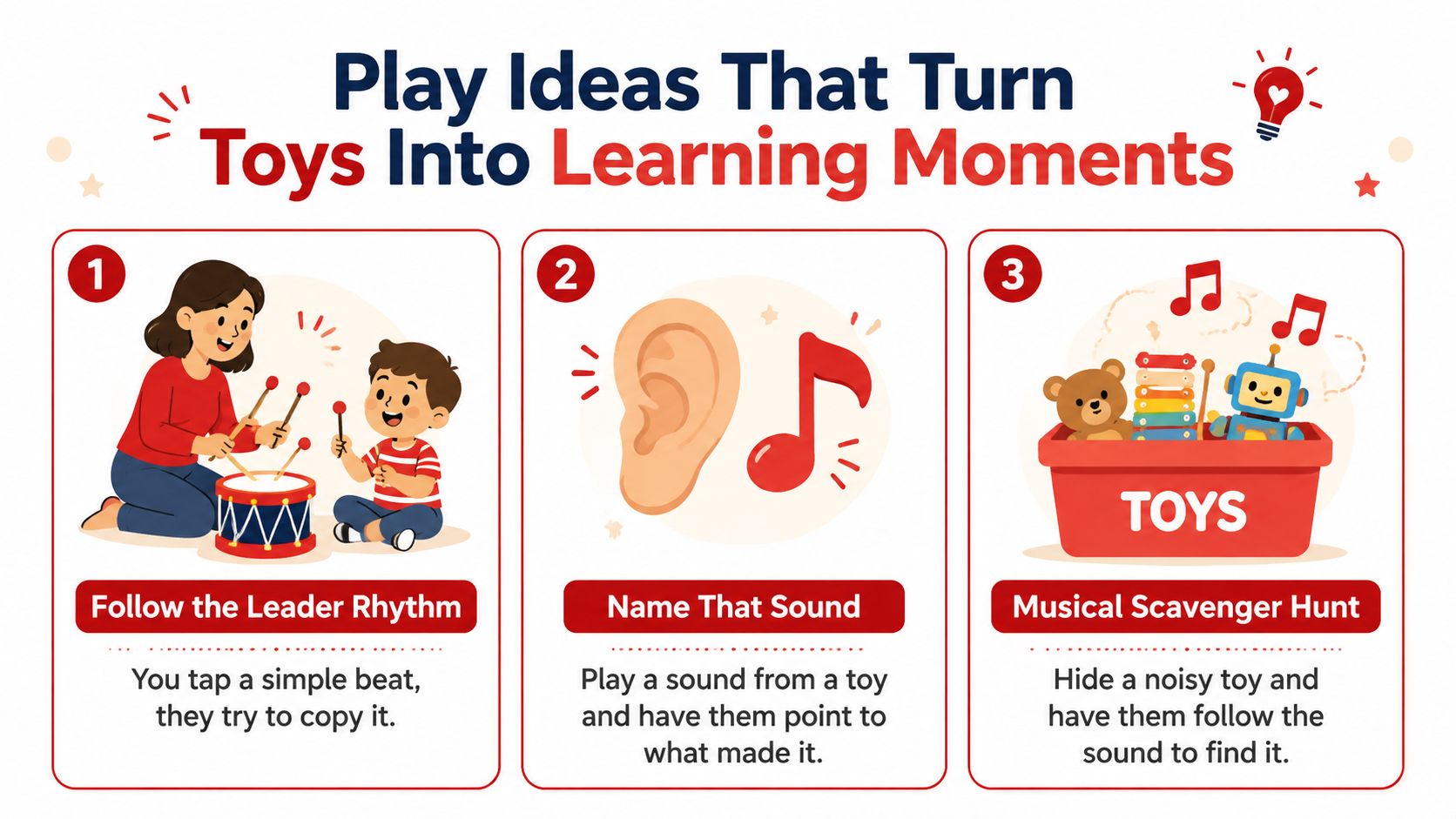
One of the easiest games is call-and-response. You tap the drum twice, then wait. The toddler taps back. That back-and-forth builds listening and helps children understand that their action changes what happens next.
Another useful pattern is freeze and move. Play a beat, then stop. Ask the toddler to dance when the music starts and freeze when it stops. This links rhythm to body control, and it gives children a clear reason to watch and wait.
A third option is duet play. You make one pattern on a xylophone or keyboard, and the child tries to copy it. The child doesn't need to get it “right” every time. The point is to compare, repeat, and notice differences.
For more ideas that connect play to active learning, play-based learning activities can help parents build simple routines without a lot of setup. Music is especially nice because it works with ordinary household items as long as the sound is safe and controlled.
Make room for sound without letting it take over
Volume-limited toys are helpful in homes where noise sensitivity matters. In my experience, a designated music corner and a few planned “loud play” windows can prevent the toy from becoming a source of tension. That lets children enjoy the toy without the whole household paying for it all day.
- Name the sound: “That drum is loud,” or “That shaker is soft.”
- Count the beats: One, two, three, stop.
- Copy the pattern: Short pattern first, then longer ones later.
- Mix motion and music: March, clap, tap, then pause.
Buying, Caring for, and Storing Music Toys
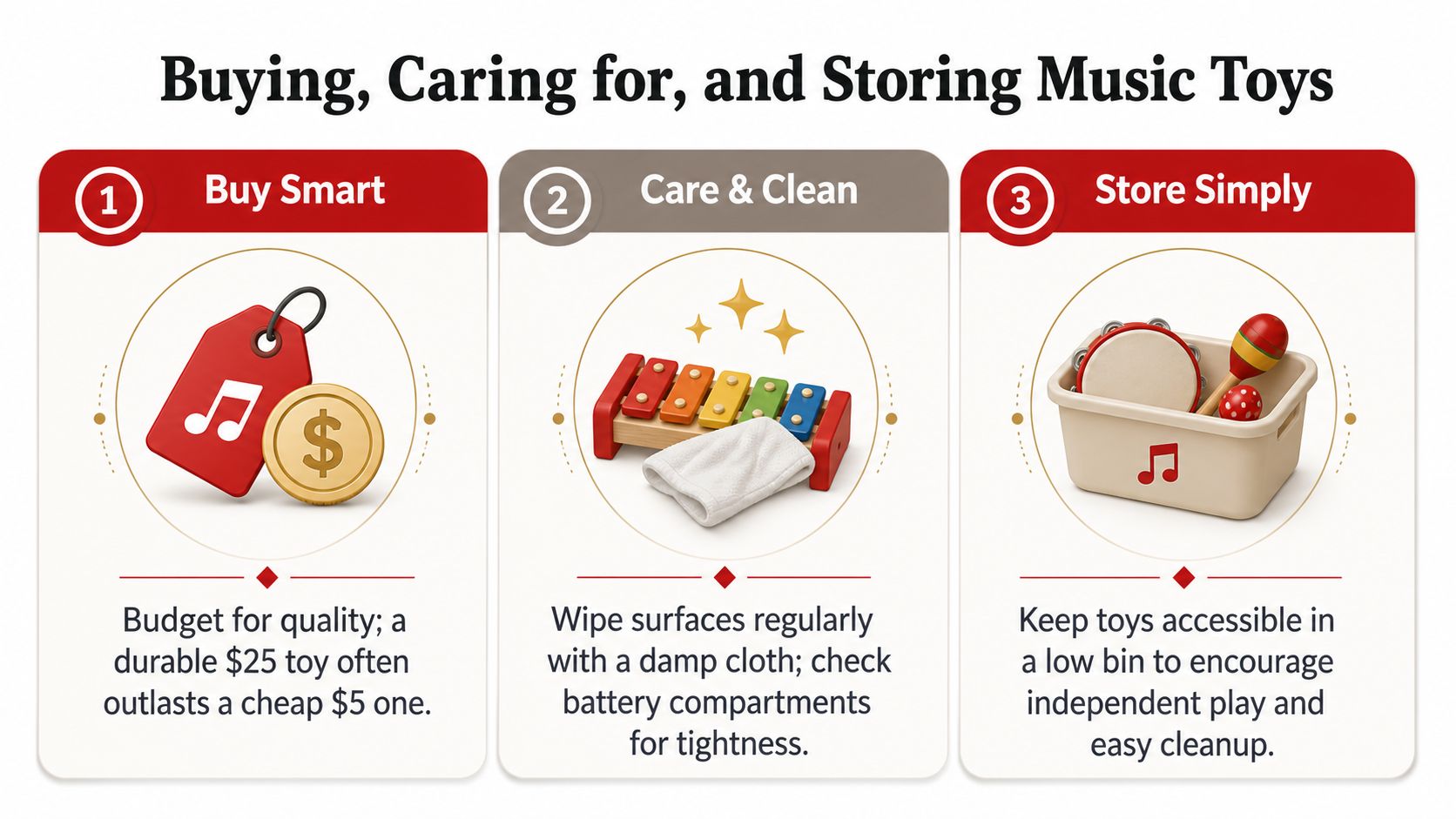
A toddler music toy should survive more than the first weekend. The best value comes from something that keeps working after repeated banging, handling, and cleaning.
Buy for durability, then keep it in rotation
Higher-quality toys that clearly advertise ASTM compliance and volume control often cost more up front, but they also tend to hold up better under toddler use. That matters because cheap toys can fail in boring ways, like weak speaker grills, loose battery covers, or controls that stop responding after a few weeks.
Wooden toys need wipe-clean care and protection from water damage. Plastic electronic toys need battery checks and a look at speaker grills, especially if the toy will be shared between siblings or used in a classroom. A damp cloth is usually enough for routine cleaning, as long as you don't flood the electronics.
Store for access, not perfection
A low open bin works better than a high shelf for this category. If the child can see the toy, reach it, and put it back, you'll get more independent play and less clutter. Rotating a few toys out of sight can also renew interest without buying more stuff.
Keep the toy visible enough for a toddler to choose it, but simple enough that cleanup doesn't become a battle.
Retire a toy when the sound quality drops, the casing cracks, the buttons stick, or the child has clearly moved past what the toy can offer. Some toys outgrow the child, and some children outgrow the toy. Both are normal.
Frequently Asked Questions About Music Toys for Toddlers
How loud is too loud for a toddler music toy? If a toy is uncomfortable at arm's length in the room where it will be used, it's too loud for regular play. Sound control matters more than whether the toy seems fun in a store.
What age can toddlers start using instruments? Many children start with simple shakers, drums, or xylophone-style toys during the 1 to 3 stage, as long as the controls are big and the sound is manageable.
Do screen-based music apps count as music toys? They can be music activities, but they usually don't offer the same tactile feedback as a real instrument or a hands-on toy. For toddlers, the best choices still involve moving something with their own hands.
When should I retire a music toy? Retire it when it becomes too loud, too fragile, or too simple for the child's current play. If your toddler only bangs it once and walks away, it may be time for a real instrument or a different kind of music game.
If you're shopping for a child who learns by touching, tapping, and repeating, Playz offers a natural next stop for active play ideas that support curiosity without screens. Visit Playz to find more toys that help families turn everyday play into learning, one simple interaction at a time.