

Welcome to the heart of the toddler classroom and playroom: circle time. It's far more than just sitting in a circle; it is a powerful daily ritual that builds community, sparks curiosity, and lays the foundation for lifelong learning. These shared moments of song, story, and play are crucial for development. They teach toddlers vital social skills like listening, sharing, and taking turns, while also nurturing their cognitive, language, and motor development in a screen-free environment. A well-planned circle time can transform a group of individual toddlers into a cohesive, caring community.
This guide is your resource for dynamic and engaging circle time activities for toddlers. We have compiled a roundup of practical, easy-to-implement ideas designed to captivate their attention and make learning a genuine adventure. Forget generic routines; this list is packed with actionable instructions, material lists, and clear learning objectives for each activity.
You will discover how to facilitate a variety of engaging experiences, including:
- Sensory circles that awaken the senses.
- Musical movement games that get little bodies active.
- Storytelling sessions that build vocabulary and empathy.
- Counting and color games that make early math concepts fun.
Each activity is crafted to be adaptable for different ages and abilities, ensuring every child can participate and thrive. Get ready to transform your circle time from a simple routine into the most anticipated part of the day, creating joyful learning experiences that prove why #KidsLearnBestThruPlayz.
1. Sensory Circle with Textured Materials
A Sensory Circle is a hands-on activity where toddlers explore diverse textures passed around the group. Each child gets a chance to touch and describe items like soft fabrics, bumpy balls, smooth stones, or crinkly paper. This simple yet effective activity transforms a standard circle time into an engaging tactile adventure, fostering language development, cognitive growth, and social interaction.
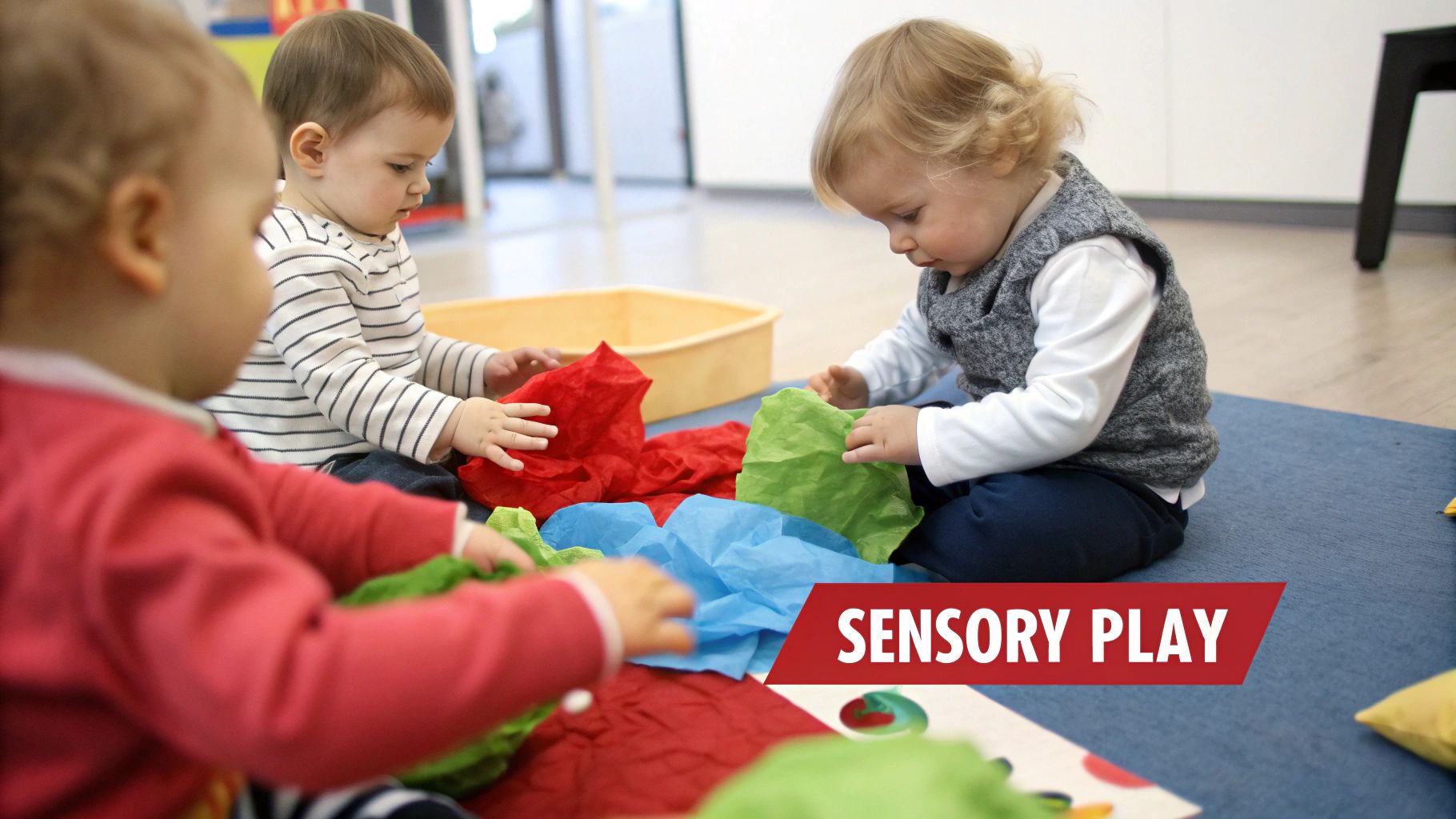
This activity is a cornerstone of many early childhood programs. Montessori classrooms, for example, often use curated "sensory baskets," while daycare centers might use swatches of corduroy, silk, and burlap. You can easily create a DIY sensory box at home with safe, everyday items. The goal is to stimulate the sense of touch while introducing new vocabulary in a calm, focused setting.
How to Implement a Sensory Circle
- Gather Materials: Collect 3-5 objects with distinct textures. Practical examples include a large, smooth river rock, a fluffy pom-pom, a rough piece of bark, and a bumpy silicone teether.
- Introduce the Activity: Sit in a circle and present the "mystery bag" or box. Build anticipation by asking children to guess what’s inside.
- Explore and Describe: Pull out one item at a time. Pass it around the circle, giving each toddler a moment to touch it. Model descriptive words like, "This feels bumpy and squishy."
- Encourage Participation: Gently prompt children to share what they feel. Even one-word responses like "soft" or "cold" are huge wins for language development.
Pro Tip: Keep the sessions short, around 5-10 minutes, to align with a toddler's attention span. Pairing textures with a simple song like "What's in the Bag?" can also enhance memory and engagement.
Learning Objectives and Benefits
A Sensory Circle is more than just fun; it’s a powerful developmental tool. It builds tactile awareness and helps children make new neural connections. When planning your activity, ensuring all materials are clean is crucial for health and safety, especially since toddlers often explore with their mouths. Learning how to effectively clean plush toys and other soft items helps maintain a hygienic environment for everyone. This is one of the most foundational circle time activities for toddlers because it directly supports their natural curiosity. To dive deeper into the science behind this, you can learn more about the benefits of sensory play.
2. Musical Movement and Dance Circle
A Musical Movement and Dance Circle invites toddlers to express themselves through motion as music plays. Children engage in simple actions like clapping, stomping, swaying, and dancing, adjusting their movements to match the music's rhythm and tempo. This lively activity combines physical exercise with auditory processing, turning a simple sing-along into a dynamic experience that enhances gross motor skills, body awareness, and pure joy.
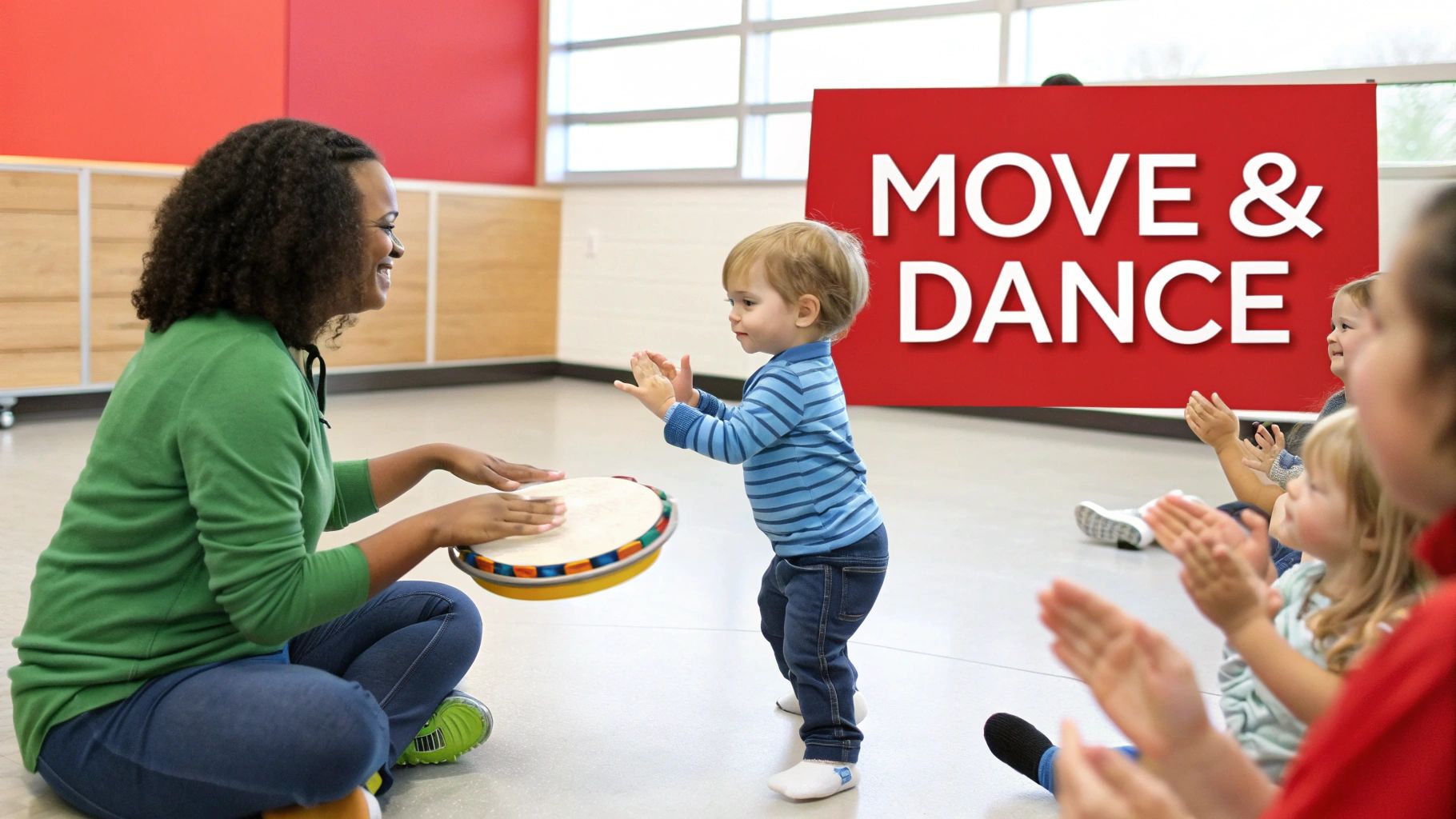
This activity is a staple in early childhood education, from Kindermusik classes incorporating circle dances to preschools using "The Freeze Dance" to build listening skills. At home, a simple Spotify playlist of nursery rhymes can instantly create an energetic dance party. The goal is to provide a structured yet free-form outlet for toddlers to explore how their bodies can move to a beat, fostering a love for music and movement.
How to Implement a Musical Movement Circle
- Prepare Your Playlist: Choose a mix of 2-4 familiar, age-appropriate songs. Include a variety of tempos, such as a slow, swaying song and an upbeat, clapping song.
- Set the Stage: Ensure you have a clear, safe space for movement. Ask children to stand in a circle with enough room to wiggle and dance without bumping into each other.
- Model the Movements: Start the first song and demonstrate simple actions. Say, "The music is fast! Let’s clap our hands fast!" or "This song is slow. Let's sway like trees."
- Encourage Free Expression: While modeling is helpful, allow children the freedom to move however the music inspires them. Celebrate their unique wiggles, jumps, and spins.
Pro Tip: Incorporate a "freeze dance" by pausing the music intermittently. When the music stops, everyone freezes in place. This adds a fun challenge that sharpens listening skills and self-regulation.
Learning Objectives and Benefits
A Musical Movement and Dance Circle is a fantastic tool for holistic development. It directly supports gross motor coordination, balance, and rhythm. For circle time activities that involve a lot of moving and dancing, ensuring your little ones are comfortable and supported is key. This includes considering their footwear, as a guide to flexible shoes for toddlers explains their importance for healthy foot development. This activity also promotes emotional expression and social bonding as children share a joyful, collective experience.
3. Color and Shape Recognition Circle
A Color and Shape Recognition Circle introduces toddlers to foundational math concepts in a playful, interactive group setting. An educator or parent presents various objects, flashcards, or props, and children identify, sort, and discuss their colors and shapes. This activity transforms abstract ideas like "red" or "square" into tangible experiences, building visual discrimination and early cognitive skills.
This classic activity is a staple in early childhood education. Daycare centers often use colored building blocks for sorting games, while parents can organize simple "color hunts" at home. The key is to make learning concrete by connecting names like "circle" or "blue" to real-world objects they can see and touch. It lays the groundwork for more complex sorting, pattern recognition, and mathematical thinking.
How to Implement a Color and Shape Recognition Circle
- Gather Materials: Collect 3-4 items of the same color (e.g., a red ball, a red block, a red car) or shape (e.g., a circular plate, a round block, a ball). Start with one concept at a time.
- Introduce the Activity: Sit in a circle and present the "color of the day" or "shape of the week." You can use a song like "Twinkle, Twinkle, Little Star" but adapt the lyrics to be about a shape.
- Explore and Identify: Pass the objects around the circle. As each child holds an item, model the language: "Look, this block is red," or "This plate has a circle shape."
- Encourage Participation: Ask simple questions like, "Can you find something else that is blue?" or "Point to the square." Celebrate every attempt to participate.
Pro Tip: Use real, three-dimensional objects instead of just flashcards. A toddler learns more about a "sphere" from holding a ball than from seeing a picture of one. Keep the focus narrow, perhaps one color or shape per week, to avoid overwhelming them.
Learning Objectives and Benefits
This activity is a powerhouse for cognitive development. It directly supports object recognition, vocabulary building, and the ability to categorize information, which are critical pre-math skills. Using a variety of brightly colored, high-contrast items can help capture and hold the attention of even the youngest toddlers. These simple sorting games are some of the most effective circle time activities for toddlers because they build essential analytical skills in a fun, pressure-free way. To explore more ways to support your child's thinking skills, you can find more ideas about cognitive development activities for preschoolers.
4. Story and Picture Book Circle
A Story and Picture Book Circle transforms reading into a dynamic group experience. Educators or parents read age-appropriate books to toddlers, using animated voices and pointing to illustrations. Children are invited to participate by making predictions, mimicking sounds, and performing actions related to the story, turning passive listening into an active, shared adventure that boosts early literacy and social bonding.
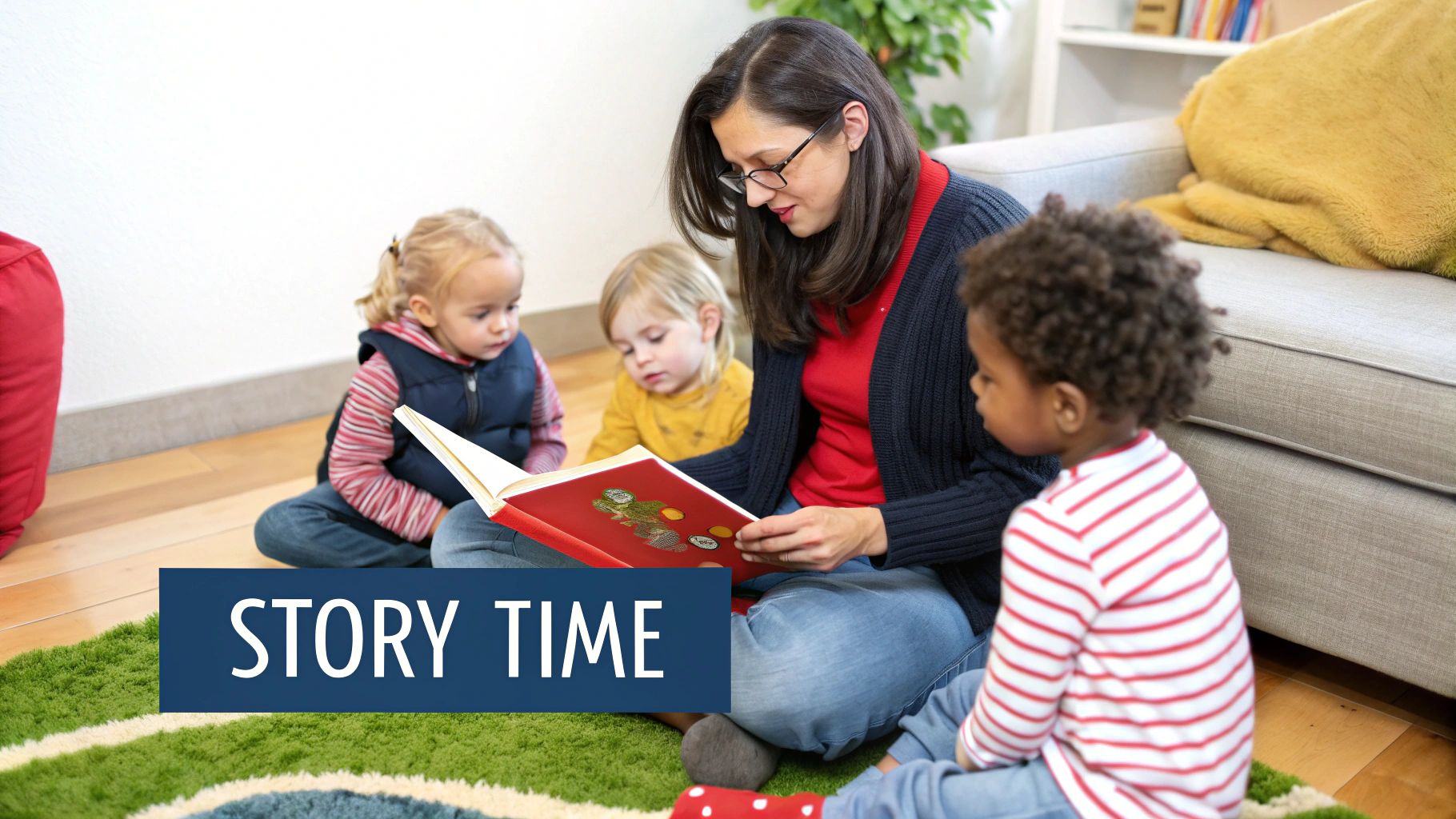
This activity is a staple in libraries and preschools everywhere. Books like Brown Bear, Brown Bear, What Do You See? by Eric Carle use repetition and predictable patterns that empower toddlers to "read" along. Similarly, lift-the-flap books such as Dear Zoo by Rod Campbell add an interactive, hands-on element that keeps little fingers and minds busy. The goal is to build a positive association with books and reading from a very young age.
How to Implement a Story and Picture Book Circle
- Choose the Right Book: Select a book with large, clear illustrations, repetitive text, and an engaging, simple plot. Board books are ideal for their durability.
- Set the Stage: Gather the children in a close circle where everyone can see the pages. Hold the book open, facing the group, and announce the title with excitement.
- Read with Animation: Use different voices for characters, vary your pace, and use expressive facial gestures. Pause at key moments to ask questions like, "What do you think will happen next?"
- Incorporate Actions: Encourage children to roar like a lion, hop like a frog, or make other movements that correspond with the story. This physical engagement aids comprehension and retention.
Pro Tip: Don't be afraid to read the same book multiple times. Repetition is crucial for toddlers, as it builds vocabulary, confidence, and a deep sense of comfort and familiarity with the story.
Learning Objectives and Benefits
A Story and Picture Book Circle is one of the most effective circle time activities for toddlers because it lays the foundation for lifelong literacy. It enhances listening skills, expands vocabulary, and introduces concepts like plot and character. Group reading also teaches social skills like taking turns and paying attention. This narrative-based engagement directly supports imagination and the development of creative thinking, which you can learn more about by exploring the benefits of pretend play.
5. Nature and Exploration Circle
A Nature and Exploration Circle brings the outdoors in, allowing toddlers to observe, discuss, and explore natural items like leaves, rocks, flowers, and twigs. Each child can contribute an item they've found, using tools like magnifying glasses to get a closer look. This activity transforms circle time into a scientific discovery session, connecting children to the natural world and fostering curiosity, observational skills, and new vocabulary.

This concept is a cornerstone of forest schools, where daily nature circles are part of the core curriculum, and outdoor preschools that focus on seasonal exploration. You can easily adapt this for home by creating a "nature discovery basket" from a backyard hunt. The goal is to encourage a hands-on connection with nature, promoting respect for the environment and early scientific thinking.
How to Implement a Nature and Exploration Circle
- Gather Materials: Go on a nature walk to collect 3-5 interesting and safe items. Good examples include a smooth, flat stone, a large, colorful leaf, a sturdy twig, and a non-toxic flower.
- Introduce the Activity: Sit in a circle and present the "nature basket." Build excitement by asking toddlers what they think might be inside from their outdoor adventures.
- Explore and Observe: Pass one item around the circle, giving each child a turn to hold it and look at it through a magnifying glass. Model descriptive language like, "This leaf has lines running through it," or "This rock feels heavy and cool."
- Encourage Inquiry: Gently prompt children with open-ended questions like, "What do you see?" or "How does that feel?" This helps them develop observational and communication skills.
Pro Tip: Ensure all natural items are pre-inspected for safety, avoiding sharp edges, small pieces, or toxic plants. Sorting items by color, size, or texture can add a cognitive challenge for older toddlers.
Learning Objectives and Benefits
A Nature and Exploration Circle is an excellent way to introduce foundational STEM concepts. It enhances fine motor skills as children handle delicate objects and develops their scientific thinking through observation and questioning. This is one of the most enriching circle time activities for toddlers because it grounds their learning in the real world. You can extend this activity by creating a nature journal with photos or drawings of the items discovered, documenting their learning journey.
6. Singing and Finger Play Circle
A Singing and Finger Play Circle is a classic and joyful activity where toddlers sing simple, repetitive songs while performing coordinated hand movements. Familiar tunes like "Itsy Bitsy Spider," "Wheels on the Bus," and "Twinkle Twinkle Little Star" become multi-sensory experiences that combine music, rhythm, and fine motor practice. This activity is a powerhouse for development, building language skills, coordination, memory, and a strong sense of community.
This approach is fundamental in early childhood education, from preschools using songs by Raffi or Dr. Jean Feldman to toddler music programs like Kindermusik. The magic lies in its simplicity and repetition; children learn patterns, anticipate actions, and gain confidence with each verse. It’s an easy activity to implement at home or in a classroom, requiring nothing more than your voice and hands.
How to Implement a Singing and Finger Play Circle
- Choose Familiar Songs: Start with 2-3 well-known nursery rhymes. The predictability helps toddlers feel successful and encourages participation.
- Model the Actions: Sit facing the children and demonstrate the hand movements slowly and clearly. Exaggerate your gestures to make them easy to follow.
- Sing Together: Lead the group in singing the song. Don't worry about being a perfect singer; your enthusiasm is what matters most.
- Repeat and Add: Repeat the same songs for several days or weeks. Once the children have mastered them, gradually introduce a new one to keep the activity fresh and exciting.
Pro Tip: Incorporate simple props like colorful scarves for "Pop Goes the Weasel" or small bells to jingle during "Jingle Bells." This adds a new layer of sensory engagement and helps maintain focus.
Learning Objectives and Benefits
Singing and finger plays are far more than just a fun way to pass the time; they are critical circle time activities for toddlers that build foundational skills. The synchronized movements enhance fine motor control and hand-eye coordination. Rhyming and repetition are proven to boost phonological awareness, a key pre-reading skill. Furthermore, singing in a group fosters social cohesion and emotional connection, making every child feel like a valued part of the circle. You can find a huge library of classic and new toddler songs on Super Simple Songs.
7. Emotion and Feelings Recognition Circle
An Emotion and Feelings Recognition Circle is a focused activity where toddlers learn to identify, name, and understand different emotions. Using tools like picture cards, puppets, or mirrors, children explore feelings such as happy, sad, angry, and surprised. This activity provides a safe space for toddlers to share their own feelings, laying the groundwork for emotional intelligence, empathy, and positive social interactions.
This foundational activity is a core component of social-emotional learning (SEL) in early childhood education. Educators might use Todd Parr's The Feelings Book to spark discussion or incorporate emotion puppets to act out scenarios. At home, you can simply use a mirror to make faces and name the corresponding feelings. The goal is to build an emotional vocabulary and normalize the experience of having different feelings.
How to Implement an Emotion and Feelings Circle
- Gather Materials: Select your tools, such as emotion flashcards, a hand mirror, or a feelings-focused picture book. Start with 2-3 basic emotions.
- Introduce the Activity: Sit in a circle and introduce the concept of feelings. You could start with a song like "If You're Happy and You Know It" to get everyone engaged.
- Explore and Describe: Show a flashcard or make a facial expression (e.g., a big smile). Ask, "How do you think this person is feeling?" Model the word: "This is a happy face."
- Encourage Participation: Pass a mirror around and ask each child to make their "happy" or "sad" face. Validate every child's attempt and encourage them to share a time they felt that way.
Pro Tip: Keep the conversation simple and relatable. Connect feelings to concrete experiences, like "I feel happy when we play outside" or "I feel sad when my tower falls down."
Learning Objectives and Benefits
This activity is crucial for developing emotional literacy and self-awareness. It teaches toddlers that all feelings are valid and gives them the tools to express themselves constructively. By building this foundation, you are directly supporting their ability to form healthy relationships. This is one of the most important circle time activities for toddlers because it nurtures empathy from a very young age. To expand on this, you can explore more emotional intelligence activities for kids.
8. Counting and Number Recognition Circle
A Counting and Number Recognition Circle transforms group time into a fun and foundational math lesson. Toddlers engage with numbers through songs, rhymes, and hands-on objects. This activity focuses on building number sense by counting classmates, passing numbered blocks, or singing familiar counting songs. It’s an interactive way to introduce early math concepts like one-to-one correspondence and number identification in a playful, low-pressure setting.
This activity is a staple in early learning environments because it makes abstract numbers concrete and understandable. You can use number flashcards, sing "Five Little Monkeys," or simply count how many friends are present. The goal is to weave numeracy into daily routines, helping toddlers see math as a natural and accessible part of their world. Using tangible items, like colorful building blocks, helps solidify these early mathematical concepts.
How to Implement a Counting and Number Recognition Circle
- Select a Counting Tool: Gather tangible items for counting. This could be a set of large, colorful blocks, seasonal items like pumpkins in the fall, or even the children's fingers.
- Introduce a Counting Song or Rhyme: Start with a catchy, repetitive song like "1, 2, 3, 4, 5, Once I Caught a Fish Alive." The rhythm and melody help with memory and engagement.
- Practice One-to-One Correspondence: Count the children in the circle, pointing to each one as you say a number. This demonstrates that each number corresponds to a specific person or object.
- Incorporate Number Recognition: Hold up a number flashcard (e.g., the number "3") and ask the children to find three of a certain colored block or hold up three fingers.
Pro Tip: Begin with numbers 1-5 and gradually increase as toddlers show mastery. Repetition is key, so make counting a consistent part of your daily circle time to build confidence and fluency.
Learning Objectives and Benefits
A Counting and Number Recognition Circle lays the groundwork for all future mathematical learning. It enhances cognitive skills by developing number sense, memory, and problem-solving abilities. When toddlers physically touch and move objects as they count, they are creating stronger neural pathways for understanding quantity. This is one of the most important circle time activities for toddlers as it prepares them for kindergarten readiness and beyond. You can expand on this by exploring other math games for kids that reinforce these essential skills.
9. Weather and Seasonal Awareness Circle
A Weather and Seasonal Awareness Circle connects toddlers to the world around them by discussing the day's weather and the current season. Children look outside, share observations, and learn how nature's cycles affect their daily lives, from the clothes they wear to the activities they do. This routine transforms circle time into a lesson in environmental science, building observation skills, vocabulary, and a foundational understanding of the natural world.
This activity is a staple in early childhood education because it’s simple, relevant, and requires no special materials. Many classrooms use a weather chart that a "weather helper" updates daily. You can easily replicate this at home by simply looking out the window together each morning. The goal is to foster curiosity and encourage scientific thinking by observing, questioning, and discussing the environment.
How to Implement a Weather and Seasonal Awareness Circle
- Gather Materials: Create or print a simple weather chart with icons for sun, clouds, rain, wind, and snow. You can also gather props like a toy sun or cotton ball clouds.
- Start with Observation: Begin by asking, "What's the weather like today?" Guide the children to a window to look outside together.
- Discuss and Describe: Encourage children to describe what they see. Model vocabulary like, "I see gray clouds, and the leaves are blowing in the wind." Connect the weather to their senses: "Does the air feel cold on your face?"
- Update the Chart: Have a designated child place the correct weather icon on your chart. Sing a simple weather song like "What's the Weather?" to reinforce the concepts.
Pro Tip: Connect the weather to clothing choices. Ask questions like, "It’s sunny today! Should we wear our heavy winter coats or our light jackets?" This makes the concept practical and relatable.
Learning Objectives and Benefits
A Weather and Seasonal Awareness Circle is an excellent tool for developing scientific observation skills and expanding vocabulary. It helps toddlers understand cause and effect (e.g., rain means we play inside) and the concept of time and change. Discussing weather also offers opportunities to talk about emotions, such as how a sunny day might make us feel happy. This daily routine is one of the most effective circle time activities for toddlers because it grounds them in their immediate environment and encourages them to be mindful observers. For more ideas on integrating nature into learning, explore resources on the importance of outdoor play.
10. Pass and Share Circle Games
Pass and Share Circle Games involve toddlers sitting in a circle and passing an object from one friend to the next, often accompanied by a song or simple instructions. Classic games like a gentle, non-elimination version of "Hot Potato" or "Pass the Parcel" teach fundamental social skills like turn-taking, sharing, and patience. This activity transforms a simple circle into a dynamic lesson in cooperation and community.
This type of game is a staple in early childhood education because it directly addresses a key toddler challenge: learning to share and wait. Preschools often use a favorite stuffed animal or a special "talking stick" to pass around, while at home you can use a favorite toy. The goal is to create a positive, structured experience around the concept of giving and receiving, reinforcing that when you give something away, it comes back to you.
How to Implement a Pass and Share Game
- Choose an Object: Select a single, easy-to-handle item. This could be a soft ball, a beanbag, a favorite stuffed animal, or a large, smooth block.
- Explain the Game: Use simple language: "We are going to pass the bear to our friends. When you get the bear, you hold it, then pass it to the next person."
- Start the Music or Song: Use a simple, rhythmic song like "Row, Row, Row Your Boat" or make one up like, "Pass the ball, pass the ball, to your friend right next to you." The music provides a clear cue for when to pass.
- Model and Guide: You may need to help the first few children by gently guiding their hands to pass the object to their neighbor. Offer lots of praise for sharing.
Pro Tip: Avoid elimination-style games for this age group. The focus should be on participation and cooperation, not winning or losing. Ensure the game continues long enough for every child to have several turns.
Learning Objectives and Benefits
Pass and Share games are powerful tools for social-emotional development. They build impulse control, fine motor skills (grasping and releasing), and an understanding of group dynamics. This is one of the most effective circle time activities for toddlers to practice cooperation in a fun, low-pressure way. For more ideas on fostering teamwork, you can discover a variety of cooperative play activities for preschoolers. This activity helps toddlers learn that waiting for their turn can be just as fun as having it.
Toddler Circle Time: 10-Activity Comparison
| Activity | 🔄 Implementation complexity | ⚡ Resource & prep requirements | 📊 Expected outcomes | 💡 Ideal use cases | ⭐ Key advantages |
|---|---|---|---|---|---|
| Sensory Circle with Textured Materials | Low — simple setup, requires supervision | Low — inexpensive materials, regular sanitization | Tactile awareness, fine motor, vocabulary, self-regulation | Short circle time, calming or language-focus sessions | Inclusive multi-sensory engagement, low-cost |
| Musical Movement and Dance Circle | Low–Medium — needs space management and pacing | Minimal — music source, open space | Gross motor skills, rhythm, listening, social bonding | Transitions, energy-release, gross-motor lessons | High engagement, adaptable to music/age |
| Color and Shape Recognition Circle | Medium — prep and differentiation required | Moderate — flashcards, manipulatives, props | Visual discrimination, sorting, early STEM vocabulary | Small-group lessons, STEM foundation activities | Strong visual/STEM focus, easily scaffolded |
| Story and Picture Book Circle | Low — book selection and expressive delivery | Low–Moderate — quality picture books, seating area | Language development, comprehension, imagination | Calming transitions, literacy routines, group read-alouds | Fosters reading habits, accessible and inclusive |
| Nature and Exploration Circle | Medium — safety checks and seasonal planning | Low — natural items, magnifier, outdoor access | Scientific observation, curiosity, environmental awareness | Outdoor circle time, nature units, seasonal study | Real-world exploration, fosters stewardship |
| Singing and Finger Play Circle | Low — repertoire and clear modeling needed | Minimal — songs, optional simple props | Language, fine motor sequencing, memory, routine | Short routines, transitions, language practice | No equipment required, multi-domain benefits |
| Emotion and Feelings Recognition Circle | Medium — requires sensitive, trained facilitation | Low — emotion cards/puppets, facilitator skill | Emotional vocabulary, empathy, coping strategies | SEL sessions, behavior support, small-group check-ins | Builds emotional intelligence and safe expression |
| Counting and Number Recognition Circle | Medium — pacing must match readiness | Low–Moderate — manipulatives, number visuals, songs | Number sense, one-to-one correspondence, sequencing | Early math lessons, daily routines, small groups | Concrete math foundations, scalable activities |
| Weather and Seasonal Awareness Circle | Low — observation-led, discussion focused | Minimal — window/outdoor access, weather chart | Environmental vocabulary, observation, cause-effect | Morning meeting, seasonal units, science discussions | Real-world relevance, minimal prep, cross-curricular |
| Pass and Share Circle Games | Low–Medium — requires careful group management | Minimal — safe objects, music or song cues | Turn-taking, sharing, patience, cooperation | Social skills teaching, cooperative play, circle games | Teaches sharing/cooperation, highly engaging |
Keep the Circle of Learning and Fun Going Strong
We've explored a wide array of engaging, screen-free circle time activities for toddlers, from sensory explorations and musical movement to foundational lessons in colors, numbers, and emotions. This collection isn't just a list of things to do; it's a blueprint for creating a dynamic, inclusive, and joyful learning environment. Each activity, whether it's the gentle rhythm of a Pass and Share game or the expressive fun of a Story and Picture Book Circle, serves as a vital building block in a toddler's developmental journey.
The true magic of circle time lies in its powerful combination of structure and spontaneity. It provides a predictable routine that helps toddlers feel safe and secure, while also offering the flexibility to adapt to their ever-changing moods and interests. By consistently implementing these activities, you are laying the groundwork for crucial life skills. You're not just teaching them to count or sing; you're teaching them how to listen, take turns, express themselves, and connect with their peers.
Key Takeaways for Transformative Circle Time
As you move forward, keep these core principles at the forefront of your planning. They are the pillars that support meaningful and effective circle time experiences.
- Connection Over Content: Your enthusiasm is the most important tool you have. A warm, engaging presence creates a positive atmosphere where toddlers feel comfortable participating and taking risks. The goal is joyful participation, not perfect execution.
- Flexibility is Paramount: A toddler's attention span is short and their energy is unpredictable. Be prepared to pivot. If the group is restless, switch to a high-energy Musical Movement activity. If they seem calm and focused, it might be the perfect moment for a quiet Story and Picture Book Circle.
- Embrace Multi-Sensory Learning: Toddlers learn with their whole bodies. Incorporate activities that engage multiple senses: the feeling of textured materials, the sound of different instruments, the sight of colorful props, and the movement of their bodies. This holistic approach deepens understanding and makes learning more memorable.
- Simplicity Wins: You don't need elaborate setups or expensive materials. Simple, everyday items like scarves, beanbags, and nature finds can be transformed into powerful learning tools. The focus should always be on the interaction and the experience, not the complexity of the supplies.
Actionable Next Steps: Building Your Circle Time Routine
Mastering circle time is a process of trial, observation, and joyful repetition. The value extends far beyond the 15 or 20 minutes you spend in the circle; it fosters a community of curious, confident, and collaborative young learners. Here’s how you can continue to build on this foundation:
- Create a "Favorites" Rotation: Observe which circle time activities for toddlers resonate most with your group. Create a weekly plan that rotates through these favorites while introducing one new activity to keep things fresh and exciting.
- Involve the Children in Planning: Even young toddlers can have a say. Offer simple choices, such as, "Should we sing 'The Wheels on the Bus' or 'Twinkle, Twinkle, Little Star' today?" This empowers them and increases their investment in the activity.
- Extend the Learning: Connect circle time themes to other parts of the day. If you explored a Nature and Exploration Circle in the morning, carry that theme into outdoor play by going on a leaf hunt or observing insects. This reinforces concepts and shows that learning happens everywhere.
Ultimately, the circle is a symbol of unity and community. It's a space where every child belongs and every contribution is valued. By thoughtfully curating these shared experiences, you are doing more than just filling time; you are nurturing social-emotional intelligence, sparking cognitive growth, and building a foundation of positive associations with learning that will last a lifetime. Keep the circle strong, and watch your little learners thrive.
Ready to extend the spirit of hands-on discovery beyond the circle? Playz offers an incredible range of STEM kits, creative play tents, and active toys designed to fuel your toddler's curiosity and make learning an adventure. Continue the journey of purposeful play and see how our products can enrich your child's world, one amazing discovery at a time. Explore the world of Playz today!