

The bath toys are floating in a plastic bowl, and your toddler is already conducting an experiment. One cup fills, tips, and spills. A rubber duck stays on the surface while a wooden spoon sinks. Your child watches, repeats the action, and announces the result in the language available to them: “Again!” or “Down!”
That ordinary moment captures the value of toddler science toys. The strongest choices don't need complicated instructions or a dazzling control panel. They give children something safe to handle, a change to notice, and enough freedom to try again. A useful buying decision rests on three questions: Does the toy fit the child's development? Can the family manage the setup and cleanup? Will it remain safe when a toddler drops, chews, pulls, or throws it?
What Makes a Science Toy Work for Toddlers
A science toy turns a familiar action into a small investigation. A toddler pours water through a funnel, watches it emerge, and changes the angle. They stack cups, discover that a smaller cup fits inside a larger one, then knock the tower down and rebuild it. The child isn't reciting a scientific definition, but they're noticing relationships between actions and results.
For an activity to feel genuinely science-based, look for three features:
- A child-controlled variable: The child can change the amount of water, the object being dropped, the height of a ramp, or the order of stacked pieces.
- An observable result: Something moves, sinks, floats, rolls, mixes, fits, separates, or makes a sound.
- A reason to repeat: The outcome invites another attempt rather than ending the play after one button press.
A passive toy may entertain, but it offers little for the child to manipulate. A scripted electronic toy that gives the same response each time leaves less room for prediction. A generic craft kit can support creativity, yet it becomes science play only when the child can test a material, compare outcomes, or explore cause and effect.
Features that suit early learners
Toddlers need large grips, sturdy pieces, clear sensory feedback, and activities that work in short bursts. A wide scoop is easier to control than a narrow pipette. A chunky ramp is more approachable than a construction system with tiny connectors. Open-ended materials also matter because there isn't just one correct result.
Caregivers don't need specialist equipment. A bowl, a few large household objects, and a towel can create a useful floating investigation. For more ideas about selecting purposeful play materials, see this guide to educational science toys.
A practical test: If your toddler can act, notice, and try again without waiting for an adult to operate the toy, it has the foundations of a strong science experience.
The adult's role is to provide safe boundaries and language. “You poured more water.” “That one stayed on top.” “The ball rolled farther from the higher ramp.” Those short observations help a toddler connect what their hands did with what their eyes saw.
Understanding the Core Science Play Experience
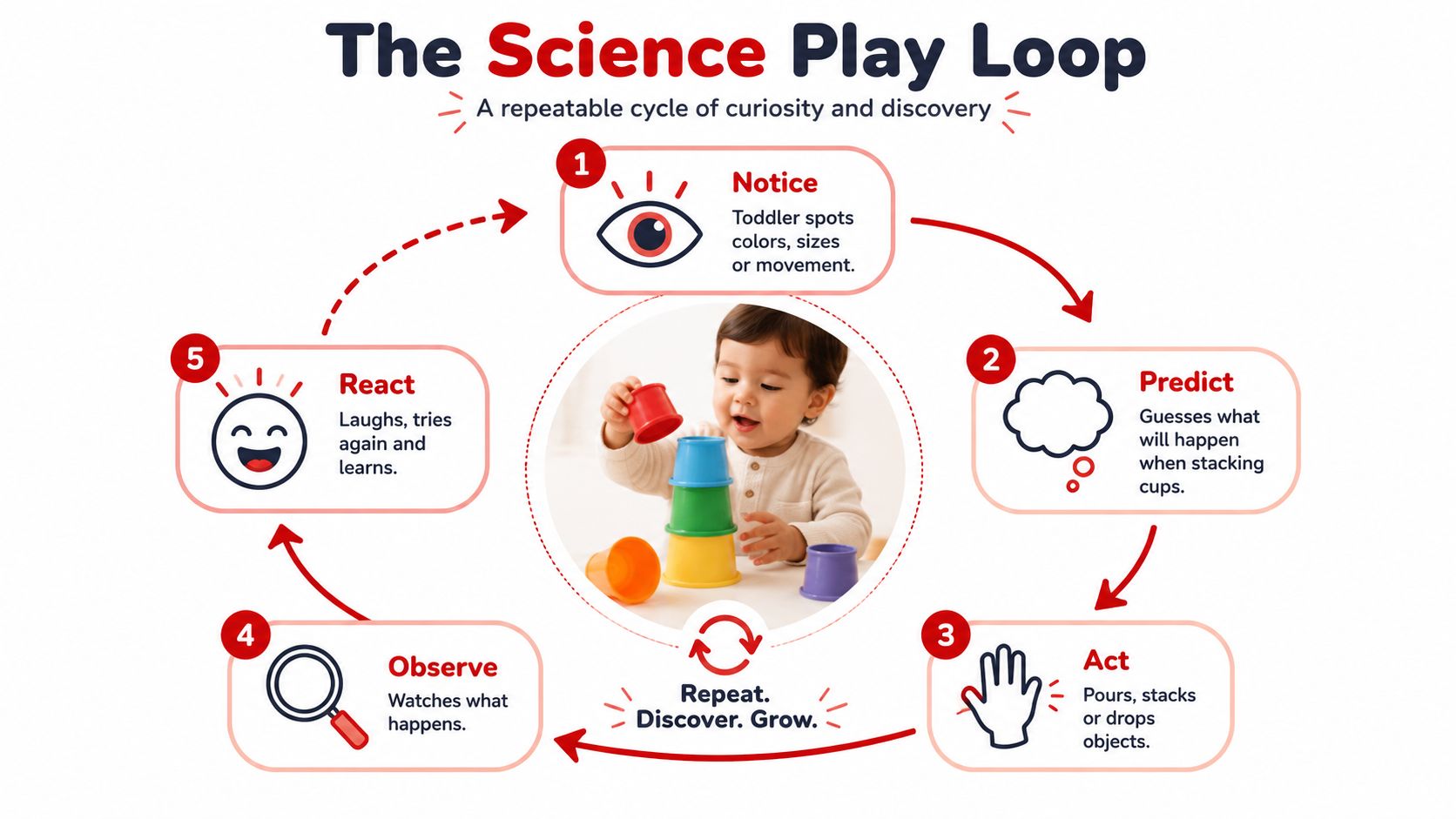
Toddler science play follows a simple loop:
- Notice
- Predict
- Act
- Observe
- React
A child may notice that one cup is wider than another. They predict that the smaller cup will fit inside. They act by placing it into the larger cup, observe the fit, and react by laughing, removing it, or trying a different arrangement. The loop begins again each time the child changes something.
How adults support the loop
Adults often want to demonstrate the “right” way immediately. That can shorten the investigation. If a toddler is trying to fit a large ring onto a small post, pause before correcting them. Let them rotate the ring, change the pressure, or choose another piece. A small failure gives the child information.
Use language that keeps the child in charge:
- Before the action: “What do you think will happen?”
- During the action: “You're tipping the cup slowly.”
- After the result: “The leaf is floating. What could we try next?”
A toddler may not answer with a full explanation. Pointing, repeating the action, or making a sound still counts as participation. You can name the result without demanding a verbal response.
Hands-on exploration differs from a demonstration because the child controls the sequence. If an adult drops every object into the water, the child watches. If the child chooses each object, drops it, and checks the surface, the child investigates.
The same pattern in different play settings
Water play makes the loop visible through floating, sinking, pouring, and splashing. Light play can involve moving a flashlight across a wall and noticing how shadows change. Basic mechanics appear when a child presses a lever and watches a wheel turn. Sensory play adds texture, temperature, and resistance.
The subject changes, but the thinking stays recognizable. Research on early-childhood STEM play connects technology-enhanced and STEM-oriented toys with problem-solving, computational thinking, collaboration, critical thinking, and verbal expression, especially when children manipulate materials and respond to outcomes, as discussed in this research summary on hands-on learning benefits.
Developmental Benefits of Hands-On Exploration
A toddler who sorts, stacks, pours, and adjusts isn't completing separate academic exercises. They're coordinating movement with memory, attention, language, and flexible thinking. Research on STEM toys describes young children using hypothesis testing, sequencing, and error correction during play, which supports the case for choosing activities with a visible action-response link. Early-childhood STEM research also supports hands-on experiences that invite children to solve problems rather than only watch an outcome.
Matching behavior to design
A ring-stacking toy can encourage size comparison and sequencing. A ramp-and-ball activity creates a manageable problem: the ball stopped, so the child changes the slope or tries another ball. A shared water station gives two children a reason to take turns, point, request a cup, and describe what happened.
Fine-motor materials also deserve attention. Large pegs, chunky connectors, wide tongs, and substantial scoops ask the child to grasp, release, align, and coordinate both hands. Those movements don't guarantee a particular later academic result, but they give children useful practice controlling their hands while concentrating on a goal.
| Observable Behavior | Supporting Toy Feature | Developmental Skill | Example Play Moment |
|---|---|---|---|
| Sorts objects by size | Containers or nesting cups with clear size differences | Sequencing and comparison | The child places smaller cups inside larger ones |
| Repeats a failed action | Ramp, ball, or rolling track with adjustable parts | Persistence and problem-solving | The child raises the ramp after the ball stops |
| Watches a partner's action | Shared pouring or building materials | Turn-taking and joint attention | One child pours while another holds the bowl |
| Names or gestures toward results | Materials that create visible changes | Verbal expression and vocabulary | The child says “full,” “wet,” or “down” |
| Grasps, transfers, and aligns pieces | Large manipulatives and simple tools | Hand coordination | The child moves scooped objects into a container |
The most productive struggle remains small and manageable. A toddler should be able to make progress through another attempt, not face a puzzle that requires an adult to complete every step. Toys that children can mostly operate alone often create more opportunities for initiative, while the caregiver adds occasional prompts and safety checks.
For texture-rich ideas that support manipulation and observation, explore sensory toys for toddlers. The useful question isn't whether a toy looks educational. Ask what the child can change, what they can notice, and whether they'll want to repeat the experience.
Comparing Toys by Effort and Play Value
A toy can look rich on the box and still be demanding at home. An adult may need to install batteries, sort many pieces, explain several rules, refill containers, and remain involved throughout. A simple pouring station may offer fewer parts but give a toddler more control and require less preparation.
Compare choices using four practical measures:
- Adult setup: How quickly can someone get the activity ready?
- Child independence: Can the toddler begin and continue without constant instructions?
- Developmental fit: Does the action match the child's motor control, language, and attention?
- Repeat-use value: Can the materials support new variations after the first play session?
A household-energy comparison
A magnet set may provide strong discovery opportunities, but it demands careful inventory control and close supervision because individual pieces can create a serious hazard. A water table may offer rich pouring and floating play, yet it needs a safe location, regular cleaning, and an adult close by. A stacking science kit can support order and balance, while a bug viewer can encourage outdoor observation if the pieces are large, secure, and age-appropriate.
The right choice depends on the adults available, not only the child's curiosity. A caregiver with limited time may get more value from a washable set of nesting cups than from a kit that requires a long setup. A classroom may manage a water station well because an educator can prepare a defined area and introduce a clear turn-taking routine.
| Toy Category | Setup Effort | Child Independence | Repeat-Play Value | Best Age Fit |
|---|---|---|---|---|
| Magnet sets | High, with strict piece control | Limited when safety monitoring is required | High for older, age-appropriate users | Follow the package age grade, not toddler access |
| Water tables | Moderate, with water and cleanup | Moderate with nearby adult support | High through pouring, floating, and transferring | Toddlers with direct supervision |
| Stacking science kits | Low to moderate, depending on parts | Often high when pieces are chunky | Moderate to high through sorting and balancing | Toddlers when parts are large and secure |
| Bug viewers | Low, if used outdoors | Moderate, with adult guidance | Moderate through repeated nature observations | Toddlers with sturdy, age-appropriate designs |
Age labels also involve trade-offs. A toy aimed at a younger toddler may become familiar quickly, but that familiarity can support independent repetition. A preschool-oriented kit may appear more exciting, yet complex rules or small components can frustrate a younger child and leave the adult managing the activity.
A simpler design often creates better conversation because the adult isn't busy tracking pieces. For families comparing structured options, this overview of science kits for kids can help you distinguish topic variety from genuine toddler suitability.
Safety Features Every Buyer Must Check
A science-themed label doesn't make a toy safe for a toddler. Water, loose parts, magnets, batteries, and sensory materials all require a closer inspection than the front of a package usually provides.
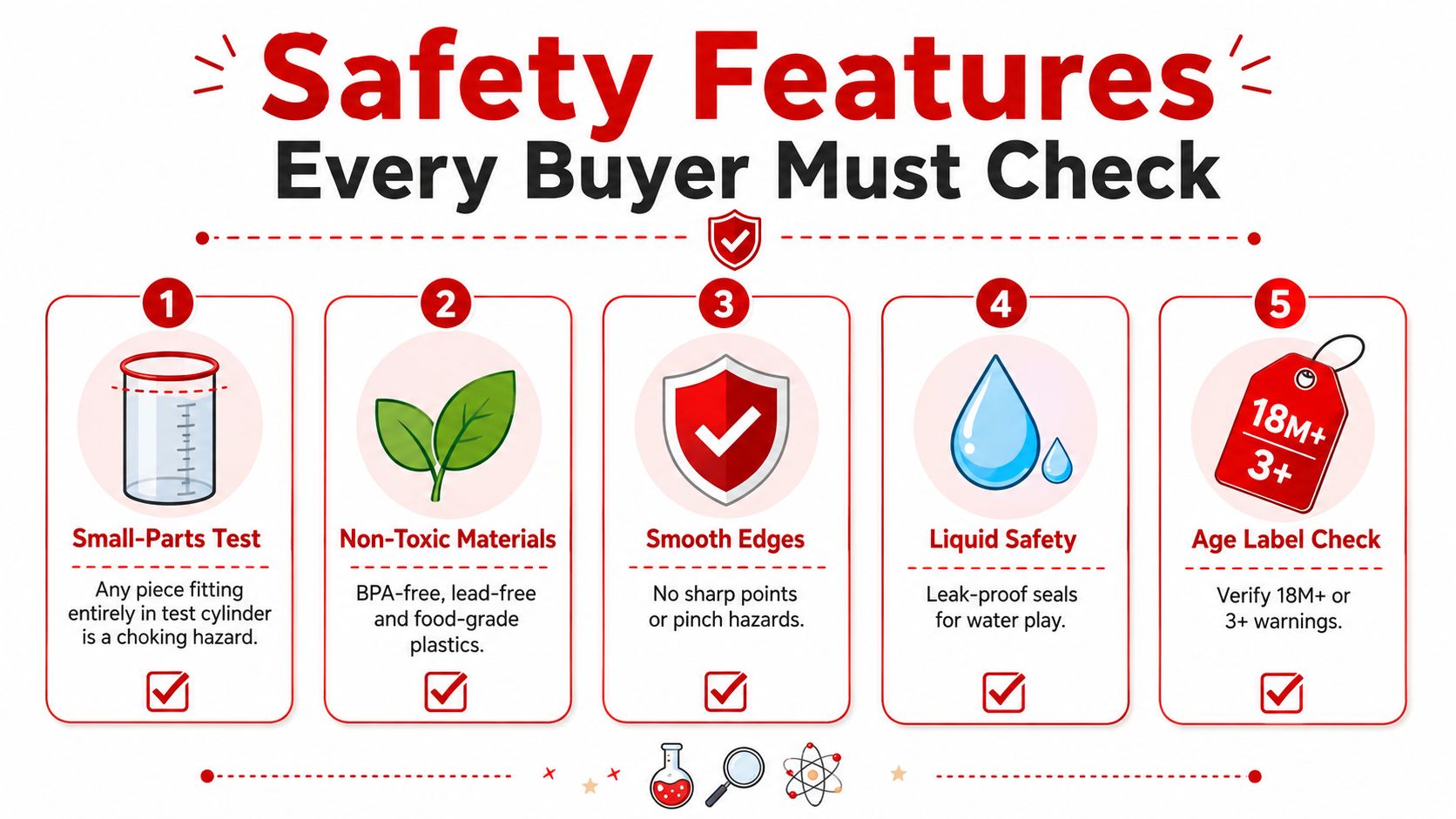
The first check is the small-parts cylinder. Under the applicable test geometry, a detachable component that fits entirely inside a cylinder with an internal diameter of 31.7 mm and an effective depth of about 57.1 mm is treated as a choking hazard for children under 36 months. U.S. guidance describes the comparable test cylinder as 2.25 inches long and 1.25 inches wide, and the test applies to individual pieces as well as parts that break off during abuse testing. See the European toy safety standard text and the U.S. small-parts regulation for the relevant test framework.
Common hazards deserve specific attention
Avoid loose beads, removable caps, tiny magnets, detachable wheels, and snap-fit parts that separate when pulled, twisted, dropped, or bitten. Childcare guidance also identifies marbles, magnets, balloons, coins, and glitter as unsafe for access by children under three, as summarized in this early-childhood safety guidance.
Magnet sets need especially strict handling. If a child swallows more than one strong magnet, the pieces can attract through intestinal walls and cause serious internal injury. Keep them away from toddlers, and don't rely on a warning label if the product can be opened or its magnets can escape.
Liquid and sensory materials need their own review. Drinkable tap water is different from an activity involving dry ice, hydrogen peroxide, expanded water beads, or undiluted essential oils. Don't introduce those materials into toddler play. Glass thermometers also have no place in a toddler science tray.
Inspect the whole toy, not just the parts
Check for rounded edges, secure battery compartments fastened with screws, non-toxic paints that meet applicable ASTM or EN71 requirements, washable fabrics on plush science characters, and construction that can withstand chewing and throwing. Follow the age range printed on the packaging. Age grading reflects safety considerations, not a judgment about a child's intelligence, as explained in this research on toy age grading.
For any pouring, floating, or sink-and-float activity, stay within arm's reach. “Independent play” describes the child's ability to operate the toy, not permission for an adult to leave the area.
Supervision rule: If water, loose objects, or a toddler's mouth are part of the activity, an adult needs to remain close enough to intervene immediately.
Read material and care information before buying, and inspect the toy again after use. A product that was safe when new may become unsafe after a crack, loose seam, missing screw, or broken connector appears. More guidance on choosing materials is available in this overview of non-toxic toys for babies.
Easy Science Activities for Home and Classroom
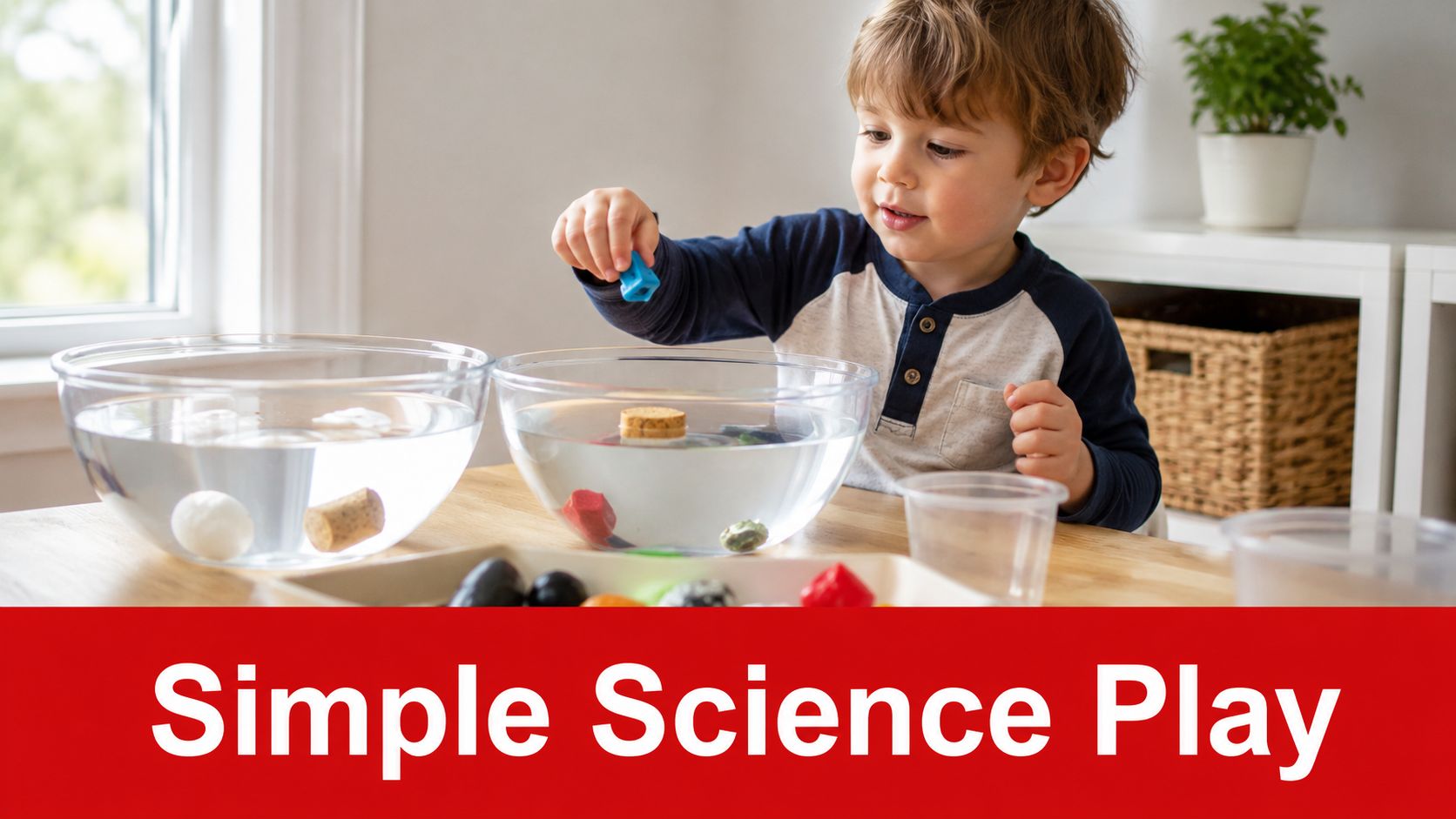
Start with what you already have. A shallow bowl, several cups, and a small collection of large objects can create a sink-and-float investigation without a special kit.
Sink and float sorting
Offer objects such as a wooden spoon, a cork, and large bath toys after checking that every item is too large to present a choking risk. Let the child choose one object, ask what they think will happen, and place it in the water. Keep the language simple: “It stayed on top,” “It went down,” or “The water moved.”
Draw two large areas on paper, labelled “floats” and “sinks.” After each test, let the toddler place a sticker or make a mark in the matching area. The chart doesn't need to be accurate or tidy. Its purpose is to connect an experience with a record.
Color mixing with washable paint
Put washable tempera paint on large paper secured to a highchair tray or an outdoor wall. Use broad brushes, sponges, or hands if the setting allows it. Start with a small amount of two colors, then pause while the child notices the new color.
Protect the next round by keeping towels, a washable mat, and a container for wet tools nearby. Cleanup becomes easier when the activity has a defined boundary rather than spreading across the entire room.
For classroom planning beyond individual experiments, these science week classroom activities offer additional ways to organize shared investigation.
A ramp-and-roll setup needs only a sturdy cardboard tube, a stack of books, and large balls that are safe for the children using them. Change the height or direction of the ramp and watch what happens. Ask, “What could we try next?” rather than moving the ramp for the child.
In a classroom, a group water-pour station can use measured jugs and large containers. Educators can model words such as full, empty, more, and less while children take turns. Keep the station shallow, place it on a stable surface, and prepare a clear drying and cleanup routine.
Choosing and Using Toys with Lasting Value
A lasting toddler science toy doesn't need the largest box or the most elaborate experiment list. Choose one that matches the child's current motor abilities, passes the small-parts and material checks, and offers several ways to act and observe.
Use this quick filter:
- Developmental fit: The child can grasp, move, and understand the basic action with limited help.
- Safety: The assembled toy and foreseeable breakaway parts remain outside the small-parts threshold.
- Simplicity: The child can begin without batteries, lengthy instructions, or adult-controlled effects.
- Repeat play: The same materials support sorting, pouring, comparing, building, or testing different objects.
- Independence: The toddler can make meaningful choices while an adult stays nearby when needed.
Storage matters as much as the play idea. A basket that holds cups, scoops, and large containers makes independent access easier, while washable surfaces and sturdy construction reduce the work between sessions. Rotate a few toys with household materials so familiar pieces feel new without adding clutter.
This week, choose one small activity, such as floating objects in a bowl or rolling balls down a cardboard ramp. Watch what your child changes, repeats, and talks about, then use those observations to guide your next purchase.
Playz offers science kits for kids alongside creative toys and play-focused learning materials, giving families options for hands-on exploration across science topics and age ranges. Visit Playz to explore materials that can complement simple toddler investigations while keeping active, purposeful play at the center.