


Welcome to the incredible world of a 9-month-old! This is a pivotal time of explosive growth where your little one is transforming from a passive observer into an active explorer. They are mastering crawling, pulling up to stand, and babbling with newfound purpose. To support this amazing journey, providing the right stimulation is key. This guide offers a comprehensive roundup of powerful, yet simple, activities for 9 month old babies designed to foster cognitive, motor, and sensory development.
We move beyond generic advice to give you practical, step-by-step instructions, safety tips, and creative variations for each activity. From building simple obstacle courses to exploring object permanence with peek-a-boo, you will find engaging ways to support your baby's milestones. These play-based learning moments are crucial for brain development, but remember that growth also happens during downtime. Beyond daily engagement, ensuring your baby gets adequate rest is fundamental; explore effective strategies on how to sleep train a baby for more restful nights.
Get ready to turn everyday household items and moments into meaningful learning opportunities that strengthen your bond. Let’s dive into the best activities for your 9-month-old.
1. Sensory Exploration with Textured Play Materials
At nine months, your baby’s brain is rapidly building connections through sensory experiences. Offering them a variety of safe, textured materials to touch, grasp, and mouth is one of the most foundational activities for 9 month old babies. This type of play directly supports their tactile awareness and fine motor development as they learn to manipulate different objects with their hands.
Sensory exploration is how babies learn about their world. When they feel a soft piece of velvet versus a bumpy silicone teether, they are making crucial neural connections that lay the groundwork for more complex learning.
How to Set Up a Texture-Rich Play Session
Materials You'll Need:
- Household Items: A basket filled with fabric swatches (corduroy, silk, fleece), large, smooth wooden spoons, and crinkly parchment paper (supervised).
- DIY Option: Create a simple texture board by gluing different materials like large pom-poms, ribbons, and soft sponges onto a sturdy piece of cardboard.
- Playz Toy Suggestion: The Playz Edible Slime Candy Making Food Science Chemistry Kit offers a unique, taste-safe sensory experience perfect for this age group, allowing them to explore gooey textures under strict supervision.
Step-by-Step Instructions:
- Create a Safe Space: Lay a blanket on the floor and gather your chosen sensory items.
- Present the Items: Place a few different textured items in front of your baby. Avoid overwhelming them with too many choices at once.
- Encourage Exploration: Let your baby lead the way. They might pat, squeeze, crinkle, or try to mouth the items. Narrate their actions by saying things like, "That feels soft!" or "You're making a crinkly sound!"
Key Takeaway: The goal isn't to teach them what each texture is called, but to allow their brains to process the different physical sensations, which builds a strong foundation for object recognition and categorization.
Developmental Benefits & Safety
This simple activity is a powerhouse for development, strengthening hand-eye coordination, fine motor skills, and cognitive understanding of cause and effect (e.g., "When I squeeze this, it makes a sound").
Safety First:
- Always supervise sensory play closely.
- Ensure all items are large enough that they cannot be a choking hazard. A good rule of thumb is to use items that cannot fit through a toilet paper roll.
- Regularly check all materials for any loose parts or wear and tear.
2. Crawling and Obstacle Course Activities
Around nine months, many babies are mastering crawling or are on the verge of this major milestone. Creating simple, safe obstacle courses is one of the most effective activities for 9 month old babies to encourage this new skill. This playful challenge builds core strength, enhances coordination, and develops spatial awareness as they learn to navigate their environment.
This type of active play is crucial for gross motor development. By figuring out how to crawl over a pillow or through a tunnel, your baby is building physical confidence and problem-solving skills, which are foundational for walking, climbing, and exploring the world with greater independence.
How to Set Up a Mini Obstacle Course
Materials You'll Need:
- Household Items: Couch cushions, pillows, sturdy cardboard boxes (with ends opened), and blankets to create "mountains" and "tunnels."
- DIY Option: Arrange soft foam blocks or rolled-up towels in a path for your baby to navigate around or over.
- Playz Toy Suggestion: The Playz 5pc Kids Play Tent Crawl Tunnel & Ball Pit with Basketball Hoop can be used to create an exciting central feature, offering a tunnel to crawl through and a safe space to explore at the end.
Step-by-Step Instructions:
- Clear a Safe Zone: Choose a carpeted or soft-matted area, free from sharp corners or hazards.
- Arrange the Obstacles: Start simple. Place one or two pillows in a line for your baby to crawl over. As they get more confident, you can add a box tunnel or a small cushion mountain.
- Encourage and Motivate: Get down on the floor with your baby. Place a favorite toy at the end of the course to motivate them, or sit at the finish line with open arms and encouraging words. Celebrate their effort and success!
Key Takeaway: The goal is not to create a difficult challenge, but to foster curiosity and persistence. A simple path with one or two low obstacles is enough to engage their developing body and mind.
Developmental Benefits & Safety
This activity is a powerhouse for physical development, strengthening the muscles in their arms, legs, and core. It also promotes body awareness, balance, and the cognitive skill of planning their movements.
Safety First:
- Always supervise your baby during this activity.
- Use only soft, stable materials that will not topple over or cause injury.
- Keep the course low to the ground to minimize the risk of falls.
- Ensure the play area is clear of any small objects, cords, or other hazards.
3. Object Permanence Games and Peek-a-Boo Variations
Around nine months, your baby is mastering a huge cognitive leap: object permanence. This is the fundamental understanding that things continue to exist even when they can no longer see them. Playing games that reinforce this concept is one of the most impactful activities for 9 month old babies, supporting memory, anticipation, and early problem-solving skills.
When you hide your face behind your hands during peek-a-boo, your baby's delighted surprise at your "reappearance" is their brain hard at work. They are learning to predict outcomes and trust that things (and people) will return, which builds both cognitive skills and emotional security.
How to Set Up an Object Permanence Game
Materials You'll Need:
- Household Items: A lightweight blanket or scarf for hiding, stacking cups, and small, safe toys.
- DIY Option: A "peek-a-boo box." Cut a small flap in the side of a cardboard box and place a favorite toy inside for your baby to discover by opening the flap.
- Playz Toy Suggestion: The sturdy containers from a Playz science kit are perfect for this. Hide a small toy inside a container and let your baby work on opening it to find the treasure.
Step-by-Step Instructions:
- Start Simple: Begin with classic peek-a-boo, using your hands or a light scarf. Use exaggerated expressions to keep them engaged.
- Hide a Toy: While your baby is watching, partially cover a favorite toy with a blanket. Let them pull the blanket away to "find" it.
- Increase the Challenge: Once they master partial hiding, fully conceal the toy. You can also introduce containers, starting with a clear one so they can see the toy inside before progressing to an opaque one.
Key Takeaway: The joy of the "reveal" is a powerful motivator. Your enthusiastic celebration when they find the hidden object reinforces the concept and encourages them to keep exploring, strengthening their working memory and attention span.
Developmental Benefits & Safety
These simple hiding games are crucial for cognitive development. They teach cause and effect ("If I lift the blanket, I will find my toy"), enhance visual tracking, and lay the foundation for logical thinking.
Safety First:
- Always supervise your baby during play.
- Ensure any toys you hide are large enough to not be a choking hazard.
- Use lightweight blankets or scarves to avoid any risk of suffocation.
- Check that any boxes or containers are safe, with no sharp edges.
4. Cause-and-Effect Toy Exploration
At nine months, your baby is beginning to understand that they can make things happen, a foundational cognitive leap. Exploring toys that react to their actions is one of the most exciting activities for 9 month old babies. This type of play demonstrates the concept of cause and effect, teaching them that pushing a button creates a sound or dropping a ball makes it bounce.
This dawning realization is a baby's first step into scientific thinking and problem-solving. When they purposefully press a switch to hear a song again, they are not just playing; they are conducting mini-experiments, learning that their actions have predictable, repeatable outcomes.
How to Set Up a Cause-and-Effect Play Session
Materials You'll Need:
- Household Items: A set of lightweight pots and a wooden spoon for banging, or a "mystery box" with a lid they can open and close to find a toy inside.
- DIY Option: Fill a clear, securely sealed plastic bottle with rice or beans. When your baby shakes it (the cause), it makes a fun rattling sound (the effect).
- Playz Toy Suggestion: The Playz Musical Activity Mat is a fantastic cause-and-effect tool. When your baby kicks or pats a specific area, it responds with sounds and music, providing immediate auditory feedback for their movements.
Step-by-Step Instructions:
- Select an Appropriate Toy: Choose a toy with a clear and simple cause-and-effect mechanism. Start with one to avoid overstimulation.
- Demonstrate the Action: Show your baby how it works. Press the button and say, "Look! When I push this, it makes a sound!"
- Encourage Independent Play: Hand the toy to your baby and let them explore. Guide their hand to the button if needed, but allow them plenty of time to figure it out on their own.
Key Takeaway: The magic of this play lies in the "aha!" moment. Repeatedly activating a toy helps your baby build confidence and an understanding of their own agency, motivating them to interact more with their environment.
Developmental Benefits & Safety
This activity is a powerhouse for cognitive growth, fostering an understanding of object permanence, problem-solving skills, and fine motor control. It also encourages curiosity and persistence.
Safety First:
- Always choose age-appropriate toys that do not have small parts that could break off.
- If using battery-operated toys, ensure the battery compartment is securely screwed shut.
- Rotate toys regularly to keep your baby engaged and prevent them from becoming bored or overstimulated by a single sound or light.
5. Music and Rhythm Play Activities
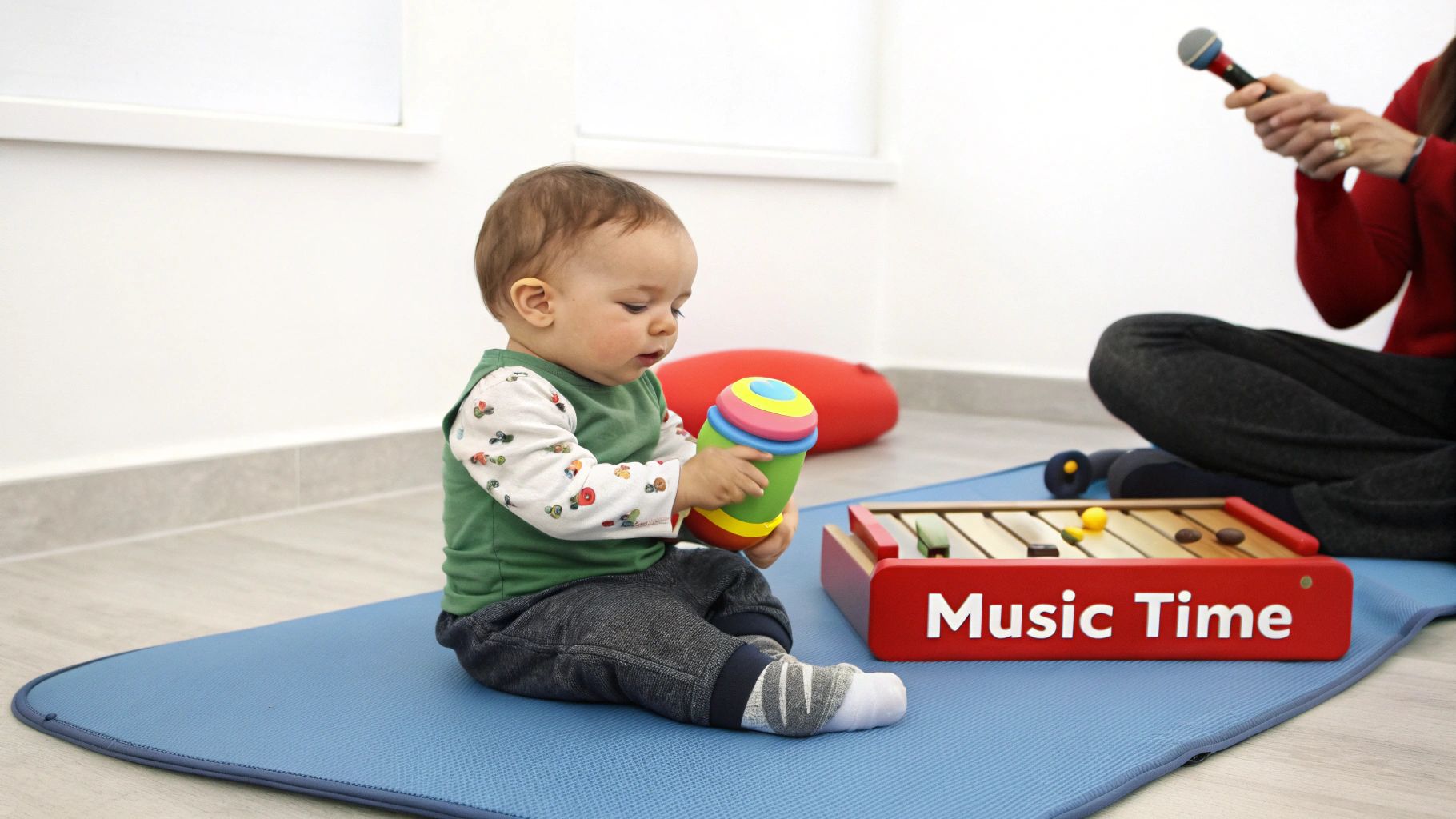
At nine months, your baby's brain is highly attuned to sounds, patterns, and rhythms, making music one of the most engaging activities for 9 month old babies. Introducing simple instruments and songs supports auditory development, rhythm recognition, and even foundational language skills. This type of play helps them understand cause and effect while refining their motor control.
Music and rhythm are not just for entertainment; they are powerful tools for brain development. When your baby bangs a drum or shakes a maraca, they are learning about sound creation, practicing listening skills, and strengthening the parent-child bond through a joyful, shared experience.
How to Set Up a Musical Play Session
Materials You'll Need:
- Household Items: Create a DIY shaker by sealing dried beans or rice in a small, sturdy plastic container (tape the lid shut). Use wooden spoons to tap on upside-down pots and pans.
- DIY Option: Craft simple shakers from toilet paper rolls. Securely cover one end, fill it partway with rice, and then securely cover the other end.
- Playz Toy Suggestion: The Playz My First Coding & Computer Science Kit can introduce concepts of sequencing and patterns, which are foundational to musical rhythm, through its interactive, hands-on activities.
Step-by-Step Instructions:
- Choose Your Instruments: Gather a few age-appropriate instruments, like a soft baby drum or fabric maracas.
- Sing and Play: Sit with your baby and start singing a simple, repetitive song like "Twinkle, Twinkle, Little Star" or "Row, Row, Row Your Boat."
- Demonstrate and Share: Gently tap a rhythm on the drum or shake the maracas along with the music. Hand an instrument to your baby and encourage them to join in. Clap your hands and praise their efforts to make them feel involved.
Key Takeaway: The goal isn't musical perfection but participation. Responding positively to their sounds, no matter how random, reinforces their sense of agency and encourages them to continue exploring auditory cause and effect.
Developmental Benefits & Safety
This activity boosts auditory processing, fine and gross motor skills (grasping shakers, banging drums), and cognitive skills. Singing together also directly supports language acquisition by exposing them to new words, rhymes, and cadences.
Safety First:
- Always supervise your baby during music play, especially with DIY or smaller instruments.
- Ensure any homemade shakers are completely sealed so small contents cannot escape and become a choking hazard.
- Check all instruments for small, loose parts. Opt for toys designed specifically for babies, which are made from non-toxic materials.
6. Stacking, Nesting, and Simple Building Activities
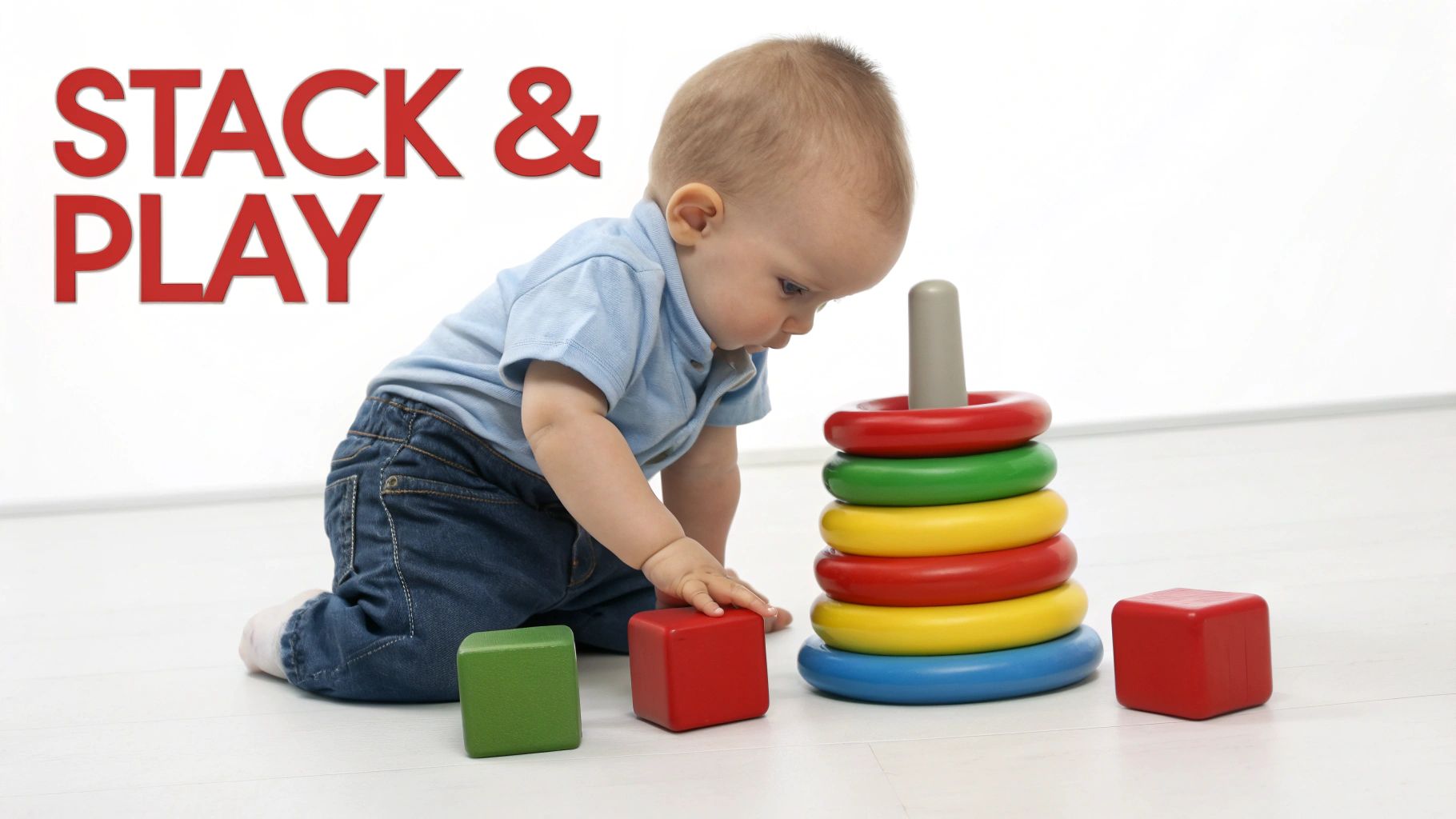
Around nine months, your baby's fine motor skills and hand-eye coordination are advancing rapidly, making it the perfect time to introduce stacking and nesting. These simple yet powerful activities for 9 month old babies teach crucial lessons about spatial relationships, cause and effect, and basic physics. They are beginning to understand how objects relate to one another in size and shape.
This type of focused play builds problem-solving skills as your baby figures out how to balance one block on another or which cup fits inside the next. It’s a foundational step toward more complex construction and reasoning, all disguised as the simple joy of building something up and knocking it back down.
How to Set Up a Simple Building Session
Materials You'll Need:
- Household Items: Nesting plastic containers from the kitchen, empty (and clean) cardboard food boxes, or large, chunky board books.
- DIY Option: Collect and clean several empty tissue boxes or formula cans (ensure no sharp edges) that your baby can safely stack.
- Playz Toy Suggestion: The Playz My First Stacking Cups Set is designed with bright colors and various sizes, making it ideal for learning about nesting, stacking, and size sequencing in a safe, baby-friendly way.
Step-by-Step Instructions:
- Start Small: Begin with just two or three items, like a couple of large, soft blocks or nesting cups. This prevents them from feeling overwhelmed.
- Demonstrate the Action: Sit with your baby and slowly stack one item on top of another. Narrate your actions: "I'm putting the blue block on the yellow block."
- Encourage Participation: Hand a block to your baby and encourage them to place it on top. Praise their effort, even if the tower tumbles. The act of trying is what builds skill.
Key Takeaway: Don't forget that knocking the tower down is a huge part of the fun and learning process. This "destruction" phase teaches them about gravity and object permanence while being incredibly satisfying for a nine-month-old.
Developmental Benefits & Safety
Stacking and nesting are fantastic for developing fine motor control, spatial awareness, and the concept of sequencing. It also strengthens cognitive skills like problem-solving and concentration.
Safety First:
- Ensure all stacking items are lightweight to prevent injury if they fall.
- Avoid items with sharp corners or edges; opt for soft blocks, rounded plastic, or smooth wood.
- Always check that items are too large to be a choking hazard.
7. Picture Book Exploration and Early Language Development
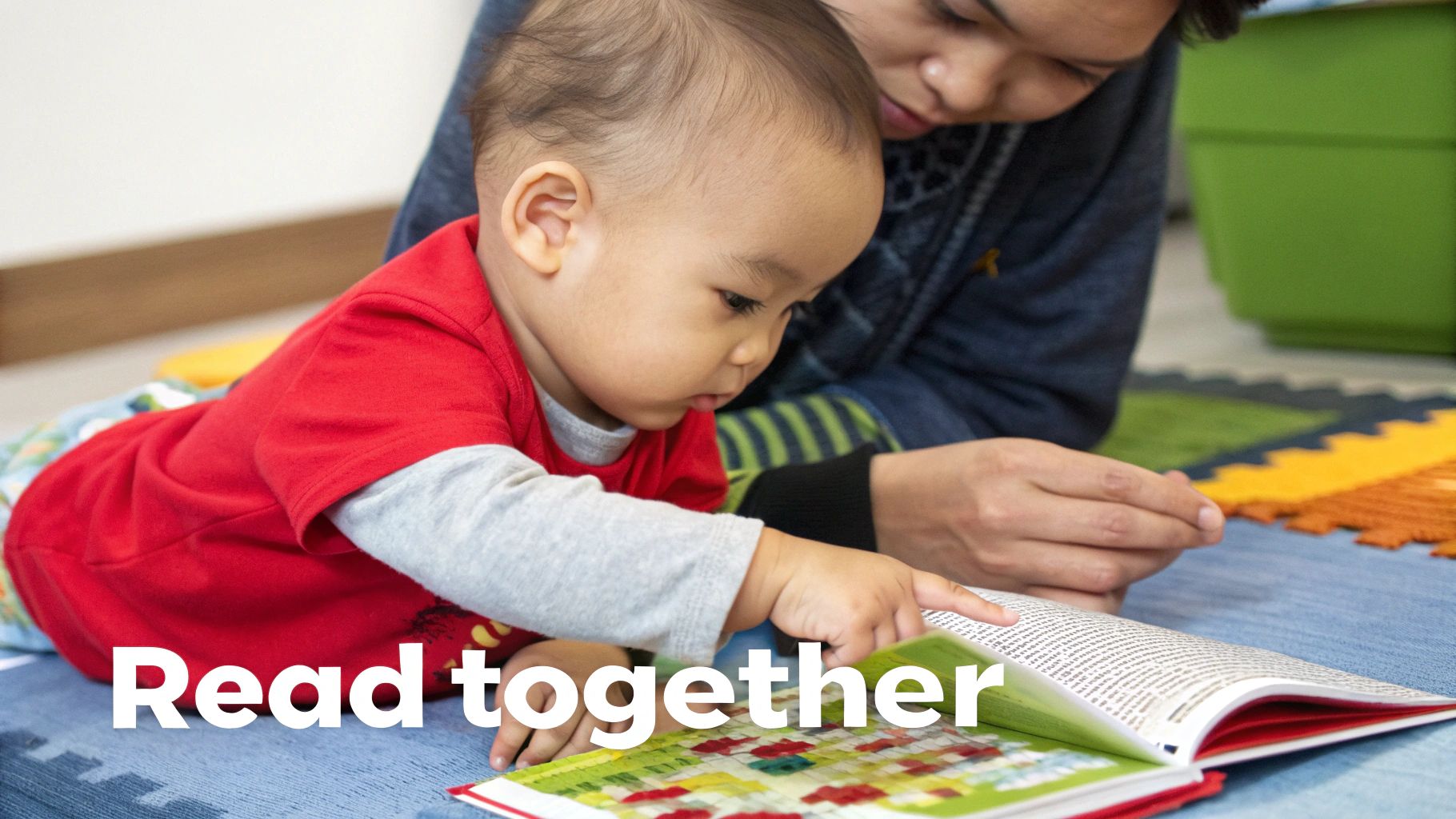
At nine months, your baby is beginning to understand that pictures represent real-world objects, making storytime one of the most impactful activities for 9 month old babies. Sharing a picture book isn't just about reading words on a page; it’s an interactive experience that builds foundational language skills, strengthens your bond, and introduces the magic of storytelling.
This simple routine exposes them to new vocabulary, rhythm, and the concept of communication. As you point to images and name them, you are actively wiring their brain for language acquisition and creating positive associations with reading that can last a lifetime.
How to Set Up an Interactive Reading Session
Materials You'll Need:
- Household Items: A small collection of sturdy board books. Look for books with high-contrast images, touch-and-feel textures, lift-the-flaps, or simple pictures of familiar objects like animals or toys.
- DIY Option: Create a simple "family book" by printing photos of relatives and pets and putting them in a small, baby-safe photo album. Name each person as you turn the pages.
- Playz Toy Suggestion: While reading a book about potions or colors, you can complement the experience with the Playz My First Magical Science & Potions Kit. Mixing colorful, safe ingredients can bring the magic of a story into the real world, enhancing sensory learning.
Step-by-Step Instructions:
- Find a Cozy Spot: Cuddle up with your baby in a comfortable chair or on the floor, ensuring they can see the book clearly.
- Let Baby Help: Allow your baby to hold the book (with your help) and turn the thick pages. Mouthing the book is normal and part of their exploration.
- Read with Expression: Point to the pictures and name what you see. Use exaggerated voices and make corresponding sounds, like "Moo!" for a cow or "Vroom!" for a car. Keep reading sessions short and sweet, following your baby's cues.
Key Takeaway: The goal at this age is interaction, not completion. If your baby is fascinated by one page, spend extra time there. The shared experience is more important than finishing the story.
Developmental Benefits & Safety
This activity is a powerhouse for cognitive and language development. It boosts vocabulary, teaches cause and effect (lifting a flap reveals a picture), and enhances visual tracking skills.
Safety First:
- Always choose durable board books that are specifically designed for babies and can withstand chewing and rough handling.
- Avoid books with small, detachable parts that could become a choking hazard.
- Regularly inspect books for any damage, such as peeling layers or loose bindings, and discard any that are broken.
8. Safe Exploration Play Spaces and Baby-Proofed Environments
As your nine-month-old becomes more mobile, their desire to explore skyrockets. Creating a designated, fully baby-proofed exploration space is one of the most crucial activities for 9 month old babies. This "yes-space" allows them to move freely and investigate their surroundings without constant redirection, fostering independence and confidence.
These controlled environments reduce parental anxiety and give your baby the freedom to practice new motor skills safely. When they can explore without hearing "no," they build a positive association with curiosity and learning. Understanding how to create a safe and engaging space is crucial; you can find useful advice on how to decorate a nursery for your baby.
How to Set Up a Safe Exploration Space
Materials You'll Need:
- Household Items: Baby gates to block off a section of a room, outlet covers, cabinet locks, and soft furnishings like pillows or a play mat to cushion falls.
- DIY Option: Use large, sturdy cardboard boxes (with any staples removed) to create a simple, temporary crawl-through tunnel or fort within a gated area.
- Playz Toy Suggestion: The Playz 5pc Kids Playhouse Jungle Gym Ball Pit with Dart Board creates an instant, contained adventure zone. Its tunnels and tents offer exciting places for your baby to crawl into and explore, promoting gross motor skills in a secure setting.
Step-by-Step Instructions:
- Select and Secure the Area: Choose a part of a room and use baby gates to enclose it. Meticulously baby-proof everything inside this zone, covering outlets, securing furniture, and removing any potential hazards.
- Add Engaging Items: Place 3-4 safe, age-appropriate toys inside the space. Consider a mix of soft toys, stacking rings, and board books to stimulate different interests.
- Encourage Independent Play: Place your baby in the space and sit nearby where they can see you. Allow them to explore on their own, offering encouragement without directing their play.
Key Takeaway: A "yes-space" is less about the specific toys within it and more about the freedom it provides. This autonomy is a powerful tool for building your baby's self-esteem and problem-solving skills as they learn to navigate their mini-world.
Developmental Benefits & Safety
This setup directly supports gross motor development (crawling, climbing, standing), spatial awareness, and independent problem-solving. It also nurtures emotional development by building your baby's confidence and sense of security.
Safety First:
- Conduct daily checks of the space to ensure no new hazards have appeared.
- Rotate the toys every few days to maintain your baby's interest and prevent boredom.
- Ensure the space is well-lit and you always have a clear line of sight to your baby.
- Check that all gates are securely installed according to manufacturer instructions.
Comparison of 8 Activities for 9-Month-Old Babies
| Activity | 🔄 Implementation Complexity | ⚡ Resource Requirements | 📊 Expected Outcomes | 💡 Ideal Use Cases | ⭐ Key Advantages |
|---|---|---|---|---|---|
| Sensory Exploration with Textured Play Materials | Low — minimal setup but needs constant supervision | Low — affordable, safe textures; regular cleaning | Improves tactile discrimination, fine motor skills, cause-and-effect | Rotating sensory baskets, short independent exploration sessions | High engagement; cost-effective; adaptable |
| Crawling and Obstacle Course Activities | Moderate — requires space, setup and supervision | Medium — cushions, soft blocks, tunnels; storage space | Builds gross motor strength, balance, spatial awareness | Indoor gross-motor practice, multi-child play, energy release | Strong physical development; promotes independence |
| Object Permanence Games and Peek-a-Boo Variations | Low — very simple setup; caregiver participation required | Low — blankets, small toys or containers; highly portable | Reinforces object permanence, memory, anticipation skills | Bonding moments, travel, quick cognitive bursts | High interactional value; strengthens attachment |
| Cause-and-Effect Toy Exploration | Low–Medium — choose appropriate toys and monitor stimulation | Medium — interactive/battery toys; maintenance and rotation | Teaches cause-effect, early problem-solving, motor coordination | Independent experimentation, guided play sessions | Encourages exploration and scientific thinking; very engaging |
| Music and Rhythm Play Activities | Low — simple instruments; benefits from caregiver-led routines | Low–Medium — shakers, drums, xylophone; noise management may be needed | Boosts auditory discrimination, rhythm recognition, early language, regulation | Short musical routines, calming or energetic play, bonding time | Multi-domain benefits (language, emotion, motor) |
| Stacking, Nesting, and Simple Building Activities | Low–Moderate — supervise for small pieces; model stacking | Low — stacking rings, nesting cups, soft blocks; compact storage | Enhances hand-eye coordination, spatial reasoning, persistence | Short guided practice, solo exploration, transitioning skills | Builds problem-solving, fine motor skills; scalable with age |
| Picture Book Exploration and Early Language Development | Low — minimal materials; active reading and pointing needed | Low — sturdy board books; rotate selection for novelty | Builds vocabulary, listening, visual discrimination, early literacy | Quiet routines, nap/bedtime, short read-aloud sessions | Establishes early literacy habits and strong caregiver bonding |
| Safe Exploration Play Spaces and Baby-Proofed Environments | Moderate — planning, regular safety audits and setup | Medium — play yard/tent or gated area; initial investment | Encourages autonomy, confidence, safe risk-taking, extended play | Hands-free supervision, mixed-activity play areas, independent exploration | Reduces caregiver stress; provides safe, versatile play environment |
Your Play-Powered Journey Starts Now
You now have a comprehensive toolkit filled with engaging, developmentally-rich activities for 9 month old babies. This incredible stage is less about mastering specific skills and more about fostering a deep love for exploration. The journey through these crucial months is powered by simple, intentional play that builds a strong foundation for a lifetime of learning. From the giggles of a peek-a-boo game to the determined focus of stacking a wobbly tower, every interaction is a powerful building block for your baby’s cognitive, physical, and emotional growth.
Key Takeaways for Your 9-Month-Old's Development
The most impactful activities for your baby are those that are simple, safe, and sensory-rich. You don't need expensive, complicated gadgets; the most profound learning happens with everyday objects like cardboard boxes, measuring cups, and textured fabrics. Remember that your presence and encouragement are the most essential ingredients.
The key developmental themes we explored include:
- Sensory Exploration: Engaging touch, sight, and sound helps build critical neural pathways.
- Gross Motor Skills: Creating safe opportunities to crawl, pull up, and cruise strengthens muscles and builds confidence.
- Cognitive Milestones: Games centered on object permanence and cause-and-effect teach foundational problem-solving skills.
- Language and Social Skills: Reading books, singing songs, and simply talking to your baby are powerful ways to nurture early communication.
Putting It All Into Action
Your next step is to choose one or two activities that feel right for you and your baby today. Don't feel pressured to do everything at once. Start by setting up a simple obstacle course with pillows or introducing a sensory bin with baby-safe materials. Observe what captures your little one's interest and adapt from there. Is your baby fascinated by how things fall? Focus on stacking and cause-and-effect toys. Do they love rhythmic sounds? Make music a bigger part of your daily routine.
The true value in mastering these approaches lies in your ability to see the world through your baby's eyes. This transforms everyday moments into meaningful learning opportunities, strengthening your bond and celebrating each tiny milestone. Embrace the mess, cherish the curiosity, and enjoy this wonderfully dynamic stage of growth. You are not just playing; you are building a brain, one joyful interaction at a time.
Ready to create the ultimate, screen-free play space for your little explorer? Discover the Playz collection of award-winning developmental toys, ball pits, and play tents designed to make learning an adventure. Explore our collection and see why #KidsLearnBestThruPlayz.