


Finding the best science kits for kids is about more than just grabbing the coolest-looking box off the shelf. The right kit is an adventure waiting to happen—one that matches your child's developmental stage and turns their endless questions into genuine "aha!" moments.
From Why to Wow: The Power of the Right Science Kit

If you're a parent, you know the non-stop chorus of "why?" that comes from a curious child. A great science kit takes those questions and turns them into hands-on discoveries. It’s not just a toy; it's a launchpad for critical thinking, resilience, and a real love for learning that can last a lifetime.
This guide will help you cut through the noise and find the perfect kit for your child's age and passions. We'll skip the overwhelming options and show you how to spot quality, understand the real developmental perks, and set up a fun, safe "lab" space right in your own home.
More Than Just a Toy: A Tool for Learning
Science kits are powerful tools for learning through play. They offer a structured—yet creative—outlet that builds foundational skills far beyond simple entertainment. This hands-on method works so well because it connects with different learning styles.
For example, kinesthetic learners thrive when they can touch, build, and interact with what they're studying. A chemistry kit isn't just about reading instructions; it's about feeling the temperature change in a beaker or seeing the vibrant colors mix firsthand.
Key Takeaway: A science kit isn’t just about the flashy finale, like an erupting volcano. It’s about the whole process: measuring ingredients, following steps, observing outcomes, and figuring out why things sometimes don't go as planned. This process builds critical thinking and resilience.
A Growing Movement in Education
It’s clear that families are looking for toys that do more than just entertain. The global science kits market has already hit USD 1.97 billion, signaling a huge demand for educational products that get kids doing, not just watching.
This growth proves that parents are actively investing in their kids' STEM education early on. You can check out more insights on the science kits market growth on dataintelo.com.
Ultimately, think of this guide as your go-to resource for turning playtime into a powerful learning adventure. We’ll cover:
- Why hands-on play is so important for brain development.
- How to match a kit to your child’s specific age and interests.
- The different types of STEM kits you'll find out there.
- Simple tips for setting up a discovery zone in your home.
Why Hands-On Play Builds Smarter Brains
Watching a science video is one thing, but feeling the fizzy warmth of a chemical reaction in your own hands? That’s something else entirely. This is the magic behind hands-on play and why it’s so powerful for building smarter, more resilient brains. While a screen can show a child a concept, tactile learning lets them truly understand it.
Think about learning to ride a bike. You can’t master balance by just watching YouTube tutorials. You have to get on the bike, feel the wobble, and push the pedals yourself. Science kits work the exact same way, turning abstract ideas into tangible, memorable experiences.
This isn't just about fun; it's about brain science. When a child builds a circuit, mixes a solution, or watches a crystal grow, they're engaging multiple senses at once. This sensory-rich process forges stronger neural pathways, cementing knowledge far more effectively than reading from a textbook ever could.
Beyond Rote Memorization to Real-World Skills
The real value of the best science kits for kids is what they teach beyond the core science. These kits are miniature training grounds for life skills that will stick around long after the experiment is cleaned up.
When a project doesn't go as planned—and sometimes they won't—it’s not a failure. It’s a priceless lesson in problem-solving. Your child learns to ask, "Okay, why didn't that work?" and "What can I try differently?" This process builds resilience and a mindset that embraces challenges.
The sensory experience is what creates those vivid, lasting memories. The unique smell of a volcano experiment, the sight of a crystal slowly forming, or the feel of slime between their fingers—these are the moments that ignite a genuine, lifelong passion for science.
Developing Essential Skills Through Play
Even the simplest actions are learning opportunities. Handling small tools, measuring powders, and carefully pouring liquids all help develop fine motor skills. Following step-by-step instructions strengthens sequential thinking and attention to detail.
- Problem-Solving: When an experiment fizzles instead of foams, kids learn to troubleshoot and think like a real scientist.
- Fine Motor Control: Manipulating beakers, droppers, and small components refines the delicate hand-eye coordination needed for writing, drawing, and more.
- Patience and Persistence: Some experiments, like growing a crystal, take time. This teaches kids the value of waiting and observing processes as they unfold.
This kind of hands-on play is a natural introduction to inquiry-based learning and lays a solid foundation for understanding the 7 steps of the scientific method.
Creating Lasting Connections to Learning
Ultimately, getting their hands dirty creates an emotional connection to learning. The pride a child feels after successfully building a working robot or creating a beautiful crystal is a huge motivator. These positive experiences build confidence and help them associate science with fun and discovery, not frustration.
For a deeper dive into how this all works, check out the many benefits of hands-on learning and see how it helps kids lock in information more effectively. It’s this active, joyful participation that turns a simple afternoon activity into a powerful building block for a smarter, more curious mind. This is how the best science kits for kids transform playtime into a profound educational experience.
How to Choose the Perfect Science Kit for Your Child
Stepping into the world of science kits can feel overwhelming. With so many options, how do you pick one that will actually get used instead of collecting dust? The good news is, finding the perfect fit is easier than you think.
Forget endlessly scrolling through product pages. By focusing on four key things—your child's developmental stage, their genuine interests, the level of parent involvement required, and the kit's overall quality—you can cut through the noise and find a kit that truly sparks their curiosity.
Match Their Developmental Stage, Not Just Their Age
It’s easy to just look at the "Ages 8-12" label on a box and call it a day, but those ranges are just a starting point. The best science kits are built around developmental milestones, not just birthdays.
A five-year-old is all about sensory learning—squishing, mixing, and seeing what happens. They live for cause-and-effect. A ten-year-old, on the other hand, is ready to sink their teeth into more abstract ideas and follow multi-step instructions.
If a kit is too advanced, it just leads to frustration. Too simple, and they'll be bored in minutes. The sweet spot is a kit that offers just enough of a challenge to be exciting without feeling impossible. You know your child's patience level and fine motor skills better than anyone, so trust your gut over the box.
To help you narrow down the options, here’s a quick reference table. Think of it as a cheat sheet for matching a kit to your child’s current stage and passions.
Comparison Table: Matching Science Kits to Your Child's Age and Interests
| Age Group | Developmental Focus | Recommended Kit Types | Real-World Interests | Skills Developed |
|---|---|---|---|---|
| 3-5 Years | Sensory Exploration & Cause-and-Effect | Slime, Bubbles, Color Mixing, Basic Building | Dinosaurs, Animals, Painting, Getting Messy | Fine Motor Skills, Observation, Basic Vocabulary |
| 6-8 Years | Following Instructions & Basic Concepts | Crystal Growing, Volcanoes, Simple Circuits, Bug Habitats | Space, Cooking, Nature, Building Forts | Following Steps, Critical Thinking, Measurement |
| 9-12 Years | Abstract Thinking & Independent Work | Chemistry Sets, Robotics, Coding Kits, Fossil Digs | Video Games, Spy Movies, Mysteries, How Things Work | Problem-Solving, Scientific Method, Perseverance |
| 13+ Years | Complex Problem-Solving & Advanced Topics | Advanced Chemistry, Electronics, Engineering Models | YouTube Explainers, Sci-Fi, Creating Content | Advanced Logic, Research, Design Thinking |
This table should give you a solid starting point for finding a kit that feels like it was made just for them.
Connect With Their Natural Curiosity and Passions
The best science kit isn't just about science—it's about what your child is already obsessed with. Does your kid know the name of every single dinosaur? Then an excavation kit will feel less like a lesson and more like a real-life adventure. Do they spend hours staring at the stars? A simple telescope or a solar system model will blow their mind.
Think of their passions as a backdoor to learning. When you connect a kit to something they already love, it doesn't feel like you're trying to teach them something. You're just giving them cool new tools to explore their world.
- For the Animal Lover: A bug-catching kit or a build-your-own terrarium.
- For the Future Chef: An edible chemistry kit for making rock candy or fizzy drinks.
- For the Artist: A crystal-growing kit or a slime-making set focused on color mixing.
This approach makes learning feel like play. For more ideas on finding toys that build on these interests, check out our guide on STEM toys for kids.
Gauge the Parent Involvement Level
Let’s be real: how much time can you actually spend helping out? Some kits are perfect for independent play, while others need an adult co-pilot, especially if they involve tricky instructions or specific chemical reactions. Neither is better than the other; it’s just about what works for your family.
Key Takeaway: Parent reviews are your best friend here. They’ll tell you straight up if a kit was a "set it and forget it" activity or if it became a full-blown weekend project that required their constant attention.
Choosing a kit with the right involvement level sets everyone up for a good time. If you want a project you can tackle together, a more complex kit can be an awesome bonding experience. If you need something to keep your child happily occupied while you get things done, look for one designed for solo exploration.
Prioritize Safety and Quality Materials
This one is non-negotiable. A great science kit is a safe one. Look for kits made with durable, non-toxic materials and, most importantly, clear instructions. A well-designed manual doesn’t just tell you what to do; it explains the why behind the fun, turning a simple experiment into a lasting lesson.
Hands-on learning with a quality kit literally builds stronger brain connections compared to just passively watching a screen.
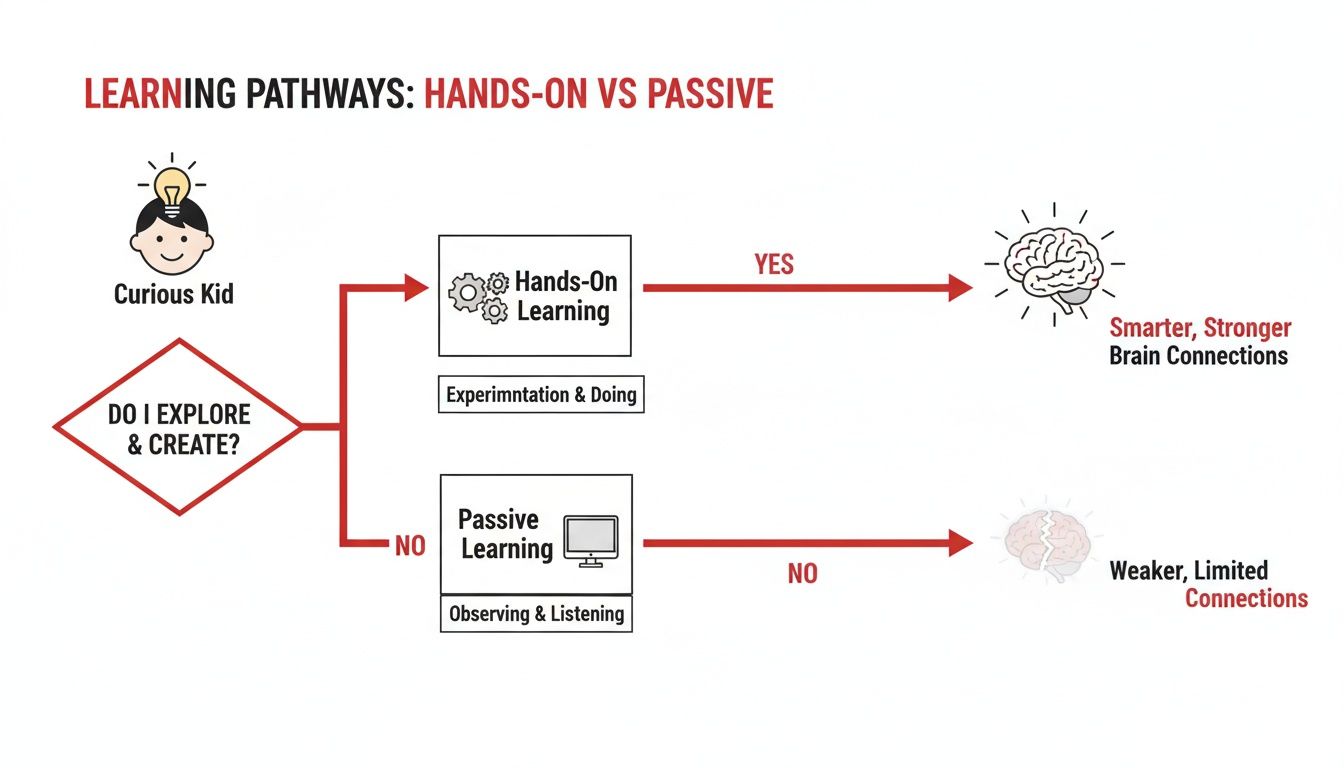
As you can see, getting their hands dirty helps kids build a smarter, more connected brain. By thinking through these four areas—developmental stage, interests, involvement, and safety—you can confidently pick the perfect science kit to kickstart a lifelong love of discovery.
Exploring the Different Worlds of STEM Kits
Today’s science kits have come a long way from the classic chemistry set. The modern landscape is a huge ecosystem of specialized kits, each designed to spark curiosity in a specific corner of the STEM world. From fizzing chemical reactions to programmable robots, there’s a perfect match for every kid’s passion.
This isn't just about fun and games; it's a major shift in how we approach playtime. The market for STEM toys, which covers everything from science kits to robotics, was recently valued at around USD 6 billion. That number is expected to more than double by 2034, all because parents and educators are recognizing the power of weaving technology and hands-on learning into play. You can dig into more details about the growth of the STEM toys market on gminsights.com.
So, how do you navigate this exciting world? It’s all about matching the right kit to the right interest. Let's break down the main categories to help you find the one that will make your child’s eyes light up.
Chemistry and Crystal Growing Kits: For Potion Masters
If your child is a natural "potion mixer" who loves watching colors change and creating something new out of simple ingredients, chemistry kits are a fantastic starting point. These kits are all about transformation, turning everyday substances into something spectacular. They make abstract concepts like acids, bases, and solutions real, tangible, and exciting.
Popular activities include:
- Colorful Slime Creation: A gooey, sensory-rich activity that teaches the basics of polymers.
- Fizzy Bath Bomb Making: A great introduction to acid-base reactions that results in a cool product they can actually use.
- Crystal Growing Projects: A beautiful lesson in patience and chemistry, showing how molecules arrange themselves into structured patterns over time.
These experiences turn your kitchen table into a safe and engaging laboratory, pulling back the curtain on the hidden science all around us.
Physics and Engineering Kits: For Natural Builders
Got a natural builder, tinkerer, or a kid who’s always asking, "how does that work?" Physics and engineering kits are a dream come true for them. These kits empower kids to build things that light up, move, and solve problems, demystifying the forces that govern our world—like gravity, electricity, and motion.
Think of these kits as a playground for the mind. They don’t just teach a principle; they let a child feel the laws of physics with their own hands, building a deep, intuitive understanding that no textbook can replicate.
A great physics kit lets a child snap together a simple circuit and see a bulb light up for the first time or build a small catapult to understand leverage. These hands-on activities are fantastic for developing spatial reasoning, logic, and problem-solving skills as they see firsthand how different pieces work together to create something that actually functions.
Biology and Earth Science Kits: For Nature Explorers
Does your child love digging in the dirt, watching insects, or learning about animals? Biology and Earth science kits create a direct connection to the living world. They bring huge concepts like ecosystems, geology, and botany down to a manageable, hands-on scale.
These kits are perfect for nurturing patience and a keen eye for observation. A kid can excavate cool minerals from a plaster block, learning about geology in the process, or build their own terrarium to watch a miniature ecosystem thrive. Other engaging options include:
- Volcano Eruption Kits: A classic for a reason! This experiment provides a thrilling visual of a chemical reaction while teaching basic geology.
- Plant Growing Sets: These offer a long-term look at a plant's life cycle, from germination all the way to photosynthesis.
- Insect Observation Habitats: Perfect for the budding entomologist to safely study bugs up close.
Technology and Robotics Kits: For Future Innovators
In a world that’s becoming more automated by the day, technology and robotics kits offer a friendly and empowering introduction to the fundamentals of coding, automation, and mechanical engineering. They transform kids from being passive consumers of tech into active creators. Even the most basic kits can lay a powerful foundation. For a deeper look at this category, you might find our guide on robotics kits for beginners helpful.
By building and programming a simple robot to follow a line or pick something up, a child learns logical thinking and sequencing in a way that feels like play. These kits are more than just toys; they are foundational tools that build the skills needed for future success in countless fields.
Setting Up Your At-Home Discovery Zone
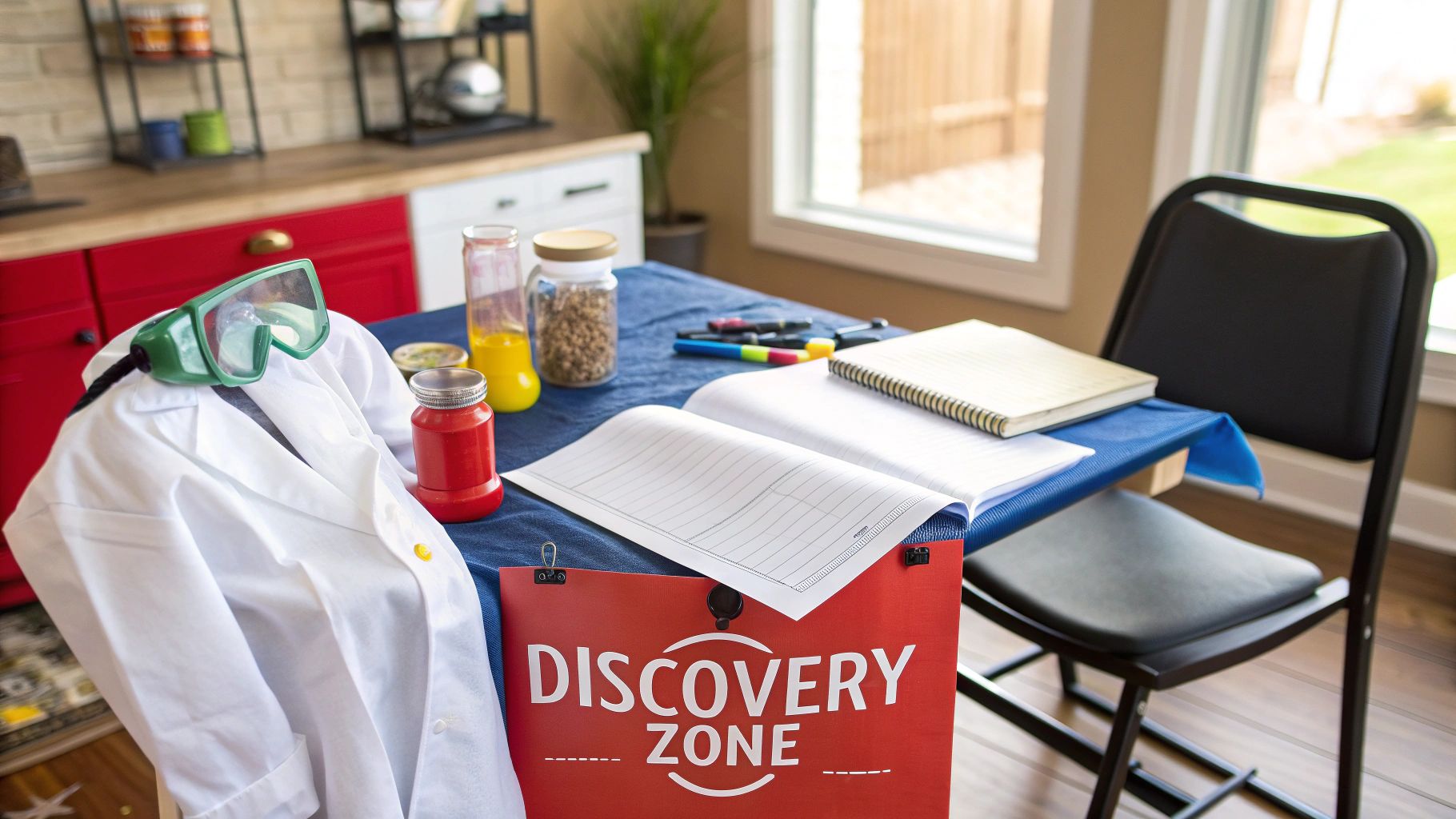
You don't need a pristine, white-walled laboratory to kickstart a genuine love for science. Some of the most amazing discoveries happen right at the kitchen table. The secret is creating a dedicated "Discovery Zone," which is less about having the perfect space and more about cultivating a mindset of curiosity and fun.
This simple act takes away the intimidation factor and makes you an enthusiastic partner in their scientific adventures. Your zone can be a small corner of the playroom, a specific shelf, or even a portable "lab-in-a-box." The goal is just to carve out a spot where it's okay to ask questions, make a mess, and see what happens.
Crafting Your Experiment Headquarters
The key to a great Discovery Zone is keeping it practical and accessible. Start by picking a surface that’s easy to clean. A simple vinyl tablecloth or an old shower curtain can instantly turn any table into a spill-proof workstation, ready for any fizz, foam, or accidental overflow.
Next up, organization. Keeping all the science kit materials in one spot means you can jump into an experiment without a frustrating 20-minute hunt for supplies. A clear plastic bin or a designated drawer works perfectly. For more great ideas on taming the clutter, check out our guide on how to organize a toy room—the tips adapt easily for science gear!
Actionable Tip: A well-organized space sends a clear message to your child: this is a place for discovery, and we are ready for it. It removes barriers and allows curiosity to take the lead.
This little bit of prep work builds excitement and makes science feel like a special event. It’s all part of creating a productive learning environment where kids feel empowered to explore.
Essentials for Your Discovery Zone
Gathering a few core items will make your science sessions run smoothly and add to the fun. You don’t need to buy expensive equipment; many of the best tools are things you probably already have lying around the house.
- Protective Gear: Safety goggles are a must for any experiment, and an old, oversized t-shirt makes the perfect "lab coat." This simple step helps kids feel like real scientists and reinforces important safety habits from day one.
- A Scientist's Notebook: Hand them a simple notebook and a pencil to jot down observations, draw what they see, or track their results. This introduces the core scientific practice of documentation in a fun, no-pressure way.
- Basic Tools: Keep things like paper towels, measuring cups, spoons, and a tray with a lip (to contain spills!) close by. These simple items empower your child to work more independently and manage their own experiments.
With just a little setup, you can create a space that practically begs for hands-on exploration. This preparation builds your confidence as a parent, turning any corner of your home into a launchpad for incredible scientific journeys with the best science kits for kids.
Frequently Asked Questions About Science Kits
Even after you've narrowed down the options, a few last-minute questions can pop up. Whether you're a parent trying to find the perfect fit or a gift-giver aiming for that genuine "wow!" moment, a little extra clarity goes a long way. Let’s tackle the most common questions we hear so you can feel totally confident in your choice.
What is the best age to introduce a science kit?
You can start much earlier than most people think. The secret isn't hitting a specific birthday but matching the activity to their developmental stage. It's about turning everyday play into a subtle science lesson.
For toddlers (ages 1-3), "science" is really just sensory exploration. Think about safe textures, bright colors, and simple cause-and-effect. Stacking blocks and splashing in a water table—that’s their first physics lab.
The preschool years (ages 3-5) are the sweet spot for introductory kits that feel like pure, unadulterated fun. This is the time for kits with big, easy-to-handle pieces, like a basic botany set for planting a seed, a color-mixing lab, or a bubble-making station. These activities build foundational skills without ever feeling like a lesson.
Are these science kits actually safe for home use?
Absolutely, as long as you stick with reputable brands and always follow the instructions. High-quality kits are designed with safety as the top priority, using materials and instructions that are specifically tested for kids to use at home.
Here’s a quick safety checklist:
- Check the Age Recommendation: This is your most important safety guide. It considers not just the complexity of the science, but also the size of the parts (to avoid choking hazards) and the motor skills needed.
- Look for Non-Toxic Materials: Good kits will always use non-toxic, child-safe materials or clearly labeled, safe-for-home chemicals.
- Prioritize Adult Supervision: This is the ultimate safety feature. Working on experiments together, especially those involving any kind of reaction or small pieces, creates a secure and supportive space for exploration.
A great science kit will always include the essentials, like safety goggles, and feature crystal-clear instructions with specific warnings right where you need them. That thoughtful design is what makes hands-on science an exciting and safe family activity.
How do I get my child interested if they dislike science?
The trick is to connect science to something they already love. Many kids who claim to "dislike science" are just picturing a boring textbook. You have to reframe it as a cool tool for exploring their real passions.
Think of their interests as a backdoor to learning. Instead of leading with the science, lead with the fun.
- For the Artist: A kit for growing colorful crystals or one that explores the chemistry of paints will feel like a creative project, not a science lesson.
- For the Future Chef: An edible chemistry kit that lets them whip up their own rock candy connects scientific principles directly to the fun of being in the kitchen.
- For the Gamer: A basic coding or robotics kit can capture their imagination by showing them how the digital worlds they love are actually built.
Try framing the activity around the action. Don't say, "Let's do a science experiment." Instead, try, "Want to build a mini-volcano that actually erupts?" By linking science to their world, you show them that it’s really just a powerful and creative way to play.
What should we do if an experiment fails?
First, don't panic! An experiment that doesn't go according to plan is one of the best learning opportunities you can possibly have. This is where real scientific thinking kicks in. It’s a chance to teach resilience and problem-solving in a fun, low-stakes environment.
Treat it like you're detectives solving a fun puzzle together. Resist the urge to just fix it for them. Instead, ask curious questions:
- "Hmm, that's not what we expected. What do you think happened?"
- "Let's look at the instructions again. Did we miss a step?"
- "Maybe one of our measurements was a little off. Should we try it again?"
This process is invaluable. It teaches critical thinking, attention to detail, and persistence—skills that are way more important than getting a perfect result on the first try. It also shows them that science is all about discovery, and unexpected outcomes are just part of the journey. That mindset turns potential frustration into a powerful and memorable lesson.
At Playz, we believe the best learning happens when you don't even realize you're learning. Our science kits are designed to spark curiosity, build confidence, and make complex topics feel like an adventure. Ready to turn "why?" into "wow!"?