


The best STEM toys for 5-year-olds are masters of disguise. They look like simple playtime fun but are secretly packed with brain-building power. Think of gravity-defying building blocks, fizzing and popping science kits, or colorful logic puzzles that get those little gears turning.
These aren't just toys; they are perfectly designed tools for this incredible developmental stage. They harness a child's natural curiosity and transform it into real-world skills like problem-solving and critical thinking—all without ever feeling like a lesson.
Why STEM Toys Are More Than Just a Buzzword
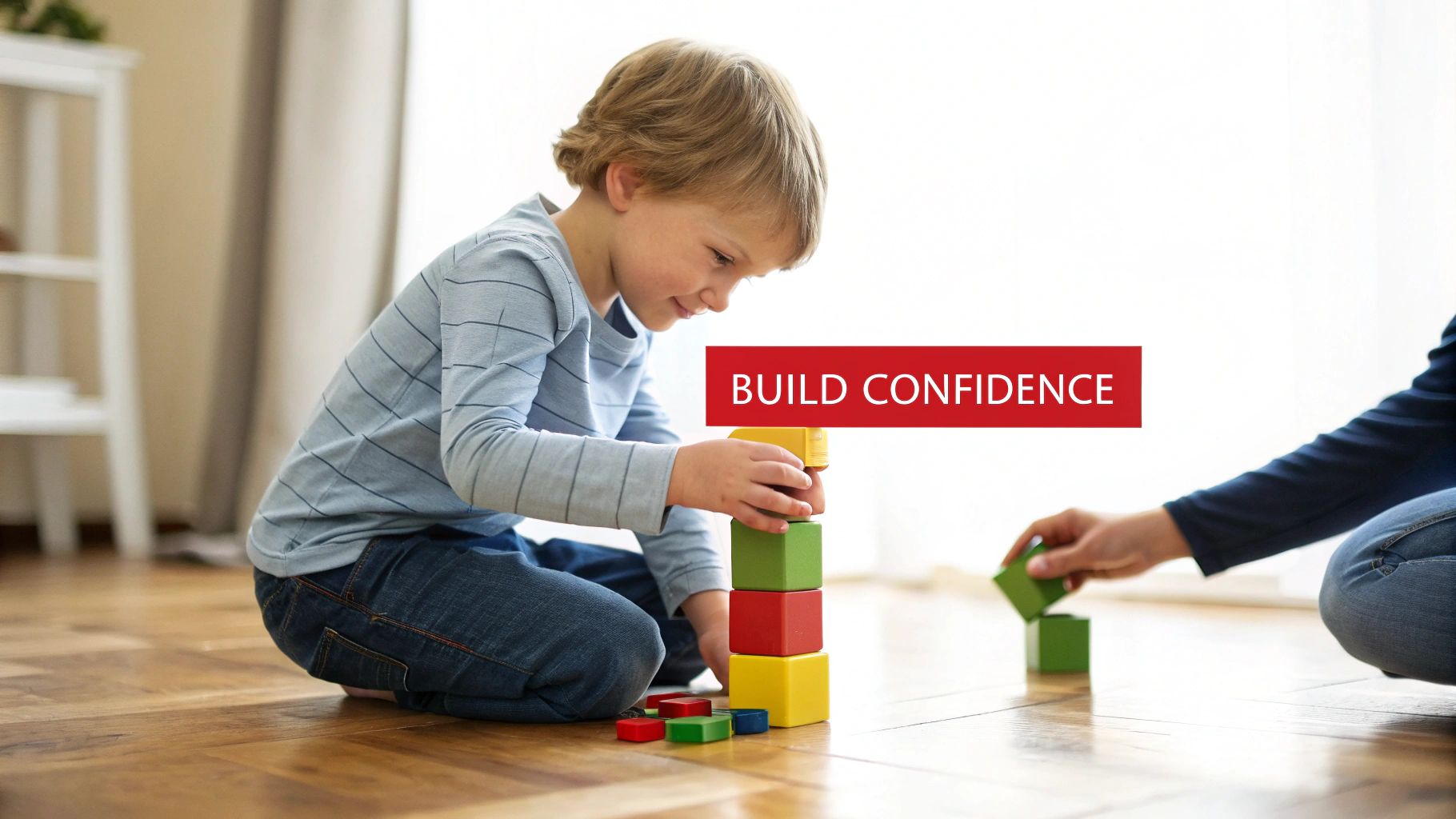
At five years old, a child's brain is a powerhouse, forging new connections every second as they figure out how the world works. Think of your kid as a master architect who just needs the right materials to build their understanding. STEM toys are those materials.
They ditch the "buzzword" label by providing tangible, hands-on experiences crucial at this age. When your five-year-old experiments with magnetic tiles or a simple volcano kit, they're not just having a blast—they're running tiny, real-world experiments in physics and chemistry.
Building a Foundation for Lifelong Learning
Every time they figure out how to keep a block tower from toppling or guess what will happen when they mix two paint colors, they’re learning about cause and effect. It's a natural cycle of trial, error, and discovery that builds something far more important than a tower: resilience and confidence.
These positive early experiences with problem-solving are priceless. They frame Science, Technology, Engineering, and Math not as intimidating school subjects, but as exciting ways to explore the world.
The best STEM toys for 5-year-olds make this happen by focusing on three key elements:
- Hands-On Exploration: Kids this age learn by doing. Tangible toys let them touch, manipulate, and see the immediate results of their actions.
- Nurturing Natural Curiosity: A 5-year-old’s endless stream of “why?” is the very foundation of scientific inquiry. STEM toys give them the tools to start finding their own answers.
- Developing Critical Thinking: These toys gently push kids to think ahead, plan their next move, and pivot when their first idea doesn’t work out.
Key Takeaway: A STEM toy’s true value isn't in the facts it teaches, but in the mindset it fosters—one of curiosity, experimentation, and the confidence to tackle any problem.
The Growing Importance of Playful Education
It's clear that parents are catching on to the power of purposeful play. The market for in-home STEM toys is expected to skyrocket by USD 7.26 billion between 2024 and 2029. Why? Because 75% of parents now prioritize toys that help prepare their kids for the future.
This huge shift shows a strong preference for screen-free options like building sets and beginner circuit kits that fuel genuine creativity. It’s a sign that parents view these toys not just as entertainment, but as vital investments in their child's development.
By choosing toys that match your child’s natural curiosity, you’re laying the groundwork for a future full of confident, excited learning. You can learn more about this powerful approach in our guide to play-based learning.
What Makes a Great STEM Toy for a 5-Year-Old?
Walking down the toy aisle can feel overwhelming. Every box shouts about its educational benefits, but how do you cut through the noise? When looking for the best STEM toys for 5-year-olds, it helps to have a game plan. The best toys aren't about flashy screens; they're about sparking natural curiosity and letting your kid feel like an inventor.
A truly great STEM toy is a launchpad for open-ended play. For a real-world example, think about the difference between a plain set of wooden blocks and a toy car that just moves forward. That car will always be a car. But in a single afternoon, those blocks can become a skyscraper, a bridge to another world, or a rocket ship. That versatility is gold because it encourages real creativity and problem-solving, not just passive entertainment.
The Power of Age-Appropriate Challenges
For a five-year-old, the sweet spot is a toy that offers a gentle challenge—enough to be interesting, but not so hard it leads to a meltdown. A toy that’s too simple gets boring fast, while one that’s too advanced just makes them feel defeated. The right toy meets them exactly where they are. If you want to better understand these crucial learning phases, our guide on childhood development milestones is a great resource.
This means you should look for toys with intuitive designs. For instance, magnetic tiles that snap together easily let a child focus on their awesome creation instead of struggling with tricky pieces. Success is a huge motivator. A well-designed toy serves up plenty of "I did it!" moments that build confidence and a love for learning.
Targeting Key Skills Through Tangible Play
Every great STEM toy is designed with a purpose. It's built to target specific skills vital for a kindergartener. Some toys focus on developing spatial reasoning as your child figures out how shapes fit together. Others might introduce the basics of logic and sequencing through simple coding games or pattern-matching activities.
The best options are often screen-free, giving kids a hands-on experience a tablet can't match. Tangible play engages more senses, which helps learning stick and builds deeper concentration. Feeling the texture of different materials or hearing the click of a piece snapping into place is a much richer experience than tapping on glass.
Actionable Insight: An effective STEM toy doesn't just teach a concept; it invites a child to discover it for themselves. It’s the difference between being told how a bridge works and being given the tools to build one.
When it comes down to it, the rules for picking great gifts and toys for children's birthdays also apply here. Safety, engagement, and developmental fit are non-negotiable. Always look for high-quality, durable materials that can stand up to enthusiastic play.
To make shopping easier, here is a quick checklist of what to keep in mind.
Quick Checklist for Choosing the Right STEM Toy
| Evaluation Criteria | Why It Matters for a 5-Year-Old | What to Look For (Real-World Examples) |
|---|---|---|
| Open-Ended Play | Encourages creativity and problem-solving instead of just following instructions. | Building blocks, magnetic tiles, art supplies, or anything without a single, fixed outcome. |
| Age-Appropriate Challenge | Builds confidence by being challenging but not frustrating. Avoids boredom. | Toys with "low floor, high ceiling" potential—easy to start but with room to grow. |
| Hands-On & Screen-Free | Engages multiple senses, which cements learning and improves focus. | Tactile materials like wood or sturdy plastic. Anything that encourages physical manipulation. |
| Targets Specific Skills | Purposefully develops key abilities like spatial reasoning, logic, or fine motor skills. | Clear labeling (e.g., "builds engineering skills") and obvious play patterns. |
| Durable & Safe | Withstands enthusiastic play and is made from non-toxic, child-safe materials. | Reputable brands, sturdy construction, and clear safety certifications. |
This table is a quick reference to help you spot the real winners on the shelf and choose a toy that truly sparks a love for learning.
Top Categories of STEM Toys for Curious Minds
Walking into a toy store can be overwhelming, with endless aisles promising the next best thing for your child. To cut through the noise and find the best STEM toys for 5-year-olds, it helps to break them down into a few key categories.
Each type is like a different playground, designed to strengthen specific skills while your child is just having fun. One toy might be perfect for building their engineering brain, while another taps into their inner scientist. Let's dig into the most effective types of toys out there.
This simple concept map breaks down the core qualities—open-endedness, age-appropriateness, and durability—that make any STEM toy a winner.
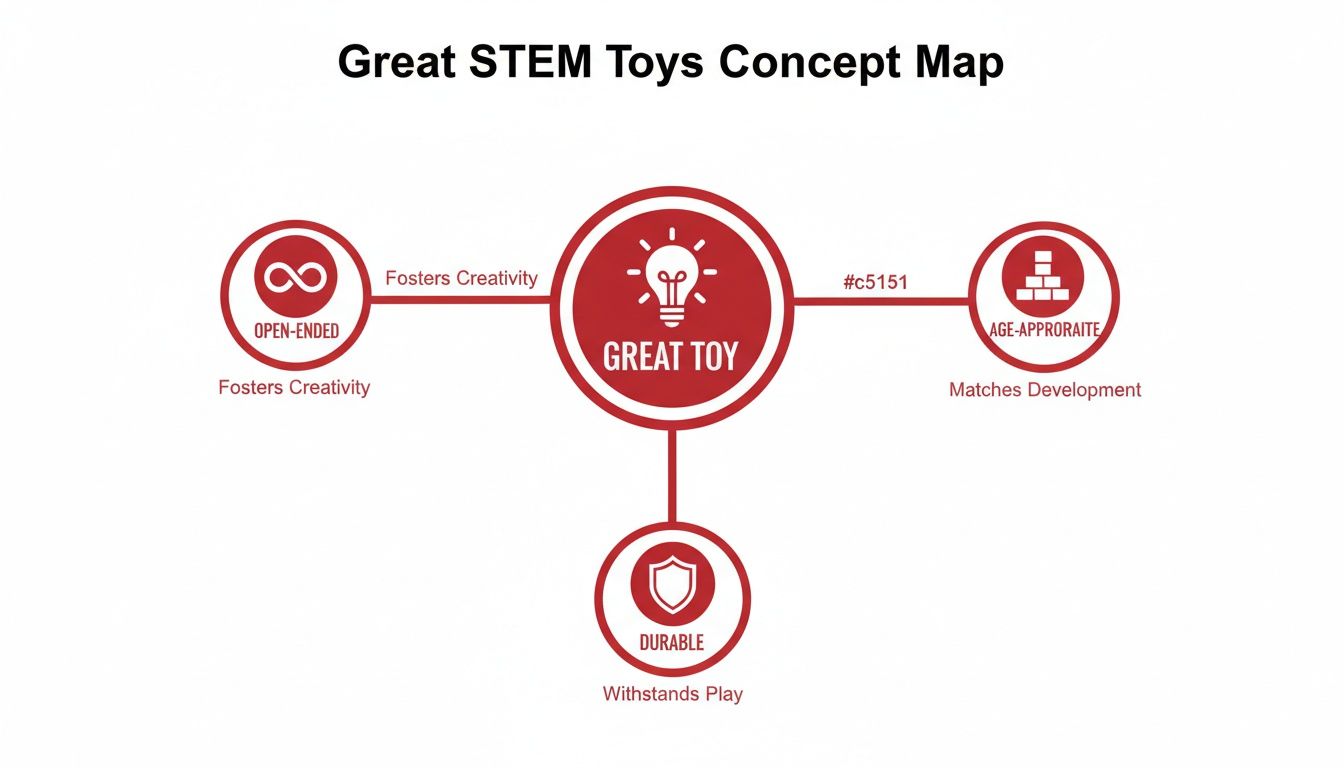
As you can see, the sweet spot is where these three ideas overlap. That's where you'll find a toy that sparks curiosity and holds up to hours of play.
Keyword-Rich Subheading: Building and Engineering Sets
Building and engineering sets are the classic, can't-go-wrong introduction to physics and design. Think of timeless wooden blocks or magnetic tiles. They are fantastic playgrounds for budding architects.
Every time a child stacks a tower, they get a hands-on lesson in balance, gravity, and stability. When they ask, "Why did my tower fall over?" they are in the middle of a physics experiment. This process of trial and error is priceless, teaching them to adapt their designs and test new ideas without fear of failure.
Keyword-Rich Subheading: Science and Exploration Kits
Science kits are awesome for turning your kitchen counter into a mini laboratory. For a 5-year-old, this doesn't have to be complicated. It could be a simple kit for growing a bean plant, excavating a "dinosaur" fossil, or mixing primary colors.
These kits nurture a child's natural curiosity and introduce the scientific method in a fun way.
- Observe: They watch a seed sprout over a few days.
- Hypothesize: They guess what will happen when they mix baking soda and vinegar.
- Experiment: They pour the vinegar and watch the awesome fizzy reaction.
This cycle builds a solid foundation for scientific thinking and shows them science isn't just in a book—it's something you do.
Keyword-Rich Subheading: Screen-Free Coding and Logic Toys
Coding might sound advanced for a kindergartener, but the best toys in this category are completely screen-free and surprisingly intuitive. They boil coding down to its core concepts: sequencing and logic. A popular real-world example is a toy where a child arranges command blocks to guide a robot mouse to a piece of cheese.
Key Takeaway: These toys teach children that big problems can be solved by breaking them down into small, manageable steps—a fundamental concept in both coding and life.
This kind of play is a powerhouse for strengthening critical thinking and planning skills. If your kid gets into building their own gadgets, our guide on robotics kits for beginners is a great next step.
Keyword-Rich Subheading: Math and Counting Toys
Finally, math and counting toys make abstract numbers feel concrete and fun. This category covers everything from colorful abacuses and counting bears to pattern blocks and simple board games with dice.
These toys help kids understand number recognition, basic addition, and shape identification because they can touch and move the pieces. When a child physically slides five beads on an abacus, the number "5" becomes a real, tangible thing. The global STEM toys market, which hit USD 6.83 billion in 2023, is packed with these foundational toys. They've been shown to improve spatial reasoning by up to 25%, making them a powerful tool for early learning.
Bringing STEM Learning to Life Beyond the Box
The true potential of a great STEM toy is unlocked when you take the fun beyond the instruction manual. Think of the toy as the starting point; the real magic happens when you and your child become co-discoverers.
Your role isn't to be the teacher with all the answers. You get to be the curious guide who sparks their imagination. By asking the right questions and offering fun new challenges, you can turn a simple play session into a memorable adventure.
Asking Powerful, Open-Ended Questions
One of the most powerful tools in your parenting toolkit is the open-ended question. Unlike questions that get a simple "yes" or "no," these queries invite your child to observe, predict, and think deeper.
Try weaving these prompts into your next playtime:
- "What do you think would happen if we tried it this way?"
- "Whoa, why do you think that worked so well?"
- "What did you notice right when you added that piece?"
- "How could we make this tower even stronger?"
These questions don't have a single "right" answer. Instead, they kickstart a conversation, encouraging your child to explain their reasoning. This simple habit is the foundation of the scientific method—observe, guess, test, and learn.
Actionable Insight: The goal is to celebrate the process of experimentation, not just the final product. When a block tower falls, it’s not a failure. It’s a data point for building the next, even better, one.
Extending Play with Creative Prompts
To keep things fresh, introduce new challenges that connect their toys to the world around them. Simple prompts can breathe new life into any STEM toy.
Consider these actionable ideas to stretch their imagination:
- Nature Walk Integration: Take a science kit on a nature walk. Challenge your kid to use the magnifying glass to inspect different leaves or to classify rocks by texture and color.
- Structural Integrity Tests: Got building blocks? Pose a fun design challenge. Ask, "Can you build a bridge that's strong enough to hold this toy car?" or "Let's see which tower design can withstand a gentle breeze from a fan."
- Real-World Connections: If they build something with magnetic tiles, connect it to real architecture. You could say, "Wow, that looks like the skyscraper we saw downtown! What makes it so tall and strong?"
By joining in and offering these prompts, you empower your child to think more deeply. For parents interested in more structured programs, you can explore options like these top STEM education platforms.
For more inspiration on turning everyday moments into learning opportunities, check out these other hands-on science activities you can do at home.
How to Choose Your Child's First Science Kit

Science kits are a fantastic way to dip your child’s toes into the world of STEM. They take abstract ideas and turn them into a real-life magic show. For a 5-year-old, the right kit isn't just a toy—it's their first laboratory, packed with the thrill of discovery.
These kits are perfectly designed to introduce the scientific method without your child knowing they're learning it. They get to observe, guess, test, and learn, all while having a blast. Instead of reading about a chemical reaction, they get to cause one. That’s how you create powerful, positive first memories with science.
The Magic of a Simple Experiment: A Real-World Example
Think about the classic baking soda and vinegar volcano. It’s so much more than a fizzy mess; it’s a full-circle learning moment wrapped up in a few minutes of pure joy.
- Observe & Guess: Your child sees two ordinary kitchen items. You ask, "What do you think will happen when we mix these?" That simple question plants the seed for their first hypothesis.
- Test & Learn: They pour the vinegar, and whoosh! The volcano erupts. They see the cause and effect happen right before their eyes—a hands-on lesson that sticks far longer than a verbal explanation.
This process is invaluable. It teaches kids that experimenting is exciting. There are no "failures," only discoveries, which builds the confidence they need to tackle problems without fear.
Key Takeaway: Choosing the right science kit is less about complexity and more about the joy of discovery. The goal is to make science feel like an amazing superpower your child is just starting to unlock.
What to Look For in a First Science Kit
When you're browsing science kits, think clarity and engagement. The instructions should be heavy on pictures, and the materials need to be safe and easy for little hands to manage. For a deeper dive, check out our guide to the best science kits for kids.
The market for STEM toys aimed at the 4-7 age group hit a massive USD 5.1 billion in 2024. This boom is fueled by parents who know that 80% of brain development happens by age 5. Plus, credible studies show kids who use these toys have 30% better concept retention. A great first kit makes learning real, tangible, and fun.
FAQ: Answering Common Questions About STEM Toys
Diving into educational toys can feel overwhelming. You want to pick the perfect thing, but the options are endless. Let's tackle some of the most common questions parents have about finding the right STEM toys for their five-year-olds.
Are STEM Toys Too Advanced for a 5-Year-Old?
Not at all! The best STEM toys for this age are cleverly designed to meet them where they are. They skip the jargon and use hands-on, playful experiences to introduce big ideas in a way that just feels like fun.
For a five-year-old, a "STEM toy" isn't a complex robotics kit. Real-world examples include colorful magnetic tiles for building forts, a simple circuit kit with chunky, snap-together pieces, or a garden set for watching a seed sprout. The point is to tap into their natural curiosity through activities they already love.
How Can I Get My Child Interested in STEM Toys?
The secret is to connect the toy to something they're already obsessed with. If your kid loves dinosaurs, a fossil excavation kit is a guaranteed win. If they love fantasy stories, use building blocks to construct magical castles.
Getting involved yourself is the other magic ingredient.
- Play alongside them. Open the box and explore it together without pressure.
- Be curious out loud. Your interest is contagious. Ask, "Hmm, I wonder what would happen if we tried this?"
- Celebrate the process, not just the result. A wobbly tower that falls down is a great learning moment, not a failure.
It’s never about forcing a "lesson." It's about showing them that discovering and building are just new ways to play.
How Do I Balance STEM Toys with Other Kinds of Play?
A healthy play "diet" for a five-year-old is all about variety. STEM toys are fantastic for building critical thinking, but imaginative, social, and physical play are just as crucial.
Think of STEM toys as one essential food group. One afternoon might be about engineering a block tower (STEM), while the next is dedicated to a tea party for stuffed animals (social-emotional skills). These types of play often blend together naturally.
Key Takeaway: A great play routine isn't about picking one type of toy over another. It's about creating a rich environment where a child can build a tower, paint a picture, and run outside—all in the same day.
What Is the Difference Between STEM and STEAM Toys?
This is a great question. STEM stands for Science, Technology, Engineering, and Math. STEAM just adds an "A" for Arts.
Why the "A"? It recognizes that creativity and design are a huge part of innovation. For a five-year-old, the distinction barely matters because their play naturally blends both. A good set of building blocks is a STEAM toy by default—it involves engineering to make a structure stable, but also creative design to make it look cool.
Ultimately, the label on the box is far less important than the quality of play it inspires. The best toys encourage your child to be creative, curious, and inventive.
At Playz, we believe the most powerful learning happens when kids are just having fun. Our science kits and creative toys are designed to spark that natural curiosity and turn playtime into an adventure of discovery.
Ready to find the perfect toy to inspire your little innovator? Explore our collection of engaging, hands-on STEM kits at playzusa.com and start building a love for learning today.