

The best learning toys for 6-year-olds are those that match their incredible developmental leap, blending fun with foundational skills in STEM, creativity, and problem-solving. Top choices include open-ended science kits that spark curiosity, versatile building and construction sets that teach physics in disguise, and imaginative artsy toys that challenge their growing minds while keeping them glued to the action.
The Power of Play in a Six-Year-Old's World
Welcome to the wild and wonderful world of the six-year-old. This is a huge year—a time when their boundless curiosity finally meets some real-deal capability. If you're hunting for the perfect educational toy, you've already noticed that something special is happening. They're graduating from playing next to friends to collaborating on complex problems, thinking logically, and building genuine social bonds.
At six, kids aren't just playing anymore; they're experimenting, testing theories, and bringing their own ideas to life. A pile of building blocks suddenly becomes a hands-on lesson in physics and structural engineering. For example, when they discover that a wider base makes their tower stronger, that’s a real-world physics lesson. This is the magic of purposeful play—where having fun and learning are one and the same.
Why Purposeful Play Matters Now More Than Ever
In a world overflowing with digital distractions, fostering a love for hands-on activities is more important than ever. The right toys are powerful tools for growth, offering a much-needed (and way more beneficial) alternative to screen time. They don't just entertain; they help build skills that last a lifetime.
- Builds Critical Thinking: A construction set or simple coding game teaches them to think through a problem—like how to build a bridge that won't collapse—and find a solution on their own.
- Encourages Social Skills: Collaborative toys, like a large-scale building project, create the perfect space for learning about teamwork, sharing, and clear communication.
- Sparks Lifelong Curiosity: Hooking a child's natural interests with a Playz science kit can ignite a passion for learning that goes far beyond the playroom.
Key Takeaway: The real value of a toy isn’t just in what it does, but in what it empowers a child to do. The best learning toys for 6-year-olds act as a launchpad for their incredible imagination and intellect.
This shift toward meaningful, hands-on engagement is at the heart of play-based learning. You can dive deeper into the benefits of play-based learning in our detailed guide, which breaks down exactly how these activities shape a child's cognitive and emotional growth. The goal is to find toys that don’t just fill their time but enrich their minds.
Understanding Your Six-Year-Old's Developmental Milestones
Six is a magical age. It’s that sweet spot where the world really starts to click into place for your child. They're moving beyond simple, repetitive play and stepping into a new phase of complex thinking, deeper friendships, and seriously impressive physical skills.
Getting a handle on these developmental milestones is the secret to choosing toys that don’t just fill an afternoon but truly support their incredible growth.
Cognitive Leaps: The Age of "Why" and "How"
This is the year of "why" and "how." Cognitively, six-year-olds are starting to connect the dots and grasp the concept of cause and effect. They can now follow multi-step instructions (like “go to your room, grab your blue backpack, and meet me by the door”) and have a much longer attention span, which is perfect for bigger, more involved projects.
This cognitive leap is what makes the best learning toys for 6 year olds so powerful. A building set is no longer just about stacking blocks; it’s a hands-on lab for learning about balance, gravity, and spatial reasoning. In the same way, a science kit encourages them to form a hypothesis ("What will happen if I mix these two things?"), test it, and see the results for themselves.
The Social and Emotional Journey: Learning to Connect
Socially, your six-year-old is becoming a true friend. They are genuinely learning to share, take turns, and navigate the sometimes-tricky world of peer relationships. This is also when they start to understand rules in games and the importance of fairness, which can lead to some very passionate debates about what’s "fair"!
Emotionally, they're developing a stronger sense of who they are and are beginning to understand others’ feelings with more empathy. This is a crucial time for building emotional intelligence.
Pro-Tip: A huge part of this stage is learning to be resilient and stay positive when things get tough. Toys that encourage teamwork and problem-solving help them practice working through frustration and celebrating successes with others.
Nurturing a growth mindset is another key milestone for 6-year-olds, as it shapes how they see challenges and learning. If you're looking for practical ways to build this at home, these growth mindset lesson plans have some fantastic activities for families.
Growing Physical Skills and Coordination
Physically, your six-year-old is getting more agile and coordinated by the day. Their fine motor skills are becoming much more refined, allowing them to handle smaller, more intricate objects with confidence. This is why they can now master complex building toys, craft kits that require precision, and even some science experiments with smaller components.
Here’s a quick snapshot of how these developmental areas all tie together.
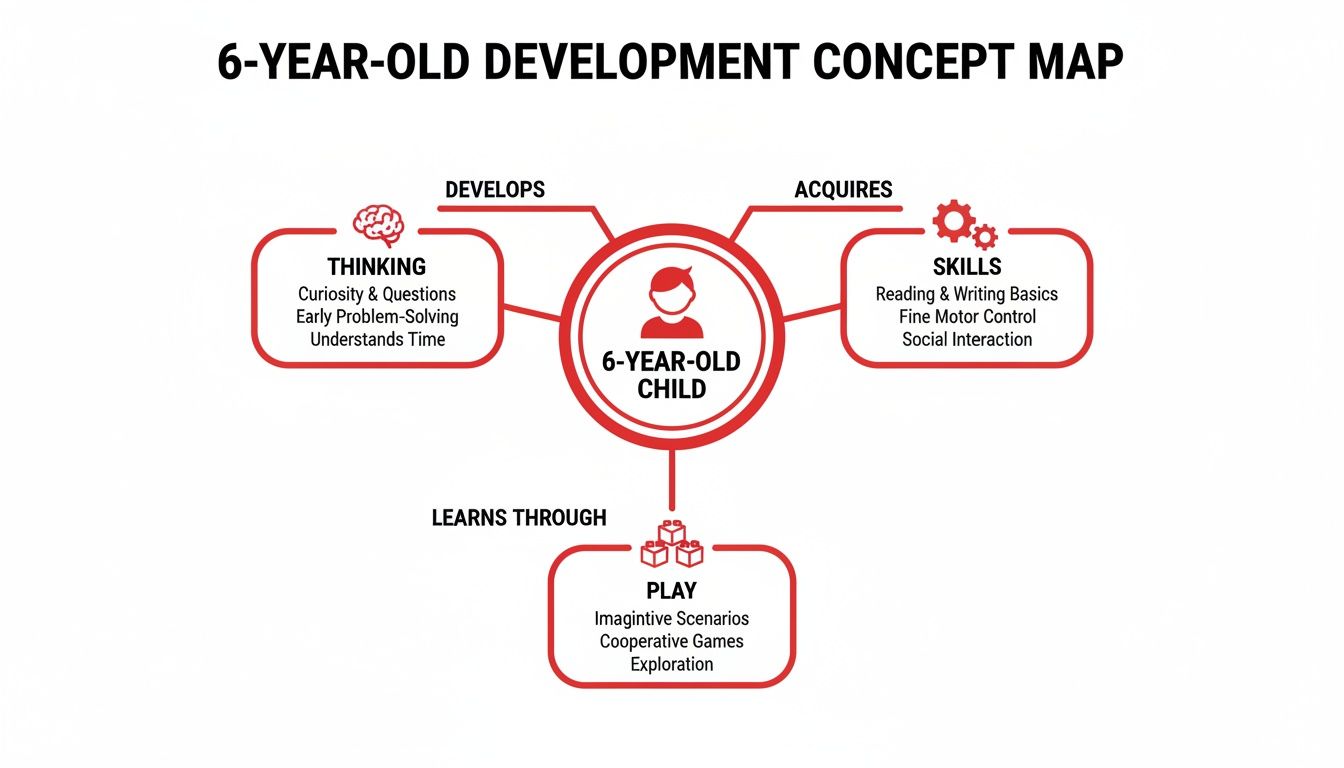
This map shows how thinking, skills, and play aren't separate things—they’re all interconnected, forming the foundation of your six-year-old's development.
To make this connection even clearer, this table breaks down how specific types of toys align with these key growth areas.
Matching Toys to a 6-Year-Old's Milestones: A Quick Guide
| Developmental Area | Key Milestones | Supported By These Toy Types |
|---|---|---|
| Cognitive | Grasping cause & effect, longer attention span, multi-step problem solving. | STEM kits, strategy board games, complex puzzles, coding toys. |
| Social-Emotional | Learning to share, take turns, understand rules, and show empathy. | Cooperative board games, role-playing sets, large group building projects. |
| Fine Motor Skills | Improved dexterity, better hand-eye coordination, ability to handle small parts. | Intricate building blocks, craft kits (beading, clay), science experiment tools. |
| Gross Motor Skills | Developing balance, strength, and agility in large movements. | Outdoor exploration kits, sports equipment, active games, ride-on toys. |
By seeing toys not just as fun objects but as partners in development, you can make powerful, informed choices that really count.
If you want to dive deeper into what to expect at each stage, check out our comprehensive guide on childhood development milestones. This knowledge will help you choose toys that perfectly match where your child is right now—and where they're headed next.
How to Choose the Right Learning Toys for Your Child
Alright, now that we've covered all the incredible developmental leaps happening in your six-year-old's world, let's get practical. Walking into a toy aisle can feel overwhelming. But with a clear game plan, you can spot the perfect toy like a seasoned pro. This isn't just about finding something to keep them busy; it's about investing in tools that will genuinely support their growth for years to come.
The trick is to look past the flashy packaging and zero in on a toy's real potential. By keeping a few core principles in mind, you can confidently choose the best learning toys for 6 year olds that pack a real educational punch.
Tip 1: Look for Open-Ended Play Potential
If I could give you only one piece of advice, it would be this: look for versatility. Does the toy do one thing, or can it do a hundred? That's the heart of open-ended play, where your child—not the toy—is calling the shots.
Think about it. A single-function electronic toy might hold their attention for an afternoon as they follow its pre-programmed rules. But a great building kit can become a towering castle one day, a futuristic spaceship the next, and a wild marble run the day after that. The building kit offers an endless runway for creativity and problem-solving, making it a much smarter investment.
Toys that champion this kind of imaginative play are critical for fostering independent thinking. They challenge kids to invent their own stories, solve their own puzzles, and even make up their own rules.
Tip 2: Prioritize Skill Building and Engagement
Every fantastic learning toy has a mission, even if it’s cleverly disguised as fun. The question to ask is, what skill is this toy building?
This is where knowing those developmental milestones really pays off.
- For Fine Motor Skills: Look for toys with small, intricate parts like building sets or detailed craft kits.
- For Critical Thinking: Science kits, strategy board games, or logic puzzles are your best friends.
- For Social Skills: Cooperative games or large-scale role-playing sets that encourage teamwork are perfect.
But skill-building is only half the battle. The toy also has to be genuinely fun. Let's be honest, it needs a serious "wow factor" to compete with screens. It should spark so much curiosity that your child can't wait to play with it again and again.
Key Takeaway: The sweet spot for a great learning toy is the intersection of fun and function. It should be so captivating that your child doesn't even realize they're mastering new skills.
Tip 3: Ensure Safety and Durability Above All Else
Finally, let's get practical. Safety and durability are completely non-negotiable. At six, playtime can still get pretty rowdy and experimental, so toys need to be tough enough to handle it.
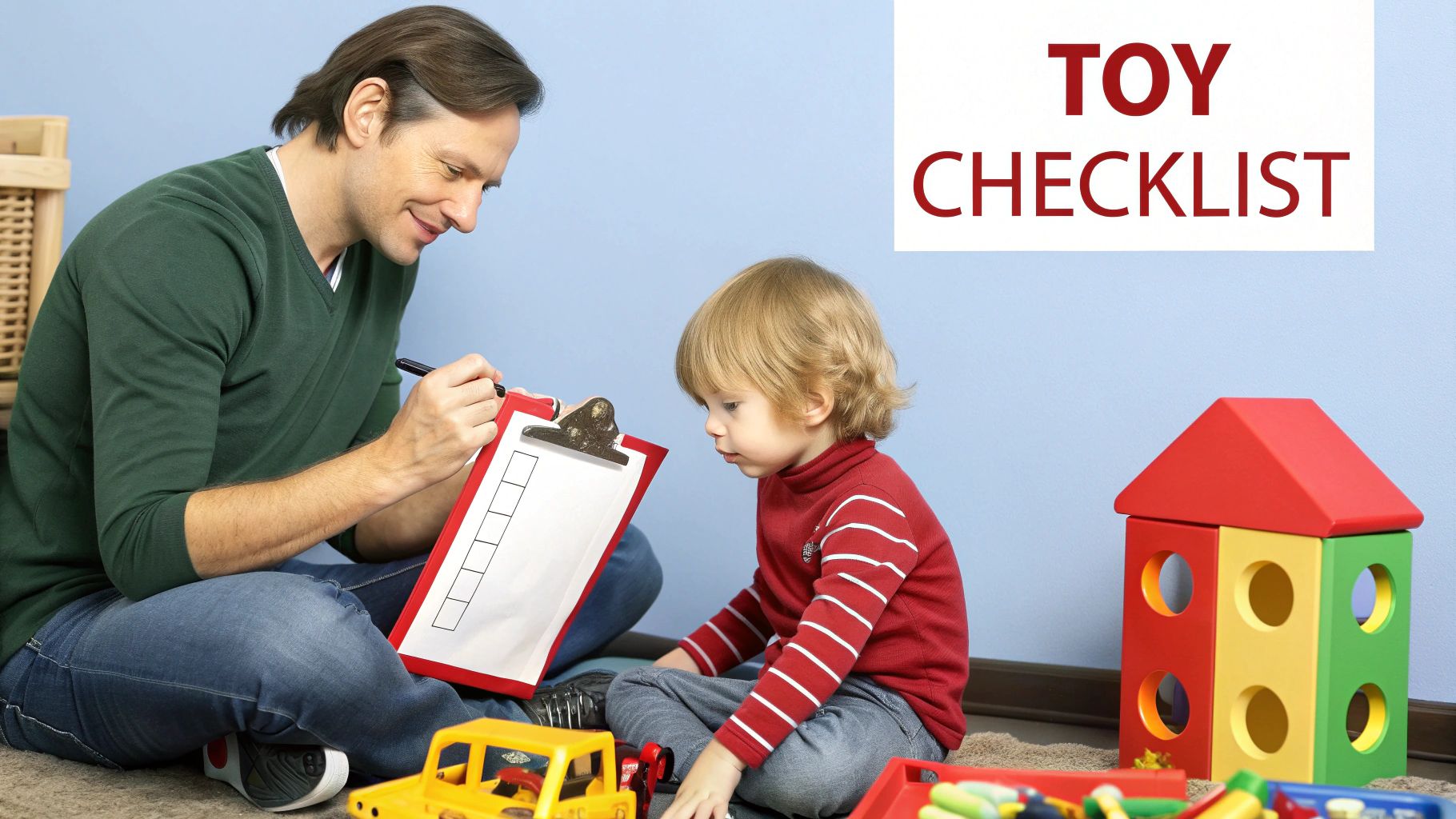
Here’s a quick checklist for quality and safety:
- Age-Appropriate Labels: Always check for the "6+" label. This means the toy has been specifically tested and deemed safe for this age group.
- Non-Toxic Materials: Stick with reputable brands that make it a priority to use high-quality, safe plastics, woods, and paints.
- Sturdy Construction: Give it a little shake. Avoid anything flimsy that could easily break, creating sharp edges or small, hazardous pieces.
A well-made toy from a trusted brand like Playz is not only safer but ends up being a better value because it can withstand years of enthusiastic play. If you're looking for a broader overview of different toy categories, you can find more inspiration in our guide to the best educational toys for kids. Armed with this checklist, you're ready to make smart, impactful choices for your child's playroom.
Exploring the Top Categories of Learning Toys
Now that you have a solid checklist for picking the right toys, let’s get to the fun part—exploring the top categories that are a perfect match for six-year-olds. The world of educational toys is huge, a clear sign of a big shift in how we think about play. It’s not just about passing the time anymore; it’s a core part of how kids grow.
Just look at the global educational toys market. It was valued at a massive USD 66.22 billion and is expected to climb to USD 126.02 billion by 2032. That kind of growth tells you something important: parents and educators are all-in on toys that teach real skills like problem-solving, creativity, and coordination.
With so many great options out there, we can break them down into a few key categories. Each one offers something unique for their curious, fast-growing minds.
STEM and Science Kits for Budding Innovators
At six, a kid’s curiosity is firing on all cylinders. They are natural-born scientists, always hitting you with the "why?" and "how?" questions. This is why STEM (Science, Technology, Engineering, and Math) toys and science kits are such a slam dunk. These aren't just playthings; they're hands-on experiments that make big ideas feel exciting and totally understandable.
A good science kit can turn your kitchen table into a buzzing laboratory. Instead of just reading about chemistry, your kid is mixing ingredients to make a volcano erupt or growing their own stunning crystals. This process teaches so much more than just the science itself.
- Critical Thinking: They learn to follow steps, guess what might happen next, and figure out why it did (or didn't).
- Problem-Solving: When an experiment fizzles, they have to backtrack and troubleshoot. That’s a huge lesson in resilience.
- A Love for Learning: Most of all, it frames science as a thrilling adventure, not just another school subject.
These moments are what the #KidsLearnBestThruPlayz philosophy is all about, proving that learning can be the best part of their day. For more ideas on sparking that scientific curiosity, check out our in-depth guide to the best STEM toys for kids.
Building and Construction Toys for Future Architects
Building and construction toys have been around forever, and for good reason. From classic wooden blocks to complex magnetic tiles or interlocking bricks, these toys are absolute powerhouses for developing a child’s brain and body. For a six-year-old, they offer the perfect level of challenge for their growing patience and improving fine motor skills.
When your child is building a tower, they’re doing a whole lot more than just stacking pieces. It’s a full-on mental workout.
Key Takeaway: Every structure they create is a mini-lesson in physics, geometry, and structural integrity. They learn about balance, symmetry, and cause-and-effect every time a tower wobbles or a bridge holds strong.
This kind of play also builds some serious grit. That first attempt at a magnificent castle might come crashing down, but the real learning happens when they decide to try again, tweak the design, and finally make it work. It's how you build a growth mindset, right there on the living room floor.
Creative and Artsy Toys for Little Storytellers
While STEM and building toys flex the logical muscles, creative and artsy toys are just as vital for nurturing a child's emotional and expressive side. At six, kids are creating rich inner worlds and spinning complex stories in their heads. Toys like modeling clay, paint sets, puppet theaters, and even basic craft kits give them a way to bring all those amazing ideas into the real world.
These toys empower them to:
- Express Themselves: Art gives kids a safe and powerful outlet for feelings and ideas that are often too big for words.
- Develop Fine Motor Skills: The delicate movements needed for drawing, using safety scissors, or sculpting clay are fantastic for sharpening hand-eye coordination.
- Boost Imagination: A blank sheet of paper or a lump of dough has endless possibilities, pushing them to think creatively and bring their unique visions to life.
And let’s not forget about books. Reading is a powerhouse for sparking imagination and building vocabulary. If you’re looking for some great, age-appropriate reads, you can explore the best books for 6 year olds that are a hit with both parents and kids.
Active and Outdoor Play for Healthy Bodies
Finally, let’s get moving! We can't overlook how important active and outdoor toys are for developing gross motor skills—the big muscle movements needed for running, jumping, climbing, and throwing. A six-year-old is a bundle of energy, and that energy needs somewhere positive to go.
Toys that get kids physical do more than just tire them out. They help improve balance, coordination, and overall physical confidence. It could be as simple as a ball or a jump rope, or something more involved like an outdoor explorer kit. Whatever it is, these toys lay the foundation for a healthy, active lifestyle. This kind of physical play is also directly tied to better focus in the classroom, proving that a healthy body really does support a healthy mind.
Making Learning an Adventure with Playz Toys
Picking out the right learning toy is a great start, but it's just that—a start. The real magic happens when you turn that toy into a shared experience. With just a little creativity, a Playz toy can be the star of an unforgettable family adventure, making playtime a serious learning opportunity. This is how you go beyond the box and create memories that stick.
There's a good reason educational toys are booming right now. Parents are catching on to the real value of play. In North America, which makes up a massive 38.09% of the market, parents aren't just buying toys; they're investing in skill-builders. They want toys that foster everything from brain development to resilience. You can read more about this growing trend over at Global Toy News.
This whole trend just confirms what most of us already know deep down: the right toys, used the right way, can make a huge difference.
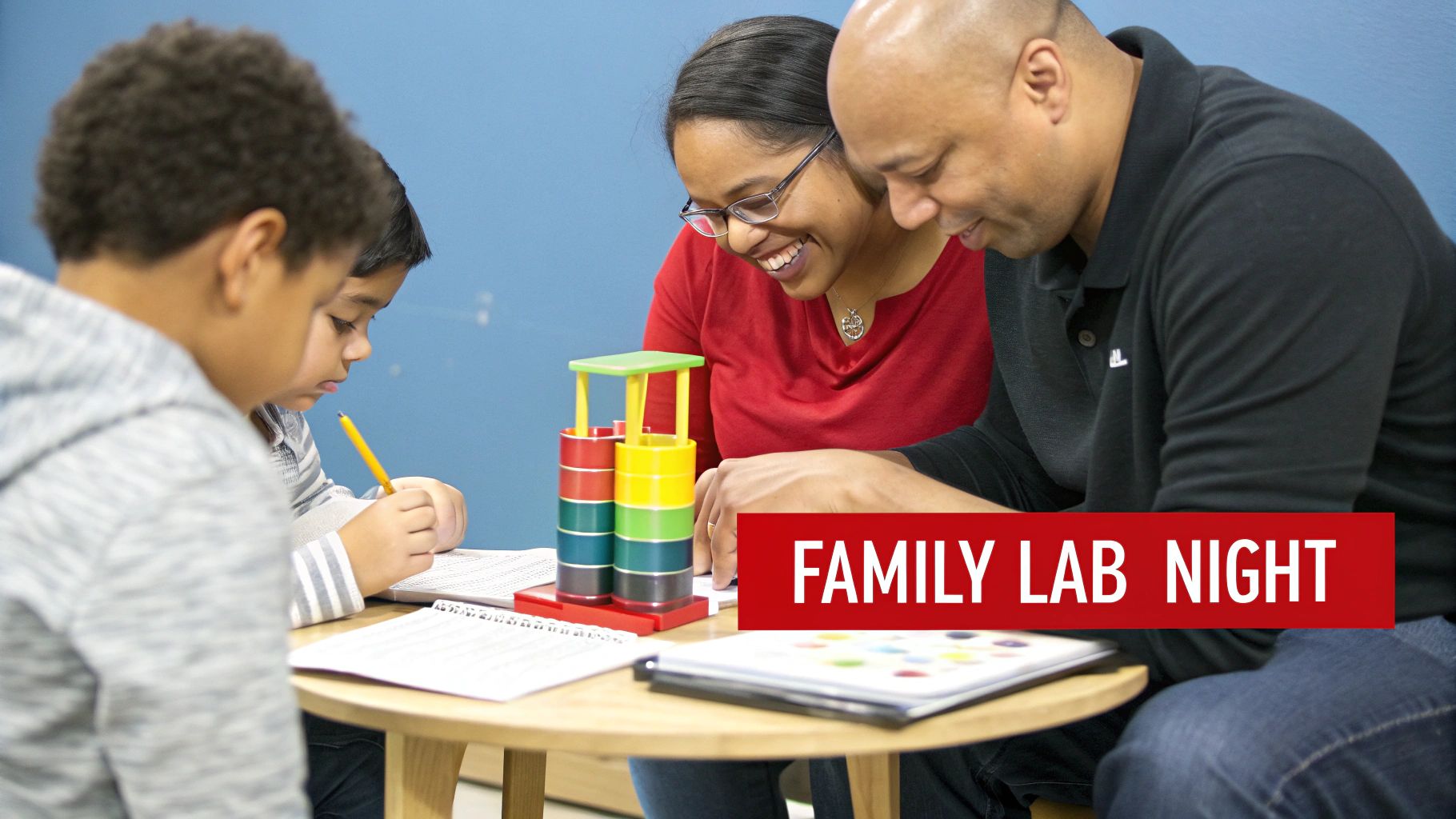
Actionable Tip 1: Turn Science Kits into Family Lab Nights
A Playz science kit is so much more than a box of materials and instructions; it's an open invitation to get curious. Instead of just handing it over, why not turn it into a weekly "Family Lab Night"? That simple change in framing transforms a solo activity into a collaborative event everyone looks forward to.
Here’s a practical example:
- Assign Roles: Let your child be the "Lead Scientist" (reading the steps), you be the "Lab Technician" (measuring and mixing), and a sibling be the "Observer" (taking notes on what happens).
- Ask Good Questions: Keep the curiosity flowing with open-ended questions. Try things like, "What do you think will happen next?" or "Why did it fizz up like that?"
- Document Everything: Give your child a "lab notebook" to draw their observations. This is a sneaky way to practice writing, sequencing, and the basics of scientific documentation.
This approach isn't just about the experiment; it's about teamwork, communication, and making big science concepts feel fun and manageable. It's about enjoying the process of discovery, not just getting the "right" answer.
Actionable Tip 2: Use Play Tents as Creative Retreats
An imaginative play tent is one of the most versatile toys you can own. Think of it as a blank canvas for your kid's imagination. Sure, it can be a castle or a spaceship, but it can also be a special place for quiet, focused activities that build totally different skills.
Pro-Tip: By making the play tent a "Reading Retreat" or a "Storytelling Stage," you create magic around literacy and self-expression. The novelty of the space makes these activities feel less like homework and more like a special treat.
For example, toss in some comfy pillows and a flashlight, and you've got the coziest reading nook ever. Reading by flashlight can make a story feel ten times more exciting. Or, use it as a stage for a puppet show, letting your child build narrative skills by inventing characters and plots from scratch.
Actionable Tip 3: Maximize Construction Sets for Storytelling
Building toys are champs at developing spatial reasoning and fine motor skills, but their potential doesn't end there. It's easy to stretch their educational value by mixing in some storytelling and writing. Once your six-year-old has built an amazing structure, use it as a launchpad for their imagination.
Get the story started with a few simple questions:
- Who lives in this incredible castle you built?
- What big adventure is about to happen here?
- If this spaceship could go anywhere, where would it go first?
For an extra layer, have them write down a short story about their creation. This activity seamlessly connects the logical, hands-on act of building with the creative, abstract skill of storytelling. It’s a perfect example of whole-brain learning, all disguised as fun. You can find plenty of these versatile Playz toys suitable for kids ages 5-7 to kickstart your own learning adventures.
FAQ: Your Questions About Learning Toys Answered
Diving into the world of educational toys can feel a bit overwhelming. You want what's best for your kid's brain, but you also don't want to kill the fun. It’s a balancing act! Let's clear up some of the most common questions parents have, so you can feel good about the toys you bring into your home.
How can I balance screen time with educational toys?
This is the big one, isn't it? The goal isn't to demonize screens entirely, but to make hands-on play so awesome that it becomes the preferred choice. The secret is shifting "toy time" from a solo mission to a special, shared event.
First, set clear and consistent limits around screens. Kids thrive on predictability. Then, carve out dedicated "play sessions" where you introduce a cool new building challenge or a fizzy science experiment. Your enthusiasm is the magic ingredient; when you're genuinely into it, a toy transforms into a collaborative adventure that no tablet can compete with.
Think about it this way: instead of saying, "Go play with your toys," try, "Hey, let's see if we can build the tallest tower ever!" That simple switch changes the whole dynamic, framing hands-on play as valuable family time.
Are expensive smart toys better than traditional ones?
Not necessarily. While some high-tech gadgets look impressive, they often have rigid, pre-programmed play patterns that can limit creativity and problem-solving.
| Smart Toys (Pros & Cons) | Traditional Toys (Pros & Cons) |
|---|---|
| Pros: Can teach specific skills like coding basics. Often highly engaging. | Pros: Open-ended, fostering creativity. Builds a wider range of skills. |
| Cons: Can be expensive. Often have limited, single-purpose use. Can limit imagination. | Cons: May require more parental involvement to get started. |
Key Takeaway: The true value of a toy isn't in its price tag or circuit board. It's in its ability to spark imagination and adapt to whatever your child dreams up. An open-ended toy gives you a much better return on investment with its endless play possibilities.
What if my child isn’t interested in STEM toys?
That’s totally fine! In fact, that disinterest is valuable information. The absolute best learning toy for a 6 year old is one that taps into what they already love. Trying to force a toy that doesn't click will just end in frustration.
The trick is to follow their lead and sneak the learning into their existing passions.
- For the Artist: Got a kid who loves to draw? Look for advanced craft kits that subtly teach color theory or design.
- For the Storyteller: If their imagination runs wild, give them tools to build their worlds, like puppet theaters or costume sets.
You can also build a bridge from their interests straight to STEM. For a child who loves collecting beautiful rocks, a Playz crystal-growing kit is a perfect example of how science can create something truly stunning. The key is making learning feel like a natural extension of their favorite things, not a separate chore.
How do I make sure the toys I buy are safe?
Safety is non-negotiable. Always buy from reputable brands that follow strict safety standards. Check the packaging for an age-appropriate label (like "6+"), which tells you the toy has been tested for that developmental stage.
Next, do a quick physical inspection:
- Materials: Make sure it's made from durable, non-toxic materials.
- Construction: Feel for any sharp edges or pointy bits that could cause a scrape.
- Small Parts: While a six-year-old is generally past the choking-hazard stage, be mindful if younger siblings are around.
- Supervision: For kits with many tiny pieces or chemicals (like in some science kits), ensure they're only used with adult supervision.
Finally, get in the habit of checking your child's toys every so often for wear and tear. A well-made toy isn't just about lasting longer—it's a critical part of keeping your kid safe while they learn and play.
Ready to make learning an unforgettable adventure? The Playz collection is designed to spark curiosity, build confidence, and make complex concepts fun and accessible.
Explore our award-winning science kits and learning toys today!