

In a world of constant change, the ability to think critically and solve complex problems is one of the most valuable skills a child can develop. But how do you teach this essential capability without it feeling like another chore or homework assignment? The answer lies in the power of play. This guide is your definitive resource for transforming playtime into a powerful brain-building experience with a curated list of problem solving games for kids.
We’ll move beyond generic advice to provide a comprehensive roundup of engaging, screen-free (and some tech-friendly) activities that make learning an adventure. You'll discover practical, step-by-step instructions for everything from cooperative board games and STEM challenges to creative Maker Space projects and thrilling escape room scenarios. Each game is designed to foster resilience, creativity, and a genuine love for tackling challenges.
These activities are more than just fun; they are foundational exercises in logic, strategy, and innovation. The developmental journey starts early, and to further understand how playtime translates into cognitive skill development from the toddler years, a valuable resource covers a range of toddler problem-solving toys that build brilliant minds. Let’s dive into the games that will unlock your child's potential.
1. Escape Room Games and Logic Puzzles
Escape room games are immersive, collaborative adventures where kids solve a series of interconnected puzzles to achieve a specific goal within a time limit. This format turns abstract problem-solving into a tangible, high-stakes mission. Whether using a commercial kit like those from ThinkFun or creating a DIY version at home, these games are fantastic for developing logical reasoning and teamwork.
The core of an escape room is sequential problem-solving. A riddle might lead to a hidden key, which unlocks a box containing a coded message. This structure teaches children how to break down a large, overwhelming problem into smaller, manageable steps. By working together, they learn to communicate ideas, delegate tasks, and value different perspectives to reach a common goal.
How to Implement Escape Rooms: A Practical Guide
- Materials: DIY (locks, puzzle boxes, written clues), commercial kits (Exit: The Game), or digital versions.
- Setup: Designate a room or area. Hide clues and puzzles in a logical sequence. Set a timer and provide a backstory to enhance immersion. For example, "You are scientists who must find the antidote to a shrinking potion before you disappear in 60 minutes!"
- Best For: Ages 8+. Ideal for parties, family game nights, or classroom activities that require group collaboration and critical thinking.
To get the most out of these problem solving games for kids, ensure the difficulty is appropriate for the age group and provide a simple hint system to prevent frustration. A well-designed escape game not only sharpens analytical skills but also builds confidence and resilience. For more tips on fostering these skills, explore our guide on how to encourage critical thinking.
2. Building and Construction Challenges
Building and construction challenges are engineering-based activities where children design and build structures to meet specific criteria, like height, stability, or weight capacity. Using materials from LEGO and K'NEX to recycled cardboard, these hands-on challenges teach spatial reasoning, basic physics, and creative problem-solving through a fun, trial-and-error process.
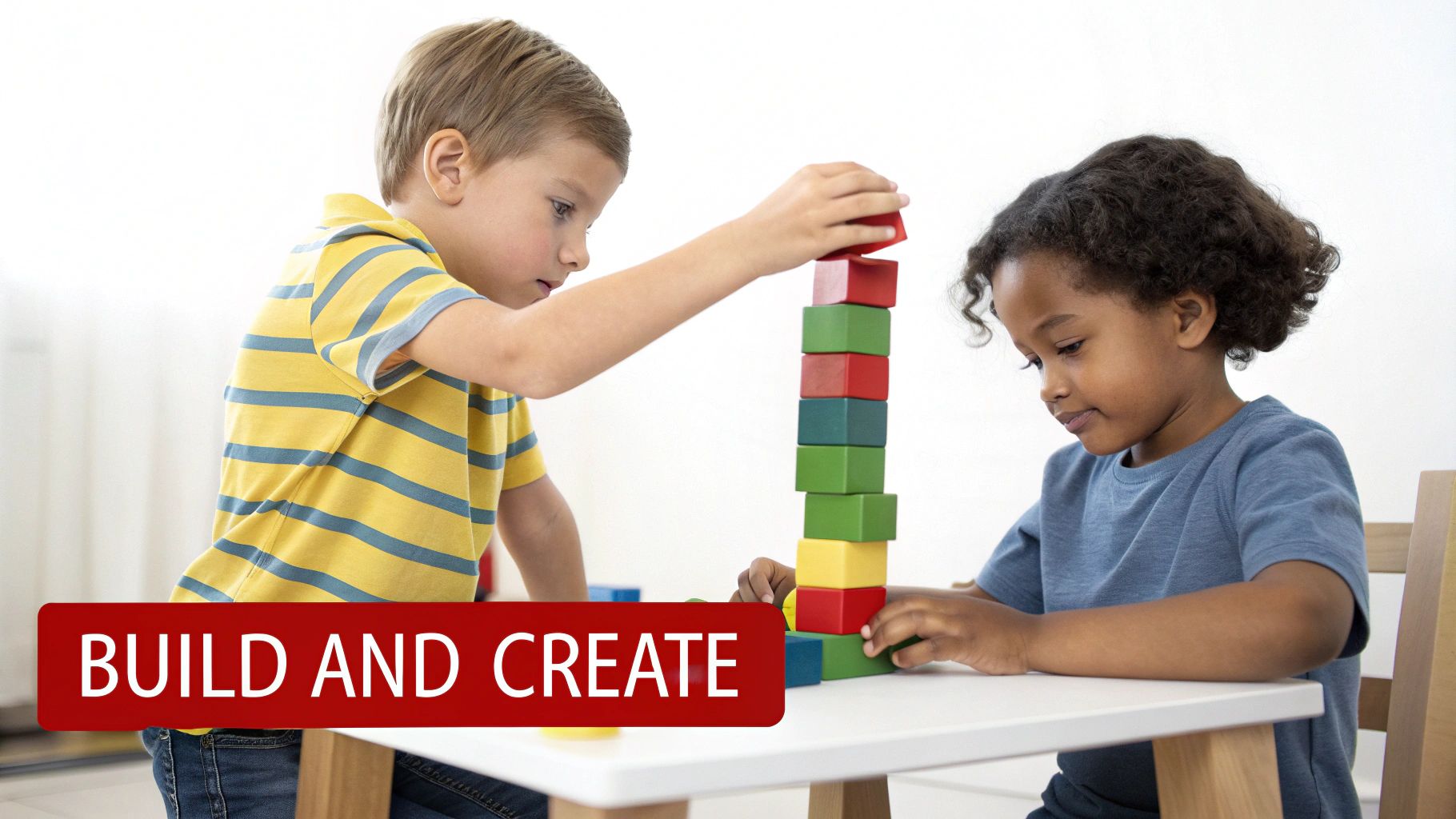
The core lesson in these games is iterative design. A child might build a tower that collapses, analyze why it fell, and then rebuild it with a stronger base. This cycle of building, testing, and refining teaches resilience and analytical thinking. Kids learn to plan ahead, visualize outcomes, and adapt their strategy when faced with unexpected structural failures, making these some of the most effective problem solving games for kids.
How to Implement Building Challenges: A Practical Guide
- Materials: LEGO, K'NEX, Magna-Tiles, wooden blocks, or DIY materials like cardboard tubes, craft sticks, and tape.
- Setup: Provide a clear goal and constraints. For example, "Build the tallest possible free-standing tower using only 20 craft sticks and one foot of tape," or "Design a bridge that can hold a small book." Encourage sketching a design before building.
- Best For: Ages 4+. Perfect for solo play at home, STEM stations in classrooms, or group competitions that encourage innovative design and friendly rivalry.
To enhance the learning, introduce real-world scenarios, such as designing an earthquake-resistant building or a habitat for Mars. These challenges not only improve engineering skills but also foster creativity and the confidence to tackle complex problems. For a great starting point, check out the engineering kits available at Playz.
3. Logic Grid Puzzles and Sudoku Variants
Logic grid puzzles and their numerical cousins, like Sudoku, are powerful tools for developing deductive reasoning. These games challenge children to use given clues and a process of elimination to fill in a grid correctly. Unlike many problem-solving activities, they require pure logic rather than creative or social skills, making them an excellent exercise for systematic, analytical thinking.
The essence of these puzzles is constraint satisfaction. For example, in a classic logic grid puzzle, a child might need to match four friends with their favorite pets and sports. Clues like "The dog owner does not play basketball" teach them to systematically cross off possibilities. This method trains the brain to manage multiple variables and make logical connections, a foundational skill for STEM fields and one of the best problem solving games for kids that can be done solo.
How to Implement Logic Puzzles: A Practical Guide
- Materials: Puzzle books (Logic Puzzles for Clever Kids), printable worksheets, Sudoku for Kids apps, or online platforms like WebSudoku.
- Setup: Start with a simple puzzle, like a 4x4 Sudoku grid or a logic puzzle with few variables. Provide a pencil and eraser. For beginners, demonstrate how to use the clues to eliminate options and mark certainties on the grid.
- Best For: Ages 7+. Perfect for quiet time, travel, or as a focused individual activity in a classroom setting to build concentration and patience.
To maximize engagement, begin with smaller grids and provide an answer key for self-checking, which builds confidence. Using colored pencils to track different possibilities can also help visual learners. Over time, these puzzles cultivate a methodical approach to complex challenges.
4. Treasure Hunts and Scavenger Hunts
Treasure hunts and scavenger hunts are adventure-based problem-solving games where children follow a trail of clues to find a hidden prize or destination. This classic activity transforms any environment into a world of discovery, combining physical movement with cognitive challenges like riddles, puzzles, and observation tasks. From a simple backyard search to a high-tech geocaching adventure, these hunts are incredibly versatile.

The power of a treasure hunt lies in its sequential, goal-oriented structure. Each clue solved provides a piece of the puzzle and a sense of accomplishment, motivating kids to persevere. This process strengthens deductive reasoning, reading comprehension, and spatial awareness. As they decipher clues, they learn to think critically, connect seemingly unrelated information, and work methodically toward a final objective.
How to Implement Treasure Hunts: A Practical Guide
- Materials: Pen and paper for clues, a "treasure" (like small toys or treats), and optional props like maps or compasses.
- Setup: Write a series of clues, with each one leading to the location of the next. Hide them in a safe, designated area like your home, backyard, or a local park. Start by giving the first clue directly to the participants to kick off the adventure.
- Best For: Ages 4+. Perfect for birthday parties, family outings, or as a classroom activity to review curriculum content in an interactive way.
To make these problem solving games for kids more engaging, tailor the theme to their interests, such as pirates, spies, or nature explorers. Incorporating a mix of clue types like riddles, picture-based puzzles, and simple math problems can keep the challenge fresh and exciting for all participants.
5. STEM Challenge Kits and Engineering Tasks
STEM challenge kits provide structured, hands-on activities that merge Science, Technology, Engineering, and Mathematics. These kits guide children through specific engineering tasks, like building a catapult, designing a marble run, or constructing a circuit. They turn abstract scientific principles into tangible, interactive projects, fostering a deep understanding of cause-and-effect and the engineering design process.
The core of these challenges is iterative problem-solving. A child might build a bridge that collapses, analyze the weak points, and then reinforce the structure to make it stronger. This cycle of building, testing, and improving teaches resilience and analytical thinking. Kits like Playz science sets or Snap Circuits provide all the necessary components, transforming complex concepts into accessible and engaging problem solving games for kids.
How to Implement STEM Challenges: A Practical Guide
- Materials: All-in-one commercial kits (Playz, LEGO Mindstorms), household items for DIY challenges (cardboard, tape, craft sticks), or digital building platforms.
- Setup: Designate a clear workspace. Read all instructions with your child before starting and organize all the materials. Encourage them to hypothesize what might happen before each step.
- Best For: Ages 6+. Perfect for solo exploration at home, collaborative classroom projects, or science fairs that encourage creative design and systematic thinking.
To maximize the learning potential, allow children the freedom to experiment and even fail; this is a critical part of the scientific method. Encourage them to document their process and connect their creations to real-world examples. To explore a variety of options, check out our ultimate guide to science kits for kids.
6. Cooperative Board Games and Strategy Games
Cooperative board games and strategy games shift the focus from individual competition to collaborative problem-solving. Instead of players competing against each other, they work together as a team to overcome the game's challenges. Titles like Pandemic or Forbidden Island require kids to communicate, plan, and execute strategies collectively to achieve a shared victory. This format is excellent for developing social-emotional skills alongside critical thinking.
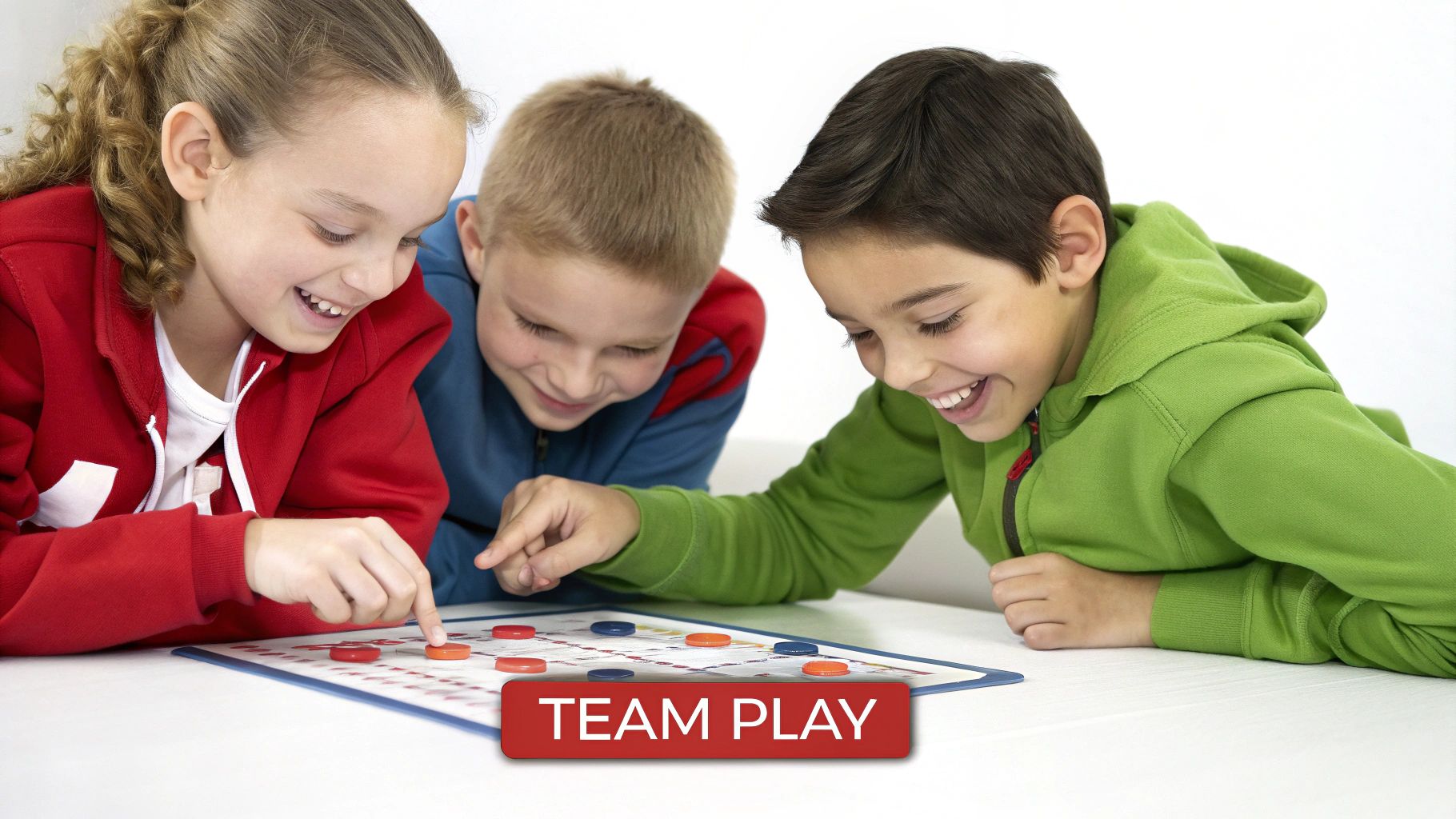
These problem solving games for kids teach valuable lessons in teamwork, negotiation, and collective responsibility. Players must listen to each other's ideas, weigh the pros and cons of different moves, and agree on a course of action. This process enhances strategic planning and foresight, as children learn to anticipate future obstacles and manage resources together. For a timeless challenge that hones strategic thinking and problem-solving skills, a beautiful hand-carved onyx chess set can provide hours of engaging play.
How to Implement Cooperative Board Games: A Practical Guide
- Materials: Commercial board games (Forbidden Island, Castle Panic, Hanabi), classic strategy games (Chess, Checkers), or DIY cooperative challenges.
- Setup: Choose a game appropriate for the group's age and experience level. Read the rules together and establish a "no criticism" rule to encourage open discussion of strategies. A clear playing area with all components accessible is key.
- Best For: Ages 5+. Perfect for family nights, classroom centers, or playdates where the goal is to build teamwork, communication, and strategic thinking without direct competition.
To maximize the benefits, facilitate a discussion after each game about what strategies worked, what didn't, and why. This reflection helps solidify the learning experience. For younger kids, discover more ways to encourage teamwork with our guide on cooperative play activities.
7. Coding and Programming Challenges
Coding and programming challenges introduce kids to computational thinking, teaching them how to communicate instructions to a computer. These activities use visual, game-based platforms like Scratch or tangible tools like Bee-Bot robots, transforming the logic of programming into an engaging and interactive experience. This approach demystifies coding, showing it as a creative tool for building games, animations, and solutions.
The essence of these problem solving games for kids is learning to create and debug algorithms. Kids devise a sequence of steps to make a character move or a robot navigate a maze. When it doesn't work, they must systematically review their code to find the error, a process that builds resilience and analytical skills. This teaches them that problems are puzzles to be solved through logic, experimentation, and persistence.
How to Implement Coding Challenges: A Practical Guide
- Materials: Free platforms (Code.org, Scratch), tangible robots (Cubetto), or app-based games (Lightbot, CodeMonkey). Unplugged activities can use just paper and markers.
- Setup: Start with a clear goal, like "make the cat sprite dance to a song." Use drag-and-drop interfaces for beginners before moving to text. Encourage experimentation by asking "What happens if you change this block?"
- Best For: Ages 5+. Excellent for solo exploration or collaborative projects in classrooms and coding clubs. The tiered difficulty of most platforms makes it adaptable for a wide range of skill levels.
To effectively introduce these concepts, focus on debugging as a positive part of the problem-solving process rather than a failure. Framing it this way helps build a growth mindset. To learn more about getting started, check out our guide on how to teach coding to kids.
8. Riddle and Brain Teaser Challenges
Riddles and brain teasers are classic problem solving games for kids that sharpen analytical skills using only language and logic. These challenges encourage children to think creatively, interpret information from multiple angles, and look beyond the obvious answers. By engaging with these puzzles, kids learn to dissect language, identify hidden assumptions, and practice lateral thinking, all of which are foundational skills for more complex problem-solving.
The power of a good riddle lies in its ability to reframe a situation and demand a non-conventional solution. A question like, "What has to be broken before you can use it?" (an egg) teaches kids that problems often have surprising, simple answers if you approach them from the right perspective. This process builds cognitive flexibility and encourages a playful, inquisitive mindset toward challenges in both academic and real-life scenarios.
How to Implement Riddle Challenges: A Practical Guide
- Materials: Riddle books, brain teaser apps, websites with daily puzzles, or just your own creativity.
- Setup: Simply present the riddle or brain teaser verbally or in writing. Create a "riddle of the day" routine at breakfast or in the classroom to start the day with a fun mental warm-up. For a group activity, organize a riddle competition with small prizes.
- Best For: Ages 6+. Perfect for car rides, waiting rooms, or as quick, engaging brain breaks during homework or lessons.
To make these challenges effective, tailor the difficulty to the child's age and provide a hint system if they get stuck. Encourage kids to create their own riddles, which deepens their understanding of how language and logic can be creatively manipulated. Celebrating clever thinking, even for incorrect answers, fosters a safe environment for intellectual risk-taking.
9. Mystery and Detective Role-Play Games
Mystery and detective games transform children into investigators, tasking them with solving a crime or uncovering a secret through evidence analysis and critical thinking. This immersive role-play format turns problem-solving into a compelling narrative adventure. By sifting through clues, interviewing "witnesses," and piecing together a timeline, kids learn to organize information and draw evidence-based conclusions.
The core of a detective game is systematic investigation. Children must identify relevant facts, dismiss red herrings, and develop hypotheses to explain the events. This process hones their deductive reasoning and attention to detail. Whether it’s a family game night playing Clue or a DIY "who stole the cookies?" scenario, these activities teach kids how to approach a complex problem with a structured, logical mindset, making them excellent problem solving games for kids.
How to Implement Mystery Games: A Practical Guide
- Materials: DIY (character cards, written clues, props), commercial mystery kits, or board games like Clue.
- Setup: Create a central mystery with a clear backstory. Prepare evidence, such as coded notes, "witness" testimonies, and physical objects, and plant them for discovery. Assign roles to participants and kick off the story with the initial incident.
- Best For: Ages 7+. Perfect for themed parties, classroom projects, and family activities that promote logical deduction and creative thinking.
To make the game successful, provide a mix of straightforward clues and a few false leads to increase the challenge. Encourage players to take notes and discuss their theories openly. A well-crafted mystery not only sharpens analytical skills but also builds confidence in making reasoned judgments.
10. Maker Spaces and Creative Engineering Projects
Maker spaces are open-ended, creative environments where children design and build solutions using a wide variety of materials. This approach shifts the focus from finding a single correct answer to fostering innovation, experimentation, and resilience. By giving kids the tools and freedom to invent, they learn to tackle problems through hands-on engineering and iterative design.
The core of a maker space is creative problem-solving. A child might be challenged to build a device that can carry a marble across a room or design a structure from recycled materials. This process teaches valuable lessons in planning, prototyping, and adapting when initial ideas don't work. It’s one of the most effective problem solving games for kids because it mirrors real-world engineering, where failure is just a step toward a better solution.
How to Implement a Maker Space: A Practical Guide
- Materials: Recycled items (cardboard, plastic bottles), craft supplies (tape, glue, pipe cleaners), building toys, and basic tools.
- Setup: Designate a corner or table as the "maker station." Provide challenge cards with open-ended prompts like, "Build a bridge that can hold 10 pennies," or "Invent a new toy." The goal is to provide a starting point without prescribing a final outcome.
- Best For: Ages 5+. Excellent for classrooms, libraries, or home settings to encourage independent thinking, creativity, and hands-on STEM skills.
To maximize the benefits, focus on the creative process rather than the polished result. Celebrate every creation and encourage children to explain their design choices and how they overcame challenges. For more ideas, explore our list of engaging engineering activities for kids.
Which Problem-Solving Game is Right for Your Child? A Quick Comparison
| Activity | 🔄 Implementation Complexity | ⚡ Resource Requirements | 📊 Expected Outcomes | 💡 Ideal Use Cases | ⭐ Key Advantages |
|---|---|---|---|---|---|
| Escape Room Games and Logic Puzzles | Medium–High — multi-step design and timed flow | Moderate — themed props, space, prep time | Logic, teamwork, time management; high engagement | Parties, class group problem-solving, library events | Highly engaging; strong collaboration & critical thinking |
| Building and Construction Challenges | Low–Medium — set constraints and supervise builds | Low–Moderate — blocks, connectors, workspace | Spatial reasoning, engineering concepts, creativity | STEM lessons, free play, design competitions | Tactile learning; scalable complexity; visible results |
| Logic Grid Puzzles and Sudoku Variants | Low — straightforward preparation or use printables | Minimal — paper/app access, pencils | Deduction, pattern recognition, sustained focus | Independent practice, quiet time, math enrichment | Low cost; self-paced; effective for logical skill-building |
| Treasure Hunts and Scavenger Hunts | Medium — route planning and clue sequencing | Low — printed clues; outdoor/indoor space | Observation, problem-solving, physical activity | Field trips, outdoor learning, event icebreakers | Active, customizable, memorable experiential learning |
| STEM Challenge Kits and Engineering Tasks | Medium — follow protocols, prepare materials | Moderate–High — kits, consumables, adult supervision | Scientific method, engineering design, testing skills | Curriculum labs, STEM clubs, targeted skill lessons | Curriculum-aligned; hands-on experiments with measurable outcomes |
| Cooperative Board Games and Strategy Games | Low–Medium — learn rules and guide turns | Low — games and table space | Communication, strategy, decision-making, empathy | Family game nights, small groups, classroom social skills | Encourages cooperation; replayable; fosters perspective-taking |
| Coding and Programming Challenges | Medium — scaffolded learning curve and debugging cycles | Moderate — devices or unplugged materials, internet | Computational thinking, sequencing, problem-solving | Computer classes, coding clubs, blended learning activities | Builds future-ready skills; immediate feedback and progression |
| Riddle and Brain Teaser Challenges | Low — instant play, minimal setup | Minimal — none or printable materials | Lateral thinking, language comprehension, quick reasoning | Warm-ups, transitions, short group activities | Portable, very low-cost, promotes creative thinking |
| Mystery and Detective Role-Play Games | High — narrative design, roles, and facilitation | Moderate — scripts, props, facilitator time | Investigative reasoning, evidence analysis, narrative skills | Library programs, drama classes, immersive lessons | Deep engagement; practices source evaluation and deduction |
| Maker Spaces and Creative Engineering Projects | High — open-ended facilitation and safety oversight | High — tools, varied materials, workspace, mentors | Creative problem-solving, design thinking, tool proficiency | Innovation labs, after-school programs, project-based learning | Promotes innovation, iteration, real-world creation and agency |
From Playtime to Problem-Solver: Your Next Steps
You've just explored a powerful toolkit of activities designed to transform everyday play into a dynamic learning laboratory. From the collaborative strategy of cooperative board games to the independent logic required for a Sudoku puzzle, each of these problem solving games for kids serves a unique purpose. They are not just distractions; they are foundational building blocks for developing critical thinking, resilience, and creativity.
The journey through this list has highlighted a crucial theme: problem-solving is not a single skill but a mosaic of interconnected abilities. A treasure hunt hones observational skills and deduction, while a STEM challenge kit emphasizes the engineering design process of hypothesizing, testing, and refining. By offering a variety of these challenges, you expose your child to different ways of thinking and approaching obstacles, ensuring they develop a flexible and adaptable mindset.
Key Takeaways for Nurturing Young Innovators
As you move forward, keep these core principles in mind to maximize the impact of these games:
- Process Over Perfection: The true learning happens in the "messy middle" of problem-solving. Celebrate the creative attempts, the thoughtful questions, and the perseverance shown when a first idea doesn't work. The goal isn't just to find the right answer but to enjoy the process of discovery.
- Embrace Productive Failure: Create a safe space where making mistakes is seen as a vital part of learning. When a block tower topples or a code has a bug, frame it as a valuable clue, not a failure. Ask questions like, "That's interesting! What do you think we can learn from that?" or "What's another way we could try this?"
- Connect Play to the Real World: Help your child see how these skills apply outside the game. After solving a logic puzzle, you might say, "That's just like how we figured out the best route to the library!" This helps solidify the learning and demonstrates the real-world value of their new abilities.
Your Actionable Next Steps
Integrating these activities into your routine is simpler than it seems. Start small. Choose one or two games from this list that align with your child’s current interests.
- Schedule "Problem-Solving Time": Dedicate a specific time each week, perhaps a weekend afternoon or a post-dinner activity, to tackle a new challenge together. Consistency builds momentum.
- Create a "Maker's Box": Gather common household materials like cardboard, tape, string, and craft sticks into a designated box. This makes spontaneous building and engineering challenges easy to initiate.
- Observe and Adapt: Pay attention to what sparks your child’s curiosity. If they love building challenges, introduce more complex materials. If riddles are a hit, create a family riddle-of-the-day tradition.
By intentionally weaving these problem solving games for kids into your family's life, you are doing more than just keeping them entertained. You are actively nurturing the next generation of thinkers, innovators, and leaders who will confidently face the challenges of tomorrow. You are giving them the priceless gift of knowing how to think, not just what to think.
Ready to take the next step in your child's learning adventure? The Playz collection of STEM kits is expertly designed to make complex science and engineering concepts accessible and fun, turning abstract ideas into hands-on experiments. Explore our award-winning kits at Playz and discover the perfect challenge to spark your young problem-solver's imagination.