

Choosing the best toys for 4 year olds feels like a major decision—because it is. You're not just buying another object to clutter the playroom; you're investing in your child's incredible development. At four, their world is exploding with new ideas, bigger questions, and a powerful drive to figure out how everything works. The right toys are the tools that help them make sense of it all.
This guide will help you look past the flashy packaging and trendy gadgets to focus on toys that truly support their journey. We'll connect the dots between key developmental milestones and the specific types of toys that foster them, so you can make choices that feel intentional and perfectly match your child's budding personality.
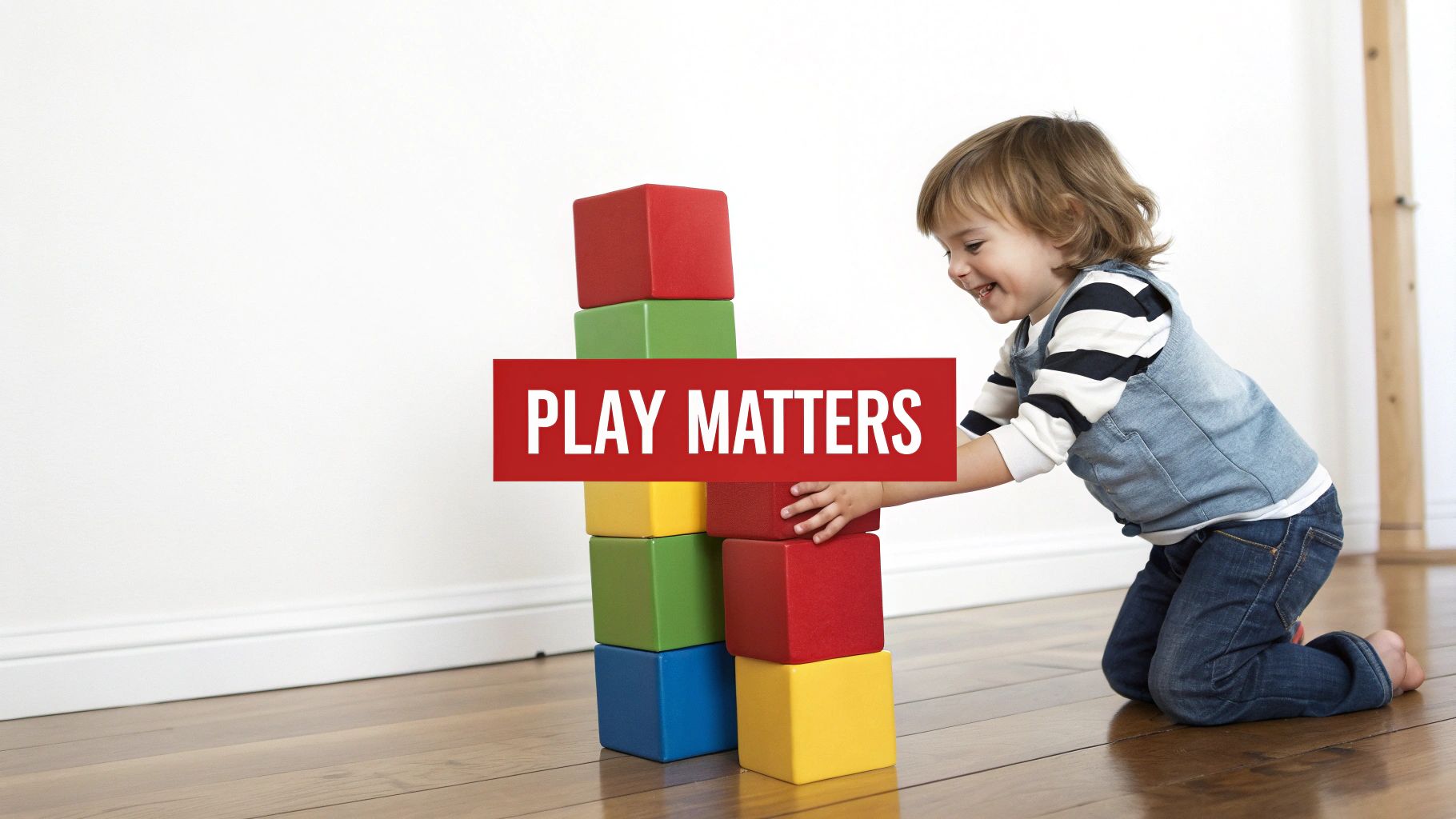
The Power of Play for a Growing 4 Year Old
You’ve likely heard that play is the "work" of childhood, and for a 4-year-old, that’s the absolute truth. Every wobbly block tower, pretend phone call, and scribbled masterpiece is a building block for their future.
Why Your Toy Choices Matter More Than Ever
At four, kids aren't just messing around. They’re running tiny experiments, solving puzzles, and piecing together their understanding of the world. The toys they use become their primary tools for learning.
Key Takeaway: Choosing a toy is like choosing an adventure. An open-ended toy, like a set of magnetic tiles, can become a castle one day and a spaceship the next. This offers endless possibilities for creativity, a stark contrast to a single-function toy that limits imaginative input.
Understanding the benefits of play-based learning can completely change how you view the contents of your toy box.
What Skills Should the Best Toys for 4 Year Olds Foster?
The best toys for a 4-year-old help them grow in multiple ways. They aren't just for fun; they are instruments for building real-world skills. Here's what to aim for:
- Cognitive Growth: Puzzles, sorting games, and simple science kits build the foundation for logic and reasoning. Example: A simple gear set teaches cause-and-effect when they see turning one gear makes another move.
- Social and Emotional Learning: Role-playing toys are golden. A play kitchen or doctor's kit creates a safe space to practice empathy, cooperation, and navigating social scenarios. Example: Deciding who gets to be the "chef" and who is the "customer" is a real-life lesson in negotiation.
- Motor Skill Development: Physical play is non-negotiable. Fine motor skills are honed by threading beads, while gross motor skills are built by riding a scooter. Adding fun movement activities for preschool kids alongside toy-based play is a fantastic way to support their physical growth.
By seeing these connections, you can curate a collection of toys that don't just entertain but truly nurture your child's expanding mind and body.
Understanding Your 4 Year Old's World
To find the perfect toy, you first have to step inside the wild, wonderful, and constantly buzzing mind of a 4-year-old. This age is a whirlwind of growth. Think of their brain as a city under rapid construction—new connections are paved every second, leading to massive leaps in how they think, feel, and interact.
Cognitive Leaps and Endless "Why?" Questions
A 4-year-old’s brain is shifting into high gear. They’re moving beyond simply identifying colors and are starting to grasp much bigger ideas. This is the age of the perpetual "why?"—a sure sign their mind is working hard to figure out cause and effect. They are becoming little problem-solvers.
Actionable Insight: Feed this incredible growth with toys that encourage:
- Pattern Recognition: Simple sequencing toys, puzzles, or bead-stringing activities.
- Problem-Solving: Age-appropriate building sets or beginner board games that require simple choices.
- Curiosity: Toys that invite experimentation, like a basic science kit or a set of interlocking gears.
Social-Emotional Growth: The Magic of Pretend Play
For a 4-year-old, imaginative play isn't just a game—it's everything. When they pretend to be a doctor, chef, or superhero, they are rehearsing for life. This is their laboratory for understanding big emotions, practicing empathy, and learning to get along with others. Friendships are becoming more meaningful as they shift from playing next to a friend to playing with one on a shared goal.
Real-World Example: A play kitchen isn't just for making pretend food; it's a space to practice negotiation ("My turn to stir!"), empathy ("My baby doll is hungry"), and understanding social roles.
Fine and Gross Motor Skill Refinement
Physically, 4-year-olds are gaining significant coordination and confidence. Their movements are becoming more deliberate and controlled.
Gross Motor Skills (Whole-Body Movement):
- What they can do: Hop on one foot, catch a bounced ball, pedal a tricycle.
- Toys that help: Scooters, balance beams, balls of all sizes.
Fine Motor Skills (Hand and Finger Control):
- What they can do: Use kid-safe scissors, draw recognizable shapes, build taller block towers.
- Toys that help: Lacing beads, modeling clay, LEGOs or other interlocking blocks.
Choosing toys that challenge these physical skills builds more than just strength; it builds a powerful sense of "I can do it!" confidence. You can explore more about these key childhood development milestones to get an even clearer picture. When you align toy choices with these stages, you give them the best possible tools to thrive.
How to Choose Toys That Truly Matter
Walking into a toy store can be overwhelming. The secret? Think like a play expert, not just a shopper. It’s not about finding the hottest toy, but the right toy for your child. By looking past the packaging to see a toy's true potential, you can confidently choose the best toys for 4 year olds—the ones that will spark their imagination and stand the test of time.
The Open-Ended Toy Test
First, ask yourself this simple question: How many different ways can my child play with this? A toy with high open-ended potential is like a blank canvas; it invites your child to create their own stories and solve their own problems.
| Open-Ended Toy (High Play Value) | Closed-Ended Toy (Low Play Value) |
|---|---|
| Example: Wooden Blocks | Example: A character that sings one song |
| Can be a tower, a fence, a car, or food. | Performs one specific function when a button is pushed. |
| Encourages creativity and problem-solving. | Encourages passive observation. |
Key Takeaway: The best toys are 90% child and 10% toy. They should be the spark, not the whole fire. Always look for toys that adapt as your child’s imagination grows.
The Engagement Factor: Will It Hold Their Attention?
A great toy does more than just distract; it truly engages. The goal is to find something that pulls your child into that deep, focused state of play. The "engagement factor" is what brings them back to a toy again and again.
Look for toys that require active participation. Does it make them think, build, or experiment? Toys that offer just the right amount of challenge without being frustrating are the sweet spot.
- Building Sets: Magnetic tiles or classic LEGOs are engagement machines.
- Art Supplies: A fresh box of crayons, paper, and kid-safe scissors offer endless possibilities.
- Imaginative Kits: A doctor's kit or play food gives them props to act out their own stories.
Safety and Durability Checklist
A toy is useless if it breaks after one play session or isn't safe. Four-year-olds are not always gentle, so durability is a must.
Quick Quality Check:
- Age-Appropriate Design: Ensure the toy is rated for ages 3+. This is critical for avoiding small parts that can be a choking hazard.
- Solid Construction: Look for sturdy materials like solid wood or high-quality, non-toxic plastics.
- No Sharp Edges: Run your hands over the toy to check for any sharp points or rough spots.
- Secure Battery Compartments: If batteries are needed, the compartment should be screwed shut.
Does It Match Their Current Interests?
Finally, the most perfectly designed toy will collect dust if it doesn’t connect with what your child is genuinely into right now. Pay attention to their current obsessions. Are they all about dinosaurs? Fascinated by construction sites? Leaning into what they already love is the easiest way to guarantee a hit.
This focus on fun that also educates is a huge trend. In fact, in 2023, the market for educational toys boomed. Building sets alone grabbed over 27% of the market share because they perfectly blend entertainment with critical skill-building. You can see more about these educational toy market trends here.
Top Toy Categories for Nurturing Young Minds
Now that we know what makes a great toy, let's explore the categories that really deliver. Think of these as different playgrounds for your child’s brain, each nurturing a unique set of skills to fuel their incredible growth.
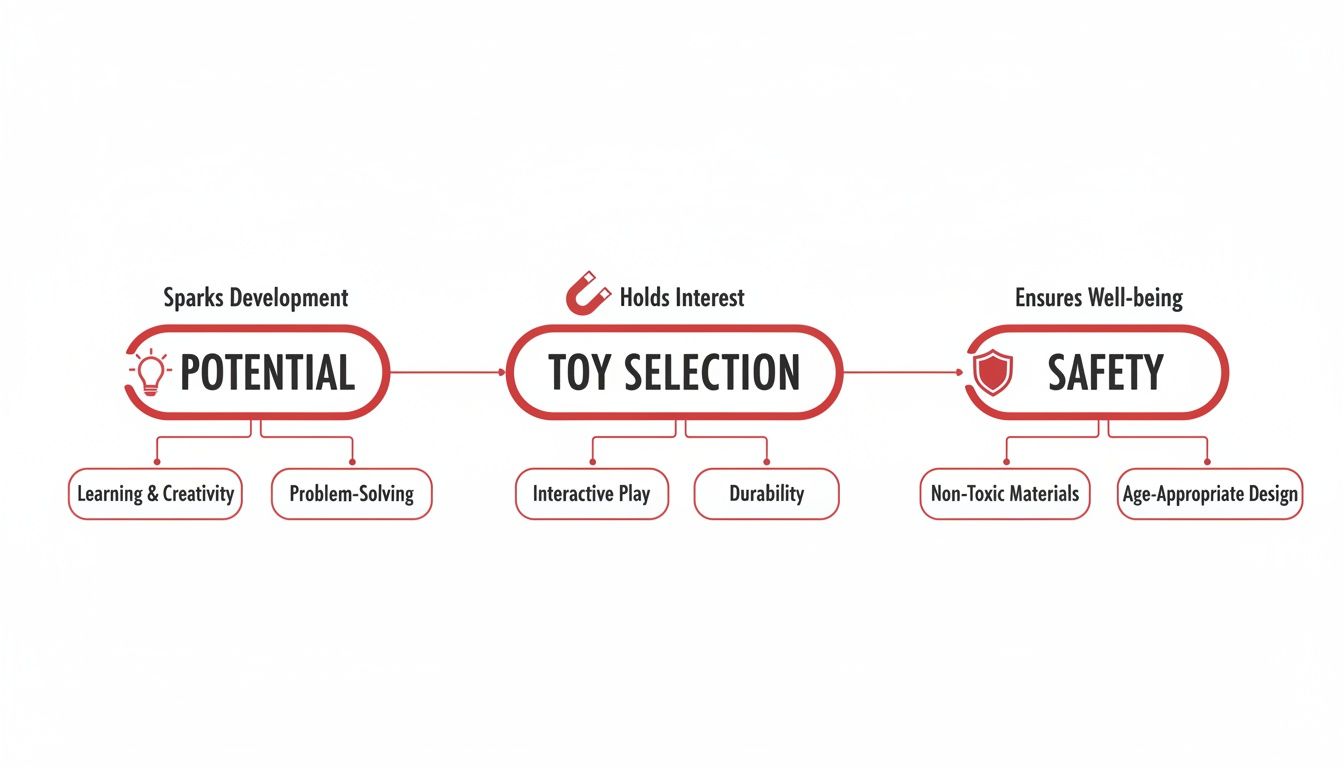
Choosing the right toy is about finding the sweet spot between learning potential, fun factor, and safety. This flowchart breaks down the core ideas to simplify your decision.
Keyword-Rich Subheading: STEM and Building Toys for Problem-Solving
This is where logical thinking and spatial awareness are born. Toys like magnetic tiles, interlocking blocks, and simple building sets are powerhouses for developing problem-solving skills. Every time a four-year-old builds a tower, they're getting a hands-on lesson in gravity, balance, and structural integrity.
Real-World Example: A simple science kit isn't just about mixing colors; it's a child's first step into hypothesis and observation. It teaches them to ask "what if?" and then gives them the tools to find out.
If you want to spark that early curiosity, our guide to the best STEM toys for preschoolers is a great place to start.
Keyword-Rich Subheading: Imaginative and Role-Playing Toys for Social Skills
Welcome to the world of make-believe, where a cardboard box is a rocket ship. Imaginative play is where social and emotional skills blossom. Dress-up clothes, puppet theaters, and dollhouses give kids a safe space to try on different roles and feelings. Through pretend play, they practice negotiation, empathy, and storytelling.
- Play Tents: Creates an instant private world—a fort, a castle, or a quiet reading spot.
- Kitchen Sets: A classic for a reason. Encourages cooperative play and following a process.
- Action Figures & Dolls: Characters in the plays they direct themselves, helping them process social dynamics.
Keyword-Rich Subheading: Creative and Artistic Supplies for Self-Expression
Art supplies are the ultimate open-ended toys. A blank page and a box of crayons hold infinite possibilities, empowering a four-year-old to express their thoughts and feelings without words. Activities like painting, drawing, and sculpting with modeling clay are also fantastic for building fine motor skills and creative confidence.
Don't forget that exploring engaging story books for 4 year olds is another powerful creative outlet that sparks imagination.
Keyword-Rich Subheading: Active and Outdoor Toys for Gross Motor Development
A four-year-old’s body is buzzing with energy—it’s built to move! Active toys are essential for developing strong muscles, coordination, and a love for physical activity. Tricycles, scooters, and simple balls help improve balance and hand-eye coordination. They also sneak in important lessons about taking turns and playing safely.
Globally, activity and construction toys are always in high demand. In fact, toys that boost motor skills are so prized that the 'up to 4 years' segment is expected to grab over 54% of the educational toy market by 2026.
Toy Category vs. Developmental Skill Matrix
This table breaks down which skills get the biggest workout from each type of toy, helping you build a balanced collection.
| Toy Category | Primary Cognitive Skill | Primary Physical Skill | Primary Social/Emotional Skill |
|---|---|---|---|
| STEM & Building | Problem-Solving, Spatial Reasoning | Fine Motor Control, Hand-Eye Coordination | Patience, Persistence |
| Imaginative Play | Storytelling, Abstract Thinking | Gross Motor (acting out roles) | Empathy, Negotiation, Cooperation |
| Creative & Artistic | Self-Expression, Symbolic Thinking | Fine Motor Precision (gripping) | Emotional Regulation, Confidence |
| Active & Outdoor | Rule Following, Cause-and-Effect | Gross Motor Skills, Balance | Turn-Taking, Sportsmanship |
Making Playtime More Meaningful
Even the best toys for 4-year-olds need one key ingredient: connection. Your role as a play partner transforms simple fun into a powerful bonding and learning experience. Engaging with your child during play doesn't mean directing every move; it means being a curious and supportive co-adventurer.
Become a Play Partner, Not a Director
Your number one goal is to follow your child’s lead. Get down on the floor and become their assistant builder. This empowers them, showing that their ideas have value.
Actionable Insight: Use open-ended questions to fuel their imagination:
- Instead of "What color is that block?" try "What are we building with these amazing blocks?"
- Instead of "Is that a car?" ask "Where is this vehicle going on its adventure?"
- Instead of "That's not how a doctor does it," say "Oh no, my teddy bear is sick! What should we do, Doctor?"
This technique keeps creative control in their hands, which is crucial for building confidence.
Set Up "Invitations to Play"
An “invitation to play” means arranging a few materials in an appealing way that sparks curiosity—without instructions. For example, lay out blue play-doh, a few plastic sea animals, and some seashells on a tray. Don't say, "Let's make an ocean scene." Let them discover it. This encourages independent, self-directed play.
The Power of Toy Rotation
Too many choices can be overwhelming. Toy rotation is the simple solution.
- Curate: Keep a manageable number of toys available.
- Store: Put the rest away out of sight.
- Swap: Every few weeks, rotate the toys.
This strategy makes old toys feel new again, reigniting interest and encouraging deeper play. It also makes cleanup less daunting. Learning how to organize kids’ toys can be a total game-changer.
Balance Structure with Freedom
Find a balance between structured activities (like a board game) and unstructured free play. Structured play teaches rules and patience. However, unstructured free play is where imagination truly takes flight. This is the time with no set goals, where they can mix toys, invent stories, and explore their own ideas. It’s during this free-for-all that the most critical developmental work happens.
FAQs: Answering Your Top Questions About Toys for 4-Year-Olds
Picking the perfect toy can bring up a lot of questions. This section tackles the most common concerns from parents, offering clear, practical answers to help you choose with confidence.
How many toys does a 4-year-old actually need?
There's no magic number, but experts agree: quality over quantity. A room overflowing with gadgets can be more overwhelming than inspiring. The goal is a curated collection of open-ended toys that can be used in countless ways. A small, thoughtful selection covering different play types is far more powerful.
Actionable Insight: Try the "one or two" rule. Aim for one or two great options for each key area: one building set (like magnetic tiles), one creative outlet (art supplies), one imaginative prompt (a play tent), and one active toy (a scooter or ball). Toy rotation is your best friend here.
Are electronic or "smart" toys good for 4-year-olds?
The answer is all about balance and discernment. Many "smart" toys are passive, asking a child only to press a button and watch. That's entertainment, not engagement. The best toys put your child in the driver's seat. When considering a tech toy, ask: Is this a tool for creation or just a distraction? A simple robot they can program to move is far more valuable than a repetitive tablet game.
Key Takeaway: Always prioritize hands-on, screen-free play. It’s the foundational work of childhood, essential for building fine motor skills, social skills, and creative thinking that will serve them for a lifetime.
What are the best non-toy gifts for a 4-year-old?
Sometimes the best gifts aren't things at all. Experiences create memories that last long after a toy is forgotten.
Pros of Experience Gifts:
- Create lasting memories
- Reduce clutter
- Encourage real-world exploration
Cons of Experience Gifts:
- Less immediate gratification on gift-opening day
- May require more planning from parents
Great Ideas:
- Memberships: An annual pass to a local children's museum, zoo, or science center.
- Lessons: Swimming, gymnastics, or a toddler art class.
- Subscription Boxes: A monthly science or craft kit tailored to their interests.
How do I choose a toy that will grow with my child?
The secret is open-ended potential. Look for toys that don't have a single, right way to be used. These are the chameleons of the toy world, adapting as your child's abilities expand. Building blocks, magnetic tiles, and high-quality art supplies are prime examples. A four-year-old might build a simple tower; a six-year-old will use the same set to construct an elaborate castle. For more ideas, check out our collection of toys for 2-4 year olds.
At Playz, we believe the best learning is loud, messy, and fun. Our range of science kits, play tents, and creative toys are all designed to spark that "aha!" moment and foster a lifelong love of discovery. We're committed to making high-quality, engaging toys that get kids building, creating, and wondering.
Ready to find the perfect toy to inspire your little learner? Explore our collections and see why over 5 million customers trust us to make playtime meaningful.