

Your kitchen table might look familiar right now. A tray of tiny gears is sliding toward the edge, the instruction booklet is already bent, and your child is asking if they can do “just one more experiment” tomorrow. Or maybe the opposite is happening. The box got opened once, everyone said “cool,” and now it's sitting on a shelf with half the parts in a zipper bag.
That split matters more than most parents realize.
I've seen the same pattern at home and in classrooms. A STEM kit doesn't become educational because the box says science, coding, or engineering. It becomes educational when a child keeps returning to it, when an adult helps at the right moments, and when the activity is structured enough to turn curiosity into understanding.
That's a big reason this category keeps growing. One market report values the global STEM Education Kit market at $3.2 billion in 2025, with a projection of $7.8 billion by 2034 and a 12.3% CAGR. The same report says robotics kits held 35.2% of the market and Asia Pacific accounted for 42.1% of revenue, which tells you these kits are already mainstream and especially strong in hands-on technical play across major regions (STEM Education Kit market report).
What Educational STEM Kits Really Are
An educational STEM kit is more than a toy with parts in a box.
It's a curated set of materials and guided activities that helps a child learn a science, technology, engineering, or math concept by doing something physical. They build, test, measure, compare, mix, troubleshoot, or redesign. That hands-on work is the point.
What separates a real STEM kit from a generic activity box
Parents often lump these together with craft kits, fidget toys, or monthly surprise boxes. They're not the same.
A real educational STEM kit usually includes three things:
- A clear learning objective. The child is exploring something specific, like chemical reactions, force and motion, circuits, coding logic, or structural design.
- The materials needed to do the work. That includes the parts, tools, or experiment supplies required to complete the activity.
- Some kind of scaffold. This might be a lab guide, experiment cards, prompts, or diagrams that help a child ask better questions and move past “I'm stuck.”
If you're sorting through options, it helps to compare them with other STEM toys for kids, because not every STEM-labeled product teaches in the same way.
What most educational STEM kits include
Most kits are built around a pretty predictable structure, and that's useful once you know what to look for.
You'll usually find:
- A project manual or experiment cards with steps, prompts, and simple explanations
- Reusable components such as tubes, connectors, gears, measuring tools, wires, or build pieces
- Consumable materials like powders, slime ingredients, paper parts, or testing strips
- Safety notes that tell you what needs supervision and what materials need careful handling
- Optional digital extras like videos, companion apps, or printable logs
Practical rule: If a kit gives you parts but very little guidance, you're not really buying teaching support. You're buying adult prep work.
The strongest kits don't just entertain for an afternoon. They create a repeatable pattern: build something, notice what happened, change one variable, and try again.
That's where learning starts.
Benefits of Educational STEM Kits by Age and Skill Level
The benefits of educational STEM kits change a lot depending on a child's age. A preschooler and a middle schooler might both enjoy a science activity, but they're not building the same kind of understanding from it.
The broad market reflects that range. One report estimates the educational STEM toy market at $28.6 billion in 2025 and projects $54.2 billion by 2034, with science kits at 18.7% of share and valued at $5.3 billion, technology kits at 10.2% and valued at $2.9 billion, building sets at 28.5%, and Asia Pacific leading with 35.2% of revenue (educational STEM toy market data). Families aren't just buying one type of learning toy. They're choosing across science, technology, and build-based formats.
Early childhood benefits
For younger kids, the biggest win is often cause-and-effect thinking.
They pour, mix, stack, squeeze, and observe. A baking soda experiment teaches more than “wow, it fizzed.” It teaches that actions lead to outcomes, materials behave differently, and words like dissolve, sticky, float, and react have meaning tied to real experiences.
At this age, good kits also support:
- Fine motor control through droppers, stirrers, small assembly steps, and sorting
- Vocabulary growth through adult-child conversation during the activity
- Confidence with mistakes because a failed result can still feel playful
Elementary age benefits
Around the elementary years, kids can handle multi-step procedures and simple recording.
STEM kits become a bridge into the scientific method. Children can make a prediction, follow directions in order, record what happened, and compare one result to another. An ERIC-indexed study found teachers used science kits to add an average of 37 minutes per week of hands-on science activities (ERIC study on science kit use). That matters because more hands-on time gives students more chances to test ideas instead of just hearing about them.
| Age Range | Core Skills Built | Typical Kit Format | Example Activity Type |
|---|---|---|---|
| 4 to 7 | Fine motor control, cause and effect, science vocabulary | Short guided experiments with strong adult support | Color mixing, simple reactions, sink-or-float tests |
| 8 to 10 | Measurement, observation, multi-step problem solving, teamwork | Manual-based science or engineering builds | Crystal growing, bridge building, circuit basics |
| 11 to 14 | Systems thinking, redesign, data habits, persistence | Longer projects with troubleshooting and iteration | Robotics builds, chemistry investigations, coding tasks |
Tween and preteen benefits
Older kids need more than novelty. They're ready for systems thinking.
A stronger kit at this stage asks them to build something, test it, identify what failed, and revise their approach. A modular science kit study for children ages 8 to 14 described a useful learning pattern: first pupils build the setup and visualize the phenomenon, then a handbook guides them toward the underlying concept (modular science kit study).
If you're choosing for this age range, it helps to browse age-specific options like these science kits for 10-year-olds, because the jump from simple activity to true independent investigation happens fast.
The same kit can feel magical to one child and frustrating to another. Age on the box matters less than whether the child can follow the thinking the activity requires.
How to Choose the Right Educational STEM Kit
The right kit isn't the flashiest one. It's the one your child can use with enough success to want a second round.
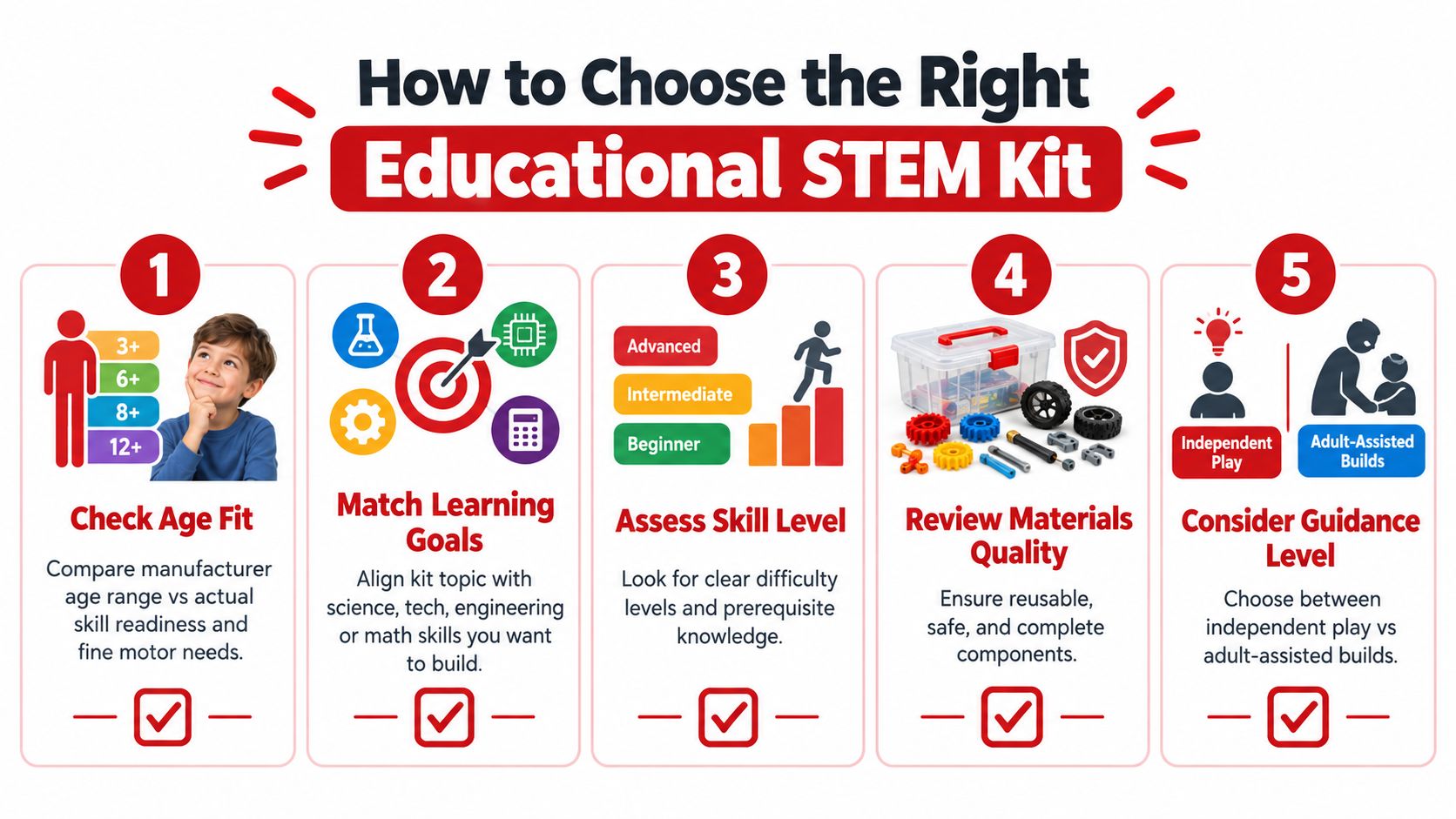
Start with real readiness, not just the box age
Manufacturers often give a wide age band, but that doesn't tell the whole story. One eight-year-old can follow a diagram, measure carefully, and handle delayed gratification. Another still needs frequent help opening packets and resetting after mistakes.
Look for signs of actual readiness:
- Can your child follow three or four steps in sequence?
- Can they handle small parts safely?
- Will they enjoy repeating a test if it fails the first time?
That third question is huge. If a child wants instant payoff every time, a heavily guided kit is usually a better fit than an open engineering set.
Match the kit to the learning goal
Parents often shop by theme when it's smarter to shop by skill.
If you want broad science exposure, choose experiment kits with multiple short activities. If your child loves taking things apart, engineering and build-based kits usually hold attention longer. If they like patterns, logic, or screens used with purpose, coding kits can work well. If they resist writing but enjoy making, pick a kit where the notebooking can stay simple.
A good place to compare different formats is this collection of science kits for kids, because the format of the activity often tells you more than the branding.
Decide how much adult help you can realistically give
Many purchases go wrong.
A very open-ended kit can be wonderful in a classroom with a confident teacher or at home with a parent who likes improvising. It can also flop if the adult wants the child to run with it independently on day one.
Here's the simplest way I frame it:
- Guided kits work well when you want lower setup stress, clearer wins, and better odds of follow-through.
- Open-ended kits work well when the child already likes tinkering and the adult can coach without taking over.
- Hybrid kits often give the best balance. They start with one clear project, then allow variations.
Don't treat safety as a footnote
Check the material list, the warning labels, and the storage needs before you buy. Younger siblings change the safety picture immediately. So do batteries, powders, glass-like parts, and anything that gets heated or mixed.
A safe kit isn't just about ingredients. It's about whether the child can use the materials in the way the activity expects.
A final filter is whether the kit can connect to school learning. If it loosely maps to science or engineering concepts your child will meet in class, it's easier to return to and easier to explain.
Curriculum Alignment Safety and Screen Time
Parents and teachers often ask two separate questions. Does this line up with what kids should be learning, and is it practical to use? In real life, those are the same question.
What curriculum alignment looks like in plain English
You don't need to be deep into standards language to spot useful alignment.
A force-and-motion kit fits naturally with lessons about pushing, pulling, ramps, and speed. A chemistry kit can support units on matter, mixtures, and reactions. A coding activity can support sequencing, debugging, and logical problem-solving. The value isn't in dropping acronyms into a product page. The value is that the activity connects to concepts a child can revisit later in class.
A large meta-analysis of STEM instructional interventions found an average weighted impact of +0.21 standard deviations overall, with stronger outcomes when teachers were trained, built content and pedagogical knowledge, and had chances to troubleshoot implementation (STEM instructional meta-analysis). That matches what many educators already know. Materials alone don't teach. Guided use does.
Safety and durability shape whether the kit gets reused
Age grading tells you something, but not everything. It usually reflects parts size, complexity, and hazard level. It doesn't tell you whether your child is ready to read the instructions, wait between steps, or clean up carefully.
| Kit Type | Standards Alignment | Screen Use | Safety Note |
|---|---|---|---|
| Simple science experiment kit | Matter, observation, variables | Usually none | Watch for powders, liquids, and younger siblings nearby |
| Engineering build kit | Design process, force, structure | Often none | Check small connectors and stability of finished builds |
| Coding or robotics kit | Sequencing, logic, troubleshooting | Often required or optional | Review battery use, wiring, and device setup |
| Hybrid app-supported science kit | Concept reinforcement plus demonstration | Optional companion screen | Best when the screen adds explanation, not distraction |
Durability matters too. If parts bend, crack, or go missing after one session, the learning stops with them.
Families trying to cut device use often ask whether kits really help. They can, especially if you choose screen-free or optional-screen formats and pair them with clear routines. This guide on how to limit screen time is useful because the goal usually isn't zero screens. It's choosing when a screen supports learning and when it replaces it.
Why Playz Educational STEM Kits Stand Out
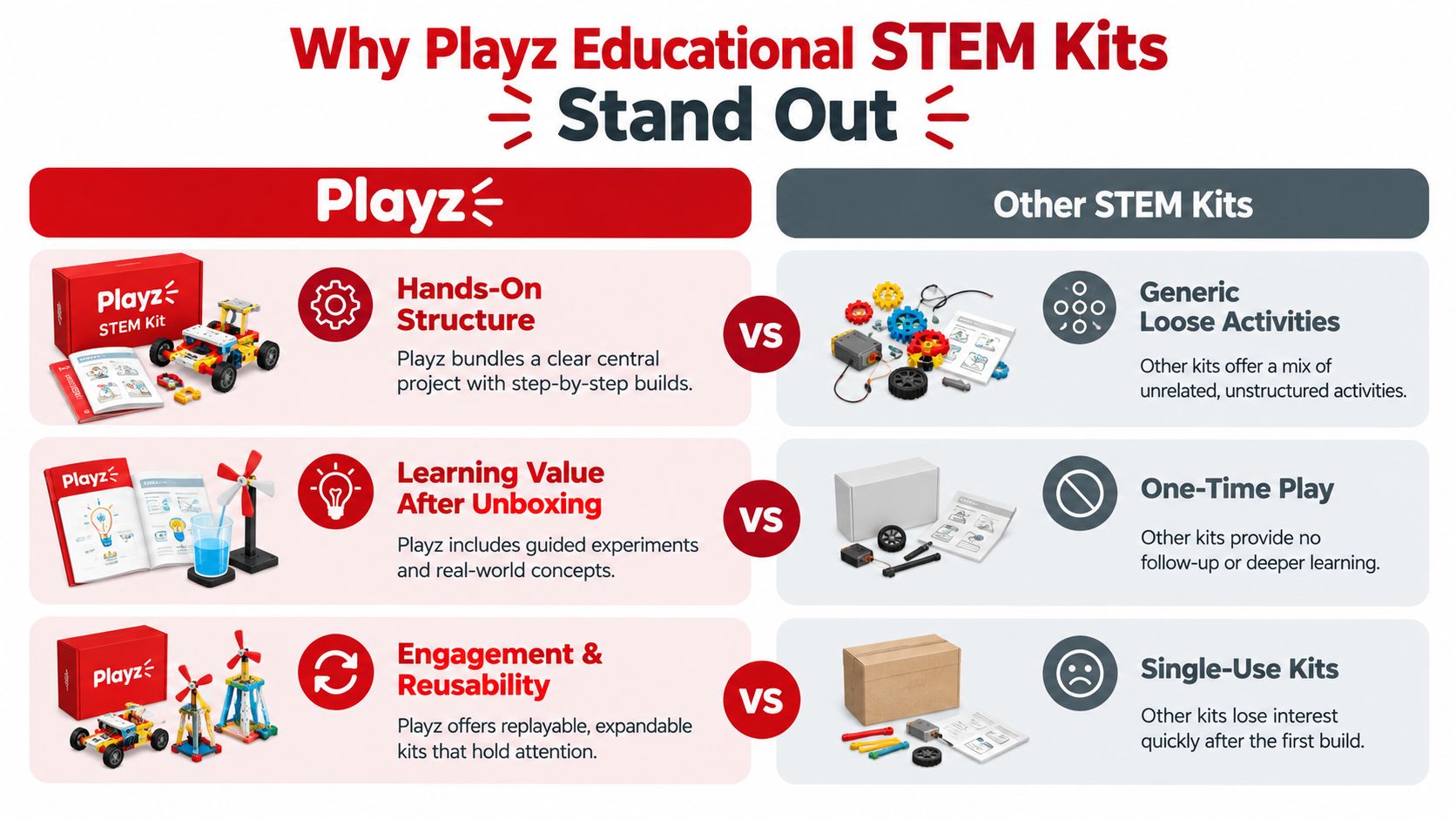
Not all educational STEM kits fail for the same reason. Some are too loose. Some are too shallow. Some give you one dramatic result and then nothing worth revisiting.
That's why I compare kits on what happens after unboxing.
Structure matters more than spectacle
The broad market has room for many formats, but science and engineering kits work best when they combine a central build or experiment with enough extension to keep the child engaged. Research on hands-on science kits found significant knowledge acquisition, with pretest-to-posttest mean differences of 0.21 to 0.41 and evidence of retention on delayed testing, especially when repeated manipulation and inquiry were part of the experience (Foley and colleagues on science kits).
That's one reason I pay attention to whether a kit offers branching experiments rather than one finished result.
Support for non-expert adults changes everything
A lot of adults buying STEM kits aren't science teachers. They're busy parents, grandparents, classroom aides, or homeschool caregivers who need the instructions to carry some of the teaching load.
Research on homeschool families points to the need for kits that support parents acting as engineering educators, and classroom grant examples highlight demand for structured tools like Arduino, water testing, soil testing, and sensors rather than loose materials alone (home facilitation and engineering educator needs). That tells me to look for plain-language instructions, setup clarity, and activities that help adults ask better questions.
One option in that segment is Playz, which offers science kits built around guided experiments and step-by-step activity formats. That matters less as a brand point than as a design choice. Clearer guidance usually lowers drop-off after the first use.
What to compare before you buy
When I'm comparing kits side by side, I focus on:
- Repeatability. Can the child do variations, retries, or follow-up builds?
- Refill reality. If consumables run out, can a family easily replace them?
- Sibling use. Will one child monopolize the kit, or can two kids participate?
- Prompt quality. Do the directions just tell kids what to do, or do they help them think?
The best kit for most families isn't the one with the biggest “wow.” It's the one that still gets opened on a rainy Tuesday two weeks later.
Real World Play Based Learning Scenarios
The most useful way to judge educational STEM kits is to picture them in ordinary life, not in product photos.
A Saturday morning kitchen-table experiment
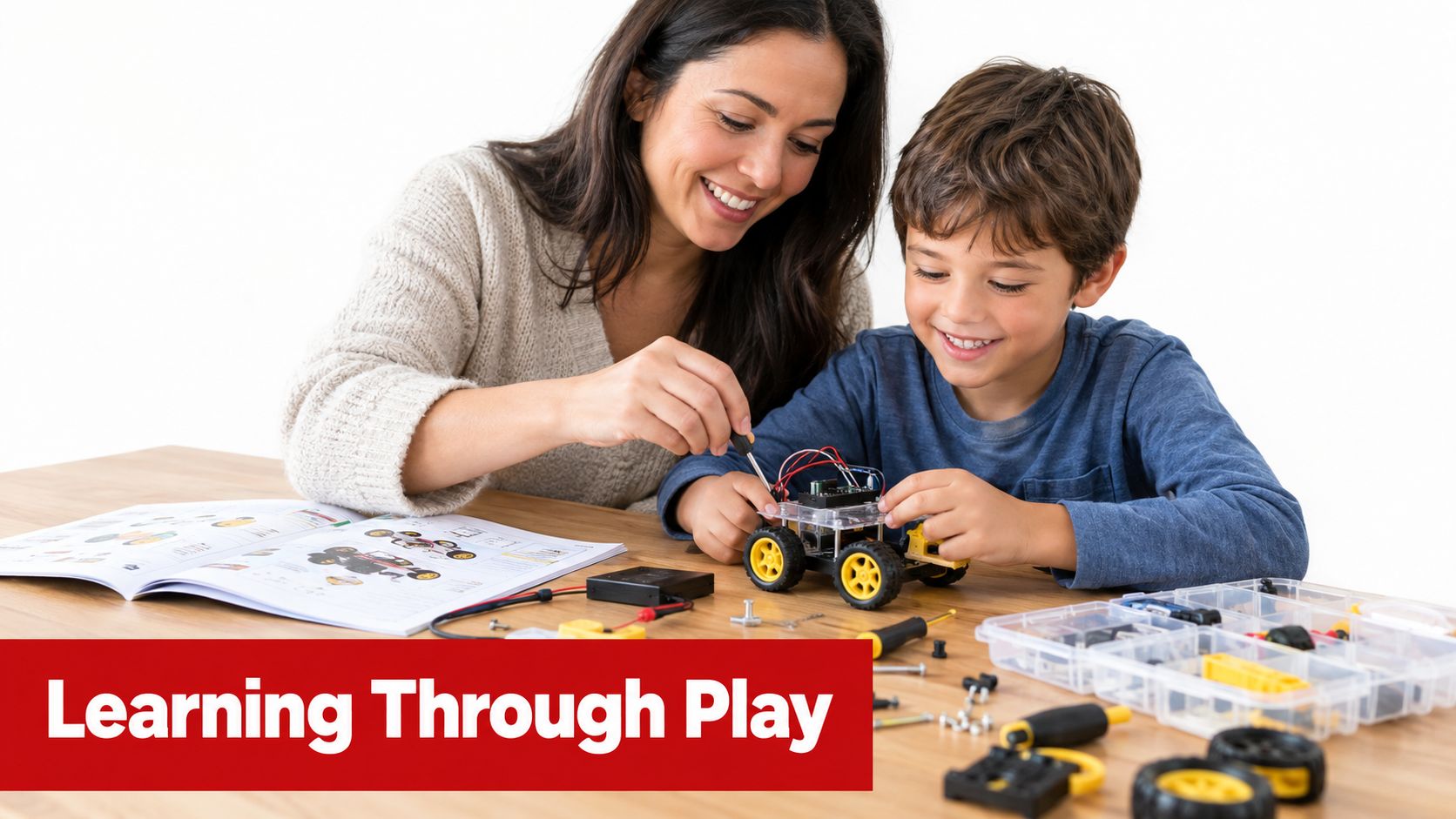
A parent and a seven-year-old sit down with a slime-and-polymers kit after breakfast. The child wants the stretchiest slime possible. They follow the first recipe, mix too fast, and end up with a clumpy mess.
That moment is where the teaching begins.
Instead of saying, “We did it wrong,” the parent asks, “What should we change next time?” They try a second batch and slow the mixing. The child notices the texture changes. They write two quick notes in a notebook: batch one clumpy, batch two smoother. That tiny record-keeping step turns an activity into an investigation.
A lot of families do better with this kind of guided scene than with free-form tinkering. In one controlled study of parents with preschool children, guided STEM activity kits led to significantly more sustained use over 10 weeks, along with higher parent self-efficacy and stronger perceived child learning than basic kits (guided kit study on sustained use).
A classroom station that actually works
In a fourth-grade classroom, a bridge-building kit becomes a two-day station instead of a one-off reward activity.
Day one is short. Students read a brief passage about real bridges, then build in pairs using the kit parts and one design rule from the teacher. Day two is the test-and-revise day. Each group checks what holds, what bends, and what collapses.
A large teacher survey of NSW stem.T4L kits found 94% of 386 surveyed teachers believed the kits had a positive or very positive impact on student learning (NSW teacher survey on STEM kits). That doesn't prove every kit works equally well, but it does match the classroom reality that teachers value kits when they support structured discussion and observation.
If you like turning activities into teachable scenes, this piece on scenario based training explained is a helpful companion. It shows why realistic setups improve learning transfer. That idea fits STEM kit use surprisingly well.
For families thinking in broader developmental terms, these play-based learning benefits connect nicely to what happens during hands-on experimentation.
A short video can also help adults picture the pacing of guided making before they try it at home or in class.
A simple mini-lesson you can run in about 40 minutes
Try this structure with almost any build or experiment kit:
- Learning objective: Students will test one variable and explain how it changed the result.
- Materials: One kit, a timer, a notebook page, and pencils.
- Hook: Show the materials and ask for one prediction.
- Build or experiment: Let kids complete the core activity.
- Test: Change one thing only.
- Explain: Ask each child or group what changed and why they think it mattered.
Early finishers can extend with two prompts:
- Redesign prompt: What would you modify for a third test?
- Real-world prompt: Where might an engineer or scientist care about this same problem?
That structure keeps the adult from over-talking while still giving the activity a clear learning arc.
Common Questions About Educational STEM Kits
Parents and teachers usually ask the same practical questions, and the answers are less complicated than they seem.
What age is actually right for a STEM kit
The age printed on the box is a starting point, not a guarantee.
A younger child may enjoy the theme but struggle with the steps. An older child may technically fit the age band but find the activity too simple. I'd always rather give a child a slightly easier kit they can revisit independently than a more advanced one that depends on constant rescue.
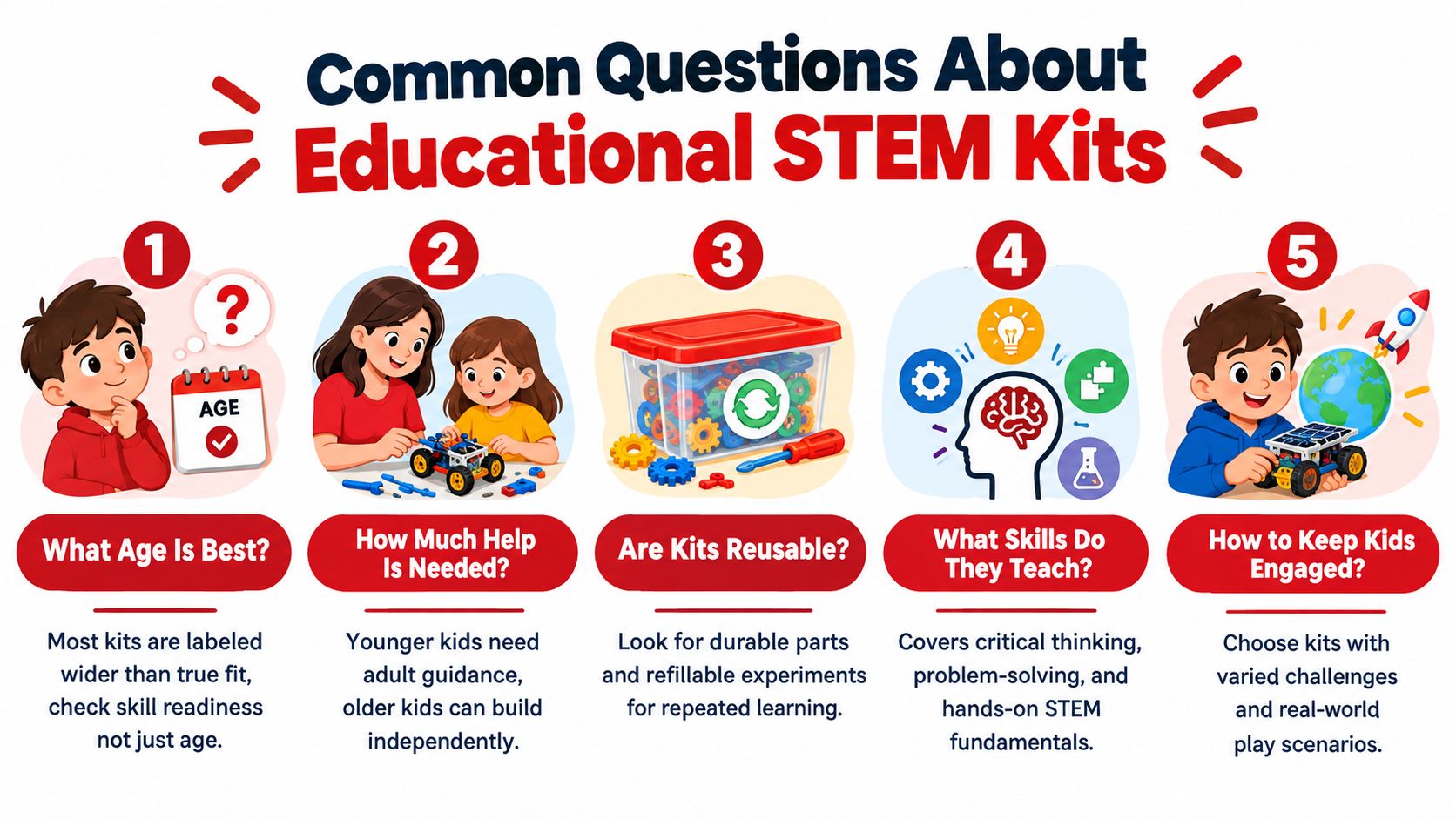
How much adult help should I expect
More than the marketing usually suggests.
Younger children need help reading directions, pacing the steps, and cleaning up safely. Older kids can often build more independently, but they still benefit when an adult asks questions instead of solving the problem for them.
If a child says “It didn't work,” try asking “What did you notice?” before you step in with the fix.
Are STEM kits good for classrooms
Some are, some aren't.
Kits with repeatable parts, short setup time, and activities that work in pairs tend to translate well to small groups. Kits that rely on exact timing, one shared container, or lots of adult-managed mixing are better for one-on-one use or demonstrations.
Do STEM kits make good gifts
Yes, if you buy with the household in mind.
For another family's child, check whether the box signals adult involvement, mess level, and refill needs. A gift is more likely to get used if the parent can picture when and how to pull it out. The prettiest packaging won't help if the activity feels like a project they need to postpone.
Bringing It All Together and Next Steps
If you remember one thing, make it this. The kit matters, but the facilitation around the kit matters more.
Kids learn the most from educational STEM kits when the activity lasts longer than the first burst of excitement. That usually happens when the child cares about the topic, the instructions are clear enough to prevent early frustration, and an adult stays nearby for the first session without taking over. The families and teachers who get the strongest results don't treat the box as the lesson. They treat it as the launch point for questions, retries, and small discoveries.
If you're choosing a first kit, start with the subject your child already talks about on their own. Go for something a little more guided and a little less flashy than your instincts might suggest. Then block off time to sit beside them the first time they use it.
That first session sets the tone. If it feels manageable, they'll come back to it.
If you're ready to move from browsing to doing, Playz offers hands-on science and STEM activity ideas that are built for real use at home, not just shelf appeal. If you want a practical starting point for experiments, guided builds, and repeatable play, take a look at Playz.