


The living room is already full, yet a child still wants a space of their own. A blanket draped over two chairs becomes a reading nook, then collapses when someone reaches for a toy. In a classroom, the same problem appears during quiet time, dramatic play, or a sudden change in the daily routine. A foldable play tent can create that small, child-sized world without permanently taking over the room.
The best choice isn't just the tent with the brightest pattern or fastest setup. Parents, teachers, and gift buyers also need to consider floor space, folding parts, visibility, cleaning, age suitability, and the rules that may apply to a child-entered toy. This guide connects those decisions to everyday use, from choosing a suitable design to storing it safely and turning it into a useful play and learning space.
Why a Foldable Play Tent Belongs in Every Play Space
A toddler crawls into a colorful tent while an adult clears the surrounding floor for blocks and books. The tent gives the child a defined boundary, but it doesn't demand a dedicated room. When play ends, the structure can be folded away, leaving the living space ready for dinner, movement, or the next activity.
That flexibility matters in early childhood settings. A childcare room may need to shift from free play to story time quickly. A home may serve as a playroom in the morning and a shared family room later. A foldable design supports both uses because the play space is temporary by choice, not fixed furniture.
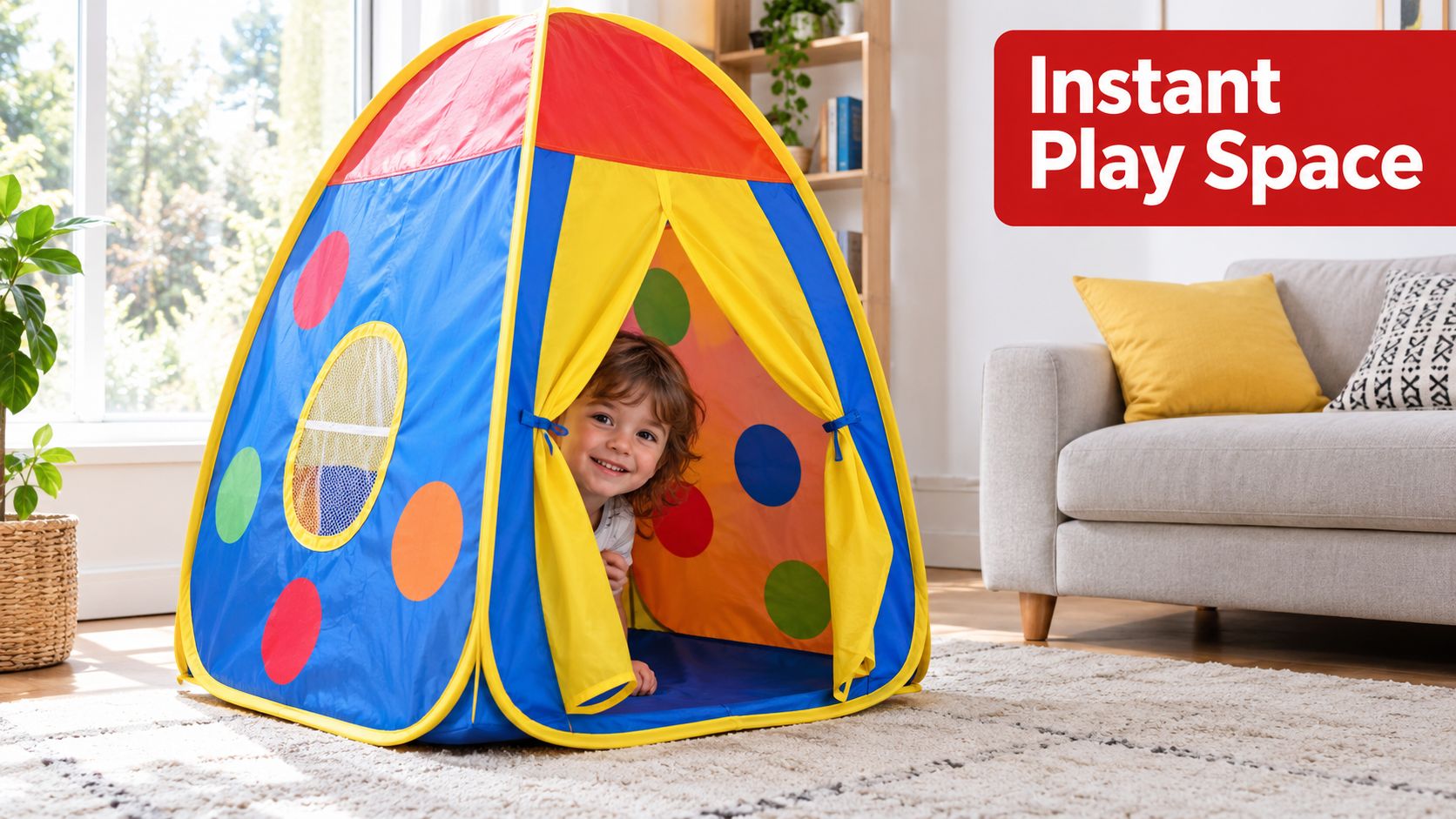
Small footprint, big imaginative value
Inside a tent, ordinary objects gain a new role. Cushions become train seats, a flashlight becomes a moon, and a basket of books becomes a library. The child controls the story, while adults can join without directing every move. For more ideas about the developmental value of pretend scenarios, explore this guide to the benefits of pretend play.
Teachers can use the same principle with a little more structure. A tent might become a veterinary clinic, a weather station, a puppet theatre, or a calm corner. The activity stays open-ended, so children can practice language, cooperation, sequencing, and emotional expression through play rather than a worksheet.
Portability changes the routine
A permanent playhouse can be charming, but it takes commitment. A foldable play tent is easier to move between rooms, pack for a visit, or put away when adults need the floor clear. That makes it useful for families with limited space and educators who regularly rearrange their classroom.
The practical promise is simple: by the end of this guide, you'll be able to compare designs, read safety information with more confidence, establish a care routine, and choose a tent that fits both the child and the space.
How a Foldable Play Tent Works and Why It Is Different
A traditional camping tent is built to shelter people outdoors. It usually prioritizes weather resistance, ground anchoring, sleeping space, and carrying equipment. A foldable play tent is closer to a pop-up book. It opens into a recognizable little environment, then closes into a more manageable shape when the story is over.
That difference affects nearly every design choice. The frame may use flexible supports, collapsible sections, or a pop-up mechanism. Fabric panels often create windows, doors, or themed walls at a child's height. The structure is generally intended for play in a home, classroom, or similar supervised environment, not as a replacement for outdoor camping equipment.
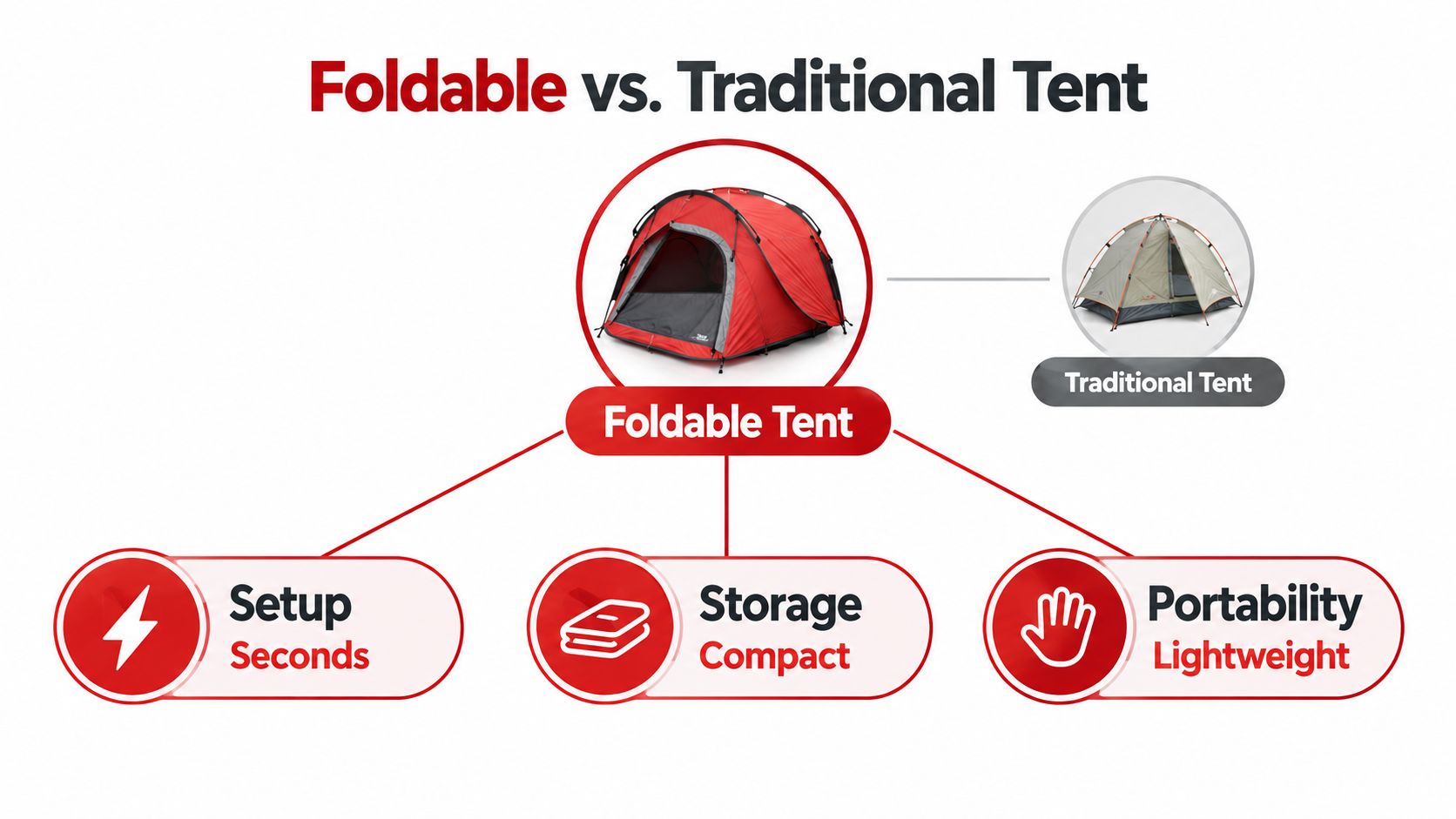
What the folding design changes
The main advantage is not just that the tent folds. It's that folding changes how adults can manage the environment.
- Setup: A caregiver can open the play area when it serves a purpose and remove it when the room needs to change.
- Storage: A folded structure can fit into a storage location that couldn't accommodate a rigid playhouse.
- Portability: Families can move the tent between rooms, while teachers can reposition it for different activities.
A good folding mechanism should feel predictable. If an adult needs to force a frame, twist fabric into place, or guess where a support belongs, daily use becomes frustrating and the product may experience unnecessary stress.
Practical rule: Treat the tent as a child-sized activity space, not as a miniature camping shelter. Its value comes from quick transformation, visibility, and imaginative possibility.
Why child scale matters
A child-entered toy needs a different balance than adult outdoor gear. Children need openings they can understand, surfaces adults can inspect, and enough structure to support imaginative play without creating a confusing maze. Teachers also need to see or hear children during use, especially when several activities are happening at once.
The design can support independent play without making supervision disappear. A window, open doorway, or breathable panel helps an adult check in naturally. For related ideas about combining enclosed play with movement, see this resource on play tents and play tunnels.
How to Choose the Right Foldable Play Tent for Your Needs
Start with the room, not the product photograph. Measure the floor area where the tent will stand, then check the path through the doorway and the place where you'll store it. A tent that fits the play area but can't pass through the storage door will become a daily nuisance.
Next, decide who will use it and how. One child reading needs a different layout from a classroom group using the tent for dramatic play. A smaller structure may be easier to supervise and store, while a roomier design may support shared storytelling but occupy more floor space.
Compare the priorities
| Feature | Home Playroom Priority | Classroom Daycare Priority | Travel and Small Space Priority |
|---|---|---|---|
| Footprint | Fits the room without blocking walking paths | Leaves clear routes between activities | Packs into the available luggage or storage space |
| Visibility | Lets adults check in from nearby | Supports active supervision of multiple children | Keeps the interior easy to inspect |
| Materials | Comfortable fabric and a frame suited to regular indoor play | Surfaces that can be wiped and inspected | Light, compact construction |
| Folding | Simple enough for frequent setup and storage | Reliable during room changes | Fast to pack without tools |
| Durability | Handles repeated imaginative play | Tolerates frequent handling and cleaning | Resists damage during transport |
Look closely at materials and construction
Fabric should feel suitable for the intended setting, with seams and attachment points that look secure. A soft surface can make the tent inviting, but softness shouldn't prevent cleaning or inspection. Check whether the care instructions allow wiping, spot cleaning, or another method that fits your routine.
The frame deserves equal attention. Flexible supports can make setup easy, but they still need to remain properly seated in the design. Folding hinges, connectors, or latches should not feel loose, sharp, or unpredictable. If the product includes removable parts, keep them with the tent and inspect them before play.
Balance portability against roominess
Portability is useful only if the adult can manage the folded form. A compact tent may be the better choice for a bedroom, apartment, or travel bag. A larger design can work well in a dedicated classroom corner, provided it doesn't create a blind spot or obstruct an exit.
Ventilation and visibility also influence comfort. Openings can help adults supervise and may make the interior feel less enclosed. A tent with more panels or decorations may look appealing, but every added feature should still allow easy inspection and straightforward cleaning.
For more product-focused comparison ideas, browse this guide to the best kids' play tents, then compare each option against your measurements and routine rather than choosing by appearance alone.
Safety Age Suitability and What Regulations Mean for You
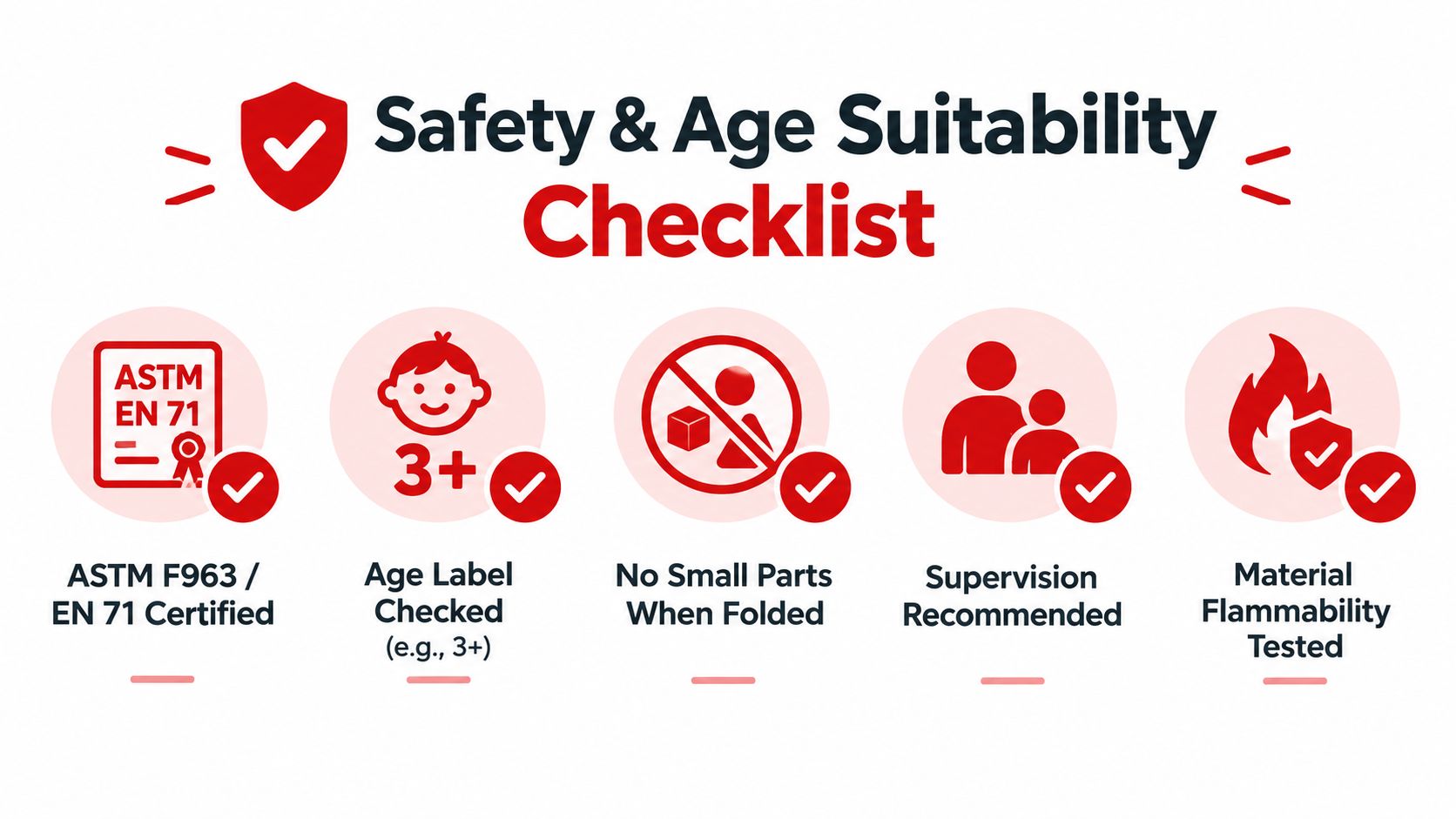
A foldable play tent can look like a fabric shelter, yet its safety questions resemble those for other child-entered toys. In Canada, Health Canada identifies a play tent as a toy intended to be entered by a child. The category can connect with both the Toys Regulations and the Tents Regulations through the federal safety framework.
That classification gives parents and teachers a useful buying lens. Age grading, materials, warnings, fire safety, and folding behaviour all matter because children touch the surfaces, pull on parts, and use the space in ways adults may not predict. For younger children, see guidance on choosing an infant play tent before relying on appearance or size.
Read the label before the pattern
Start with the recommended age range, instructions, warnings, and manufacturer information. A larger tent is not automatically suitable for a younger child. Consider the child's mobility, whether they pull on fabric, how well they follow directions, and how much adult supervision the setting provides.
In Canada, a children's play tent that meets the legal definition of a tent may be subject to fire-safety labelling and flammability performance requirements. If it also qualifies as a toy, the manufacturer must account for both sets of requirements rather than treating it as an ordinary fabric product, as explained in Health Canada's guidance for children's toys and related products.
Understand flammability language
In the EU, toy tents are commonly assessed under EN 71-1 and EN 71-2. EN 71-2 covers toy tents, puppet theatres, wigwams, tepees, and play tunnels. It requires the tested specimen's flame spread rate not to exceed 30 mm/s, or requires the specimen to self-extinguish, according to the EN 71-2 safety standard document.
This technical wording is not an invitation to test fabric at home. Use it as a reminder to review compliance information, keep the tent away from flames and heat, and follow the manufacturer's instructions.
Check folding stability
A folding tent should remain open during its recommended use. In the United States, a play yard standard describes a unit that may fold for storage or travel and requires a folding unit to have a latching, locking, or equivalent feature that prevents unintended collapse under the applicable play yard rule.
Requirements vary by market. Australia's Product Safety Commission states that there is no mandatory safety standard for cubby houses and tents, while still publishing consumer guidance for safer use in its cubby houses and tents guide. Check the rules and product information that apply where you live.
Easy Setup Folding and Care Tips That Extend Tent Life
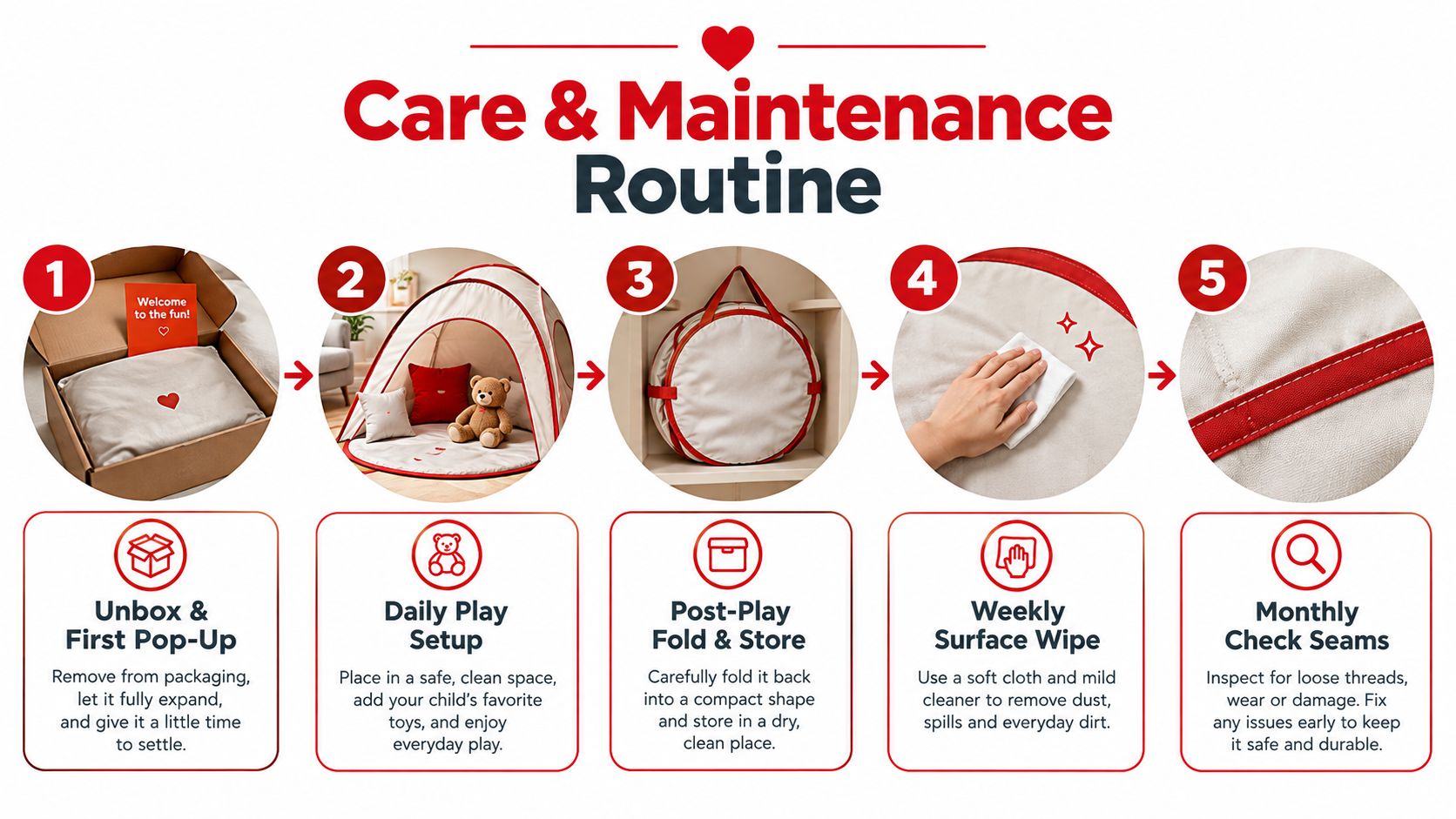
A foldable play tent lasts longer when adults use a consistent routine. The first setup is especially important because it reveals whether the frame, seams, doors, and accessories are working as expected before children begin playing.
Establish a repeatable routine
- Unbox and inspect: Remove packaging, open the tent fully, and look at seams, supports, windows, fasteners, and the floor area. Follow the supplied setup instructions rather than forcing a component into place.
- Choose a clear surface: Set the tent on a stable indoor area away from heat sources, sharp furniture edges, and busy walkways. Clear loose toys from underneath so the base sits evenly.
- Open and check: Make sure the structure has reached its intended shape. Test doors and closures gently, then confirm that the tent doesn't lean, twist, or show unusual tension.
- Fold without fighting the frame: Reverse the stated setup sequence. If a section resists, stop and look for trapped fabric, a misaligned support, or a fastener that hasn't been released.
- Store it dry and flat enough: Keep the folded tent where moisture, heavy objects, and sharp items won't damage the fabric. Avoid compressing it under a pile of equipment.
Clean gently and inspect regularly
Use the care label as the authority for washing. If it calls for surface cleaning, use a soft cloth and a mild method that won't damage coatings, printed details, or stitching. Let damp fabric dry completely before folding it away, since trapped moisture can create unpleasant odors and weaken the storage routine.
A quick inspection can become part of the classroom closing process or bedtime tidy-up. Look for loose threads, stretched seams, bent supports, damaged fasteners, and fabric that no longer sits correctly. Keep children away from a tent that has a structural problem until the manufacturer's instructions explain a suitable repair or replacement.
For a visual demonstration of setup and care habits, watch the following video:
Creative Play Ideas and Classroom Uses That Spark Learning
On Monday morning, a teacher places a few books inside the tent and calls it the “story station.” One child becomes the librarian, another chooses a book, and a third retells the story using toy figures. Later, the same structure becomes a post office. The tent stays the same, but the children's language, roles, and problems change.
At home, keep the invitation simple. Add cushions and books for a reading nook, fabric puppets for a small theatre, or a basket of safe sensory materials for a quiet hideaway. Adults can offer a theme, then step back long enough for children to decide what the space means.
Adapt the play to the child
For younger children who are still building vocabulary, place familiar objects inside and name what they find. Ask, “Who lives here?” or “Where should the teddy sleep?” These questions encourage short exchanges without turning pretend play into a test.
Older preschoolers can plan a shared scenario. They might draw a sign for a pretend shop, sort objects for a science station, or create a story with a beginning, middle, and end. The tent becomes a physical boundary for planning, cooperation, and sustained attention.
Build classroom routines around the space
A classroom tent works best when its purpose is visible. A small picture cue can show whether it's open for reading, role-play, or calming down. Teachers can also limit the number of children inside according to the available space and the product's instructions, then rotate access fairly.
Useful classroom roles include:
- Story director: Chooses the setting and invites peers to add characters.
- Materials keeper: Returns books, puppets, or props after the activity.
- Kindness monitor: Helps children practice taking turns and using respectful language.
- Question collector: Brings questions from inside the tent to a group discussion.
A quiet corner should never become forced isolation. Offer it as one choice among several, and stay available to help a child rejoin the group. Educators looking for ways to organize play zones can also explore preschool classroom setup ideas.
Your Next Step to Choosing a Tent Kids Will Love
A useful foldable play tent decision comes down to three tests: fit, protection, and purpose.
First, fit the tent to the room and the routine. Measure the usable floor area, confirm the folded form can be stored, and check that adults can walk around and supervise. A compact option often makes more sense in a shared living room, while a larger classroom design may justify its footprint if children can use it without blocking other activity zones.
Second, review protection details before you focus on decoration. Read the age label and warnings, inspect the folding mechanism, look for secure seams and fasteners, and follow the market-specific compliance information supplied with the product. The regulatory context matters because a child-entered toy can involve mechanical, material, labelling, and flammability expectations.
Third, decide what the tent will do most often. A reading nook needs visibility and calm access. A dramatic-play station needs room for props and conversation. Travel use puts more pressure on compact folding and manageable storage. The right choice is the one that supports the actual child and setting, not an imaginary playroom.
For parents, that may mean choosing a tent that can disappear after play. For teachers, it may mean selecting a design that supports supervision, cleaning, and clear classroom routines. For gift buyers, the strongest present is one that offers a child an open invitation to invent, tell stories, and make the space their own.
Visit Playz to explore foldable play tents and other purposeful play products suited to imaginative home and classroom activities. Compare the available designs with your space, supervision routine, and child's interests, then choose a play area you'll feel confident setting up and using often.