

Rainy afternoons expose the weakness of many children's toys. The television is already on, cushions are scattered across the floor, and your child is asking what to do for the third time before lunch. A well-chosen play tent or play tunnel can change that scene, but only if you buy for more than bright colors and a quick pop-up design.
The best play structures invite crawling, hiding, carrying, pretending, and repeating. The poor ones sag, trap heat, smell strongly, collect moisture, or become impossible to fold away. This guide focuses on the details most buying guides skip, including ventilation, flame retardants, fabric durability, cleaning, storage, and the difference between a tent that creates a destination and a tunnel that creates movement.
Why Active Play Structures Matter for Modern Families
The rainy-day problem is familiar. A child has energy to burn, outdoor time is off the table, and screens offer instant stimulation. You need an activity that doesn't require constant instructions, a complicated setup, or a living room large enough to become an indoor playground.
That's where a play tent or tunnel earns its floor space. A tunnel gives children a reason to crawl, turn around, back up, and try again. A tent creates a smaller world for reading, role-play, hiding, or quiet recovery. Together, they support the kind of active, open-ended play that can keep children engaged without an adult directing every move.

Movement that has a purpose
Crawling isn't just a way to get from one side of the room to the other. Children use both sides of the body, adjust their balance, judge distance, and plan their next movement as they move through a flexible tunnel. They also learn through repetition. A toddler may crawl through once, reverse direction, carry a soft toy inside, then repeat the sequence with a completely different story attached to it.
The tent adds a contrasting kind of engagement. Inside, a child might run a pretend veterinary clinic, build a reading nook, or create a secret base. The play becomes less about speed and more about language, sequencing, emotional expression, and focused imagination.
The active play toys guide offers a useful starting point for parents building a broader movement-friendly play area.
A practical answer to screen-heavy routines
The World Health Organization's pooled analysis of children aged 5 to 17 found that 79.4% actively played for more than one hour per day, while 60.2% had screen time below two hours per day and 84.9% slept nine to eleven hours per night. The same analysis found that active-play participation varied from 61.7% to 98.3% across countries, showing why active-play products can appeal across very different markets and family routines. Read the WHO-linked analysis of physical activity, screen time, and sleep.
A nationally representative U.S. study of children aged 4 to 11 found that 37.3% had low active play, 65.0% had high screen time, and 26.3% experienced both patterns at once. It also reported that 10% played actively two or fewer times per week, while another 10% did so ten or more times per week, indicating very uneven play habits rather than one typical family routine. Review the U.S. active-play and screen-time benchmark.
Practical rule: Buy a structure that makes movement easy to start, then leave enough room for your child to invent the game.
A tent and tunnel setup can become a household “yes space,” meaning a defined area where children can explore within clear safety boundaries. That won't replace supervision, but it can reduce the number of times you need to interrupt play with “don't climb that” or “get off the furniture.” For busy families, that combination of movement, imagination, and greater independence is the value.
Comparing Play Tents and Play Tunnels
A play tent is a destination. A play tunnel is a route. That simple distinction helps you choose the right structure faster than a long list of decorative features.
Tents work well for children who like pretend scenarios, books, dolls, stuffed animals, or quiet hideaways. They need floor space and vertical clearance, but they don't usually require a long, unobstructed path. Tunnels suit children who want to move. Crawling through, reversing, peeking out, and transporting toys turns a small footprint into a repeated physical challenge.
| Feature | Play Tents | Play Tunnels |
|---|---|---|
| Primary play pattern | Imaginative, stationary play | Crawling, movement, and repetition |
| Best use | Reading nook, pretend home, secret base | Obstacle route, hide-and-seek, movement circuit |
| Space requirement | Floor area plus vertical clearance | Horizontal clearance and open pathway |
| Social play | Children gather inside and assign roles | Children take turns entering and exiting |
| Storage concern | Folded frame and fabric bundle | Collapsible tube, often easier to tuck away |
| Ideal pairing | Cushions, blankets, books, pretend-play props | Tents, mats, pillows, and soft barriers |
Choose by your child's play style
A child who settles into a pretend kitchen for long stretches will probably use a tent more consistently than a tunnel. A child who climbs over furniture, crawls under tables, and repeats physical routes will get more from a tunnel.
Age matters, but temperament matters just as much. Younger children often benefit from a simple, approachable tunnel with an obvious entrance and exit. Older preschoolers may want a tent as a base and a tunnel as a challenge. Children playing together can use the tent for role assignment and the tunnel for taking turns.
Browse crawl tunnels for children with your actual room layout in mind, not an imagined playroom.
The combined setup wins for flexible households
A tent connected to a tunnel creates a basic play circuit. The child leaves the “base,” crawls through the route, returns with a toy, and starts a new mission. Add a floor cushion outside the entrance and you have a stopping point. Add a second tent or a blanket divider and the structure becomes a multi-room story.
This combination also balances activity levels. A high-energy child can crawl and carry objects, then retreat to the tent for a calmer game. Two children can assign one child as the “shopkeeper” inside the tent while the other delivers pretend supplies through the tunnel.
The tradeoff is practical. Combined systems occupy more floor space and create more seams, connectors, and fabric panels to inspect. If storage is tight, start with the structure your child will use most, then add the second piece only after you've confirmed a safe, repeatable setup area.
Safety Standards and Material Toxicity
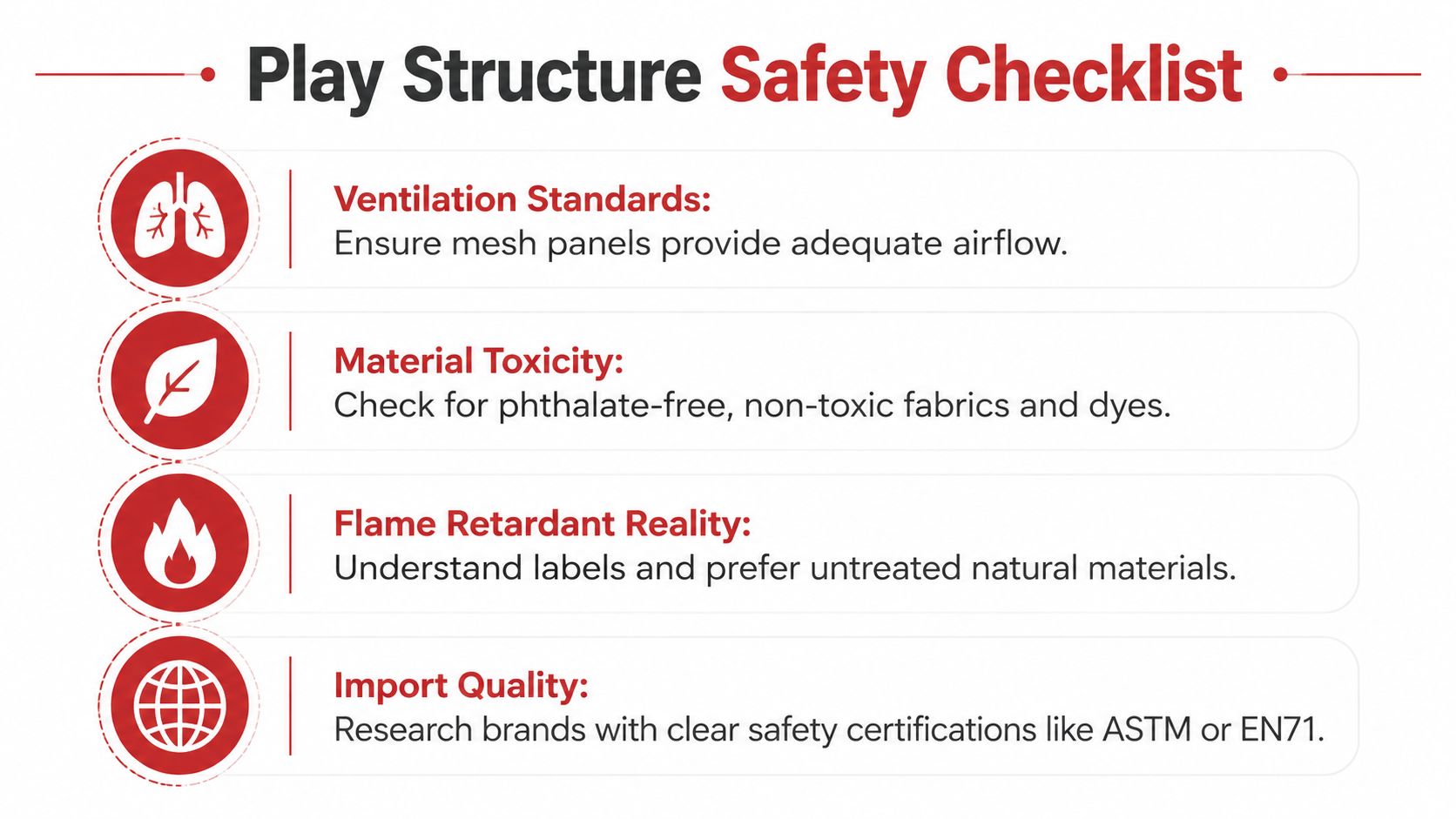
A bright play tent can look harmless while hiding important safety questions. Parents should inspect the enclosure, fabric, frame, labels, and airflow before thinking about patterns or accessories.
For the EU market, play tents and tunnels fall under EN 71-1, which covers mechanical and physical safety requirements for toys intended for children under 14. The standard specifically addresses entrapment and asphyxiation risks in toys that can fully enclose a child, so enclosure geometry and ventilation aren't minor design details. Review the EN 71-1 mechanical and physical safety requirements.
Ventilation is a design requirement
A tent should have mesh panels or other openings that provide reliable airflow. Openings must remain unobstructed, and bedding, blankets, and stuffed animals shouldn't cover vents. Independent safety guidance warns that restricted airflow inside an enclosed children's tent can create a serious oxygen-deficiency hazard, while children should never be left unattended inside. Read the children's tent ventilation and supervision guidance.
The Australian Competition and Consumer Commission recommends adequate ventilation, easy opening from inside, and a 1.5 cm gap on the hinged side of doors for cubby houses and tents. Australia doesn't have a mandatory safety standard for these products, which makes practical inspection especially important. See the ACCC cubby-house and tent safety guide.
Flame retardants deserve direct questions
Washington State Ecology found toxic flame retardants in some children's play tents, tunnels, and chairs. Its review also noted that, for products without a California TB 117-2013 label, parents usually have no practical way to know whether flame retardants are present without laboratory testing. The recommended risk-reduction steps include washing hands before eating and using HEPA vacuuming to reduce dust exposure. Read the review of flame retardants in children's products.
That means a vague “non-toxic” statement isn't enough. Look for clear material disclosures, manufacturer contact information, care instructions, and safety documentation that identifies the applicable market standard. Certifications can be useful, but don't treat a logo without product-specific details as proof of every safety characteristic.
For nearby flooring and soft-surface planning, a practical resource on safest playground ground cover materials can help you create a safer landing area around indoor or outdoor play equipment.
Inspect the structure before every active session
Use this short inspection:
- Mesh and seams: Look for torn panels, pulled stitching, and openings large enough for fingers or limbs to catch.
- Zippers and ties: Check that zippers move smoothly and that cords don't create loops within reach.
- Frame: Reject bent spring steel, exposed wire, cracked fiberglass, or supports that no longer hold their shape.
- Base: Place the structure on a stable, soft surface away from stairs, heaters, windows, cords, and sharp furniture edges.
- Enclosure: Make sure a child can exit easily and that adults can open the entrance quickly.
- Labels: Check the intended age range, care instructions, importer details, and relevant compliance information.
Material construction matters too. Retail specifications show examples using polyester taffeta with steel frames, 190T polyester taffeta with thick steel wire, and 600D polyester Dacron with padded heavy-duty spring-steel structures. These examples indicate that fabric denier, weave, and frame stiffness often drive durability more than tunnel length alone. Compare representative polyester and frame specifications.
For parents researching lower-exposure options, this non-toxic toys for babies guide provides useful questions to apply to fabrics, coatings, dyes, and labels.
Choosing the Right Size and Configuration
Start with the room, not the product page. Measure the usable floor area, note low furniture and ceiling fixtures, then leave a clear safety buffer around every entrance and exit. A structure that technically fits but blocks a doorway will become a daily nuisance and may encourage unsafe shortcuts.
Next, match the layout to your child's confidence and movement. Toddlers generally need an easy-to-enter route that doesn't feel like a long, dark passage. Preschoolers can handle more distance and benefit from a tent that gives pretend play enough room to develop. School-age children usually need a larger circuit or multiple connected zones if the structure is expected to hold their interest.
Use this planning table as a starting point
| Age Group | Tunnel Length | Tunnel Diameter | Tent Base Size | Best Configuration |
|---|---|---|---|---|
| Toddlers aged 1 to 3 | 4 to 5 feet | 18 to 20 inches | Compact footprint | One short tunnel with a visible exit |
| Preschoolers aged 3 to 5 | 6 to 8 feet | A roomier passage | 3 to 4 feet | Tent-and-tunnel route for pretend missions |
| School-age children | 8 feet or more | Larger passage | Larger or multi-room layout | Modular circuit for cooperative games |
These dimensions are practical planning targets, not universal safety rules. Your child's body size, confidence, supervision needs, and the manufacturer's instructions should determine the final choice.
Indoor and outdoor configurations need different priorities
Indoor buyers should prioritize quick disassembly, compact folded dimensions, quiet frames, and a base that won't slide across hard flooring. A pop-up tent can reach several feet in height, so check ceiling clearance before buying and avoid positioning it under ceiling fans or light fixtures.
Outdoor users need weather-resistant fabric, secure anchoring, shade planning, and a realistic drying routine. Don't leave a fabric structure wet or damp after use, and don't assume outdoor suitability means permanent exposure to sun and weather. UV light, moisture, and rough ground can shorten the useful life of fabric and weaken supporting materials.
Modular systems make more sense as children grow
Interchangeable connectors and expandable panels let you begin with a simple route and add complexity later. They also allow you to reconfigure the structure when your room changes. Standardized parts are valuable, but only if the manufacturer clearly explains compatibility and replacement options.
The safest configuration is one you can supervise easily. Avoid creating blind corners, compressed entrances, or narrow connections where children pile up. One child at a time may be appropriate for a small tunnel, while larger group play requires enough room for children to enter, exit, and wait without blocking one another.
Creative Play Patterns and Screen-Free Ideas
A tent and tunnel don't need electronic features to stay interesting. They need a changing story, a manageable challenge, and enough open-ended parts for children to make decisions.
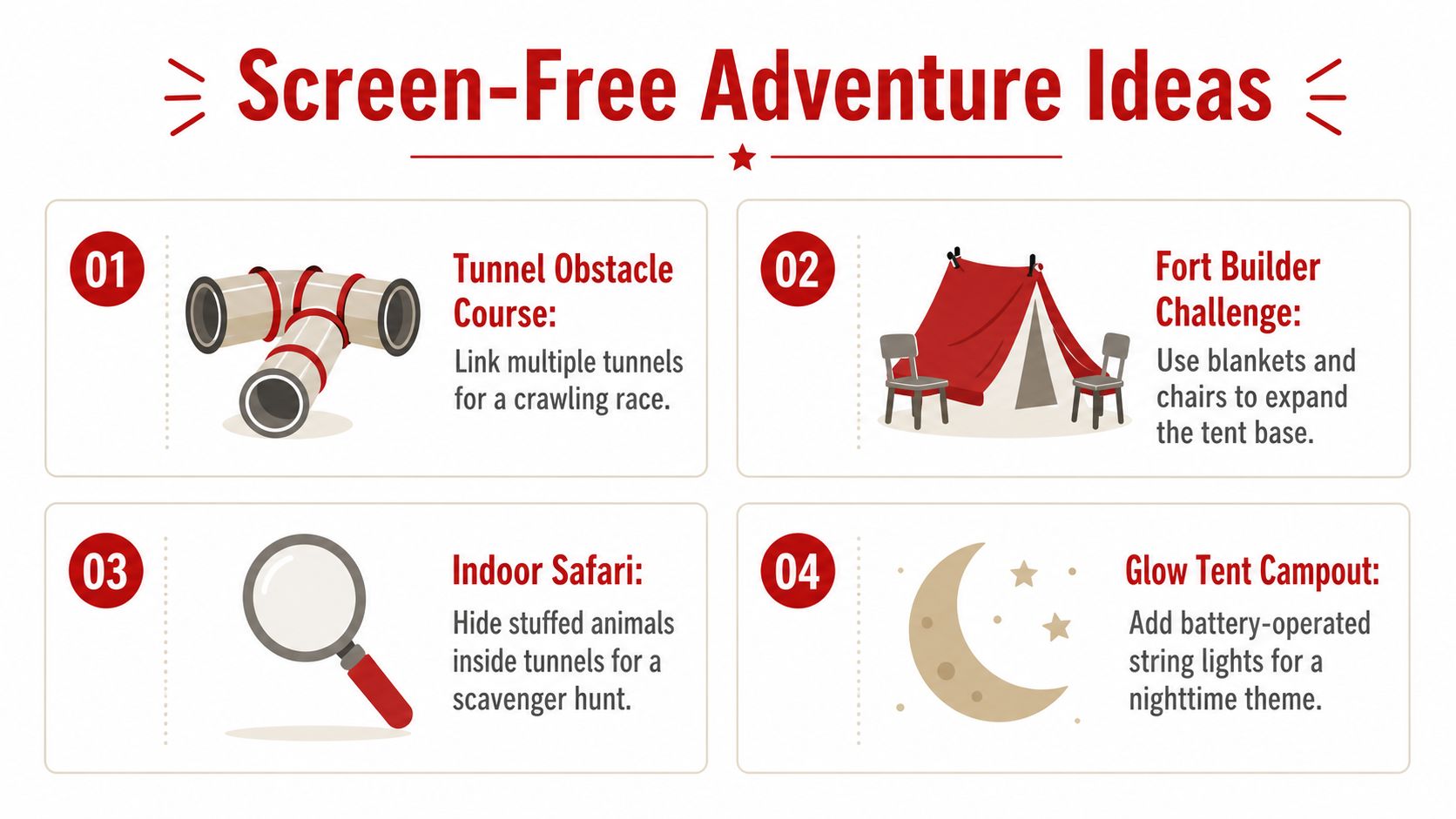
Start with one route. Place the tunnel between a soft starting mat and the tent, then give the child a mission such as delivering a stuffed animal, rescuing a toy, or carrying a message. Once that game becomes familiar, change the rule rather than buying another accessory.
Build movement into pretend play
A pirate ship needs a hidden passage. A space station needs a launch tunnel. A veterinary clinic needs a waiting room and an animal delivery route. The tent supplies the setting, while the tunnel supplies the action.
You can add cushions as low barriers, pool noodles as visual boundaries, and blankets as removable walls. Keep every added item soft, stable, and easy to remove. A timed obstacle course can build coordination, but don't turn every session into a race. Some children engage more when they can crawl slowly, hide, and repeat a route at their own pace.
Add learning without making play feel like school
Hide lettered, numbered, or picture cards along the route. Call out a color to find, ask the child to collect objects that begin with a chosen sound, or create a simple delivery sequence. The physical route gives the task a purpose, and the tent becomes the place where the child sorts or displays the discoveries.
For multiple children, assign cooperative roles. One child can be the dispatcher, another the explorer, and another the tent-based shopkeeper. Rotate the roles so the fastest crawler doesn't control every round. A cooperative challenge, such as moving all the stuffed animals through the tunnel without touching the floor, encourages communication and turn-taking.
The indoor obstacle course ideas collection can help you expand a basic setup without overcrowding the room.
Use light, texture, and seasonal themes carefully
A tent can become a calm sensory space with a textured mat, soft fabric strips secured well above reach, or battery-operated lights designed for safe indoor use. Flashlight games work best with an adult nearby and the entrance fully accessible. Never darken the tent in a way that blocks ventilation or makes exit difficult.
Outdoor play can use seasonal stories, such as an autumn animal trail or a summer explorer camp. Don't mist a fabric structure unless the manufacturer permits it, and dry every component fully before storage.
Maintenance Cleaning and Storage Best Practices
Maintenance determines whether a play tent or tunnel remains inviting or turns into a dusty, musty object in the corner. Establish a simple routine from the first day, especially if children use the structure on floors, patios, or grass.
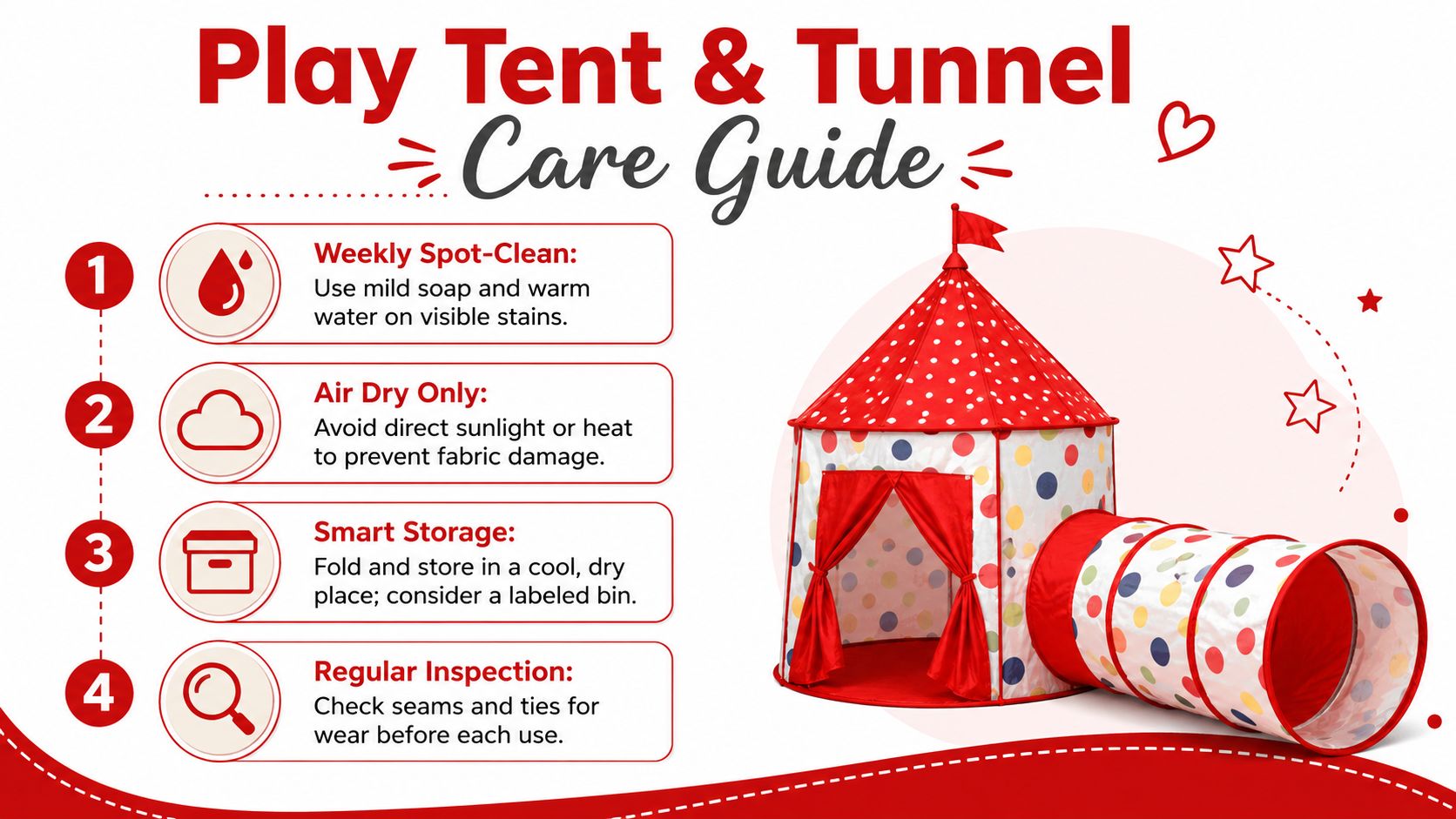
Start with visible dirt. Spot-clean fabric with mild soap and warm water, following the manufacturer's care label. Avoid harsh chemicals unless the instructions specifically allow them, because aggressive cleaners can weaken fabric finishes, irritate skin, or damage prints and mesh.
Clean in a repeatable cycle
- After messy play: Remove crumbs, grass, and loose debris before folding.
- On a regular schedule: Wipe high-contact areas such as entrances, handles, and floor panels.
- After outdoor use: Check for dampness, soil, insects, and plant residue.
- Before storage: Allow every panel, seam, and fold to dry completely.
Machine-washable tunnels should only be laundered according to their care instructions. Use a gentle cycle and cool water when permitted, then air-dry completely. Never fold damp fabric, even if it feels only slightly cool to the touch. Moisture trapped in folds encourages mildew and unpleasant odors.
Inspect the frame as carefully as the fabric
Before each use, scan seams, ties, mesh, connectors, and spring frames. A bent wire can create a sharp point, while a torn panel can become an entanglement or escape hazard. Remove the product from play immediately if the frame no longer locks into shape or the fabric pulls away from its attachment points.
Store clean, dry components in a cool, dry location. A breathable fabric bag is preferable to sealing damp material in plastic. If you use a labeled bin for organization, make sure the structure is fully dry before closing it.
The toy storage solutions for small spaces guide can help you keep folded structures accessible without leaving them permanently spread across the room.
Final Recommendations for Long-Term Value
Buy the modular play tent and tunnel system if you have the space and expect regular use. Interchangeable connectors and expandable panels let the setup change as your child's confidence, size, and play interests change. A single tunnel can be useful, but a system with a tent base and reconfigurable routes offers more ways to play and more opportunities to keep the structure relevant.
Look for reinforced stitching at stress points, firm frame supports, well-attached mesh, and fabric described with meaningful construction details. For outdoor use, UV-resistant fabric and secure anchoring options matter. Standardized pole diameters may also make it easier to combine replacement parts, but confirm compatibility before mixing brands.
Canadian rules add another layer of scrutiny. Health Canada's 2024 Tent Regulations include children's play tents that resemble camping tents or other shelters and are intended for outdoor use, linking requirements to CAN/CGSB-182.1-2020 for flammability and labelling. A Canadian proposal also describes a play tent as a toy intended to be entered by a child and connects fire-safety labelling and flammability requirements with ISO 8124-2:2014. Review the Canadian tent regulations and the Canadian play-tent proposal.
Before buying, confirm:
- Safety documentation: Look for applicable standards and market-specific compliance information, not just a decorative certification badge.
- Material transparency: Ask whether added flame retardants are used and whether the manufacturer identifies fabric and coatings.
- Ventilation: Check for open mesh panels and an exit that a child can access easily.
- Structural integrity: Inspect stitching, frames, connectors, and zipper construction.
- Storage reality: Measure the folded product and decide where it will live between play sessions.
- Maintenance demands: Read the cleaning and drying instructions before purchase.
Don't choose flashy prints over strong seams and honest material information. Choose the structure that will stay stable, ventilated, cleanable, and usable in your actual home.
Playz offers play tent bundles that combine pop-up tents and crawl tunnels, along with standalone tents and tunnels for families building a flexible active-play area. Visit Playz to compare options, check the available configurations, and choose a setup that gives your child more room to move and imagine.