

You're standing in a toy aisle, trying to choose a birthday gift for a seven-year-old who has outgrown simple stacking but may still abandon a complicated kit after the first mistake. One box says “STEM,” another promises open-ended creativity, and a third has an impressive age range that doesn't tell you whether your child can manage the build.
The best building toys for 7 year olds aren't necessarily the ones with the most pieces or the most advanced label. They're the ones that match a child's current skills, offer a manageable challenge, and leave room for rebuilding, storytelling, and independent ideas.
Why 7 Is the Golden Age for Building Toys
A seven-year-old may spend one afternoon following instructions to make a vehicle and the next dismantling it to create a rescue station. That shift matters. Children at this age are often ready to move beyond balancing pieces and begin thinking about stability, sequence, proportion, and structure.
Building play has a long educational history. Friedrich Froebel's 1837 “Gifts” introduced geometric wooden blocks as hands-on tools for teaching forms, shapes, and early spatial reasoning. By the late nineteenth and early twentieth centuries, the idea had influenced widely marketed construction toys and later educational play systems. You can read more about this development in the history of architectural toys and construction-based education.
Why the challenge matters
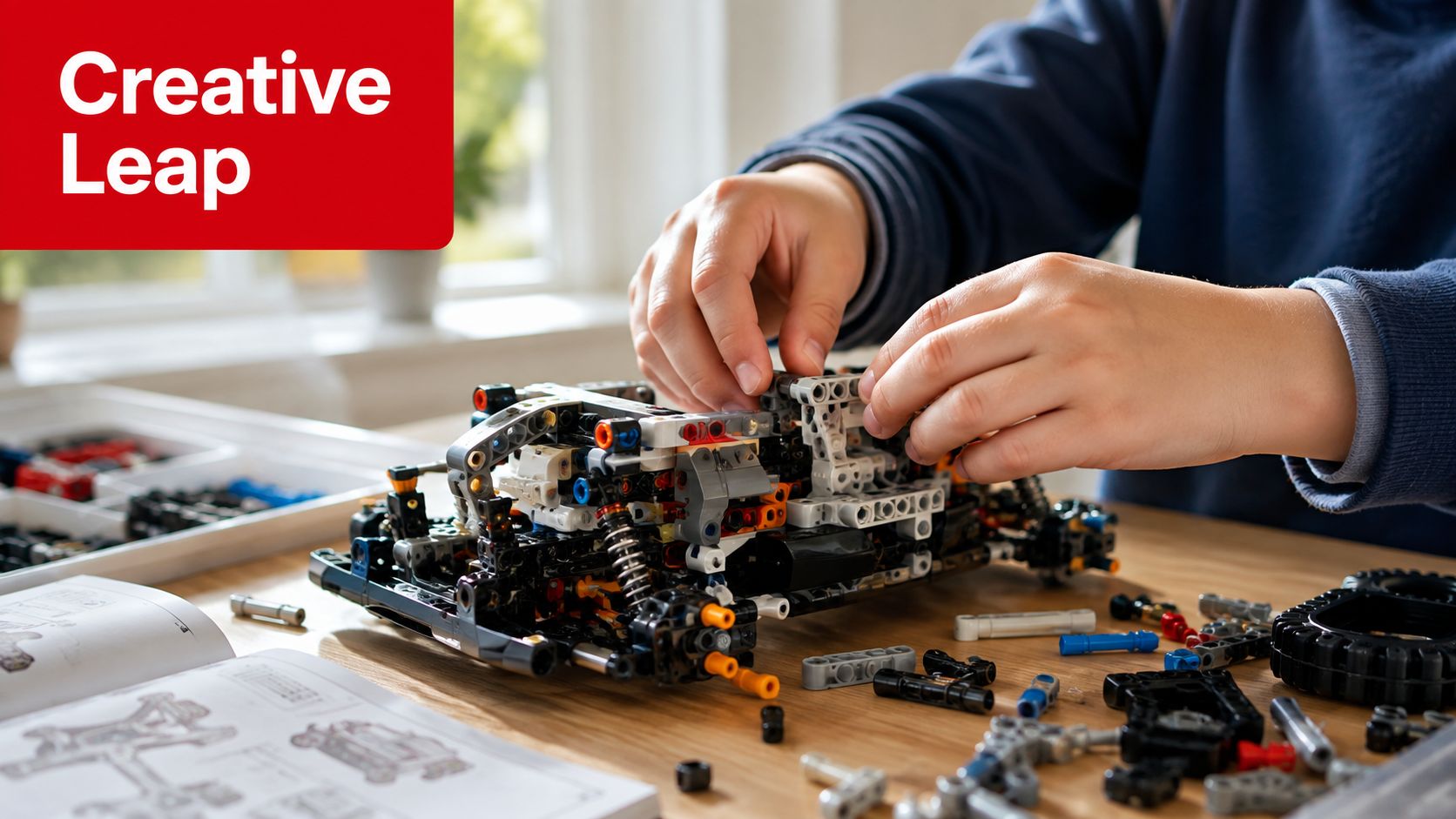
At seven, a child may be able to read visual instructions, sort parts by shape, hold a design in mind, and notice why a structure collapses. Those skills support early engineering habits without requiring formal lessons. A child learns that a wide base may hold more weight, that symmetrical parts often improve balance, and that changing one connection can alter the entire model.
Fine motor control also becomes more useful during construction play. Turning a connector, pressing bricks together, aligning a wheel, or attaching a small panel requires controlled hand movements. The activity feels like play, but the child is practicing precision and patience.
The right set can also strengthen confidence. Completing a guided model gives a child a clear success point, while rebuilding it differently gives them ownership. Parents looking for more hands-on activities can also browse crafts for 7-9 year olds, especially when a child enjoys switching between construction, drawing, and making.
Practical rule: Choose a toy that offers one reliable way to succeed and several ways to continue.
That balance supports curiosity rather than performance pressure. For more ideas about encouraging children to ask questions and investigate their surroundings, explore how to develop curiosity. A good building toy doesn't need to produce a perfect display model. It needs to make the child want to try one more design.
The Real Benefits of Construction Play
Construction play gives children a concrete way to reason through problems. They can see the result of a choice immediately. If a bridge bends, a tower tips, or a wheel won't turn, the child has a visible problem to investigate rather than an abstract question to answer.
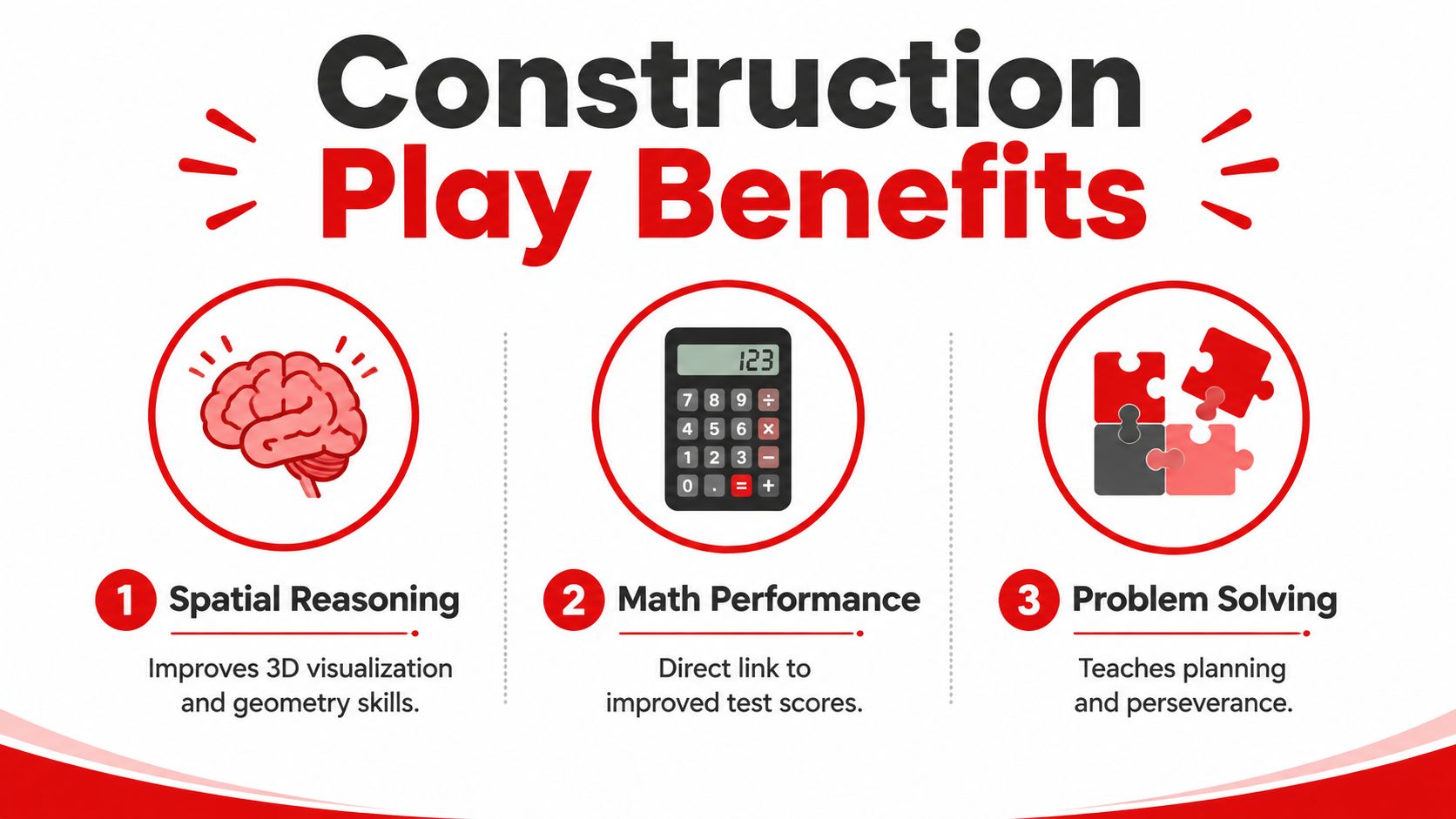
A University of Derby study found that a child's skill in building with LEGO sets was a strong predictor of math performance. A 2018 University of Colorado Boulder study also found that adults who had played with construction toys such as LEGO during childhood showed higher spatial awareness than adults who had not. These findings help explain why building toys remain relevant for seven-year-olds, whose spatial, mathematical, and problem-solving abilities are developing rapidly. The research summary on LEGO and skill development provides further context.
What children practice while building
- Spatial reasoning: Children mentally rotate parts, compare dimensions, and work out how pieces fit in three-dimensional space.
- Mathematical thinking: Sorting, counting, repeating patterns, comparing lengths, and balancing quantities make numbers meaningful.
- Planning: A child learns to gather parts, follow a sequence, and anticipate what the next stage requires.
- Troubleshooting: When a model fails, the child tests a new connection or changes the design.
- Fine motor control: Small, deliberate movements strengthen coordination between the eyes and hands.
- Persistence: A difficult build gives children a reason to pause, reconsider, and try again.
The learning becomes stronger when adults ask useful questions instead of taking over. “What part moved when the tower fell?” encourages analysis. “Would a wider base help?” points toward a possible solution without removing the child's responsibility.
Loose materials can support the same habits outside formal kits. A resource on loose parts for school readiness offers ideas for using everyday, movable materials in ways that encourage sorting, designing, and independent problem solving. The child doesn't need a branded set to practice construction thinking.
This short video can also provide a visual starting point for discussing how children build and revise ideas:
For a broader explanation of play that involves making, testing, and changing objects, see what constructive play means. The central question isn't whether a child completes the intended model. It's whether the toy gives them meaningful choices and feedback.
Comparing Popular Building Systems
Different construction systems create different kinds of play. A child who loves clear goals may prefer interlocking bricks, while a child who builds houses, animals, and fantasy creations may get more from wooden blocks or magnetic tiles.
| System Type | Best For | Pros | Cons |
|---|---|---|---|
| Interlocking bricks | Guided builds and detailed reconstruction | Clear instructions, strong replay value, precise models, durable connections | Small parts can be difficult to sort, and highly prescribed builds may limit spontaneous designs |
| Wooden blocks | Large structures and open-ended construction | Simple shapes, natural visual appeal, broad creative freedom, easy collaborative play | Designs may collapse more easily, and pieces usually offer fewer specialized functions |
| Magnetic tiles | Quick structures and visual experimentation | Fast assembly, easy experimentation with flat and three-dimensional forms, accessible for children who dislike long instructions | Connections may not support heavy or intricate structures, and loose magnetic components require careful safety review |
| Modular engineering kits | Mechanisms, machines, and design challenges | Introduces gears, axles, fasteners, motion, and cause-and-effect reasoning | Often needs more patience, careful instructions, and adult support during difficult stages |
Match the system to the child
Interlocking bricks work well for a child who enjoys completing a model and then modifying it. They provide frequent small successes, which can help a first-time builder stay engaged.
Wooden blocks suit children who invent settings rather than follow a finished design. A block can become a wall, a bridge, a table, or part of a pretend city. The absence of specialized pieces encourages the child to assign their own meaning.
Magnetic tiles make spatial experimentation quick. Children can build a square, turn it into a cube, and discover how flat shapes become structures. Parents should inspect the product carefully and avoid sets containing loose magnetic pellets or balls, which present a serious swallowing hazard.
Modular systems are better for children who have already completed simpler builds and want to understand how parts work together. A gear-driven vehicle or model engine can teach more than assembly if the child can change a component and observe what happens.
Before choosing a system, consider whether the child wants a finished result, an imaginative world, a rapid design cycle, or a mechanical challenge. A guide to STEM building kits can help families compare construction with science and engineering activities, but the age label alone won't identify the best match.
Choosing the Right Complexity Level
Age is only the starting point. The more useful question is, what kind of challenge can this child manage without losing the desire to continue?
Start by watching how the child already plays. A child who completes puzzles independently may manage longer visual instructions. A child who prefers free construction may need a kit with short guided builds and plenty of spare parts. A child who becomes upset when a model fails may benefit from larger components and a design that can be repaired easily.
Use these four checks
- Look at the piece count. First-time builders often do better with classic interlocking systems, clear step-by-step plans, and sets containing under about 100 pieces. This is a practical starting point, not a rule for every child. Guidance on choosing construction toys for seven-year-olds emphasizes skill stage and manageable complexity over age alone.
- Read the instructions before buying. Look for clear diagrams, visible part changes, and stages that end in a stable result. Dense pages with several similar-looking pieces can create unnecessary frustration.
- Check adult involvement. Some kits invite a child to work independently. Others require an adult to identify parts, stabilize a subassembly, or explain a mechanism. Neither option is automatically better. Choose the level of support your household can realistically provide.
- Balance guidance with freedom. A useful set may begin with a model and finish with an invitation to redesign it. Once the child understands how the pieces work, ask them to create a stronger bridge, a faster vehicle, or a home for an invented character.
A successful build should stretch a child's thinking, not test their tolerance for confusion.
Motorized or gear-heavy kits generally make more sense after a child has completed a few simpler builds. If the child finishes quickly and immediately asks for a harder challenge, increase complexity gradually through mechanisms, unusual shapes, or open-ended design rather than buying a much larger set.
Safety First Understanding Age Labels
Toy age labels are safety and developmental guidance, not a score for intelligence. Industry guidance explains that the label reflects whether the toy's design, size, and hazard profile fit the intended developmental stage. In the United States, ASTM F963 toy safety requirements are mandatory under federal law for children's toys, as explained by the U.S. Consumer Product Safety Commission's toy safety guidance.
A seven-year-old may be ready for more complex assembly than a toddler, but that doesn't make every small component harmless. U.S. small-parts rules define a hazardous piece as one that fits completely inside a 2.25-inch by 1.25-inch test cylinder. Regulations also check whether parts break off after impact, flexure, torque, tension, and compression testing. The CPSC small-parts regulation explains the testing framework.
Read the box for your household
- Check loose parts: Small connectors and decorative pieces may be manageable for a seven-year-old but unsafe around a toddler who mouths objects.
- Inspect connection points: Repeated assembly should not cause clips, fasteners, or attachments to fracture into hazardous fragments.
- Consider magnets carefully: Avoid loose magnetic pellets or balls, and supervise magnetic construction sets when the product includes small magnetic components.
- Follow every warning: A toy marked for an older age may contain small parts, points, magnets, or more demanding assembly steps.
- Plan storage: Keep mixed-age building sets in a closed container or a location younger siblings can't reach.
The CPSC age-determination guidance specifically includes a 6-through-8-years developmental band, which includes seven-year-olds. Its broader guidance also notes that many block sets are appropriate for children 19 months and older, while emphasizing that material size and weight influence age decisions. These details don't mean every block set suits every home. They show why parents must evaluate the actual parts, construction, and household supervision needs. The CPSC age-determination guidelines offer the relevant safety context.
STEM Versus Creative Play What Really Matters
A “STEM” label doesn't automatically mean a toy teaches engineering. A child may assemble a model by copying diagrams without understanding why the structure works, what causes movement, or how changing one part affects the result.
An educational building toy creates opportunities to make predictions, test them, and revise the design. For example, a gear kit becomes more meaningful when a child changes gear sizes and observes differences in motion. A bridge-building activity teaches more when the child tests stability, compares supports, and explains why one arrangement holds weight better than another.
Look for learning actions, not marketing words
A strong set encourages at least some of these behaviors:
- Prediction: The child guesses what will happen before changing a part.
- Testing: The child tries the design under a simple, visible condition.
- Revision: The child changes the structure after observing a weakness.
- Explanation: The child describes why the design succeeded or failed.
- Transfer: The child applies the idea to a new model rather than repeating one answer.
Open-ended creative play deserves equal attention. A modular construction platform can support design, storytelling, spatial reasoning, and social play without announcing itself as a science lesson. A child who builds a shelter for toy animals is still making decisions about size, balance, access, and function.
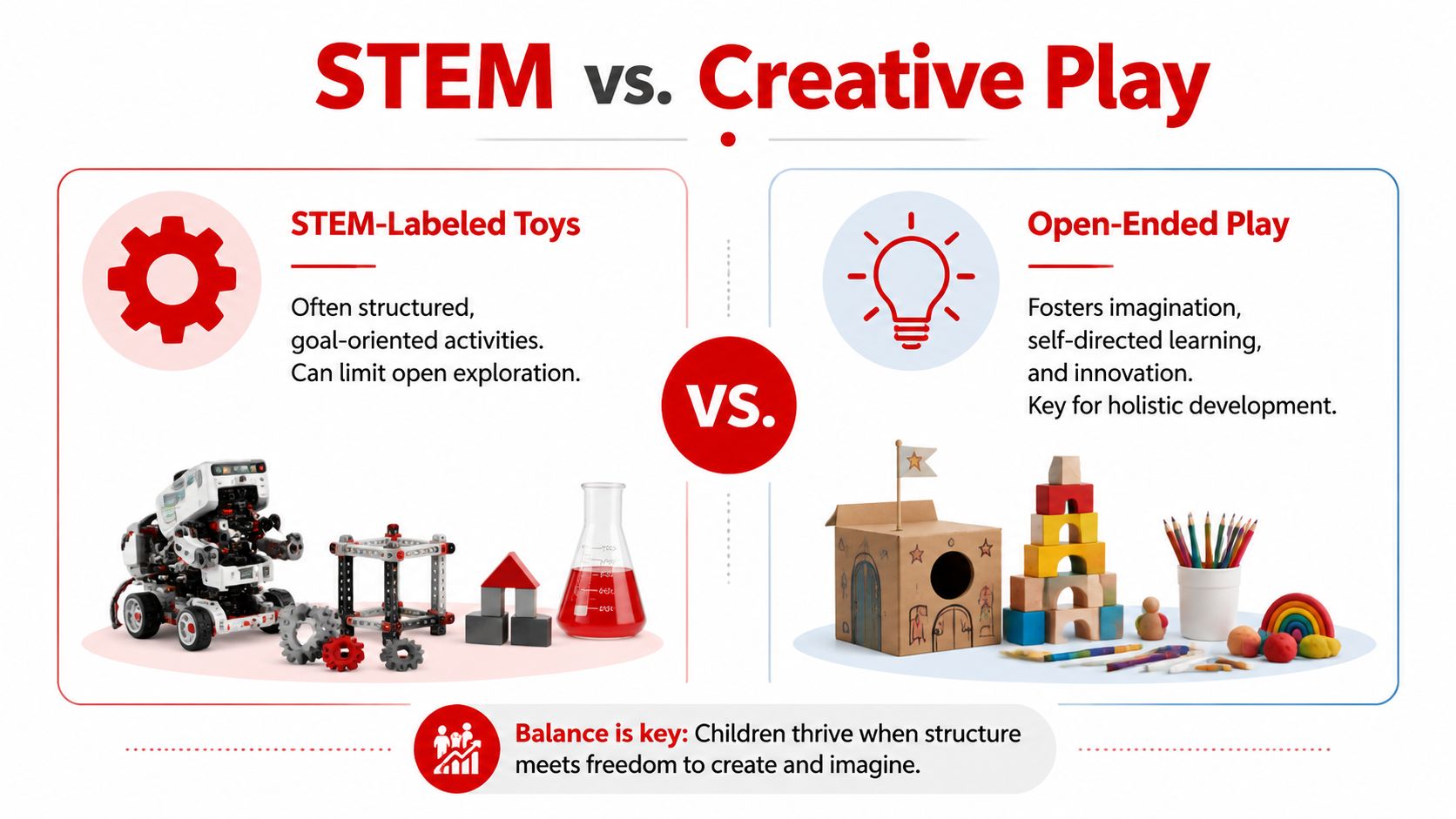
The Toy Association reports that 78% of parents want more toys that develop creativity and problem-solving skills, according to industry coverage of building toys for seven-year-olds. The same source describes the STEM toys segment as projected to nearly double from 2024 to 2034, with open-ended modular platforms and design-led creative toys identified as important growth areas. That projection shouldn't make parents chase a trend. It should encourage them to ask whether a product supports active thinking beyond assembly.
For more options that combine making with imagination, explore creative building toys. The strongest choice may be a hybrid: guided instructions for learning the system, followed by unrestricted time to invent.
Maximizing Play Value and Fun
A building toy earns its place when children return to it after the first model is finished. You can encourage that by changing the invitation, not by adding pressure.
Set up a stable workspace with a tray or shallow containers for sorting. Keep instructions nearby, but don't insist that the child follow them every time. One day, the challenge might be completing a model. Another day, it could be building a shelter that survives a gentle “storm” made with a sheet of paper.
Turn construction into a wider activity
- Add a story: Ask who lives in the building, what problem the vehicle solves, or where the structure is going.
- Introduce a design brief: Suggest a goal such as “build a bridge for this toy” without dictating the solution.
- Invite collaboration: One child can sort parts, another can build, and both can negotiate changes.
- Record revisions: Take simple photos or have the child sketch the first design and its improved version.
- Connect interests: A space fan might build a launch station, while an animal lover creates habitats and paths.
Storage affects whether a child can begin independently. A clear sorting routine and a defined home for pieces can help transform bedroom clutter into calm. You don't need a perfect playroom. You need a system that makes finding and returning parts manageable.
Toy rotation can also restore interest without buying more. Put away some pieces while leaving one accessible project, then revisit the stored materials later. A practical toy rotation system can help families keep construction play visible without covering every surface.
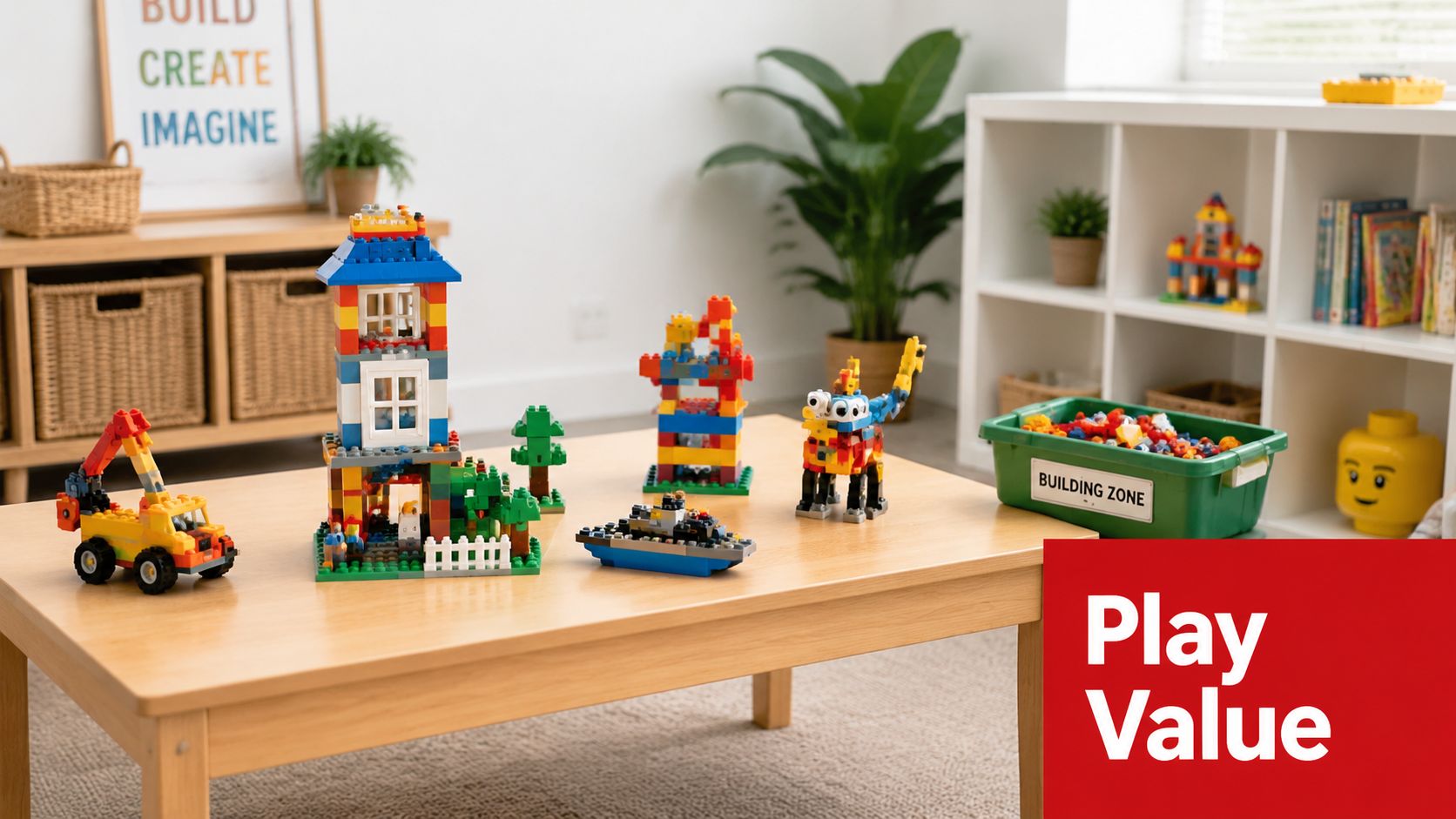
The best building session may end with a structure that looks nothing like the picture on the box. That's a sign the child is using the system as a tool for thinking, not merely completing an assignment.
Playz offers age-range options that include 5–7 years, along with model kits and creative play products that can complement construction activities for children in this stage. Visit Playz to find a hands-on kit that gives your seven-year-old a clear starting point and room to explore beyond it.