


Your child has built the model exactly as the instructions show, yet the learning may begin only after the final piece clicks into place. Why does one gear turn another? What makes a bridge stand instead of collapse? Why does a robot stop when its sensor detects an obstacle? STEM building kits give children a way to investigate those questions with their hands, not just memorize answers from a page.
The right kit can turn a rainy afternoon, a science lesson, or a birthday gift into a small engineering laboratory. The wrong kit can create frustration, loose parts, or a project that's finished before curiosity has had time to grow. This guide focuses on the principles behind construction play and a practical way to match a kit with a child's age, confidence, and learning goals.
What Are STEM Building Kits and Why They Matter
A child may begin with a clear assignment: assemble the vehicle, bridge, circuit, or creature on the box. Then the model behaves differently. A wheel scrapes the frame, a tower tilts, or a lamp stays dark. The child examines the result, suggests a cause, changes one part, and tests the model again.
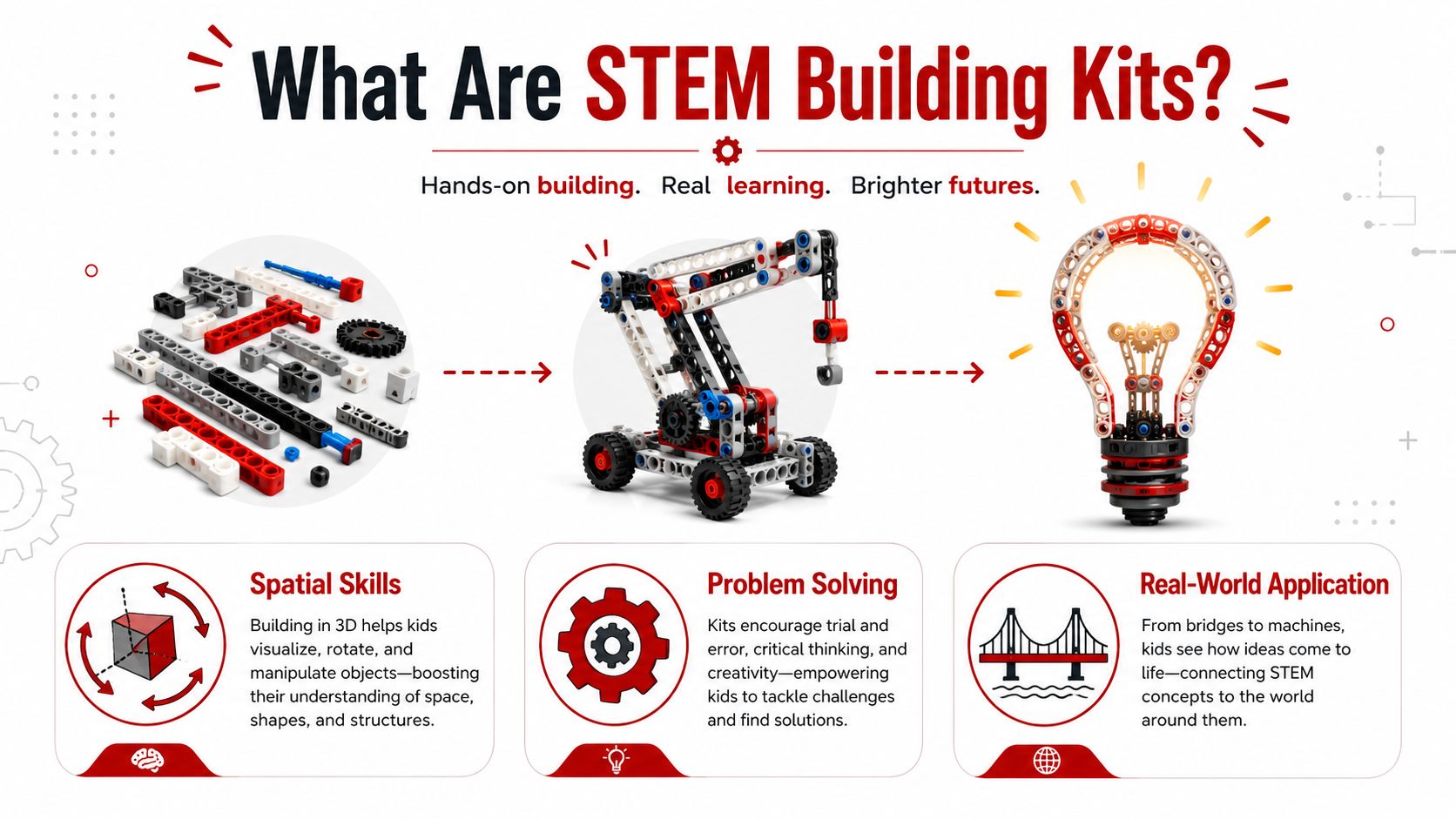
That process gives STEM building kits their educational value. They connect science, technology, engineering, and mathematics to physical action. A child feels stability when a structure remains upright, observes energy transfer as gears turn, and sees cause and effect when a switch completes a circuit. The kit turns engineering into a cycle of defining a problem, designing a response, testing it, and improving the result.
From parts to principles
Assembly is only the starting point. A useful kit encourages questions such as: What changes if the axle is longer? Does moving a support make the structure steadier? What happens when a motor reverses or a different gear is added? Each adjustment works like a small experiment, turning a finished object into evidence that children can inspect.
The wider market reflects growing interest in these learning tools. The global STEM toys category was estimated at USD 1.20 billion in 2024 and projected to reach USD 1.83 billion by 2030, with a 7.2% CAGR from 2025 to 2030, according to Grand View Research's STEM toys market analysis. The same analysis reported that North America held about 35% of global STEM-toy demand in 2024, and the U.S. made up roughly 80% of that regional share.
The 8-12 age group accounted for about 41% of overall STEM-toy use in 2025, according to that source. Construction kits suit this audience because they combine hands-on building with introductory engineering ideas, while still allowing children to invent beyond the instructions.
Parents comparing options can review STEM toys for kids by examining what happens after the model is complete. Can the child rebuild it, explain why it works, or test a new design? Those features help distinguish a display project from a tool for continued curiosity.
Practical rule: Choose a kit that gives children a problem to solve after they follow the instructions.
The Educational Science Behind Construction Play
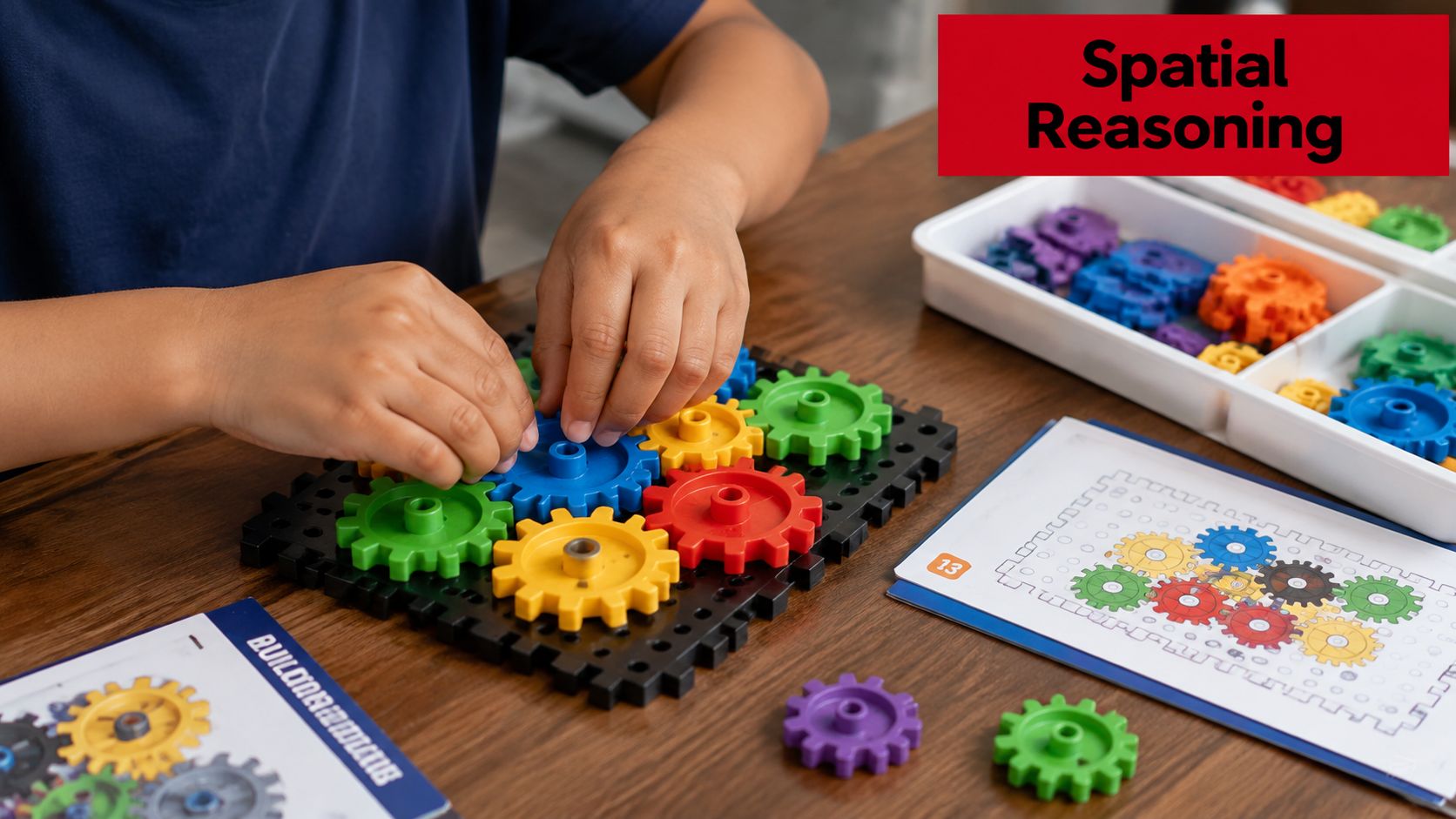
Construction play works because children must coordinate several kinds of thinking at the same time. They interpret a diagram, locate a part, rotate it mentally, position it in space, and predict what the finished mechanism will do. The activity turns an abstract idea such as balance or motion into a visible result.
Research on construction and engineering kits for children aged 6-9 found that boys and girls assembled interlocking toys at similar speed, although six-year-old girls were initially less accurate. By age nine, performance became similar. The findings, reported in research on children's experiences with construction sets, underline an important design lesson: clear instructions, stable connectors, and age-appropriate complexity can influence confidence as well as accuracy.
The same research notes that building toys can enhance spatial abilities that may support later mathematics and science aptitude. That doesn't mean a kit guarantees future achievement. It means the act of manipulating shapes, directions, and relationships gives children valuable practice in seeing how parts fit together.
Why iteration beats perfect assembly
A child learns more from a failed bridge that gets redesigned than from a model assembled flawlessly with adult help. Each revision creates a small test. If the structure bends, the child may add a brace. If the gear skips, the child may adjust alignment. The result makes the reasoning visible.
A study of 62 students aged 8-14 using LEGO Mindstorms found that students reported active learning, authentic learning, multiple perspectives, and collaboration. The study of LEGO Mindstorms and construction-based learning supports the value of exploration and design rather than passive instruction.
This approach aligns with constructivist learning theory, where learners develop understanding by connecting new experiences to what they already know. A gear system becomes more meaningful when a child has physically observed one gear driving another.
The kit still needs thoughtful design
Hands-on learning isn't automatic. A physical science and engineering invention-kit study indexed by ERIC reported no measurable impact on students' science and engineering achievement, as documented in the ERIC study of an invention-kit intervention. The counterpoint is useful for buyers and teachers. A kit needs a clear challenge, room for decisions, and guidance that helps children connect actions with concepts.
Look for prompts that ask children to predict, test, compare, and explain. A box full of attractive parts may entertain, but a well-designed learning tool gives those parts a purpose.
Choosing the Right Kit Based on Age and Skill Level
Age labels offer a useful starting point, but they cannot describe every child's experience. Two children of the same age may differ in construction practice, diagram-reading, fine-motor control, and patience with mistakes. Match the kit to the child's current ability, then choose a challenge just beyond it. That small stretch works like a step on a staircase: high enough to build skill, low enough to reach.
Start with the learning target
For younger builders, large pieces and simple connectors make handling safer and cause and effect easier to see. A child might build a moving animal, connect a wheel to an axle, or discover that a wider base makes a tower steadier. Look for clear pictures, short sequences, and parts that still work when alignment is imperfect.
As noted earlier, Grand View Research reports that the 8-12 age group accounts for 41% of STEM-toy use. Many children at this stage can explore gears, levers, pulleys, structural frames, and basic circuits. Select a kit that begins with copying a model, then lets the child change its design and observe what happens.
Older students and teenagers may be ready for motors, sensors, programmable controllers, and robotics. The right choice depends on the learning goal. A child interested in how forces move through a machine may benefit from mechanical building first, while a child already curious about coding may be ready to connect instructions with physical behavior.
| Child's starting point | Useful kit features | Adult support |
|---|---|---|
| New builder | Large parts, visual instructions, stable connectors | Help name parts and ask simple prediction questions |
| Confident elementary builder | Gears, axles, levers, circuits, challenge cards | Encourage redesign instead of correcting every mistake |
| Advanced learner | Sensors, motors, programming, open-ended projects | Discuss debugging, evidence, and design tradeoffs |
Watch the difficulty curve
A productive kit creates effort without making every attempt feel like failure. If a child cannot identify the parts or find the first step, reduce the task to one connection or one short instruction. If the child finishes quickly and leaves the model unchanged, add a test: make it stronger, faster, quieter, or more efficient.
Before buying, review science kits for kids with the same questions you would ask about a building set: What can the child do independently? What can they rebuild? Which concept should they be able to explain afterward? These questions connect the kit's age range to its actual engineering value.
Comparing Traditional Mechanical Kits Versus Robotics
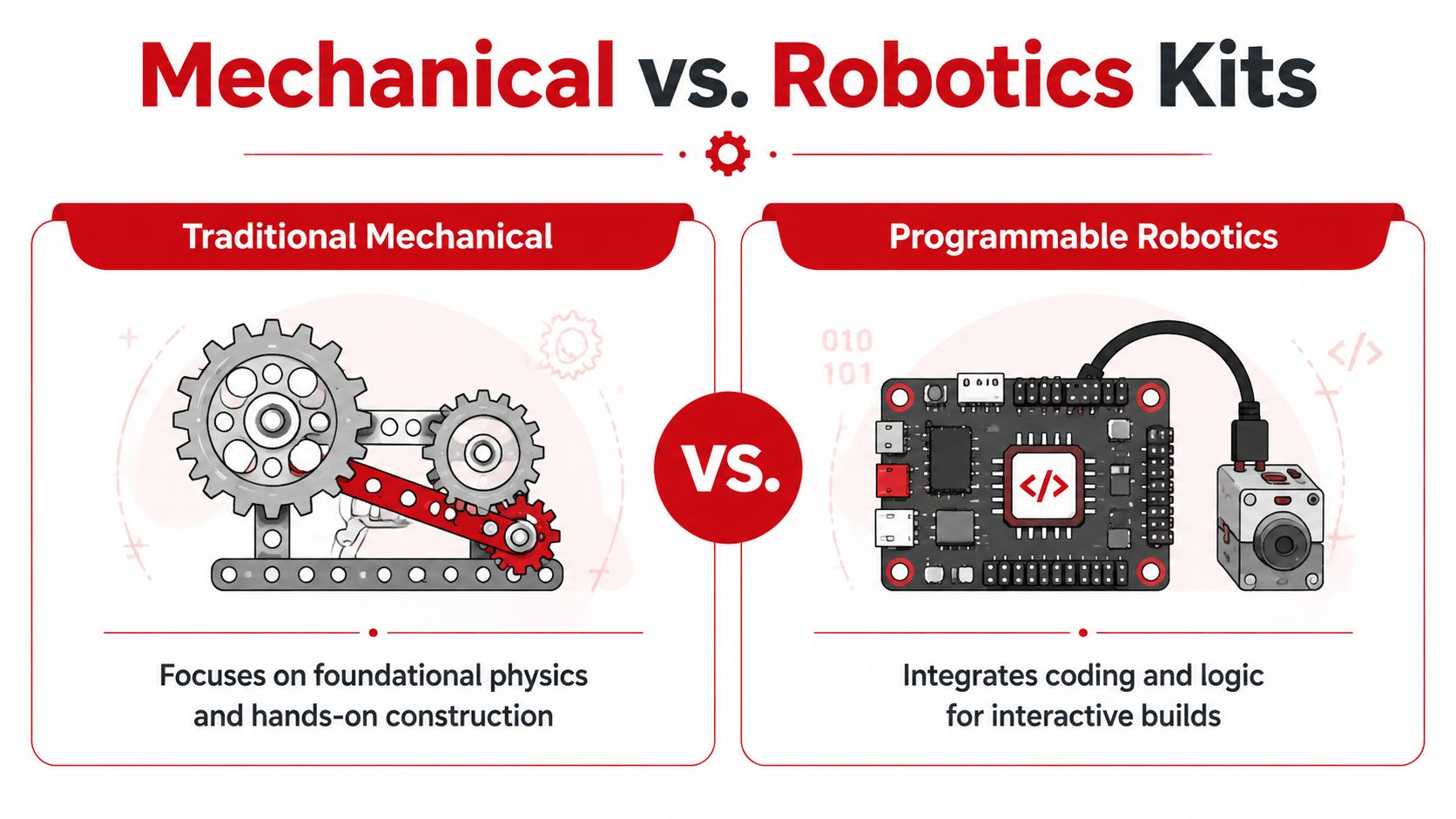
Traditional mechanical kits and programmable robotics kits share a foundation: children create a system from separate components and learn by testing the result. Their emphasis differs, however. Mechanical kits make motion and structure visible immediately, while robotics kits add software, sensors, and automated behavior.
A child working with a gear train can see the input gear rotate and watch that movement transfer through the system. They can explore speed, direction, alignment, and resistance without first learning a programming interface. A child working with a robot may write instructions, read sensor input, find a logic error, and revise the code until the machine responds as intended.
A practical side-by-side comparison
| Decision factor | Traditional mechanical kits | Programmable robotics kits |
|---|---|---|
| Main focus | Structure, motion, physical cause and effect | Coding, logic, sensing, and automation |
| Early success | Often visible as soon as a mechanism moves | May depend on wiring, software, or debugging |
| Strong fit | Children who enjoy building with their hands | Children curious about robots and computer behavior |
| Adult role | Ask why a design is stable or unstable | Help interpret errors and break tasks into steps |
| Growth path | More complex mechanisms and engineering challenges | More advanced programs, sensors, and autonomous actions |
Building sets still held 34.6% of STEM toy revenue in 2025, while robotics kits are forecast to grow at an 11.1% CAGR through 2031, according to Research and Markets' STEM toys market analysis. These figures describe different parts of the market, but they also reflect a question many buyers ask: should a child begin with physical construction or move directly into programming?
The answer usually depends on the learning goal. If the child needs to understand how forces, supports, gears, or linkages work, a mechanical kit offers a clear entry point. If the child is already eager to make a machine react to its surroundings, robotics may provide stronger motivation.
A good progression: Build the mechanism first, then add a motor, sensor, or program when the child is ready to make it behave.
Robotics also shouldn't be treated as a replacement for construction. A robot still needs a stable frame, correctly aligned wheels, and a purposeful mechanism. Readers looking for a gentler starting point can review robotics kits for beginners and check whether the product teaches both physical design and coding logic.
Safety Standards and Quality Considerations for Buyers
A STEM kit earns its place in a home or classroom only when children can use it safely and repeatedly. Start with the recommended age, then inspect the parts, connectors, instructions, and storage system. A project isn't suitable if the pieces are too small, the steps are unclear, or the materials fail after a few rebuilds.
Small parts require particular care. UK and EU toy-safety guidance uses a small-parts cylinder about 3.17 cm wide and 5.71 cm deep. Anything that fits inside it is considered a choking hazard for children under three, as explained in construction-toy safety guidance. Age labeling should therefore be treated as a hard safety boundary, not a casual suggestion.
Inspect the build experience
Quality affects learning because children need reliable feedback. If a connector slips for reasons unrelated to the design, the child may blame their own reasoning. Stronger construction materials, consistent tolerances, and stable joins let children focus on the engineering problem.
Use this buying checklist:
- Part safety: Check size, edges, materials, and the stated age range.
- Connector quality: Look for pieces that hold firmly but can still be separated without excessive force.
- Instruction clarity: Prefer diagrams that show orientation and identify parts.
- Rebuild potential: Choose models that support variations rather than a single finished object.
- Storage: A compartmented box or labeled bag system reduces lost components.
- Classroom suitability: Consider durability, replacement parts, and whether several children can share the kit.
Research on kit-based learning points in two directions. Hands-on tools can support collaboration, spatial thinking, computational thinking, and language development, but outcomes depend on how adults structure the activity and how well the kit fits the learners. Safety and durability create the foundation. Good questions and meaningful challenges turn that foundation into education.
Maximizing Learning at Home and in the Classroom
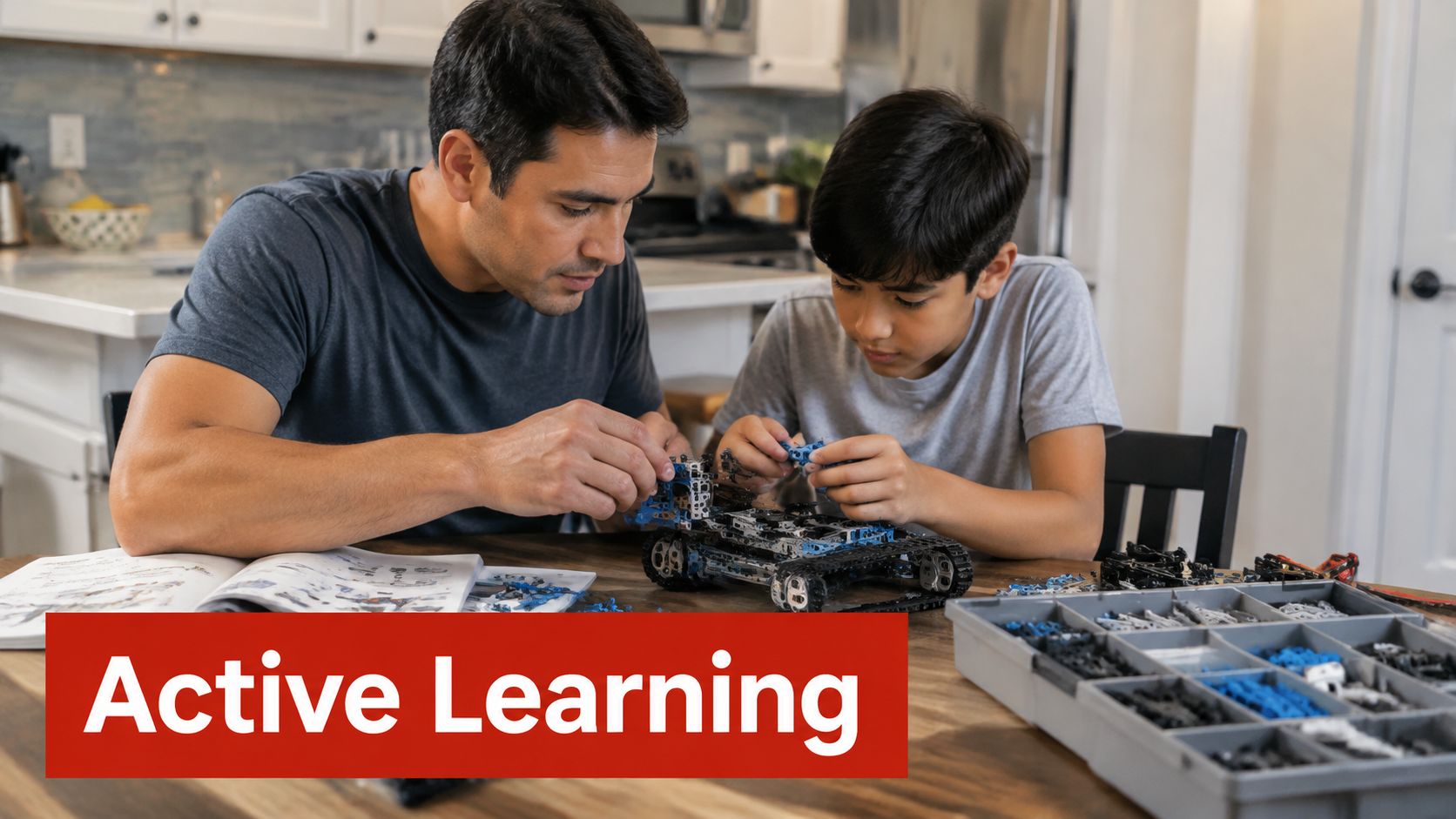
The adult's role isn't to build the model for the child. It's to create conditions where the child can notice, explain, and improve. Sit nearby, ask what they predict will happen, and wait long enough for them to test the idea.
Use a simple learning routine
- Build: Let the child follow the instructions with as little intervention as possible.
- Notice: Ask what moves, bends, lights up, or stops.
- Change: Invite one deliberate modification, such as widening the base or reversing a gear.
- Explain: Ask the child to describe what changed and why.
- Record: In a classroom, use a quick sketch or sentence to capture the design decision.
A parent might ask, “What do you think will happen if we move this support?” A teacher could ask teams to design a bridge that carries a chosen classroom object, then compare the structures without declaring one design correct from the start. These prompts make engineering language part of ordinary play.
A New South Wales STEM education report found that kit-based activities had a positive or very positive impact on student learning for 386 students, according to the STEM student learning outcomes report. A separate South Korean classroom STEAM program using robotic kits reported significant increases in computational thinking and expressive vocabulary among young children in the treatment group, as described in the classroom robotics study.
For classroom planning, the engineering design process for kids offers a useful structure for turning a build into a repeatable cycle of questions, prototypes, tests, and revisions.
Frequently Asked Questions About STEM Building Kits
Are STEM building kits different from ordinary construction toys?
They can be. Both types may involve stacking, joining, or assembling parts, but a STEM-focused kit usually makes a principle or challenge more explicit. It might ask children to transfer motion through gears, complete a circuit, stabilize a structure, or program a response. The strongest products combine instructions with opportunities to modify the design.
Does a young child need programming to benefit?
No. Programming is one pathway into STEM, not a requirement for meaningful construction play. Younger children can explore balance, shape, motion, sequencing, and cause and effect with mechanical parts. Coding becomes useful when it matches the child's interest and the kit provides enough physical context to make the code's effect visible.
How can I tell whether a kit is genuinely educational?
Look for active decisions, not just a long parts list. A worthwhile kit should encourage prediction, testing, explanation, and revision. It should also match the learner's abilities, provide clear guidance, and support more than one successful outcome.
How do we keep the kit usable?
Store components by type, return pieces after each session, and check connectors for damage. In a classroom, label containers and establish a parts-count routine before groups move to a new activity. Choose kits with durable components and accessible replacement options when possible.
The best STEM building kits don't make children feel as if they're taking a test. They give children a reason to ask questions, make a design, encounter a problem, and try again. That pattern can begin with a simple gear and grow into confident engineering thinking.
Playz offers model-building kits, including a V8 Combustion Engine Model Building Kit and an Electrical Circuit Board Engineering Kit for hands-on experiments. Visit Playz to find a purposeful build that matches your child's interests and creates an inviting starting point for learning through play.