

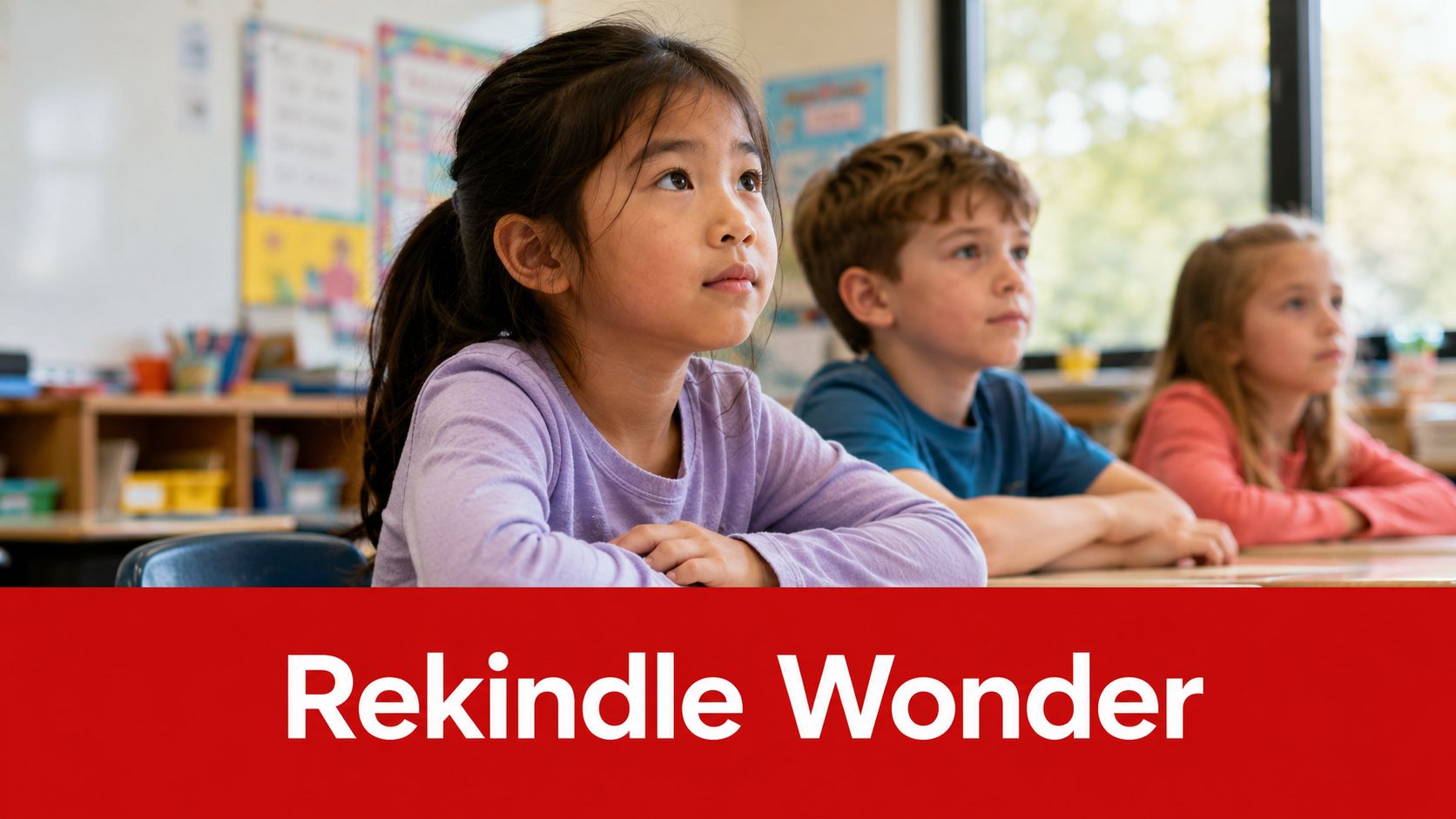
At the kitchen table, a child who once asked why the moon followed the car now shrugs at nearly every question. In the classroom, hands that used to rise before the teacher finished speaking stay folded. Adults often read this silence as laziness, distraction, or a fixed lack of interest. More often, children have learned that guessing is risky, uncertainty is uncomfortable, or a screen will provide an answer without requiring much effort.
Curiosity can return. Learning how to develop curiosity means creating repeated opportunities to notice something puzzling, ask about it, test an idea, and share what remains unclear. Research describes curiosity as a universal characteristic of childhood that directs attention during information-seeking, while also distinguishing between internal and external curiosity across ages and contexts in a 2024 Nature Reviews Psychology synthesis. The practical question isn't whether a child is “naturally curious.” It's whether home and school routines make curiosity safe, visible, and worth pursuing.
Why Curiosity Fades and How to Bring It Back
A student looks closely at a cup of cloudy water during science time. “Why does it look like that?” she asks. The adult, rushing to finish the worksheet, answers immediately: “Because dirt is mixed in.” The child nods, copies the sentence, and moves on. Nothing went wrong in the narrow sense. The answer was useful. Yet the moment that could have become an investigation ended before the child had made a prediction.
Curiosity often fades through small adult habits. We answer before children have time to think, praise only correct responses, treat questions as interruptions, or turn every interesting discovery into a lesson. At home, a tired parent may hand over a device because it settles the “why” questions. In school, a tight schedule may reward completion more reliably than wondering.
Practical rule: Protect the question before supplying the answer.
Curiosity isn't merely a passive trait that appears when a topic happens to interest a child. A randomized pedagogical intervention in elementary schools explicitly fostered curiosity and increased curiosity, knowledge retention, and science test scores, with gains persisting into the middle school years. The study also reported more information sharing and peer learning in the classroom. Its practical sequence was simple: prompt uncertainty, encourage question-asking, then reinforce information sharing. You can read more about the relationship between investigation and learning through discovery-based learning.
The hidden skill is tolerating uncertainty
A child who says, “I don't know,” may be showing the beginning of inquiry, not failure. The next move is to ask what they notice, what they expect, or what they'd need to find out. Adults model curiosity when they say, “I'm not sure yet. Let's work it out.”
A 2019 experimental study found that a one standard deviation increase in curiosity was associated with a 56% increase in the probability of answering correctly, while actual learning was predicted by both curiosity and objective prior knowledge (study details). Curiosity opens the door, but children still need background knowledge to make sense of what they discover.
Bring curiosity back by changing the emotional conditions around questions. Let children see that uncertainty is temporary, mistakes provide information, and sharing an incomplete thought can move a group forward. You don't need a spectacular activity. You need a routine that gives wondering somewhere to go.
The Curiosity Loop That Works at Home and in Class
The most useful routine I've used with children follows three moves: prompt uncertainty, encourage questions, and share gaps. It works because it turns a vague invitation to “be curious” into a social process. Children notice a mismatch, put their questions into words, and discover that not knowing is something a group can address together.
First, prompt uncertainty
Give children something that doesn't resolve itself immediately. Place ice in two different locations and ask which piece will melt first. Show a sealed container and ask what might be inside. In a science warm-up, demonstrate a result without explaining the cause.
At breakfast, you might say, “This slice of apple turned brown, but this one didn't. What could be different?” Don't rush to confirm the best idea. The point is to make an expectation visible and leave room for a mismatch.
Next, encourage questions
Ask children to generate questions before you teach the explanation. Younger children can draw or dictate questions. Older students can write several possibilities, sort them by what can be tested, and choose one to investigate.
Useful prompts include:
- Notice the difference: “What changed?”
- Make a prediction: “What do you think will happen next?”
- Name the gap: “What part don't we understand yet?”
- Change one condition: “What could we alter to test that idea?”
This structure matters because children can become curious without knowing how to proceed. An open-ended environment still needs low-friction entry points.
Finally, share gaps
Invite children to explain not only what they found, but also what remains confusing. A teacher might create a “still wondering” board. A parent can keep a question jar near the kitchen table and choose one question to explore during the week.
Praise the contribution, not just the answer: “That question helped us notice something important,” or “Your prediction didn't match the result, so now we have a better question.” The randomized classroom intervention described above used information sharing and peer learning as part of the process, and its reported gains in curiosity, retention, and science scores lasted into middle school (research source).
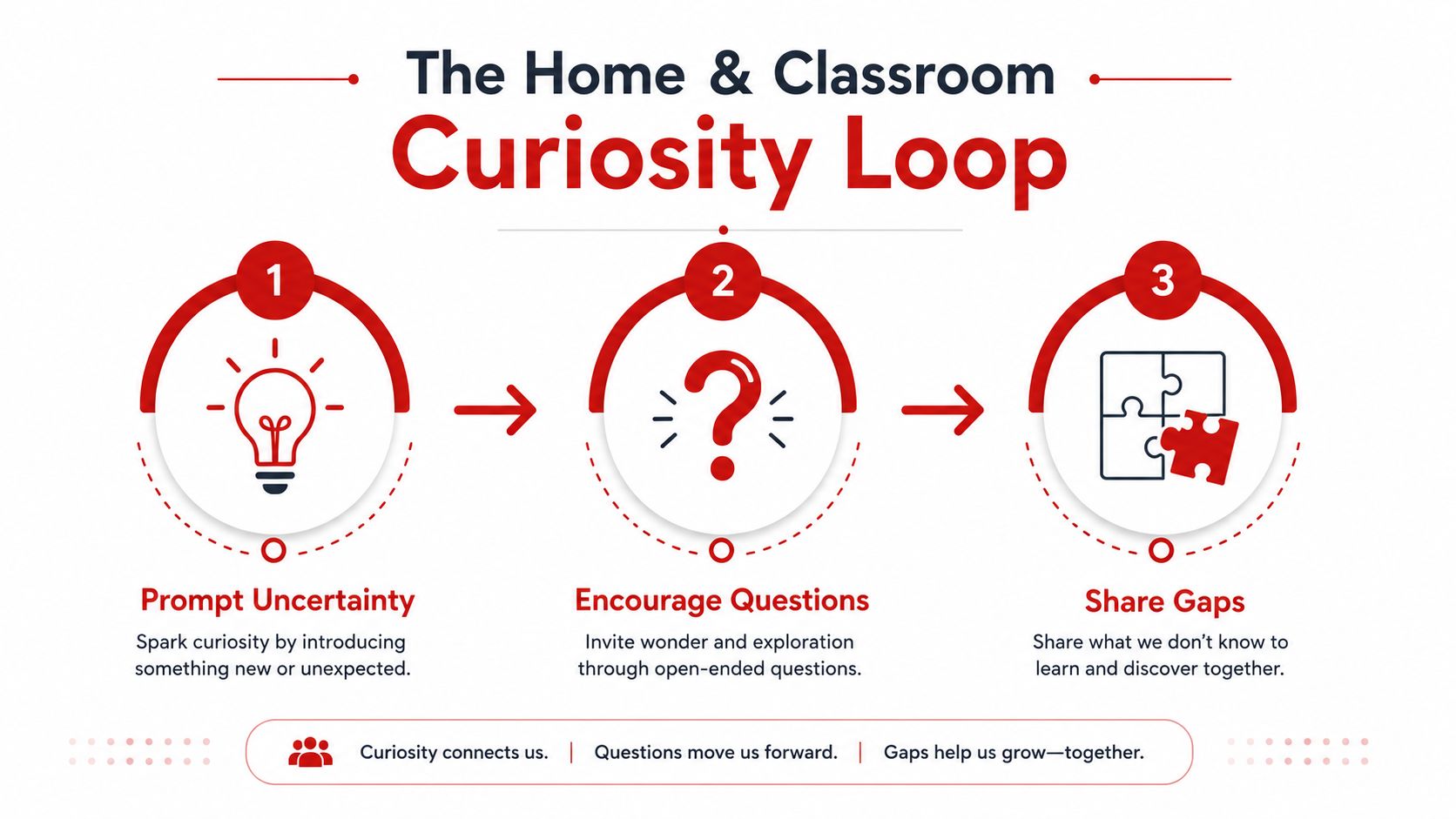
A weekly routine might look like this: introduce one puzzling observation, collect children's questions, test one idea, and end by sharing what the group still wants to know. The approach fits naturally with the Reggio Emilia method for early years, which values children's interests, observation, expression, and investigation as meaningful parts of learning.
Hands-on routines become more effective when children can manipulate materials, revise ideas, and explain discoveries. That's one reason play-based learning benefits extend beyond entertainment.
Age-Specific Moves for Ages 3 to 5, 6 to 9, and 10 to 12
Curiosity changes as children gain language, memory, motor control, and independence. A three-year-old may investigate by touching every surface. An eight-year-old can compare evidence. A twelve-year-old often wants ownership over the question itself.
Ages 3 to 5
Young children need sensory invitations and time to linger. Take a wonder walk and collect questions about sounds, textures, shadows, puddles, or insects. If a child asks why a puddle is shrinking, resist stacking your own explanation on top of theirs. Ask, “What do you think is happening?” Then return later to see what changed.
A strong signature activity is a puddle measurement lab. Mark the edge with a stick, compare a sunny spot with a shaded spot, and let the child notice which puddle changes first. The activity is less about mastering evaporation than learning that observation can continue after the first question.
Ages 6 to 9
Children in this band can record predictions, compare results, and hold more than one possibility in mind. Keep a small prediction journal near the kitchen table. Before trying something, write or draw what the child expects, then revisit the page afterward.
A question wall works well in classrooms. During quiz review, replace a few recall prompts with a board titled “What we still don't know.” Students can add questions about a plant, a local weather pattern, or an experiment that produced an unexpected result. This makes uncertainty part of the learning record rather than evidence that a child wasn't paying attention.
Ages 10 to 12
Older children need meaningful autonomy. Offer a design challenge with constraints, such as building a paper structure that supports an object, creating a water filter from household materials, or improving a game rule. Avoid giving the method too quickly. Ask the child to define the problem, identify what success would look like, and decide which variable to change first.
A student-led investigation might begin with a familiar question: “Why does one bicycle tire lose air faster?” The child can list possible causes, choose what to inspect, and explain which evidence would support each idea. The adult's role is to provide safety, materials, and useful questions without taking ownership of the investigation. For more ideas matched to children's developmental stages, explore these play-based learning activities.
| Age Band | Signature Activity | Favorite Question Type | Signal That Curiosity Is Growing |
|---|---|---|---|
| 3 to 5 | Wonder walk or puddle lab | “What do you notice?” | The child returns to inspect a change |
| 6 to 9 | Prediction journal or question wall | “What do you think will happen?” | The child compares a result with a prediction |
| 10 to 12 | Open-ended design challenge | “Which variable should we change?” | The child plans a follow-up investigation |
The age bands aren't rigid labels. A cautious five-year-old may need the autonomy usually offered to an older child, while an inquisitive ten-year-old may enjoy sensory exploration. Start with the level of thinking the child can sustain, then increase the challenge gradually.
Questioning Techniques That Actually Build Curiosity
The quality of a question matters more than the number of questions an adult asks. “Did you have fun?” often produces a quick yes or no. “What surprised you?” asks the child to search memory, identify a mismatch, and decide what deserves attention.
A Harvard educator summarizes findings in which children who practiced asking many questions over two weeks became more willing to spend effort learning new science information and learned more, while children told only to pay close attention did worse (Harvard Graduate School of Education). The lesson isn't to interrogate children. It's to help them become question authors.
Replace answer-hunting with investigation
Try these prompts during ordinary moments:
- For observation: “What detail would someone else miss?”
- For prediction: “What do you expect, and what makes you think that?”
- For variation: “What would happen if we changed one thing?”
- For evidence: “What did we see that supports that idea?”
- For transfer: “Where else might this happen?”
- For uncertainty: “Which part should we find out first?”
Framing matters. “Why did you do that?” can sound like a challenge when a child already fears being wrong. “What were you trying to make happen?” invites the child to explain intention without defending themselves.
Use the pause after the answer
Many adults ask a thoughtful question, hear a response, and immediately fire off another. Instead, wait. Repeat the child's key word, nod, and give them time to add something. If the answer is “I don't know,” say, “That's a useful starting point. What could we observe?”
“I'm not sure yet” is a complete sentence, but it doesn't have to be the end of the investigation.
Model your own uncertainty openly. “I wonder whether the warm water or the shape of the container made the difference. We could test one at a time.” This teaches children that capable thinkers don't always begin with certainty.
For a broader set of prompts that connect curiosity with reasoning, use this guide to encourage critical thinking. Keep the emotional stakes low, especially for children who have learned that wrong answers attract laughter, correction, or comparison.
Play-Based Experiments With Toys Like Playz Kits
A science kit becomes a curiosity tool only when the child gets to predict, test, and explain. If the adult reads every instruction aloud, corrects each step, and celebrates only the expected result, the child may complete the activity without doing much thinking. The materials can be excellent, but the learning depends on who controls the questions.
One afternoon, a parent opens a volcano kit with a child and sets the instructions aside. The parent asks, “What do you think will happen when these materials meet?” The child predicts a small fizz. They run the experiment, watch the reaction, and then compare the result with the prediction.
The conversation afterward matters more than the eruption. “What surprised you?” comes first. Then, “What might explain that?” The parent doesn't turn the debrief into a vocabulary test. They help the child name the observation, identify a possible cause, and choose one change to try next.
Stretch one activity across a week
A single experiment can support repeated inquiry when the child changes one condition at a time. On another day, they might alter the amount of one ingredient. Later, they could compare container shapes, temperature, or mixing speed, provided the activity remains safe and age-appropriate.
Household materials keep the routine manageable. Paper, water, ice, cardboard, measuring cups, tape, and recycled containers can turn a purchased activity into a longer investigation. Play tents and creative toys can add a different kind of question: What structure keeps its shape? How can we redesign the space? What story does this setting invite?
The same principle applies to imaginative play. Resources on the imagination behind adventures offer useful context for seeing play as a place where children construct possibilities, not merely pass time.
For families choosing materials, Playz offers science kits, play tents, and creative toys that can serve as prompts inside a predict-test-explain routine. The brand describes its customer base as including over 5 million satisfied customers, as stated in its publisher information. Adults should still leave room for children to alter the setup, ask their own questions, and pursue an unexpected result. A kit is a starting point, not a script, and these science kits for kids are most useful when children remain active investigators.
Troubleshooting Barriers That Quiet Real Curiosity
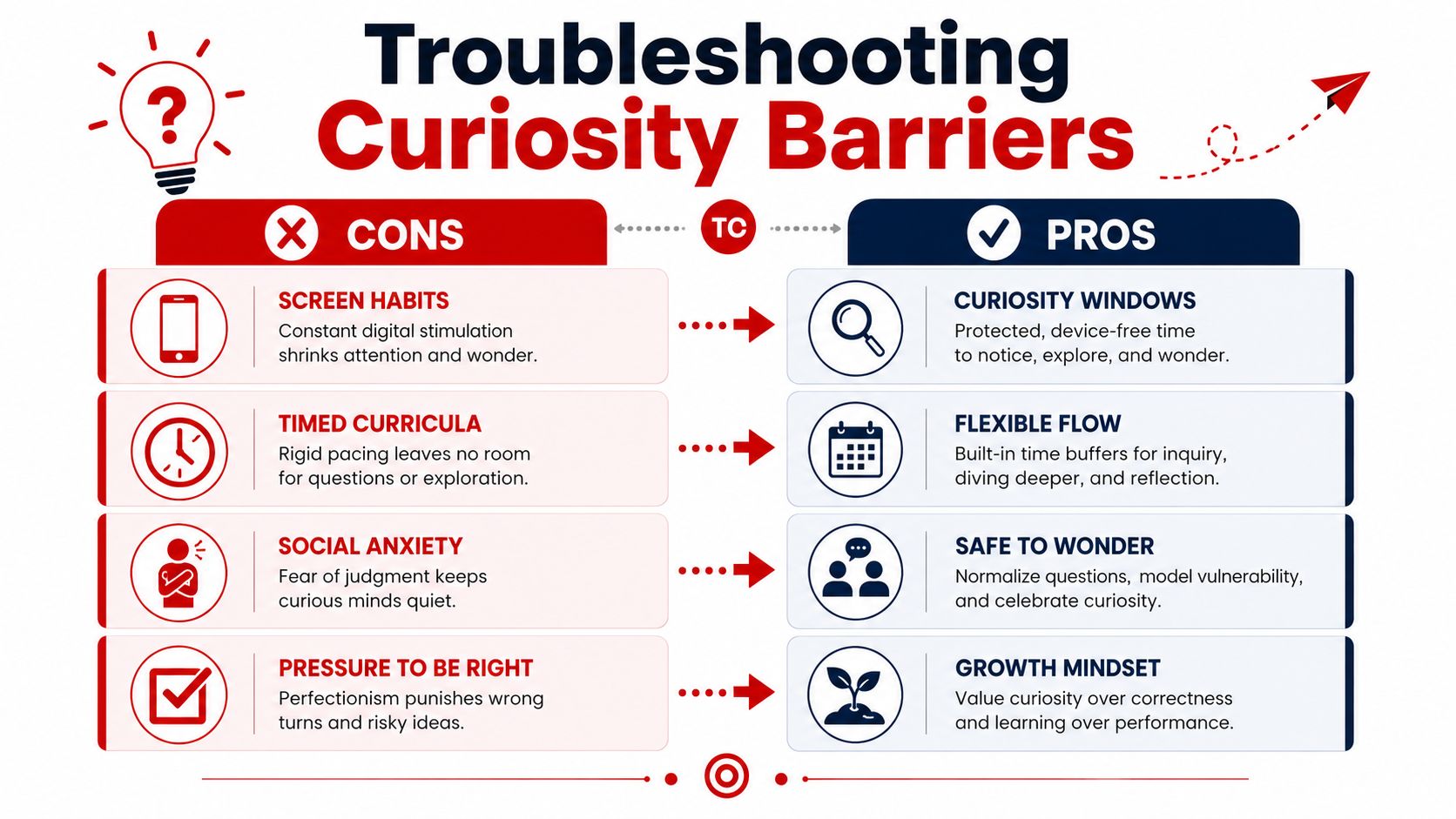
Curiosity rarely disappears for just one reason. A child may spend hours asking questions outdoors but show little interest in schoolwork. Another may be fascinated by science but refuse to speak in front of classmates. A third may prefer videos because the screen supplies constant novelty without the discomfort of making a wrong prediction.
The response shouldn't be a blanket ban or a speech about motivation. Diagnose the barrier, then lower the cost of taking the next curious step.
Screen habits
Use a curiosity swap, not a sudden demand for total abstinence. After a video about animals, ask the child to inspect a nearby habitat, sketch an animal's features, or design a shelter from household materials. Keep the screen as a source of questions, then move the child toward observation and making.
Timed curricula
Teachers often have little space for open exploration. Build curiosity into existing lessons rather than treating it as an extra unit. Replace one review question with a prediction, invite students to record a remaining mystery, or let pairs choose which evidence to examine first.
A 2025 review notes that some educational contexts don't prioritize curiosity and that children can show little school-related curiosity. The review also describes a randomized pedagogical intervention that increased curiosity by about 0.11 standard deviations, improved knowledge retention and science scores, and produced effects that lasted into middle school (review and related evidence). School pressure doesn't make curiosity impossible, but it does make the routine need deliberate protection.
Social anxiety
Start with private writing, partner talk, drawing, or anonymous question cards. Let a child rehearse an idea before sharing it publicly. Adults can also model a mistake without turning it into a performance: “I expected this to happen, but I was wrong. I need another clue.”
Pressure to be right
Stop rewarding speed as the main sign of competence. Ask students to compare two plausible explanations, explain what evidence would change their minds, or identify what they don't yet know. A classroom where only polished answers receive attention teaches children to hide the very uncertainty that generates inquiry.
Curiosity may also support children who have been underserved by traditional expectations. Earlier research found that highly curious low-income children performed similarly to higher-income peers in kindergarten reading and math, suggesting that curiosity-building may help close achievement gaps rather than merely enrich children who already have abundant learning opportunities. The important design question is whether every child gets safe, repeated access to questions, materials, and adult attention.
Measuring Curiosity Growth and Frequently Asked Questions
Don't turn curiosity into another test. Observe it over four to six weeks through a few consistent signals:
- Follow-up questions: Does the child ask what happens next or pursue a detail voluntarily?
- Unfamiliar attempts: Will the child try an activity without knowing the outcome?
- Uncertainty tolerance: Can the child say, “I don't know yet,” and choose a way to investigate?
- Revision: Does the child change an idea after seeing new evidence?
- Sharing: Does the child tell someone else about a question or discovery?
Is curiosity innate?
Children may show different interests and starting points, but evidence supports curiosity as intervention-responsive. A meta-analysis pooled 41 randomized controlled trials with 4,496 participants and found a statistically significant increase in curiosity across interventions (meta-analysis).
How often should we use these routines?
Choose a repeatable rhythm that doesn't exhaust your family or class. A short question-and-test routine several times during a week is more sustainable than an occasional elaborate project.
What if my child answers, “I don't know,” to everything?
Lower the demand. Offer two observations to compare, let the child point or draw, and model your own uncertainty. Then ask for one small next step, such as “What could we look at first?”
A longitudinal infant study reported that information-guided attention at 8 months was linked to IQ scores at 3.5 years in a sample of 60 infants, indicating that early curiosity-like behavior can have measurable later cognitive associations (study report). Start with the child in front of you, not with a perfect plan. Pick one age-appropriate activity, one low-stakes questioning technique, and one hands-on kit this week, then write down what your child notices, asks, and tries.
Playz offers science kits, play tents, and creative toys that give children materials for active exploration rather than passive entertainment. Visit Playz, choose one activity that fits your child's age, and use it as the opening move in a predict-test-explain conversation this week.