

The floor is covered with magnetic tiles, wooden blocks, half-built vehicles, and a model that lost its instructions sometime last week. Your child is focused, then suddenly frustrated because one connection won't hold or a tower keeps tipping over. You're left wondering whether the set is helping them learn, whether a simpler toy would work better, or whether an app-linked kit would hold their attention longer.
That uncertainty is understandable. Creative building toys cover a wide range of experiences, from quiet stacking for a young toddler to complex model construction for an older child. The most useful choice isn't automatically the set with the most pieces, the highest age label, or the strongest STEM language. It's the toy that matches your child's current motor control, attention, imagination, and tolerance for trial and error.
What Creative Building Toys Actually Are
A familiar playroom scene makes the category easier to understand. One child lines up chunky wooden blocks and builds a road. Another joins magnetic tiles into a roof, takes it apart, and tries a wider base. An older sibling uses interlocking bricks to make a vehicle, then replaces the wheels with a completely different mechanism.
All three are using creative building toys. The defining feature isn't the material or the age printed on the box. It's the ability to combine separate parts in multiple ways and produce something new.
That includes classic wooden blocks, magnetic tiles, interlocking bricks, modular engineering kits, loose construction parts, and some three-dimensional puzzle systems. A model kit with only one intended result offers less open-ended play, but it can still support valuable assembly skills. A box of irregular parts may offer more creative freedom, although younger children can find too much choice overwhelming.
Parents often use “constructive play” and “building play” interchangeably. This practical guide to constructive play is useful when you want to distinguish handling objects from using them with a purpose, such as making a bridge, enclosure, machine, or pretend setting.
A category with deep roots
Construction toys aren't a recent response to the popularity of STEM education. Museum research traces their emergence to the middle of the 19th century, with increasing importance in technological modernity before World War II. Contemporary educational research connects construction play with spatial learning and later achievement in STEAM-related disciplines, making this one of the most historically established toy categories. The research review on construction toys provides that historical and developmental context.
The category has changed, but the central experience remains stable. Children select parts, predict relationships, test connections, notice failure, and revise a design. The toy provides the materials, but the child supplies the decisions.
Practical rule: Judge a building toy by how many meaningful choices it creates, not by how impressive the finished photograph looks.
That distinction matters because highly prescribed sets can be excellent for learning sequence and following visual instructions, while open-ended systems are stronger for flexible design. Most children benefit from having access to both, but the balance should reflect the child, not the marketing category.
How Building Play Shapes Developing Brains
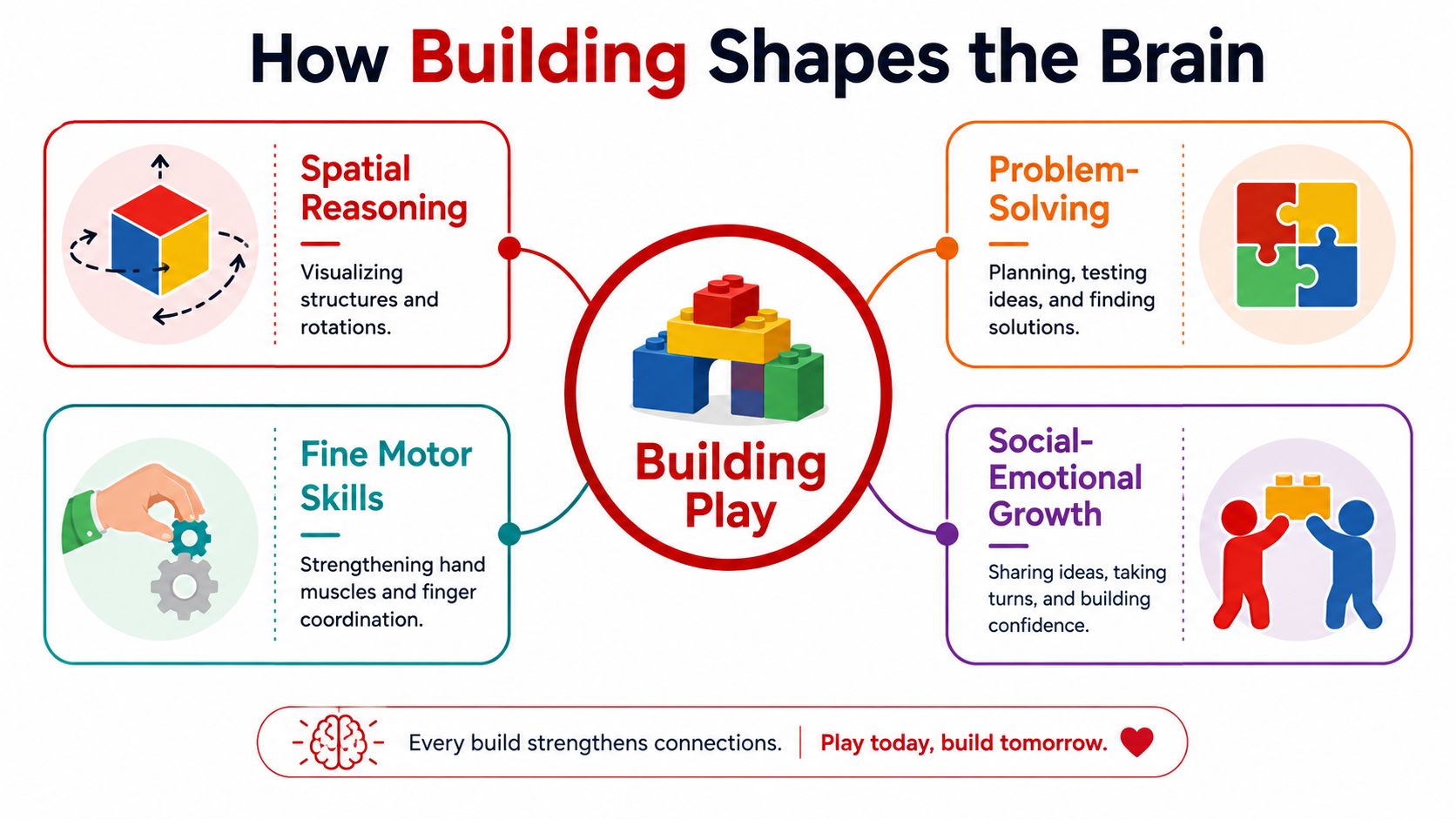
A child who stacks two pieces, pauses, and adds a third is doing more than filling time. They're testing balance, height, position, and consequence. Building play turns abstract relationships into something the child can see and physically change.
Spatial reasoning becomes visible
Simple blocks help children judge relationships such as over and under, beside and inside, aligned and perpendicular. Those judgments form part of the spatial reasoning later used in mathematics, design, engineering, and science. A review of construction play and spatial reasoning describes how block play supports these foundational relationships.
Watch what happens when a child builds a bridge. They need to estimate whether two supports are far enough apart, whether the top piece will reach, and whether the structure can carry a toy. If the bridge collapses, the child receives immediate feedback without needing an adult to explain the error.
Rotating a tile, comparing two lengths, or fitting a shape into a gap also strengthens visual prediction. The child begins to reason about an object before touching it, then updates that prediction through action.
Hands and thinking work together
Construction requires children to identify parts, select among them, align edges, control pressure, and maintain a goal. Research involving children aged 3 to 6 found increasing cognitive and fine-motor skills across age during assembly play, alongside more positive attitudes and self-esteem during building activities. The experimental study of assembled toys links manipulation of parts with both motor coordination and cognitive identification.
That combination explains why a child may struggle with a connection but still remain engaged. Their fingers are practicing control while their mind compares shapes and predicts what should happen next. A toy that requires alignment and visible completion gives the child a useful feedback loop.
Design builds persistence
A four-month observational study of 18 children aged 3 to 5 recorded behaviors aligned with early engineering design. These included goal-oriented design, problem-solving, innovation through combining designs, pattern repetition, and design testing. The block-play study indexed by ERIC offers a useful lens for recognizing those behaviors during ordinary play.
You might hear a child say, “This one needs to be stronger,” after a wall falls. They may repeat a pattern, combine two earlier structures, or test whether a toy can travel across a ramp. Those actions show planning and revision, even when the child doesn't use formal engineering language.
Research on STEAM-based block play also reported improved problem-solving proficiency over time, with imaginative thinking positively correlated with efficient block use. The research on STEAM-based block play supports an important practical point: imagination and problem-solving aren't competing outcomes. A child who invents more possibilities may also become better at choosing and using parts effectively.
The strongest developmental pattern appears in repeated practice. A longitudinal infant and toddler study found distinct trajectories for stacking, nesting, and affixing between 10 and 24 months, and found that early construction skill predicted later toddler construction skill. The longitudinal construction-behavior study suggests that building play can scaffold later object-construction competence rather than merely reflect general maturation.
For parents, the takeaway is straightforward. Small, repeated building sessions matter more than occasional heroic projects.
A hands-on learning routine can also make these benefits easier to notice, especially when adults observe and ask questions instead of taking over. This guide to the benefits of hands-on learning offers a useful companion for connecting play with broader learning habits.
Types of Creative Building Toys and What Is Trending Now
Different building systems create different kinds of decisions. Magnetic tiles make planes, angles, and enclosure easy to explore. Interlocking bricks reward precision and part combinations. Wooden blocks offer no built-in connection, so children must manage balance and structural stability themselves.
Match the system to the play
- Magnetic tiles support quick construction, large structures, and visible experimentation with shape and space. They work well when a child enjoys building up and knocking down, but magnetic connections can limit the challenge if every joint snaps together too easily.
- Interlocking bricks offer strong modularity and detailed part combinations. They're useful for following instructions and remixing designs, although a large mixed collection can overwhelm a younger child.
- Wooden blocks encourage balance, proportion, and careful placement. They're durable and screen-free, but they demand more patience because there's no connector to rescue an unstable design.
- Modular construction kits introduce gears, axles, hinges, wheels, or fasteners. These sets can deepen mechanical reasoning, though small parts and complex sequences may create frustration before a child has the necessary hand control.
- Three-dimensional puzzles emphasize ordered assembly and visual-spatial planning. They're a good bridge between prescribed construction and freer design, but they usually offer fewer alternate outcomes.
- Loose-parts sets provide the broadest imaginative range. They can include blocks, connectors, tubes, discs, and unusual shapes, but adults may need to limit the starting selection so the child has a manageable design space.
For toddler activities that use simple household materials alongside toys, the creative activities guide from Happy Tree Academy offers ideas that can extend building play without requiring a more complicated purchase.
The market is expanding and broadening
One industry estimate valued the global construction toys market at USD 14.6 billion in 2023 and projected growth above 6.5% CAGR from 2024 to 2032. The market estimate and forecast reflects the category's commercial scale, but market growth doesn't tell parents which toy will earn repeated use.
Current products increasingly combine three directions: sustainable materials, digital features, and personal customization. Eco-friendly sets may appeal to families trying to reduce reliance on disposable plastic, while app-linked systems can provide instructions, animation, or interactive challenges. Open-ended sets usually offer the least screen dependence and the most freedom, but they may need more adult setup and encouragement.
The practical choice depends on the child's behavior. Choose an open-ended set when the child enjoys inventing, rebuilding, and storytelling. Consider a digital hybrid when guided prompts help the child start, but set clear boundaries so the app remains a tool rather than the main attraction. Choose sustainable materials when the design is durable and repairable, not because the packaging uses environmental language.
A useful guide to STEM learning toys can help distinguish genuine construction opportunities from products that use STEM wording without requiring much thinking or making.
Choosing Building Toys by Age and Ability
Age labels are useful for safety, but they're blunt tools for developmental fit. A child's ability to connect, release, sort, tolerate failure, and stay with a goal often matters more than their birthday.
The commercial picture exposes a gap. Toddlers held 38.95% of market share in 2025, while teenagers were projected to grow fastest at 7.31% CAGR through 2031. The market trend report highlights how strongly the category still speaks to early childhood, even as older and adapted-use needs receive less attention.
Use progression instead of piece count
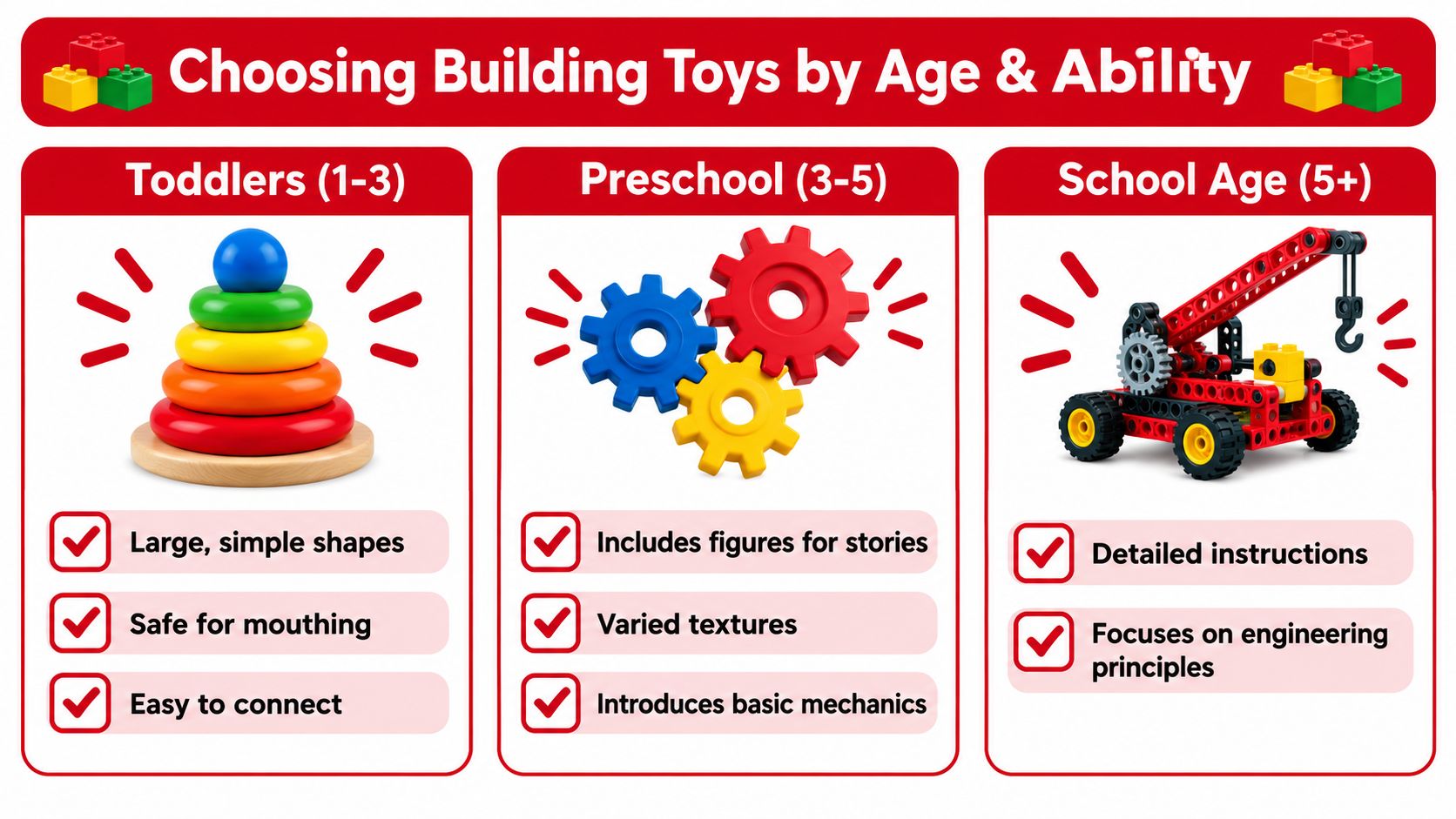
For children around 12 months, start with large, easy-to-grasp parts that support stacking, nesting, and simple placement. Avoid treating successful construction as the only goal. Carrying, tapping, separating, and dropping parts are all ways a young child learns what objects can do.
Between the toddler and preschool years, look for connectors that provide clear success without requiring excessive force. A lower-piece-count tray can work better than a huge tub, particularly for children with attention differences or difficulty choosing among many options.
Preschool builders often benefit from varied shapes, simple figures, wheels, ramps, and parts that support stories. The best sets at this stage allow a child to copy a model, then alter it. That transition from imitation to variation helps preserve confidence while introducing flexible thinking.
School-age children may enjoy detailed instructions, mechanical systems, and design challenges. Teen builders can need more specialized pathways, such as architecture, vehicles, robotics, or model engineering, rather than products marketed as “more advanced.”
Accessibility principle: More complex isn't always better. Easier connections, fewer starting pieces, tactile variety, and a quick reset can create more successful play.
A decision tree for real families
Ask these questions before buying:
- Can the child physically manage the parts? If not, choose larger pieces, softer resistance, or simpler connection modes.
- Does the child need a clear starting point? Choose a guided model, a small challenge card, or a limited selection of loose parts.
- Does the child become distressed when structures fail? Favor stable connectors, easy-reset designs, and projects that can be completed in short stages.
- Will siblings share the set? Look for enough compatible parts to support parallel play, or choose a system that allows different levels of difficulty.
- What should become harder next? Prioritize progressive connection modes and escalating assembly complexity over raw piece count.
Repeated building behaviors develop from simpler actions toward more advanced fitting and attaching. The product should grow with that sequence instead of forcing a child directly into a complex build. For targeted ideas, see this selection of building toys for 8-year-olds.
Safety Standards and Durability You Can Trust
A building toy can be educational and still be a poor purchase if its parts break, connections splinter, or small components create a hazard. Safety starts with the child's actual behavior, including mouthing, throwing, squeezing, and placing pieces in pockets or containers.
Two regulatory systems appear frequently on packaging and retailer pages:
| Region | Standard | Key Safety Areas Covered |
|---|---|---|
| European Union | EN 71 | Mechanical and physical safety, flammability, and migration of heavy metals |
| United States | ASTM F963 and CPSIA | Phthalates, lead content, and small-parts choking hazards |
The overview of toy-safety requirements for building blocks explains these frameworks and the areas they address. Compliance language should be specific enough to identify the applicable market and standard, not merely say “safe” or “non-toxic.”
Look beyond the badge
Before purchasing, check whether the manufacturer clearly identifies:
- Part dimensions: Small components may be unsuitable for younger children or children who mouth objects.
- Material information: Look for clear material descriptions and care guidance.
- Connection force: A joint that needs excessive pressure can exclude children with fine-motor delays.
- Surface quality: Inspect photos for sharp edges, rough seams, cracked finishes, or exposed hardware.
- Replacement support: Modular toys last longer when missing or damaged parts can be replaced.
- Storage design: A practical container reduces lost pieces and makes independent cleanup more realistic.
Durability also affects learning. If a child's structure collapses because a connector is weak rather than because the design needs revision, the toy creates confusion. Strong parts should still allow children to encounter genuine design problems, but the product shouldn't introduce avoidable failure.
Families choosing products for babies and young toddlers may also find this guide to non-toxic toys for babies helpful when comparing materials and safety considerations.
Turning Building Play Into Real Learning Moments
A box of parts doesn't automatically become a lesson. Children learn most when the activity gives them a meaningful problem and enough freedom to solve it their way.
A study of block play observed behaviors that resemble early engineering design, including goal-oriented planning, problem-solving, combining designs in new ways, repeating patterns, and testing whether a design works. Those behaviors can become simple home activities.
Five activities that need almost no preparation
The bridge challenge works for preschool and school-age children. Provide blocks, tiles, or bricks and ask the child to build a bridge between two books. The learning objective is stability and spatial planning. Ask, “What could make the bridge stronger without making it much wider?”
The animal shelter suits younger preschoolers. Offer a small group of blocks and a toy animal, then invite the child to make a home with an entrance. The objective is purposeful design and enclosure. Ask, “How will the animal get in, and what happens if the roof is too low?”
The repeated-pattern wall develops visual comparison. Start a simple color or shape sequence, then ask the child to continue it or invent a new one. The prompt is, “What part repeats, and how could you prove your pattern is consistent?”
The moving machine fits children ready for gears, wheels, axles, or ramps. Ask them to make something that moves from one point to another. The objective is testing and revision. Ask, “Which change made it move farther, and what stayed the same?”
The redesign round supports older builders. Give the child a structure they've already made and ask for two different versions that solve the same problem. The goal is innovation through combining or altering designs. Ask, “Which version is easier to repair, and why?”
A helpful adult doesn't grab the loose piece and finish the build. Instead, describe what you notice, offer a choice, or ask the child to predict the result. “You've made the base wider” encourages reflection without dictating the next move.
Fit building into ordinary routines
A five-minute morning build can turn waiting time into focused activity. After school, a small tray of selected parts can provide a calmer transition than an overflowing bin. Weekend projects work well when every family member has a role, such as designer, tester, builder, or storyteller.
Keep the starting collection deliberately limited when a child freezes in front of too many choices. Add parts after the child has a plan. For a child who prefers instructions, begin with a picture or simple challenge, then ask what could be changed.
The adult's job is to protect the problem, not solve it.
Notice effort that reveals thinking. “You tested the wheel twice” is more useful than “That's a great tower,” because it reinforces experimentation rather than only the finished appearance.
Building Better Play Experiences at Playz
A thoughtful building collection should offer more than a single impressive project. It should give children ways to start easily, repeat a skill, add complexity, and move into imaginative or subject-based play without making screen use the center of the experience.
Playz's range includes creative building sets, model-building kits, science kits, and play tents that can support different kinds of purposeful play. A model kit can provide a structured route into assembly, while an imaginative play tent can become the setting for a child's own constructed world. The useful question remains the same as it is with any brand: does the product match the child's abilities, invite active decisions, and withstand repeated use?
The brand presents this philosophy through #KidsLearnBestThruPlayz and reports over 5 million satisfied customers in its company description. Those details don't replace checking age guidance, materials, connection difficulty, or the likely level of adult support. They do reflect a product range built around active play and learning through making rather than passive entertainment.
For families comparing sustainable, open-ended, and tech-hybrid options, the strongest choice is usually the one that remains useful after the novelty fades. A durable set with progressive challenges, accessible connections, and room for storytelling can support more than a product that depends on a single app or finished model.
Explore Playz for creative building sets, model kits, science activities, and imaginative play products that you can match to your child's age, abilities, and learning style. Choose a set that offers a manageable starting point today, then gives your child room to redesign, test, and build again tomorrow.