

The best building toys for 8-year-olds are the ones that can keep up with them. This is an age of incredible developmental leaps, and kids are ready for challenges that build real confidence and critical thinking skills. We're talking about everything from complex construction sets to introductory robotics kits—toys designed to engage their budding engineering minds.
Why Age 8 Is the Perfect Time for Advanced Building Toys
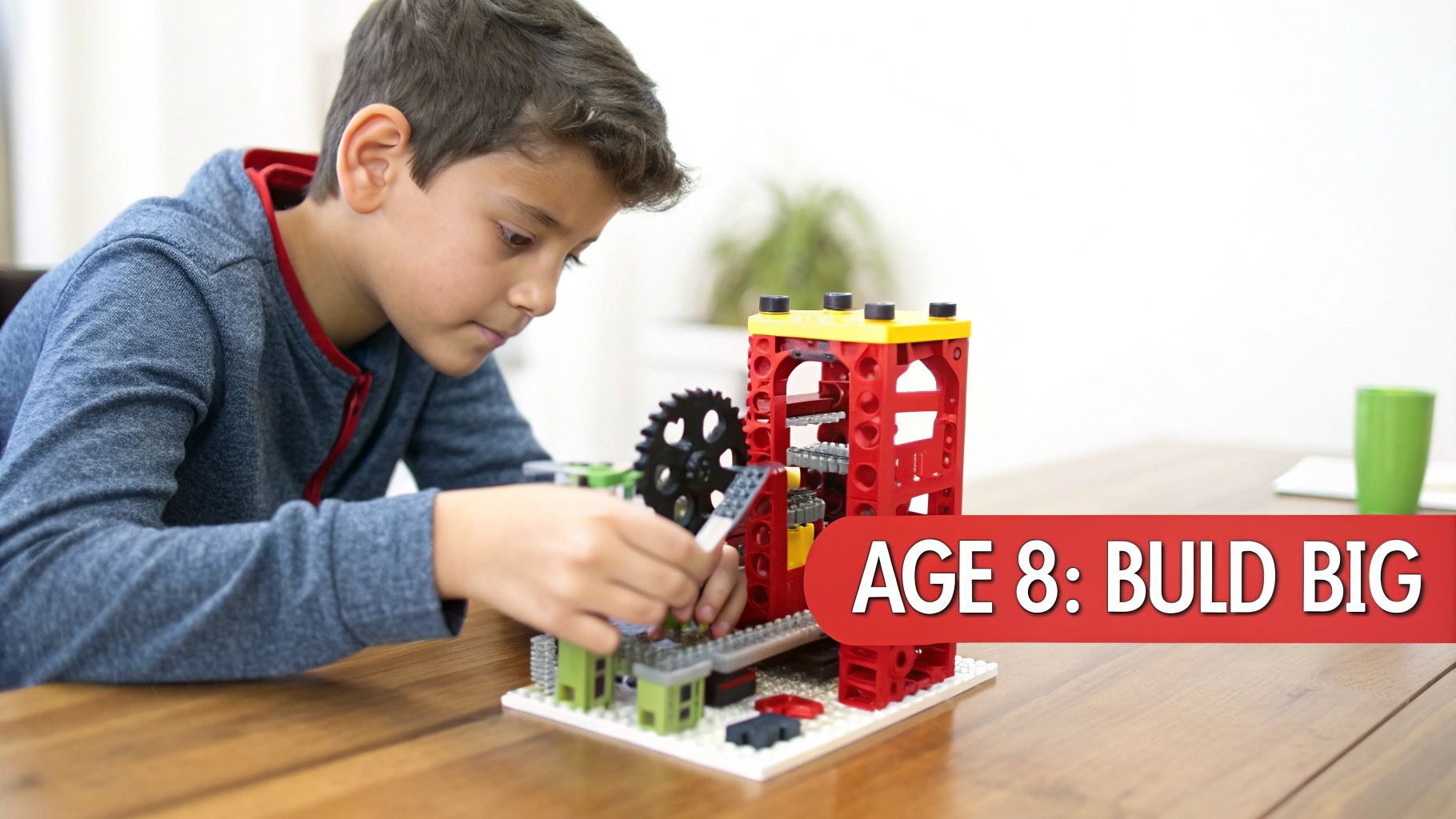
There's a special kind of magic that happens when an eight-year-old connects the final piece of a complex build. This isn't just playtime anymore. At this age, simple block stacking gives way to sophisticated construction and seriously imaginative engineering.
Their minds are primed for more advanced challenges. At eight, most kids have developed the patience to follow multi-step instructions and the fine motor skills needed to handle smaller, more intricate pieces. It’s a developmental sweet spot where abstract thinking kicks in, letting them visualize outcomes and solve problems in creative new ways.
The Leap from Simple Play to Complex Problem-Solving
An 8-year-old’s cognitive growth is remarkable. They are no longer just building up; they're building out, creating entire worlds with unique rules and functions. This shift is a huge deal for developing key life skills.
- Enhanced Spatial Reasoning: They can mentally rotate objects and understand how different parts fit together in three-dimensional space. For example, they can look at a flat diagram of a spaceship and visualize how it will look when fully assembled.
- Logical Thinking: Following a detailed manual or figuring out why a design isn't working requires sequential and logical thought. It's real-world troubleshooting!
- Sustained Focus: Their ability to concentrate on a single project for longer stretches improves dramatically, making larger, more rewarding builds possible.
This is where the #KidsLearnBestThruPlayz philosophy truly comes to life. Engaging, hands-on toys aren't just a way to pass the time; they are essential tools for nurturing a curious and capable mind.
Key Takeaway: The right building toy for an 8-year-old acts as a bridge between their imagination and real-world scientific principles. It offers a challenge that inspires persistence rather than causing frustration, laying the groundwork for a lifelong love of learning and discovery.
Developmental Milestones for 8-Year-Old Builders
This table highlights the key skills that make 8-year-olds ready for more complex building toys and what that looks like in action.
| Developmental Skill | What It Looks Like in Play | Toy Feature to Look For |
|---|---|---|
| Fine Motor Control | Handling small pieces like gears, screws, and connectors with precision. | Sets with smaller, more detailed components. |
| Abstract Thinking | Planning a multi-stage build and anticipating the final outcome. | Kits with blueprints or multi-step instructions. |
| Problem-Solving | Figuring out why a structure is unstable and making adjustments. | Open-ended sets that allow for trial and error. |
| Sustained Attention | Working on a single project for an hour or more without getting discouraged. | Builds with 100+ pieces or complex mechanisms. |
| Following Instructions | Interpreting diagrams and written steps to assemble a model correctly. | Manuals with clear, sequential visual guides. |
Seeing these skills in action is a clear sign that a child is ready for toys that will meet them where they are and push them to grow even further.
Fueling the Next Generation of Innovators
The impact of these toys extends far beyond the playroom. Building toys are powerful gateways to STEM (Science, Technology, Engineering, and Math). The global STEM toy market is projected to hit an incredible $15 billion by 2025, a testament to how much parents and educators value them.
This readiness for advanced play is also reflected in sales data. Building sets for kids aged 9-11 have seen a 9% increase in sales, telling us that 8-year-olds are perfectly positioned on the cusp of this advanced stage, eager for toys that match their expanding abilities. To see how these skills develop over time, check out our guide on the benefits of STEM toys for kids.
How to Choose the Right Building Toy for an 8 Year Old
Walking into the toy aisle can feel overwhelming. How do you pick the one that will actually capture your 8-year-old’s imagination instead of just collecting dust?
The secret is finding a toy that hits the sweet spot between challenge and reward. It needs to stretch their skills just enough without causing frustration, and it has to be flexible enough for them to come back to again and again. Think of it like finding the right-sized puzzle—too easy and it’s boring, too hard and it’s frustrating.
Open-Ended Creativity vs. Guided Instruction
Building toys tend to fall into two camps: open-ended sets and instruction-based kits. Neither is better than the other; they just build different, equally important skills.
- Open-Ended Sets: Think classic LEGOs or magnetic tiles. With no final goal, kids have the freedom to build whatever pops into their heads. This is fantastic for sparking creativity, spontaneous problem-solving, and storytelling.
- Instruction-Based Kits: These are more like a detailed robotics project or an architectural model with a clear objective and manual. They are amazing for teaching kids to follow directions, understand complex mechanics, and develop patience. Nailing a guided build delivers a huge sense of accomplishment.
Actionable Insight: The best approach is often a mix of both. A child who builds confidence by finishing a guided model is far more likely to take those same pieces later and start inventing something new.
Finding the Sweet Spot: Piece Count and Complexity
The number of pieces is a quick way to gauge a set's complexity, but it doesn't tell the whole story. For an 8-year-old, a set with 300 to 800 pieces is usually the sweet spot. It feels like a substantial project without turning into a month-long chore.
But also consider the type of pieces. A 500-piece set of simple bricks is totally different from a 500-piece electronics kit with wires, sensors, and tiny gears. At this age, the challenge should come from the cleverness of the design, not from fumbling with parts that are too tiny or hard to connect.
Evaluating STEM Value and Educational Depth
Many toys claim to be "educational," but what does that really mean? A truly valuable building toy weaves learning right into the fun. It doesn’t just teach a kid to follow steps; it shows them why those steps work.
Here’s how to spot real educational value:
- Real-World Principles: Does the toy demonstrate concepts like leverage, gravity, or circuits? Building a hydraulic arm isn't just about snapping pieces together; it's a hands-on lesson in fluid dynamics.
- Problem-Solving Opportunities: The best kits have moments that make a kid stop and think. Maybe they need to figure out how to balance a structure or troubleshoot a mechanism. This encourages them to test, fail, and try again—the core of engineering.
- Skill Progression: Is there room to grow? A great robotics kit might start with simple guided builds but later allow for custom programming.
To dig a little deeper, you can learn more about how to identify the best educational toys for kids in our detailed guide.
Prioritizing Durability and Material Quality
A good building toy is an investment, and it needs to stand up to enthusiastic play. Flimsy, low-quality plastics lead to pieces that don't fit together right or break easily. Nothing kills the fun faster.
Look for toys made from sturdy, high-quality materials like ABS plastic. The pieces should connect firmly but still be easy enough for an 8-year-old to pull apart without help. This not only makes the toy last longer, but it also makes the building experience more enjoyable. A well-made set can be used for years, making it a much better value in the long run.
Top Building Toy Categories for Eight-Year-Olds
Not all building toys are the same, and the best one for your 8-year-old comes down to their personality and passions. The world of construction sets is huge, but it helps to think about it in terms of different play styles.
Some kids love following a detailed blueprint to create a perfect replica of a spaceship. Others just want a big pile of parts to build whatever pops into their imagination. Understanding which camp your kid falls into is the first step toward finding a toy that will truly click.
This chart breaks down the key things to keep in mind when you're on the hunt: play style, educational benefits, and whether the toy can stand up to hours of play.
Finding a toy that hits the sweet spot between these three areas is how you land on a real winner—something that's both fun and built to last.
Classic Interlocking Bricks (LEGOs, etc.)
When you think of building toys, interlocking plastic bricks are probably the first thing that comes to mind. These sets are the foundation of creative construction, teaching spatial awareness, fine motor skills, and problem-solving. An 8-year-old is ready for a wide range of complexity, from a giant tub of assorted bricks for free-building to themed kits with 500+ pieces.
- Pros: Highly versatile, promotes creativity (open-ended sets) and precision (guided kits), huge variety of themes available.
- Cons: Small pieces can be easy to lose, complex sets can be expensive.
Magnetic Tiles and Construction Sets
Magnetic toys have exploded in popularity, and for good reason. The satisfying "click" as the magnets connect makes building fast and less frustrating. This lets kids experiment with geometric shapes and architectural ideas on a much bigger scale. At eight, kids can move beyond simple cubes to create complex 3D structures like domes, bridges, and multi-story buildings.
Real-World Example: The real beauty of magnetic tiles is how they secretly teach physics. A child will quickly discover that a triangle makes a stronger support than a square—not because a textbook told them so, but because they saw it happen firsthand while trying to keep their masterpiece from toppling over.
- Pros: Easy to use, encourages rapid prototyping, teaches geometry and physics concepts intuitively.
- Cons: Structures can be less stable than interlocking bricks, can be pricey for larger sets.
Advanced Construction and Engineering Kits (Erector Sets, etc.)
Got a kid who loves figuring out how things work? Advanced construction sets are their jam. These kits use metal or plastic beams, screws, gears, and pulleys to build functional models like cranes, vehicles, or robotic arms. They introduce core engineering principles in a practical way, but require more precision and patience than simple bricks.
- Pros: Teaches real-world mechanical principles, develops fine motor skills and patience, creates functional models.
- Cons: Can be challenging for kids who get frustrated easily, many small parts to manage.
Comparison of Building Toy Categories
| Toy Category | Primary Skills Developed | Complexity Level (for age 8) | Best for This Type of Child |
|---|---|---|---|
| Classic Interlocking Bricks | Fine Motor Skills, Spatial Reasoning, Creativity | Low to High | The imaginative creator or the rule-follower |
| Magnetic Tiles | 3D Visualization, Geometry, Structural Stability | Low to Medium | The visual-spatial learner and rapid prototyper |
| Engineering Kits | Mechanical Principles, Problem-Solving, Patience | Medium to High | The tinkerer who loves to know how things work |
| Robotics & Coding Kits | Logic, Programming Basics, Cause-and-Effect | Medium to High | The future tech innovator and problem-solver |
| Science-Based Kits | Scientific Principles, Experimentation, Critical Thinking | Medium | The curious experimenter who always asks "why?" |
Robotics and Coding Kits
At eight years old, many kids are ready to dip their toes into robotics and coding. These kits merge physical building with digital programming, offering an interactive way to learn the basics of logic and automation. Most beginner kits use a simple, visual drag-and-drop interface, so no prior coding experience is needed. They can build a robot and then program it to follow a line, dodge obstacles, or dance.
- Pros: Introduces coding in a fun way, combines hardware and software skills, highly engaging and interactive.
- Cons: Can have a steeper learning curve, may require a compatible tablet or computer.
To learn more, explore our guide to robotics kits for beginners and find the perfect entry point.
Science-Based Building Kits
This is where construction meets experimentation. Science-based kits, like the ones we create at Playz, are designed to do more than just build a static model. Each project is a hands-on science experiment that teaches a specific principle. Imagine your child building a hydraulic claw that actually works by pushing water through syringes. They aren't just snapping pieces together; they're directly engaging with concepts like fluid dynamics and pressure.
- Pros: Makes abstract science concepts tangible, highly educational, builds confidence through experimentation.
- Cons: Often focused on a single project rather than open-ended play.
It's the perfect embodiment of our #KidsLearnBestThruPlayz philosophy. They build something awesome, and they learn exactly why and how it works at the same time.
Inspiring Future Innovators with Playz Kits
Some building toys are for making a cool model to sit on a shelf. Others are designed to spark a genuine "Aha!" moment. That’s where Playz kits really shine—they transform tricky STEM principles into exciting, hands-on adventures.
These aren't just toys you build; they’re experiences you discover. The real magic is in the thrill of seeing science in action. It's the pride that lights up a kid's face when their hand-built circuit flashes to life or the satisfaction of making a mechanical arm move with their own power.
This approach is the heart of the #KidsLearnBestThruPlayz philosophy. It’s all about creating unforgettable learning moments by mashing up construction with real-world science, making sure the "why" is just as exciting as the "how."
Translating Complex Concepts into Hands-On Fun
Playz kits are designed to break down subjects that can feel intimidating in a textbook. They act as a bridge between abstract ideas and tangible results, showing kids that science and engineering aren't just school subjects—they're powerful tools for creating amazing things.
Take a circuit-building kit. An 8-year-old doesn't just connect wires by following a diagram. They build a real, working circuit from the ground up, getting a firsthand lesson on conductivity and power sources. When that final connection makes a light blink or a buzzer sound, electricity is no longer just a word; it’s a direct, memorable experience.
Key Takeaway: The magic of a Playz kit is in that moment of discovery. It’s the shift from passively following instructions to actively understanding the scientific principle that makes it all work. This is how curiosity catches fire and a lifelong passion for learning begins.
Engineering Principles Brought to Life
A hydraulic arm set is another fantastic example. This project is a direct lesson in fluid dynamics and simple machines. Kids don't just assemble a cool-looking robot arm; they build the very system that powers it.
- Actionable Learning: By pushing water through syringes, they physically feel the force and pressure that gets the arm moving.
- Cause and Effect: They immediately see how their input creates a specific output, teaching them about mechanical advantage.
- Problem-Solving: If a joint doesn't move right, they learn to troubleshoot the system—checking for air bubbles or leaks, just like a real engineer would.
This kind of hands-on engagement delivers a deeper, more intuitive understanding that reading a book simply can't match.
Meeting a Growing Demand for Educational Play
Today's toy market for 8-year-olds is all about building sets that successfully blend education with genuine excitement. This trend is backed by market data, with U.S. sales for these types of toys climbing 6% in the first half of 2025 as more families look for toys that support development. Playz fits right into this movement, offering creative toys that its 5+ million fans love. This lines up with the impressive 25% growth seen in subscription boxes and the 28% rise in customizable toys—a clear signal that parents want engaging, educational experiences for their kids.
By focusing on interactive science, Playz kits don't just entertain. They build foundational skills in critical thinking, problem-solving, and scientific literacy.
Creative Building Challenges Beyond the Instruction Manual
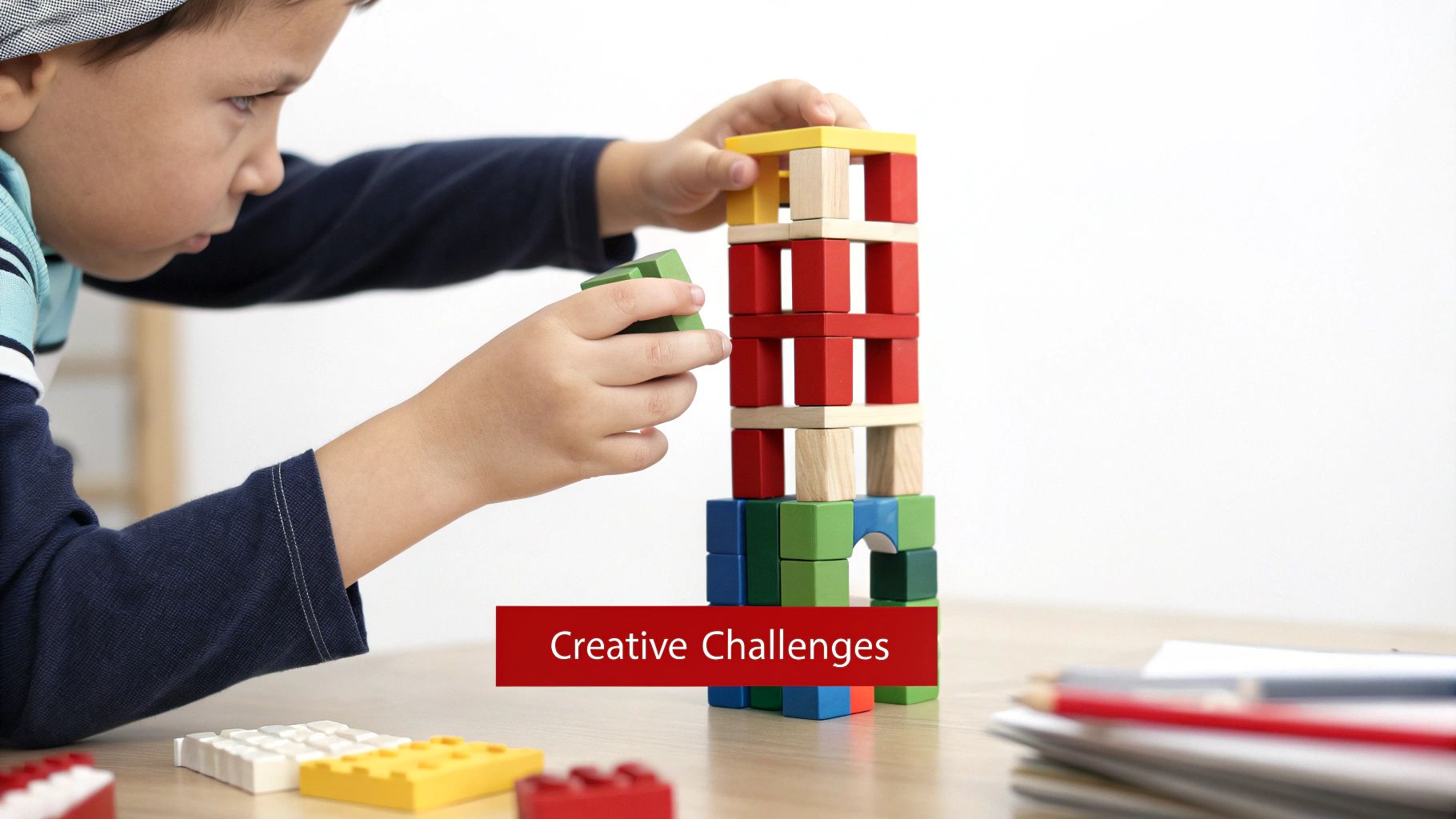
The real fun often begins after the instruction manual is put away. Completing a guided build is a fantastic achievement, but the true magic of a great building toy is its potential for endless reinvention. This is your chance to turn a single kit into a launchpad for creativity.
By tossing out simple, fun challenges, you can breathe new life into an old toy and turn playtime into a dynamic learning session. These prompts encourage kids to look at the same pieces in new ways, pushing them to experiment, problem-solve, and innovate.
Sparking Creativity with Building Prompts
Sometimes, all it takes is a little nudge to get those creative gears turning. Instead of just saying "go build something," try offering a specific challenge.
- The Tallest Tower Challenge: Who can build the most stable, tallest structure using only 50 pieces? This simple game is a hands-on lesson in structural integrity and balance.
- Marble Run Mania: Using whatever pieces are on hand (plus cardboard tubes or books), create a path to get a marble from point A to point B. This explores physics concepts like momentum, friction, and gravity.
- Build a Story: Give a narrative prompt like, "Build a vehicle for an astronaut to explore a new planet," or "Create a home for a tiny fantasy creature." This beautifully merges engineering with storytelling.
Actionable Insight: The goal here isn't to create a perfect model; it's to encourage experimentation. Celebrating the process of trying, failing, and adapting builds resilience and a true engineering mindset.
LEGO has been the king of building toys for decades, and its versatile bricks are perfect for these kinds of challenges. LEGO's sets for 8-year-olds, often with 500-1000 pieces, hit that developmental sweet spot. In fact, research shows this kind of block play can boost spatial reasoning by 20-30% in kids this age.
Advanced Challenges for Young Engineers
Once your 8-year-old gets comfortable building off-script, introduce more complex challenges.
A great one is Reverse Engineering. Find a simple household object—like a stapler or a can opener—and challenge your child to replicate its basic function using their toy pieces. They won't build an exact copy, but the exercise forces them to analyze how a mechanism works and then figure out how to recreate it.
Another idea is the Limited Piece Challenge. Give them a small, random assortment of pieces and see what they can dream up. This constraint forces them to think outside the box and find clever uses for parts they might normally ignore. It's a fantastic stepping stone to more complex tasks, like figuring out how to build simple robots from scratch.
These challenges empower kids to become active creators, not just passive assemblers.
Frequently Asked Questions About Building Toys
Picking out the right building toy can feel like a big decision. Here are answers to some of the most common questions parents have when shopping for an 8-year-old.
How many pieces should a set for an 8-year-old have?
For most kids this age, a set with 300 to 800 pieces is the sweet spot. This range offers a satisfying project that they can finish in a reasonable amount of time. It's big enough to feel like a real accomplishment but not so huge that it becomes a frustrating, months-long chore left half-finished in a corner. The goal is a tangible win that gives them a powerful "I did it!" feeling.
Are kits with instructions bad for creativity?
Not at all! While open-ended play is fantastic for imagination, following instructions builds an equally valuable set of skills. Think of it as learning the rules of a game before inventing your own. Guided kits teach crucial abilities like spatial reasoning (turning a 2D diagram into a 3D object), problem-solving, and planning. A successful guided build often provides the confidence a child needs to start experimenting with their own creations.
Key Takeaway: Think of an instruction manual as a framework for success. Once a child understands the "how" and "why" of a build, they are better equipped to apply those same ideas to their own creations.
How can I encourage my child to play with building toys instead of screens?
The trick is to make building a fun, collaborative experience. Start by creating an organized and inviting play space where the toys are easy to see and grab. Joining in on the first few builds can also make a world of difference. When you get down on the floor with them, it signals that this is a fun, shared activity. You can also throw out simple challenges, like "Let's build the tallest tower we can!" to turn a box of parts into an exciting, collaborative adventure.
Ready to find a toy that turns complex science into an unforgettable adventure? At Playz, we design award-winning kits that do just that.
Explore the full collection of Playz kits at Playz USA and give your child the gift of learning through play.