

You're probably reading this with a half-built tower on the floor, a child asking for “just one more piece,” and a pile of bricks that somehow spread from the play table to the hallway. That's usually how building toys show up in real family life. Not as a neatly staged learning activity, but as a busy, slightly chaotic scene where a 5-year-old is trying to make an idea stay standing.
That's exactly why this age matters so much.
A good building toy at 5 isn't just something to keep little hands busy. It's a tool for helping a child plan, test, change course, and try again. The best building toys for 5 year olds don't only match the age on the box. They match the child in front of you, and they give that child room to grow.
Why Building Toys Matter at Age 5
A 5-year-old at the play table usually tells you everything you need to know. They line up pieces, squint at a picture, press parts together too hard, knock the whole thing over, groan, and start again. Adults often see a mess. I see a child practicing how to handle a challenge.
That matters because construction play isn't a small corner of childhood. One review of play research found that in some preschool classrooms, construction play took up 40% to 50% of children's time in observational studies, and another study in that same review found it made up about 15% of preschool free-play activity. The same review also notes that children ages 2 to 6 typically spend about 30% of their waking time in play (review of play research).
What that looks like in real life
At 5, kids are standing right between pure pretend and more deliberate problem solving. They still want the tower to be a castle for dragons. But now they also care whether the bridge reaches the other side.
That shift shows up in small moments:
- Fine-motor planning gets sharper when they line up studs, snap pieces in place, or balance blocks without toppling them.
- Spatial reasoning grows when they rotate a piece, flip it, and realize it fits better the other way.
- Persistence gets tested every time a wall collapses or an instruction page stops making sense.
Practical rule: If a toy gives your child a chance to build, fail, adjust, and rebuild, it's doing more than entertaining them.
Research summaries also connect block and construction play with motor skills, hand-eye coordination, spatial reasoning, language, divergent thinking, social competence, and engineering skills. Complex block play is also associated with higher mathematical achievement (summary on block play and toy use).
Why parents often underestimate this stage
Five can look deceptively easy. Kids this age talk more clearly, seem more independent, and often insist they “know how.” But they still need toys that support the process, not just the finished model.
That's why I usually steer families toward open-ended options first, especially if they want toys that can keep pace with a child's changing ideas. If you want a broader look at how different construction options support play, this guide to building toys for children is a helpful next read.
What a 5 Year Old Is Ready to Build
A lot of toy confusion happens because age labels flatten real children into one category. Two kids can both be 5 and have very different building styles. One happily follows picture steps. Another wants to invent a zoo, garage, and spaceship out of the same pile.
Still, there are some reliable patterns at this age.
Hands first, then attention, then ideas
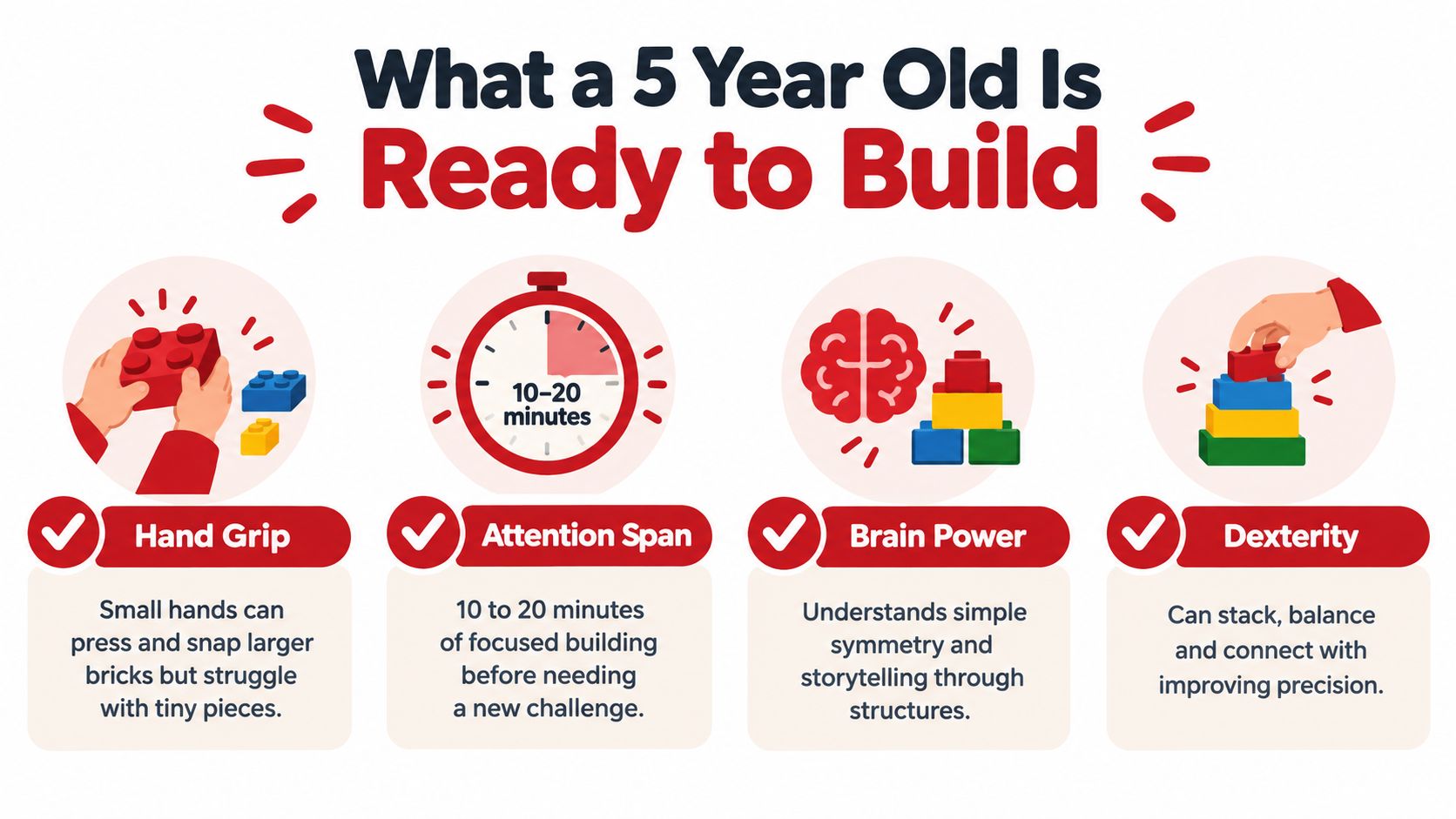
A 5-year-old's hands can usually press and snap larger interlocking pieces with confidence. They can stack, balance, and connect with improving precision. But very tiny pieces can still lead to fatigue, crooked joins, or that frustrated “I can't do it” moment.
Their attention span also matters. Many 5-year-olds can stay with a build for a focused stretch, especially if the toy offers quick wins along the way. A wall goes up. A roof clicks on. Wheels spin. Those visible rewards help them keep going.
Then comes the thinking side. At this age, kids often begin to:
- Follow multi-step directions without needing constant rescue
- Recreate a structure from a picture
- Notice symmetry, like wanting both sides of a gate to match
- Add story to structure, turning a simple house into a vet clinic or rocket base
Signs a toy is a good match
Parents ask me this in stores all the time: “How do I know if this is right for my child?”
Here are the clues I watch for:
-
Your child can connect the pieces without constant adult force.
If you're doing most of the snapping, the toy may be too fiddly. -
They can hold the build in mind long enough to finish one idea.
Not the whole giant set. Just one idea, like “I'm making a bridge.” -
They recover after a mistake.
A good-fit toy creates challenge, not shutdown.
If the toy invites effort but not despair, you're close to the sweet spot.
A pediatric toy review also points out that toy categories for ages 3 to 5 tend to center on larger, safer construction pieces, while ages 6 to 8 can handle more complex systems (pediatric toy review). That's why some “all ages” building guides feel unhelpful. They blur an important line.
If you're also thinking about the bigger picture of what kids this age can handle across play categories, this roundup of educational toys for 5-year-olds can help you compare beyond building sets.
The Main Types of Building Toys Compared
Not all building toys ask for the same kind of effort. Some reward imagination fast. Some demand patience. Some invite storytelling, while others pull kids toward testing and tinkering.
Building Toy Families at a Glance
| Toy Family | Core Skills | Typical Play Pattern | Watch Out For |
|---|---|---|---|
| Wooden unit blocks | Balance, planning, pretend play, spatial awareness | Build big, knock down, rebuild into scenes | Can feel too open-ended for kids who want clear instructions |
| Magnetic tiles | Shape recognition, symmetry, early geometry, experimentation | Quick building, flat-to-3D designs, lots of repetition | Some children make the same structures over and over without a prompt |
| Screw-and-bolt construction kits | Hand strength, sequencing, mechanical thinking | Slower builds, more focused assembly, lots of testing | Can frustrate kids if pieces require too much force |
| DUPLO and LEGO-compatible bricks | Fine motor control, storytelling, patterning, step-by-step thinking | Mix of guided builds and free play worlds | Tiny parts or dense manuals can tip a child into frustration |
| STEM build sets with moving parts or simple science elements | Cause and effect, engineering habits, prediction | Build, test, observe, modify | Too many “rules” can crowd out play for some children |
Where each type shines
Wooden blocks are still one of the best tools for children who want complete freedom. They're quiet, flexible, and easy to combine with toy animals, cars, and dolls. The trade-off is that some 5-year-olds want more “click” and less collapse.
Magnetic tiles give fast satisfaction. A child can build upward almost immediately, which is great for confidence. They're especially useful for kids who love windows, towers, domes, and symmetrical shapes.
Construction kits with screws and bolts tend to attract kids who like tools, machines, and figuring out how parts work together. These sets slow the child down in a good way, but low-quality connectors can turn a thoughtful build into a wrestling match.
Some toys reward imagination first. Others reward precision first. A 5-year-old usually does best when the toy offers a bit of both.
The step-up options parents ask about most
DUPLO and beginner LEGO-compatible systems sit in an interesting middle zone. LEGO's modern brick was patented in 1958, and the classic stud-and-tube design lets two bricks join in 24 different ways. Six bricks can combine in 102,981,500 ways. LEGO later introduced DUPLO in 1969, creating a clearer age progression for younger builders (LEGO history and milestones).
That history matters because the best sets in this family tend to preserve open-ended play while gradually increasing complexity.
For families comparing toy styles before they buy, this collection of creative building toys can help narrow the field.
Safety Beyond the No Small Parts Rule
Most parents know to avoid tiny loose pieces for younger children. That's a good start, but it isn't the whole story for 5-year-olds. Safety questions usually show up after the box is open and the toy has been played with for weeks.
What to check before you buy
For ages 4 through 5, U.S. age-determination guidance places building play blocks in a category where part size and shape are key safety variables, with smaller interlocking systems becoming more appropriate as children move into older age bands (CPSC age determination guidance).
That's the developmental side. On the product side, there's more to watch:
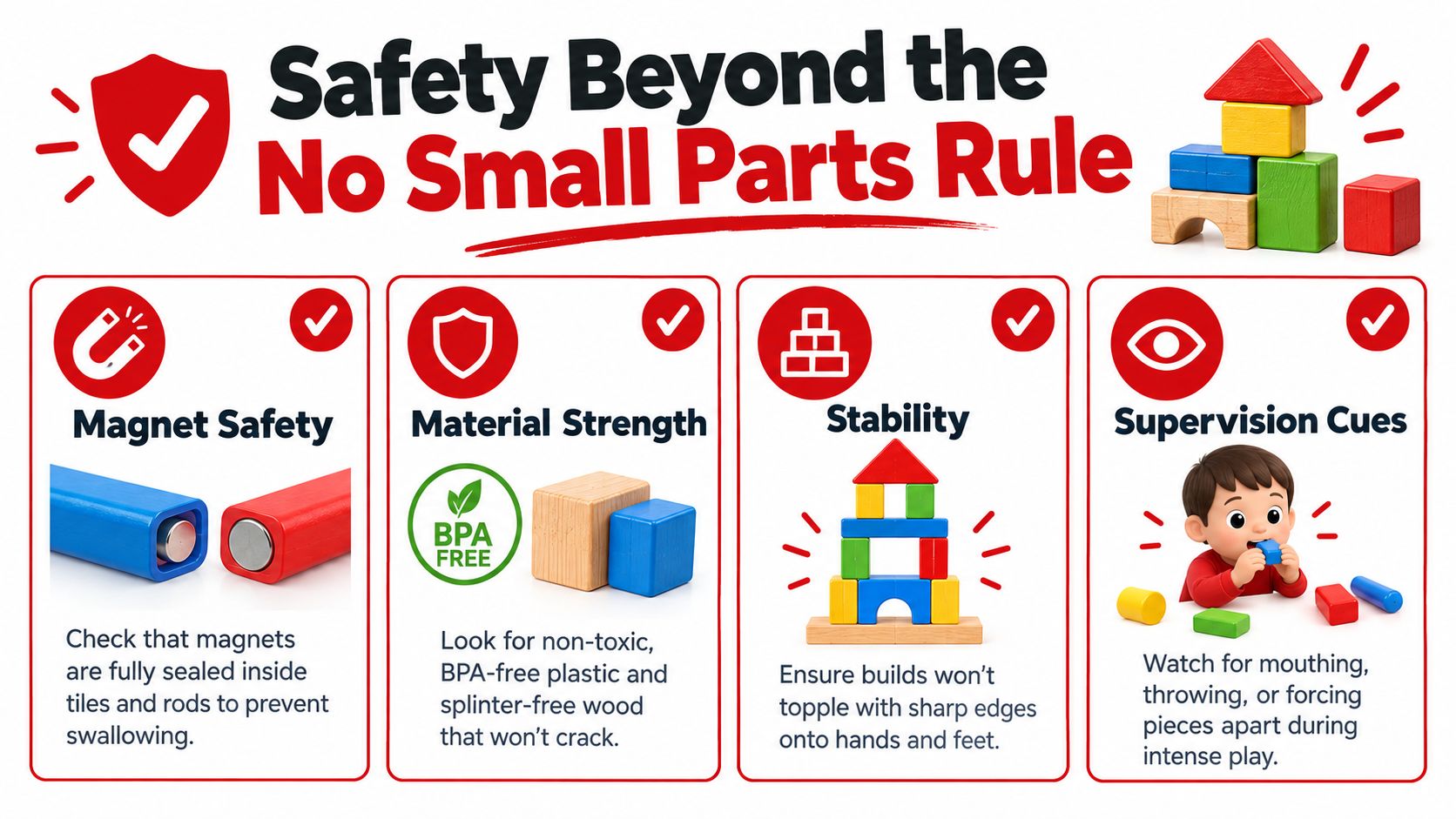
- Magnets need special attention. U.S. toy guidance notes that age rules also consider magnets, strings, and component size, and injuries can happen through swallowed magnets or broken pieces, especially in mixed-age homes (draft CPSC research document on toy age guidance).
- Broken pieces matter. A cracked tile, chipped block, or split connector can create sharp edges fast.
- Shared households change the risk. A safe toy for one 5-year-old can become a hazard when a younger sibling finds a loose piece under the couch.
The legal framework matters too. The U.S. Consumer Product Safety Improvement Act made ASTM F963 a mandatory toy safety standard, and CPSC testing and certification requirements apply to products designed primarily for children 12 years old or younger (CPSC toy safety overview).
Here's a short video overview parents may find useful before buying magnetic or construction toys:
A plain-language home checklist
The CPSC also ties building-toy safety to the Small Parts Regulation's five abuse tests: impact, torque, tension, flexure, and compression (CPSC guidance on abuse testing).
That sounds technical, but the parent version is simple:
- Pull on joins if your child tends to pry toys apart.
- Inspect magnets and seams on magnetic sets.
- Run your hand over edges to catch cracks or splinters.
- Separate sets by age if younger siblings share the same floor space.
- Recheck every few months because wear changes a toy.
If material safety is high on your list, especially for younger siblings nearby, this guide to non-toxic toys for babies helps families think through finishes, plastics, and everyday use.
How to Choose the Right Set for Your Child
Parents often think they need to choose the “best” set. Usually, they need to choose the best first category.
A 5-year-old doesn't need every kind of building toy at once. They need one set that fits their hands, their attention, and the way they like to play. Once you get that match right, expansion is easy.
Use these four filters
Start with fine-motor comfort. Can your child press, twist, stack, and separate pieces without getting worn out too quickly? If not, go larger and simpler.
Then look at play style. Some children love guided builds with a clear picture to follow. Others ignore instructions and build habitats, garages, or monster traps out of everything.
Next comes interest hook. A child who loves vehicles may stay with a screw-and-bolt construction set far longer than with plain geometric blocks. A child who tells stories all day may use brick systems more richly because every structure becomes a scene.
Finally, think about space. A toy that spreads beautifully across a playroom may become stressful in a small apartment kitchen.
Matching Building Toys to Your 5-Year-Old
| Toy Type | Best For Kids Who | Watch Out If | Storage Footprint |
|---|---|---|---|
| Wooden blocks | Love inventing scenes and don't need instructions | They get frustrated when builds fall easily | Medium to large |
| Magnetic tiles | Want quick success and visual builds | They mouth pieces, force seams, or have younger siblings nearby | Medium |
| Screw-and-bolt kits | Enjoy tools, vehicles, and figuring out mechanisms | They tire quickly when parts need strong hand pressure | Small to medium |
| DUPLO or larger interlocking bricks | Like both stories and repeatable structures | The set is too babyish for their current skill level | Medium |
| Beginner STEM build kits | Ask “what happens if…” and enjoy testing | The kit has too many steps or too much adult setup | Small to medium |
Choose for the child's current rhythm, not the child you hope the toy will create.
One more thing parents miss. The same 5-year-old might be ready for a fairly involved brick set but not ready for a science-heavy build with lots of waiting, wiring, or rule-following. Fit matters more than category.
If you want one factual example of a build-based option in this broader space, the Playz Solar System for Kids Exploration Kit includes hands-on DIY activities such as building a rocket and is labeled for kids ages 4+, which may suit children who like construction mixed with science play.
Play Activities That Build Real Skills
A strong toy helps. A simple play setup helps even more. I've watched the same set produce completely different learning depending on the prompt a child gets at the start.
Scenario one with magnetic tiles
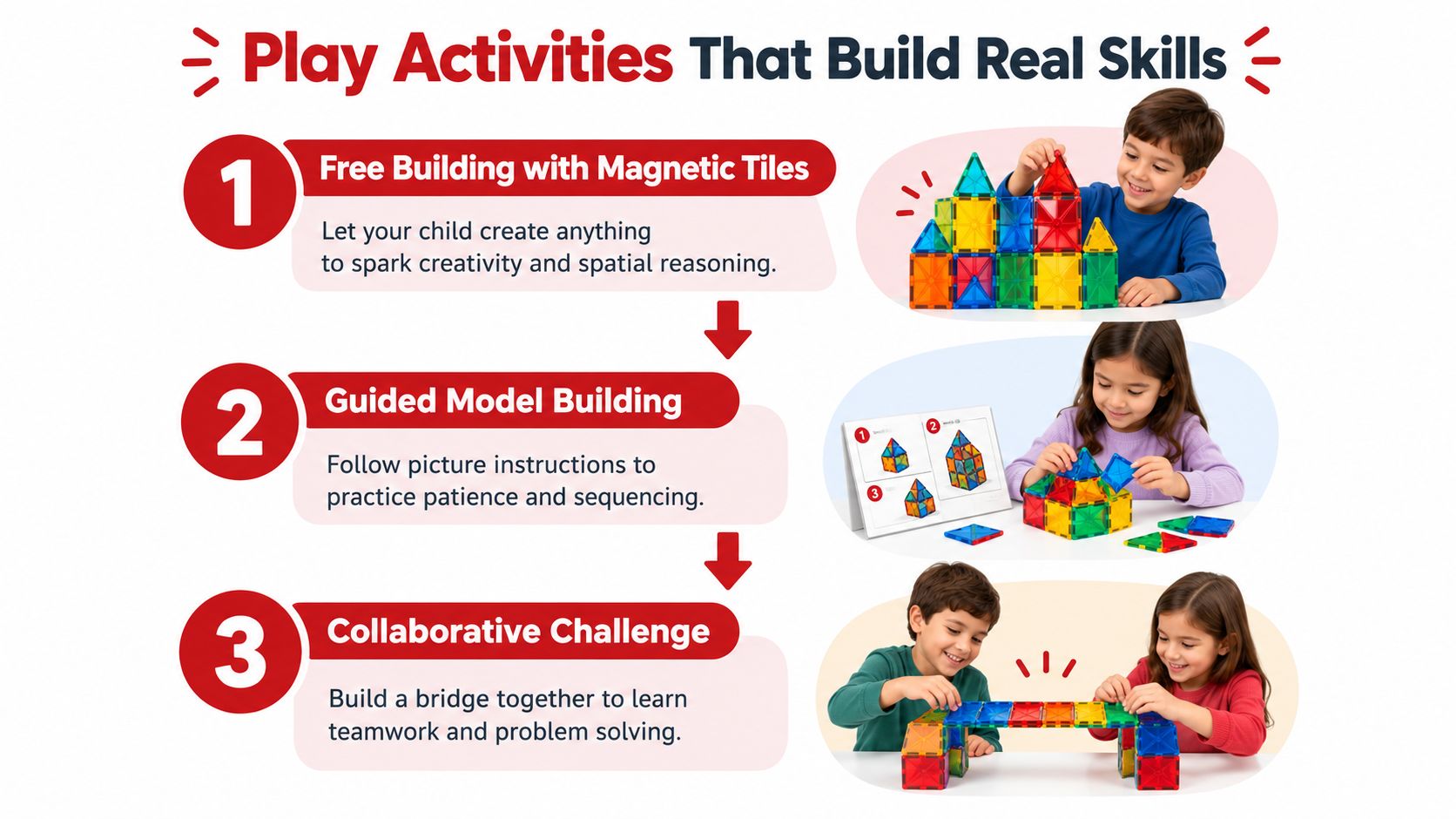
A child begins by dumping tiles into a pile and making the usual tall tower. Instead of correcting or directing too much, try this: “Can you sort the shapes first, then make both sides of your building match?”
Now the toy is doing more than stacking. It's supporting classification, visual matching, and early symmetry. The child still feels like they're building freely, but the prompt sharpens the thinking.
The next-day extension is easy. Ask them to build a house with only two shapes, or make a pattern that repeats around all four sides.
Scenario two with a bridge challenge
A simple construction kit can become a problem-solving lab with one sentence: “Can you make a bridge that holds this toy car?”
The first design often collapses. Good. That's where the learning is. Ask:
- What part bent first
- What could make the middle stronger
- Do you want it wider or taller next time
Independent construction-play research notes that building with construction materials supports the development of engineering skills as part of STEM learning (construction play and engineering skills).
“Try changing just one thing” is often a better prompt than “Let me show you how.”
If your child likes this kind of challenge, you may also enjoy these simple ideas for how to develop problem-solving skills.
Scenario three with bricks and story prompts
With DUPLO or beginner LEGO-compatible bricks, I like to start with a structure prompt and then add a character problem. “Build a house for a dog that hates rain.” Or: “Make a garage for a fire truck, but the door has to open.”
Now the child is practicing:
- Sequencing, because they have to decide what goes first
- Language, because they explain what the build does
- Social-emotional thinking, because the structure solves someone's problem
This kind of play often lasts longer than a straight “copy the picture” activity because the story keeps renewing the build.
Putting It All Together for Your Family
By the time parents finish reading about toy categories, safety rules, and developmental fit, they sometimes feel like choosing a building toy got much harder. It doesn't have to.
In real homes, the best building toys for 5 year olds usually earn their place in small routines. Saturday morning at the table. A ten-minute build while dinner finishes. A rainy afternoon challenge when everyone's energy is getting loud. The toy matters, but the repeatable family pattern matters just as much.
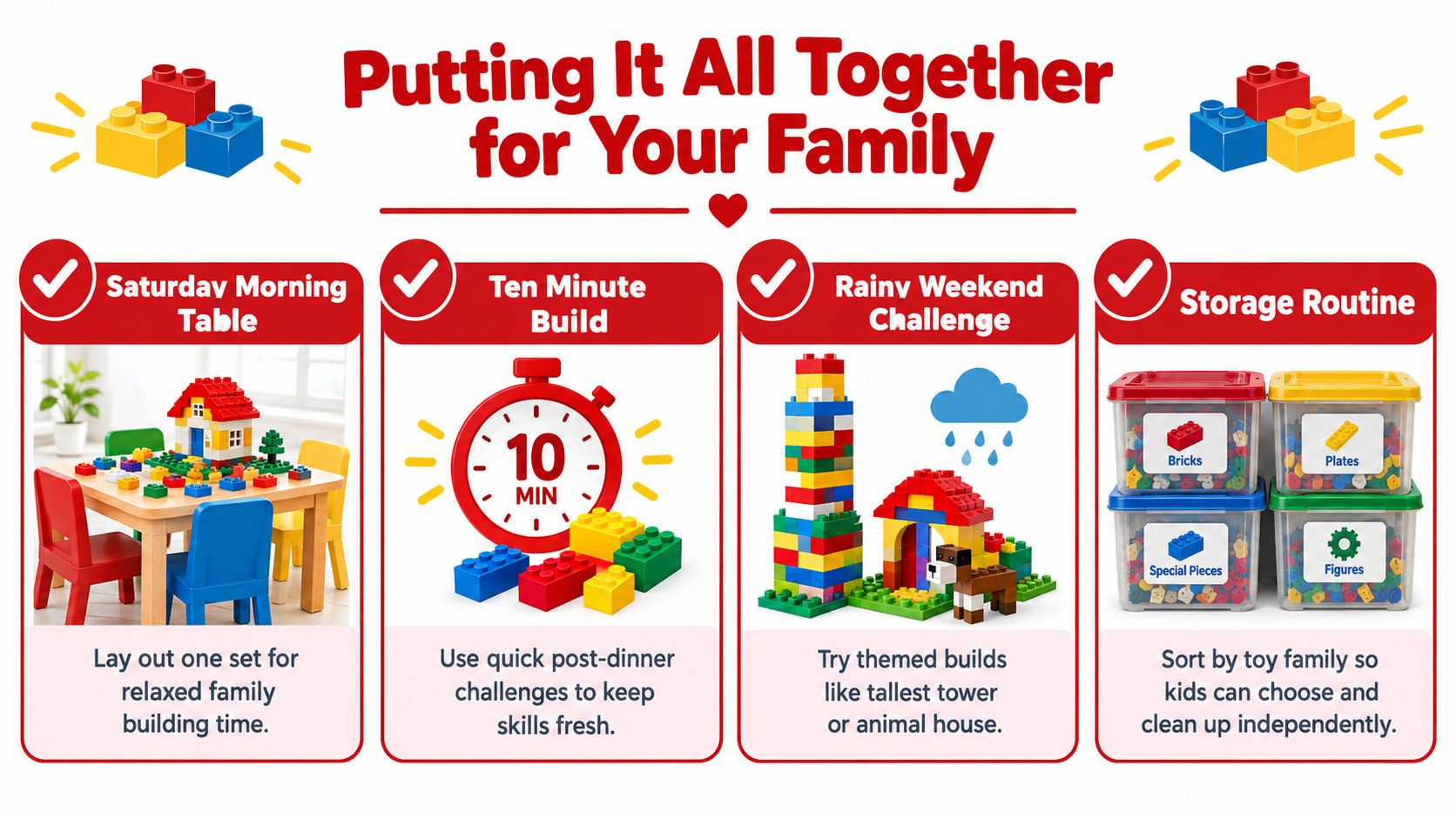
A simple routine that works
You don't need a Pinterest setup. You need one accessible bin, a clear surface, and a prompt simple enough that your child can enter the play without waiting for a full lesson.
Try this weekly rhythm:
- Pick one skill goal. Maybe you want more patience, more storytelling, or more independent problem solving.
- Choose one toy family that supports that goal.
- Offer one prompt. “Build the tallest tower that can still hold an animal.” That's enough.
- Rotate weekly so the toy feels fresh again before boredom sets in.
A short checklist for the toy aisle
When I help families choose, I come back to the same questions every time.
- Does the toy fit my child's hands?
- Can my child succeed without me doing the hard parts?
- Does it leave room for imagination after the first build?
- Is it safe for the whole household, including younger siblings nearby?
- Can we store it without resenting it?
The right set doesn't create zero frustration. It creates manageable frustration, followed by pride.
That's what you're looking for. Not perfection. Not the flashiest box. A toy your child returns to, wrestles with a little, and slowly masters.
When that happens, a pile of blocks becomes more than a gift. It becomes part of how your child learns to think.
FAQs
What are the best building toys for 5 year olds who get frustrated easily?
Start with magnetic tiles, larger interlocking bricks, or sturdy wooden blocks. These give quick success and don't demand too much finger strength. Avoid very tiny pieces or sets that require constant adult force.
Are LEGO sets good for 5-year-olds?
Some are, especially beginner-friendly or larger-piece systems. The main question isn't the brand name. It's whether the specific set matches your child's hand strength, patience, and ability to follow steps.
Are magnetic tiles safe for 5-year-olds?
They can be appropriate when they're age-rated correctly and kept in good condition. Check that magnets are fully enclosed, inspect for cracks, and be extra careful in homes with younger siblings.
How many pieces should a 5-year-old building set have?
There isn't one perfect number. What matters more is whether the child can manage the pieces comfortably, find what they need, and finish a satisfying idea without getting overwhelmed.
Which type of building toy teaches the most?
No single type teaches “the most.” Wooden blocks support open-ended design, magnetic tiles help with shape and symmetry, brick systems support sequencing and storytelling, and construction kits strengthen mechanical thinking. The strongest learning usually comes from matching the toy to the child and adding a simple play prompt.
Should I choose open-ended sets or instruction-based sets?
Most 5-year-olds benefit from some of both. If your child loves freedom, start open-ended. If they like a clear goal, begin with simple guided builds. Many families do best with one toy that can handle both styles.
If you're looking for toys that turn hands-on play into real learning, Playz offers science kits, creative toys, and age-based options that fit the same build-test-discover approach covered here. If your child lights up when they can make something, change it, and see what happens next, it's worth taking a look.