

The best educational toys for 5-year-olds are the ones that sneakily blend serious skill-building with pure fun. Think of them as tools that spark problem-solving, creativity, and hands-on tinkering—turning regular old playtime into a powerful learning moment.
The Power of Playful Learning at Age Five
For a five-year-old, the world is a giant laboratory of discovery, and play is their most important job. The right toys aren't just for keeping them busy; they are the essential tools that lay the foundation for a lifetime of learning. Purposeful play is what shapes their budding creativity, sharpens their problem-solving instincts, and helps them make sense of the world.
Choosing a great toy is a real investment in their cognitive, social, and emotional growth. It's about swapping passive screen time for active, hands-on engagement that actually brings them joy.
Shifting from Entertainment to Engagement
It's no surprise that the global market for educational toys is exploding. Valued at USD 54.00 billion in 2023, it's expected to rocket to USD 118.79 billion by 2030. This isn't just a trend; it's a fundamental shift in how we see toys—not as mere distractions, but as vital instruments for development.
This shift gets to the heart of what early childhood education is all about:
- Active Involvement: Kids learn best by doing. For example, building a tower with blocks teaches physics concepts far better than watching a video about them.
- Curiosity-Driven Exploration: A good toy doesn't just hand over the answers. It makes a child ask, "What if I try this?" or "How does this thing work?"
- Safe Failure: Play is a safe zone where messing up is part of the fun. When a block tower tumbles, it’s not a mistake—it’s a hands-on lesson in balance and physics.
“Play is often talked about as if it were a relief from serious learning. But for children, play is serious learning. Play is really the work of childhood.” - Fred Rogers
The Joy of Purposeful Play
The secret is to frame these toys as instruments of joy, not homework. They aren't meant to turn playtime into a chore, but to make learning feel like a grand adventure.
When a child is completely lost in a building project or a make-believe scenario, they're developing critical skills without even noticing. They’re practicing focus, learning to negotiate with friends, and expanding their vocabulary. To truly appreciate this, you can explore the profound impact of play on a child's development, which reinforces just how essential it is for every kid.
Ultimately, the real power of these toys is their ability to spark a genuine love for learning. By connecting curiosity with positive, fun experiences, we help our five-year-olds see themselves as capable, creative thinkers. You can dive deeper into the many play-based learning benefits in our detailed guide. That confident, curious mindset is probably the greatest gift any toy can give.
Inside the Mind of a Five Year Old
To pick the perfect educational toys for 5 year olds, you have to get a peek inside their amazing, buzzing brains. This age is a huge turning point. Their minds are firing on all cylinders, turning them from toddlers into thoughtful, curious, and surprisingly complex little people. When you understand what’s happening upstairs, you can see exactly why certain toys just click.
Think of their attention span like upgrading from a simple picture book to the first few chapters of a novel. Suddenly, they can follow more complex instructions, stick with an activity for longer, and start wrapping their heads around bigger ideas. It's the ideal time to introduce toys that ask for a little more patience and focus.
The Four Pillars of Development at Age Five
A five-year-old's growth isn't a straight line—it’s happening across several key areas all at once. By knowing what these pillars are, you can choose toys that support them from all angles and build a rock-solid foundation for the school years ahead.
Here’s a quick look at what’s going on:
- Cognitive Leaps: Their thinking is getting way more sophisticated. They're moving past just counting objects to telling elaborate, multi-part stories and are starting to grasp cause and effect.
- Physical Mastery: That small muscle control, or fine motor skills, is getting seriously good. They can now button up their own shirts, hold a pencil the right way, and handle smaller, more intricate toy parts with confidence.
- Social and Emotional Growth: Empathy is starting to bloom. They're really learning how to share, take turns, and understand that their friends have feelings, too.
- The Language Explosion: Their vocabulary is growing daily, and they've graduated from simple statements to the never-ending "Why?" phase. This isn't just to be difficult—it shows a deep, genuine desire to figure out how the world works.
From Milestones to Meaningful Play
Matching toys to these developmental milestones is where the magic happens. It unlocks their full learning potential in a way that feels like pure fun. A child who’s mastering their fine motor skills will get a huge sense of accomplishment from a set of lacing beads or a simple science kit with droppers and test tubes. In the same way, a kid figuring out social rules will thrive with cooperative board games or role-playing sets that get them working as a team.
This is the whole idea behind playful learning—it’s the hub where creativity, skill-building, and growth all connect.
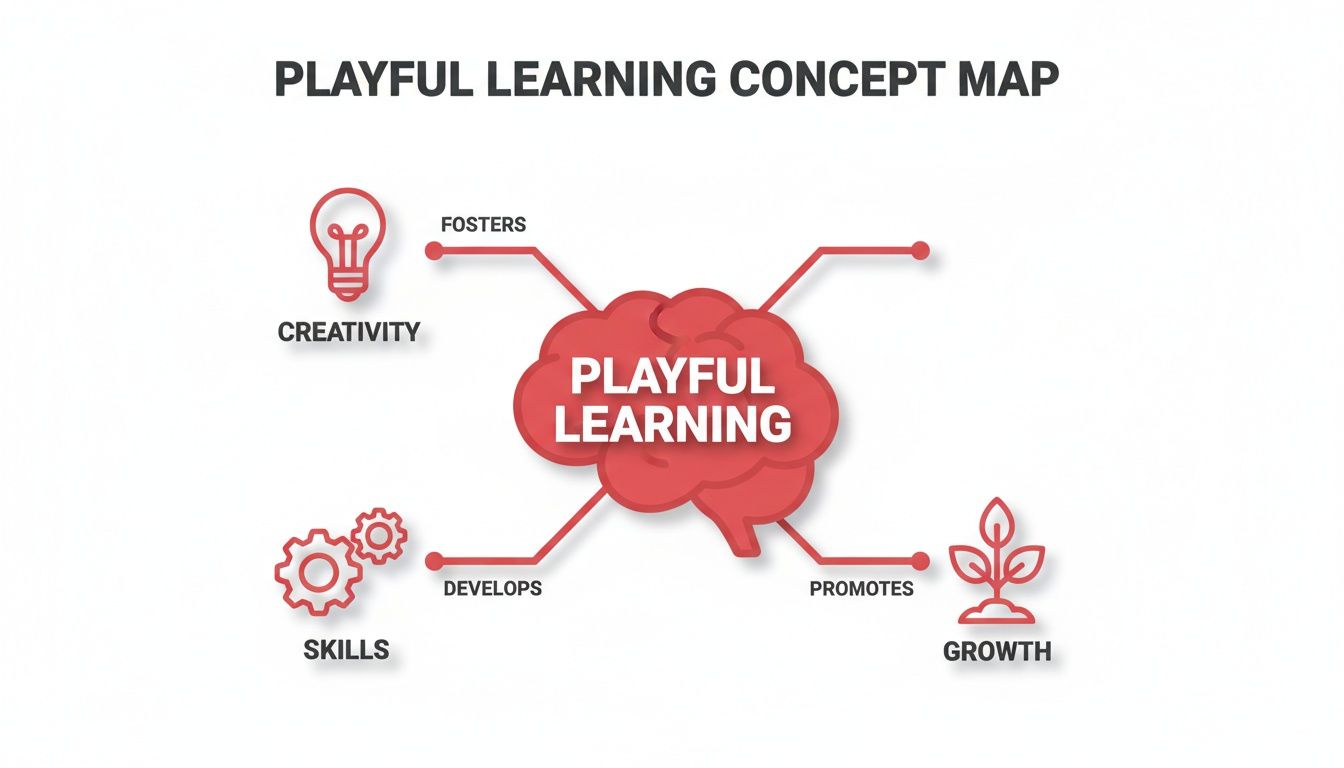
As you can see, play isn't just a single activity. It's a powerful engine that drives progress in multiple areas at the same time. This is a big reason why the 5-to-10 years age group is the largest segment of the educational toy market. Parents know this is a critical window for school readiness.
At age five, children aren't just playing. They are experimenting, testing hypotheses, and building mental models of their world. Every block tower is a physics lesson, and every game of make-believe is a masterclass in social studies.
Choosing Toys That Build the Brain
Knowing about these cognitive shifts helps you make smarter choices. For instance, a five-year-old’s growing ability to think logically means they are ready for toys that involve sequencing and recognizing patterns. To get a better sense of skills like spatial reasoning and problem-solving, you could check out this guide to nonverbal ability tests.
The table below is a handy reference for connecting what's happening in your child's development to the types of toys that will support them best.
Connecting Milestones to Toy Categories at Age 5
| Developmental Area | What It Looks Like in a 5 Year Old | Ideal Toy Category |
|---|---|---|
| Cognitive | Asking "why," telling stories, recognizing patterns, solving simple problems. | STEM kits, puzzles, beginner board games. |
| Fine Motor | Using scissors, drawing shapes, building with small blocks, buttoning clothes. | Building sets, craft kits, science tools. |
| Gross Motor | Hopping, skipping, climbing, throwing a ball with better aim. | Outdoor toys, climbing structures, ride-on toys. |
| Social-Emotional | Taking turns, showing empathy, understanding rules, expressing feelings. | Role-playing sets, cooperative games, puppets. |
| Language | Using complex sentences, telling jokes, understanding instructions. | Storytelling games, interactive books, playsets. |
When you align your toy choices with their natural developmental path, you’re not forcing them to learn—you’re empowering them to learn in the most effective way they know how: through joyful, engaging play.
For a deeper dive into the stages of growth, take a look at our guide on childhood development milestones. Armed with this knowledge, you’ll feel confident finding toys that will truly challenge and delight your five-year-old.
Choosing Your Child's Next Favorite Learning Toy
Stepping into the toy aisle can feel like wandering into a loud, colorful jungle. Everything is blinking, buzzing, and begging for your attention. So, how do you cut through the noise to find the toys that will actually spark your kid's curiosity and help them grow?
The secret is to look past the flashy boxes and think about the type of play each toy encourages.
To make it simple, we can break down the best educational toys for 5 year olds into five main groups. Think of it like building a balanced meal for their brain—each category provides a different, essential nutrient for their development. A little bit of everything helps them grow into a well-rounded, confident kid.
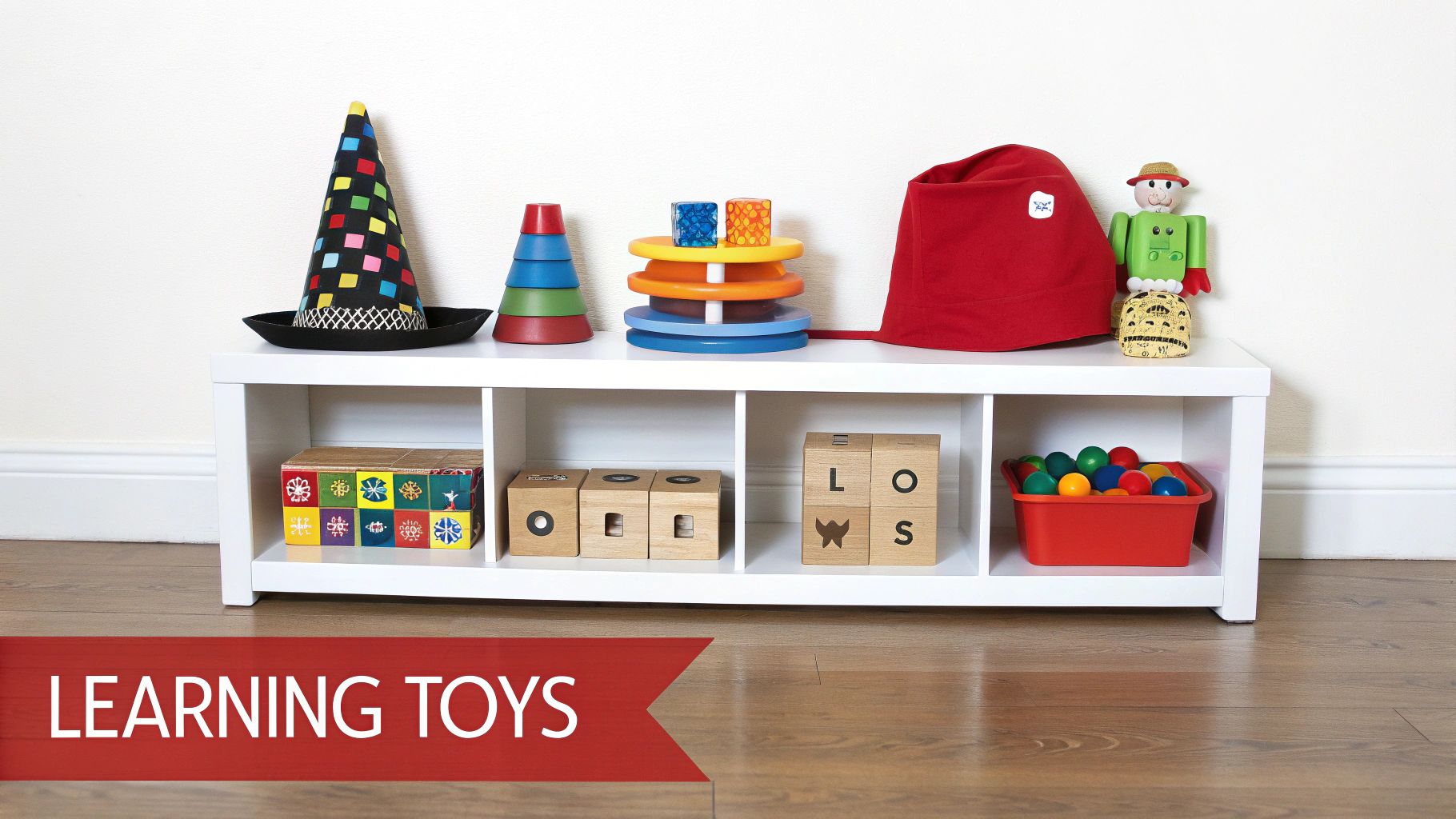
STEM and Logic Toys: For the Budding Innovator
This is where you'll find the tools to nurture your child's inner scientist and engineer. STEM (Science, Technology, Engineering, and Math) toys are all about asking "what if?" and seeing what happens next. They're designed to build curiosity and critical thinking by letting kids experiment, observe, and learn from the results.
These toys aren't just for future astronauts; they build the kind of foundational problem-solving skills everyone needs. That focus from parents is a big reason why North America leads the educational toy market, holding a 38.09% share in 2024.
- Examples: Simple science kits that fizz and bubble, magnetic building tiles, interlocking blocks, or entry-level coding robots.
- Superpower Unlocked: Problem-Solving. These toys teach kids to try an idea, see if it works, and if not, try something else. It's one of the most important life skills they can learn. To explore this area more, check out our guide to finding the right STEM toys for kids.
Arts and Creativity Toys: For the Young Visionary
This is where the imagination gets to run completely free. Arts and creativity toys are less about following instructions and all about self-expression. They give kids the tools to bring their wild ideas to life, whether it’s a lumpy clay monster or a vibrant, finger-painted sunset.
This kind of open-ended play is crucial for emotional development, offering a safe way for kids to express feelings they might not have the words for yet.
Creativity is intelligence having fun. These toys aren't just about making something pretty; they're about giving a child's inner world a physical form, building confidence and originality.
- Examples: Modeling clay, washable paints, craft kits with different textures, or even a simple box of fresh crayons and paper.
- Superpower Unlocked: Self-Expression. Art helps kids find their voice, building confidence and showing them their ideas have real value.
Imaginative and Role-Play Toys: For the Storyteller
Ever seen a five-year-old turn a simple cardboard box into a rocket ship? That’s the magic of imaginative play. These toys are the props for the incredible stories unfolding in your child's head, helping them make sense of the world by acting out different roles and situations.
This is also where they get to practice social skills in a safe, low-stakes way. When they pretend to be a doctor, a chef, or a teacher, they're exploring big ideas like empathy, cooperation, and communication.
- Examples: A play tent that becomes a secret fort, costume sets, puppet theaters, or a toy kitchen stocked with pretend food.
- Superpower Unlocked: Social Skills. Role-playing teaches kids how to take turns, negotiate ("You be the patient, and I'll be the doctor!"), and see the world from someone else's point of view.
Puzzles and Strategy Games: For the Strategic Thinker
Puzzles and strategy games are fantastic for building patience and logical thinking. By age five, many kids are ready to move beyond simple shape-sorters to more complex jigsaw puzzles and games that require them to think a few steps ahead.
This category also includes cooperative games, which are wonderful for this age group. Instead of competing, players work together toward a common goal, which is a powerful way to teach teamwork and shared success.
- Examples: 50-piece jigsaw puzzles, cooperative board games where everyone wins or loses together, memory matching games, or pattern blocks.
- Superpower Unlocked: Patience and Teamwork. These toys show kids the deep satisfaction of sticking with a challenge and the fun of working with others to solve it.
Gross and Fine Motor Toys: For the Active Explorer
Finally, let's not forget the toys that get bodies moving and little hands working. Physical development is deeply connected to brain development. Gross motor toys build balance, coordination, and large muscle control, while fine motor toys refine the small, precise hand movements needed for skills like writing and drawing.
Mastering these physical skills gives kids confidence in what their bodies can do, which directly prepares them for classroom activities like holding a pencil or using scissors.
- Examples: Lacing beads, balance boards, oversized building blocks, or outdoor toys like balls and scooters.
- Superpower Unlocked: Coordination. Every time a child masters a physical task, it reinforces a powerful sense of "I can do it," fueling their confidence to tackle all sorts of new challenges.
The Smart Parent's Toy Buying Checklist
Alright, you know what kinds of toys to look for. But how do you spot the real gems on the shelf? The next step is learning to see past the flashy packaging and zero in on educational toys for 5 year olds that deliver genuine, lasting value.
Think of this checklist as your secret weapon for navigating the toy aisle. These four criteria will help you cut through the noise and invest in toys that become cherished favorites instead of forgotten clutter.
Criterion 1: Safety First, Always
Before any toy can be fun or educational, it has to be safe. This is non-negotiable, especially for a five-year-old who still might explore things with their mouth or play with the force of a tiny tornado.
- Look for Official Seals: On the packaging, keep an eye out for the ASTM International label. This is your assurance that the toy meets strict U.S. safety standards.
- Insist on Non-Toxic Materials: Make sure paints and plastics are clearly marked as non-toxic, BPA-free, and phthalate-free. This is critical for art supplies or anything your kid will be handling for hours.
- Respect the Age Recommendation: That age label isn't just a suggestion—it's a safety guideline. A toy marked for ages 6+ could have small parts that are a serious choking hazard for a younger child.
Criterion 2: Built to Last Through Enthusiastic Play
Let’s be real: five-year-olds are not gentle. A good educational toy is an investment, so it needs to be tough enough to survive being dropped, crashed, and loved to pieces.
A toy that breaks after a week isn't just a waste of money; it's a huge source of frustration for your kid. Look for high-quality materials like solid wood, thick ABS plastic, and reinforced stitching. A well-made toy can be passed down to siblings or friends, becoming a reliable go-to for years of play.
Criterion 3: Open-Ended Potential for Endless Fun
This is probably the single biggest difference between a great educational toy and a mediocre one. Ask yourself: does this toy do one thing, or can it do a hundred things? A toy car that only zooms forward when you press a button is a closed-ended toy. It has one function and leaves very little room for imagination.
Open-ended toys, on the other hand, are 90% child and 10% toy. They are simple tools that can be used in countless ways, limited only by your kid’s incredible creativity.
The real value of a toy isn't in what it does, but in what your child can do with it. The best toys are a blank canvas for a new adventure every single time.
Take a set of magnetic tiles. One day, they're a towering fortress. The next, they're 2D shapes for a math lesson. The day after, they're fences for a zoo of stuffed animals. That versatility is the secret ingredient to a toy with real staying power.
Criterion 4: The 'Just Right' Challenge
The best learning happens in that sweet spot right between "I'm bored" and "This is too hard!" A toy that’s too simple gets tossed aside in minutes, but one that’s too complicated just leads to frustration.
You want to find toys that offer what educators call a "scaffolded" challenge. They meet your child where they are now but give them room to grow. A good science kit, for example, might have a few simple experiments to build confidence, plus more complex ones they can tackle later. This ensures the toy stays engaging for months, not just minutes.
To help you spot the difference in the wild, here's a quick cheat sheet.
Educational vs. Standard Toys: A Quick Comparison
This table breaks down the key features that separate a high-value educational toy from a standard, single-purpose one.
| Feature | High-Quality Educational Toy | Standard Toy |
|---|---|---|
| Play Pattern | Open-ended, sparks imagination and creativity. | Closed-ended, usually has one specific function. |
| Durability | Made with robust, high-quality materials. | Often made with thinner, less durable plastic. |
| Longevity | Grows with the child's skills and interests. | Quickly outgrown or becomes repetitive and boring. |
| Child's Role | Active creator, problem-solver, and director. | Passive observer or simple button-pusher. |
By keeping these four principles—Safety, Durability, Open-Ended Potential, and The 'Just Right' Challenge—in your back pocket, you can walk into any toy store and confidently pick out educational toys for 5 year olds that will truly enrich their playtime and support their amazing development.
Unlocking the Full Potential of Every Toy
The real magic of an educational toy isn’t in the box itself—it's sparked in the moments you and your child share while playing with it. Just handing over a science kit is a start, but guiding them through an experiment transforms simple playtime into a powerful learning experience. The trick is to shift from a passive observer to an active play partner.
And the secret ingredient? Asking great questions.
Instead of a yes/no question like, "Is that a red block?" try asking, "What could we build with these red blocks?" That tiny change swings the door wide open for creativity and critical thinking, inviting a world of ideas instead of a one-word answer.
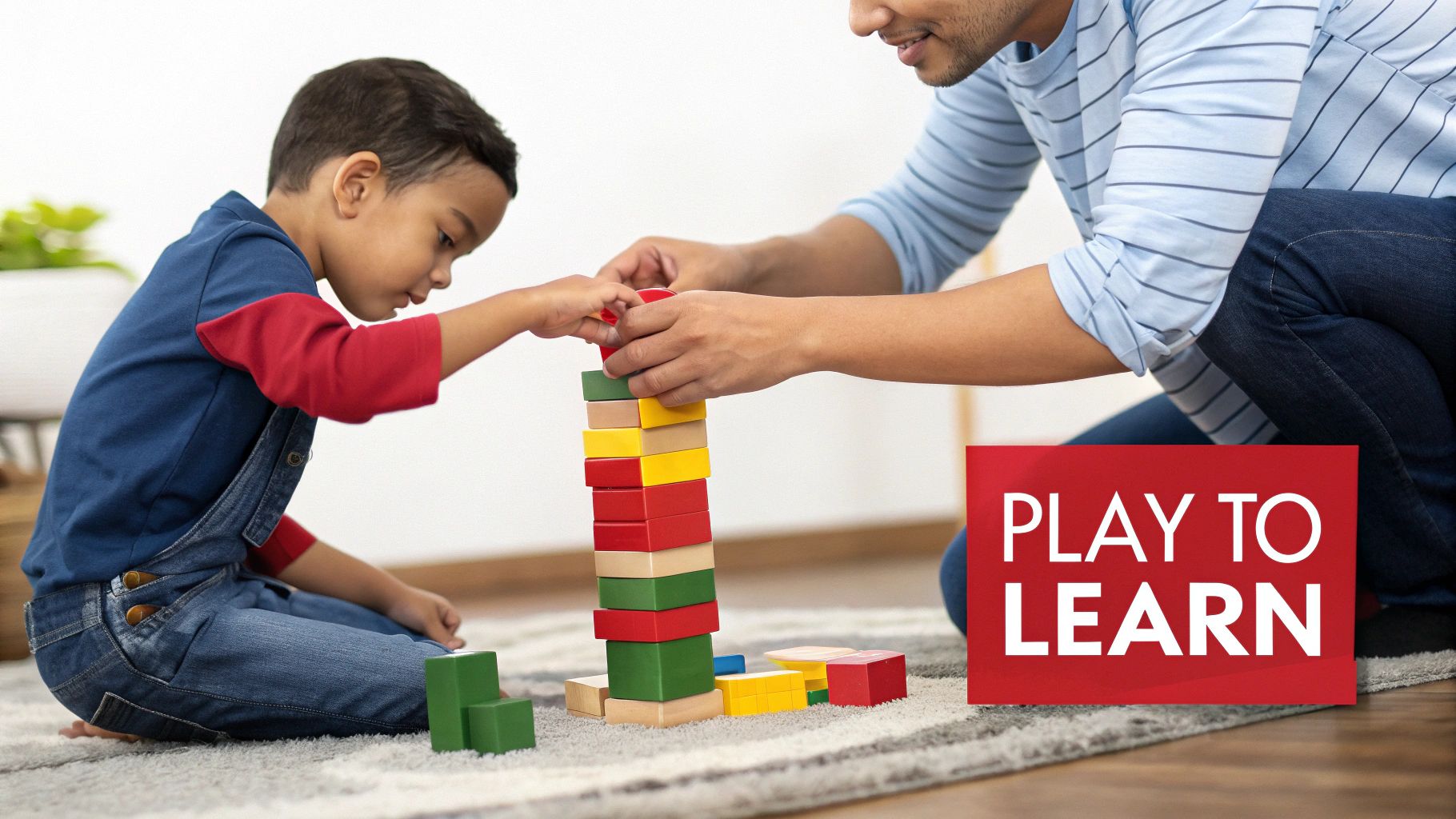
This approach turns you into a co-discoverer, helping your five-year-old see new possibilities without just giving them the answers. When you get curious, they get curious, and every interaction becomes a chance to connect and explore.
Sparking Curiosity with Strategic Questions
The right question at the right time can turn a simple activity into a mini-lesson on physics, storytelling, or scientific reasoning. You're not quizzing them; you're prompting their thinking, encouraging them to tinker, and helping them find the words for their big ideas.
Here are a few actionable conversation starters you can use with different types of educational toys for 5 year olds:
- For STEM & Science Kits: Don't just follow the instructions. Pause and ask, "What do you predict will happen when we mix these?" This simple question introduces the idea of a hypothesis. Afterward, follow up with, "Was your prediction right? Why do you think that happened?"
- For Building Blocks & Construction Toys: Challenge their inner engineer. Try prompts like, "How tall can we build this tower before it wobbles?" or "What kind of bridge could we build to get this car from the chair to the table?" Suddenly, they're thinking about balance, support, and structure.
- For Arts & Crafts Supplies: This is a perfect time to encourage storytelling. Ask, "Tell me about the picture you're drawing. What's happening in this world?" or "If this clay monster could talk, what would it say?"
- For Role-Playing & Imaginative Sets: Go deeper into their make-believe worlds. If they’re playing restaurant, throw in a fun problem: "Oh no, a customer is unhappy with their food! What should the chef do?" This is a fantastic way to build problem-solving skills and empathy.
Guiding Play Without Taking Over
Being an active play partner is a delicate balance. You want to provide support and inspiration without directing the entire show. Think of yourself as a co-pilot, not the pilot.
Your role is to offer just enough support to help your child reach the next level of understanding, without doing the work for them. This supportive learning process is known as scaffolding, where you build a temporary framework that allows them to achieve more than they could alone.
This technique is incredibly powerful. When you see your child getting frustrated—say, their block tower keeps falling—you can offer a gentle nudge. "I notice the bottom part is very narrow. What if we tried making it wider?" You can learn more about this effective technique by exploring what is scaffolding in child development and how to apply it during play.
From Playtime to Problem-Solving
Ultimately, this guided approach does more than just make playtime more fun. It actively teaches your five-year-old the foundations of critical thinking and how to solve problems with others.
By asking "What if?" and "Why?", you're wiring their brain to look for solutions, test out ideas, and learn from what happens next. You’re showing them that challenges are interesting puzzles, not frustrating dead ends. This transforms every toy—from a simple set of blocks to a cool science kit—into a tool for building a curious, resilient, and confident mind.
Answering Your Top Questions About Educational Toys
Even when you know what to look for, picking the perfect toy can feel like a high-stakes decision. It's totally normal to second-guess yourself. Let's tackle some of the most common questions parents ask so you can feel confident you're making a great choice.
How Many Educational Toys Does My 5-Year-Old Really Need?
This is a big one, and the answer is always quality over quantity. Trust us, a handful of versatile, open-ended toys will do more for your child's development than a room overflowing with one-trick ponies that get forgotten after a week.
Think of it like building a solid toolkit. You don't need a hundred different screwdrivers, just a few good ones that can handle any job. Aim for a balanced collection with something from each of the core categories:
- Something for building: This could be a cool science model, a set of magnetic tiles, or even just classic wooden blocks.
- Something for creativity: Art supplies are your best friend here. Think modeling clay, paints, or a well-stocked craft box.
- Something for imagination: A simple play tent, a few costumes, or a bucket of animal figurines can fuel incredible stories.
Actionable Tip: Rotate your toys. Pack a few away for a couple of weeks. When you bring them back out, it’s like they’re brand new again. This simple trick fights off toy fatigue and encourages your child to dive deeper into play. The goal isn't having the most toys, but the right toys that grow with them.
Are Electronic Toys with Batteries Actually Educational?
They absolutely can be, but you have to be a discerning shopper. The best electronic toys prompt your child to think, create, and solve problems—not just sit back and be entertained. The key is finding toys that demand active engagement over passive consumption.
For example, a toy that uses programmable blocks to teach the basics of coding is fantastic. It puts your child in control. On the other hand, a toy that just flashes lights and sings a song when a button is pushed offers almost no real learning value.
When you're looking at an electronic toy, ask yourself this simple question: Does this toy empower my child to be a creator, or does it just turn them into a consumer?
It's also essential to balance screen time with plenty of hands-on, unplugged play. Nothing can replace the developmental magic of building with blocks, squishing play-doh, or drawing a picture when it comes to fine motor skills and spatial awareness.
My 5-Year-Old Gets Bored with New Toys Almost Instantly. What Can I Do?
We hear this from parents all the time, and it almost always comes down to one thing: "closed-ended" toys. These are the toys designed to be used in only one specific way. Once that one thing is done, the fun is over.
The fix? Prioritize open-ended toys that are more like a blank canvas for their imagination.
A set of magnetic tiles can be a castle one day and a rocket ship the next. A play tent can go from being a secret jungle fort to a bustling vet's office. When the possibilities are limitless, the toy stays interesting for much, much longer.
The other secret ingredient is you. As we talked about earlier, getting on the floor and joining in can completely change the game. Ask curious questions, introduce a new challenge, and model different ways to play. You can turn a "boring" toy into an amazing adventure just by getting involved. This is also a fantastic way to teach resilience; you can find more great ideas by exploring ways to develop problem-solving skills with your child.
How Do I Balance Educational Toys with Just Letting My Child Have Fun?
This question gets right to the heart of it all! The good news is, you don't have to choose. The best educational toys for 5 year olds are the ones where the learning is baked right into the fun.
At this age, play is learning. The goal isn't to turn your home into a classroom. It's to provide awesome tools that feed their natural curiosity.
A science kit is a blast because of the fizzing, bubbling reactions—not because you call it a "chemistry lesson." A cooperative board game is exciting because everyone is working together to win, not just because it teaches sharing.
When your child is lost in joyful, meaningful play, they are learning. The fun and the education aren't two separate things; they're one and the same. Trust their instincts, give them great tools to explore with, and the learning will take care of itself.
Ready to spark your child's love for learning? Explore the exciting world of Playz and discover our range of science kits, play tents, and creative toys designed to make every playtime an adventure. Find the perfect educational toy for your five-year-old at https://www.playzusa.com and watch their curiosity come to life.