


The best science kits for 6 year olds are so much more than just another toy. They're a secret weapon for unlocking a child's natural curiosity and building some seriously important learning skills. These kits offer a fun, hands-on escape from screens, turning fuzzy science concepts into real, tangible experiences that can spark a genuine love for discovery.
Why Science Kits Are a Game-Changer for Young Learners
At six years old, a child's brain is a little question factory. They’re constantly observing, wondering, and trying to piece together how their world works. A good science kit is like a key that helps them explore those questions in a fun, structured way, turning the living room floor into their very own discovery lab.
Think about it: instead of just watching a video about volcanoes, they get to mix the ingredients and see the fizzy eruption for themselves. That kind of direct interaction is pure gold for their growing minds. The simple act of following steps, measuring ingredients, and watching what happens builds critical thinking and problem-solving skills from the ground up.
Building Real STEM Skills Through Play
Hands-on experiments are fantastic because they make abstract ideas concrete. When a 6-year-old builds a simple circuit or grows a crystal, they aren't just messing around—they're getting a feel for the fundamentals of science, technology, engineering, and math (STEM).
Getting kids started this early is a huge advantage. Getting messy with science kits for 6 year olds helps them develop:
- Problem-Solving: They learn to think on their feet and figure out what went wrong when an experiment doesn't go exactly as planned.
- Patience and Focus: Watching a plant slowly sprout or a crystal form teaches them to observe things over time.
- Fine Motor Skills: Using tools like droppers, tweezers, and little scoops is great practice for refining their dexterity.
Key Takeaway: A great science kit makes learning feel like play. It meets a child right where they are, tapping into their natural curiosity to introduce core scientific principles and build their confidence one successful experiment at a time.
This isn't just a hunch; it's a huge movement in the world of educational play. The STEM toys market was valued at a massive USD 54 billion in 2023 and is expected to more than double by 2030, with science-based toys showing the fastest growth. This data, reported by SkyQuestt.com, highlights a major shift toward educational play.
Ultimately, these kits do more than just teach science—they nurture a can-do attitude. They show kids that it’s not only okay to ask "why," but that they have the power to find the answer themselves. This lays the groundwork for a future of confident, curious learning. By embracing this kind of active engagement, you're tapping into the powerful benefits of hands-on learning that go far beyond the experiment itself.
How to Choose The Right Science Kit For Your Child
Walking down the toy aisle and seeing all the science kits for 6 year olds can feel a bit like an experiment itself. There are bubbling volcanoes, sparkling crystal gardens, and everything in between. So, how do you pick the one that will actually grab your kid's attention and not end up collecting dust?
The secret isn't in the flashy box art. It’s all about finding a kit that’s truly accessible for a six-year-old. Think of it this way: you wouldn't hand them a complex model car kit and expect them to succeed. They need something more like LEGO blocks—chunky tools that are easy for small hands to grip and instructions that are almost all pictures. This small detail is a huge confidence booster and lets them take the lead.
Actionable Tip: Match The Kit To Your Child’s Interests
The absolute best way to make sure a kit is a hit is to tap into what your child is already obsessed with. If they can't stop talking about dinosaurs, a fossil digging kit is a no-brainer. Got a little potion-maker who loves mixing things in the kitchen? A simple, non-toxic chemistry set will feel like pure magic to them.
When the theme connects to something they already love, the learning just feels like a natural part of their playtime. It’s not a lesson; it’s an adventure.
Key Takeaway: The goal is to find a kit that sparks a "Wow!" moment. When the science directly connects to something a child is passionate about—be it space, nature, or geology—the experience becomes more memorable and impactful.
You can also find broader educational home resources to create a rich learning environment that goes beyond just one kit. When it’s time to choose, a simple guide like this can help you cut through the noise.
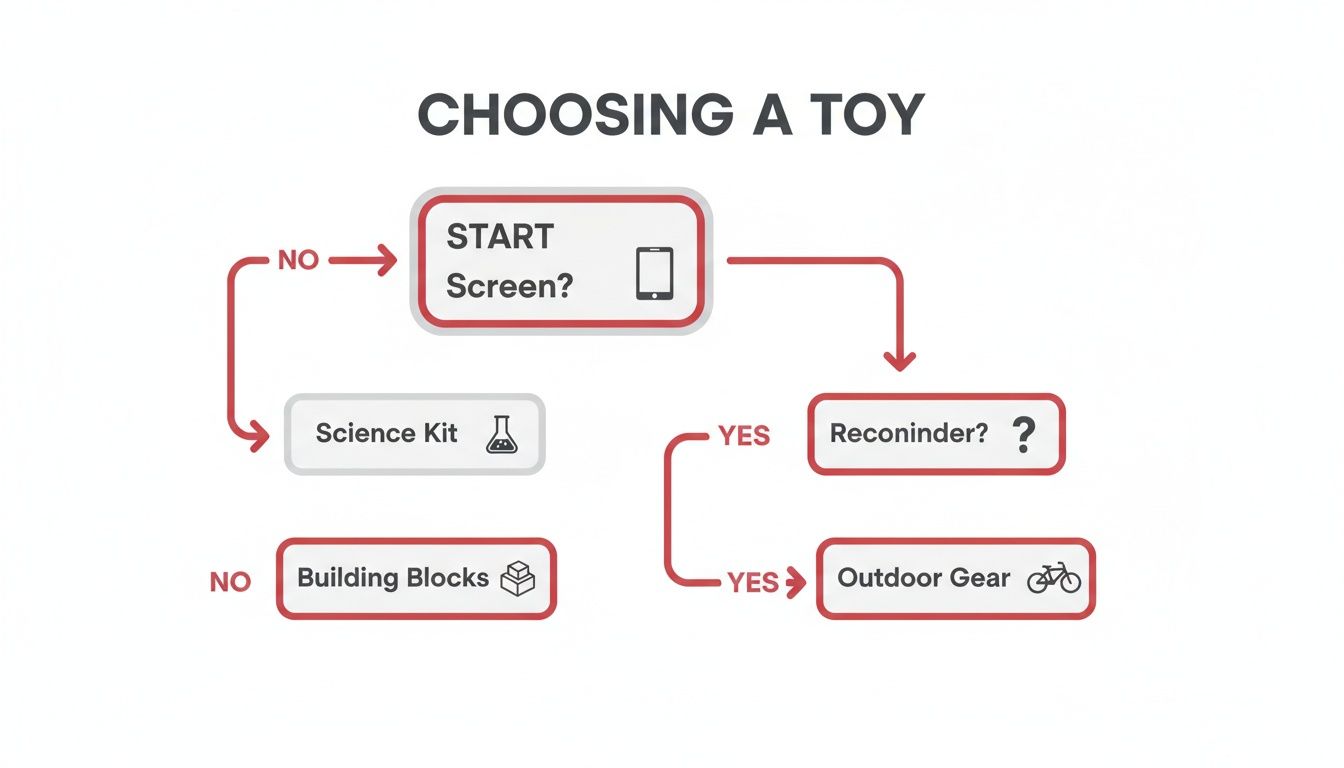
This flowchart is a great reminder of how to steer away from more screens and toward hands-on, engaging options. A little bit of thought before buying can lead to much more enriching playtime.
Key Features and Developmental Benefits of Top Science Kits
Knowing what to look for on the box can make your decision so much easier. The best science kits are designed with a purpose—they’re not just fun, they’re secretly building critical skills that are perfect for a developing six-year-old. A great kit is both a toy and a powerful teaching tool, hitting all the right notes for kindergarten-level learning. You can dive deeper into this topic in our guide on educational toys for kindergarten.
This table breaks down the features you should look for and explains why each one is so important for your child’s growth.
| Key Feature | What to Look For | Developmental Benefit |
|---|---|---|
| Visual Instructions | Step-by-step guides with big, clear pictures and very little text. | Builds confidence and the ability to follow a sequence on their own. |
| Durable Components | Chunky, oversized tools like beakers, droppers, and funnels made from sturdy plastic. | Improves fine motor skills and hand-eye coordination. |
| Safety Standards | Clearly labeled as non-toxic and compliant with safety regulations (like ASTM F963). | Ensures a safe, worry-free environment for them to explore. |
| Focused Theme | Kits that stick to one engaging topic, like chemistry, geology, or botany. | Fosters a deeper interest and understanding of one area of science at a time. |
By keeping these features in mind, you can find a kit that’s not just a one-and-done activity but a genuine tool for learning and fun.
Bringing Science to Life with Fun, Hands-On Experiments
This is where the real magic happens. The best science kits for 6 year olds don't just teach concepts; they turn your kitchen table into a buzzing laboratory of discovery. Instead of just reading about a chemical reaction, your child gets to see it, touch it, and cause it.
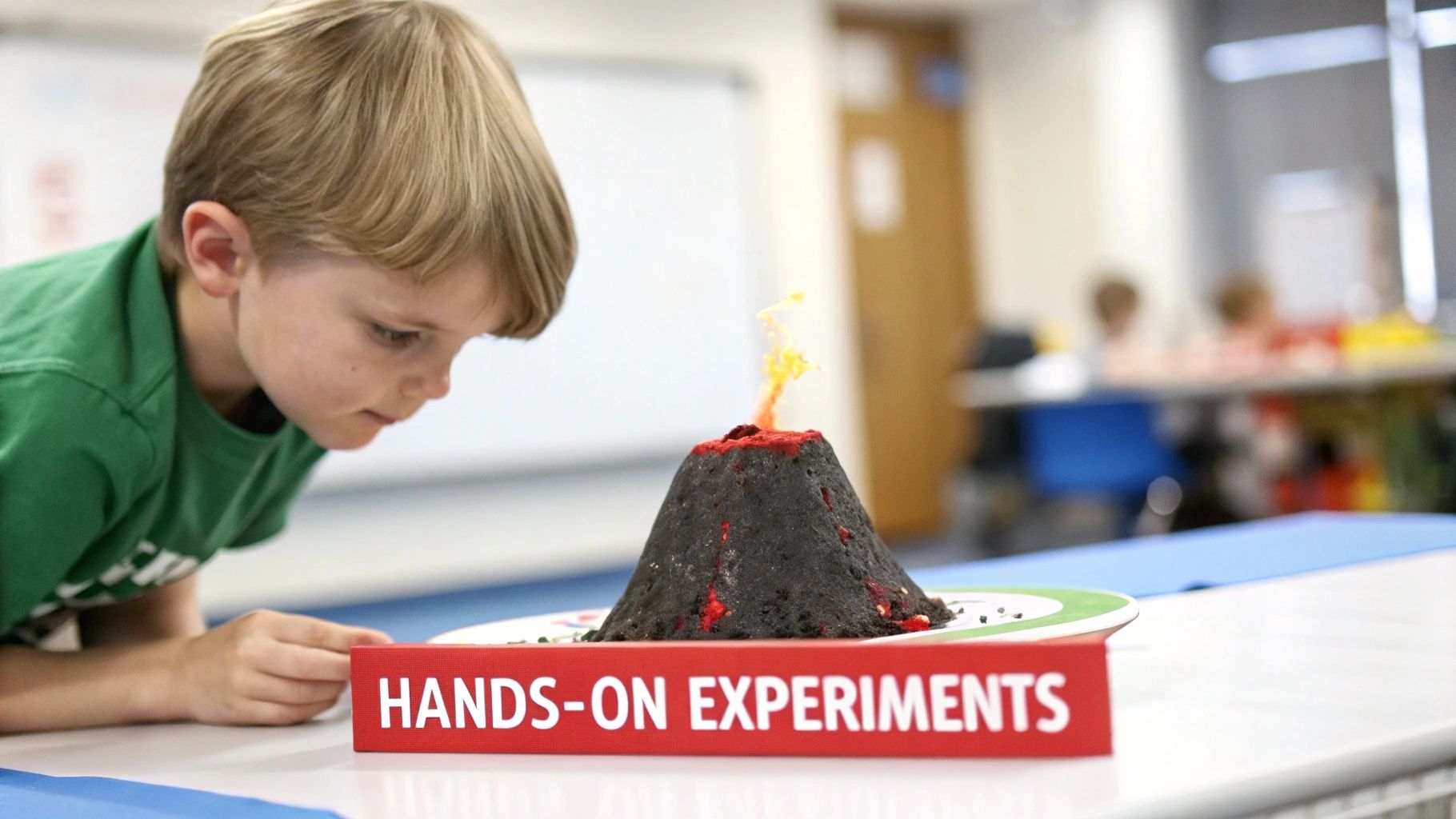
Let's dive into a few classic experiments that make these kits so captivating. Each one is a mini-adventure, connecting hands-on fun to a core scientific principle.
Real-World Example: The Classic Volcano Eruption
It's the most iconic experiment for a reason. The volcano eruption is the perfect, explosive introduction to chemistry. Kids mix baking soda (a base) with something like citric acid or vinegar (an acid), and suddenly—fizzing, bubbling chaos!
But this isn't just about making a fun mess. It’s a physical demonstration of a chemical reaction in action. The two ingredients release carbon dioxide gas, which bubbles up and creates that awesome "lava" flow. For a six-year-old, this makes the abstract idea of a "reaction" totally real and unforgettable.
Key Takeaway: That "wow" moment from a fizzing volcano isn't just entertainment. It's a foundational lesson in cause and effect, proving that combining specific ingredients can create something entirely new and exciting.
Real-World Example: The Magic of Growing Crystals
Another kid-favorite is the crystal-growing experiment, which is a brilliant lesson in both geology and patience. Children get to mix up a supersaturated solution, usually with a special powder, and then watch as intricate, colorful crystals slowly form over several days.
This slow, mesmerizing process introduces them to molecular structures and states of matter. They learn firsthand that liquids can transform into beautiful, solid geometric shapes all on their own.
- What it teaches: This activity builds patience and sharpens observation skills as kids eagerly check the progress each day.
- The takeaway: It shows how molecules can organize themselves into ordered, repeating patterns—the very essence of crystal formation.
Real-World Example: Creating Colorful Slime
Making slime is way more than just a gooey good time; it's a fantastic, hands-on exploration of polymers. Kits provide specific ingredients like polyvinyl alcohol (PVA) and a borate solution, which acts as a "cross-linker." When you mix them, they form long, flexible chains, creating that uniquely stretchy, weirdly wonderful texture of slime.
This experiment helps kids understand how different substances can combine to create a material with totally new properties. They can literally feel the science happening in their hands as the mixture transforms from a liquid into a non-Newtonian fluid. For more ideas like this, you can find tons of easy science experiments for kids at home that build on these same principles.
Each of these experiments does something crucial: it takes a big scientific idea and shrinks it down to a fun, manageable activity. It builds a child’s confidence and shows them that science isn't just something you read about in a book—it's something you do.
How to Guide Your Child's Scientific Discovery
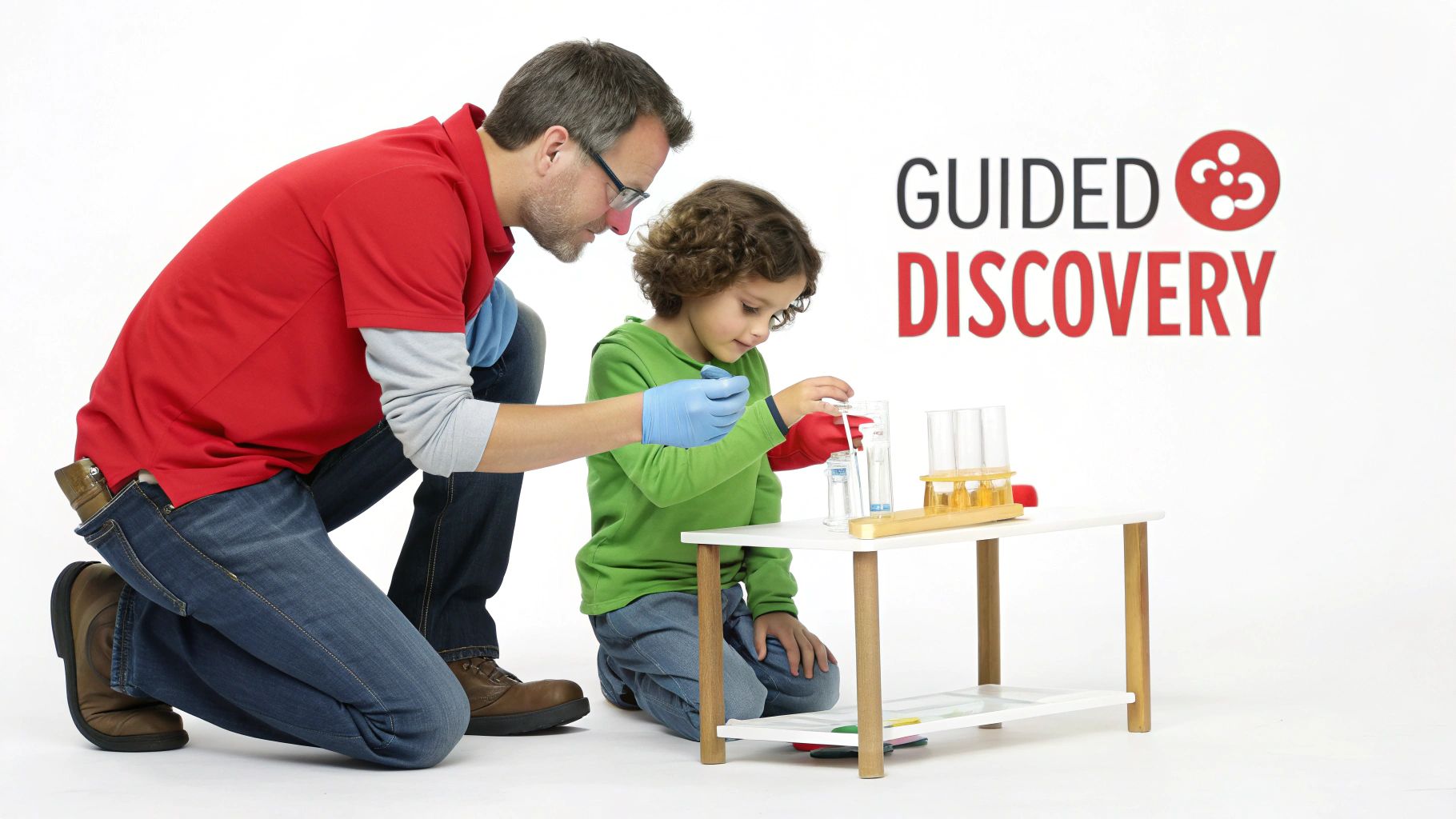
The best kind of learning happens when a kid feels like they’re in the driver’s seat. When you open up a science kit for a 6-year-old, your job isn't to be the lead scientist giving a lecture. Think of yourself as the enthusiastic lab assistant, the one who passes the tools and cheers them on.
This simple shift in perspective makes all the difference. It turns a fun afternoon into a powerful lesson in self-reliance and critical thinking.
Your goal is to guide, not dictate. When you let your child take charge, you give them the freedom to make predictions, test their own theories, and even mess up—and those mistakes are often the best teachers. The real "aha!" moments happen when they feel a sense of ownership over what they’re doing.
Actionable Tip: Become Their Lab Assistant
See yourself as their trusted partner in discovery. Your main job is to create a safe, positive space where their curiosity can run wild. Instead of just handing out answers, you can get their gears turning with a few simple, open-ended questions.
Here are a few phrases to keep in your back pocket:
- "What do you think will happen if we add this next?"
- "Oh, that's an interesting idea! Why do you think that?"
- "Whoa, that didn't go as we expected! What should we try differently?"
- "Tell me what you're seeing. What’s happening in there?"
This approach is the heart of what is discovery-based learning. It helps kids build knowledge from their own exploration instead of just memorizing a bunch of facts someone told them.
Key Takeaway: The most powerful question you can ask is "Why?" It nudges a six-year-old to go beyond just looking and start connecting cause and effect—the real foundation of scientific thinking.
The 6-8 year old segment is a powerhouse in the STEM toy industry, with the global market expected to grow from USD 6 billion in 2024 to USD 13.8 billion by 2034. This trend is backed by data showing that 80% of educators who use these kinds of kits report seeing much higher student engagement.
Celebrate the Process Over the Result
Let's be real: sometimes an experiment just fizzles instead of fizzing. That's not a failure; it’s a perfect teaching moment. Celebrate the effort, have a laugh about the mistake, or marvel at the weird, unexpected outcome.
When you react with curiosity instead of disappointment, you’re teaching your kid that science is a journey, not just a destination. A positive "lab" environment is one where trial and error are just part of the fun. This builds the confidence they need to eventually lead their own learning adventures.
You can even broaden their scientific horizons with other hands-on activities, like a junior outdoor survival experience, which connects these same principles of observation and problem-solving to the world around them.
Why a Science Kit Is the Perfect Gift
Picking a gift for a six-year-old can feel like trying to hit a moving target. You want that big, excited smile when they tear off the wrapping paper, but you also hope it's something that won’t be collecting dust by next Tuesday. That's exactly why a science kit for 6 year olds is such a standout gift.
It’s more than just another toy—it’s an experience in a box. It’s an open invitation to get a little messy, ask a million questions, and actually discover something new. Instead of just passively watching a screen, they’re getting hours of hands-on, active fun that both kids and parents can get behind.
More Than a Toy, It’s an Investment in Learning
Think of a good science kit not just as a one-and-done item, but as an investment in your child’s learning toolkit. The real value kicks in long after the initial "wow" moment. Every experiment is a mini-lesson in following directions, solving problems when things go sideways, and having a bit of patience—all skills they’ll take straight into the classroom.
This is the gift that keeps on giving. Most kits have enough activities to keep a kid busy for weeks, making them a much better value than a toy with limited replayability. Plus, you can't put a price on the memories made watching a bubbling volcano erupt on the kitchen counter.
Key Takeaway: A science kit is one of those rare gifts that truly combines pure fun with real educational value. It taps into a child’s natural curiosity and quietly builds the confidence they need to become resilient, curious learners.
This idea is catching on in a big way. The global market for STEM toy kits is projected to climb from USD 2.35 billion in 2024 to USD 4.53 billion by 2033. This boom is fueled by parents and teachers who see the incredible power of learning through play—a philosophy that connects with the over 5 million families using Playz kits to spark that curiosity.
The Gift of Doing Things Together
In a world packed with digital distractions, a science kit creates a special opportunity to connect. It gets parents, grandparents, or siblings to gather around the table and figure things out together. These collaborative moments are where some of the best learning—and bonding—really happens.
When you guide a child through an experiment, you’re not just teaching them about acids and bases. You’re showing them that learning is an adventure you can share. You’re giving them the tools to explore their world and helping them see themselves as thinkers and creators. Whether you’re grabbing a one-time gift or looking into monthly science kits for kids, you’re choosing a present with a lasting impact.
Frequently Asked Questions (FAQs) About Science Kits
Jumping into the world of science kits is exciting, but it’s totally normal to have a few questions. To help you feel confident you're picking a winner, we’ve put together some straightforward answers to the things parents and gift-givers ask us most.
Are the materials in these kits safe for 6-year-olds?
Yes, absolutely. Any reputable science kit designed for this age group uses non-toxic, common household ingredients. Think things like baking soda, citric acid, and food-grade coloring—stuff you probably already have in your kitchen.
All components go through serious testing to meet strict safety standards, like ASTM F963, so you can be sure they’re safe for little hands (with a grown-up nearby, of course). Always look for safety certifications on the box and follow the included instructions. It keeps the "lab" fun and completely worry-free.
Can a 6-year-old do the experiments on their own?
These kits are really designed to be a team effort, but one where your child gets to be the star scientist. A 6-year-old can definitely handle simple steps on their own, like mixing ingredients or pouring liquids, especially with picture-based guides.
However, they’ll still need their trusted lab assistant (that’s you!) to read the instructions, ensure safety, and help with any tricky steps. This partnership is the magic formula: it builds their confidence and lets them lead, but keeps frustration out of the picture.
Key Takeaway: The sweet spot is letting them feel like they're in charge of the experiment, while knowing you’re right there to help decipher instructions and cheer on their discoveries. It’s the perfect mix of independence and teamwork.
How do science kits help with school readiness?
Think of a science kit as a fun-sized head start for the classroom. They introduce core scientific ideas—like cause and effect, making observations, and simple chemistry—in a way that’s playful and totally low-pressure. This hands-on experience makes these big concepts click long before they see them in a textbook.
But it’s not just about the science. These kits build critical skills they’ll use in every subject:
- Following Multi-Step Directions: Every experiment is practice for listening and completing tasks in the right order.
- Practicing Fine Motor Skills: Using tools like droppers, scoops, and test tubes refines the hand-eye coordination they need for writing.
- Developing Problem-Solving Muscles: When a volcano doesn't erupt perfectly, it’s not a failure! It’s a chance to think about what went wrong and try again.
Kids who play with science at home walk into the classroom feeling more curious, confident, and ready to learn.
What if my kid gets bored with it after one use?
That’s a valid concern with any new toy. The trick is to treat the kit less like a one-time-use toy and more like an activity station. The best kits are packed with a wide variety of experiments, so there’s always something new to try.
Don't try to do everything at once! Knock out one or two experiments in a single session. This keeps the novelty alive and makes the kit last way longer. The element of surprise is a powerful motivator for little kids, and by spacing out the fun, you create an experience they’ll be excited to come back to.
Ready to give the gift of discovery and watch your little scientist’s eyes light up? Playz creates award-winning science kits designed to make learning an unforgettable adventure. Explore our collection and find the perfect kit to spark a lifelong love of science.
Discover the fun at https://www.playzusa.com.