

Welcome to the ultimate guide to unlocking endless creativity with one of the most versatile and accessible craft supplies: the humble popsicle stick. Hands-on activities are essential for fostering imagination, developing fine motor skills, and encouraging problem-solving. This guide is packed with engaging and educational projects with popsicle sticks, designed to inspire builders, artists, and engineers of all ages.
From simple picture frames for preschoolers to complex catapults for young engineers, each project offers a unique opportunity for learning through play. We provide everything you need to get started: clear age and difficulty ratings, complete materials lists, and concise step-by-step summaries for each idea. Our goal is to help you transform a simple bundle of sticks into a masterpiece of creativity and fun. This collection focuses specifically on popsicle stick crafts, but for a wider range of activities that boost creativity and learning, you can explore other hands-on project ideas for kids that build real-world skills.
Get ready to build, create, and make lasting memories. These projects are the perfect way to bring hands-on learning to life, proving that some of the best tools for innovation can be found right in your craft drawer.
1. DIY Popsicle Stick Birdhouses
A timeless classic among projects with popsicle sticks, the DIY birdhouse is a fantastic way to blend creativity with a hands-on science lesson. This project involves constructing a small, functional shelter for birds using basic craft supplies, turning a simple activity into a lesson on engineering, animal habitats, and environmental stewardship. Kids not only build a charming decoration but also create a safe haven for local wildlife.
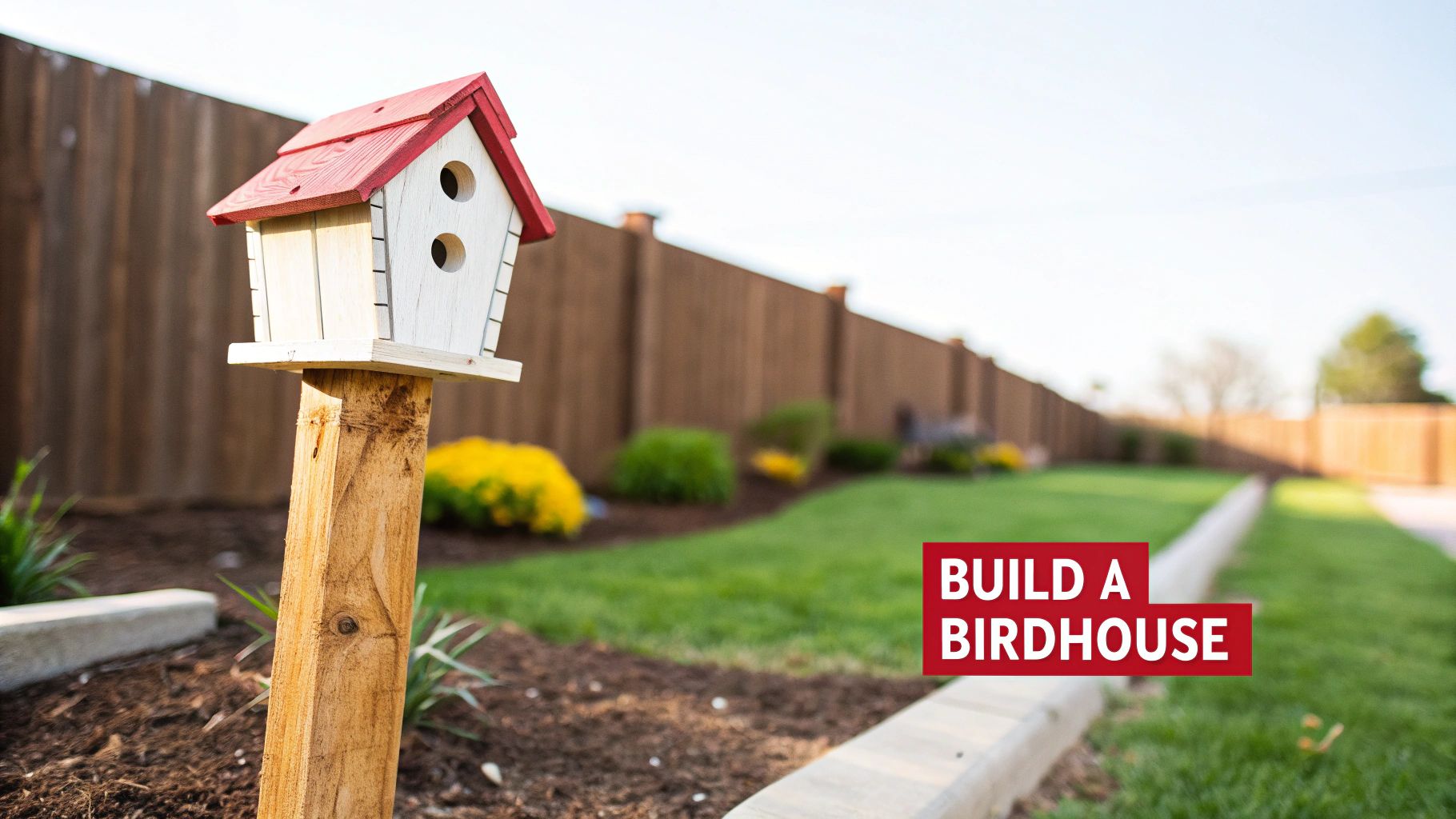
The construction process teaches fundamental building principles, like creating stable walls by layering sticks in alternating patterns and designing a sloped roof for rain runoff. This project is ideal for spring science units in classrooms or as a weekend activity that gets children thinking about their local ecosystem. Real-world example: Community gardens have even used these handmade birdhouses to attract beneficial birds that help with pest control.
Actionable Insights for a Better Birdhouse
- Safety First: An adult should pre-drill a small entrance hole before assembly to avoid splitting the wood and ensure a clean, safe opening for birds.
- Outdoor Durability: Use non-toxic, water-resistant paint or sealant to protect the birdhouse from rain and sun, ensuring it lasts longer outdoors.
- Promote Teamwork: Group children in pairs. This encourages collaboration, problem-solving, and peer learning as they work together to construct their birdhouse.
- Add Drainage: A few small holes drilled in the base will allow any rainwater that gets inside to drain out, keeping the nest dry and safe.
2. Personalized Popsicle Stick Picture Frames
A wonderfully straightforward yet highly personal project, the DIY popsicle stick picture frame is a perfect craft for all ages. This activity involves designing and assembling decorative frames using popsicle sticks, which can be arranged in countless patterns to hold photos, artwork, or even small mirrors. It’s an ideal project for teaching basic design principles, fine motor skills, and creative expression through personalization with paints and embellishments.
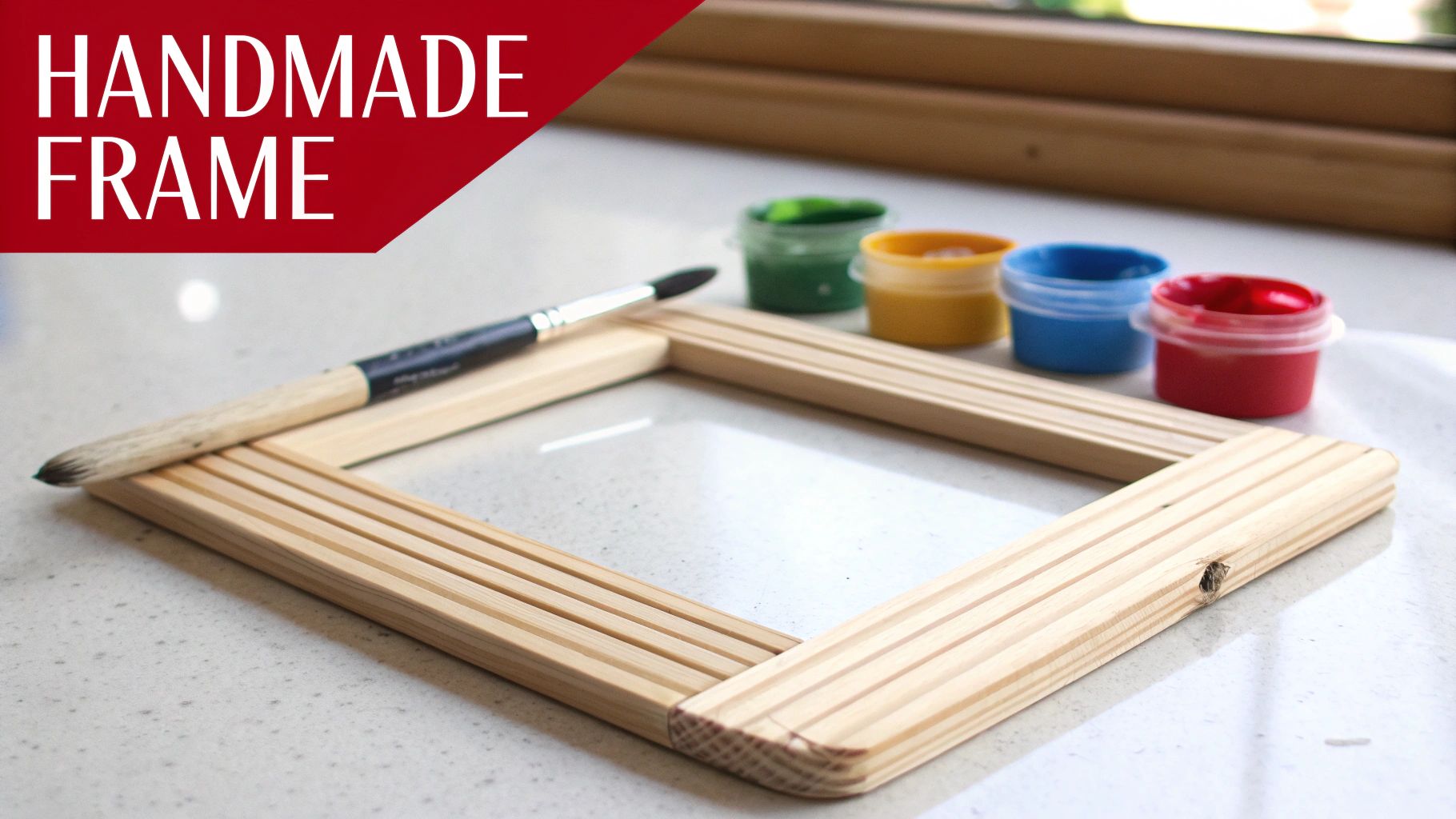
This project’s simplicity and versatility make it a staple in many settings. Real-world example: Classrooms often use it for heartfelt Mother's Day and Father's Day gifts, while summer camps and daycare centers use it to boost creative confidence. The process of layering sticks, ensuring square corners, and planning decorations introduces foundational concepts of geometry and construction in an accessible, hands-on way. These frames are more than just crafts; they become treasured keepsakes.
Actionable Insights for a Perfect Frame
- Achieve Perfect Angles: Use a square or corner clamp while the glue sets to ensure your frame has perfect 90-degree angles for a professional look.
- Decorate First: Apply paint, glitter, and other decorations to the individual sticks before final assembly. This helps prevent messy glue smudges and paint drips.
- Create Template Guides: For younger children, draw a frame outline on a piece of paper. They can use this guide to help with spacing and alignment as they build.
- Introduce Color Theory: Encourage older kids to explore complementary or analogous color schemes with their paint choices, turning a simple craft into a mini art lesson.
3. Engineering a Popsicle Stick Catapult
A fantastic entry point into STEM, the popsicle stick catapult is a dynamic project that teaches fundamental physics concepts through exciting, hands-on play. This activity involves engineering a small, working launcher using popsicle sticks, rubber bands, and a bottle cap or plastic spoon. It’s an engaging way to introduce principles like leverage, tension, and trajectory, turning a simple craft into a memorable science experiment.
Building a catapult demonstrates how stored energy (in the stretched rubber bands) can be converted into kinetic energy to launch a projectile. Real-world example: This project is a staple in school science fairs and STEM camps because it perfectly balances construction with experimentation. Kids can build their launcher and then immediately test its performance, leading to endless modifications and competitive fun. Explore more engaging physics projects on playzusa.com to expand on these concepts.
Actionable Insights for a Better Catapult
- Prioritize Safety: Use soft projectiles like cotton balls, pom-poms, or small marshmallows to prevent injuries. Establish clear rules about not aiming at people or pets before starting.
- Encourage Experimentation: Challenge kids to modify their designs to launch projectiles farther or more accurately. Variables like rubber band tension, arm length, and launch angle can be adjusted.
- Incorporate Data Analysis: Turn playtime into a scientific investigation by having children measure launch distances, record data in a chart, and calculate averages to analyze their catapult’s performance.
- Host a Competition: Organize friendly competitions for distance or accuracy. This adds an element of excitement and motivates children to refine their engineering skills to build the best possible launcher.
4. Building Popsicle Stick Structures & Geometric Domes
Moving beyond simple crafts, this project introduces children to the fundamentals of architecture and engineering by building complex 3D structures. From towering skyscrapers to sturdy bridges and intricate geometric shapes, these popsicle stick projects are a hands-on way to explore concepts of design, stability, and spatial reasoning. This activity transforms basic craft sticks into a powerful learning tool for STEM education.
The construction process teaches critical engineering principles, such as how triangular supports create strength and how weight distribution affects a bridge's integrity. Real-world example: It's a perfect fit for classroom STEM challenges, science museum workshops, or homeschooling lessons focused on geometry and physics. By tackling these projects with popsicle sticks, learners can visualize and test architectural theories in a tangible, engaging way. Learn more about engineering activities for kids to expand on these concepts.
Actionable Insights for Better Structures
- Plan First: Encourage builders to sketch their designs on paper first. Planning helps visualize the final structure and troubleshoot potential weak points before construction begins.
- Start Simple: Begin by creating flat, 2D shapes like squares and triangles. Once mastered, these can be joined together to form more complex 3D structures like cubes and pyramids.
- Test for Strength: Challenge builders to test the stability of their creations. Carefully add small weights (like coins or washers) to a bridge to see how much it can hold, demonstrating structural integrity.
- Introduce Blueprints: For younger children or beginners, provide simple blueprint templates to guide their construction, helping them understand how plans translate into physical objects.
5. Crafting Popsicle Stick Woven Baskets
This textile-inspired craft introduces traditional weaving techniques using an unconventional medium, making it one of the more unique projects with popsicle sticks. Children can create woven baskets, placemats, or wall hangings by interlacing yarn, string, or fabric strips through a frame of popsicle sticks. This project enhances fine motor control, teaches pattern recognition, and combines structural engineering with fiber arts.
The process involves creating a "loom" by arranging sticks in a grid or starburst pattern and then weaving material over and under the sticks. Real-world example: Special education programs often use this activity to develop fine motor skills and concentration, as the repetitive motion can be both calming and skill-building. It's also a fantastic quiet-time activity for summer camps or a hands-on lesson for art classes exploring cultural crafts.
Actionable Insights for Better Weaving
- Create a Simple Loom: Start by hot gluing popsicle sticks into a stable frame, like a square or asterisk shape, to hold the vertical "warp" sticks steady.
- Visualize Patterns: Use sticks of alternating colors for the frame to make the over-and-under weaving pattern easier for beginners to follow.
- Prevent Shifting: For younger children, tape the ends of the frame sticks to the work surface to prevent the loom from moving around during weaving.
- Promote Durability: If the finished item, like a basket, is intended for functional use, apply a coat of clear varnish or sealant to strengthen the structure.
6. Creating Popsicle Stick Puppets and Theaters
Transforming simple craft sticks into lively characters, popsicle stick puppets offer an incredible gateway to storytelling, drama, and imaginative play. This project combines art with performance, allowing children to design their own cast of characters and then bring them to life in a homemade theater. It's a dynamic activity that nurtures creativity, public speaking skills, and narrative development all at once.
The process of creating the puppets and then performing with them is a fantastic way to build confidence and communication skills. Real-world example: In classrooms, teachers use this project to reenact historical events or scenes from literature, making lessons more interactive. Libraries often incorporate puppet-making into storytelling sessions, helping young children engage more deeply with the tales. This simple project is a powerful tool for self-expression and is one of the most versatile projects with popsicle sticks. To explore the educational value of this activity further, you can read more about the benefits of pretend play.
Actionable Insights for a Better Puppet Show
- Use Templates: Provide pre-made templates for puppet heads or bodies. This gives kids a starting point and makes character creation less intimidating for beginners.
- Varied Materials: Offer a mix of fabric scraps, felt, yarn, and markers. This allows for rich character development as children can add unique hair, clothes, and accessories.
- Build a Simple Stage: A large cardboard box can be easily converted into a puppet theater. Cut out a window for the stage and let the kids decorate the exterior.
- Develop Character Voices: Encourage children to think about what their puppet would sound like. Practicing different voices and personalities helps them fully step into their roles.
7. Constructing Popsicle Stick Marble Runs
A dynamic fusion of engineering and play, the popsicle stick marble run is an exceptional project for exploring physics concepts. This activity challenges creators to design and build intricate tracks, ramps, and obstacles for marbles, providing a hands-on demonstration of gravity, momentum, and potential energy. It’s a project that encourages creative problem-solving, as builders continuously test and modify their designs to achieve the perfect run.
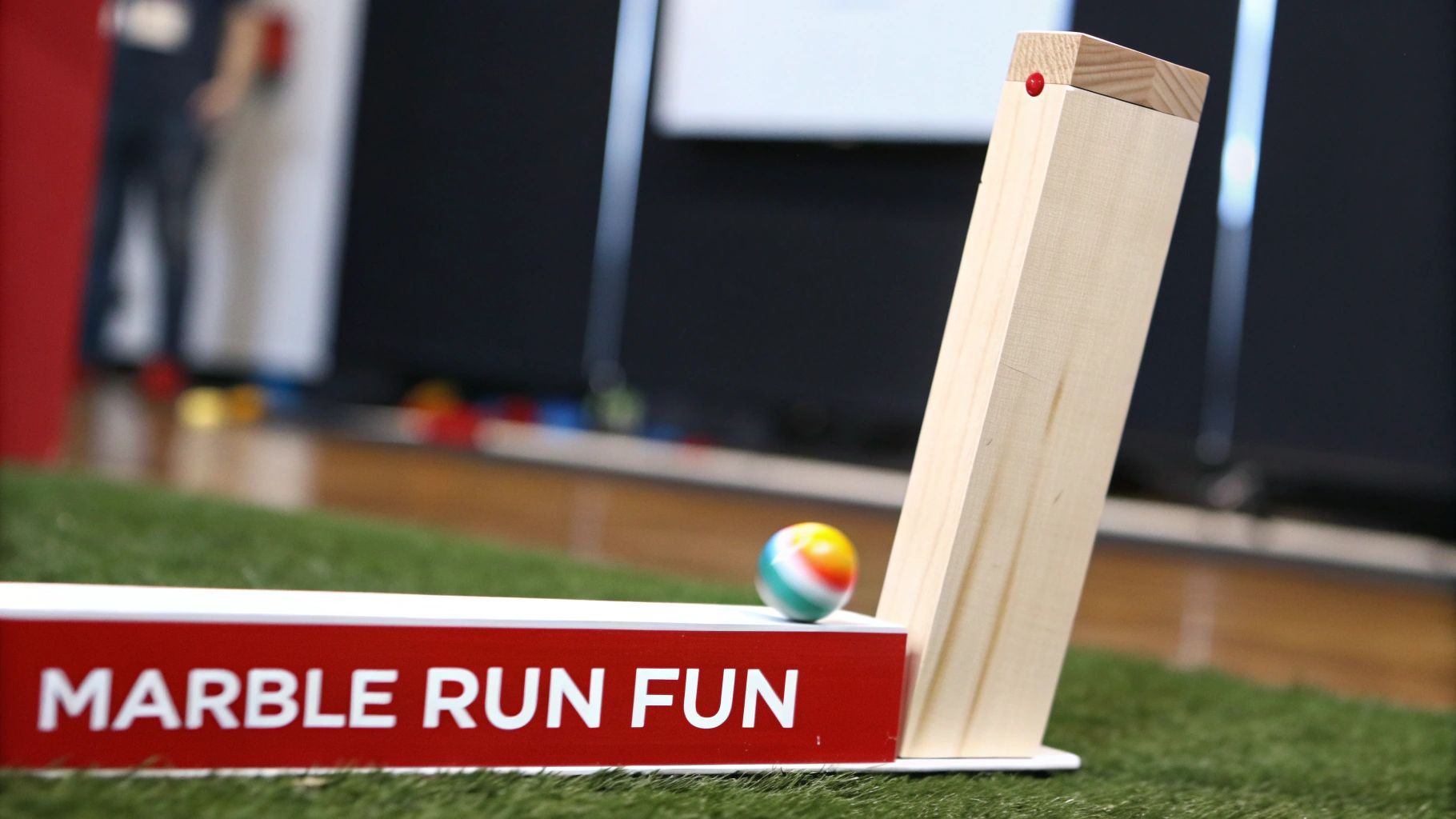
This STEM-focused craft is a staple in science museum exhibits and school workshops because it makes complex physics tangible and fun. By adjusting ramp angles, heights, and curves, children learn firsthand how these changes affect a marble's speed and trajectory. Marble runs are fantastic projects with popsicle sticks for turning a home or classroom into an exciting physics lab where experimentation and learning go hand in hand.
Actionable Insights for a Better Marble Run
- Start Simple: Begin by constructing a single, straight ramp to understand the basic mechanics before attempting more complex systems with turns and drops.
- Introduce Data Collection: Use a stopwatch to time the marble's journey. Measure ramp lengths and angles to introduce basic data analysis and scientific method principles.
- Encourage Competition: Create friendly challenges, like who can build the fastest track or the one that takes the longest for the marble to complete.
- Analyze and Improve: Use a phone's slow-motion video feature to watch the marble move through tricky sections. This helps identify problems and inspires design improvements.
8. Making Popsicle Stick Seasonal Wreaths
A wonderfully versatile entry among projects with popsicle sticks, the decorative wreath is a festive craft that can be adapted for any holiday or season. This project involves arranging popsicle sticks into circular or other festive shapes, offering a blank canvas for creative expression. It’s an engaging way to teach children about patterns, symmetry, and seasonal traditions, resulting in charming home décor.
The process of creating these wreaths can be as simple or complex as desired, making it suitable for a wide range of ages. Younger children can glue sticks onto a paper plate base, while older kids can create intricate, layered designs. Real-world example: This craft is a popular choice for classroom holiday parties, community craft fairs, and family activity nights, allowing participants to create personalized keepsakes that celebrate the changing seasons. The fundamental concepts of art and craft for preschoolers are beautifully showcased in such simple, yet effective activities.
Actionable Insights for Better Wreaths
- Use a Template: For a perfectly round wreath, have kids arrange their sticks around a circular object like a paper plate or a bowl to guide their design.
- Create Radiating Effects: An adult can pre-cut some popsicle sticks at an angle. When glued together, these angled ends create a more professional-looking, radiating wreath effect.
- Offer Diverse Embellishments: Provide a wide array of decorative materials like ribbons, beads, glitter, paint, and artificial flowers to allow for maximum creativity.
- Connect to Culture: Use this craft as a gateway to discuss different holidays and cultural traditions associated with wreaths and seasonal decorations.
9. Designing Popsicle Stick Mosaic Art
A brilliant fusion of fine art and hands-on crafting, popsicle stick mosaic art allows creators to build vibrant, textured masterpieces. This project involves painting individual sticks and arranging them into intricate patterns or pictures on a backing surface, turning a simple craft supply into a medium for artistic expression. It's an excellent activity for teaching color theory, pattern recognition, and composition.
This project with popsicle sticks is incredibly versatile, making it perfect for various educational settings. In an art class, it can serve as a practical lesson on complementary and analogous color schemes. Real-world example: In therapeutic environments, it offers a calming, structured activity for creative expression. A large-scale version can even become a collaborative art installation for a classroom or community center, where each participant contributes a small section to a larger design.
Actionable Insights for Better Mosaic Art
- Plan Ahead: Encourage children to sketch their design on paper first. This helps them visualize the final product and plan their color placement before gluing.
- Create Templates: For younger artists or beginners, provide simple printed templates or grid patterns they can follow to build confidence and learn basic design principles.
- Introduce Art History: Connect the activity to famous mosaic artists or art movements like Pointillism or Cubism to add a rich educational layer to the project.
- Prepare Paint Stations: Set up organized stations with a variety of paint colors and brushes. This streamlines the painting process and makes cleanup more efficient.
10. Building Popsicle Stick Historical Replicas
For a more advanced and educational challenge, projects with popsicle sticks can extend to creating detailed model kits and historical replicas. This sophisticated activity involves following plans to construct scale models of famous structures, vehicles, or inventions, transforming a simple craft into a lesson in engineering, history, and precision. It's an excellent project for older children and teens who are ready to move beyond basic building.
This type of project teaches builders to follow complex instructions, understand scale, and appreciate architectural or mechanical design. Real-world example: It’s a perfect fit for history curriculum projects, like building a Roman Colosseum or Egyptian pyramid, and serves as an impressive science fair display. These kits often require careful measurement and cutting, providing a fantastic, hands-on application of geometry and STEM principles. For more inspiration on building detailed structures, explore these ideas for a volcano model on playzusa.com.
Actionable Insights for Better Model Replicas
- Use Illustrated Instructions: Provide clear, step-by-step instruction sheets with detailed diagrams to guide the construction process and prevent frustration.
- Break It Down: Divide complex models into smaller, manageable phases. Completing each section provides a sense of accomplishment and makes the overall project less daunting.
- Create Assembly Jigs: For models requiring precise angles, like a truss bridge, create simple jigs from cardboard or wood scraps to hold sticks in the correct position while the glue dries.
- Connect to Curriculum: Include historical facts or technical information about the real-world structure being built. Encourage builders to research and present their findings alongside their finished model.
Popsicle Stick Projects: A Quick Comparison
| Project | 🔄 Implementation Complexity | ⚡ Resources & Time | 📊 Expected Outcomes | Ideal Use Cases | ⭐ Key Advantages |
|---|---|---|---|---|---|
| DIY Popsicle Stick Birdhouses | Low — basic assembly, adult help for holes | Low cost; moderate drying time | Functional birdhouse; habitat learning | School nature programs, gardens | Real-world impact; environmental stewardship |
| Personalized Picture Frames | Low — straightforward cuts and gluing | Low cost; single-session possible | Decorative frame; measurement practice | Gift projects, classroom crafts | High perceived value; quick completion |
| Engineering a Popsicle Stick Catapult | Medium — secure assembly and safety checks | Low cost; needs outdoor/clear space | Working launcher; physics & trial data | STEM classes, science fairs, camps | Highly engaging; tangible physics learning |
| Building Geometric Structures | High — planning, measuring, 3D assembly | Low–Medium cost; longer build times | Complex 3D models; structural insights | Architecture intro, engineering challenges | Builds advanced spatial & engineering skills |
| Crafting Woven Baskets | Medium — setup for warp and stepwise weaving | Low cost; steady, focused time | Functional or decorative baskets; pattern skills | Art classes, fine-motor interventions | Calming activity; strong pattern recognition |
| Creating Puppets & Theaters | Low — simple construction; add performance prep | Low cost; extra time for scripts/rehearsal | Puppets + performances; storytelling skills | Early childhood, library programs, therapy | Encourages narrative play and social skills |
| Constructing Marble Runs | Medium — requires precise angles and supports | Low cost; iterative testing time | Operational runs; experiments in motion | Physics lessons, STEM workshops, exhibits | Immediate visual feedback; experimental design |
| Making Seasonal Wreaths | Low — repetitive assembly with embellishments | Low cost; optional extra embellishment expense | Seasonal décor; symmetry and radial design | Holiday crafts, community events | Highly customizable; strong visual appeal |
| Designing Mosaic Art | Medium — painting then precise assembly | Low–Medium cost; drying and layout time | Vibrant wall art; color theory practice | Art class, therapy, collaborative installations | Gallery-quality results; color composition learning |
| Building Historical Replicas | High — detailed instruction following & precision | Low–Medium to High (special parts/time) | Accurate scale models; cross-disciplinary learning | Advanced students, competitions, history projects | Deep interdisciplinary learning; technical skill development |
Start Building Your Next Adventure Today
From the simple physics of a catapult to the intricate geometry of a geodesic dome, we've explored ten diverse and engaging projects with popsicle sticks that prove creativity knows no bounds. These crafts are far more than just a way to fill an afternoon; they are miniature masterclasses in engineering, art, and critical thinking. Each project offers a unique opportunity to transform a humble wooden stick into a tangible lesson, whether it’s understanding kinetic energy with a marble run or exploring structural integrity by building a bridge.
The true value of these activities lies in their adaptability. A simple birdhouse can become a detailed lesson in animal habitats, while a set of stick puppets can lay the foundation for storytelling and emotional expression. This collection of ideas serves as a launchpad, not a final destination. The most memorable creations will come from the unexpected variations and personal touches your young builders add along the way.
From Craft Time to Core Memories: Key Takeaways
The most significant takeaway is that these hands-on projects build more than just objects; they build confidence, patience, and problem-solving skills. When a child successfully launches a marshmallow from their homemade catapult or proudly displays a mosaic they designed, they are internalizing the powerful lesson that they can bring their ideas to life.
Here are the key benefits you unlock with these simple crafts:
- STEM Skill Development: Concepts like leverage, tension, geometry, and structural design are no longer abstract. They become real, interactive principles that kids can see and feel.
- Enhanced Creativity and Artistry: Projects like mosaics, wreaths, and picture frames encourage artistic expression, color theory, and an eye for design, proving that art and science are deeply connected.
- Improved Fine Motor Skills: The precise actions of gluing, placing, and weaving sticks are excellent for developing dexterity and hand-eye coordination in young children.
Your Actionable Next Steps
Ready to get started? Don't just read about these amazing projects with popsicle sticks; bring them to life. Begin by choosing one project that aligns with your child’s current interests. If they love nature, start with the birdhouse. If they are fascinated by how things work, the catapult or marble run is a perfect entry point.
Many of these creations also make wonderful, heartfelt presents. A beautifully decorated picture frame or a custom-painted wreath can be a cherished item. For more inspiration on turning simple materials into meaningful presents, you can find a variety of general handmade gift ideas to spark your next creation. The most important step is simply to begin, embracing the process of learning and creating together. The journey is just as rewarding as the final product.
Ready to take hands-on learning to the next level? If you and your child loved the science behind these projects, explore the award-winning STEM kits from Playz. Our kits make complex concepts in chemistry, physics, and biology exciting and accessible for young minds. Discover your next scientific adventure with Playz today!