


You're standing in the toy aisle with two very different options in your hands. One box promises a colorful plastic construction system. The other contains simple wooden blocks. At home, your three-year-old may stack a few pieces, watch the tower fall, and immediately start again. It can look repetitive, but that small cycle of building, testing, and rebuilding is meaningful learning.
The best building toys for children aren't always the most complicated. They give children a physical problem they can understand, change, and solve with their own hands. This guide connects age-appropriate choices with observable developmental skills, practical activities, and the safety and material questions that matter at home or in a classroom.
Why Building Toys Have Been a Learning Staple for Generations
Building toys have survived because they meet children at the level of action. A young child doesn't need to read instructions to discover that a wide base supports a taller tower, or that a bridge needs space underneath for a car to pass. The child can try an idea, see what happens, and make another choice.
Wooden construction kits appeared around 1800, and German pedagogue Friedrich Fröbel helped popularize construction play through the kindergarten movement in the 19th century. His approach made building a formal part of early childhood education rather than treating it as a distraction from learning. The history of construction toys is traced through educational and museum research in this overview of the benefits of building blocks and sets.
From wooden pieces to connected systems
By the mid-19th century, building toys were established enough to be studied as a category. During the 20th century, the market expanded from basic blocks to framed construction sets and plastic systems with pieces designed to connect in increasingly complex ways.
The materials changed, but the central experience stayed familiar:
- Stacking asks children to notice height, balance, and weight.
- Connecting requires controlled hand movements and attention to fit.
- Balancing introduces cause and effect without a lecture.
- Rebuilding gives children a safe way to respond to failure.
Historical collections trace construction toys from the mid-1800s through the Second World War, showing how they developed alongside industrial and technological modernity. Museums now present wooden kits, metal sets, and later plastic systems as milestones in the history of technological toys. Each format gave children another way to assemble structures and imagine how designed objects work.
Classroom insight: A block tower that falls isn't wasted effort. It gives a child information that a finished model can't provide.
That same principle still shapes modern early learning. A simple set of blocks can support open-ended exploration, while magnetic tiles, interlocking bricks, gear sets, and model kits add new challenges as children gain control and confidence. Families looking for more ideas about active, practical learning can also explore hands-on learning activities for children.
What Building Toys Actually Teach the Brain and the Hands
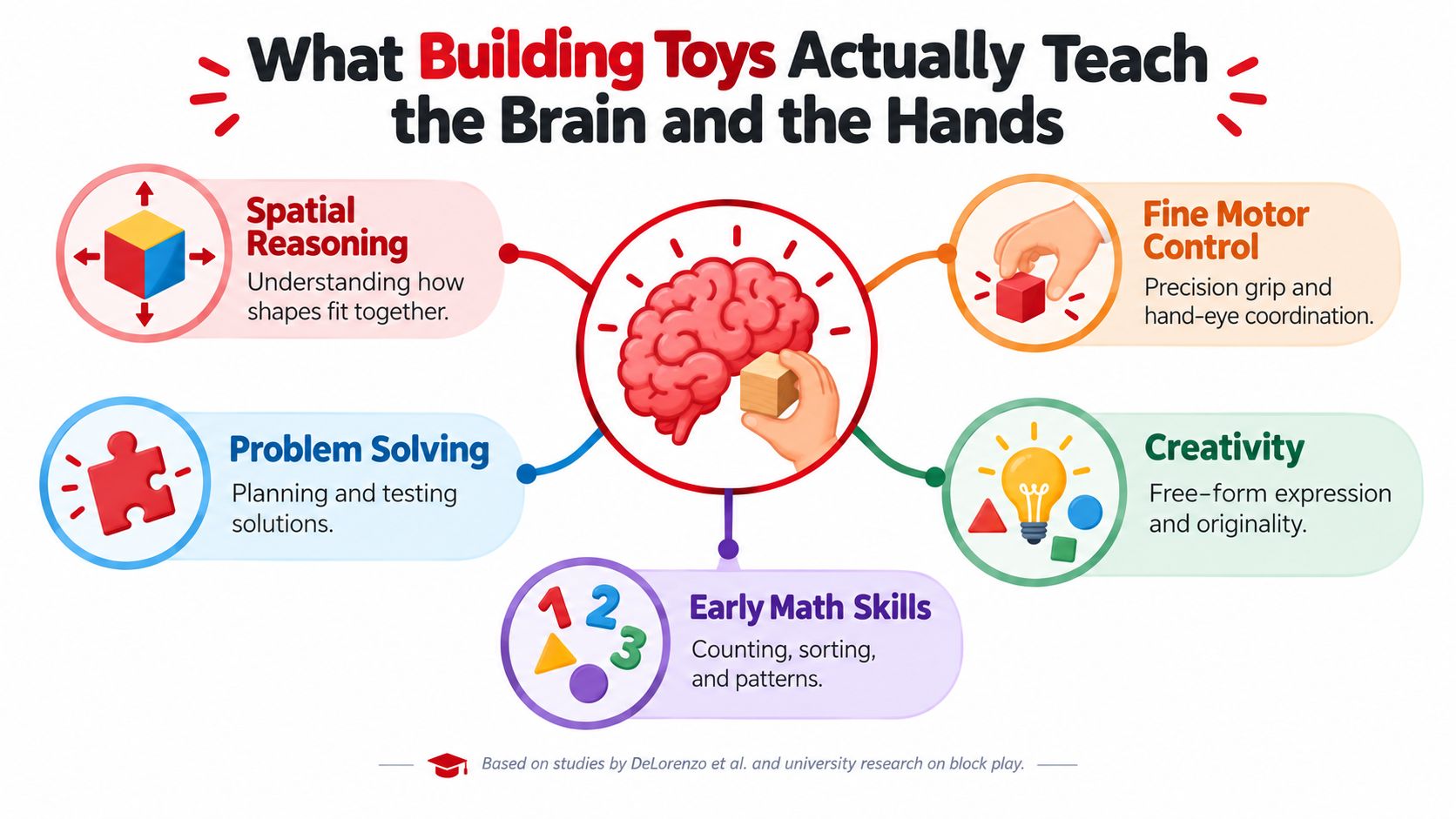
Building play develops several skills at the same time because children must coordinate their thinking with physical action. They don't merely imagine a structure. They select a piece, orient it, place it, evaluate the result, and often explain what they're doing.
Fine-motor control you can observe
Watch a child turn a piece several times before snapping it into place. That pause involves grip control, hand-eye coordination, and the use of both hands together. One hand may hold a base steady while the other attaches a piece.
Children also practice pressure control. A connector must be pushed firmly enough to hold, but not so forcefully that the structure shifts or breaks. These repeated movements support the controlled hand use needed for drawing, fastening clothing, and other everyday tasks. For more practical ideas, see activities that improve fine-motor skills.
Spatial reasoning through movement
A child who rotates a block before placing it is learning that an object can change orientation while keeping its shape. Magnetic tiles and three-dimensional construction sets make this especially visible. Children begin to notice which pieces form a flat surface, which pieces create an angle, and how separate parts can enclose space.
Research summaries connect block play with spatial skills, and the complexity of structures built at age 4 has been associated with mathematics achievement in 7th grade in contemporary child-development summaries. The same source describes effects of spatial play that can persist for years, alongside links to early numeracy ideas such as length, measurement, symmetry, balance, number, and estimation.
Planning, testing, and revising
Executive-function habits appear in ordinary play. A child may announce, “First the red piece, then the roof,” follow a sequence, notice a mistake, and change the plan. Another child may rebuild a collapsed tower with a wider bottom instead of repeating the same design.
These habits support persistence and flexible thinking. Building play also invites language, creativity, cooperation, and both fine- and gross-motor development, according to the cited developmental summaries. That doesn't mean a block set guarantees academic success. It means the toy creates repeated opportunities for children to practice behaviors that later support mathematics, comprehension, design work, and collaborative problem-solving.
Matching Building Toys to Your Child's Age and Stage
Age labels help, but they aren't the whole decision. Piece size, weight, connection strength, and the child's actual hand control matter just as much. The U.S. Consumer Product Safety Commission's age-determination guidance says most block sets are appropriate for children 19 months and older, with size and weight serving as important distinctions in safer early-age sets according to its published guidelines.
Use the table as a starting point, then inspect every set for detachable parts and supervision needs.
Building toys by age band
| Age Band | Recommended Toy Types | Skills Sharpened | Realistic Builds |
|---|---|---|---|
| 12–24 months | Large wooden blocks, soft stackers, chunky brick systems | Grasping, release control, stacking, cause and effect | Short towers, rows, simple enclosures |
| 2–3 years | Magnetic tiles with safe construction, large foam or cardboard bricks | Matching, simple spatial planning, vocabulary, balance | Houses, flat shapes, short walls |
| 4–6 years | Standard plastic bricks, wooden pattern blocks, beginner marble runs | Sequencing, symmetry, measurement language, persistence | Vehicles, bridges, towers, simple tracks |
| 7–9 years | Intermediate engineering kits, bridge and gear sets, architecture models | Systems thinking, planning, testing, structural reasoning | Working bridges, gear mechanisms, detailed buildings |
| 10–14 years | Robotics kits, advanced brick sets, design challenges | Iteration, technical reasoning, collaboration, early engineering | Moving machines, prototypes, themed models |
What to watch at the youngest ages
For children under 36 months, small detachable components can create serious risks. Major-market requirements prohibit or tightly control small detachable parts, require battery compartments in battery-operated toys to be secured with a tool, and limit accessible lead in toy parts to 90 mg/kg in Canada's federal guidance for toys used by children up to and including 36 months.
A baby-registry checklist can help families separate useful early play materials from tempting but unsuitable small-part sets. The must-haves for your baby registry are most helpful when you use them as a practical planning tool, not as a reason to buy every suggested item.
Moving toward complexity
By the preschool years, children can often manage more pieces, but they still benefit from visible success. At school age, a child may enjoy a model with a target outcome, provided the instructions don't remove every opportunity to make decisions. Older children need adult supervision when kits include tools, motors, batteries, sharp components, or complex construction steps.
For age-specific ideas, building toys for 7-year-olds can help families compare a child's current skill level with the challenge offered by a set.
Classroom and Home Activities That Grow With Your Child
A preschool teacher places 30 wooden blocks on the floor and asks a group of four-year-olds to build. At first, the children make separate towers. The teacher doesn't correct them or demonstrate a finished structure. She watches, asks what each child is trying to make, and waits for the children to decide what comes next.
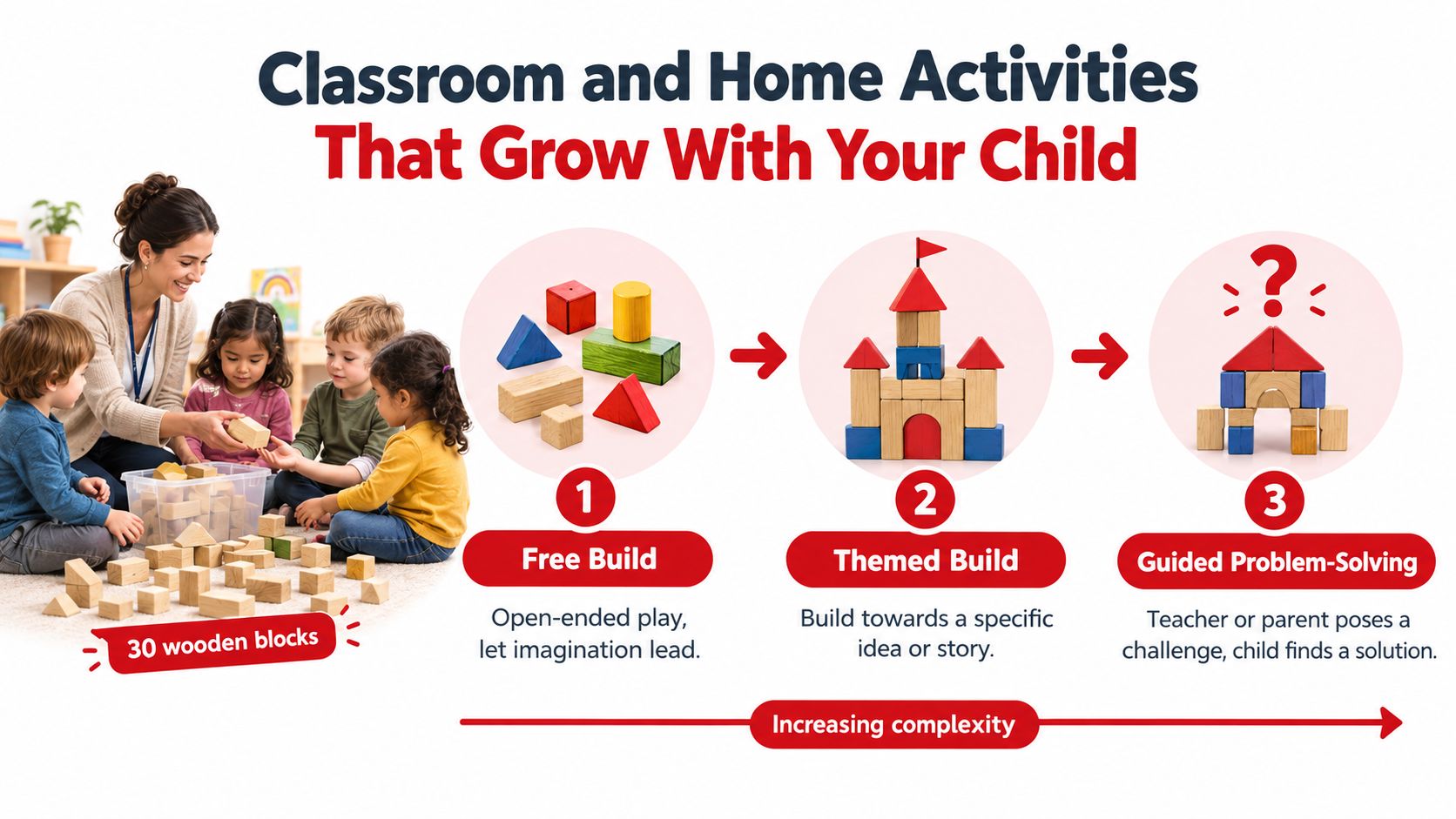
Later, she introduces a bridge challenge. A toy car must pass underneath without touching the blocks. The children discover that a taller bridge may wobble, while a wider base takes more pieces but holds better. The teacher's questions turn free construction into guided problem-solving without taking ownership away from the children.
Three stages of useful challenge
- Free build gives children control. Offer blocks, connectors, or tiles and let them explore without a model. Here, children develop personal ideas and become comfortable handling the material.
- Themed build adds a story or purpose. Ask for a fire station, animal shelter, road, or home for a toy figure. The theme encourages children to use language, represent ideas, and choose pieces with intention.
- Guided problem-solving introduces a constraint. “Can the car cross?” “Can the roof stay on?” or “Can you build it again with fewer pieces?” gives children a reason to test and revise.
Try this tonight: Give your child ten minutes to build, then ask one question about the structure. Avoid taking the pieces or fixing the problem yourself.
At home, a six-year-old might begin with magnetic tiles and build a small house. Add a paper roof and ask, “What happens when it rains?” The child may make the roof steeper, add supports, or decide that the paper needs a second layer. Each response creates a new design decision.
Partner activities work well too. One child builds while another copies from a photo. A parent can leave one piece out of a familiar model and invite the child to repair the “broken” structure. Keep a simple photo journal on a tablet or in a folder so children can compare early designs with later versions.
For additional ideas that practitioners use with young children, explore these practitioner-led nursery activities. You can also find more options in play-based learning activities.
How to Compare Safety, Materials, and Play Value
A building toy should fit both the child and the setting. A quiet wooden set may work beautifully on a bedroom rug, while a daycare needs pieces that tolerate frequent handling, easy cleaning, and replacement. A detailed electronic kit may suit an older child's supervised project but frustrate a preschooler who still wants immediate, open-ended results.
Building toy categories compared
| Category | Best Age | Key Safety Check | Material Note | Replay Value |
|---|---|---|---|---|
| Magnetic tiles | Usually for children ready to handle larger connected pieces and understand basic shapes | Inspect magnet housing, seams, cracks, and age labeling | Commonly plastic with enclosed magnets; check construction and finish | High for open-ended 2D and 3D designs |
| Wooden blocks | Early builders through school age, with size matched to the child | Check for splinters, loose parts, sharp edges, and finish condition | Wood can be durable and biodegradable, but finish quality varies | High for towers, roads, buildings, and pretend play |
| Plastic brick systems | Preschool and older children, depending on piece size | Check small-part warnings, connection condition, and broken edges | Systems may use different plastics, including ABS or polypropylene; verify the product information | High when pieces, instructions, and compatible expansions remain available |
| Hybrid STEM kits | Older children with adult supervision when tools, motors, or batteries are included | Check fastener retention, battery access, moving parts, and testing instructions | Combines plastic, metal, electronics, and sometimes cardboard | Strong for projects, but often narrower than open-ended blocks |
Questions to answer before buying
For a child who still mouths objects, piece size and detachable-part risk come first. For older children, inspect whether magnets are securely enclosed, whether gears can pinch fingers, and whether batteries are protected. U.S. products intended primarily for children 12 and under fall under ASTM F963, a mandatory toy safety standard incorporated into federal regulation, and manufacturers must use third-party testing and certification through a Children's Product Certificate according to CPSC toy-safety guidance.
Safety should begin during design, not at the last inspection. Relevant abuse testing can include impact, torque, tension, flexure, and compression, because those forces can loosen parts or create sharp edges. Parents can't perform laboratory testing at home, but they can reject cracked housings, loose magnets, damaged connectors, and unclear age labeling.
Sustainability and replay value
Wood often offers a tactile, quiet experience and can last through repeated play, but wooden blocks provide fewer specialized shapes. Magnetic tiles make shape exploration quick, although pieces may slide or frustrate children who don't yet have enough grip control. Plastic systems offer broad ecosystems and replacement possibilities, but families should ask how they handle damaged or unwanted pieces.
Hybrid kits introduce motors, circuits, and code. They can make engineering ideas concrete, but a child may use them mainly to complete the prescribed model. Review STEM building kits with the question, “Will my child design beyond the example?”
Choose the material according to the floor, the child's grip, the supervision available, and whether siblings will inherit the set. The most sustainable toy is often the one that remains safe, complete, repairable, and interesting for repeated use.
Choosing Building Toys as Gifts That Earn Their Place
A strong building-toy gift gets opened once but used many times. The right choice matches what the child can do now while leaving room for a new challenge later. A toddler may gain more from a set of large wooden blocks than from an electronic toy with lights and fixed buttons because the blocks allow the child to control every action.
Three gift situations
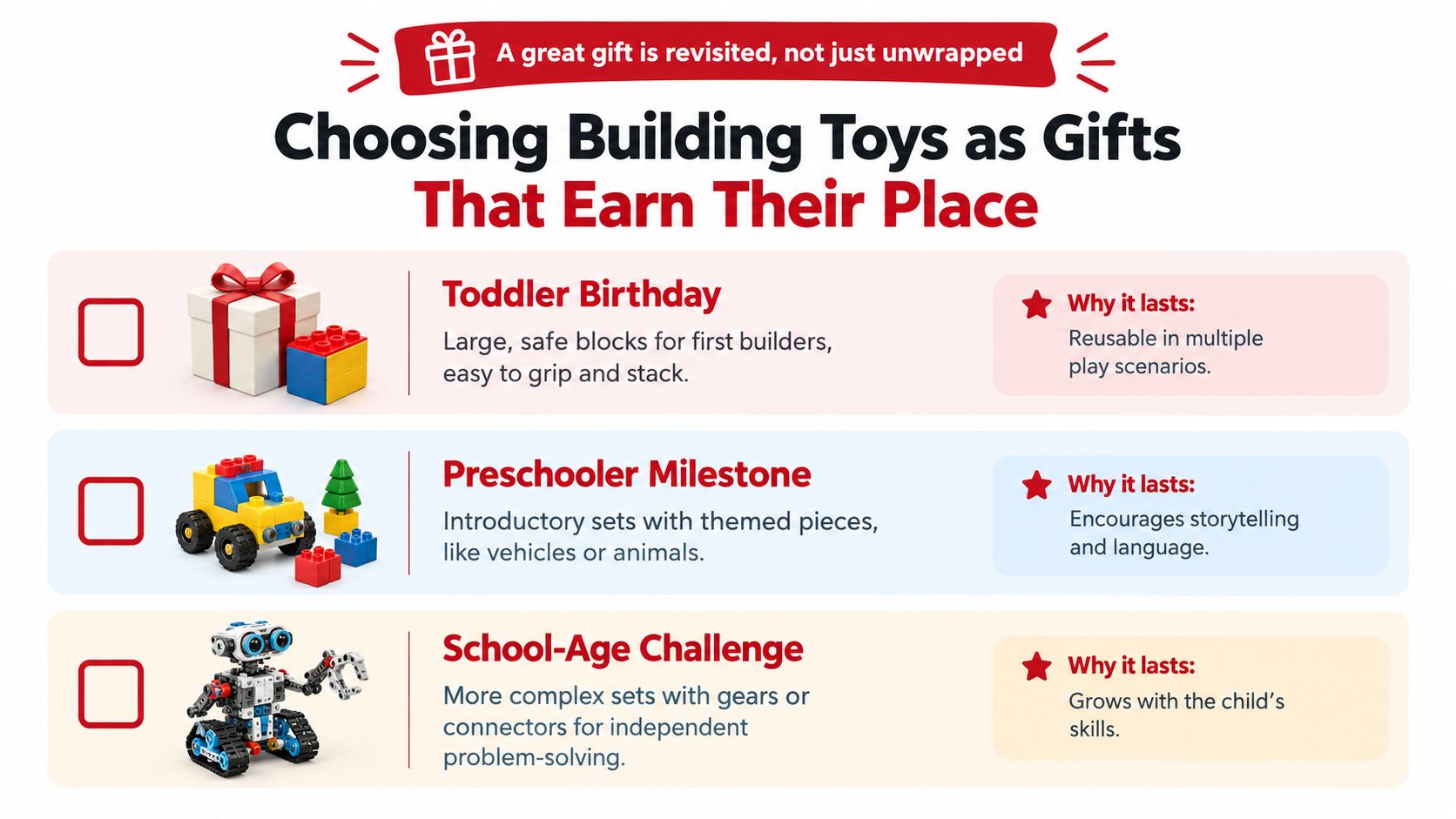
For a toddler's birthday, choose pieces that are easy to grasp, stack, and store. For a seven-year-old, pair a magnetic-tile expansion with challenge cards that suggest bridges, shelters, or vehicles without dictating every step. For a tween, an engineering kit with gears, connectors, or circuits may hold attention better than another game with a single way to play.
A useful shortlist looks like this:
- Around age 2: Large blocks for grip control and early construction.
- Around age 4: Pattern blocks or chunky bricks for spatial reasoning and design language.
- Around age 7: Magnetic tiles, bridge sets, or gear systems for perseverance and testing.
- Around age 10: Intermediate engineering models for systems thinking.
- Around age 12: Robotics, circuitry, or advanced construction challenges for early engineering practice.
These age points are selection guides, not promises about readiness. Always inspect the manufacturer's age label, part size, and supervision requirements.
Make the gift last
A core set with an expansion can serve more play purposes than a box chosen only for its appearance. Families can add one expansion set over time, rotate specialized pieces into storage, and bring them back when the child needs a fresh challenge.
Write the child's name on the storage bin, especially when the set will travel to playdates or be shared with siblings. Take a photo of completed builds before dismantling them. That small record helps children revisit their ideas and notice how their designs change.
Gift-giving rule: Choose a toy that supports the child's next experiment, not just the child's current favorite theme.
Frequently Asked Questions From Parents and Teachers
Why are magnetic tiles often introduced around age 3?
Magnetic tiles require children to manage connected surfaces, recognize shapes, and begin moving between flat designs and three-dimensional structures. On top of that, some sets contain magnets that can become dangerous if a child detaches and swallows them. Follow the product's age label, inspect every tile for cracks or separation, and keep the set away from children who still mouth objects.
Can children mix brands and construction systems?
They can, as long as the pieces are physically compatible and each product remains safe to use. Mixing systems can encourage comparison, sorting, and creative combinations, but it also makes storage harder. Use separate bins or labeled compartments, and teach children to remove damaged pieces rather than returning them to the collection.
Can guided building replace passive screen time?
Building can provide a constructive alternative when adults make the transition predictable. Instead of abruptly removing a screen, give the child a clear invitation such as, “Let's choose a ten-minute building challenge,” then sit nearby for the first few minutes and ask a specific question about the design. Some children will play independently once they get started, while others need help choosing a first step.
What matters most for classroom durability?
Look for sturdy connections, smooth surfaces, secure components, clear age labeling, and a practical replacement-parts policy. A classroom set needs to survive repeated handling by many children, so the supplier's information about warranty coverage, replacement pieces, cleaning, and storage matters as much as the initial design.
How should families manage lost pieces?
Keep a “found pieces” container near the play area and sort it during a regular tidy-up. Store instruction-based sets separately from open-ended blocks, because one missing specialized piece can stop a model while a block collection can keep evolving. Rotating kits prevents the oldest children from seeing the same materials as finished or predictable.
Building toys work best when adults protect the play without controlling it. Offer the right size, stay alert to safety, and ask questions that help children notice their own choices.
Playz offers hands-on options that connect construction with science and engineering, including model-building and circuit-focused activities for children ready for more structured challenges. Visit Playz to explore play materials that can turn curiosity, building, and experimentation into an active learning routine.