


You're at the kitchen table with a newly opened science kit, a nine-year-old who's excited to begin, and a growing pile of tiny packets, plastic parts, and instruction sheets. The first activity produces a satisfying fizz. Your child calls it “cool,” wanders away, and the kit disappears beneath homework and water bottles.
That scene doesn't necessarily mean the kit was poor quality. It may have been too dependent on adult setup, too messy for your household, or too focused on a single dramatic result. The most useful question isn't which science kit for 9 year olds is best. It's which kit matches your child's independence, your tolerance for mess, and the amount of replay value you want.
Why Most Science Kits End Up Half-Finished
Novelty gets a kit opened. It doesn't always keep a child working through the next activity. A nine-year-old may enjoy mixing powders, cracking a geode, or switching on a circuit, but follow-through depends on what happens after the first payoff.
A kit that requires measuring, cleanup, and an adult to interpret every result can quickly become a parent-led project. A kit with unclear diagrams can frustrate a child who was perfectly capable of doing the experiment but couldn't work out what the instructions meant. Even an engaging activity may be abandoned if the remaining experiments all feel like variations of the same trick.
Practical rule: Judge a kit by what your child can do after the unboxing excitement fades.
A useful buying framework asks five questions:
- Skills: Does the kit build observation, measurement, troubleshooting, or life-cycle awareness?
- Complexity: Can your child read and physically manage the procedure without constant rescue?
- Safety: Are the materials and tools appropriate, and does the kit make supervision requirements clear?
- Replay value: Can your child repeat, modify, or extend an activity?
- Household fit: Can your family tolerate the mess, storage, noise, and setup?
Science kits have been used as learning tools for a long time. Chemical sets for children appeared by the 1830s, including Robert Best Ede's “No. 1. Youth's Laboratory, or Chemical Amusement Box,” produced in 1836–37. Porter Chemical Company's Chemcraft set followed in 1915, and Kosmos was publishing a hands-on science kit for children and young adults by 1922. That history shows why modern kits combine equipment, models, and instructions, rather than functioning as ordinary craft boxes. The history of children's science kits traces the category's movement from laboratory-style learning toward educational toys.
For parents, the practical lesson is simple. Don't buy the loudest box on the shelf. Use the toy rotation system to keep one activity visible, store the rest properly, and reintroduce the kit when your child has enough attention for it.
How 9-Year-Olds Actually Learn From Hands-On Science
A chemistry kit works a little like a recipe in reverse. Your child combines two materials and sees a new color, foam, solid, or gas appear. Instead of merely following a recipe toward a known meal, they can reason backward from the result: What changed, and which ingredient caused it?
That backward reasoning matters because the child is connecting an action with an observable consequence. The kit turns an abstract idea such as a chemical reaction into something they have personally measured, mixed, and watched transform.
Physics kits behave more like controlled playgrounds. A child changes one feature, such as the steepness of a ramp or the position of a weight, then watches what happens. They're beginning to test an idea without needing formal terms such as “controlled variable” or “experimental design.”
What the strongest kits practice
A well-designed activity gives your child several kinds of work at once:
- Observation: noticing color, movement, texture, sound, or timing.
- Sequencing: completing steps in an order and recognizing when a missed step affects the result.
- Fine-motor precision: pouring, connecting, fastening, sorting, or positioning small components.
- Cause and effect: linking a change in materials or structure to a different outcome.
- Early measurement fluency: using a spoon, ruler, thermometer, timer, or simple comparison scale.
Nine-year-olds often sit in a useful middle ground. They can manage more reading and multi-step direction than a much younger child, yet they still want an immediate and visible payoff. A kit that makes the child wait for every result may lose momentum, while a kit that offers only instant effects may not create much thinking.
Research on children's STEM kits offers an important caution. Activities can produce enthusiastic procedural participation, such as mixing, observing, and following steps, without reliably building conceptual understanding unless an adult helps connect the action to the idea. A review of STEM-toy research supports choosing kits with explanation prompts, not just impressive effects.
The value isn't that a nine-year-old will master advanced chemistry or engineering from one box. The value is that school concepts become tangible. A child can touch the circuit, see the crystal, inspect the insect, or compare the ramp results. That personal experience gives later explanations something concrete to attach to.
For more ideas about why physical activities can deepen children's engagement, see the benefits of hands-on learning.
The Four Kit Categories Worth Knowing
Different science kits invite different kinds of attention. Chemistry tends to reward children who want an immediate reaction. Biology asks them to return repeatedly. Physics suits builders and troubleshooters, while earth science often attracts collectors and children who enjoy uncovering or growing something.
| Category | Example Kits | Core Skills | Time to First Result |
|---|---|---|---|
| Chemistry | Thames & Kosmos Chem C1000, National Geographic Mega Kit | Observation, measurement, safe chemical handling | Often immediate |
| Physics | Snap Circuits, LEGO Education Simple Machines | Circuit logic, structural engineering, troubleshooting | Often immediate after assembly |
| Biology | Insect Lore butterfly garden, dissection sets, hydroponic growing kits | Patience, life-cycle awareness, documentation | May develop over days or weeks |
| Earth science | Rock and crystal growing sets, volcano kits | Geology vocabulary, patience, collection building | Ranges from immediate to gradual |
Chemistry for visible cause and effect
Thames & Kosmos Chem C1000 and the National Geographic Mega Kit represent the classic reaction-based approach. Children measure, combine, observe, and compare. These kits can support careful handling and early measurement, but they're also the category most likely to need close adult attention, especially when procedures involve unfamiliar materials or cleanup.
Choose chemistry for a child who enjoys “What happens if?” questions and won't mind pausing to read before mixing.
Physics for builders and troubleshooters
Snap Circuits makes circuit logic physical. A child connects parts, tests whether the system works, and checks the arrangement when it doesn't. LEGO Education Simple Machines takes a construction route, using builds to explore levers, wheels, axles, pulleys, and related mechanisms.
Physics kits usually offer strong replay value because a child can rebuild, alter, and troubleshoot rather than consume a material once.
Biology for patience
An Insect Lore butterfly garden, a dissection set, or a hydroponic growing kit shifts the rhythm. The child may need to observe changes over time, record details, and accept that the next stage won't appear instantly.
These are good choices for children who like animals, plants, drawing, or keeping track of gradual change. A notebook can become as important as the kit itself.
Earth science for collecting and uncovering
Rock and crystal growing sets, volcano kits, and fossil or dinosaur dig activities provide visual and tactile appeal. They introduce geology vocabulary and encourage sorting, comparing, and displaying results.
Pick the category that matches the habit you want to encourage, not the loudest packaging. A child who loves building may return to a quiet circuit set more often than to a dramatic volcano. A child who notices every backyard insect may stay with a biology kit long after a chemistry reaction is over.
Five Checks That Separate a Great Kit From a Dusty One
Before buying, inspect the kit as if you're already standing at the kitchen table with the box open. The age label is only a starting point. Modern science kits commonly target children in the 8–14 range, which places nine-year-olds within the core market for hands-on STEM tools. A peer-reviewed discussion of modular science kits also describes their use in primary and secondary classrooms and at home, framing them as a bridge between school and home learning. The peer-reviewed study on modular science kits also cites historical 2012 PISA science-skill data, including 18% of pupils in the European Union with low-level science skills, compared with 7% in Korea and 8% in Japan. Those figures are historical context, not a promise that one toy will close a learning gap.
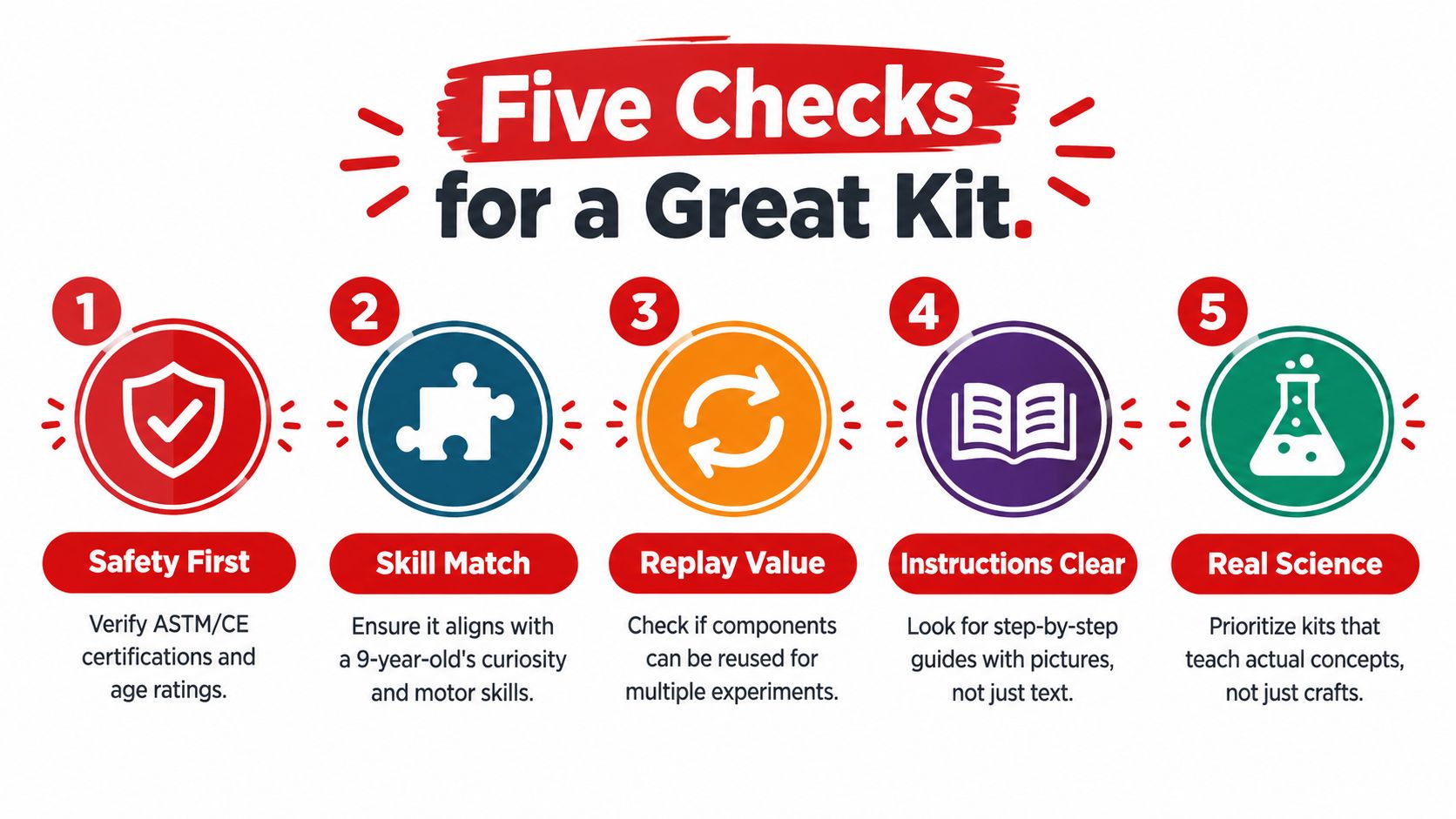
1. Safety comes before independence
Read the age guidance, warnings, tool list, and supervision notes. The U.S. Consumer Product Safety Commission guidance summarized by KiwiCo says materials suitable for ages 6 through 8 generally remain appropriate for ages 9 through 12, and it identifies magnifying glasses, prisms, thermometers, stethoscopes, and rock or shell kits as age-appropriate examples. The age guidance for science-related materials also notes that some activities still need adult help.
Treat an age label as a safety floor, not an independence rating. Heat, sharp tools, glass, or chemistry materials require a different supervision plan from a magnifying glass or snap-together circuit.
2. Match the skill load
Look at the actual instructions, not just the recommended age. Can your child read the verbs, identify the parts, pour accurately, and complete several steps without losing the sequence?
A kit can be technically suitable and still be a poor match if the reading is dense or the pieces are too fiddly. A child who needs help with every page won't experience the independence the package implies.
3. Inspect the materials
Check what the box includes and what your home must supply. Extra vinegar or baking soda is easy to provide. Specialized replacements, unusual containers, or frequent consumables create more planning.
Quality also includes storage. Small parts without labeled bags or a tray tend to spread across the house, which makes the next session harder to start.
4. Test independence honestly
Ask what happens after your demonstration. Can your child repeat the activity by reading picture-supported steps, or will you need to measure, supervise, explain, and clean everything?
Coverage of STEM toys frequently highlights this gap between an age label and genuine independent use. A practical review of STEM toys notes that complex pieces, safety steps, chemistry materials, storage, and extra household supplies can still require adult involvement.
5. Look for replay value
Count the ways the kit can be reused, not merely the number of activities printed on the front. Circuits, simple machines, observation tools, and growing projects often invite modification. A single geode or one sealed reaction may offer a memorable result but little repeat use.
Use this one-minute shortcut: eliminate anything with unclear safety information, then ask whether your child can understand the instructions, whether the materials will last beyond the first session, whether you can tolerate the cleanup, and whether the activity has a natural next question. The right choice is the kit whose demands fit your home.
For a broader starting point, compare that checklist with Playz's guide to science kits for kids, then inspect each product's actual materials and supervision notes before purchasing.
Four Experiments You Can Picture Doing Tonight
A good kit becomes easier to evaluate when you can picture the activity itself. These examples show how different categories create different demands for time, mess, and adult involvement.
Slime and vinegar chemistry
Materials: A slime-oriented chemistry kit, suitable ingredients, mixing container, spoon, and a protected work surface. For a vinegar reaction, add vinegar and baking soda only when the instructions call for them.
Time: A short session for mixing and observing, with additional time for cleanup.
Mess level: Moderate to high, depending on the amount and container.
Concept to explain: Materials can change when they combine, and the properties of the new mixture differ from the starting ingredients.
Slime gives a child a tactile result, while vinegar and baking soda create a visible gas-producing reaction. Ask, “What evidence tells you something changed?” rather than naming the explanation immediately.
A simple circuit
Materials: Batteries, LEDs, wires or snap-together circuit pieces, and a switch.
Time: A short build session, followed by repeated rearranging.
Mess level: Low.
Concept to explain: A circuit needs a complete path for electricity to flow.
Snap-together pieces reduce the frustration of loose wires and let a child test different arrangements. If the light stays off, don't repair it immediately. Ask the child to identify the break in the loop and predict which connection might solve it.
Crystal growing
Materials: A crystal-growing kit, water or other listed solution, a container, a safe resting place, and a notebook.
Time: Setup can fit into one evening, but the visible result develops gradually.
Mess level: Low to moderate.
Concept to explain: A solution can hold a dissolved material, and crystals form as the material comes out of solution and arranges into a solid structure.
The waiting is part of the lesson. Have your child draw the crystal at each observation and record changes in size, shape, or color instead of checking it constantly.
Plant biology or a dissection activity
Materials: For plant biology, seeds, growing medium, a clear container, water, and light. For a dissection set, use only the supplied tools and follow its safety directions closely.
Time: Plant growth requires repeated observations over days or weeks. A dissection is usually a focused session.
Mess level: Low for a seedling chamber, higher and more supervision-dependent for dissection.
Concept to explain: Living things have structures and processes that help them grow, function, or change.
A frog dissection and a seed-to-seedling project aren't interchangeable experiences. The first emphasizes anatomy and careful observation. The second builds patience and documentation. For additional low-prep ideas, explore ways to spark curiosity with kitchen-table science and browse science experiments for kids at home.
Extending the Learning and Cutting Screen Time
The kit stays useful when the experiment ends with a question rather than a verdict. Keep a notebook beside the materials and use prompts such as:
- Prediction: What do you think will happen?
- Observation: What changed first?
- Comparison: How was this result different from the last one?
- Reasoning: Which part of the setup may have caused the difference?
- Next test: What could you change safely?
A child doesn't need a formal lab report. Drawings, short sentences, measured marks, and labeled diagrams are enough to build scientific habits without turning the activity into extra homework.
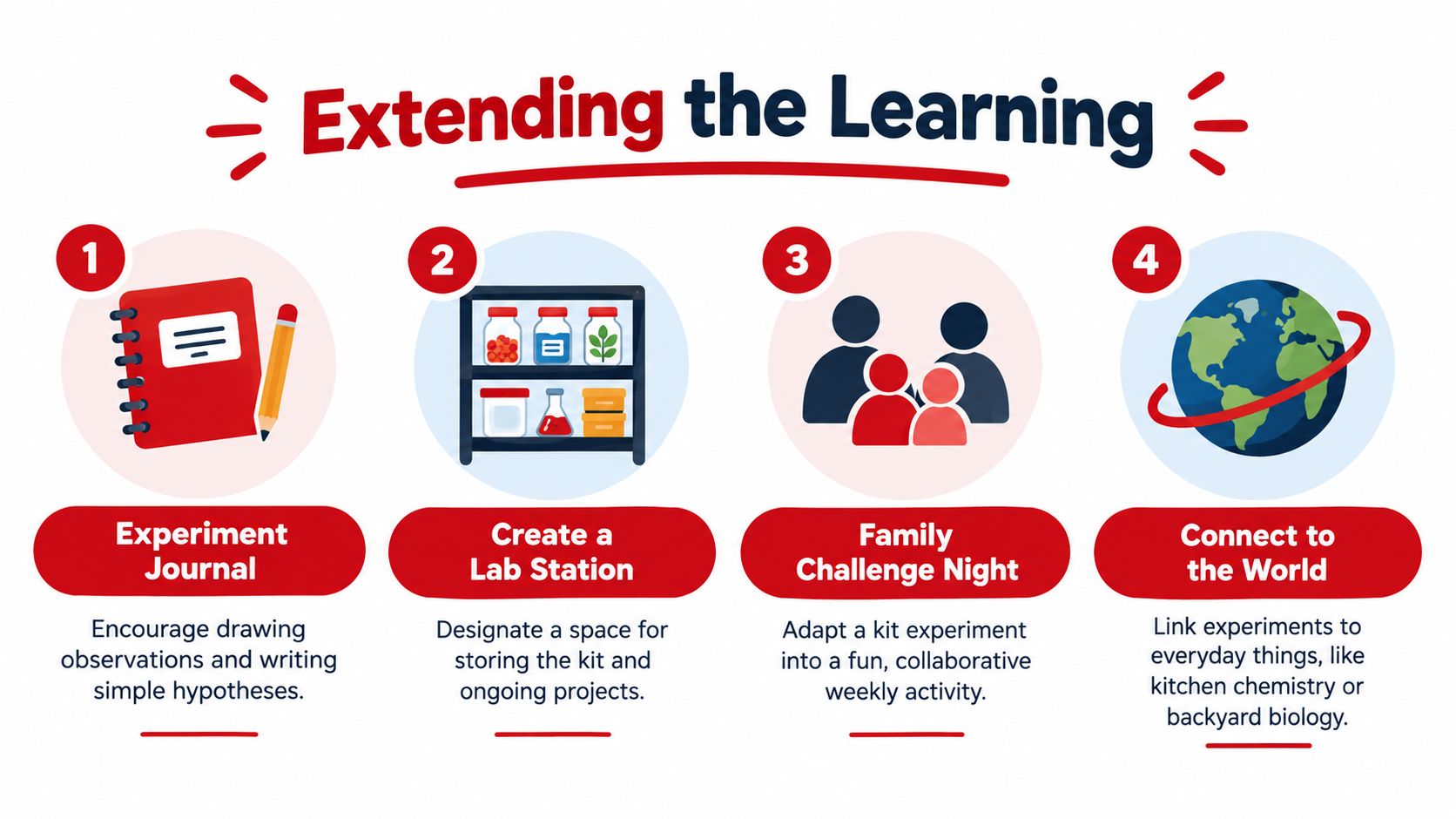
Make the next session easy to start
Create a small lab station with a tray, notebook, pencil, timer, magnifying glass, and labeled storage bags. Keep common supplies such as vinegar and baking soda available when they're appropriate for the kit's instructions. A visible setup removes the friction that often sends a child back to a tablet.
A weekly “lab hour” works better than leaving the kit in a cupboard and hoping curiosity returns. Offer a specific challenge, such as building a circuit with a switch or comparing two growing conditions. The activity becomes part of the family rhythm instead of competing with screens during unstructured free time.
Adult scaffolding: Ask why, describe what you notice, and wait before supplying the answer.
You can narrate without taking over: “The liquid looks cloudier than it did before.” Then ask, “What do you think caused that?” If the result fails, treat the failure as information. Research on elementary science-kit use found stronger outcomes when kits were integrated into structured instruction. Teacher survey data reported that 90% or more of respondents observed increased student interest and improved understanding, while 88% reported improved overall science achievement after implementing kits. The elementary science-kit research supports using the box as part of guided learning, not as an isolated novelty.
For practical family routines around devices and activities, see how to limit screen time.
Quick Answers Parents Ask Before Clicking Buy
Can a 9-year-old use a science kit independently?
Often, yes, especially with physics, circuits, simple machines, observation tools, and some crystal kits after a parent demonstrates the first activity. Chemistry sets and projects involving heat, sharp tools, glass, or unfamiliar materials need an adult close by. Independence also depends on reading ability, fine-motor control, storage, and whether the instructions use clear pictures.
Do science kits actually reduce screen time?
They can, but scheduling matters. A kit usually works better as a weekly lab hour with a prepared surface and a defined challenge than as a vague suggestion during free time. Novelty fades quickly when the child must find missing pieces, gather supplies, and interpret dense instructions alone.
Are home kits different from classroom versions?
Yes. Classroom kits commonly support group activities, include teacher-oriented guidance, and provide materials for repeated use by several learners. A home kit is usually a better fit for one child because it's smaller in scope and easier to manage, but check what consumables and household supplies it requires.
Choose according to your family's real tolerance for mess, noise, supervision, and setup time, not the promise on the front of the box. The right science kit is the one your child can return to without turning every session into a production.
Playz offers hands-on science kits covering areas such as chemistry, biology, physics, and earth science, including options designed for children aged eight and older. Visit Playz to explore kits that can turn a manageable kitchen-table activity into a repeatable screen-free learning routine.