


Ready to take on the classic egg drop challenge? This isn't just about dropping an egg and hoping for the best. It's a fantastic, hands-on dive into the world of physics, engineering, and creative problem-solving that turns abstract science into a real-world adventure.
The goal is simple: build a device from everyday materials that can protect a raw egg from a high fall. This guide is your complete blueprint for turning a pile of household items into a high-tech vessel that saves your fragile cargo from a dramatic, splattery end.
The egg drop experiment is a perfect example of how engaging, student-centered learning activities make science unforgettable. More than just a school project, it’s an incredible activity for a classroom or a family weekend that builds critical-thinking and engineering skills in a fun, memorable way.
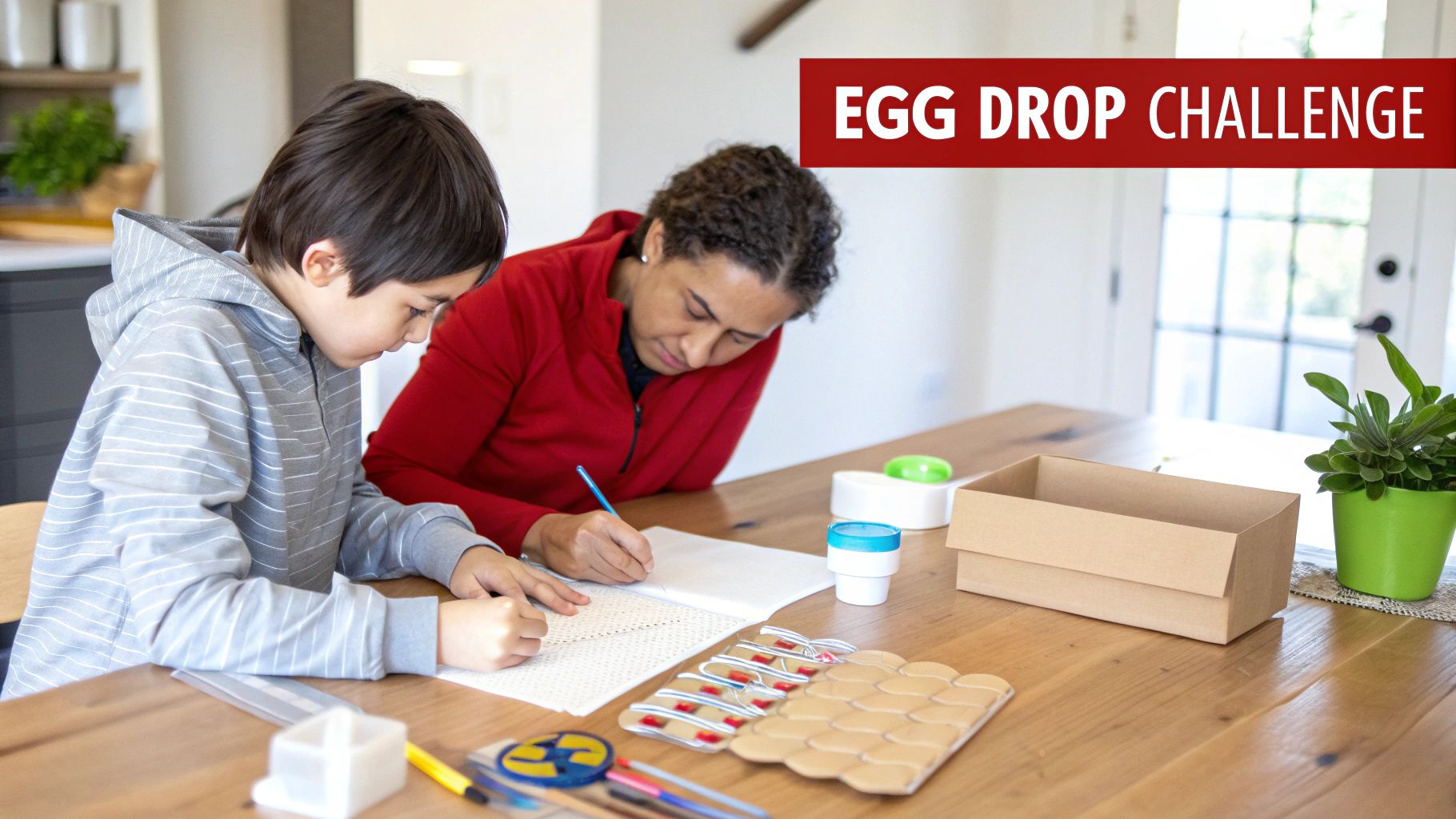
The Surprising History of the Egg Drop
This famous challenge has surprisingly cool roots. It traces back to the dawn of the Space Race in the late 1950s, shortly after the Soviet Union's Sputnik launch. Educators, inspired by the race to the stars, designed these challenges to mimic the re-entry of space capsules, with the humble egg playing the role of a precious astronaut.
The legacy continues today. At one recent school event, students achieved an astonishing 80%+ survival rate, with 19 out of 23 eggs staying intact after a 46-foot plunge, proving what clever design can accomplish.
This project teaches one of science's most important lessons: failure is not a setback; it's data. Analyzing what went wrong with a cracked egg is often more valuable than a flawless first drop.
When you take on this challenge, you're joining a long line of innovators who learn by doing. Whether your design flies beautifully or ends with a splat, the real win is in the process of discovery, testing, and redesigning.
If you're looking for more ideas that blend creativity with STEM, check out our guide on finding the perfect example of a science fair project. We'll help you turn your home or classroom into an exciting lab where hands-on play leads to deep learning.
Gathering Your Materials for the Perfect Design
Before any engineering magic can happen, every good scientist needs to stock their lab. The beauty of the egg drop experiment is that you don’t need fancy equipment—just a bit of creativity and a willingness to see everyday items in a new light. Think of it as a scavenger hunt for innovation right in your own home.
A fantastic place to start is the recycling bin. Not only is this a great lesson in resourcefulness, but items like cardboard, plastic bottles, and paper towel tubes are perfect for this challenge. Beyond recycled treasures, there are a few non-negotiables you'll need to run the experiment properly.
Core Experiment Essentials
No matter what wild contraption you dream up, you'll need these key items to get started. Make sure you have them on hand before you begin building.
- Raw Eggs: The star of the show! It's wise to have a few extras on standby for multiple tests or... those inevitable learning opportunities.
- Measuring Tape: Crucial for accurately measuring your drop height. Keeping this consistent is key to a fair test and reliable data.
- A Tarp or Newspaper: This is your cleanup crew. A broken egg should be a data point, not a cleaning nightmare!
- Ziploc Bag: This is the ultimate pro-tip. Always place your egg in a sealed bag before putting it in your device. It contains any potential mess and makes post-drop inspection a breeze.
A Buffet of Building Supplies
Now for the fun part. The best designs usually combine materials from three different categories, each serving a specific scientific purpose. Let's break down the "why" behind what you're building with.
Egg Drop Material Ideas and Their Purpose
Thinking like an engineer means choosing materials for a specific job. Here’s a look at common items you can use and the physics principle that makes them work.
| Material Category | Example Items | Primary Physics Principle |
|---|---|---|
| Cushioning | Cotton Balls, Bubble Wrap, Sponges, Packing Peanuts | Shock Absorption: These materials compress on impact, increasing the time it takes for the egg to stop and reducing the overall force. |
| Structural Frame | Cardboard Boxes, Plastic Straws, Popsicle Sticks, Paper Cups | Force Distribution: Creates a rigid cage that distributes the force of impact around the egg instead of directly on it. |
| Deceleration | Plastic Bags, Coffee Filters, Streamers, Lightweight Fabric | Air Resistance (Drag): Increases the surface area of your device to work against gravity, slowing its descent for a gentler landing. |
Each category plays a vital role. A great structure is useless without cushioning, and even the best cushioning can fail if the impact is too fast.
Cushioning Materials to Absorb Shock
The main job of your cushioning is to absorb the kinetic energy from the fall. When your device hits the ground, these soft materials deform and compress, which increases the time it takes for the egg to come to a full stop. A longer stop time means a much gentler force.
- Cotton Balls & Sponges
- Bubble Wrap & Packing Peanuts
- Shredded Paper or Fabric Scraps
Structural Materials for a Protective Frame
These are the bones of your contraption. You need something to create a protective "chassis" or cage that holds the cushioning in place and keeps the egg secure. Cardboard is a real MVP here; you can find tons of inspiration for building strong frames with these cardboard craft ideas.
- Cardboard Boxes or Tubes
- Plastic Straws or Popsicle Sticks
- Paper Cups or Small Plastic Containers
Key Takeaway: You can't stop gravity, so don't even try. Your real mission is to manage the landing by absorbing and redirecting the energy of the impact away from the egg.
Deceleration Materials to Slow the Descent
These materials act like a parachute. By increasing the surface area of your device, you increase the air resistance, or drag, that pushes up against it as it falls. This force works against gravity to slow your contraption down, leading to a softer landing with less impact force to handle.
- Plastic Grocery Bags
- Coffee Filters or Streamers
- Lightweight Fabric Scraps
Building Your Uncrackable Egg Contraption
Alright, you’ve gathered your materials. Now for the fun part: turning that collection of everyday items into an engineering masterpiece. This is where your creativity shines, blending imaginative ideas with the cold, hard facts of physics. The goal is to take your design from a sketch on paper to a real, functional device ready for its first test flight.
A winning egg drop experiment contraption usually tackles three key challenges at once: a secure "cockpit" for the egg, a shock-absorbing outer layer, and a way to slow the entire device as it falls.
Thinking about your design in these distinct parts can focus your building process. You're not just stuffing an egg in a box; you're building a multi-layered system designed to protect your precious cargo from the moment it’s dropped until it lands safely.
This visual breaks down how different materials work together for a successful drop.
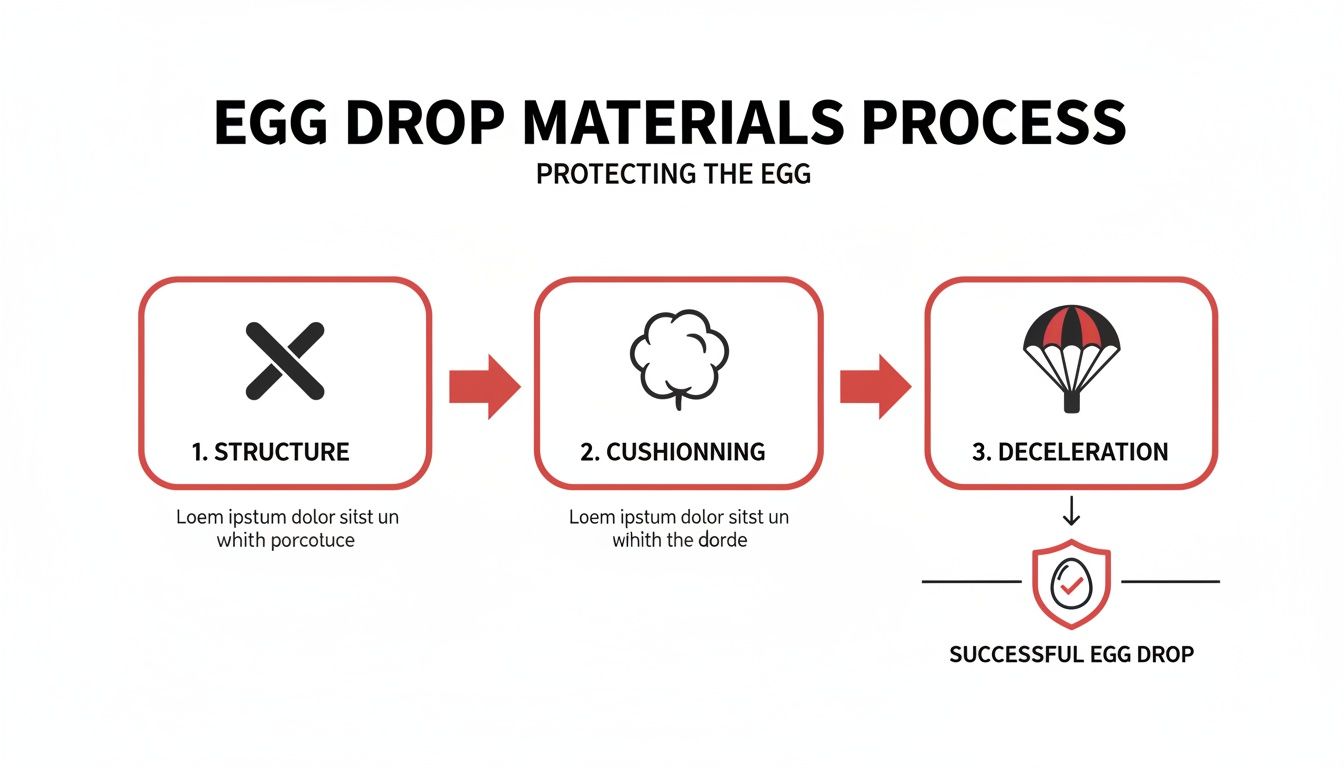
As you can see, a balanced design integrates a solid structure, soft cushioning, and a method for slowing down. It’s a complete system built to manage the fall.
Crafting the Egg's Protective Cockpit
Your first job is to create a safe, secure spot for the egg. You can't have it rattling around inside—that movement alone could crack it before it even hits the ground. But you also can’t pack it so tightly that the impact force transfers directly to the shell.
Think of it like building a custom-fit car seat. Your goal is to suspend the egg right in the center of your device, keeping it away from the hard outer walls.
- Suspension Systems: Try using rubber bands or string to weave a web or sling that holds the egg in the middle of a larger frame, like a cardboard box. This way, the frame takes the initial hit while the egg stays cushioned by the flexible bands.
- Molded Cushioning: Pack soft materials like cotton balls or sponges tightly around the egg, creating a form-fitting nest. This helps spread any impact force evenly across the egg’s surface instead of focusing it on one weak point.
Engineering a Shock-Absorbing Outer Layer
The outer shell of your device is its first line of defense. Its job is to absorb and spread out the kinetic energy from the impact, much like the crumple zone on a car. This is where you can get clever by combining rigid materials with softer ones.
A common mistake is making the outer layer too hard. A completely rigid device will just transfer all the shock straight to the egg inside. You want to build something that has a little give—something that can bend, crush, or deform to soak up that landing energy.
Pro Tip: Don't just pad the bottom! Your contraption might tumble on its way down and land on a side or corner. Ensure you have cushioning and structural protection on all sides to give your egg the best chance of survival.
For more ideas on building strong yet lightweight structures, you can find tons of inspiration in other engineering activities for kids that explore these same core concepts.
A Game-Changing Insight on Egg Orientation
Here’s a small tip that can make a huge difference. For years, people have argued about the best way to position the egg. While old-school thinking suggested pointing it downwards, surprising research has flipped that idea on its head.
Rigorous testing by MIT engineering students proved that eggs are far more resilient when they land on their sides. Dynamic drop tests revealed that even with similar peak forces, horizontal eggs cracked less often. Why? Their curved shape is naturally better at absorbing and distributing energy across a wider surface area. Placing your egg on its side inside your device is a simple change that leverages its natural structural strength to your advantage.
Understanding the Science Behind the Splat
So, why does one carefully built device land with a gentle thud, while another ends in a messy splat? The secret isn’t magic—it’s pure physics. Understanding the science behind the egg drop experiment transforms this fun activity into a powerful, memorable lesson.
At its core, your mission isn't to stop the egg from falling. You can't fight gravity. Your real job is to manage what happens at the very end of that fall. Three key physics principles will decide whether your egg survives its journey back to Earth.
Gravity and Air Resistance: The Tug of War
The second you let go, gravity takes over, pulling your contraption downward and increasing its speed. The higher the drop, the more speed it picks up. This is where your design can start to fight back.
By adding a parachute or even just some streamers, you introduce a powerful opposing force: air resistance, also known as drag. Think about how a feather floats gently down while a rock plummets. The feather's large, light surface catches the air, slowing it down. A parachute does the same thing for your device, increasing its surface area to create more drag. More drag means a slower descent and a much softer landing.
Your ultimate goal is not to stop the fall but to control the landing. Every design choice should aim to either slow the descent or soften the final impact by spreading out the force over time.
Impact Force: The Final Showdown
This is the make-or-break moment. When your device hits the ground, it comes to a dead stop almost instantly. All that kinetic energy it built up during the fall has to go somewhere. If it transfers directly to the eggshell in a fraction of a second, you’re going to have a scramble on your hands.
This is where cushioning becomes your best friend. Soft materials like cotton balls, bubble wrap, or sponges act like a car's crumple zone. They compress upon landing, dramatically stretching out the time it takes for the egg to come to a complete halt. By extending that impact from a split second to a few milliseconds longer, you slash the peak force hitting the egg down to a survivable level.
You can explore even more hands-on activities that make these concepts click with these other cool physics projects for a science fair. The main takeaway is simple: a longer, softer stop is always better than a short, sharp one. Your design succeeds by cleverly manipulating time and force.
How to Safely Test Your Egg Drop Project
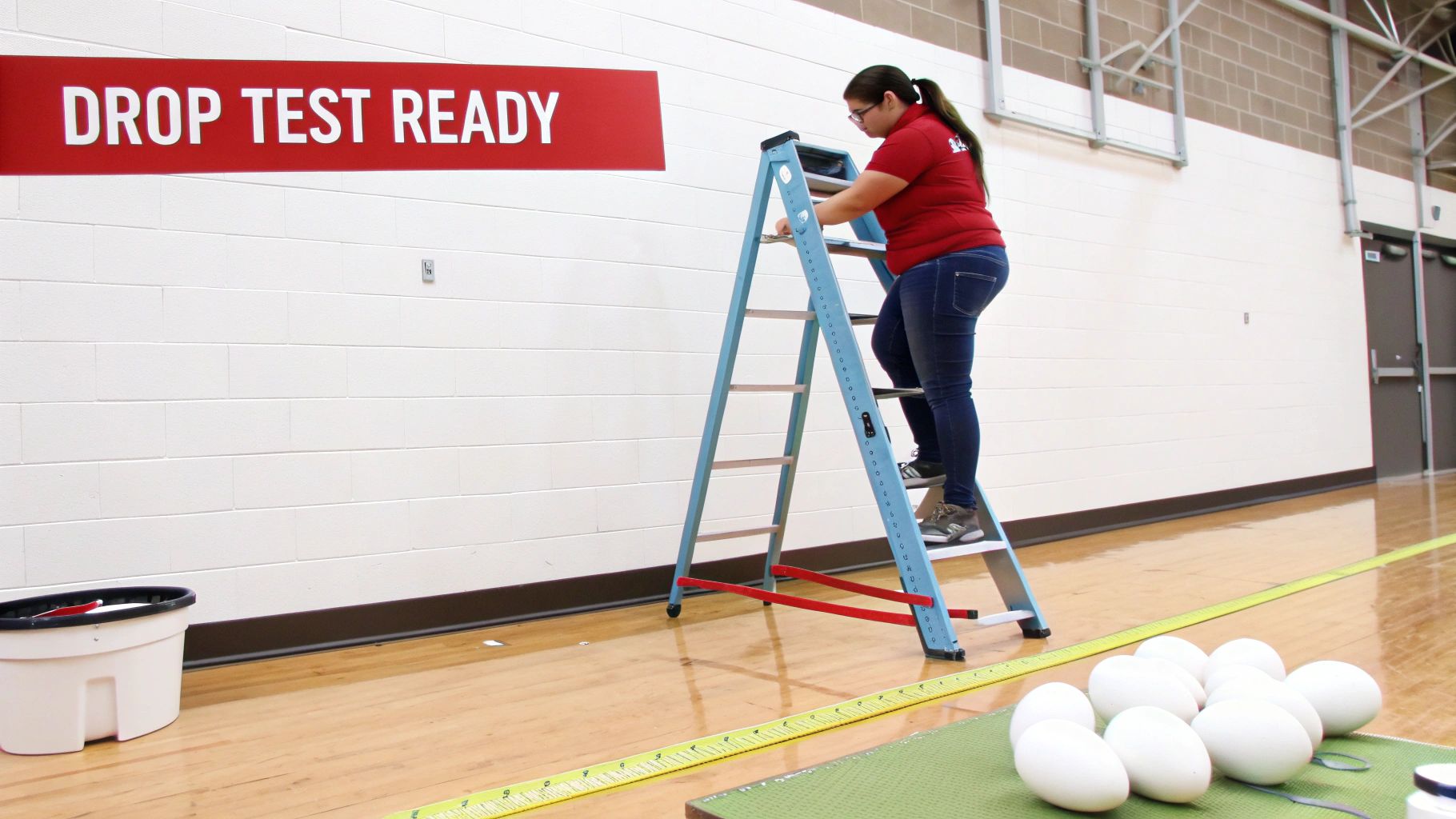
Alright, the moment of truth has arrived! After all the brainstorming, building, and tweaking, it’s time to see if your engineering masterpiece can protect its precious cargo. Launch day for your egg drop experiment is always a blast, but a little prep work can turn a fun activity into a real scientific investigation.
Running a successful test is about more than just chucking a project off a ledge. It’s about treating it like a genuine experiment. That means controlling your variables, making an educated guess (a hypothesis), and carefully observing what happens—whether you get a perfect landing or a spectacular splat.
Setting Up a Safe Drop Zone
Safety is priority number one on launch day. A secure, well-managed testing area is non-negotiable and lets everyone focus on the science without any worries. An adult should always be supervising, especially when dropping from any height.
First, pick your drop location. A second-story window or a sturdy stepladder usually provides enough height to make things interesting. Before anyone launches anything, make sure the drop zone is completely clear of people, pets, or anything breakable. It’s a good idea to mark off this landing area to keep excited spectators from getting too close to the action.
The Official Launch Protocol
To make your test feel like a real scientific trial, follow a simple pre-flight checklist. This isn't just for show; it adds structure and helps you gather useful data from every single drop.
Here’s a simple protocol we recommend:
- Run a Pre-Flight Check: Do a quick once-over. Is your egg snug inside its contraption? Are all parts of your device attached correctly?
- Measure Your Drop Height: Grab a measuring tape and get a precise height from the drop point to the ground. Keeping this consistent for every test is absolutely critical for good data.
- State Your Hypothesis: Before you let go, make a prediction. Will the egg survive? Why do you think so? This is a core part of the scientific method.
- Start the Countdown: You can’t go wrong with a classic "3, 2, 1, drop!" It builds excitement and makes sure everyone is ready and watching.
The real win isn't just avoiding a cracked egg; it's learning from every single outcome. When you shift your focus from a simple pass/fail to a process of discovery, you unlock the real learning. Figure out what worked, what didn't, and why.
After the drop, carefully inspect your device and the egg. Jot down the results. Was it a complete success? A tiny crack? Or a total mess? A broken egg gives you the best data for making improvements, so don't get discouraged!
Even in a controlled setting, success isn't guaranteed. I once saw a high school physics experiment where drops from over 160 feet still only had a 51.5% survival rate. It’s a powerful reminder of how much your choice of materials and impact distribution really matters. These kinds of science experiments for kids at home are fantastic for seeing physics in action, splats and all.
Common Egg Drop Experiment Questions
Even the most seasoned engineers have questions, and a few always pop up when it comes to the classic egg drop experiment. Let's tackle the most frequent ones to help you move past any roadblocks and turn this project into a real scientific exploration.
What Is the Best Material for an Egg Drop?
This is the big question, but there's no single "best" material—and that’s the whole point! The most brilliant designs don't rely on one magic ingredient. Instead, they cleverly combine different materials to do specific jobs.
Think of it like building a team where every player has a unique role:
- For Cushioning: You need things that are soft and compressible. Sponges, bubble wrap, or even a fortress of marshmallows are fantastic choices. Their job is to absorb the shock by deforming when the device hits the ground.
- For Structure: This is your protective frame. Lightweight but strong materials like cardboard, drinking straws, or popsicle sticks create a cage that keeps the egg from being crushed and helps spread out the impact force.
- For Deceleration: The goal here is to slow the whole thing down. A simple plastic grocery bag or a well-designed paper cone can act as a parachute, increasing air resistance and giving your egg a much gentler ride to the ground.
The winning project is almost always the one that creatively combines these different elements, turning everyday items into a high-performance landing system.
How Can We Make the Egg Drop More Challenging?
Once you've nailed the basic drop, it's time to up the ante! By adding a few constraints, you can transform this from a simple activity into a serious engineering challenge, perfect for older kids or advanced groups. This is where real problem-solving skills come into play.
A few ideas we love are introducing a budget system—give everyone some play money and assign a "cost" to each material. Suddenly, that roll of bubble wrap looks a lot more expensive! You could also enforce strict size or weight limits, which forces a more efficient and clever design.
For a true test of engineering, require a design that's reusable. Can it survive multiple drops without needing a single repair?
Want to bring in the math? Challenge participants to calculate the potential energy of the egg before the drop (mass × gravity × height) and estimate its final velocity. This adds a fantastic layer of physics to the hands-on fun.
What Is the Main Learning Goal of This Project?
At its heart, the egg drop project is a hands-on, unforgettable way to see physics in action. It makes abstract concepts like gravity, air resistance, and impulse (the change in momentum) feel real and easy to grasp.
But the science is only half the story. The experiment is a perfect introduction to the engineering design process: you brainstorm, design a prototype, build it, test it, and then figure out how to make it better. It also teaches crucial life skills like creative problem-solving and critical thinking—and maybe most importantly, resilience when a design doesn't work perfectly on the first try.
My Egg Broke. How Do I Make It a Positive Experience?
First things first: a broken egg is a fantastic learning opportunity, not a failure! In fact, this is where the real science begins.
Encourage your child to become a "forensic engineer." Together, investigate the crash scene. Look carefully at the device and the cracked egg. Where did the structure fail? Did the parachute not open? Did the cushioning get completely squashed, transferring the force directly to the egg?
This analysis is the most valuable part of the scientific method. Celebrate the effort and everything you learned from the test. Then, start brainstorming how to improve the design for the next round. This is how you teach resilience and show that science and engineering are all about trying, failing, and trying again.
At Playz, we believe the best learning happens when you're having fun. The egg drop is a perfect example of how a simple challenge can spark a lifelong love for science. If you’re looking for more ways to make learning an adventure, check out our collection of science kits and creative toys designed to inspire curiosity in every kid.
Discover more at Playz and join over 5 million satisfied customers who know that #KidsLearnBestThruPlayz.