

Gross motor skills—the large movements using arms, legs, and the entire body—are the bedrock of a preschooler's physical development. They aren't just about running and jumping; they are about building the strength, coordination, and confidence needed to explore the world with curiosity and capability. Mastering these big movements is fundamentally linked to improved classroom focus, healthier social interactions, and establishing a lifelong love of physical activity.
Providing purposeful opportunities for active play is more critical than ever. This guide moves beyond generic advice to provide a detailed, actionable roadmap for ten engaging and fun-filled gross motor activities for preschoolers. Each activity is broken down with step-by-step instructions, clear objectives, and practical variations for both indoor and outdoor settings. For those seeking even more structured approaches to development, you can explore a wealth of ideas for occupational therapy activities designed to promote motor skills.
This curated collection is designed for immediate use by parents, caregivers, and educators. You'll find everything needed to set up dynamic play sessions that challenge and delight your preschooler, building a strong foundation for their physical and cognitive journey. Let’s get moving!
1. Obstacle Course Training
An obstacle course is a fantastic way to structure physical play, guiding preschoolers through a series of challenges that target different gross motor skills. This activity involves setting up a path with various stations where children must crawl, jump, balance, or climb, providing a comprehensive physical and mental workout. It’s one of the most versatile gross motor activities for preschoolers because it can be adapted to any space, skill level, or available materials.
How It Works
An obstacle course creates a clear start and finish line with multiple tasks in between. For example, a child might start by crawling through a play tunnel, then walk heel-to-toe along a line of tape on the floor (the "balance beam"), jump over a row of pillows ("hot lava"), and finish by tossing a beanbag into a bucket. The sequence encourages problem-solving, planning, and memory as they recall the order of events.
Why It's a Great Gross Motor Activity
Obstacle courses are effective because they engage multiple muscle groups and developmental domains simultaneously. They improve:
- Coordination and Balance: Navigating different obstacles requires precise body control.
- Strength and Endurance: Climbing, jumping, and crawling build muscle.
- Spatial Awareness: Understanding how their body moves in relation to objects around them.
- Confidence: Successfully completing a course provides a powerful sense of accomplishment.
Actionable Tips for Implementation
- Start Simple: Begin with 3-4 low-risk challenges, like crawling under a blanket draped over two chairs. As they master it, add a new station.
- Use Household Items: You don't need special equipment. Use pillows for jumping over, painter's tape for balance lines, and laundry baskets for targets.
- Involve Your Child in the Design: Ask your preschooler, "What should we do next?" This boosts engagement, creativity, and ownership of the game.
- Supervise Actively: Always stay close to offer a helping hand and encouragement, especially for new or challenging obstacles.
2. Dancing and Movement Games
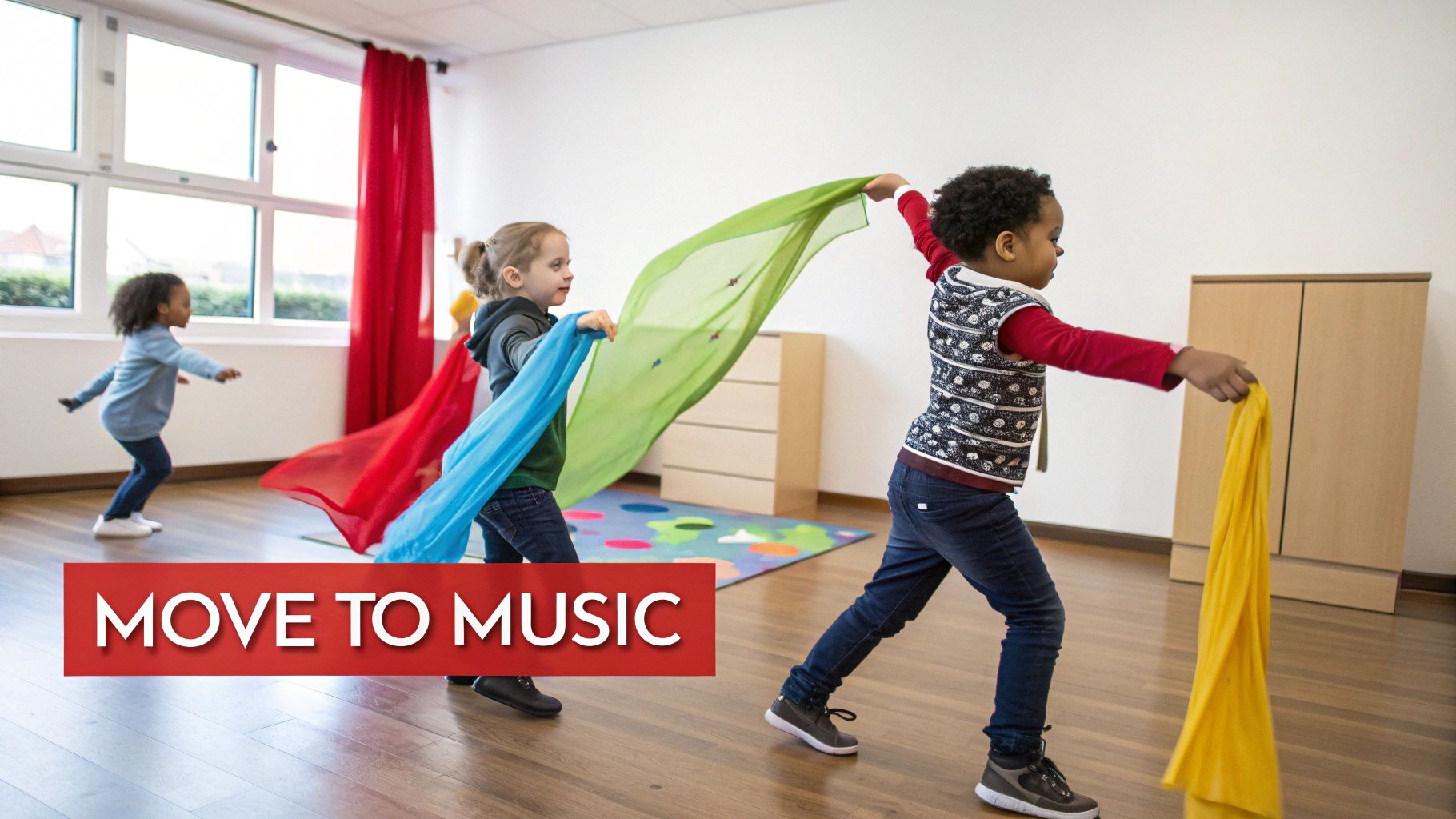
Dancing and movement games are joyful and rhythmic activities that encourage preschoolers to express themselves creatively through motion. These games, like freeze dance or musical statues, use music to inspire running, jumping, spinning, and swaying, making them some of the most engaging gross motor activities for preschoolers. This approach naturally develops coordination, rhythm, and body awareness in a fun, low-pressure environment.
How It Works
The premise is simple: play music and invite children to move their bodies to the rhythm. Games like "Freeze Dance" add a layer of challenge by requiring children to stop moving when the music pauses and hold their pose. Other variations involve imitating animal walks (like a bear crawl or frog hop) or using props like colorful scarves to guide motion. This combination of auditory cues and physical response strengthens the mind-body connection.
Why It's a Great Gross Motor Activity
Music-based movement uniquely blends physical development with sensory and cognitive processing. These activities are powerful because they improve:
- Coordination and Rhythm: Moving to a beat helps children synchronize their body movements.
- Balance and Body Control: Activities like freeze dance require children to hold still in various positions, challenging their stability.
- Listening Skills and Self-Regulation: Following cues to start and stop movement builds focus and impulse control.
- Emotional Expression: Dance provides a healthy outlet for children to express feelings and release energy.
Actionable Tips for Implementation
- Use Diverse Music: Introduce different genres and tempos—from slow, flowing classical to upbeat pop—to inspire a variety of movements.
- Incorporate Props: Add play scarves, ribbons, or even balloons. Watching a scarf float down after being thrown in the air helps teach body control and timing.
- Model, Don't Direct: Show fun movements yourself instead of telling children exactly what to do. Your enthusiasm is contagious and encourages their creativity.
- Add Storytelling: Pretend to be different animals, growing flowers, or floating clouds to spark imagination. This method supports a kinesthetic learning style by connecting physical action to concepts.
3. Climbing Structures and Play Equipment
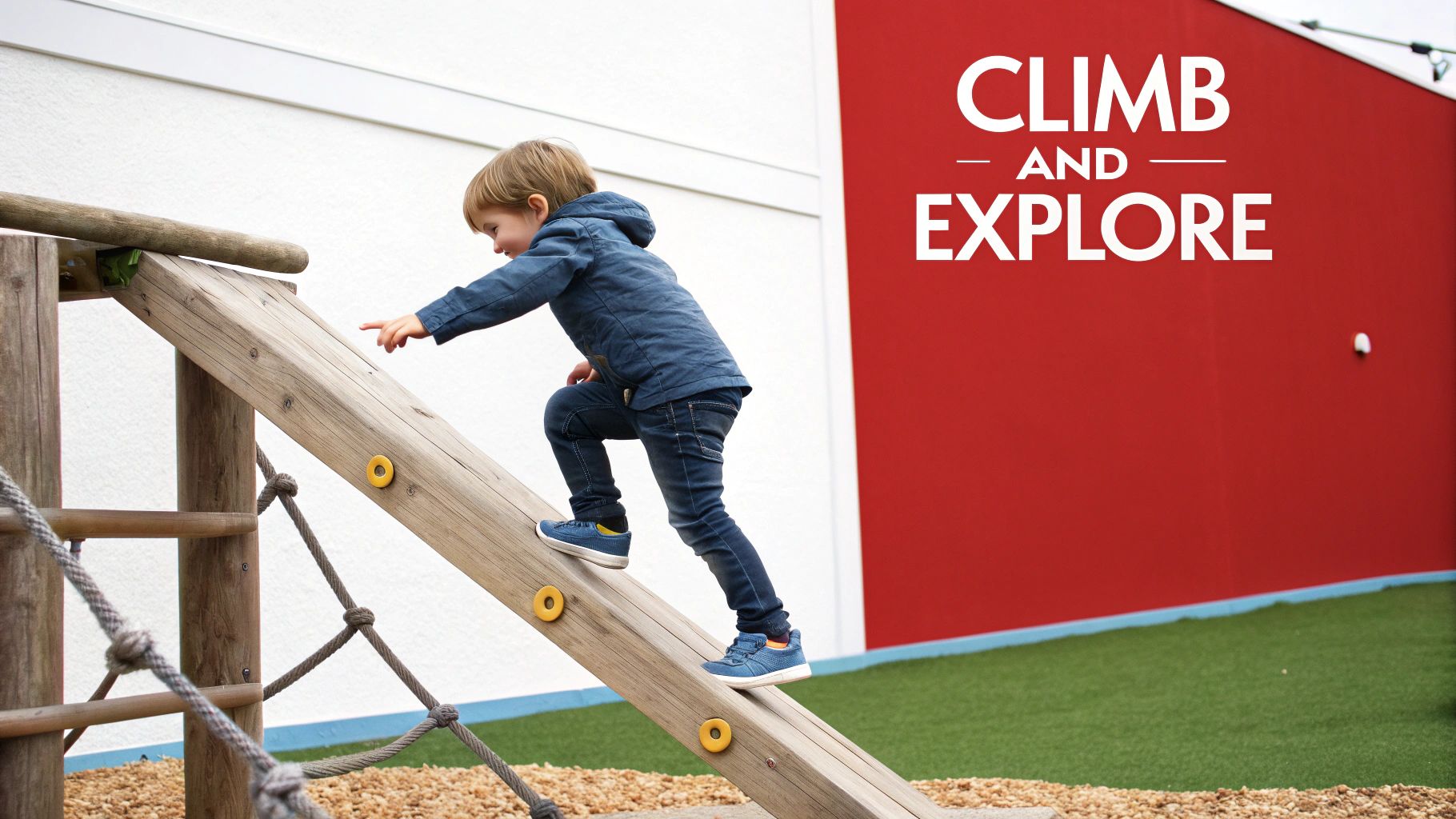
Climbing on dedicated structures like jungle gyms, low climbing walls, or playground equipment is a foundational gross motor activity that builds strength, coordination, and confidence. This activity encourages preschoolers to use their entire body to navigate vertical and horizontal challenges, engaging muscles that aren't typically used during ground-level play. From small indoor climbing triangles to larger outdoor setups, these structures offer a safe and engaging environment for physical development.
How It Works
Climbing involves a complex sequence of movements: reaching, pulling, pushing, and stepping. Children must assess the structure, plan their route, and execute a series of coordinated actions to move from one point to another. This process naturally enhances problem-solving skills as they figure out where to place their hands and feet. When selecting structures, exploring the top playground equipment for toddlers can help ensure you find options that are both safe and developmentally appropriate.
Why It's a Great Gross Motor Activity
Climbing is one of the most effective gross motor activities for preschoolers because it targets multiple physical and cognitive skills simultaneously. It directly improves:
- Upper Body and Core Strength: Pulling their body weight up builds significant muscle in the arms, shoulders, and abdomen.
- Balance and Coordination: Maintaining stability while moving all four limbs requires advanced body control.
- Risk Assessment: Safely navigating a climbing structure teaches children to evaluate challenges and understand their physical limits.
- Motor Planning: The mental process of planning and executing movements ("what do I move next?") is heavily stimulated.
Actionable Tips for Implementation
- Start Low: Introduce climbing with low-to-the-ground structures, like a pikler triangle or a small slide, to build confidence before moving to higher equipment.
- Ensure Soft Landings: Always have a soft surface like rubber mulch, sand, or interlocking mats underneath climbing areas.
- Teach the "Three-Point" Rule: Instruct children to always keep three points of contact (two hands and one foot, or two feet and one hand) on the structure for stability.
- Supervise, Don't Push: Stay close for support but allow the child to climb at their own pace and to a height that feels comfortable for them. Many of the best learning toys for preschoolers incorporate safe, low-level climbing elements.
4. Ball Games and Throwing Activities
Ball games are a classic and highly effective way to engage preschoolers in physical activity, building foundational skills that are crucial for athletic and everyday movements. These activities involve throwing, catching, kicking, and rolling, helping children understand how their bodies can interact with objects in motion. As one of the most fundamental gross motor activities for preschoolers, ball play can range from simple, unstructured fun to more organized games, adapting easily to any child's developmental stage.
How It Works
Ball play is centered on the concept of cause and effect. A child throws a ball and watches it travel, learning to predict its path and adjust their movements accordingly. Activities can include rolling a soft ball back and forth with a partner, attempting to catch a large, slow-moving ball, or kicking a ball toward a target like a cardboard box. This teaches children to coordinate their hands, eyes, and feet to achieve a goal.
Why It's a Great Gross Motor Activity
Ball games and throwing activities are excellent for developing a wide range of physical and cognitive skills. They directly improve:
- Hand-Eye Coordination: Watching, tracking, and reacting to a moving ball is a powerful way to build this skill.
- Timing and Rhythm: Learning when to release a ball or position their hands to catch it develops a sense of timing.
- Force and Distance Judgment: Children learn how much strength to use to make a ball go a certain distance.
- Bilateral Integration: Using both hands together to catch or both feet to kick strengthens communication between both sides of the brain.
Actionable Tips for Implementation
- Start Big and Soft: Use oversized, lightweight balls (like beach balls or playground balls) to make catching and throwing less intimidating and more successful.
- Focus on Cooperation: Begin with cooperative games, like rolling the ball to a partner, before introducing competition. You can learn more about how to structure these activities with cooperative play activities for preschoolers.
- Create Targets: Set up buckets, hula hoops, or cardboard boxes as targets for throwing. This makes practice fun and goal-oriented. For example, "Can you feed the monster?" by tossing a beanbag into a decorated box.
- Celebrate the Effort: Praise the attempt to throw or catch, not just the successful outcome. Say, "Great try!" or "You kept your eye on the ball!" to build confidence and resilience.
5. Running and Chasing Games
Running and chasing games are classic, high-energy activities that build cardiovascular fitness, speed, and agility. These dynamic games, like tag or follow the leader, involve sustained movement, quick directional changes, and the thrill of pursuit, making them a natural and joyful way for children to develop powerful leg muscles and improve their reaction time. They are foundational gross motor activities for preschoolers that tap into a child’s instinctual love for active play.
How It Works
These games are based on simple rules of pursuit and evasion. In a game of "Freeze Tag," one child chases the others, and anyone tagged must freeze in place until another player unfreezes them. In "Red Light, Green Light," children run on "green" and must stop instantly on "red," practicing their ability to start and stop on command. The core mechanic involves reacting to others' movements and navigating space efficiently.
Why It's a Great Gross Motor Activity
Running and chasing games are essential for developing a wide range of physical and social skills beyond just running fast. They help improve:
- Cardiovascular Endurance: Sustained running builds heart and lung strength.
- Agility and Coordination: Quickly changing direction and dodging obstacles enhances body control.
- Reaction Time: Responding swiftly to a tagger or a command sharpens cognitive processing.
- Social Skills: Learning to take turns, follow rules, and engage in fair play are key components.
Actionable Tips for Implementation
- Establish Clear Boundaries: Use cones, chalk, or even shoes to mark a safe, defined play area to prevent children from running into unsafe zones.
- Use Modified Rules for Beginners: Start with versions like "Shadow Tag" (tagging shadows instead of bodies) or bubble-chasing to reduce physical contact and competition.
- Ensure Safe Surfaces: Choose soft, open areas like grass or a padded gym floor. These games are a perfect example of the benefits of outdoor play.
- Monitor for Fatigue: These are high-energy games! Encourage frequent water breaks and ensure children rest when they feel tired.
6. Jump Rope and Jumping Activities
Jump rope and other jumping activities are fundamental for developing lower body strength, rhythm, and coordination. This category of play focuses on using the large leg muscles to propel the body upward, an action that requires timing, balance, and power. For young children, these are essential gross motor activities for preschoolers that build a foundation for more complex movements like running, skipping, and sports.
How It Works
Jumping activities progress in difficulty as a child develops. Initially, a preschooler may practice simple two-foot vertical jumps in one spot. As they gain confidence, they can try hopping on one foot, jumping over small objects like a line on the floor ("jumping over the river"), or jumping in different directions. Introducing a jump rope adds another layer of complexity, requiring them to coordinate the movement of their arms and legs simultaneously.
Why It's a Great Gross Motor Activity
Jumping is a high-impact activity that offers significant developmental benefits in a fun, engaging package. It effectively improves:
- Leg Strength and Power: The repetitive motion of jumping builds muscle in the calves, quadriceps, and glutes.
- Rhythm and Timing: Successfully clearing a rope or landing a sequence of hops requires a strong internal sense of rhythm.
- Cardiovascular Endurance: Jumping is an excellent aerobic exercise that strengthens the heart and lungs.
- Bone Density: Weight-bearing activities like jumping help build strong, healthy bones.
Actionable Tips for Implementation
- Start Without a Rope: Begin by practicing simple jumps in place, forward and backward, and side to side. Use games like "Simon Says" (e.g., "Simon says jump three times!").
- Use Visual Targets: Place painter's tape on the floor and encourage your child to jump from one line to another.
- Introduce the Rope Slowly: First, lay the rope on the ground and have them practice jumping over it. Then, have two adults hold the rope and wiggle it back and forth on the ground (like a snake) for them to jump over.
- Choose the Right Rope: A shorter, lighter, beaded rope is often easier for a preschooler to handle and feel as it hits the ground, providing a helpful auditory cue.
7. Tricycle and Bike Riding
Tricycle and bike riding are classic activities that powerfully develop leg strength, balance, and directional awareness. This progression, from stable tricycles to bikes with training wheels, allows children to build confidence as they master new skills. These activities are excellent gross motor activities for preschoolers because they directly teach cause-and-effect as children learn that pedaling creates forward motion.
How It Works
This activity centers on mastering a pedal-powered vehicle. A preschooler first learns to sit, steer, and push with their feet on a tricycle or balance bike. They then progress to coordinating pedaling and steering simultaneously. The goal is to move from one point to another with control, navigating gentle turns and learning to stop safely.
Why It's a Great Gross Motor Activity
Riding a tricycle or bike offers a unique combination of physical and cognitive benefits, making it a cornerstone of gross motor development. It specifically enhances:
- Leg Strength and Endurance: The repetitive motion of pedaling builds major muscle groups in the legs.
- Balance and Coordination: Staying upright and steering requires the body and brain to work together.
- Directional Control: Children learn to navigate, understanding concepts like left, right, forward, and stop.
- Independence: Mastering a bike gives preschoolers a significant boost in self-confidence and autonomy.
Actionable Tips for Implementation
- Ensure a Proper Fit: Adjust the seat height so your child's feet can comfortably touch the ground or pedals. Their knees should have a slight bend when the pedal is at its lowest point.
- Start on Flat Ground: Begin in a safe, open area like an empty driveway, a quiet cul-de-sac, or park path, away from traffic.
- Helmet First, Always: Make wearing a properly fitted helmet a non-negotiable rule from the very first ride. This establishes a lifelong safety habit.
- Focus on Steering and Stopping: Before worrying about speed, practice making wide turns and steering toward specific targets. Also, practice how to stop safely using their feet or a coaster brake.
8. Yoga and Stretching for Preschoolers
Yoga and stretching are gentle yet powerful ways to enhance flexibility, body awareness, and balance in young children. Rather than focusing on perfect poses, preschool yoga uses storytelling, animal themes, and playful movements to make physical activity engaging. This approach makes it one of the best gross motor activities for preschoolers for developing body control and mindfulness simultaneously.
How It Works
Preschool yoga guides children through a series of simple poses often disguised as a fun story or adventure. For example, a "trip to the zoo" could involve stretching into a "downward dog" pose, balancing like a "flamingo" on one leg, and arching the back like a "cat." This narrative approach holds their attention while they explore how their bodies can move, bend, and balance in new ways. Popular resources like the Cosmic Kids Yoga channel on YouTube excel at this method.
Why It's a Great Gross Motor Activity
This activity offers a unique combination of physical and mental benefits, helping children develop a strong mind-body connection. The core benefits include:
- Flexibility and Strength: Gentle poses lengthen and strengthen muscles.
- Body Awareness and Coordination: Children learn to identify and control different parts of their bodies.
- Balance and Posture: Holding poses improves stability and encourages proper alignment.
- Focus and Calm: Combining movement with breathing exercises helps regulate emotions and improve concentration.
Actionable Tips for Implementation
- Tell a Story: Frame poses around a theme your child loves, like animals, nature, or transportation, to keep it fun and engaging.
- Keep It Short and Sweet: Aim for 10-15 minute sessions to match a preschooler's attention span. You can do a few poses before naptime or as a calming activity.
- Be Playful, Not Perfect: Let go of perfect form. The goal is exploration and fun, not flawless execution of a pose.
- Use Visuals: Use yoga cards for kids or demonstrate the poses yourself to provide a clear, easy-to-copy guide.
- Never Force a Stretch: Encourage gentle movement and listen to their body. Stop if a child shows discomfort.
9. Foam Pit and Soft Play Structures
Foam pits and soft play structures offer a cushioned, safe environment where preschoolers can confidently practice dynamic movements like jumping, falling, and rolling. These specially designed areas, filled with foam blocks or covered in soft padding, create a forgiving space for children to test their physical limits without the fear of getting hurt. This makes them one of the best gross motor activities for preschoolers to build foundational courage for more advanced skills.
How It Works
These environments encourage free-form exploration and calculated risk-taking. A child might leap from a low platform into a foam pit, climb over large padded blocks, or practice somersaults on a soft mat. The structures absorb impact, which empowers children to experiment with their balance and coordination. This setup is similar to how a padded play area inside a play tent can create a designated safe zone for motor skill development. For more ideas on creating contained play spaces, you can find inspiration for indoor play tents on playzusa.com.
Why It's a Great Gross Motor Activity
Soft play is highly effective because it directly addresses the fear that can inhibit motor skill development. The controlled environment helps improve:
- Body Control and Proprioception: Learning how to land, roll, and absorb impact safely.
- Confidence and Risk Assessment: Building the courage to try new movements and understanding physical boundaries in a low-consequence setting.
- Core Strength: Engaging abdominal and back muscles while climbing and maneuvering over soft obstacles.
- Coordination: Combining jumping, landing, and balancing in a continuous flow of movement.
Actionable Tips for Implementation
- Teach Safe Landings: Show children how to bend their knees when landing or how to perform a simple tuck-and-roll. "Land like a superhero!"
- Start Small: Encourage jumping off a very low surface before moving to higher platforms.
- Supervise Actively: Always have a spotter nearby to guide children and ensure they are using the equipment safely, following any posted rules of the play area.
- Celebrate the Attempt: Praise their bravery for trying, regardless of how "perfect" the movement is. This builds resilience and a willingness to try again.
10. Balance Bike and Scooter Activities
Balance bikes and scooters are incredible tools for developing dynamic balance and coordination. Unlike tricycles, these pedal-free vehicles teach preschoolers to glide and steer using their own body weight and momentum. They sit lower to the ground, allowing children to plant their feet for stability, making them a safe and intuitive introduction to two-wheeled motion and one of the most effective gross motor activities for preschoolers.
How It Works
A child sits on the balance bike or stands on the scooter and propels it forward by pushing off the ground with their feet—like walking or running. As they gain speed, they lift their feet and glide, naturally learning how to shift their weight to maintain balance and steer. This process isolates the skill of balancing, which is often the biggest hurdle when learning to ride a traditional bicycle.
Why It's a Great Gross Motor Activity
Riding a balance bike or scooter offers a powerful combination of physical development and confidence-building. These activities significantly improve:
- Dynamic Balance: Mastering the ability to stay upright while in motion.
- Coordination: Synchronizing leg pushes with steering and body posture.
- Core Strength: Engaging abdominal and back muscles to maintain stability.
- Confidence: The sense of freedom and control builds self-esteem and often leads to a seamless transition to a pedal bike without training wheels.
Actionable Tips for Implementation
- Proper Fit is Key: Ensure the child’s feet can rest flat on the ground while they are seated on a balance bike. This gives them the control and confidence to stop.
- Start on a Gentle Slope: Find a safe, enclosed area with a very slight downhill grade. This helps them experience gliding without having to push off as hard.
- Teach Gliding: Encourage them to take long strides ("dinosaur steps!") and then lift their feet to "glide" for a few seconds.
- Always Use a Helmet: Make wearing a properly fitted helmet a non-negotiable rule from the very first ride.
Comparison of 10 Gross Motor Activities for Preschoolers
| Activity | 🔄 Implementation Complexity | ⚡ Resource & Setup | 📊 Expected Outcomes | Ideal Use Cases | ⭐ Key Advantages / 💡 Tips |
|---|---|---|---|---|---|
| Obstacle Course Training | Medium–High: planning, setup, constant supervision | Space + varied props; indoor or outdoor adaptable | ⭐⭐⭐⭐ Develops coordination, balance, strength, spatial reasoning | PE lessons, birthday parties, progressive motor-skill sessions | Highly adaptable and progressive — 💡 start simple, use visual markers, supervise |
| Dancing and Movement Games | Low: simple rules, easy adaptation | Minimal: music source and open area; possible audio gear | ⭐⭐⭐ Builds rhythm, coordination, listening and expression | Transitions, inclusive group activities, small indoor spaces | Very accessible and low-cost — 💡 use scarves/props, demo movements first |
| Climbing Structures & Play Equipment | High: installation, safety compliance, maintenance | Significant: dedicated equipment, space, periodic inspections | ⭐⭐⭐⭐ Strong gains in strength, balance, problem-solving | Playgrounds, long-term installations, indoor play centers | Measurable progression and long-term value — 💡 ensure soft landings and regular checks |
| Ball Games & Throwing Activities | Low: simple progressions, easy rule changes | Minimal: various soft balls, open clear space | ⭐⭐⭐ Improves hand‑eye coordination, social skills, motor control | Recess, PE, backyard practice, cooperative group games | Inexpensive and scalable — 💡 start with oversized soft balls and cooperative games |
| Running & Chasing Games | Low–Medium: rule design and safety management | Open flat space, clear boundaries; minimal equipment | ⭐⭐⭐⭐ Builds cardiovascular fitness, agility, speed | Outdoor play, energy-release sessions, group games | Highly engaging aerobic exercise — 💡 set clear boundaries and modify rules to include all |
| Jump Rope & Jumping Activities | Low–Medium: progressive skill teaching | Flat open area, jump ropes; proper footwear | ⭐⭐⭐⭐ Develops leg strength, rhythm, timing, explosive power | Short skill drills, cardio bursts, jump-rope clubs | Portable and measurable — 💡 begin with two-foot jumps then introduce ropes |
| Tricycle & Bike Riding | Medium: fitting, supervision, progressive training | Requires equipment, safe flat surfaces, helmets | ⭐⭐⭐⭐ Builds pedaling coordination, balance, independence | Outdoor exploration, mobility skill development, family outings | Strong long-term mobility gains — 💡 ensure proper fit and helmet use |
| Yoga & Stretching for Preschoolers | Low: short guided sessions, attention management | Minimal: mat/soft surface, short guided instruction or audio | ⭐⭐⭐ Improves flexibility, body awareness, breathing, calm | Calm-down routines, small group mindfulness, indoor sessions | Low‑impact and inclusive — 💡 keep sessions short, use stories and animal poses |
| Foam Pit & Soft Play Structures | High: installation, hygiene, maintenance, supervision | Large space, significant investment, cleaning protocols | ⭐⭐⭐⭐ Builds confidence, safe practice of jumps/rolls, resilience | Gymnastics centers, hesitant children, skills practice environments | Exceptional for safe experimentation — 💡 teach landings and maintain cleanliness |
| Balance Bike & Scooter Activities | Low–Medium: gradual progression, supervision | Balance bikes/scooters, safe flat riding area, helmets | ⭐⭐⭐⭐ Develops balance, weight distribution, directional control | Transition to pedal bikes, outdoor balance-focused play | Excellent balance builder and transition tool — 💡 ensure feet touch ground and use helmets |
Building a Foundation of Movement for a Lifetime of Fun
Incorporating dynamic and engaging gross motor activities for preschoolers into their daily lives is far more than just a way to burn off energy. From the coordinated challenge of an Obstacle Course to the freeing expression of Dancing and the focused balance required for Bike Riding, each activity is a building block for lifelong physical literacy. The consistent theme throughout these varied games is the powerful connection between movement and holistic development.
The most crucial takeaway is that fostering these skills doesn't require expensive equipment or a rigid schedule. The world is a playground. A simple line of chalk becomes a balance beam, a rolled-up sock transforms into a perfect throwing target, and a living room can instantly become a yoga studio. The goal is to view daily routines through a lens of active potential, weaving movement into the fabric of your preschooler's day naturally and joyfully.
Putting It All Into Action
So, where do you begin? Start small and build momentum.
- Observe and Adapt: Pay attention to which activities genuinely excite your child. Do they gravitate towards climbing, or do they love the thrill of a chase? Tailor your selections to their interests to ensure engagement.
- Create a "Movement Menu": Choose two or three activities from this list to try each week. This variety prevents boredom and exposes your child to a wide range of motor skill challenges, from balancing and jumping to throwing and pedaling.
- Integrate, Don't Isolate: Think about how to add movement to existing routines. Can you hop like a frog to the bathroom for toothbrush time? Can you practice balancing while waiting for a snack? These small additions accumulate into significant developmental gains.
By prioritizing these foundational movements, you are giving your child a profound gift. You are helping them build not just strong muscles and bones, but also problem-solving skills, emotional regulation, and self-confidence. They learn to assess risk on a climbing structure, persevere when learning to ride a tricycle, and cooperate during a ball game. These are lessons that extend far beyond the playground, building a resilient, capable, and confident individual who finds joy and strength in an active life.
Ready to spark even more active, hands-on learning? Explore the collection of play tents and science kits from Playz, designed to turn any space into an adventure zone that encourages both physical activity and cognitive growth. Discover your next favorite play-based learning tool at Playz and keep the fun moving