

Two eggs go into identical jars of vinegar on the same afternoon. Three days later one is a translucent rubber ball and the other still has a chalky band of shell stuck to one side. Same liquid, same timer, same kitchen counter. If the recipe was identical, what changed?
The recipe doesn't explain it. What explains it is the set of conditions the recipe never mentions: how much acid was in the jar, whether that acid was still active on day three, how large the egg was, and how warm the room got overnight. That's the gap most Egg in Vinegar Science Project write-ups leave open, and it's where the learning lives.
So treat this as a controlled experiment rather than a demonstration. You'll set a baseline, run a water control beside it, record numbers instead of impressions, and finish able to say why your egg behaved the way it did instead of just that it looked cool.
What You Need and How to Stay Safe
Set everything out before the first egg leaves the fridge. Once the shell is wet and the reaction has started, hunting for a scale or a roll of tape costs you a day of observations you can't get back.
Materials checklist
- Eggs: one fresh, uncooked large egg per test, and ideally two or three per condition so a single crack doesn't end the whole run.
- Jars: a clear glass jar of at least 500 mL with a loose lid, plus a second identical jar for the water control.
- Vinegar: about 250 mL of household white vinegar at 5% acidity for each vinegar jar.
- Measuring tools: a kitchen scale that reads to 0.1 g, and a flexible tape measure or a length of string for circumference.
- Log and labels: a notebook or printed sheet, masking tape, a marker, and a timer or phone alarm.
- Containment: a rimmed tray or baking dish under every jar, and paper towels within reach.
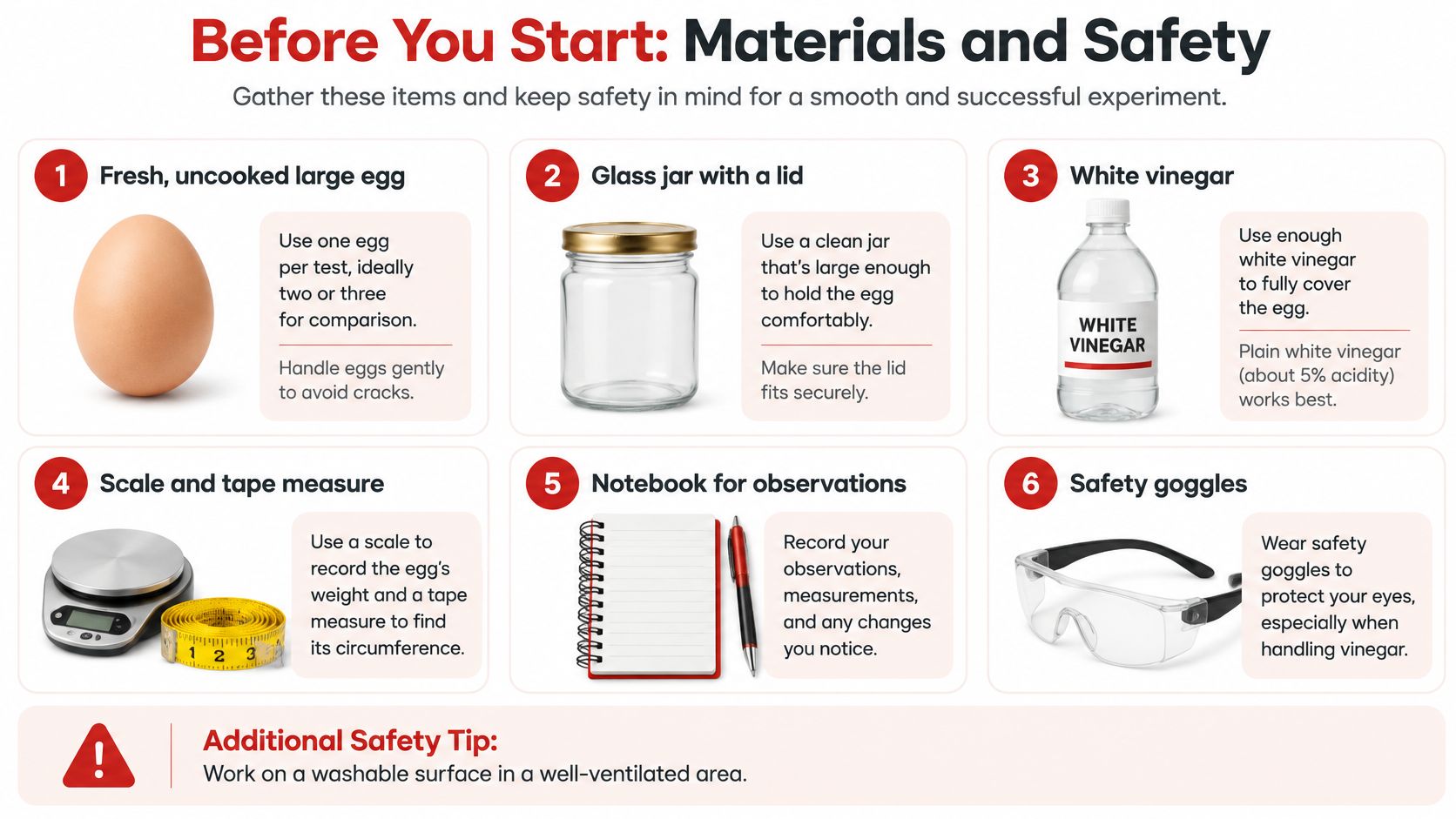
Why each safety rule exists. The American Chemical Society's experiment guide calls for adult supervision, goggles, gloves while pouring vinegar, and it states plainly that nothing you test should be tasted or eaten. That last rule matters more here than the acid: a finished rubber egg is still raw biological material, and the membrane can rupture and spread its contents across a table or a face. Wash hands thoroughly after touching the egg or the membrane, and keep jars off any surface where food gets prepared.
Household vinegar is a mild irritant, not a dangerous acid, so the bigger risk is mess and contamination. Work over the tray, bounce only over the tray, and dispose of the egg and leftover liquid according to your local household rules.
A clean, labelled setup is what makes results comparable a week later. Ten seconds with a marker now saves you from two jars you can't tell apart.
If you're assembling enough equipment for a classroom, teacher-founded tools for creative learning can cover the trays, labels and goggles in one go. And if the setup itself turns out to be the favourite part, there are more science experiments for kids that reuse exactly these jars and trays.
How to Run the Egg in Vinegar Experiment
Every step below carries the reason it matters and the mistake it prevents. Skipping a step rarely ruins the egg, but it usually ruins your ability to explain what happened.
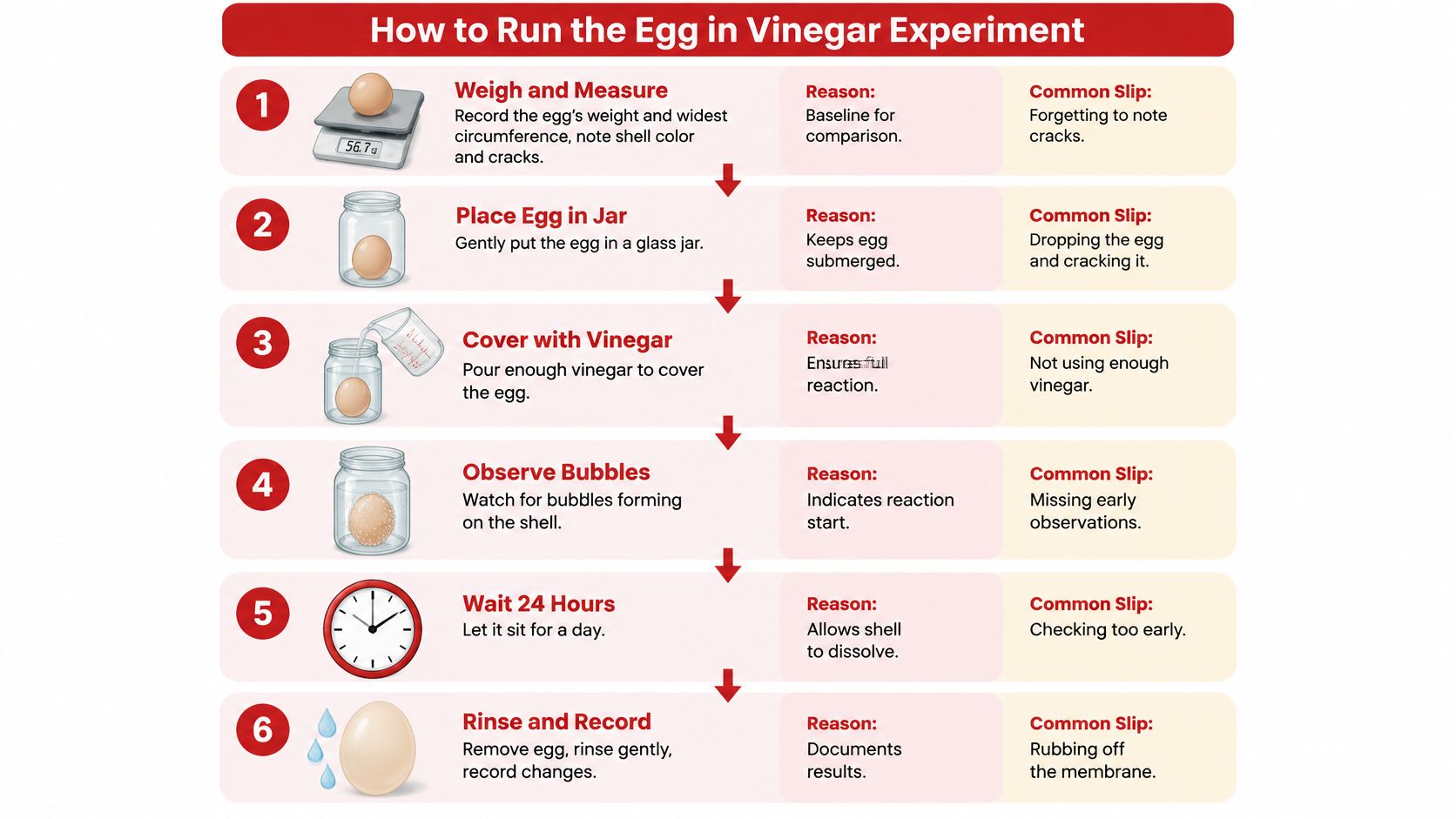
- Weigh the egg and measure its widest circumference. Record both numbers, plus shell colour and any hairline cracks. A crack you forgot about becomes a mystery leak on day two, and baseline numbers are the only thing that lets you prove the egg changed rather than argue it looks bigger.
- Lower the egg in with a spoon, not your fingers. A spoon spreads the load and keeps the shell off the jar wall. Dropping an egg even a few centimetres can start a crack that opens once the acid thins the shell.
- Pour about 250 mL of 5% white vinegar so it covers the egg by a couple of centimetres. Enough liquid means enough acid and enough room for dissolved calcium to disperse. A half-covered egg develops a tide line, with dissolved shell below and untouched shell above.
- Fill the control jar with plain water to the same level and add its own egg. Same jar, same volume, same room, same egg size. Without that comparison, every change you measure is unattributed.
- Label each jar with the date, the vinegar type and the volume. Masking tape and a marker take ten seconds. Unlabelled jars are the most common reason two results can't be compared a week later.
- Cover loosely and leave it at room temperature, out of direct sun. A loose lid lets carbon dioxide escape while keeping dust out. A sealed jar builds pressure, and a sunny windowsill warms one side of the glass, which pushes the reaction rate around.
- Count bubbles on the shell during the first hour. Fine bubbles mean the acid is working. Slow bubbling at the start is normal, not a failure, and it speeds up as the shell thins.
- Check once a day and replace the vinegar when bubbling has nearly stopped. The acid gets used up before the shell does, so fresh vinegar restarts a stalled jar. Waiting longer in spent vinegar only adds days.
- When the shell is gone, usually after two to three days, lift the egg out with a spoon, rinse it gently, pat it dry, then weigh and measure again. Rinsing removes loose shell; rubbing removes membrane. Use the same scale and the same tape position as day zero.
- Bounce only over the tray, and stop when the membrane looks thin or cloudy. A drop of a few centimetres shows the rubbery feel. Hard surfaces and confident drops end the experiment early.
Pour the used vinegar down the drain with plenty of running water, dispose of the egg per your local rules, and wash your hands.
Track Changes Day by Day
The log is what turns a novelty into an experiment. At every check, record one line and compare it against the water control before moving on.
| When | What to record | Expected result |
|---|---|---|
| Day 0 | Weight, circumference and shell colour | Baseline values for comparison |
| Within 1 hour | Number of bubbles on the shell | Small bubbles form as acid reacts with the shell |
| Day 1 | Shell texture and vinegar level | Shell looks dull and patchy; bubbling slows |
| Day 2 | Mass, circumference and membrane | Most shell gone; egg larger and rubbery |
| Day 3 | Final mass, bounce and membrane | Shell fully gone; stop before the membrane breaks |
Record what you see, not what you expect to see. A patchy shell on day one with no swelling is a result, and it's a more interesting one than a perfect egg.
The water control is the row-by-row reference point. Its egg should keep its shell and change far less in mass than the vinegar egg, which is exactly what separates acid damage from water movement. Expect a small change in the water jar; expect a large one in the vinegar jar.
You can judge the run in three checks. The vinegar egg loses shell and gains mass, the water egg keeps its shell, and the bounce test waits until the shell is completely gone. If the vinegar egg isn't heavier than its day zero weight after three days, something stalled, and the troubleshooting section will tell you what.
The Chemistry Behind It
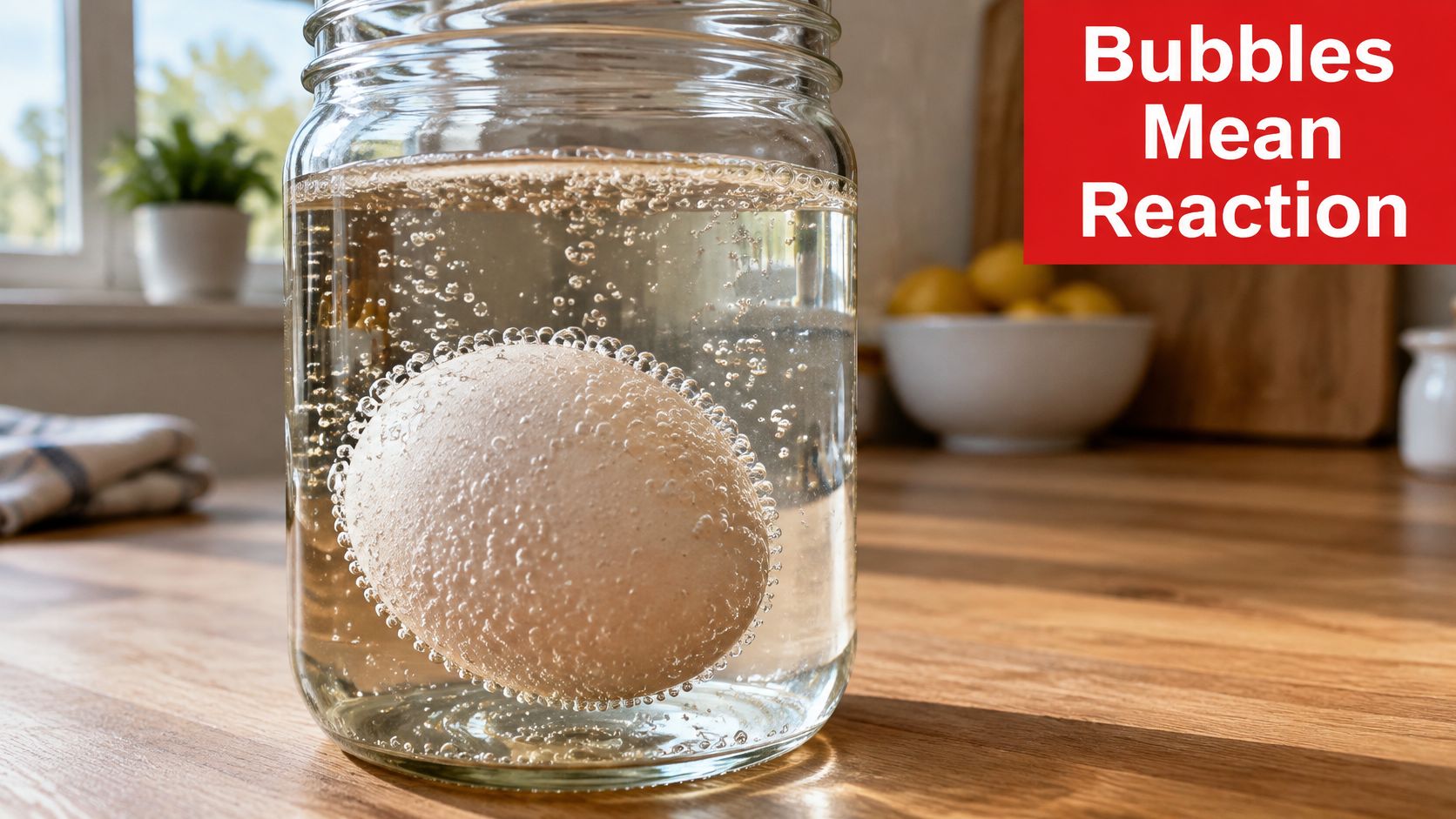
Vinegar is a dilute solution of acetic acid. An eggshell is mostly calcium carbonate, the same mineral as chalk and limestone. Put them together and the acid attacks the carbonate, releasing carbon dioxide as the bubbles you see clinging to the shell, plus water and a soluble calcium salt that drifts away into the liquid. The American Chemical Society explains the reaction in exactly these terms: acid plus calcium carbonate gives carbon dioxide and soluble products, while the membrane underneath stays intact and keeps the egg together. That membrane is the reason you end up with a whole, wobbly egg instead of a puddle.
The jar runs out of acid before the egg runs out of shell. A typical pour holds less acetic acid than the shell holds calcium carbonate, so the acid is the limiting reagent and the reaction stops when it's spent. This is the single most useful thing to understand about the experiment, because it explains why fresh vinegar works faster and why leaving the jar alone for a fourth day rarely helps.
Why a bigger egg doesn't prove vinegar got in
The shell-less egg swells, and it's tempting to say the vinegar soaked through. It didn't, at least not as the main effect. The egg's contents are more concentrated than the surrounding liquid, so water crosses the membrane to even things out, and the egg gains mass and volume without any acid making the trip.
That distinction matters for anyone running the Egg in Vinegar Science Project with a class, because it's the difference between a real conclusion and a guess. Swelling is evidence of osmosis. Shell loss is evidence of the acid reaction. Two separate processes, two separate measurements.
Families who like this kind of cause-and-effect thinking will find more of it in these chemistry experiments at home, which lean on the same acid-and-carbonate logic.
Variables That Change the Result
Every jar beyond the first two should differ from the baseline in exactly one way. Set the baseline as one large egg in 250 mL of 5% white vinegar at room temperature, with a water control beside it, and change nothing else.
| Variable | Change to test | What to measure |
|---|---|---|
| Vinegar volume | 100 mL against the 250 mL baseline | Days to full shell removal and mass change |
| Vinegar replacement | Replace daily against no replacement | Bubble count and shell removal speed |
| Vinegar concentration | 5% against a 2.5% dilution made with water | Bubbles in the first hour and shell hardness |
| Egg size | Small against large eggs of the same brand | Circumference change over the run |
| Temperature | Fridge at about 4°C against room temperature at about 21°C | Days to full shell removal |
| Water control | Plain water, same volume, same egg | Separates acid effects from water movement |
Change volume and concentration in the same jar and you've built an efficient-looking trial that tells you nothing. If the shell disappears faster, you won't know whether more acid did it or stronger acid did it. One variable per jar keeps the answer unambiguous.
Pick one row of that table for a home trial or a class project and hold everything else fixed. A single well-run comparison of fresh vinegar against no replacement will teach more than six sloppy jars lined up on a counter.
Practical rule: if you can't say in one sentence what makes jar B different from jar A, you've changed too much to interpret.
For a deeper look at designing fair tests like this one, these science experiments with variables walk through the same logic in other setups.
Fixing Results That Look Wrong
The shell is still on after three days. That's the result that sends most families to search for answers, and the cause is usually spent vinegar rather than a stubborn egg.
| Symptom | Likely cause | Fix |
|---|---|---|
| Shell still on after 3 days | Vinegar used up or too little | Replace with fresh vinegar and add more volume |
| Egg cracked or leaking | Rough handling or a hard bounce surface | Lift with a spoon and test only over a tray |
| No bubbles at all | Old vinegar, a cracked egg or a coated shell | Use fresh vinegar, check the shell, rinse gently |
| Strong smell | Egg decaying after a long run | Discard per local rules and start with a fresh egg |
| Cloudy shell, no swelling | Surface residue | Rinse gently and weigh again to compare |
A cloudy, chalky shell with no swelling usually means something is sitting on the shell rather than reacting with it. Rinse it gently and weigh the egg; a mass change over the next 24 hours tells you the reaction is running.
A run that fails is still data if you wrote it down. Log what you changed and what happened, and the next jar starts from a better hypothesis.
Frequently Asked Questions About the Egg in Vinegar Experiment
How long does the shell take to disappear? Usually two to three days in 5% white vinegar. Fresh vinegar and a room-temperature jar speed it up; a cold room or a reused jar slows it down.
Can the egg be eaten afterwards? No. It has soaked in acid and been handled raw, so don't taste, cook or eat it, and don't reuse the liquid for cooking.
Does the bounce prove the shell is gone? Yes, but test only over a tray and stop the moment the membrane looks thin or cloudy.
Can apple cider or brown vinegar be used? Yes. Acid strength differs between types, so log the exact type and keep it consistent across your control trial.
Why does the egg grow if vinegar doesn't enter it? Water crosses the intact membrane toward the more concentrated contents inside the egg.
Is the leftover liquid safe to pour away? Pour it down the drain with plenty of running water, and follow local household rules for the egg itself.
If floating and sinking questions come up next, this floating egg experiment makes a natural follow-up with the same eggs and jars.
Run a Controlled Trial at Home or in Class
Choose one variable from the table above. Set up a vinegar jar, a water control and at least one changed jar, then log mass, circumference and bubble counts on the same schedule for all three.
Two or three eggs per condition is the minimum worth comparing. One egg proves nothing except that one egg did something, and a single cracked shell can wipe out a whole day's data.
In a classroom, give each group one variable and put the results on a shared chart at the front of the room. Groups that replaced their vinegar every day will finish before the groups that didn't, and that visible gap teaches the limiting reagent better than any diagram.
Playz Science Kits cover chemistry, biology, physics, and more, so a family that enjoys this experiment has a straightforward next step into related topics with materials already prepared. Our scientific method steps for kids pairs well with the log you've just built.
Start the trial this week. Weigh both eggs today, write the numbers down, and bring the results back to compare.
Playz builds hands-on science kits that turn an afternoon at the kitchen table into a real investigation, from chemistry sets that bubble to biology kits that reward patience. If your family enjoyed watching the shell disappear, our Extreme Kids Chemistry Set and the rest of the range give you the next experiment without a trip to the shop. Visit Playz to find the kit that matches your young scientist's next question.