


The sheet keeps slipping, someone wants a bigger doorway, and your child has started dragging a chair toward the bookcase. You're trying to make a cozy place to play, not rearrange the living room into a construction site.
The best fort building supplies aren't the longest shopping list. They're the pieces that suit your child's age, fit the room, and won't create a bigger hazard when someone tugs, leans, or changes the plan.
Essential Fort Building Supplies to Gather First
Start with a lightweight covering, low walls, and a way for an adult to secure the fabric. Leave the decorations in the cupboard until the structure works.
For an afternoon build, gather a large bedsheet or lightweight blanket, couch cushions or firm pillows, and clean cardboard boxes. Keep binder clips or clothespins in the adult's hands rather than putting them into a communal building basket.
Skip the heavy quilt. A roof should feel like a loose covering, not a load suspended above children. If you need increasingly strong supports to hold it up, change the roof rather than adding furniture.
Fort building supplies to keep, add, or skip
The age suggestions below are conservative household choices, not product approvals. For purchased tents, tunnels, and lights, follow the specific product's age label and instructions.
| Supply | Job in the fort | Where it belongs | Typical cost | Age fit |
|---|---|---|---|---|
| Large bedsheet or lightweight blanket | Loose roof, never a climbing surface | Indoor | Already at home | Preschoolers and older, with an adult nearby |
| Couch cushions or firm pillows | Low walls and seats | Indoor | Already at home | Toddlers and older during supervised play |
| Large cardboard boxes | Overlapping wall panels | Indoor or dry shade | Often free if reused | Preschoolers and older |
| Binder clips or clothespins | Fabric connectors an adult attaches | Indoor | Use household supplies or check local pricing | Adult handles them |
| Pop-up play tent or crawl tunnel | Freestanding room with no furniture anchor | Indoor or outdoor, if labeled for it | Check the selected set's price | Match the product's age label |
| Battery LED puck light | Light without a flame or trailing cord | Indoor | Use an existing suitable light or check local pricing | Adult places it and secures battery access |
| Chairs or low stools | Optional supports only if they don't rock and nobody climbs | Indoor | Already at home | Older children, adult tested |
| Clothesline, stakes, or long cord | Skip for young children | Outdoor adult setup only | Not needed for the basic kit | Keep out of young children's play |
Add only what solves a problem
A pop-up play tent or crawl tunnel makes sense when you want an enclosed space without furniture supports. A rug can mark the floor boundary and reduce cushion movement. A cardboard flap can suggest a door, provided it doesn't block the opening or require a child to pull hard.
For lighting, choose a battery LED puck with a securely fastened battery compartment. Don't use a light with accessible batteries, damaged casing, or a loose cover.
Indoor and outdoor supplies aren't interchangeable. Keep household sheets, cushions, and dry cardboard indoors; outdoors, choose a purpose-built pop-up set on suitable ground, with a tarp used only as a ground sheet, never wrapped around the enclosure.
Practical rule: Choose a roof, a wall material, and an adult-controlled connector. Stop gathering when those jobs are covered.
Extra poles and furniture don't automatically improve the fort. Often, removing a troublesome piece gives children more usable room and adults fewer failure points to watch.
Sheets Cardboard and Fabric Compared
Choose materials by how they fail, not just how cozy they look. A sheet can sag, cardboard can buckle, and a clip can detach even when each piece seemed fine in the cupboard.
A lightweight cotton or flannel sheet is a useful loose roof because it's washable and easy to rearrange. But don't assume that all bedding belongs overhead. A thick quilt changes the load on every support beneath it.
Material verdicts for fort supplies
| Material | Works best for | How it fails in a child's hands | Verdict |
|---|---|---|---|
| Cotton or flannel sheet | Loose washable roof | Heavy bedding sags onto children | Keep, light sheets only |
| Polyester play-tent fabric | Frequent repeat builds | Can feel less cozy and less airy, especially with openings closed | Keep for frequent use |
| Cardboard panels | Reused overlapping walls | Softens with spills; corners crush | Keep, recycle when crushed |
| Couch cushions | Low walls and padding | Slide on hard floors | Keep with a rug underneath |
| Plastic binder clips | Holding fabric for adults | Pop off and can be mouthed by young children | Adult-controlled use, away from children who mouth objects |
| Cords, ties, stakes | Not needed for young children's forts | Entanglement, puncture, and tripping hazards | Skip |
Cardboard is particularly useful when children want to change the layout. Adults can cut doorways before play, remove staples, and check for torn edges or residue. If you need reusable boxes locally, Storage & Removal Boxes Ltd.’s Where can I get free cardboard boxes in the UK? offers a starting point for sourcing them.
Keep the alterations simple. Our cardboard craft ideas can inspire details without turning the fort into a project that needs sharp tools during play.
Fire behavior and reuse matter too
Every material in the table needs distance from ignition sources. Fabric, paperboard, foam, and thin plastic don't belong beside candles, portable heaters, fireplaces, or stoves.
The CPSC's toy-safety standards chart identifies ASTM F963 section 4.2 as the flammability provision and explains that its general exemption from mandatory third-party testing doesn't remove the underlying flammability obligations. Finished assemblies also deserve attention because seams, coatings, adhesives, printed inks, and layers can change burning or melting behavior.
Natural or recycled doesn't automatically mean safer, either. Judge a material by its condition, suitability, cleaning needs, and actual reuse rather than its label alone.
For an afternoon, a washable sheet with adult-controlled clips is practical. For a space children will rebuild throughout the week, a polyester play tent with floor cushions may mean less daily assembly. Neither choice needs extra decoration to work.
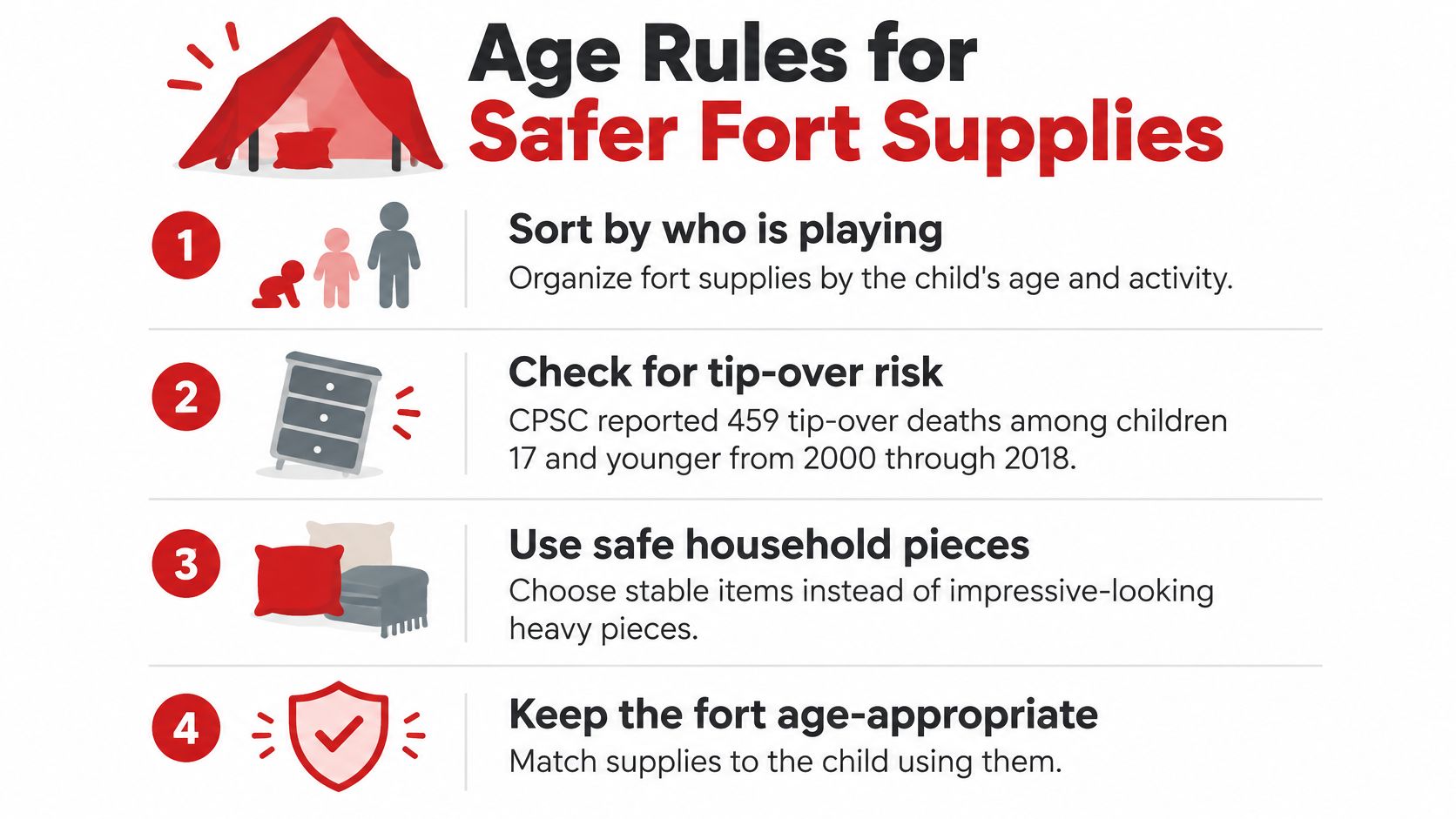
Age Rules for Safer Fort Supplies
Young children need a different kit, not just a smaller version of an older child's fort. The CPSC's tip-over safety guidance reports 459 tip-over-related deaths involving children aged 17 and younger between 2000 and 2018, with 93% involving children aged five or younger.
Those figures concern furniture, television, and appliance tip-overs, not blanket forts specifically. They underline why a fort shouldn't introduce climbing routes or pulling opportunities around heavy household objects.
Use these age bands as conservative setup guidance. A child who still mouths objects, climbs impulsively, or struggles to leave an enclosed space needs the simpler arrangement, regardless of birthday.
Fort supplies by age and what never to combine
| Age | Supplies to use | Adult role | Never combine |
|---|---|---|---|
| Under 3 | Floor blanket, large cushions, age-labeled low pop-up tent with openings unobstructed | Stay within arm's reach throughout play | Loose clips, cords, furniture walls, closed roofs |
| Ages 3 to 5 | Cardboard panels, low sheet roof, open exits, suitable crawl tunnel | Adult sets it up and stays in the room | Bookcases, TVs, stools, neck cords, candles or heaters |
| Ages 6 to 8 | Adult-approved clipped sheets, box rooms, floor-level tunnel routes | Check every support after a rebuild | Roof climbing, unanchored dressers, flame or cord lights |
| Ages 9 to 12 | Larger cardboard plans and reusable tents they help design | Approve the plan and push-test each side | Nails, power tools, improvised PVC towers, ceiling hooks |
Keep the main decisions visible during setup.
Match supervision to the activity
For a toddler, active supervision means being close enough to stop a pull or climb immediately. It doesn't mean checking occasionally from another room. Forts are play spaces, not places to leave children unattended or substitute for an appropriate sleep space.
Older children can make more design decisions, but independence doesn't turn furniture into safe framing. A stool can quickly become a ladder, and a hidden television cable is still reachable even when a sheet conceals it.
If tall furniture remains nearby, remove tempting toys from its top, keep heavier objects low, and secure it appropriately before play. Anchoring furniture doesn't make it a fort support.
For a class or playgroup, mark a floor boundary and explain the stop rule before children start moving boxes. Stop immediately if a support bends, slides, or tips; don't ask children to hold it steady while others continue crawling underneath.
The youngest child who can enter the play area sets the small-part rules for everyone.
Our toy safety guidance for children can help families think beyond the main structure to batteries, detachable pieces, and the other toys brought inside.
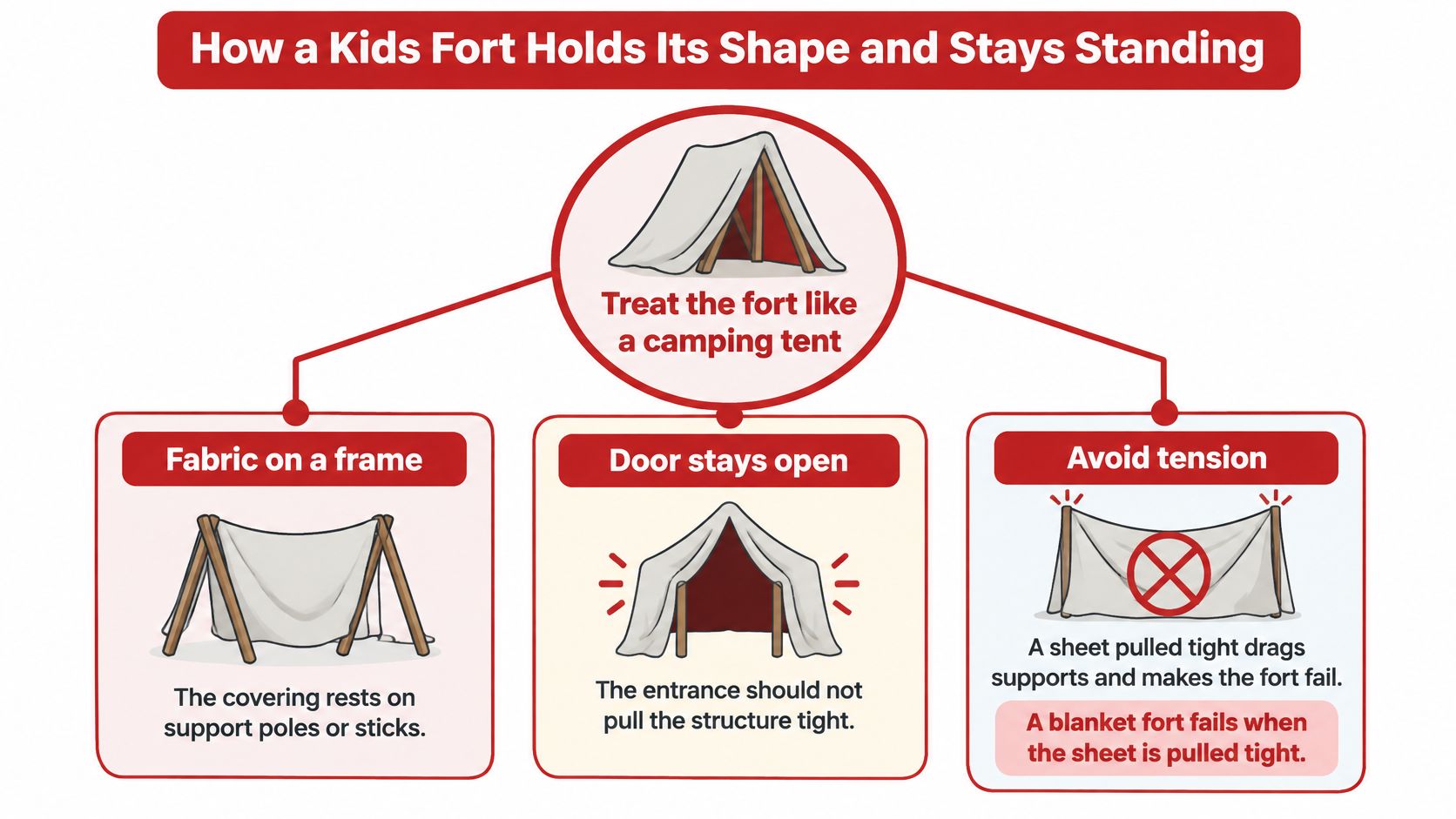
How a Kids Fort Holds Its Shape and Stays Standing
Treat the fort like a camping tent, not a little house. The covering rests loosely on its supports, and entering through the door shouldn't pull the whole structure tight.
A taut sheet can drag supports inward. Give the structure a broad footprint, low walls, and an easy way out instead of trying to make every surface look straight.
The basic relationship is simple enough for children to recognize.
Build and check before children enter
- Choose the floor zone. Keep the fort away from televisions, tall storage, window cords, heaters, and household traffic. Children should reach the entrance without squeezing behind furniture.
- Deal with nearby furniture first. Remove toys and remotes that invite climbing, and anchor furniture that needs securing. The CPSC's furniture tip-over report estimated an annual average of 22,500 emergency-department-treated injuries from furniture, television, and appliance tip-overs during 2018–2020, with children under 18 accounting for nearly 44%.
- Lay a rug flat, smoothing any curled edges. Stand the cardboard panels so they overlap rather than meeting at unsupported edges.
- Keep cushions low. Arrange them as floor walls or seats, not stacks that children will climb.
- Drape the sheet with slack. If the panels bow inward, remove the covering and change the arrangement.
- Let the adult attach fabric. Use accessible attachment points without stretching the roof. Skip loose clips when a child who mouths objects can reach them.
- Place the battery LED where it won't obstruct crawling or become buried in bedding. Check its battery cover before use.
- Push-test each side gently. Try the front, sides, and back. Remove or rebuild anything that rocks, slides, or folds.
- Check the entrance yourself without loading your weight onto the frame. Confirm another unobstructed opening and make sure fabric can't trap a child between layers.
- Explain the roof rule. It's a ceiling, not a seat. Recheck the structure whenever children move a panel or rebuild the doorway.
Test for movement, not just appearance
An empty structure can look steady but shift when children crawl, lean, or tug. The CPSC's clothing-storage-unit standard includes tests simulating children weighing up to 60 pounds interacting with furniture; that's not a fort rating or a homemade-fort load limit.
The useful lesson is to consider ordinary child behavior, not just the finished photograph. A home push test is a screening check, not certification that a structure can carry children.
Our engineering activities for kids offer ways to explore changing a design. In a full-size fort, make those changes with everyone outside first.
Learning Games Inside the Finished Fort
Say your child crawls inside, settles onto a cushion, and asks what happens next. You don't need another basket of equipment. Start with the book, light, and cardboard already at hand.
A reading nook is a good first use because children can enjoy the space without repeatedly changing its structure.
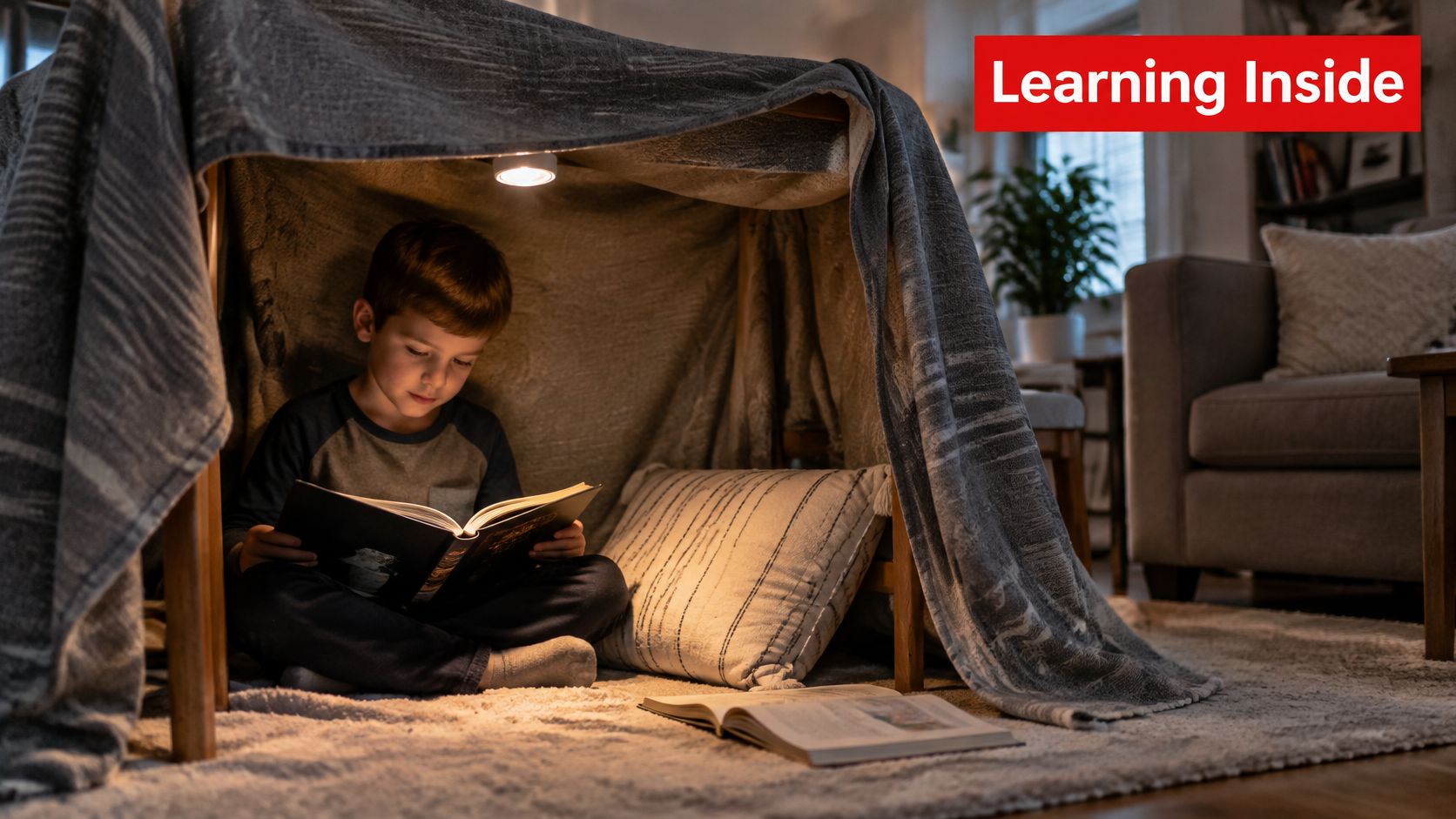
Small games with useful limits
Read and retell. Let your child choose a book, then invite them to describe what happened at the beginning and end. Keep the entrance open so you can sit alongside rather than climbing into a cramped space.
For a child who wants a quieter break, keep this as a calm corner with a short, agreed turn. Don't use the enclosure as a punishment or block a child from leaving.
Predict a shadow. An adult holds the LED while the child uses a hand or a large cardboard shape to make a shadow on the sheet. Ask what might happen when the shape moves closer to the light, then try it without moving the supports.
The constraint is part of the game: change the light or shape, not the roof. Stop if children start pulling the covering to create a different screen.
Measure without a worksheet. Ask how many cushion-lengths fit along the outside wall, then compare that with crawling movements through the tunnel. Explain that different measuring units can give different answers.
Map the room. Use a spare cardboard panel as a pretend map and point out the doorway, quiet corner, and exit. If children have drawing supplies available, they can mark those features and revise the plan when a box moves.
Keep active play on the floor
A rainy-day route can run around low cushions and through a crawl tunnel. In the backyard, keep the activity to a suitable pop-up tent on dry ground rather than improvising raised obstacles.
For another play prompt, preview this video before sharing it with children.
Ask a practical design question: how could we lift a fabric corner for more air without blocking the exit? Children can propose the change while the adult handles the structure.
Our learning games for kids offer more ideas, but choose a single game for the first session. The fort should remain a place to think and play, not somewhere to store every prop.
Fort Building Supplies Questions Parents Ask
Do fort kits need to meet toy safety rules?
In the United States, applicable toys intended primarily for children 12 and under require testing and certification through a CPSC-accepted third-party laboratory under ASTM F963, incorporated into 16 CFR Part 1250, according to the CPSC's toy-safety guidance. When buying a packaged fort kit, look for clear manufacturer identification, age labeling, instructions, and available compliance information.
Small components matter after wear and foreseeable misuse, not just when the package opens. A connector that breaks loose can create a hazard even if the original assembly looked secure.
The EU's 2025 Toy Safety Regulation introduces stricter safety provisions and a future Digital Product Passport framework, subject to its application and transition arrangements. European buyers should check the requirements currently applicable to the product rather than assume every new provision already applies.
Household bedding and reused boxes haven't been certified together as a fort kit. Adult material selection and inspection still matter.
When should a fort supply be retired?
Remove worn pieces before the next build rather than leaving them in the supply basket.
- Connectors: Discard clips that bend, crack, expose sharp edges, or no longer hold reliably.
- Fabric: Repair or retire torn seams, loose attachments, and coverings that can't be cleaned properly.
- Cardboard: Recycle clean, suitable panels when corners crush or walls stop holding their shape.
- Tent frames: Stop using a tent with exposed wiring, damaged sleeves, or broken structural parts.
Wash suitable fabrics according to their care instructions and dry them fully before storage. Keep cardboard away from drinks and discard contaminated material rather than covering the damage with another layer.
Can a fort go next to a bunk bed?
Don't use a bunk bed as a support or incorporate its ladder into the play route. Position the fort so children can't treat its cushions or roof as steps toward the bed.
Keep the boundary clear: A nearby bed is furniture, not part of the fort.
Follow the bed manufacturer's installation and safety instructions, and choose another location if the fort would obstruct access or encourage climbing.
Start with a Reusable Play Tent Kit from Playz
If every rebuild sends you searching for stronger chairs or another place to attach the sheet, consider replacing the improvised frame rather than expanding it. A freestanding pop-up set gives the covering its own structure and leaves household furniture out of the design.
That doesn't make every tent suitable for every child or room. Check the age label, footprint, openings, and setup instructions, then choose the arrangement you'll use.
Choose the layout you need
Our Rainbow Playtime Combo includes a 5pc Rainbow Tent, Tunnel and Ball Pit set plus an Extra Large Rainbow Crawl Tunnel. It's an indoor/outdoor pop-up play set priced at $99.94, with a regular price of $149.99.
Our 7pc Titan Play Tent Bundle is on sale for $74.94 and has a 4.5 out of 5 rating from 4,804 reviews. It's the lower-priced option of these choices; the Rainbow combo is worth considering when the included extra-large crawl tunnel matches your planned play.
| Your priority | Option to consider |
|---|---|
| A tent, tunnel, and ball-pit arrangement with an extra-large crawl tunnel | Rainbow Playtime Combo |
| The lower listed price between these options | Titan Play Tent Bundle |
| A layout for a particular room | Compare the product dimensions and setup instructions before choosing |
Plan the first use before ordering
Our indoor play tent guide can help you think about placement. Measure the usable floor area with the entrance and walking routes included, not just the space where the tent body will sit.
Leave room to supervise and inspect the structure. A bundle doesn't need every component assembled during every session, especially if your child wants a quiet reading corner rather than an active crawling route.
Confirm current prices before ordering, and plan a first activity that uses the space immediately. A book inside the tent or a measuring game along the tunnel gives the purchase a clear purpose without adding more supplies.
Playz offers pop-up tents, tunnels, and play-set bundles that can replace furniture-supported forts with a dedicated play space. Visit Playz to compare the Rainbow combo for its extra-large tunnel or the lower-priced Titan bundle, then choose a layout that fits your child and your room.